New safety worries about Westinghouse AP1000 nuclear plant design
 The public interest groups maintain that the NRC has given priority to the construction schedules of these corporations instead of resolving the continuously emerging problems with the design.
 Nuclear Expert Cites New Concerns About Westinghouse Reactor Design Based On Fukushima Disaster ENews Park Forest 10 Nov 11 Groups say design approval can’t legally be finalized until Fukushima lessons are incorporated, and that NRC plans to shove costly design corrections onto Georgia, South Carolina customers DURHAM, N.C. – Nuclear engineer Arnie Gundersen has documented at least six areas of unreviewed safety concern involving the Westinghouse AP1000 nuclear plant design based on the ongoing Fukushima disaster, and he says these problems require full technical review by the U.S. Nuclear Regulatory Commission before the plant design can be “certified.” Today public interest groups filed his report – which expands on problems identified by a federal task force – with NRC commissioners who are considering a final vote on the plant design without responding to a long list of problems raised earlier by experts within and outside the industry.
The Fairewinds report and the legal motion can be found at www.ncwarn.org. A video presentation by engineer Gundersen will be posted today both at www.ncwarn.org and at www.fairewinds.com Continue reading
In closed meeting of nuclear trade group, NRC warns on safety issues
NRC chair warns nuclear industry against complacency, says it must resolve long-running issues Washington Post, By Ray Henry, Associated Press, November 10 ATLANTA — The country’s top nuclear safety regulator warned power companies against complacency Thursday and said the agency must push ahead with new rules prompted by a nuclear crisis in Japan while also resolving long-running issues involving fire protection and a new analysis of earthquake risks. Continue reading
Nuclear waste laboratory workers found to have plutonium in their lungs
Further lung examinations were ordered for two workers whose body scans tested positive for radiation in their lungs and for a third worker whose lungs showed an “anomaly,”
 More tests ordered for plutonium-exposed Idaho lab workers, By Laura Zuckerman, SALMON, Idaho Nov 9, 2011 (Reuters) – Doctors at a nuclear research lab in Idaho on Wednesday ordered further medical tests of 16 workers accidentally exposed to low-levels of radiation from plutonium fuel in a decommissioned reactor. Continue reading
Tokyo now testing radiation in fresh and processed food
Tokyo city starts radiation tests on food in shops Google News, (AFP) – 8 Nov 11 TOKYO — Tokyo city government on Tuesday began radiation tests on samples of food bought in shops to reassure residents amid a contamination scare after a major nuclear accident in northeast Japan.
It is rare that authorities check on products at the point of sale and the the inspection includes processed food as well as fresh produce. The metropolitan government is measuring radiation on vegetables and other fresh food to complement pre-shipment tests at places of
production. Continue reading
Alarm about cracks in Davis Besse nuclear plant
Ohio: Scientists Sound Alarm on Nuclear Plant, NYT By THE ASSOCIATED PRESS November 8, 2011 A watchdog group is questioning the soundness of a nuclear plant where a 30-foot hairline crack was recently discovered. The crack was found in the thick concrete on the outside of the reactor containment building at the Davis-Besse plant outside Toledo. Further inspections found numerous, tiny cracks on the building’s facade. The Union of Concerned Scientists has written the Nuclear Regulatory Commission asking whether the concrete walls were built to adequate engineering specifications. The plant’s owner, the FirstEnergy Corporation, says that the walls were designed properly and that the building has been inspected thoroughly. The plant has been shut down for installation of a new 82-ton reactor head, replacing one that cracked… http://www.nytimes.co/2011/11/09/us/ohio-scientists-sound-alarm-on-nuclear-plant.html
Low security of Pakistan’s nukes
Pakistan’s nuclear weapons vulnerable to theft: report, Google News, 5 Nov 11 WASHINGTON — Pakistan has begun moving its nuclear weapons in low-security vans on congested roads to hide them from US spy agencies, making the weapons more vulnerable to theft by Islamist militants, two US magazines reported Friday.
The Atlantic and the National Journal, in a joint report citing unnamed sources, wrote that the US raid that killed Al-Qaeda chief Osama bin Laden in May at his Pakistani compound reinforced Islamabad’s longstanding fears that Washington could try to dismantle the country’s nuclear arsenal.
As a result, the head of the Strategic Plans Divisions (SPD), which is charged with safeguarding Pakistan’s atomic weapons, was ordered to take action to keep the location of nuclear weapons and components hidden from the United States, the report said. Khalid Kidwai, the retired general who leads the SPD, expanded his agency’s efforts to disperse components and sensitive materials to different facilities, it said.
But instead of transporting the nuclear parts in armored, well-defended convoys, the atomic bombs “capable of destroying entire cities are transported in delivery vans on congested and dangerous roads,” according to the report. The pace of the dispersal movements has increased, raising concerns at the Pentagon, it said…..http://www.google.com/hostednews/afp/article/ALeqM5hl_vZqjJHYTQL-3LlinxBrEl8oJQ?docId=CNG.d8a458444a1f0fb688322c8410b26047.431
New bursts of fission at the crippled Fukushima power plant
The three reactors — together with spent fuel rods stored at a fourth damaged reactor — have been leaking radioactive material since the initial disaster, and new episodes of fission would only increase their dangers.

 Fears of Fission Rise at Stricken Nuclear Plant in Japan, NYT, By HIROKO TABUCHI November 2, 2011 TOKYO — Nuclear workers at the crippled Fukushima power plant raced to inject boric acid into the plant’s No. 2 reactor early Wednesday after telltale radioactive elements were detected there, and the plant’s owner admitted for the first time that fuel deep inside three stricken plants was probably continuing to experience bursts of fission. Continue reading
Doubts on safety procedures at Los Alamos nuclear weapons laboratory
Questions about Los Alamos Nuclear Laboratory safety program raised, Security Info watch BY JOHN FLECK, Albuquerque Journal, N.M. 11-2-2011 -Los Alamos National Laboratory has repeatedly missed deadlines to fix nuclear safety problems, according to two September letters to the lab from federal managers.
The letters suggest no immediate nuclear dangers. But they raise questions about a number of systems intended to reduce risk, most importantly procedures intended to prevent what are called “criticality” accidents — inadvertent nuclear chain reactions. Continue reading
Foolhardy action to drink radioactively contaminated water
“Oh God,” said John Large, a British nuclear expert who has helped assess disasters including the wreck of the Russian nuclear submarine Kursk, when told of Mr. Sonoda’s actions. “That is incredibly foolhardy and somewhat patronizing to members of the public,”
if you drink the water you’re potentially providing radioactive particles a pathway into your gut system. It’s then down to how your gut system deals with it. It might ignore it and urinate it out. Or it might say ‘that’s a nice piece of cesium, I’ll store that in muscle tissue’ which is not a goodthing.”….

 Japanese Official Drinks Water From Fukushima Reactor Buildings, NYT By ROBERT MACKEY and RAVI SOMAIYA, November 1, 2011, After insisting for weeks that water collected from reactor buildings at the stricken Fukushima Daiichi nuclear plant posed no threat to human health once it was decontaminated, a Japanese government official poured himself a glass of the liquid and drank it on livetelevision on Monday. Continue reading
India’s uranium enrichment plant at risk from cyber attack?

 Uranium plant faces cyber attack, Deccan Chronicle November 2, 2011 , By S. Raghotham , Bengaluru India’s lone uranium enrichment facility at Rattehalli, near Mysore, may become the target of the gravest act of cyberwar against India to date, attacking no less than its strategic nuclear programme, sources in the Indian hacker/cyberwarfare community have warned.The sources said that computers at the Rattehalli facility, euphemistically called Rare Materials Plant (RMP), have likely been infected by the deadly Stuxnet, or a Stuxnet-derived malware, as a precursor to an attack to destroy thousands of centrifuges installed at the facility. Such an attack was made on Iran’s Natanz enrichment plant last year, destroying over 1,000 centrifuges and setting its alleged nuclear bomb programme back by at least 12-18 months…..
The discovery last week that the new Duqu malware, a trojan derived from the Stuxnet worm, had infected computers at a private Web hosting firm, Web Werks, in Mumbai, has lent new credence and urgency to the warning about the Rattehalli facility. While attempts to elicit the views of officials in the Department of Atomic Energy went unanswered, an Indian government official charged with protecting critical infrastructure against cyber attacks said he did not ‘rule out Stuxnet-like attacks on India’. http://www.deccanchronicle.com/channels/cities/bengaluru/uranium-plant-faces-cyber-attack-157
Davis Besse nuclear reactor – more cracks found
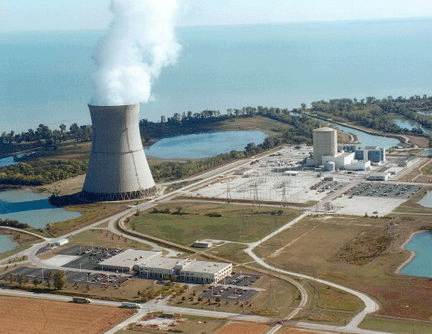 FirstEnergy Finds More Cracks at Davis-Besse Nuclear Power Plant, By Julie Johnsson Oct. 31 (Bloomberg) –– FirstEnergy Corp. said an investigation of damage to the concrete outer shell of its Davis-Besse nuclear power plant unearthed additional hairline cracks….. FirstEnergy shut the plant to install a new reactor vessel head three years earlier than previously planned. The U.S. Nuclear Regulatory Commission in 2005 imposed a $5.45 million fine, its largest ever, for FirstEnergy’s failure to discover corrosion had eaten a hole in a prior vessel head.
Contractors found the newest cracks on the shield building, a 30-inch-thick (76 centimeters) reinforced concrete structure that protects the reactor’s containment building from wind and tornadoes. FirstEnergy previously discovered a hairline crack measuring about 30 feet (9 meters) on Oct. 10 after it cut a hole in the side of building to allow for installation of the new vessel head.
The commission said last week it was sending a concrete material expert to the plant, located 21 miles (34 kilometers) southeast of Toledo, after the Oct. 10 report of cracks…..FirstEnergy is seeking regulatory permission to extend its operating license for Davis-Besse, which has been in service since 1977, by another 20 years. The commission is scheduled to issue its decision on the application next year.
The danger of dismantling nuclear submarines in a city
It is the magnitude of the consequences of a nuclear accident that make it unacceptable to locate such a facility in the middle of a city of 250,000 people….
Devonport is not immune from accidents. There have been nine radioactive leaks since 1997. The impact of a significant accident in the dockyard would be devastating. It would not remain confined behind its walls but would affect a much wider area.
 Should N-subs be dismantled in city? Plymouth Herald, October 28, 2011 ONE of the most controversial proposals to affect Plymouth in generations is set to be thrust firmly into the public domain from today.
The Ministry of Defence has today begun a 16-week consultation exercise exploring the options for dismantling decommissioned nuclear-powered submarines. The consultation aims to find a permanent home for The Submarine Dismantling Project (SDP) – either in Plymouth, or Scotland. Continue reading
India’s nuclear power safety problems are getting worse
Admitting problems, the federal Department of Atomic Energy (DAE) has said there could be a delay in the two projects.
Meanwhile, the state government of West Bengal state has refused permission to a proposed 6000 MW facility near the town of Haripur that intended to host six Russian reactors. ..
activists and experts have called for an audit by an independent body. They say that given the non-transparent nature of India’s state-controlled nuclear energy sector – there is no way to estimate whether safety issues will be carefully followed
 India’s Rising Nuclear safety Concerns , Asia Sentinel, Siddharth Srivastava, 27 Oct 11, Concerns about safety of nuclear power plants (NPPs) are threateningIndia’s massive investment plans in the sector..
Post the Fukushima nuclear disaster in Japan populations around proposed Indian NPP sites have launched protests that are now finding resonance around the country, raising questions about atomic energy as a clean and safe alternative to fossil fuels. Continue reading
China waking up to the danger of its nuclear program
 Nuclear-safety risks rising in China, warns minister, Economic Times, 27 OCT, 2011, BEIJING: China is facing increasing safety risks from its nuclear power plants as existing facilities age and a large number of new reactors go into operation, the country’s environmental minister said in comments published on Wednesday. “The safety standards of China’s early-phase nuclear facilities are relatively low, operation times are long, some facilities are obsolete and the safety risks are increasing ,” said Zhou Shengxian in a speech published on the website of China’s parliament, the National People’sCongress. Zhou told legislators that the scale and pace of nuclear construction had accelerated, a larger range of technologies had been introduced, and potential sources of radiation had become more widespread, making it harder to monitor safety .
China has 13 nuclear reactors in operation and another 28 under construction, but it has suspended all new project approvals in the wake of the tsunami in northeast Japan, which left the Fukushima Daiichi reactor on the brink of meltdown. After the suspension, Beijing launched a nationwide inspection of all nuclear sites, including reactors already operating and those under construction, and is drawing up comprehensive new industry guidelines.. http://economictimes.indiatimes.com/news/politics/nation/nuclear-safety-risks-rising-in-china-warns-minister/articleshow/10503077.cms
Tokai village – the first to get nuclear power, the first to renounce it?
“Nuclear power plants bring in money before they’re even built,” he says, noting their financial lure. “We can’t allow a government policy that mocks the countryside (by trying to win them over with money.) It’s an evil policy, the same as colonialism.
 Mayor of Japan’s home of nuclear power hoping to make village a different kind of ‘first’, Mainichi Daily News, Japan October 23, 2011 Amid the ongoing disaster at the Fukushima No. 1 Nuclear Power Plant, the mayor of the Ibaraki Prefecture village of Tokai, the birthplace of Japanese nuclear power, is calling for the village’s nuclear reactors to be decommissioned. Continue reading
1 This Month



19 November – Webinar – The Reality of Reprocessing
Time: 11:00 AM Pacific Time (US & Canada) / 2:00 PM Eastern / 7:00 PM UK / 8:00 PM CET
Register for the Zoom Event Here



Shut down the radiation-damaged Heysham nuclear reactors now
To see nuclear-related stories in greater depth and intensity – go to https://nuclearinformation.wordpress.com

Say No to NASA’s Reckless Nuclear Reactor on the Moon
Say No to NASA’s Reckless Nuclear Reactor on the Moon
-
Archives
- November 2026 (74)
- October 2026 (302)
- September 2026 (339)
- August 2026 (330)
- July 2026 (355)
- June 2026 (287)
- May 2026 (306)
- April 2026 (356)
- March 2026 (251)
- February 2026 (267)
- January 2026 (308)
- December 2025 (358)
-
Categories
- 1
- 1 NUCLEAR ISSUES
- business and costs
- climate change
- culture and arts
- ENERGY
- environment
- health
- history
- indigenous issues
- Legal
- marketing of nuclear
- media
- opposition to nuclear
- PERSONAL STORIES
- politics
- politics international
- Religion and ethics
- safety
- secrets,lies and civil liberties
- spinbuster
- technology
- Uranium
- wastes
- weapons and war
- Women
- 2 WORLD
- ACTION
- AFRICA
- Atrocities
- AUSTRALIA
- Christina's notes
- Christina's themes
- culture and arts
- Events
- Fuk 2022
- Fuk 2023
- Fukushima 2017
- Fukushima 2018
- fukushima 2019
- Fukushima 2020
- Fukushima 2021
- general
- global warming
- Humour (God we need it)
- Nuclear
- RARE EARTHS
- Reference
- resources – print
- Resources -audiovicual
- Weekly Newsletter
- World
- World Nuclear
- YouTube
-
RSS
Entries RSS
Comments RSS

