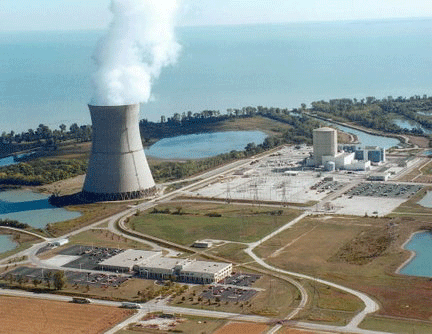
Costly cracks in Davis-Besse nuclear reactor
FirstEnergy finds cracks at Ohio nuclear reactor,
* Davis-Besse shut to replace reactor vessel head
* Small cracks found in concrete shield building
NEW YORK, Oct 17 (Reuters) – FirstEnergy said it discovered small cracks in the concrete shield building surrounding the containment structure at the Davis-Besse nuclear power plant in Ohio, which was shut for another reactor vessel head replacement, a spokesman for the Ohio-based energy company said Monday…..
Crystal River has been shut since September 2009 after workers discovered a gap in the concrete containment dome after they cut through the structure to replace the plant’s aging steam generators. The plant is not expected to return until at least 2014….
This is Davis-Besse’s third reactor vessel head.
It cost the company about $600 million to replace the first vessel head ($300 million) and buy replacement power ($300 million) after workers in 2002 discovered borated water, which acts as the reactor coolant, leaked from a control rod drive mechanism and ate a six inch hole in the first vessel head. The plant did not return to service until 2004.
In 2010 during a scheduled refueling outage, the company found small cracks in the control rod nozzels and decided to replace the second vessel head. Schneider said this head replacement project would cost about $115 million…..
Big price fall for First Energy due to crack in Davis-Besse nuclear plant.
 FirstEnergy Falls After Report of Nuclear Reactor Cracks Bloomberg By Julie Johnsson and Mark Chediak – Oct 13, 2011 FirstEnergy Corp. (FE) fell after a report that engineers discovered cracks in the concrete shell of its Davis-Besse nuclear plant.
FirstEnergy fell 2.8 percent to $43.76 at the close in New York. The Akron, Ohio-based power company had earlier dropped 5 percent, its biggest intraday decline since Aug. 8, according to data compiled by Bloomberg…..
The U.S. Nuclear Regulatory Commission is investigating the structural damage to the concrete building that protects the reactor from tornadoes and other hazards, said Viktoria Mitlyng, spokeswoman for the nuclear agency, in a telephone interview.
Previous Problems Davis-Besse was shuttered for more than three months in 2010 after workers discovered cooling water leaking through cracks in some reactor-head nozzles, steel casings that hold fuel and control rods.
Leaks and reactor corrosion prompted FirstEnergy to close the plant for two years, from 2002 to 2004, while the company retrained or replaced workers who ignored signs of damage, and eventually replaced the reactor head.
The leaks found last year at the 900-megawatt plant prompted the Union of Concerned Scientists in April 2010 to demand that the plant remain closed until its owners established better controls to maintain health and safety standards.
At last, France reveals, and questions, the safety of its nuclear industry
institutions are showing greater boldness in convicting nuclear operators guilty of negligence or issuing reprimands and demanding immediate corrective measures from giants like EDF or Areva..
With accusing fingers increasingly pointing towards the nuclear industry, a hesitant debate is beginning to open up in France. Socialist leader Segolene Royal who was defeated by Nicolas Sarkozy in France’s last presidential poll but hopes once again to be her party’s candidate, said she would close down the EPR under construction at Flamanville and completely abandon the EPR technology being pushed by Areva.
 Post-Fukushima, France breaks silence on nuclear safety, The Hindu VAIJUNARAVANE, 11 Oct 11 “…….Doubts have been raised about the benefits of the EPR reactor, of which India plans to buy six. For a country as given to debate and argument as France, there has been a deafening silence surrounding the choice of nuclear as the prime source of energy. With a population of 62 million, France boasts 59 nuclear reactors — the highest per capita in the world, with over 75 per cent of its electricity coming from the power of the atom.
In the post-Fukushima period, however, that tacit silence is being broken with increasing frequency not just by anti-nuclear associations or candidates hoping to win elections but by French courts and the Nuclear Safety Authority. Continue reading
Shanghai’s radiation security scanners potentially dangerous, and illegal
 Metro’s X-ray machines are ‘illegal’ English east Day.com, from Shanghai News, 11 Oct 11 ALL 528 X-ray security inspection machines in Shanghai’s Metro stations are “illegal devices” operating without radiation safety licenses, officials with the city’s environmental protection bureau said yesterday. Continue reading
 Delays, defects, and “social dumping” in France’s Flamanville nuclear reactor
Post-Fukushima, France breaks silence on nuclear safety The Hindu VAIJU NARAVANE, 11 Oct 11“…….Construction of the Flamanville EPR reactor which began in 2007 is experiencing significant delays with a large number of accidents including two fatalities. The EPR reactor, of which India plans to buy six, will now not be completed before 2016 at the earliest and its price tag has climbed to an estimated €7 billion per reactor of 1,650MWe capacity. Not a single EPR is as yet operational.
Of the four currently under construction, (one each in France and Finland, two in China) the Finnish reactor (construction began in August1985) is now slated to go on stream in 2013 but costs have risen from €3 billion to over €7 billion and the Finnish utility TVO is locked in costly arbitration (€2.7 billion) with Areva….. Continue reading
Radioactive leak in US National Laboratory
National Lab in NY Halts Some Work After Leak, ABC News, By FRANK ELTMAN Associated Press GARDEN CITY, N.Y. October 10, 2011 (AP) A sealed device used to check whether radiation detectors are working properly at Brookhaven National Laboratory leaked a small amount of radioactivity last month, lab authorities said. There was no threat to public health or the environment, but the lab has halted some operations while it investigates.
The radioactivity was later found on two employees, in a parking lot and private vehicle, and in one of the facility’s buildings, the lab said. The lab is reviewing policies, procedures and training programs.
“Even the leak of a small amount of radiation is unacceptable,” George Goode, assistant director for environmental safety and health at the lab on eastern Long Island, said Monday. “We are treating this very seriously.” Continue reading
Radioactive leak from Dounreay nuclear plant
Monitoring systems detected drips of caustic liquor from pipework in a shielded cell. Dounreay Site Restoration Limited (DSRL) said the plant was immediately shut down and the leak isolated and stopped. The Scottish Environment Protection Agency (Sepa) said no material had been released into the environment and that the leak was “minor”….
Dounreay’s nuclear reactor was shut down in 1994 and work to decommission the site in Caithness has been under way since then. It was the only plant in Britain to use liquid metal instead of gas or water in the cooling circuits…. http://www.google.com/hostednews/ukpress/article/ALeqM5gbScqRflnDY2MmCLODQSX6TveHNA?docId=N0834141318086993943A
Sympathy with advocates of nuclear moratorium, from NRC chief
US Nuclear Regulator Sympathizes With Moratorium Advocates, Fox Business By Ryan Tracy October 05, 2011 WASHINGTON -(Dow Jones)– The top U.S. nuclear watchdog said Wednesday that he sympathized with the views of groups who argue the U.S. should stop moving forward with plans for new nuclear-power plants until it can implement lessons from Japan’s nuclear crisis earlier this year.
“There are strong arguments on both sides about putting [in place] a moratorium,” Nuclear Regulatory Commission Chairman Gregory Jaczko said during a public discussion about the Japan incident at the National Press Club.
Jaczko noted that, collectively, the five-member commission has decided to move forward with licensing new reactors and re-licensing existing ones as it reviews the Japan incident. Jaczko didn’t dispute that course outright, but said one process should inform the other. “What I feel personally is that I think these processes can’t be independent,” he said….http://www.foxbusiness.com/industries/2011/10/05/us-nuclear-regulator-sympathizes-with-moratorium-advocates/
Generator failures hit 4 U.S. nuclear plants
4 generator failures hit US nuclear plants, Kake County News Sun, By RAY HENRY Associated Press October 9, 2011 ATLANTA — Four generators that power emergency systems at nuclear plants have failed when needed since April, an unusual cluster that has attracted the attention of federal inspectors and could prompt the industry to re-examine its maintenance plans.
None of these failures has threatened the public. But the diesel generators serve the crucial function of supplying electricity to cooling systems that prevent a nuclear plant’s hot, radioactive fuel from overheating, melting and potentially releasing radiation into the environment. Continue reading
Nuclear power and democracy in conflict in India
 Safety record at Kalpakkam facility
*In 1987, a refuelling accident ruptured the reactor core.
*In 1991, workers were exposed to a radioactive heavy water leak.
*In 1999, another leak exposed 42 workers.
*In 2002, 100 kg of radioactive sodium leaked.
*In 2003, high-level radioactive waste was released into a work area, exposing six workers to nuclear radiation.
 How pertinent is the nuclear option? Deccan Chronicle October 8, 2011 , By R. Mohan Democratic protests against nuclear plants are the flavour of the season.What began in Jaitapur has come down south to Koodankulam in Tamil Nadu and protests are bound to spread across the country to wherever nuclear power plants are being planned.
There is a fundamental conflict here between the aims of the government to arm the country with clean nuclear energy and the people’s fears over nuclear power plant catastrophes fanned further by the Fukushima experience. Continue reading
Nuclear energy’s new dangers in the “developing world”
developing countries with little nuclear experience and spotty industrial safety records are moving ahead with ambitious plans to expand generating capacity.
Nuclear energy after Fukushima, Washington Post, By Jim Hoagland, October 6, PALO ALTO, Calif. The environmental disaster at Japan’s Fukushima nuclear power plant this spring is creating a new global divide over the safety of nuclear energy.
Sharply differing responses to Fukushima from the world’s wealthiest and poorest nations will bring diminished safety for all.
Countries that should be best equipped to deal with nuclear mishaps are turning away from atomic energy Continue reading
NRC delays permitting restart of Virginia nuclear reactors
The NRC has said it wants Dominion to prove the plant can operate safely before the agency will approve of its restart.
1-NRC not ready to allow restart of Virginia reactors
* NRC to hold meeting on North Anna Oct. 21
* North Anna shut Aug. 23 following earthquake
Oct 7 (Reuters) – The U.S. Nuclear Regulatory Commission said Friday it does not expect to allow U.S. power company Dominion to restart the 1,806-megawatt North Anna nuclear power plant in Virginia until sometime after an Oct. 21 meeting. Continue reading
Nuclear industry fears on the safety of Iran’s nuclear power plant
“They say trust us, but there’s no such thing as trust us in nuclear politics. “
Iran reactor disaster warning from whistleblower, The Australian, Martin Fletcher October 08, 2011 IRAN’S first nuclear power station is unsafe and will probably cause a “tragic disaster” according to a document apparently written by an Iranian whistleblower. Continue reading
Armenia’s nuclear power plant the most dangerous in the world?
Aging nuclear technology, a disaffected work force in a facility located in a seismically active region – what could possibly go wrong?
Armenia’s Aging Metsamor Nuclear Power Plant Alarms Caucasian Neighbors International Business Times, By Dr. John C.K. Daly | October 6, 2011 The USSR might have imploded two decades ago, but debris from its headlong industrialization drive litter the post-Soviet landscape, and nothing more unsettles the population of the fifteen new nations carved out of the Soviet Union than its nuclear legacy. Continue reading
Concern over India’s Kalpakkam nuclear reprocessing facility
Indian peace activists have expressed suspicions that the plutonium separated at Indian civilian reprocessing facilities will be diverted and used to increase the country’s stock of atomic weapons.
Technological preparations towards the building of a full-scale fast breeder reactor at Kalpakkam are reportedly in an advanced stage.
Anti-Nuclear Struggle Has Large Fallout, International News Magazine, 05 October 2011 Peter Custers “……..The Kalpakkam complex does not just harbour a nuclear power plant, but also a reprocessing facility- a plant where nuclear fuel rods, after they have outlived their use in reactors, are chemically treated so as to extract raw materials for re-use as energy source.
Storage of such high-level waste in tanks has resulted in catastrophic accidents, Continue reading
1 This Month





PLEASE OPPOSE HR 8255 AND S.3639 – bills would accelerate satellite deployment, with no environmental review or safeguards – https://ncstd5li.quorum.us/campaign/169331/
To see nuclear-related stories in greater depth and intensity – go to https://nuclearinformation.wordpress.com
-
Archives
- October 2026 (10)
- September 2026 (339)
- August 2026 (330)
- July 2026 (355)
- June 2026 (287)
- May 2026 (306)
- April 2026 (356)
- March 2026 (251)
- February 2026 (267)
- January 2026 (308)
- December 2025 (358)
- November 2025 (359)
-
Categories
- 1
- 1 NUCLEAR ISSUES
- business and costs
- climate change
- culture and arts
- ENERGY
- environment
- health
- history
- indigenous issues
- Legal
- marketing of nuclear
- media
- opposition to nuclear
- PERSONAL STORIES
- politics
- politics international
- Religion and ethics
- safety
- secrets,lies and civil liberties
- spinbuster
- technology
- Uranium
- wastes
- weapons and war
- Women
- 2 WORLD
- ACTION
- AFRICA
- Atrocities
- AUSTRALIA
- Christina's notes
- Christina's themes
- culture and arts
- Events
- Fuk 2022
- Fuk 2023
- Fukushima 2017
- Fukushima 2018
- fukushima 2019
- Fukushima 2020
- Fukushima 2021
- general
- global warming
- Humour (God we need it)
- Nuclear
- RARE EARTHS
- Reference
- resources – print
- Resources -audiovicual
- Weekly Newsletter
- World
- World Nuclear
- YouTube
-
RSS
Entries RSS
Comments RSS

