Fukushima Daiichi’s Unit 4 reactor a radioactive time bomb
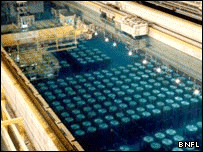 if the [spent fuel rods] pool should spring a leak, or another earthquake bring the pool crashing down, all that fuel would be exposed to the outside air, letting them heat up and release massive amounts of radiation.
Fukushima Daiichi’s Achilles Heel: Unit 4′s Spent Fuel? WSJ, By Phred Dvorak, April 17, 2012, Just how dangerous is the situation at Japan’s crippled Fukushima Daiichi nuclear plant? Very, according to U.S. Senator Ron Wyden, a senior member of the Senate’s energy committee who toured the plant earlier this month.
Another big earthquake or tsunami could send Fukushima Daiichi’s fragile reactor buildings tumbling down, resulting in “an even greater release of radiation than the initial accident,”
Mr. Wyden warned in a Monday letter to Japanese Ambassador to the U.S. Ichiro Fujisaki. Continue reading
Don’t drink and Drive a Nuclear reactor

 Nuclear regulator proposes drug, alcohol policy for workers, The Star, 18 April 12 If you can’t drink and drive, maybe you shouldn’t drink and run a nuclear power plant.
Canada’s nuclear regulator has proposed new “fitness for duty” rules that would require anyone with unescorted access to sensitive areas of a nuclear plant to be subject to random drug and alcohol testing. The policy would be a departure for the Canadian Nuclear Safety Commission. “Presently, the CNSC does not have explicit alcohol or drug testing
requirements,” a spokesman said.
The commission does require nuclear operators to have a “fitness for
duty” program, but doesn’t spell out the requirements for drug and
alcohol use. Now, the commission has released a discussion paper proposing to change that.
“The CNSC believes in being proactive, in order to reduce the risk of impairment-related safety events at Canada’s nuclear power plants,” says the paper……
http://www.thestar.com/business/article/1163170–nuclear-regulator-proposes-drug-alcohol-policy-for-workers
Fire at Idaho nuclear research laboratory
Fire prompts evacuation at nuclear research lab in Idaho SALMON, Idaho, April 16 (Reuters) – A welder’s torch ignited a small fire on the roof of a building at a nuclear research laboratory in Idaho on Monday, prompting an evacuation, but no one was hurt and no radioactive material was involved, lab officials said.
Nearly 100 employees were cleared from the building, part of a complex that includes facilities housing spent nuclear fuel and radioactive waste at the Idaho National Laboratory, the U.S. Energy Department’s leading facility for nuclear reactor technology. Continue reading
30 years later, today’s road workers affected by radioactive spill
Workers sick amid highway radiation scare http://www.abc.net.au/news/2012-04-18/radioactive-discovery-halts-pacific-hwy-upgrade/3957168 April 18, 2012 Road workers were sent for medical treatment after vomiting when suspected nuclear material was unearthed during work on an upgrade to the Pacific Highway on the mid-north coast of New South Wales The materials, which include caesium, were buried north of Port Macquarie after a truck carrying radioactive isotopes from Sydney’s Lucas Heights nuclear reactor crashed in the area in 1980.
The isotopes were being taken to Brisbane, before being shipped to the United States. The upgrade’s project manager, Bob Higgins, says road workers fell ill after unearthing a strange clay-like material.
“As we’ve taken down the cutting there we exposed the face of the existing material (and) came across a clay material that when it’s exposed to air it gets an orange streak through it,” he said. ”There were a number of workers that felt a little bit of nausea and there was a bit of vomiting when they were in close proximity. ”[They went] off to the doctor, but obviously we need to be extremely careful here.”
The Environmental Impact Statement for the highway upgrade had noted some uncertainty about where exactly the containers were buried. Specialists are in the area assessing what to do with the radioactive materials, and if they pose any risk.
Let the Facts Speak: 1980, December 4 PORT MACQUARIE, AUSTRALIA Continue reading
Radiation safety fears in Sri Lanka, due to proximity to India’s nuclear projects
The recent developments in the Kudankulam nuclear power plant in Tamil Nadu’s Tirunelveli district is making Sri Lanka nervous as the power plant is only 250 kilo meters from Sri Lanka’s northwestern coastal town of Mannar.
 Sri Lanka sets up radiation warning system, Apr 14, 2012, ColomboPage News Desk, Sri Lanka. Apr 14, Colombo: Sri Lanka has taken measures to establish a warning system to alert to the danger of radiation in an event of a leak from the nuclear plants in neighboring India. Continue reading
Thousands of gallons of radioactive water into the river
NRC reveals radioactive water spill at Limerick nuke plant, The Mercury, By Evan Brandt 04/12/12 LIMERICK — “Several thousand gallons” of water containing as much as five-times the government’s “safe” level of radioactive tritium was accidentally released at Exelon Nuclear’s Limerick Generating Station last month and then flushed into the Schuylkill River, The Mercury learned Thursday….. http://www.pottsmerc.com/article/20120412/NEWS01/120419797/nrc-reveals-radioactive-water-spill-at-limerick-nuke-plant&pager=full_story
The danger of nuclear powered drones, and plutonium for spacecraft
 The Deadly Folly of Nuclear Power Overhead HUFFINGTON POST, Karl Grossman: 04/12/2012 The crash last week of a U.S. drone on the Seychelles Islands– the second crash of a U.S. drone on Seychelles in four months — underlines the deadly folly of a plan of U.S. national laboratory scientists and the Northrop Grumman Corp. for nuclear-powered drones. Continue reading
More unusual wear found in San Onofre nuclear plant
Additional tube wear found at troubled San Onofre nuclear plant on California coast Washington Post, By Associated Press, April 12 LOS ANGELES — The operator of an idled nuclear plant on the California coast announced Thursday that more unusual wear has been found on tubing that carries radioactive water, the latest disclosure in an ongoing mystery involving the plant’s steam generators.
Southern California Edison said in a statement that investigators at the San Onofre Nuclear Generating Station found additional wear in its Unit 2 generators that is similar to degradation in its sister reactor, Unit 3, though at a lower level…….
The new findings show “all of the generators are exhibiting the same kind of wear, though the wear in unit 3 is more excessive than in Unit 2,” Nuclear Regulatory Commission spokesman Victor Dricks said.
The twin-reactor plant has been shut down for more than two months while federal regulators and company officials try to find out why tubing designed to withstand many years of use under high pressure has been quickly wearing away……..
http://www.washingtonpost.com/national/additional-tube-wear-found-at-troubled-san-onofre-nuclear-plant-on-california-coast/2012/04/12/gIQAWEx8CT_story.html
In 3 days, Japanese government runs up sloppy safety standards, to keep the nuclear industry going
It even appears that the government intentionally worked out looser standards so that utilities can meet them in order to hasten the reactivation of Oi nuclear plant’s idled reactors.
Economy, Trade and Industry Minister Yukio Edano says there is no need for reactivation of nuclear reactors stopped for regular inspections if the overall supply of electric power is sufficient.

 New standards for reactivating nuke reactors are too hasty and sloppy , 11 April 12, http://mainichi.jp/english/english/perspectives/news/20120409p2a00m0na018000c.html The government should be criticized for having moved too hastily and in a sloppy manner when it set new standards for deciding whether to reactivate nuclear reactors, even though the criteria are crucial in ensuring the safety of the public.
Prime Minister Yoshihiko Noda and three Cabinet ministers concerned approved the standards on April 6 with an eye to approving resumption of operations at the No. 3 and 4 reactors at the Oi Nuclear Power Plant in Fukui Prefecture, which are currently suspended for regular inspections. Continue reading
The danger of nuclear powered drones to foreign countries, and to USA citizens
drones have become a nightmare for local residents. Civilian deaths inflicted by drone strikes have repeatedly strained relations between America and Pakistan….. ten times as many civilians as suspected terrorists died in U.S. drone attacks.
the document gives the “green light” for drone-based domestic spying.
Pentagon considers nuclear-powered drones. Space Daily Moscow Apr 09, 2012 American scientists are working on new-generation nuclear-powered unmanned aircraft capable of staying in the air for up to several months. While being able to tackle a wider range of more complicated tasks compared to their existing analogues, the new drones will not require a costly air base network for refueling and technical maintenance.
What’s more, on February 14 President Barack Obama signed the Federal Aviation Administration Reauthorization Act that allows the use drones in U.S. airspace by both state-owned and private companies….. Continue reading
Sri Lanka will raise safety objections to India’s Koodankulam and other nuclear reactors

 Sri Lanka concerned over radiation from India’s nuclear plants, Economic Times, 9 APR, 2012, COLOMBO: Sri Lanka today expressed concern over possible impact of radiation from India’s nuclear power plants located in the southern region, as it prepares to raise the issue with global atomic watchdog IAEA.
The official raising of concern with the International Atomic Energy is to be made in September, the power and energy minister Champika Ranawaka said. “We respect the right of India to have nuclear power stations. But our concerns are on the possible radiation affects they could have on Sri Lanka. We have already written a letter”, Ranawaka said…… Sri Lankan energy officials say at least three nuclear plants are located on the southern coast of Tamil Nadu which is separated from the island by a narrow strip of sea…… Koodankulam nuclear plant in India’s Southern coast is just 250 km from Sri Lanka’s northwest coastal town of Mannar.
Sri Lanka Atomic Energy Authority does not possess adequate facilities to face a threat of nuclear accident. http://economictimes.indiatimes.com/news/politics/nation/sri-lanka-concerned-over-radiation-from-indias-nuclear-plants/articleshow/12594324.cms
Palisades Nuclear Power Plant shut down after safety violations
Troubled Michigan nuclear plant shut down for maintenance,By Todd Sperry, CNN Senior Producer April 9, 2012 – Washington — A troubled Michigan nuclear power plant cited for safety violations has been taken off line for maintenance and refueling, the plant’s owner said Monday.
Palisades Power Plant, a 39-year-old facility located near Kalamazoo, has been under increased scrutiny from inspectors after the Nuclear Regulatory Commission cited the plant for three safety violations. The plant is currently owned and operated by Entergy Corporation…….
Violations at the plant included a September 25, 2011, incident in which half of the control room indicators were lost because of an electrical fault “caused by personnel at the site,” according to the NRC. A special inspection “determined the plant failed to have adequate work procedures for the electrical panel maintenance work to ensure the job was done successfully,” the NRC report said. Additionally, the NRC cited Palisades and Entergy for an October 2010 incident in which an operator left his post unattended in the nuclear
reactor’s control room without permission.
The Palisades spokesman declined to provide a timetable for when the work will be completed….. The news of a shutdown at Palisades came just days after Friday’s report that California’s San Onofre nuclear plant would remain shut down indefinitely until the source of problems with two of its generators can be determined. http://edition.cnn.com/2012/04/09/us/michigan-nuclear-plant/
Fire at Fort Calhoun nuclear plant was a major danger
Feds confirm Neb. nuke plant fire was major threat OMAHA, Tulsa’s Channel 8, Neb. (AP) – Federal regulators on Tuesday confirmed their preliminary finding that a fire at an idled Nebraska nuclear plant last June presented a serious safety threat.
The Nuclear Regulatory Commission said in its final determination that the small fire at the Fort Calhoun plant 19 miles north of Omaha was of “high safety significance.” The finding mirrored the commission’s preliminary conclusion announced March 12.
“This finding has high safety significance because it affected multiple safety systems and consequently warrants actions to prevent recurrence,” said the NRC’s regional administrator, Elmo Collins…… http://www.ktul.com/story/17375718/feds-confirm-neb-nuke-plant-fire-was-major-threat
Far from being over, Japan’s government fears worse to come from Fukushima
Such an event would cause widespread nuclear fallout throughout the region and force the government to evacuate the nearly 10 million residents of Tokyo and surrounding areas, a scenario which government emergency planners are now taking into serious consideration.
 It’s Not Over: Government Plans for the Worst: Forced Evacuation of Tokyo. Mac Slavo SHTF Plan.com, April 3rd, 2012 While it has for the most part disappeared from mainstream view, the Fukushima nuclear disaster is anything but over. In fact, the situation in Japan has gone from bad to worse.
Bottom line: There is no way to contain the radiation.
Even more alarming is that the U.S. Nuclear Regulatory Commission (NRC) and other agencies have warned that the nuclear storage pools (the containment units that are being used to cool the nuclear fuel) have been damaged and may collapse under their own weight. Continue reading
Fukushima nuclear plant not ‘under control’ as radioactive water spills
 Tons of radioactive water spill from Fukushima nuclear plant http://rt.com/news/fukushima-nuclear-water-leak-378/ 05 April, 2012, Officials at the Tokyo Electric Power Company (TEPCO), which acts as the operator of the crippled nuclear
facility, say there is reason to believe some of the 12 tons of radioactive water has flowed into the Pacific Ocean.
A leak was found in a pipe attached to a temporary decontamination system. The water, once it has been used to cool the reactors, contains massive amounts of radioactive substances and is put into the water-processing facility so it can be recycled for use as a coolant.
“Our officials confirmed that cooling water leaked at a joint in the pipes,” a TEPCO spokesman told reporters, adding that “it is possible that some of the water may have flowed outside the facility and pouredinto the ocean.”
This accident is the latest of several leaks of radioactive water at the plant, undermining the government’s claim that the shuttered reactors were now under control.
Just last month, about 120 tons of radioactive water leaked at the plant’s water decontamination system and about 80 liters (21 gallons) seeped into the ocean, according to TEPCO. The plant, which is just north-east of Tokyo, was crippled by
meltdowns and explosions caused by Japan’s massive earthquake and tsunami
1 This Month



19 November – Webinar – The Reality of Reprocessing
Time: 11:00 AM Pacific Time (US & Canada) / 2:00 PM Eastern / 7:00 PM UK / 8:00 PM CET
Register for the Zoom Event Here



Shut down the radiation-damaged Heysham nuclear reactors now
To see nuclear-related stories in greater depth and intensity – go to https://nuclearinformation.wordpress.com

Say No to NASA’s Reckless Nuclear Reactor on the Moon
Say No to NASA’s Reckless Nuclear Reactor on the Moon
-
Archives
- November 2026 (74)
- October 2026 (302)
- September 2026 (339)
- August 2026 (330)
- July 2026 (355)
- June 2026 (287)
- May 2026 (306)
- April 2026 (356)
- March 2026 (251)
- February 2026 (267)
- January 2026 (308)
- December 2025 (358)
-
Categories
- 1
- 1 NUCLEAR ISSUES
- business and costs
- climate change
- culture and arts
- ENERGY
- environment
- health
- history
- indigenous issues
- Legal
- marketing of nuclear
- media
- opposition to nuclear
- PERSONAL STORIES
- politics
- politics international
- Religion and ethics
- safety
- secrets,lies and civil liberties
- spinbuster
- technology
- Uranium
- wastes
- weapons and war
- Women
- 2 WORLD
- ACTION
- AFRICA
- Atrocities
- AUSTRALIA
- Christina's notes
- Christina's themes
- culture and arts
- Events
- Fuk 2022
- Fuk 2023
- Fukushima 2017
- Fukushima 2018
- fukushima 2019
- Fukushima 2020
- Fukushima 2021
- general
- global warming
- Humour (God we need it)
- Nuclear
- RARE EARTHS
- Reference
- resources – print
- Resources -audiovicual
- Weekly Newsletter
- World
- World Nuclear
- YouTube
-
RSS
Entries RSS
Comments RSS

