Danger continues at Fukushima nuclear plant
Employees usually work for about two to three hours at a time, but in some areas, including highly contaminated Unit 3, they can stay only a few minutes…..
“We were just lucky that Japan was able to avoid the worst-case scenario. But
there is no guarantee this kind of luck will prevail next time.”
Japan nuclear plant still fragile: chief, SMH, February 29, 2012, Japan’s tsunami-hit Fukushima power plant remains fragile nearly a year after it suffered multiple meltdowns, its chief says, with makeshift equipment – some mended with tape – keeping crucial systems
running. Continue reading
Evacuation of Tokyo considered during Fukushima nuclear disaster
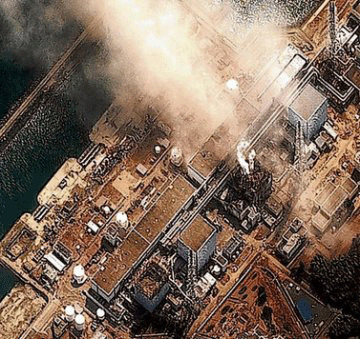 Nuclear Crisis Set Off Fears Over Tokyo, Report Says, NYT, By MARTIN FACKLER, February 27, 2012 TOKYO — In the darkest moments of last year’s nuclear accident, Japanese leaders did not know the actual extent of damage at the plant and secretly considered the possibility of evacuating Tokyo, even as they tried to play down the risks in public, an independent investigation into the accident disclosed on Monday.
The investigation by the Rebuild Japan Initiative Foundation, a new private policy organization, offered one of the most vivid accounts yet of how Japan teetered on the edge of an even larger nuclear crisis than the one that engulfed the Fukushima Daiichi Nuclear Power Plant. A team of 30 university professors, lawyers and journalists spent more than six months on the inquiry into Japan’s response to the triple meltdown at the plant, which followed a massive earthquake and tsunami last March 11 that shut down the plant’s cooling systems……. http://www.nytimes.com/2012/02/28/world/asia/japan-considered-tokyo-evacuation-during-the-nuclear-crisis-report-says.html
A change, but not enough, in the NRC’s pro nuclear culture
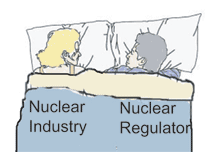
 Nuclear Regulatory Commission sea change? Chairman Jaczko wants red tape removed for Fukushima contentions By Frank Mand Wicked Local Feb 27, 2012 PLYMOUTH — While the Nuclear Regulatory Commission seems to be moving quickly now, dispensing with the objections and legal contentions standing in the way of relicensing the Pilgrim Nuclear Power Station, as those impediments are brushed aside something quite remarkable may be taking place.
Almost hidden in several recent decisions by the NRC – decisions which went against critics of relicensing – is the core of a sea change, a belief on the part of certain key individuals in this government bureaucracy that, at least in the case of recent concerns about the relevance of the Fukushima disaster to Pilgrim and other American nuclear power plants, business as usual is no longer acceptable…. Continue reading
Problems of Fort Calhoun nuclear power plant
OPPD’s nuclear problems: how far will they go? (Audio) By Robyn Wisch, KVNO News February 27th, 2012 Even before the great flood of 2011 hit Fort Calhoun last summer, the plant has been on the Nuclear Regulatory Commission’s radar for quite some time as a utility with potential problems. (The plant was cited for inadequate preparations for a flooding emergency in 2010)
But much of that only came to light when the plant actually came under threat of the Missouri waters. The plant has been offline since then – for just about a year now – and in that time the problems have only deepened. ….. Since that time though, in that interim, in June of 2011, there was a fire at Fort Calhoun, which didn’t get a lot of attention at the time. But several months later, the NRC realized the gravity of what took place at that fire, and it’s still not, I don’t think, completely clear to the public how significant that fire was because the plant was already shut down…… what we know now is that the plant suffered certain damage from the flood. Most recently, the NRC said its biggest concern is they’ve checked out the plant, and I think they’ve gone through what they can see above ground. Their biggest concern right now is below the ground, and how much damage was done underneath the earth where the Fort Calhoun plant sits on. And according to the NRC, they haven’t determined that yet, that’s still open for questions. There was a public hearing in Omaha in January. And some members of the public actually raised that issue, before I think we heard it from anybody else. Some people in the general public were wondering is the ground underneath Fort Calhoun secure? And now NRC is making it very clear they don’t know the answer to that yet, and they’re still trying to figure it out. …. http://www.kvnonews.com/2012/02/oppds-nuclear-problems-how-far-will-they-go/
Exposure to radiation by workers in Finalnd
Outokumpu workers exposed to radiation http://af.reuters.com/article/metalsNews/idAFL5E8DO6SX20120224
* Four Outokumpu workers exposed to radiation
* One worker’s exposure “material safety risk”
* Radiation should not have adverse health effects
* Recycled steel had contained americium (Adds detail) Continue reading
Expand public’s right to question nuclear safety, says Nuclear Regulatory Commission chief
 Nuclear Regulatory Commission chief sides with Pilgrim watchdog group, By Christopher Burrell, Enterprise News.com, The Patriot Ledger Feb 23, 2012 In a surprising move to side with critics of the Pilgrim nuclear power plant, the chairman of the Nuclear Regulatory Commission is arguing to expand, not limit, the public’s chance to ask plant-safety questions in light of last year’s Fukushima Dai-ichi disaster in Japan.
The Fukushima nuclear plant has a similar reactor to the one at Pilgrim, which has been trying for six years to win approval from the NRC for a 20-year extension of its operating license. “Given the significance of that accident (at Fukushima) and the potential implications for the safety of our nuclear reactors, we should allow members of the public to obtain hearings on new contentions on emerging information,” NRC Chairman Gregory Jaczko
wrote in a dissenting opinion released Wednesday. Jaczko was the sole dissenter on the five-member commission, which is appointed by the president. Continue reading
San Clemente residents want independent radiation monitoring of San Onofre nuclear plant
South Korea’s nuclear program falters, as public opposition increases
 the reactor has had 51 malfunctions since it went online, “due to flaws in machinery and components, including radiation leaks, coolant leaks and reactor shutdowns,”
 South Korea to boost nuclear power? SEOUL, Feb. 20 (UPI) — South Korea’s plans to boost nuclear power face increasing resistance from civic and environmental groups, post Fukushima, the Japanese reactor site hit by an earthquake and tsunami last year… Continue reading
USA’s worries about its nuclear reactors similar to Fukushima’s
U.S. nuclear plants similar to Fukushima spark concerns By Matt Smith, CNN
February 17, 2012 — As the United States prepares to build its first new nuclear power reactors in three decades, concerns about an early generation of plants have resurfaced since last year’s disaster in Japan.
The Vermont Yankee nuclear power plant — the subject of a battle between state authorities and the Nuclear Regulatory Commission over its continued operation — uses one of 23 U.S. reactors built with a General Electric-designed containment housing known as the Mark I.
It’s the same design that was used at Japan’s Fukushima Daiichi nuclear power plant, where three reactors melted down after the station was struck by the tsunami that followed Japan’s historic earthquake in March 2011. The disaster resulted in the widespread release of radioactive contamination that forced more than 100,000 people from their homes…..
Arnie Gundersen, a former nuclear engineer and a leading critic of the Vermont Yankee plant, says the Japanese accident shows the Mark I containment system can’t prevent a release of radioactivity in a meltdown.
Watch an excerpt from this weekend’s CNN Special Investigations Unit report on Vermont Yankee
In an October hearing before the NRC’s Petition Review Board, he said the vents were a “Band-Aid fix” for the design that failed “not once, not twice, but three times” at Fukushima Daiichi.
“True wisdom means knowing when to modify something and knowing when to stop,” said Gundersen, who leads a state commission set up to monitor the Vermont Yankee plant.
Half of U.S. reactors are more than 30 years old….. http://edition.cnn.com/2012/02/17/us/us-nuclear-reactor-concerns/?hpt=us_c1
11 USA nuclear reactors may have unsafe cooling systems
Nuclear Regulatory Commission says accident models could be amiss, By Mike M. Ahlers, CNN February 18, 2012 — The models may underestimate how much nuclear fuel would heat up during system failures
The commission is asking 11 U.S. nuclear power plants for more information
There is no immediate threat to public safety
Washington — The Nuclear Regulatory Commission has asked 11 nuclear power plants for information about the computer models they use to test different accident scenarios, saying those models may underestimate how much nuclear fuel will heat up during cooling system
failures….
At issue is a phenomenon known as “thermal conductivity degradation,” or TCD, the NRC said. TCD refers to the fact that nuclear fuel loses its capacity to transfer heat as it ages.
The NRC said it is concerned that some computer models may not account for TCD. If the plants are not considering TCD, the possibility exists that fuel rods could heat up 100 degrees more than anticipated in an accident scenario, exceeding the 2,200-degree limit considered safe,the NRC said. That could damage the fuel rods’ outer layer, leading to
reactor damage, the NRC said……
The plants have until March 19 to provide the information to the NRC
staff. http://edition.cnn.com/2012/02/17/us/nuclear-accident-models/index.html
Call for wider evacuation zones around USA nuclear plants
“Pretending that radiation from an accident at Oyster Creek would not go beyond the 10-mile evacuation zone is a fantasy placing millions of people at risk,”
Nuclear Plant Watchdogs Call for Expansion of Evacuation Zone Around Oyster Creek, Berkely Patch, 16 Feb 12, NRC spokesman says current 10-mile evacuation zone is sufficient for public safety and health By Elaine Piniat Jersey Shore advocates and 37 clean energy groups have petitioned the Nuclear Regulatory Commission to expand emergency evacuation zones and improve emergency response planning around U.S. nuclear reactors, including the Oyster Creek Generating Station. Continue reading
Fukushima in danger of new big earthquakes

 Big quake risk said greater at Fukushima Outcome Magazine, TOKYO, Feb. 14 (UPI) — The risk of strong earthquakes at the Fukushima nuclear plant increased after the magnitude-9 tremor that hit Japan last March, scientists report.
A study using data from more than 6,000 earthquakes shows the March 11, 2011, tremor caused a seismic fault close to the nuclear plant to reactivate, a release from the European Geosciences Union said Tuesday. “There are a few active faults in the nuclear power plant area, and our results show the existence of similar structural anomalies under both the Iwaki and the Fukushima Daiichi areas,” study leader Dapeng Zhao, a geophysics professor at Japan’s Tohoku University, said.
The number of earthquakes in Iwaki increased greatly after the March earthquake, he said. “Given that a large earthquake occurred in Iwaki not long ago, we think it is possible for a similarly strong earthquake to happen in Fukushima,” Zhao said…. http://outcomemag.com/world/2012/02/14/big-quake-risk-said-greater-at-fukushima/
USA taxpayers up for huge costs as NRC approves 2 new and unsafe nuclear reactors
The safety of the reactor design has been challenged over many years. An engineering study commissioned by Friends of the Earth and other groups opposed to the project identified seven key safety areas, including failure risks for the reactor containment, cooling functions and spent fuel pool integrity
Feds Approve Unsafe New Nuclear Reactors Requiring Billions Of Taxpayer Dollars ENews Park Forest, Washington, D.C.—(ENEWSPF)—February 14, 2012. Despite the opposition of its chair, the Nuclear Regulatory Commission last Thursday approved the first new construction of a new design of nuclear reactor since the Three Mile Island nuclear disaster in 1979. Friends of the Earth stated today that the decision to give the green light to building two nuclear reactors at Vogtle, Georgia raises fundamental safety and economic 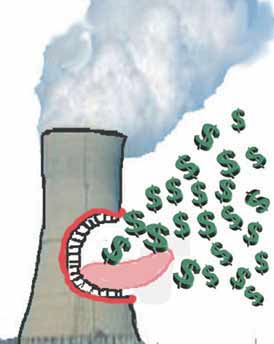 concerns.
The NRC ruling, the first such approval in the U.S. in more than 30 years, will saddle Georgians with higher electricity rates and leave American taxpayers on the hook for billions of dollars — all for a dangerous energy source with a long history of construction delays, cost overruns and safety lapses. Continue reading
Palisades and Browns Ferry nuclear reactors rated at the bottom for safety
Michigan Nuclear Plant Downgraded Over Safety, WSJ, FEBRUARY 14, 2012, COVERT TOWNSHIP, Mich.—Federal regulators said Tuesday that safety violations at the Palisades nuclear-power plant in southwestern Michigan had led them to downgrade the plant to a status held by just two others in the U.S.
The Nuclear Regulatory Commission assigns the more than 100 nuclear reactors in the U.S. to one of five categories based on their safety performance. Most are in the top-performing group. Palisades was bumped to the No. 2 category last month and now will join two others
in the third category: the Perry Nuclear Power Plant’s Unit 1 generator near Cleveland and the Susquehanna Nuclear Power Plant’s Unit 1 generator in Berwick, Pa.
The only reactor that ranks lower is Browns Ferry Unit 1 near Athens, Ala., which is in the fourth category….. http://online.wsj.com/article/SB10001424052970204883304577223561511417868.html
15 tonnes of water hourly, as Fukushima nuclear reactor hots up again
Fukushima reactor heats up again, ABC News, By Mark Willacy in Fukushima The operator of the Fukushima nuclear plant has begun injecting more water into one of the reactors, after the core temperature rose above Japan’s safety limit.
A gauge inside Fukushima’s reactor number two showed the temperature rising to 82 degrees Celsius over the weekend, its highest level since the reactor was put into a state of cold shutdown two months ago. Operator TEPCO insists there has been no nuclear reaction and that the reactor can be controlled.
Responding to the increase, the operator began injecting 15 tonnes of water an hour into the reactor in a bid to get the temperature down. TEPCO says it has not detected any xenon gas, which is created when a
nuclear reaction has been triggered.
The company suspects that cooling water has not been flowing freely into the the number two reactor, causing the
1 This Month





PLEASE OPPOSE HR 8255 AND S.3639 – bills would accelerate satellite deployment, with no environmental review or safeguards – https://ncstd5li.quorum.us/campaign/169331/
To see nuclear-related stories in greater depth and intensity – go to https://nuclearinformation.wordpress.com
-
Archives
- September 2026 (339)
- August 2026 (330)
- July 2026 (355)
- June 2026 (287)
- May 2026 (306)
- April 2026 (356)
- March 2026 (251)
- February 2026 (267)
- January 2026 (308)
- December 2025 (358)
- November 2025 (359)
- October 2025 (375)
-
Categories
- 1
- 1 NUCLEAR ISSUES
- business and costs
- climate change
- culture and arts
- ENERGY
- environment
- health
- history
- indigenous issues
- Legal
- marketing of nuclear
- media
- opposition to nuclear
- PERSONAL STORIES
- politics
- politics international
- Religion and ethics
- safety
- secrets,lies and civil liberties
- spinbuster
- technology
- Uranium
- wastes
- weapons and war
- Women
- 2 WORLD
- ACTION
- AFRICA
- Atrocities
- AUSTRALIA
- Christina's notes
- Christina's themes
- culture and arts
- Events
- Fuk 2022
- Fuk 2023
- Fukushima 2017
- Fukushima 2018
- fukushima 2019
- Fukushima 2020
- Fukushima 2021
- general
- global warming
- Humour (God we need it)
- Nuclear
- RARE EARTHS
- Reference
- resources – print
- Resources -audiovicual
- Weekly Newsletter
- World
- World Nuclear
- YouTube
-
RSS
Entries RSS
Comments RSS

