Japanese govt losing credibility, as Fukushima not anywhere near safe
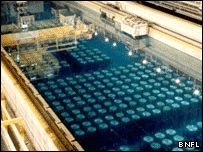 The spent fuel rods stored at the No. 4 reactor pose a particular threat, experts say, because they lie unprotected outside the unit’s containment vessel. Tokyo Electric has been racing to fortify the crumpled outer shell of the reactor, and to keep the tank fed with water. But should a problem also arise with cooling the spent fuel, the plant could run the risk of another colossal radiation leak, experts say.
“The plant is still in a precarious state,”
 Japan Admits Nuclear Plant Still Poses Dangers By HIROKO TABUCHI NYT, March 29, 2012, TOKYO — The damage to the core of at least one of the meltdown-stricken reactors at Fukushima could be far worse than previously thought, raising fresh concerns over the plant’s stability and gravely complicating the post-disaster cleanup, a recent internal investigation has shown.
The results of the inquiry, released this week by the operator of the Fukushima Daiichi Nuclear Power Plant, also cast doubt over the Japanese government’s declaration three months ago that the ravaged site is now under control. Continue reading
The world’s dangerous complacency about nuclear terrorism
the summit in Seoul called only for further voluntary reductions by the end of 2013. That is a weak commitment: the International Panel on Fissile Material estimates world stocks of HEU at 1,300 tonnes, plus 450 tonnes of separated plutonium.
 Nuclear security, Threat multiplier Dangerous complacency about nuclear terrorism The Economist, Mar 31st 2012 | SEOUL NUCLEAR mayhem can come from rogue states or badly run power stations. That fact escapes nobody in South Korea, just a mountain range away from rocket-mad North Korea, and with Japan’s stricken Fukushima Dai-ichi plant across the sea.
But it was a third threat—terrorism—that brought leaders from 53 countries to a summit in Seoul on March 26th-27th. Continue reading
Radiation so high, even robots cannot approach Fukushima No. 1 nuclear reactor

 Reactor 2 radiation too high for access March 29, 2012 73 sieverts laid to low water; level will even cripple robots By MINORU MATSUTANI Radiation inside the reactor 2 containment vessel at the Fukushima No. 1 nuclear plant has reached a lethal 73 sieverts per hour and any attempt to send robots in to accurately gauge the situation will require them to have greater resistance than currently available, experts said Wednesday.
Exposure to 73 sieverts for a minute would cause nausea and seven minutes would cause death within amonth, Tokyo Electric Power Co. said.
The experts said the high radiation level is due to the shallow level of coolant water — 60 cm — in the containment vessel, which Tepco said in January was believed to be 4 meters deep. Tepco has only peeked inside the reactor 2 containment vessel. It has few clues as to the status of reactors 1 and 3, which also suffered meltdowns, because
there is no access to their insides.
The utility said the radiation level in the reactor 2 containment vessel is too high for robots, endoscopes and other devices to function properly. Spokesman Junichi Matsumoto said it will be necessary to develop devices resistant to high radiation.
High radiation can damage the circuitry of computer chips and degrade camera-captured images. For example, a series of Quince tracked robots designed to gather data inside reactors can properly function for only two or three hours during exposure to 73 sieverts, said Eiji Koyanagi, chief developer and vice director of the Future Robotics Technology
Center of Chiba Institute of Technology. That is unlikely to be enough for them to move around and collect
video data and water samples, reactor experts said. ”Two or three hours would be too short. At least five or six hours would be necessary,” said Tsuyoshi Misawa, a reactor physics and engineering professor at Kyoto University’s Research Reactor Institute.
The high radiation level can be explained by the low water level. Water acts to block radiation. ”The shallowness of the water level is a surprise . . . the radiation level is awfully high,” Misawa said. While the water temperature is considered in a safe zone at about 50 degrees, it is unknown if the melted fuel is fully submerged, but Tepco said in November that computer simulations suggested the height of the melted fuel in reactor 2′s containment vessel is probably 20 to
40 cm, Tepco spokeswoman Ai Tanaka said.
Tepco has inserted an endoscope and a radiation meter, but not a robot, in the containment vessel. It is way too early to know how long Tepco will need to operate robots in the vessel because it is unknown what the devices will have to do, Tanaka said.
According to experts, even though high radiation in the containment vessel means additional trouble, it is not expected to further delay the decommissioning the three crippled reactors, a process Tepco said will take 40 years.
The experts noted, however, that removing the melted nuclear fuel from the bottom of the containment vessels will be extremely difficult….
Tepco has not been able to gauge the water depths and radiation levels of the containment vessels for reactors 1 and 3, as, unlike unit 2, there is no access. http://www.japantimes.co.jp/text/nn20120329a1.html
Fukushima nuclear plant is far from safe
 Still critical: radiation levels at Fukushima can kill in minutes Latest readings from tsunami-stricken nuclear plant overturn claims that reactors have been made safe The Independent, DAVID MCNEILL TOKYO THURSDAY 29 MARCH 2012 A lethal level of radiation has been detected inside one of the reactors at the Fukushima nuclear power plant, throwing fresh doubts over the operator’s claims that the disabled complex is under control. Continue reading
Nuclear smuggling, mainly by Iranian and Chinese middlemen
 US, European officials probe Iran nuclear smuggling By Mark Hosenball and John Shiffman WASHINGTON, Mar 28, 2012 (Reuters) – A dramatic expansion in nuclear and military smuggling investigations should lead to a flood of new criminal cases, primarily against Iranian and Chinese middlemen, U.S. law enforcement officials said on Wednesday.
U.S. officials said they are investigating 30 percent more cases this year than three years ago. U.S. agencies have deployed agents posing as arms brokers at more than 20 undercover companies targeting smugglers, said the officials, who briefed reporters on condition of anonymity.
Undercover arms smuggling investigations typically take two to four years to unfold, one of the officials said, which is why he expects an increase in indictments soon….
http://www.reuters.com/article/2012/03/28/usa-iran-smuggling-idUSL2E8ERODR20120328
Alarming news about the state of Fukushima’s nuclear reactors today
 Very high radiation, little water in Japan reactor, Sydney Morning Herald, MARI YAMAGUCHI, March 28, 2012 One of Japan’s crippled nuclear reactors still has fatally high radiation levels and much less water to cool it than officials had estimated, according to an internal examination that renews doubts about the plant’s stability.
A tool equipped with a tiny video camera, a thermometer, a dosimeter and a water gauge was used to assess damage inside the No. 2 reactor’s containment chamber for the second time since the tsunami swept into the Fukushima Dai-ichi plant a year ago.
The data collected Tuesday showed the damage from the disaster is so severe, the plant operator will have to develop special equipment and technology to tolerate the harsh environment and decommission the plant, a process expected to last decades. The other two reactors that had meltdowns could be in even worse shape. The No. 2 reactor is the
only one officials have been able to closely examine so far.
Tuesday’s examination with an industrial endoscope detected radiation levels up to 10 times the fatal dose inside the chamber. Plant officials previously said more than half of the melted fuel has breached the core and dropped to the floor of the primary containment vessel, some of it splashing against the wall or the floor.
Particles from melted fuel have probably sent radiation levels up to a dangerously high 70 sieverts per hour inside the container, said Junichi Matsumoto, spokesman for Tokyo Electric Power Co. The figure far exceeds the highest level previously detected, 10 sieverts per hour, which was detected around an exhaust duct shared by No. 1 and 2 units last year.
“It’s extremely high,” he said, adding that an endoscope would last only 14 hours in those conditions. “We have to develop equipment that can tolerate high radiation” when locating and removing melted fuel during the decommissioning.
The probe also found that the containment vessel _ a beaker-shaped container enclosing the core _ had cooling water up to only 60 centimeters (2 feet) from the bottom, far below the 10 meters (yards) estimated when the government declared the plant stable in December.
The plant is continuing to pump water into the reactor……
The exact conditions of the other two reactors, where hydrogen explosions damaged their buildings, are still unknown. Simulations have indicated that more fuel inside No. 1 has breached the core than the other two, but radiation at No. 3 remains the highest.
The high radiation levels inside the No. 2 reactor’s chamber mean it’s inaccessible to the workers, but parts of the reactor building are accessible for a few minutes at a time _ with the workers wearing full protection…. http://news.smh.com.au/breaking-news-technology/very-high-radiation-little-water-in-japan-reactor-20120328-1vxxz.html
NRC forbids San Onofre nuclear power plant to restart
 San Onofre nuclear power plant prohibited from restarting The Nuclear Regulatory Commission lays out steps that Southern California Edison must take before the troubled San Onofre plant will be allowed to come back on line. By Abby Sewell, Los Angeles Times March 28, 2012 The U.S. Nuclear Regulatory Commission, citing serious concerns about
equipment failures at the San Onofre nuclear power plant, has prohibited Southern California Edison from restarting the plant until the problems are thoroughly understood and fixed. Continue reading
Insecurity in Nigeria, with crooked practices in oil and gas industry
Nigeria loses over $20bn to illegal bunkering, oil theft yearly – Presidential aide Nigerian Tribune, 26 March 2012 EVERY year, Nigeria loses about 40 million metric tonnes of petroleum products amounting to about $20 billion (N3 trillion) to crude oil theft and illegal bunkering, Mr Leke Oyewole, a Senior Special Adviser to President Goodluck Jonathan on Maritime Affairs has said….. He said the loss was sequel to sharp practices characterised by numerous leakages, adulteration of products, as well as diversion of refined imported products by some of the players in the upstream and downstream sectors of the oil and gas industry……NIMASA and NPA ought to collaborate to address issues in the offshore operations in the oil industry and mitigate the insecurity arising therefrom…….
http://tribune.com.ng/index.php/news/38181-nigeria-loses-over-20bn-to-illegal-bunkering-oil-theft-yearly-presidential-aide

Earthquake close to planned vast uranium mine in Australia
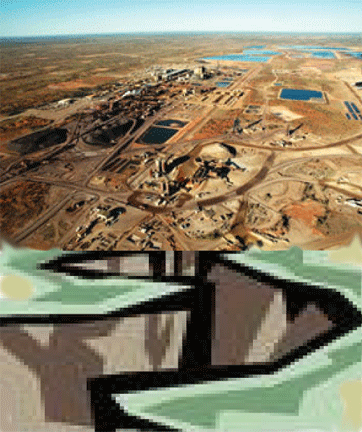 26 March 12 BHP Billiton’s planned new mega uranium mine at Olympic Dam in South Australia will be the world’s largest man-made hole. The planned open-pit mine would be 4.1 kilometres long, 3.5 kilometres wide and 1 kilometre deep. It is hard to imagine the size of this thing, and of its impact on the environment.
Just for one consideration – Australian airway flight paths will have to be changed, because this gigantic hole will have such an effect on the weather as to change the wind patterns in the region!
But – for another consideration – this uranium orebody it is situated on an earthquake fault. The current succession of earthquakes must surely cause South Australia to reconsider the wisdom, or otherwise, of siting the monster mine there! – Christina Macpherson
SEISMIC SURGE IN FAR NORTH: 3.9 EARTHQUAKE NEAR ROXBY DOWNS, Coober Pedy Regional Times, 26 March 12, A 3.9 magnitude earthquake has struck near Olympic Dam in South Australia’s Mid – Far North overnight, in addition to a spate of 4 separate earthquakes in the Far North of the state in the past week.
The succession of medium to significant earthquakes has promted Geoscience Australia to begin setting up seismic monitoring equipment in the Far North where three of the earthquakes occured last week including a 6.1 magnitude quake….. The most recent earthquake which occured overnight is not far from the townships of Roxby Downs and Andamooka near the Stuart Highway, and situated within relatively close proximity to a number of the state’s mining and prospecting operations including the Olympic Dam uranium mine, whose massive orebody engulfs the 35km Masher’s Fault. …… http://cooberpedyregionaltimes.wordpress.com/2012/03/26/seismic-surge-in-far-north-3-9-earthquake-near-roxby-downs/
As Seoul nuclear summit approaches, Britain warns of nuclear terrorism
 UK warns of nuclear risk ahead of Seoul summit (Reuters) 23 March 12, – Britain warned on Friday there was a “significant likelihood” that terrorists will one day acquire chemical, biological or nuclear weapons unless countries step up their efforts to keep sensitive materials and information secure.
The British government released its first comprehensive National Counter-Proliferation Strategy, detailing the risks from the spread such weapons and what Britain and other countries can do to stop it.
It came out days before leaders from more than 50 countries, including U.S. President Barack Obama, gather in Seoul, South Korea, for a March 26-27 nuclear security summit focusing on measures to protect nuclear materials and facilities and to prevent illicit trafficking…..
“Nuclear terrorism is now a real and global threat,” British Deputy Prime Minister Nick Clegg, who will lead Britain’s delegation in Seoul, said in a statement….
http://in.reuters.com/article/2012/03/23/nuclear-britain-idINDEE82M0N320120323
Posthumous honour for victim of killer on UK nuclear submarine
Navy officer shot dead by rampaging sailor on nuclear submarine is honoured DAILY MAIL , 24 March2012 A Royal Navy officer murdered trying to stop a sailor on a gun rampage aboard a nuclear submarine has been posthumously honoured. Lieutenant Commander Ian Molyneux was awarded a George Medal for tackling Able Seaman Ryan Donovan as he ran amok on HMS Astute. Continue reading
Critical nuclear data stolen, in Indian scientist’s lap-top
Laptop with India’s nuclear data still not found Pakistan Observer, March 18, 2012, Rabi-ul-Sani Islamabad—An Indian nuclear scientist’s laptop with classified nuclear data was stolen from a passenger rail car and is still missing raising serious alarm all over India.
Increasing danger of nuclear terrorism
Nuclear Terrorism: A Clear Danger, NYT, By KENNETH C. BRILL and KENNETH N. LUONGO, March 15, 2012 Terrorists exploit gaps in security. The current global regime for
protecting the nuclear materials that terrorists desire for their ultimate weapon is far from seamless. It is based largely on unaccountable, voluntary arrangements that are inconsistent across borders. Its weak links make it dangerous and inadequate to prevent nuclear terrorism. Continue reading
USA’s nuclear safety regulations inadequate
Chief Nuclear Regulator Admits Safety Goals Are ‘Insufficient’, Aol Energy, By Margaret Ryan, March 15, 2012 US nuclear safety goals are insufficient, and don’t address effects like those seen after the Fukushima disaster in Japan, the head of the US nuclear regulator says. Continue reading
No end of problems for San Onofre nuclear power plant
San Onofre’s Unit 3 reactor shut indefinitely while US regulators probe tube problems Washington Post, By Associated Press, March 15 LOS ANGELES — A nuclear reactor on the California coast will remain shut down indefinitely while a team of federal inspectors determines why several relatively new tubes became so frail that tests found they could rupture and release radioactive water, a federal official said Thursday….
The Unit 3 reactor at the San Onofre Nuclear Generating Station, located about 45 miles north of San Diego, was shut down as a precaution on Jan. 31 after a water leak from another tube in a massive steam generator. Traces of radiation escaped, but officials say there was no danger to workers or neighbors.
Since then, investigators have been looking into excessive wear found on steam generator tubes in the seaside plant and its twin, Unit 2, which has been off line for maintenance and refueling. The two huge steam generators at Unit 2, each containing 9,700 tubes, were replaced in fall 2009, and a year later in Unit 3 as part of a $670 million overhaul.
The NRC dispatched a special, five-member team to Unit 3 on Thursday after pressure tests showed three of the metal-alloy tubes had become so degraded that they could rupture under some circumstances. Such ruptures can require a plant to shut down, if spewing water reaches 150 gallons a day……
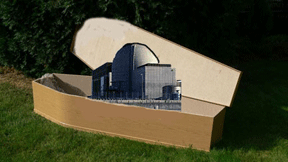 San Onofre’s Unit 1 reactor operated from 1968 to 1992, when it was shut down and dismantled. The utility’s plan to ship the 600-ton reactor vessel on a 15,500-mile voyage around South America to a disposal site in South Carolina was thwarted and it remains at San Onofre, encased in concrete and steel….
http://www.washingtonpost.com/national/federal-regulators-to-investigate-tube-failures-at-califs-san-onofre-nuclear-power-plant/2012/03/15/gIQAn3lIES_story.html
1 This Month





PLEASE OPPOSE HR 8255 AND S.3639 – bills would accelerate satellite deployment, with no environmental review or safeguards – https://ncstd5li.quorum.us/campaign/169331/
To see nuclear-related stories in greater depth and intensity – go to https://nuclearinformation.wordpress.com
-
Archives
- September 2026 (339)
- August 2026 (330)
- July 2026 (355)
- June 2026 (287)
- May 2026 (306)
- April 2026 (356)
- March 2026 (251)
- February 2026 (267)
- January 2026 (308)
- December 2025 (358)
- November 2025 (359)
- October 2025 (375)
-
Categories
- 1
- 1 NUCLEAR ISSUES
- business and costs
- climate change
- culture and arts
- ENERGY
- environment
- health
- history
- indigenous issues
- Legal
- marketing of nuclear
- media
- opposition to nuclear
- PERSONAL STORIES
- politics
- politics international
- Religion and ethics
- safety
- secrets,lies and civil liberties
- spinbuster
- technology
- Uranium
- wastes
- weapons and war
- Women
- 2 WORLD
- ACTION
- AFRICA
- Atrocities
- AUSTRALIA
- Christina's notes
- Christina's themes
- culture and arts
- Events
- Fuk 2022
- Fuk 2023
- Fukushima 2017
- Fukushima 2018
- fukushima 2019
- Fukushima 2020
- Fukushima 2021
- general
- global warming
- Humour (God we need it)
- Nuclear
- RARE EARTHS
- Reference
- resources – print
- Resources -audiovicual
- Weekly Newsletter
- World
- World Nuclear
- YouTube
-
RSS
Entries RSS
Comments RSS

