3,400 damaged steam generator tubes in San Onofre nuclear power plant!
 US nuclear plant problem worse than thought: report Google News 13 July 12 LOS ANGELES — US nuclear regulators published an update on California’s troubled San Onofre power plant Thursday, sparking an expert warning that the problem is more serious than first thought.
A reactor at the nuclear power plant near San Diego was shut down in January after a  radiation leak, although the Nuclear Regulatory Commission (NRC) said there was no danger to the public.
Investigations found unexpected erosion on tubes that carry radioactive water, and the entire plant was shut down, forcing Californian authorities to fire up alternative power generation
facilities.
On Thursday, an update on the tube erosion, posted on an obscure part of the NRC’s website, showed the situation had worsened. “This reveals a far greater problem than has been previously disclosed, and raises serious questions about whether it is safe to restart either unit,” said Daniel Hirsch, a nuclear expert at the University of California, Santa Cruz.
The new data shows that more than 3,400 steam generator tubes in the new steam generators at San Onofre have been found to be damaged — about 1,800 in Unit 3 and 1,600 in Unit 2 — he said……. http://www.google.com/hostednews/afp/article/ALeqM5hn3SqZ5jtiFKISpfeEx8GsQRTzfA?docId=CNG.f9be015e81629b87f9e150d82ec26f2f.761
Worldwide nuclear industry control of safety regulations
Those “wider structural problems” are far wider than Japan–they are global. The “regulatory capture” cited in the Japanese panel’s report has occurred all over the world–with the nuclear industry and those promoting nuclear power in governments making sure that the nuclear foxes are in charge of the nuclear hen houses. The “pus that pervades Japanese society” is international.
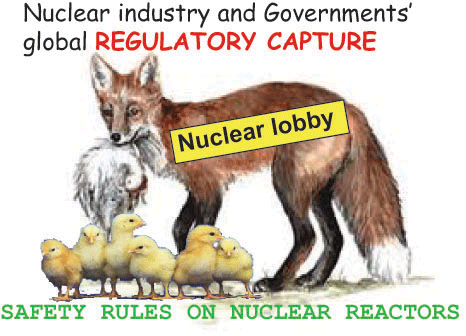
Nuclear Foxes In Charge of the Nuclear Hen Houses, OpEd News, 11 July 12 By Karl Grossman The conclusion of a report of a Japanese parliamentary panel issued last week that the Fukushima Daiichi nuclear power plant disaster was rooted in government-industry “collusion” and thus was “man-made” is mirrored throughout the world. The “regulatory capture” cited by the panel is the pattern among nuclear agencies right up to the International Atomic Energy Agency. Continue reading
South Africa’s Pelindaba facility remains a nuclear security danger
SA lags in nuclear security http://www.timeslive.co.za/thetimes/2012/07/12/sa-lags-in-nuclear-security Graeme Hosken | 12 July, 2012 A new report co-authored by a senior
Harvard academic has shed light on some of the security vulnerabilities of South Africa’s nuclear facilities.
Co-written by Harvard University associate professor and nuclear security specialist Matthew Bunn, Progress on Securing Nuclear Weapons and Materials: The Four-Year Effort and Beyond, examines nuclear-material security globally.
It reveals that, though South Africa has completed substantial security upgrades at its Pelindaba nuclear facility, and implemented regulations requiring the protection of nuclear sites against threats, these have yet to be formally enforced.
The report states that South Africa has not committed itself to eliminating hundreds of kilograms of weapons-grade highly enriched uranium.
It has yet to ratify an amendment to the Convention on the Physical Protection of Nuclear Material. The amendment is aimed at improving the physical protection of nuclear material and facilities, and reducing the vulnerability of states to the theft of nuclear material and to nuclear terrorism.
Workers exposed to airborne uranium, due to pressurised yellowcake containers
Pressurized drums create yellowcake uranium hazard, NRC says By Todd Sperry, CNN Senior Producer July 11, 2012 – Washington (CNN) — After three Canadian employees were exposed to yellowcake uranium last month when a lid blew off a pressurized 55-gallon drum, a uranium mining company has informed U.S. nuclear regulatory officials it has found additional drums possibly susceptible to the same problem, CNN has learned..
.. The NRC and
Canadian nuclear officials are investigating drums shipped from a Willow Creek, Wyoming, mining facility operated by Uranium One to an Ontario processing plant where workers opened them, including the one that ejected the powder. The three employees were overcome by a cloud of yellowcake uranium that had unexpectedly become pressurized.
The worker closest to the drum and two others in the area, who were not wearing respirators, were exposed to airborne uranium, according to the NRC..
… Yellowcake is the byproduct of uranium ore that is mined, crushed and milled until concentrated. It is a key component in manufacturing uranium fuel for nuclear reactors.
NRC officials gave Uranium One until this week to identify whether any other drums had become pressurized during manufacture or shipment…… Other drums shipped to the Canadian facility containing yellowcake were found to be bulging from internal pressure, the NRC said.
The underestimated dangers at Los Alamos nuclear weapons laboratory
Nuclear Weapons Lab Underestimates Risk of Radiation Leak, Study Finds, Project on Government Oversight (POGO) By MIA STEINLE, 10 July 12, One of the nation’s main nuclear weapons labs has sharply underestimated the amount of radiation that could leak from the facility as a result of an earthquake, according to a federal advisory panel.
The radiation could be more than four times as intense as the Los Alamos National Laboratory predicted in a safety analysis last year, according to a recent report by the Defense Nuclear Facilities Safety Board. Continue reading
Strike and problem of decaying concrete at Canada’s nuclear power plants
those employees should also be demanding safety in their workplace as well. At least one Candu plant – Gentilly-2 in Quebec – is decaying .
The plant is one of many that regulators say is operating well past its expected life of 25 to 30 years
Major Problems Facing Canada’s Nuclear Sector http://www.care2.com/causes/major-problems-facing-canadas-nuclear-sector.html#ixzz20GmGP3Pi by Amy Boughner July 9, 2012 Canada’s nuclear industry is once again facing major issues. More than 800 Candu Energy employees are on strike as of the morning of July 9, looking for higher wages. The scientists, engineers and technologists work at Candu plants in Ontario, Quebec and New Brunswick. Continue reading
Decaying concrete a problem for aging nuclear power plants
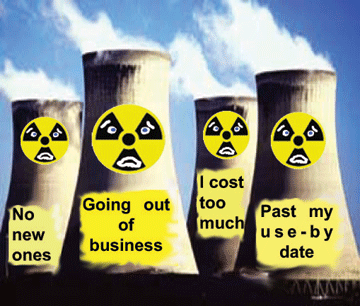 concrete degradation has surfaced in the reactor containment buildings of three U.S. nuclear power stations. The Nuclear Regulatory Commission recently warned operators there that design strengths and assumptions used in original containment building design plans “may no longer hold true,” if ASR and its telltale cracks and fissures are present.
Decaying concrete raising concerns at Canada’s aging nuclear plants, National Post Ian MacLeod, Postmedia News Jul 8, 2012 Decaying concrete at nuclear power plants is the latest concern for nuclear safety authorities.
At Quebec’s sole atomic power station, Gentilly-2, eroding concrete has prompted federal licensing officials to suggest that any provincial attempt to refurbish and re-license the 30-year-old plant must satisfy federal concerns over the aging concrete’s ability to stand up to another two or three decades of service.
The move comes as economic pressures force nuclear utilities to consider refurbishing their nuclear plants and operating them well past their 25- to 30-year initial lives. Continue reading
266 fires on UK’s nuclear submarines
 “Any one of these fires could have had catastrophic consequences and the frequency
 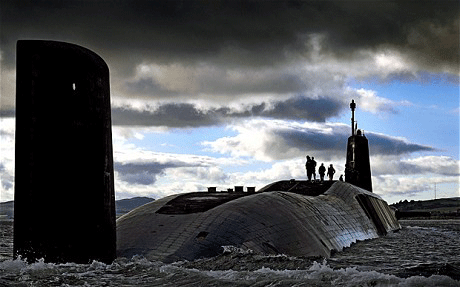 of these incidents raises the most serious safety concerns.”
 Nuclear submarine fire figures revealed BBC News 9 July 12, There have been 266 fires on nuclear submarines in the past 25 years, the Ministry of Defence has revealed. The incidents included 74 on ballistic missile submarines. Three happened while the vessels were in naval bases; one of these was on a ballistic missile submarine. Continue reading
Earthquake danger for nuclear power plants
 Earthquakes are a fairly common occurrence in Japan, and so, if the earthquake was indeed the cause of the accident, it would call into question the safety of much of Japan’s nuclear fleet, including, presumably, the reactors at the Ohi plant.
The Nuclear Power Conundrum, Bill Chameides Dean, Duke University’s Nicholas School of the Environment HUFFINGTON POST, 07/06/20 “…. a report released on Thursday by the Fukushima Nuclear Accident Independent Investigation Commission concluded that last year’s accident in northeastern Japan at the Fukushima Daiichi power plant operated by the Tokyo Electric Power Company (Tepco) was “profoundly a man-made disaster — that could and should have been foreseen and prevented.”
While the official story has been that the accident was caused by the “once-in-a-millennium” tsunami, the report concludes that damage resulting from the earthquake (before the tsunami struck) could have been liable as well. Continue reading
Danger to nuclear power plants of extreme weather conditions

 Nuclear plants must resist extreme weather http://www.swissinfo.ch/eng/swiss_news/Nuclear_plants_must_resist_extreme_weather.html?cid=33059156 Jul 6, 2012 Switzerland’s nuclear power plants have until the end of 2013 to demonstrate to the country’s safety watchdog that they are equipped to withstand weather conditions such as tornados, high winds, heavy snowfall and extreme temperatures. Continue reading
Delays in relicensing nuclear reactors, but they can continue to operate
The U.S. Court of Appeals for the District of Columbia Circuit last month told the NRC to revisit rules governing the storage of spent nuclear fuel at the nation’s 104 operating reactors. The commission, the court said, failed to conduct an environmental review when it updated its so-called “waste confidence rule” in 2010.
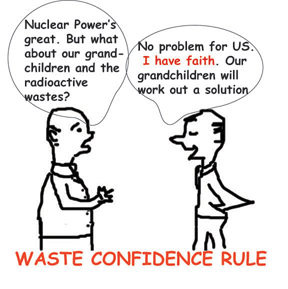
More Nuclear Reactor License Renewals Delays: NRC’s Jaczko to Platts Energy Podium WASHINGTON, July 5, 2012 Market Watch, — Speaking at a Platts Energy Podium event, the departing chairman of the U.S. Nuclear Regulatory Commission (NRC) said Thursday that the agency may not be able to renew licenses for operating nuclear plants for “a few years” because of a federal court ruling, but the practical impact will be limited…..
.. Jaczko urged the agency to continue to make post-Fukushima improvements to nuclear plants mandatory and warned that there are signs of nuclear industry “pushback” against some of the measures proposed in the wake of the tsunami-induced shutdown of the Japanese nuclear facility. Continue reading
Workers exposed to radioactive uranium
Canadian workers exposed to yellowcake http://www.theaustralian.com.au/news/breaking-news/canadian-workers-exposed-to-yellowcake/story-fn3dxix6-1226419628561 July 07, 2012 Three workers at a uranium processing plant in Canada were exposed to radioactive yellowcake when the lid blew off of a bulging container imported from the United States, US nuclear regulatory officials say. Continue reading
Gregory Jaczko urges Nuclear Regulatory Commission to put safety ahead of costs
 Mr. Jaczko said the [nuclear safety] changes were necessary for safety and the NRC should require operators to make them, regardless of cost
U.S. Nuclear Regulator: Agency Divided on Japan  Response By RYAN TRACY 5 July 12 http://online.wsj.com/article/SB10001424052702303684004577509021876463962.html WASHINGTON—The departing chief U.S. nuclear regulator said U.S. officials still can’t agree on a response to Japan’s Fukushima Daiichi accident and urged his successor to “keep the pressure on” the nuclear industry. Continue reading
Japan’s Fukushima Daini nuclear plant might never restart
 Doubts linger over Japan’s nuclear future, FT.com, By Mure Dickie, Tokyo, 4 July 12, When the world’s appalled gaze turned to Japan’s tsunami-crippled Fukushima Daiichi nuclear power station in March last year, few paid much attention to its sister atomic plant, , Fukushima Daini, , just 10 km south……
for all the seeming normality of the scene, Daini’s future is shrouded in doubt.
Work to fully restore safety systems damaged by the tsunami is expected to be completed by March. But even the new bosses of operator Tokyo Electric Power shy away from the question of whether Daini’s reactors will ever be turned back on. Continue reading
Earthquake risks under nuclear reactors at Tsuruga , Japan
 Reactor restarts, but Japan’s energy policy in flux, NISA calls for reviews of fault lines near Fukui nuclear reactors July 04, 2012, THE ASAHI SHIMBUN The Nuclear and Industrial Safety Agency said it will order reassessments of the seismic risk of geological fault lines that run near two nuclear facilities in Fukui Prefecture.
During a hearing session with expert seismologists on July 3, NISA said the potential damage from the fault lines should be studied further at the Mihama nuclear power plant, operated by Kansai Electric Power Co. (KEPCO), and the Monju prototype fast breeder reactor in Tsuruga, run by the Japan Atomic Energy Agency (JAEA).
The Shiraki-Nyu fault, which is recognized as active, runs north-south about 1 kilometer east of the Mihama nuclear plant and 500 meters west of the Monju reactor. In addition, the premises of the Mihama nuclear plant contain nine fault lines, while nine others run under the Monju reactor…. Japan Atomic Power Co., operator of the Tsuruga nuclear power plant in Tsuruga, Fukui Prefecture, is conducting re-investigations after NISA pointed out that sliding along the Urazoko active fault, which cuts through the plant’s premises, could lead to movements of a fault line directly beneath the No. 2 reactor….
1 This Month




PLEASE OPPOSE HR 8255 AND S.3639 – bills would accelerate satellite deployment, with no environmental review or safeguards – https://ncstd5li.quorum.us/campaign/169331/
To see nuclear-related stories in greater depth and intensity – go to https://nuclearinformation.wordpress.com
-
Archives
- September 2026 (339)
- August 2026 (330)
- July 2026 (355)
- June 2026 (287)
- May 2026 (306)
- April 2026 (356)
- March 2026 (251)
- February 2026 (267)
- January 2026 (308)
- December 2025 (358)
- November 2025 (359)
- October 2025 (375)
-
Categories
- 1
- 1 NUCLEAR ISSUES
- business and costs
- climate change
- culture and arts
- ENERGY
- environment
- health
- history
- indigenous issues
- Legal
- marketing of nuclear
- media
- opposition to nuclear
- PERSONAL STORIES
- politics
- politics international
- Religion and ethics
- safety
- secrets,lies and civil liberties
- spinbuster
- technology
- Uranium
- wastes
- weapons and war
- Women
- 2 WORLD
- ACTION
- AFRICA
- Atrocities
- AUSTRALIA
- Christina's notes
- Christina's themes
- culture and arts
- Events
- Fuk 2022
- Fuk 2023
- Fukushima 2017
- Fukushima 2018
- fukushima 2019
- Fukushima 2020
- Fukushima 2021
- general
- global warming
- Humour (God we need it)
- Nuclear
- RARE EARTHS
- Reference
- resources – print
- Resources -audiovicual
- Weekly Newsletter
- World
- World Nuclear
- YouTube
-
RSS
Entries RSS
Comments RSS

