New government inquiry finds that Japan’s nuclear reactors are still unsafe
 Japan nuclear plants ‘still not safe’ Report from independent panel delivers damning assessment of country’s nuclear regulator and Fukushima plant operator. Aljazeera 23 Jul 2012 A government-appointed inquiry has delivered a damning assessment of Japanese nuclear regulators and the operator of the Fukushima nuclear power plant, raising further fears that despite new rules, the country’s nuclear sector still does not meet safety requirements.
The 450-page report by a 10-member panel of independent experts was released on Monday, and comes as anti-nuclear activists continue a vociferous campaign against the restarting of two nuclear reactors in the country.
The government is currently readying a new energy policy, due next month. Continue reading
Radioactive danger of Chernobyl forest fires
Chernobyl’s radioactive trees and the forest fire risk BBC News 7 July. (this article also describes the heroism of Ukraine’s firefighters.) By Patrick Evans Chernobyl, Ukraine Much of the 30km exclusion zone around the Chernobyl nuclear plant is pine forest, and some of it so badly contaminated that a forest fire could create a devastating radioactive smoke cloud.
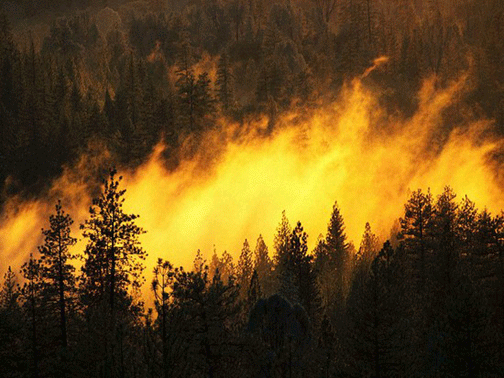
Heading north from Kiev in Ukraine, Continue reading
Stolen vehicle contained radioactive material
Nuclear material on stolen ute TVNZ July 21, 2012 Police fear radioactive material could be released from a nuclear density metre on a utility stolen in Christchurch. Continue reading
In last 24 hours – 3 earthquakes hit Fukushima
M4.5 quake hits Fukushima — Third M4 in last 24 hours July 19th, 2012 By ENENews Title: : Earthquake Information
Source: Japan Meteorological Agency Date: July 20, 2012 http://enenews.com/m4-5-quake-hits-fukushima-third-m4-in-last-24-hours
Earthquake fault line under Japan’s only operating nuclear reactor?
 Japan nuclear watchdog probes claims that country’s only working reactor sits on active fault line Warning comes just 18 months after tsunami wiped out Fukushima plant DAILY MAIL, 19 July 2012 Japan’s nuclear safety watchdog has ordered an investigation into claims the country’s only active nuclear power station is positioned above a tectonic fault line.
Geologists believe the Oi plant in Fukui Prefecture is at real risk of earthquake if the tectonic plates it sits on suddenly shift.
The news comes at a sensitive time for the Japanese nuclear industry – less than 18 months after a tsunami struck the nuclear power station at Fukushima, causing a meltdown…
The first reactor was fired up a few weeks ago and a second is planned to restart later in July. The power company insists it won’t alter its schedule, despite the order to examine the earth under the huge plant…. Experts reporting to the safety watchdog have also recommended tests are carried out at the nearby Shika plant, claiming both sites could be sitting on active fault lines. http://www.dailymail.co.uk/news/article-2176062/Japan-nuclear-watchdog-probes-claims-countrys-working-reactor-sits-active-fault-line.html#ixzz21C4tdqr4
“Uprating” – a cheap way to increase power from nuclear reactors, but is it safe?
nuclear watchdogs have warned that these bigger uprates also carry bigger risks.
“This trend is, in principle, detrimental to the stability characteristics of the reactor, inasmuch as it increases the probability of instability events and increases the severity of such events, if they were to occur,” the Advisory Committee on Reactor Safeguards, which is mandated by Congress to advise the NRC, has warned

 How to expand nuclear power without attracting (too much) attention
Washington Times, by Brad Plumer July 18, 2012 Since the 1970s, construction on new nuclear reactors in the United States has largely ground to a halt, thanks to public protests, regulatory obstacles and tight financing. Yet over that same period, U.S. utilities have managed to increase the amount of electricity they get from nuclear power. By quite a lot, in fact.
How is that possible? Through a process known as “uprating.” According to a new analysis by the U.S. Energy Information Administration, the operators of 98 of the country’s 104 commercial nuclear reactors have asked regulators for permission to boost capacity from their existing plants. All in all, the Nuclear Regulatory Commission has approved more than 6,500 megawatts worth of uprates since 1977. That’s the equivalent of building six entirely new nuclear reactors—and during a period when fresh plants were impossible to build.
Under the public radar, nuclear power is “uprated”, bringing safety concerns
nuclear watchdogs and the U.S. Nuclear Regulatory Commission’s own safety advisory panel have expressed concern over larger boosts — some by up to 20% — that the NRC began approving in 1998. Twenty of the nation’s 104 reactors have undergone these “extended power uprates.”
U.S. is increasing nuclear power through uprating Turning up the power is a little-publicized way of getting more electricity from existing nuclear plants. But scrutiny is likely to increase in the wake of Japan’s nuclear crisis. LA Times, April 17, 2011|By Alan Zarembo and Ben Welsh, Los Angeles Times
The U.S. nuclear industry is turning up the power on old reactors, spurring quiet debate over the safety of pushing aging equipment beyond its original specifications.
The little-publicized practice, known as uprating, has expanded the country’s nuclear capacity without the financial risks, public anxiety and political obstacles that have halted the construction of new plants for the last 15 years.
The power boosts come from more potent fuel rods in the reactor core and, sometimes, more highly enriched uranium. As a result, the nuclear reactions generate more heat, which boils more water into steam to drive the turbines that make electricity. Continue reading
Amid USA heatwave, loss of power to cooling equipment brings shutdown to Pennsylvania nuclear reactor
Exelon shuts Pa. Limerick 1 nuclear power reactor, Reuters Jul 19, 2012 By Scott DiSavino July 18 – Exelon Corp shut down the 1,130-megawatt (MW) Unit 1 at the Limerick nuclear power plant in Pennsylvania early Wednesday following an electrical disturbance on the non-nuclear side of the plant, the company said in a release.
The outage came at a bad time for the power grid: Homes and businesses in the U.S. Mid-Atlantic are cranking up their air conditioners amid a brutal heat wave blanketing the region.
The electrical disturbance caused a loss of power to generator cooling equipment, the company said. The unit will remain offline until repairs, inspections and testing are
completed, it said…. http://in.reuters.com/article/2012/07/18/utilities-operations-exelon-limerick-idINL2E8II8A620120718
Secrecy and safety issues at troubled Kudankulam nuclear power plant

 An atom of doubt at the Kudankulam nuclear power plant Reuters, By Gokul Chandrasekar JULY 17, 2012 KUDANKULAM NUCLEAR POWER PLANT SAFETY ISSUES Opponents of the Kudankulam Nuclear Power Plant, under construction in Tamil Nadu, are raising fresh questions about the plant’s safety because of Indian government documents that they say reveal a problem in the design of one of the two reactors.
The reactor’s design differs from the plan that Russia and India came up with when they agreed to build the reactor in 1988, according to the documents published by India’s Atomic Energy Regulatory Board.
The design of the reactor pressure vessel, which contains the reactor coolant and core, was not supposed to have welds in its core region, the bulletin said. The vessel has two welds there, it said.
People who live near the Kudankulam plant and the People’s Movement Against Nuclear Energy called this deviation a “serious breach of contract” that exposes the plant to high failure risk and a higher possibility of offsite radiological contamination. Continue reading
Japan’s Shika nuclear power plant on top of an active earthquake fault?
Shika nuclear plant may sit on active fault Confirmation could doom facility; others probed Japan Times, 17 July 12 Kyodo Government research indicates the fault running beneath Hokuriku Electric Power Co.’s Shika Nuclear Power Station may be active, raising questions about the utility’s claim in the late 1990s to the contrary, according to sources.
Government regulations do not allow construction of a nuclear reactor above an active fault. If it is confirmed active, the Shika nuclear plant in Ishikawa Prefecture may not qualify to operate. Continue reading
New, and worrying, data about safety status of San Onofre nuclear power plant
 the numbers show that the damage at San Onofre is much worse than seen elsewhere in the industry
New details about problems at San Onofre nuclear power plant LA Times, July 14, 2012 Data released by the U.S. Nuclear Regulatory Commission and a leaked analysis by Southern California Edison provide some new insights into the situation at the San Onofre nuclear plant. Continue reading
Alarming report on the unsafe state of San Onofre nuclear power plant
Made in Japan? Fukushima Crisis Is Nuclear, Not Cultural TruthOut, 14 July 2012 By Gregg Levine, Capitoilette | News Analysis “……..Back at San Onofre, US regulators disclosed Thursday that the damage to the metal tubes that circulate radioactive water between the reactor and the steam turbines (in other words, part of the system that takes heat away from the core) was far more extensive than had previously been disclosed by plant operators:
[Each of San Onofre’s steam generators has] 9,727 U-shaped tubes inside, each three-quarters of an inch in diameter.
The alloy tubes represent a critical safety barrier — if one breaks, there is the potential that radioactivity could escape into the atmosphere. Also, serious leaks can drain protective cooling water from a reactor.
Gradual wear is common in such tubing, but the rate of erosion at San Onofre startled officials since the equipment is relatively new. The generators were replaced in a $670 million overhaul and began operating in April 2010 in Unit 2 and February 2011 in Unit 3.
Tubes have to be taken out of service if 35 percent — roughly a third — of the wall wears away, and each of the four generators at the plant is designed to operate with a maximum of 778 retired tubes.
In one troubled generator in Unit 3, 420 tubes have been retired. The records show another 197 tubes in that generator have between 20 percent and 34 percent wear, meaning they are close to reaching the point when they would be at risk of breaking.
More than 500 others in that generator have between 10 percent and 19 percent wear in the tube wall.
“The new data reveal that there are thousands of damaged tubes in both Units 2 and 3, raising serious questions whether either unit should ever be restarted,” said Daniel Hirsch, a lecturer on nuclear policy at the University of California, Santa Cruz, who is a critic of the industry. “The problem is vastly larger than has been disclosed to date.”
And if anything, the Nuclear Regulatory Commission is underplaying the problem. A report from Fairewinds Associates, also released this week, unfavorably compared San Onofre’s situation with similar problems at other facilities:
[SONGS] has plugged 3.7 times as many steam generator tubes than the combined total of the entire number of plugged replacement steam generator tubes at all the other nuclear power plants in the US.
The report also explains that eight of the tubes failed a “pressure test” at San Onofre, while the same test at other facilities had never triggered any more than one tube breach. Fairewinds goes on to note that both units at San Onofre are equally precarious, and that neither can be restarted with any real promise of safe operation….. http://truth-out.org/news/item/10333-made-in-japan-fukushima-crisis-is-nuclear-not-cultural
Months passed before nuclear plant’s fire was reported to regulators
Browns Ferry nuclear plant had a control room fire in January, regulators took months to notify public Al.com, July 13, 2012, By Brian Lawson, The Huntsville Times HUNTSVILLE, Alabama –– TVA’s Browns Ferry nuclear plant near Athens had a fire in one its control rooms in January, but public notice of the event was not issued until this week.
The roughly 10-minute fire in the Unit 3 control room was caused by an electrical component determined to be about 34 years old, some four times older than its recommended shelf life, according to a TVA incident report.
TVA’s report on the Jan. 26 fire was submitted to the Nuclear Regulatory Commission on March 26. An NRC spokesman said Friday he had no explanation why the report was not made public by the NRC until July 9.
The fire was reportedly caused by a failed power supply in a panel. It burned out some plant alarms and warning lights….. Those problems should have alerted TVA, said David Lochbaum, a former Browns Ferry engineer and director of the nuclear safety program for the Washington, D.C.-based Union of Concerned Scientists. ….. TVA reported the Unit 3 capacitors all dated back to the original construction of the unit, 34 years ago.
Browns Ferry was the site of the worst nuclear plant fire in U.S. history in 1975. A plant employee using a candle to look for air hose leaks accidentally ignited some sealing material, the fire resulted in operators having no control over the plant for about an hour. Browns Ferry officials didn’t notify Limestone County Emergency Management officials about the fire until the following day……
Fatal flaws inherent in nuclear power generation
Made in Japan? Fukushima Crisis Is Nuclear, Not Cultural TruthOut, 14 July 2012 By Gregg Levine, Capitoilette | News Analysis “……..As the Diet’s report makes abundantly clear–far more clear than any talk about Japanese culture–the multiple failures at and around Fukushima Daiichi were directly related to the design of the reactors and to fatal flaws inherent in nuclear power generation.
Return for a moment to something discussed here last summer, The Light Water Paradox: “In order to safely generate a steady stream of electricity, a light water reactor needs a steady stream of electricity.” As previously noted, this is not some perpetual motion riddle–all but one of Japan’s commercial nuclear reactors and every operating reactor in the United States is of a design that requires water to be actively pumped though the reactor containment in order to keep the radioactive fuel cool enough to prevent a string of catastrophes, from hydrogen explosions and cladding fires, to core meltdowns and melt-throughs.
Most of the multiple calamities to befall Fukushima Daiichi have their roots in the paradox. As many have observed and the latest Japanese report reiterates, the Tohoku earthquake caused breaches in reactor containment and cooling structures, and damaged all of Fukushima’s electrical systems, save the diesel backup generators, which were in turn taken out by the tsunami that followed the quake. Meeting the demands of the paradox–circulating coolant in a contained system–was severely compromised after the quake, and was rendered completely impossible after the tsunami. Given Japan’s seismic history, and the need of any light water reactor for massive amounts of water, Fukushima wouldn’t really have been a surprise even if scientists hadn’t been telling plant operators and Japanese regulators about these very problems for the last two decades…..
And while the rapid degeneration of the tubing might be peculiar to San Onofre, the dangers inherent in a system that requires constant power for constant cooling–lest a long list of possible problems triggers a toxic crisis–are evident across the entire US nuclear fleet. Cracked containment buildings, coolant leaks, transformer fires, power outages, and a vast catalogue of human errors fill the NRC’s event reports practically every month of every year for the past 40 years. To put it simply, with nuclear power, too much can go wrong when everything has to go right.
And this is to say nothing of the dangers that come with nuclear waste storage. Like with the reactors, the spent fuel pools that dot the grounds of almost every nuclear plant in America and Japan require a consistent and constantly circulating water supply to keep them from overheating (which would result in many of the same disastrous outcomes seen with damaged reactors). At Fukushima, one of the spent fuel pools is, at any given point, as much of a concern as the severely damaged reactor cores. http://truth-out.org/news/item/10333-made-in-japan-fukushima-crisis-is-nuclear-not-cultural
Dangerous experimental process to remove fuel rods from Fukushima’s No.4 nuclear reactor
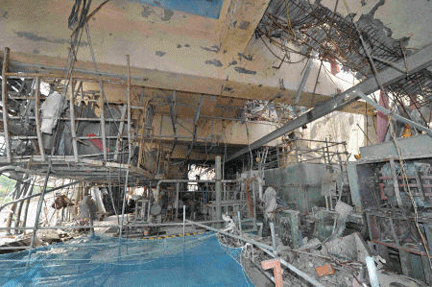 Fuel rods to be removed from No. 4 fuel pool Ene News — Concerns about sea water damage — Special container so fuel doesn’t going critical — Test date not revealed ‘for security reasons’ July 13th, 2012 the Fukushima Daiichi nuclear power plant will soon start test runs for removing fuel rods from a storage pool of the No. 4 reactor.
Removal Procedure A crane will be used to pull each of the 2 rods out of the pool, and then place them in a special container on the 5th floor of the reactor building.
The container will prevent the fuel from going critical.
Another crane will lower the container to the ground, where a truck will take it to a facility called a “common pool.”
Four cables will be used to prevent the container from falling.
Damage to Metal Container? TEPCO will also check if there’s any damage to the metal container used to store the fuel rods. This is a concern because seawater was used to cool the reactor after last year’s accident.
Security Reasons TEPCO says it cannot reveal the date of the test for security reasons.
http://enenews.com/fuel-rods-to-be-removed-from-no-4-fuel-pool-concerns-about-sea-water-damage-special-container-so-fuel-doesnt-going-critical-date-not-revealed-for-security-reasons
1 This Month




PLEASE OPPOSE HR 8255 AND S.3639 – bills would accelerate satellite deployment, with no environmental review or safeguards – https://ncstd5li.quorum.us/campaign/169331/
To see nuclear-related stories in greater depth and intensity – go to https://nuclearinformation.wordpress.com
-
Archives
- September 2026 (339)
- August 2026 (330)
- July 2026 (355)
- June 2026 (287)
- May 2026 (306)
- April 2026 (356)
- March 2026 (251)
- February 2026 (267)
- January 2026 (308)
- December 2025 (358)
- November 2025 (359)
- October 2025 (375)
-
Categories
- 1
- 1 NUCLEAR ISSUES
- business and costs
- climate change
- culture and arts
- ENERGY
- environment
- health
- history
- indigenous issues
- Legal
- marketing of nuclear
- media
- opposition to nuclear
- PERSONAL STORIES
- politics
- politics international
- Religion and ethics
- safety
- secrets,lies and civil liberties
- spinbuster
- technology
- Uranium
- wastes
- weapons and war
- Women
- 2 WORLD
- ACTION
- AFRICA
- Atrocities
- AUSTRALIA
- Christina's notes
- Christina's themes
- culture and arts
- Events
- Fuk 2022
- Fuk 2023
- Fukushima 2017
- Fukushima 2018
- fukushima 2019
- Fukushima 2020
- Fukushima 2021
- general
- global warming
- Humour (God we need it)
- Nuclear
- RARE EARTHS
- Reference
- resources – print
- Resources -audiovicual
- Weekly Newsletter
- World
- World Nuclear
- YouTube
-
RSS
Entries RSS
Comments RSS

