The major security concern about Russia’s secret nuclear cities

 Closed Cities & Nuclear Entrepreneurship In Russia JULY 30, 2012 by EDWARD PERELLO Faced with a dearth of opportunity, the aged nuclear scientist would not need much imagination, nor would he have to look far, to find a buyer interested in an exchange that would provide him with a hefty retirement package with which to live out his remaining
years….
.Russia’s ten nuclear cities contain the former Soviet Union’s principal nuclear weapons research, design and production facilities, and to the ordinary citizen, they weren’t really there. Nuclear cities were not officially recognised as existing until 1992 as they were amongst the Soviet unions many “closed cities” that were involved in certain sensitive activities. Located in remote regions around the country, closed cities were not labelled on any
publicly-available map and were isolated from the world. Continue reading
Danger and expense in relicensing aging nuclear reactor
relicensing this aging nuclear plant simply makes no sense. If the true costs are included, the energy produced is extremely expensive, and the toxic wastes produced pose an unacceptable health risk.
Columbia Generating Station: Why relicense a nuclear power plant 10 years early? http://www.oregonlive.com/opinion/index.ssf/2012/07/columbia_generating_station_wh.html, July 30, 2012, By John Pearson In May, 10 years earlier than required, the Nuclear Regulatory Commission extended the license of the Columbia Generating Station, the Northwest’s only commercial nuclear power plant, to 2043.
Located along the Columbia River within Washington’s Hanford Nuclear Reservation, the Columbia Generating Station is now 30 years old. It was formerly known as Washington Public Power Supply System Nuclear Plant No. 2 — the only nuclear plant completed by Washington public power utilities out of five under construction, leading to what was at
the time the largest municipal bond default in U.S. history. Continue reading
Kyodo: Alarm sounds at MOX reactor in Japan, no “actual leakage” detected — Nuclear fuel loaded inside July 30th, 2012 By ENENews (Subscription Only) Title: Monju alarm on sodium leakage malfunctions Source: Kyodo
Japan Atomic Energy Agency said an alarm was activated early Monday morning indicating a sodium coolant leakage at its Monju prototype fast breeder reactor in Tsuruga, Fukui Prefecture. Continue reading
a SILEX facility could make it much easier for a rogue state to clandestinely enrich weapons grade uranium to create nuclear bombs
SILEX could become America’s proliferation Fukushima,
Controversial nuclear technology alarms watchdogs http://www.smartplanet.com/blog/intelligent-energy/controversial-nuclear-technology-alarms-watchdogs/18138 By David Worthington | July 30, 2012 A controversial nuclear technology is raising alarms bells among critics who claim it may be better suited for making nuclear weapons than lowering the cost of nuclear power and could lead to a nonproliferation “Fukushima” for the United States. Continue reading
NRC alerts nuclear operators to possible design flaw July 27 Jul 28, 2012 (Reuters) – The U.S. Nuclear Regulatory Commission on Friday alerted nuclear power plant operators to a potential design vulnerability that could affect key safety equipment and requested additional information about power system designs.
The regulator’s notice comes after Exelon Corp’s 1,136-megawatt unit 2
at Byron nuclear power station automatically shut on Jan. 30 due to
unbalanced voltage entering the plant’s power system from the
transmission network……. Loss of offsite power was identified by
the NRC as an important issue to be addressed in the wake of the
devastating earthquake and tsunami that led to the meltdown of
reactors at Japan’s Fukushima nuclear plant in March 2011.
The NRC will use the information it receives to determine if further
regulatory action is needed.
The NRC issued a notice March 1 to inform licensees of recent
experience involving loss of one of three phases of the offsite power
circuit, including the Byron event.
Operators have to provide information on their electric system designs
within 90 days. Both operating commercial power reactors and the four
combined licenses for new reactors issued earlier this year must
respond, the NRC said .
http://in.reuters.com/article/2012/07/27/utilities-operations-nrc-idINL2E8IR7EL20120727
Mihama reactor 2 turns 40 years; future uncertain, Japan Times, Kyodo TSURUGA, Fukui Pref. 27 July 12 — Reactor 2 at the Mihama nuclear power plant in Fukui Prefecture marked its 40th year in operation Wednesday, while the government weighs allowing the now-idled unit to keep running longer than originally planned.
The Nuclear and Industrial Safety Agency last week approved changes in safety regulations to permit reactors to keep running for more than 40 years.
All but two of Japan’s 50 commercial nuclear reactors are now shut down due to safety concerns in the wake of the meltdowns at the Fukushima No. 1 plant in March 2011. Before they can be restarted, the reactors must pass “stress tests” to check their ability to withstand
earthquakes and tsunami.
The 500,000-kw reactor 2 at the Mihama plant, operated by Kansai Electric Power Co., is the third-oldest commercially run reactor in Japan. The two older are reactor 1 at Japan Atomic Power Co.’s Tsuruga plant, also in Fukui, and reactor 1 at the Mihama plant….. http://www.japantimes.co.jp/text/nn20120726a9.html
Scientists not happy with dangerous pool storage of spent nuclear fuel
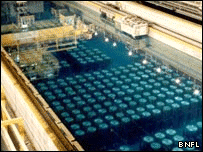 An accident or terrorist attack resulting in a rapid loss of cooling water from a pool could lead to a self-sustaining fire and release of a massive quantity of highly radioactive Cesium-137 into the environment.
NRC Report States That Storing Spent Nuclear Fuel In Wet Pools Is ‘Adequate’ To Protect Public http://www.ucsusa.org/news/media_alerts/nrc-report-adequate-not-enough-0380.html
Transferring It to Dry Casks Would Be Significantly Safer, Science Group Says Continue reading
Corrosion at Hamaoka nuclear power station

 Corrosion confirmed at Japan nuke plant — Seawater flowed into reactor pressure vessel — Years before prospects will be known http://enenews.com/corrosion-confirmed-at-japan-nuke-plant-seawater-flowed-into-reactor-years-before-prospects-for-reactor-will-be-known
July 26th, 2012 By ENENews In a fresh development adding to local worries, Chubu
Electric Power Co. said Wednesday that many parts of reactor 5 at its Hamaoka nuclear power station in Shizuoka Prefecture have been confirmed corroded. Continue reading
NHK: International nuclear experts turning attention to Onagawa nuke plant — Intensity of 3/11 quake exceeded maximum limit (VIDEO) http://enenews.com/nhk-nuclear-experts-turning-attention-to-onagawa-nuclear-plant-intensity-of-311-quake-exceeded-maximum-limit-video July 26th, 2012
By ENENews Title: IAEA to assess quake resistance at Onagawa plant Source: NHK World
Data at some nuclear plants in northern and eastern Japan show that the intensity of the quake exceeded the maximum level assumed by the plants’ designers.
Officials from the IAEA and foreign experts will visit the Onagawa nuclear plant in Miyagi Prefecture on Monday for an on-site assessment.
Japan’s Nuclear and Industrial Safety Agency says the team will enter the plant’s No.1 through No.3 reactors to examine piping and the cooling system. They will also check the condition of the nuclear fuel pools.
But this is the first time since last year’s disaster that it will assess quake resistance at a nuclear plant in Japan.
Nuclear Regulatory Commission to refuse licensing for Calvert Cliffs nuclear reactor
Experts: NRC Licensing Board Expected Friday To Strike Down Calvert
Cliffs Nuclear Reactor Project, Market Watch, WASHINGTON, July 26, 2012 — End to Former “Flagships” of Sputtering U.S. “Nuclear Renaissance”: Foreign Ownership Rules to Block Licensing of Calvert Cliffs 3 in MD, Nine Mile Point 3 in NY, and South Texas Project. Continue reading
Suspicious geological faults http://www.japantimes.co.jp/text/ed20120727a1.html 27 July 12, The trade and industry ministry’s Nuclear and Industrial Safety Agency (NISA) on July 18 ordered Kansai Electric Power Co. (Kepco) and Hokuriku Electric Power Co. to carry out geological surveys, including boring, at the Oi nuclear power plant in Fukui Prefecture and the
Shika nuclear power plant in Ishikawa Prefecture, respectively.
This is because of suspicions having been raised that fault crushing belts running through the Oi plant site and a fault running through the Shika plant site are active faults. Continue reading
Radiation exposure to over 40 Indian nuclear power plant workers
The first accident occurred on June 23 when 38 people were exposed during maintenance work on a coolant channel at the Rajasthan Atomic Power Station in Rawatbhata, senior plant manager Vinod Kumar told AFP.
Two of them received radiation doses equivalent to the annual permissible limit, he said, but all those involved have returned to work.
In a second incident last Thursday, another four maintenance workers at the plant were exposed to tritium radiation while they were repairing a faulty seal on a pipe.
India is on a nuclear power drive, with a host of plants based on Russian, Japanese, American and French technology under consideration or construction. … environmental watchdogs have expressed concerns about safety in India, where small-scale industrial accidents due to negligence or poor maintenance are commonplace and regulatory bodies are often under-staffed and under-funded…..
In May 2011, four labourers were exposed to low levels of radiation at the Kakrapur Atomic Power Station in eastern Gujarat state.
In November 2009, workers at a nuclear plant in southern Karnataka state fell ill after radioactive water contaminated their drinking water. … http://economictimes.indiatimes.com/news/politics/nation/40-india-nuclear-plant-workers-contaminated-firm/articleshow/15119386.cms
A worker set fire to a nuclear submarine
A Guy Started A Fire On A Nuclear Submarine To Leave Work Early http://www.gizmodo.com.au/2012/07/a-guy-started-a-fire-on-a-nuclear-submarine-to-leave-work-early/ CASEY CHAN 23 July 12, Here’s a friendly reminder for everyone who wants to leave work early: don’t ever set fire to your workplace. Especially if you work on a million nuclear submarine. Continue reading
Japan not able to find truly independent nuclear power regulators
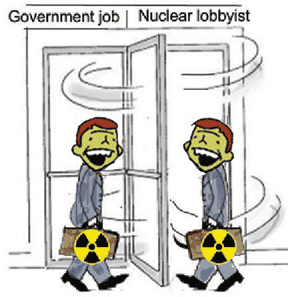 Japan Struggles to Find New Nuclear Regulators WSJ, By MARI IWATA TOKYO July 24, 2012,—Racing against a legislative deadline, the Japanese government
is trying to find regulators who understand nuclear technology—but aren’t close to the nuclear industry.
Cronyism has been widely blamed for contributing to the meltdowns at the Fukushima Daiichi nuclear plant operated by Tokyo Electric Power Co. following the huge earthquake and tsunami that struck northeastern Japan in March 2011. In a scathing investigation commissioned by parliament, a panel concluded: “The Tepco Fukushima nuclear-power-plant accident was the result of collusion between the government, the regulators and Tepco.” Continue reading
4 exposed to radiation at Rajasthan n-plant Express news service : Jaipur, Jul 24 2012 In the second such incident in a month, four workers at Rawatbhata Atomic Power Station in Rajasthan were exposed to harmful doses of leaked tritium radiationon July 19. Two persons were exposed to similar radiation on June 29.http://www.indianexpress.com/news/4-exposed-to-radiation-at-rajasthan-nplant/978569/
1 This Month




PLEASE OPPOSE HR 8255 AND S.3639 – bills would accelerate satellite deployment, with no environmental review or safeguards – https://ncstd5li.quorum.us/campaign/169331/
To see nuclear-related stories in greater depth and intensity – go to https://nuclearinformation.wordpress.com
-
Archives
- September 2026 (339)
- August 2026 (330)
- July 2026 (355)
- June 2026 (287)
- May 2026 (306)
- April 2026 (356)
- March 2026 (251)
- February 2026 (267)
- January 2026 (308)
- December 2025 (358)
- November 2025 (359)
- October 2025 (375)
-
Categories
- 1
- 1 NUCLEAR ISSUES
- business and costs
- climate change
- culture and arts
- ENERGY
- environment
- health
- history
- indigenous issues
- Legal
- marketing of nuclear
- media
- opposition to nuclear
- PERSONAL STORIES
- politics
- politics international
- Religion and ethics
- safety
- secrets,lies and civil liberties
- spinbuster
- technology
- Uranium
- wastes
- weapons and war
- Women
- 2 WORLD
- ACTION
- AFRICA
- Atrocities
- AUSTRALIA
- Christina's notes
- Christina's themes
- culture and arts
- Events
- Fuk 2022
- Fuk 2023
- Fukushima 2017
- Fukushima 2018
- fukushima 2019
- Fukushima 2020
- Fukushima 2021
- general
- global warming
- Humour (God we need it)
- Nuclear
- RARE EARTHS
- Reference
- resources – print
- Resources -audiovicual
- Weekly Newsletter
- World
- World Nuclear
- YouTube
-
RSS
Entries RSS
Comments RSS

