Nuclear industry stymied by NRC freezing licensing decisions
The NRC will be forced to analyze the potential for fires and leaks at wet spent fuel pools to comply with NEPA and to establish a timeline for how long the waste must be stored on site,
 NUCLEAR WASTE: Industry, activists gird for fallout from waste debate Hannah Northey, E&E NewsGreenwire: August 10, 2012 The nuclear industry tried to quell anxiety yesterday about the government’s decision to freeze licensing decisions while tackling the country’s nuclear waste woes, but environmentalists and some experts say change is afoot for the nuclear fleet because of an underlying court case.
At issue is the Nuclear Regulatory Commission’s decision this week to delay final license approvals and extensions until it answers a federal appeals court’s ruling that found the commission’s “waste confidence” rule violated the National Environmental Policy Act.
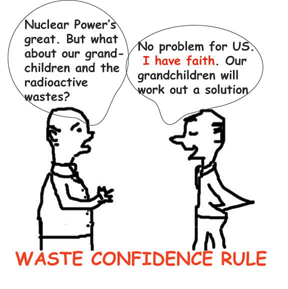
The rule, the court said, didn’t fully consider the potential for fires and leaks at spent fuel pools and had inappropriately assumed Congress would find a final repository “when necessary.” The court vacated both the waste confidence decision and a separate storage rule (Greenwire, June 8)….. Continue reading
Potentially very dangerous radiation situation at Louisiana sinkhole
Sinkhole: H-Bomb explosion equivalent in Bayou Corne possible Examiner.com
BAYOU CORNE SINKHOLE DISASTER AUGUST 12, 2012 BY: DEBORAH DUPRE Louisiana State of Emergency: Oil and gas sinkhole disaster area risks and rights violations escalating
A possible breach of a butane-filled well 1500 feet from Bayou Corne’s sinkhole, the size of three football fields, is so “very serious,” it has Assumption Parish sheriff and local residents ordered to evacuate worried about a catastrophic explosion, one according to scientists in an Examinerinvestigation, would be in the range of one and a half B83 thermonuclear (hydrogen) bombs, the most powerful United States weapons in active service.
“The disaster is made all the more worrisome because the hole is believed to be close to a well containing 1.5 million barrels of liquid butane, a highly volatile liquid that turns into a highly flammable vapor upon release,” CNNreported Friday about the declared State of Emergency…….
Since Saturday, disaster workers are required to wear respirators, although the public within the disaster area is not.
Government cover up continues angering residents and elected leaders“You can give us a straight answer because that’s all we want,” a woman said at the community meeting Tuesday. “We want to know when we can come home and be safe. Because you all go home after a days work. You’re safe, but we’re not,” she said, expressing sentiments of other locals with whom Dupré has spoken….. http://www.examiner.com/article/sinkhole-h-bomb-explosion-equivalent-bayou-corne-possible?CID=examiner_alerts_article
Palisades nuclear power plant shut down due to another leak
New water leak forces Palisades nuclear power plant to shut down again Michigan Radio 12 Aug 12 By LINDSEY SMITH The leak is somewhere in the containment building, the circular shaped one on the left. That’s where the nuclear reactor is housed. The Palisades Nuclear Power Plant near South Haven is shut down again. This is the second time this summer Entergy Corporation has had to shut down the plant for repairs. Continue reading
Mururoa Atomic Bomb test site in danger of collapsing
French Nuclear Test Site Mururoa Atoll in Danger of Collapse Report kept secret for 2 years By Raiatea Tahana-Reese Epoch Times , 10 Aug 12, The French government, since 2010, has kept secret that Mururoa Atoll, the site of French nuclear testing in the Pacific, is in danger of collapsing, according to Mururoa e Tatou (MET), the Nuclear Association in French Polynesia.
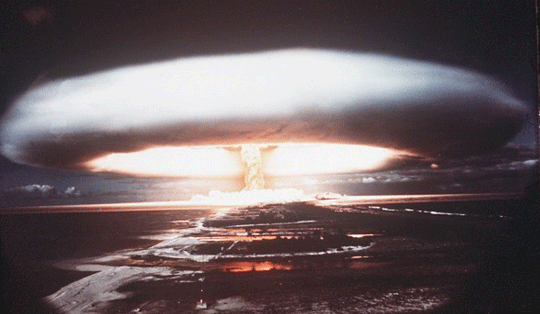
MET President Roland Oldham told ABC’s Radio Australia Pacific Beat program that the issue was detailed in a leaked report from the French Ministry of Defence and should have been made public long ago.
Mr Oldham said if the atoll were to collapse, radioactive material would be released into the Pacific Ocean, and could cause a 15-metre tsunami. “Just in that little area, there is over maybe 12 underground tests in that area, and we have to remember that France have done
altogether 193 nuclear test explosions in Mururoa,” he told Pacific Beat.
“In the soil of Mururoa, if something happens there are about 150 holes containing very dangerous radioactivity.” Continue reading
Belgium’s nuclear reactors – serious safety problems
 Installing a replacement meanwhile has never been attempted anywhere because of the problem of high radiation levels.
The agency is also mulling the permanent closure “in the worst case” of a second reactor in the country’s south near Liege. The tests showed “faults in the steel base material” on which the reactor vessel is mounted

 Belgian nuclear chief ‘sceptical’ reactor can be restarted http://www.google.com/hostednews/afp/article/ALeqM5giMgDamP-y9XYqUMpuO7Y0Bxd5kQ?docId=CNG.31919a592d9f6a151c693e0dac609bdf.111 11 Aug 12, BRUSSELS — The head of Belgium’s federal agency for nuclear safety AFCN said on Friday he was “sceptical” that an ageing reactor closed over fears of cracks could be restarted. Continue reading
Nuclear weapons lab security – like a fish, it rots from the head down
Where’s the Oversight at Nuclear Labs? Hands-Off Approach Is Recipe for Disaster HUFFINGTON POST, Project on Government Oversight (POGO) 08/10/2012 By Peter Stockton and Lydia Dennett As the saying goes, “The fish rots from the head down.” This is certainly the case at the Y-12 National Security Complex in Oak Ridge, Tenn., where an 82-year-old nun and two accomplices recently broke in, raising serious questions about the Department of Energy’s (DOE) security strategy.
Energy Secretary Steven Chu said in a statement provided to the Knoxville News Sentinel on Monday: “The department has no tolerance for security breaches at any of our sites, and I am committed to ensure that those responsible will be held accountable.” But there is no denying that Y-12 was a giant failure of federal oversight. Now the people being axed are lower-level employees rather than those who have allowed the security standards to fall far below acceptable levels, such as Secretary Chu, himself. Continue reading
Australia’s inadequate nuclear safety agencies
Inadequate Safety Practices at Lucas Heights and Inadequate Regulation by ARPANSA, Friends of the Earth 10 Aug 12 Since 2007, a saga has been unfolding regarding contamination accidents at the Australian Nuclear Science and Technology Organisation (ANSTO), ANSTO’s handling of those incidents, ANSTO’s treatment of whistleblowers, the handling of the matter by the Australian Radiation Protection and Nuclear Safety Agency (ARPANSA), and the independence or otherwise of ARPANSA.
The saga has exposed inadequate safety practices at ANSTO and an inadequate performance by the regulator ARPANSA. The problems would not have been exposed and partially rectified if not for a number of ANSTO whistleblowers.
A few snapshots of this saga are noted below and more details can be found on the Friends of the Earth website: Continue reading
How Nuclear Regulatory Commissioners undermined nuclear safety
 Congressman releases blockbuster report detailing NRC conspiracy in wake of Fukushima http://enenews.com/just-in-congressman-releases-blockbuster-report-detailing-nrc-conspiracy-in-wake-of-fukushima December 10th, 2011
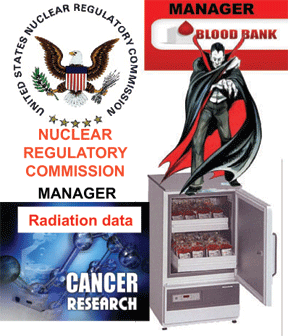
“Regulatory Meltdown” Reveals Efforts to Improve Nuclear Safety Undermined by Four NRC Commissioners New Report Details Conspiracy to Delay, Weaken US Nuclear Safety in Wake of Fukushima, Congressman Edward Markey, Dec. 9, 2011 (Emphasis Added):
WASHINGTON, D.C. – As part of his ongoing investigation into U.S. nuclear safety since the Fukushima meltdowns, today Rep. Edward J. Markey (D-Mass.), Congress’s leading voice for nuclear safety, released a blockbuster new report that details how four Commissioners at the Nuclear Regulatory Commission (NRC) colluded to prevent and then delay the work of the NRC Near-Term Task Force on Fukushima, the entity tasked with making recommendations for improvement to NRC regulations and processes after the Fukushima meltdowns, the worst nuclear disaster in history. The Near-Term Task Force members comprise more than 135 years of collective experience at the NRC, and with full access to expert NRC staff completed a methodical and comprehensive review of NRC’s regulatory system. Continue reading
82 year old anti nuclear nun shows up security danger at nuclear weapons site
 “these anti-Christ nongovernmental terrorists, Christian militias up in Michigan that are getting ready for Armageddon, to kill for Jesus, or the Nazi party or the Taliban, might just as easily have gotten to where we got, with evil intention.”
Security Questions Are Raised by Break-In at a Nuclear Site, NYT, By MATTHEW L. WALD and WILLIAM J. BROAD August 7, 2012 WASHINGTON — An 82-year-old nun and two fellow pacifists who penetrated the defenses of one of the nation’s most important nuclear weapons facilities last week are due in federal court in Knoxville, Tenn., on Thursday to face charges of trespassing and spray-painting antiwar slogans on a building that houses nuclear bomb fuel. But the incident has also put the Department of Energy’s security system on trial.
The security breach, at Oak Ridge in Tennessee, has prompted the Department of Energy to reappraise security measures across its nuclear weapons program and private experts to criticize the agency’s safeguarding of nuclear stockpiles.
The activists, who got past fences and security sensors before dawn on July 28, apparently spent several hours in the Y-12 National Security Complex before they were stopped — by a lone guard, they told friends — as they used a Bible and candles in a Christian peace ritual. In a telephone interview, Sister Megan Gillespie Rice, of Las Vegas, said she was not sure exactly how long they were there. “It was dark; we couldn’t see our watches,” she said. Continue reading
Seoul restarts aged nuclear reactor despite safety concerns
Korea Times, 7 Aug 12 The government decided Monday to restart an aged nuclear reactor that recently underwent months-long scrutiny over its safety, amid looming signs of a power shortage due to a record heat wave.
Operation of the Reactor-1 at Gori Nuclear Power Plant in Busan was
resumed earlier in the day with the reactor expected to reach its full
generation capacity on Friday, according to the Ministry of Knowledge
Economy….. The 578-megawatt reactor, located some 450 kilometers
southeast of Seoul, was manually shut down on March 12 after the Hydro
& Nuclear Power Co. belatedly reported a major safety breach during a
regular maintenance check the previous month, when the reactor, along
with its backup generator, temporarily lost power….. the reactor had
remained shut down amid widespread public concerns over safety of the
reactor whose initial 30-year lifespan ran out but was extended by 10
years in 2008….
http://www.koreatimes.co.kr/www/news/biz/2012/08/123_116740.html
Heat danger, even when nuclear reactors are shut down
For Nuclear Power This Summer, It’s Too Darn Hot, Truth Out, 05 August 2012 By Gregg Levine, ”……when it comes to nuclear power, as global temperatures continue to rise and water levels in rivers and lakes continue to drop, an even more disconcerting threat emerges.
When a coal plant is forced to shut down because of a lack of cool intake water, it can, in short order, basically get turned off. With no coal burning, the cooling needs of the facility quickly downgrade to zero.
A nuclear reactor, however, is never really “off.”
When a boiling water reactor or pressurized water reactor (BWR and PWR respectively, the two types that make up the total of the US commercial reactor fleet) is “shutdown” (be it in an orderly fashion or an abrupt “scram”), control rods are inserted amongst the fuel rods inside the reactor. The control rods absorb free neutrons, decreasing the number of heavy atoms getting hit and split in the fuel rods. It is that split, that fission, that provides the energy that heats the water in the reactor and produces the steam that drives the electricity-generating turbines. Generally, the more collisions, the more heat generated. An increase in heat means more steam to spin a turbine; fewer reactions means less heat, less steam and less electrical output. But it doesn’t mean no heat.
The water that drives the turbines also cools the fuel rods. It needs to circulate and somehow get cooled down when it is away from the reactor core. Even with control rods inserted, there are still reactions generating heat, and that heat needs to be extracted from the reactor or all kinds of trouble ensues–from too-high pressure breaching containment to melting the cladding on fuel rods, fires, and hydrogen explosions. This is why the term LOCA–a loss of coolant accident–is a scary one to nuclear watchdogs (and, theoretically, to nuclear regulators, too).
So, even when they are not producing electricity, nuclear reactors still need cooling. They still need a power source to make that cooling happen, and they still need a coolant, which, all across the United States and most of the rest of the world, means water. http://truth-out.org/news/item/10707-for-nuclear-power-this-summer-its-too-darn-hot
Radioactive water leaked from Vermont nuclear plant
Vermont Yankee employees allow water to drain from spent fuel pool http://www.commonsnews.org/site/site05/story.php?articleno=5817&page=1 The Commons August 1, 2012 By Anne Galloway/vtdigger.org VERNON—About 2,700 gallons of water from the spent fuel pool at Vermont Yankee Nuclear Power Plant drained into a wastewater system on July 22.
The 300,000 gallon pool contains 2,500 spent fuel assemblies removed from the reactor core. The spent fuel assemblies are submerged below more than 20 feet of water.
The water drained about six inches over the course of about 30 minutes when employees who were working on the fuel pool cleanup system left drain valves open. Operators in the control room discovered the problem after an alarm system went off, according to Rob Williams, spokesman for the plant.
The radioactive water drained into a wastewater collection tank….
Arnie Gundersen, a nuclear engineer and former member of a Vermont Yankee oversight panel, said several steps in a procedure were skipped by employees. He is concerned about oversight and employee training at the plant as older workers retire. Procedures, he said, must be much more specific.
“It’s a big deal, it’s a safety-related system, we’re not talking about mowing the lawn at VY,” Gundersen said. “There’s 300,000 gallons in the pool, and it lost 1 percent of the water in 30 minutes. It is radioactive water, it’s not like what you put in a water cooler.”
Serious security breach at Oak Ridge nuclear weapons plant
the activists had passed through four fences and walked for “over two hours” before reaching the uranium storage building, on which they hung banners and strung crime-scene tape.
“It is unbelievable this could happen,” Stockton said. “The significance is outrageous. If they were terrorists, they could have blown open the door and got inside.” Stockton said the security breach was the “worst we’ve ever seen.”
Oak Ridge uranium plant shut after protesters breach 4 fences, reach building By Mark Hosenball, Reuters NBCNews US, 2 Aug 12, The U.S. government’s only facility for handling, processing and storing weapons-grade uranium has been temporarily shut after anti-nuclear activists, including an 82-year-old nun, breached security fences, government officials said on Thursday. Continue reading
Concern growing about poor safety of South Korea’s nuclear reactors
 Nuclear reactor shut down for safety reasons, Aug.1,2012 Incident at Younggwang plant the latest in a long string of nuclear troubles, The Hanyoreh, By Noh Hyung-woong, staff reporter Reactor 6 at Younggwang Nuclear Power Plant in South Jeolla province was shut down again on July 30 due to a malfunctioning reactor rod….
The repeated problems with Younggwang reactor 6 have residents in the area nervous. Reactor 6 first broke down during a 2002 trial run. Since then, it has gone out of action 9 times in past 10 years.
Among those cases, some were trivial, due to lightning strikes and a mistake on operation. But in Dec. 2008, the reactor was stopped because warning signals appeared, indicating the reactor rod was in the wrong position.
Yang-yi Won-young director of Common Action for Nuke Free Society said, “The reactor rod is the last line of defense against a serious accident. It was fortunate that the reactor was shut down in time. If it hadn‘t been, it would have created a terrible disaster.”
Some brought up the problem of Korean-style pressurized light water reactors, citing their frequent breakdowns. “The reactors that recently broke down, including reactor 6 at the Younggwang plant, are localized as Korean style,” said Professor Suh Kune-yull at the
Nuclear Engineering Dept. of Seoul National University. “It seems that their electronic circuits and other components fail frequently.”…..
more and more people raised the questions of the safety of nuclear power plants. In particular, the Younggwang accident happened while MKE has been moving to restart Kori Nuclear reactor No.1…… http://english.hani.co.kr/arti/english_edition/e_business/545178.html
Oi reactors will be idled if fault under them is active, new nuclear safety chief warns, Japan Times, 1 Aug 12, Kyodo The man nominated to head the new atomic regulatory authority said Wednesday he expects the two reactors at the Oi nuclear plant in Fukui Prefecture to halt operations should there be any active fault found underneath them. Continue reading
1 This Month




PLEASE OPPOSE HR 8255 AND S.3639 – bills would accelerate satellite deployment, with no environmental review or safeguards – https://ncstd5li.quorum.us/campaign/169331/
To see nuclear-related stories in greater depth and intensity – go to https://nuclearinformation.wordpress.com
-
Archives
- September 2026 (339)
- August 2026 (330)
- July 2026 (355)
- June 2026 (287)
- May 2026 (306)
- April 2026 (356)
- March 2026 (251)
- February 2026 (267)
- January 2026 (308)
- December 2025 (358)
- November 2025 (359)
- October 2025 (375)
-
Categories
- 1
- 1 NUCLEAR ISSUES
- business and costs
- climate change
- culture and arts
- ENERGY
- environment
- health
- history
- indigenous issues
- Legal
- marketing of nuclear
- media
- opposition to nuclear
- PERSONAL STORIES
- politics
- politics international
- Religion and ethics
- safety
- secrets,lies and civil liberties
- spinbuster
- technology
- Uranium
- wastes
- weapons and war
- Women
- 2 WORLD
- ACTION
- AFRICA
- Atrocities
- AUSTRALIA
- Christina's notes
- Christina's themes
- culture and arts
- Events
- Fuk 2022
- Fuk 2023
- Fukushima 2017
- Fukushima 2018
- fukushima 2019
- Fukushima 2020
- Fukushima 2021
- general
- global warming
- Humour (God we need it)
- Nuclear
- RARE EARTHS
- Reference
- resources – print
- Resources -audiovicual
- Weekly Newsletter
- World
- World Nuclear
- YouTube
-
RSS
Entries RSS
Comments RSS

