EDF wants to weaken safety standard at Dungeness nuclear atation

 Nuclear power plant dismisses safety concerns Folkestone Herald, By Antony Thrower June 04, 2014
DUNGENESS power station has dismissed claims in the media this morning which claimed a reactor at the site would have breached the agreed safety margin “within months” and could have to “shut down”.
The BBC reported graphite bricks at the core of the advanced gas-cooled reactors were cracking and starting to lose weight due to decades of radiation, which could affect safety.
It suggested the current graphite weight loss limit for Dungeness is set at 6.2% but the regulator says when it reached 5.7% its operator, French power giant EDF, applied to raise it to 8%…….http://www.folkestoneherald.co.uk/Nuclear-power-plant-dismisses-safety-concerns/story-21186452-detail/story.html
Canada’s nuclear regulator allows Pickering nuclear reactors to operate past their design limit

 Pickering nuclear reactors can exceed design operating limit Canada’s nuclear regulator will allow reactors at the Pickering nuclear station to operate past their design limit. The Star, By: John Spears Business reporter, Published on Tue Jun 03 2014 Canada’s nuclear regulator says reactors at the Pickering power station will be allowed to operate beyond their stated design limit.
But the Canadian Nuclear Safety Commission has ordered Ontario Power Generation to present further detailed information about the station at a meeting in August.
One of the six active reactors at Pickering would have had to shut down later this month had the commission not made its decision, released Tuesday. Others are also nearing their limit.
The pressure tubes in the reactors – which hold the uranium fuel – have a design life of operating for 210,000 “equivalent full power hours.” OPG is not allowed to operate them past that limit.
OPG has asked the nuclear safety commission to extend the operating limit to 247,000 hours. The company wants to extend Pickering’s life to about 2020, but wants to do so without performing the expensive and lengthy task of replacing all the pressure tubes in the reactors……….
Environmental groups that had appeared before the commission had argued that the limit shouldn’t be exceeded because OPG’s emergency plans for a serious nuclear accident and a wide-spread release of radiation are inadequate.
“The fact they’re asking OPG to do this additional work for August is pretty significant,” said Theresa McCleneghan of the Canadian Environmental Law Association…….
Shawn-Patrick Stensil of Greenpeace said it’s “irresponsible” to still be running the Pickering plant.
People living near the plant don’t know enough about emergency plans in the event of an accident, he said.
He said the commission’s decision to extend the hours of operation is “kicking the can down the road.”
The province doesn’t need the output of the reactor that was about to hit the 210,000-hour limit Stensil said.
In fact, he noted that even with the warm weather on Tuesday, Ontario was exporting 2,000 megawatts of power – or the equivalent of about four Pickering reactors.
“We could be reducing risk much more tangibly just by shutting down reactors that we don’t need,” he said. http://www.thestar.com/business/economy/2014/06/03/pickering_nuclear_reactors_can_exceed_design_operating_limit.html
Another pesky NRC Chair who puts public safety above nuclear industry profits!
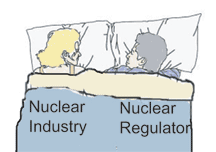 NRC rejects effort to move radwaste from pools; Macfarlane issues strong dissent Michael Mariotte, Green World, 30 May 14, The Nuclear Regulatory Commission has again sided with the nuclear power industry (where have you heard that one before?) and rejected efforts by environmental/clean energy groups and five U.S. Senators to move high-level radioactive waste out of overcrowded, dangerous and poorly-protected fuel pools as soon as it is cool enough to be placed in dry casks.
Not only did the NRC Commissioners take this unconscionable vote, they said this was their last word on the subject and they would refuse to ever again consider the issue.
 But the vote wasn’t unanimous: NRC Chair Allison Macfarlane, who has spent her career studying radioactive waste issues, issued a strong dissent to the decision, essentially arguing that the NRC staff hasn’t done its homework.
Which brings up an interesting subject we’ll talk about more below: what if the four Commissioners who voted for the industry on the waste issue–and nearly always vote for the industry–had been unsuccessful in their efforts in 2012 to oust then-chair Greg Jaczko, who almost certainly would have taken the same position as Macfarlane? We might then be looking at a Commission that could in a few months have had both Jaczko and Macfarlane as members, and perhaps at least one more Commissioner independent of the agency. That would be a very different situation than the industry-dominated and sympathetic Commission that has far too long run the NRC……….
In her dissent, Macfarlane castigated the staff for essentially shoddy research: “In my view, the staff has not adequately explored the issue of spent fuel management in the pool and as a result, I do not have adequate information on which to base a view on the need to require approaches that may lead to some form of expedited transfer of spent fuel from pools to dry casks.”
Macfarlane said she did not necessarily support a program to move the radioactive fuel to dry casks within five years, but primarily because the technical capacity to do so may not exist. And she complained that was the only option presented by the staff to the Commission:…….
In her nine-page dissent, the NRC chair also complained about the NRC staff’s failure unwillingness to fully engage the public in the agency’s radioactive waste discussions, writing, “I do not agree with the staff’s approach in engaging the public near the very end of the
current two-year regulatory review process, without the ability to fully provide input on key regulatory factors or review the draft regulatory analysis that was provided to the Commission. In accelerating this Tier 3 activity to align with the Waste Confidence environmental activities for public transparency, the staff may have ironically impeded the same public from fully vetting this issue in the safety and security arenas.”
Macfarlane concluded citing the precautionary principle:……….http://safeenergy.org/2014/05/29/nrc-rejects-effort-to-move-radwaste-from-pools/
Japan about to extract the teeth from its Nuclear safety Watchdog?
 The government should not be allowed to make the nuclear watchdog toothless by nominating experts who are convenient to it and the industry.
EDITORIAL: Nuclear watchdog must not be made toothless –The Asahi Shimbun, May 29 Prime Minister Shinzo Abe has a habit of trying to promote policy changes through political appointments. His administration seems to have employed this political ploy to achieve its goals in the area of nuclear safety inspections.
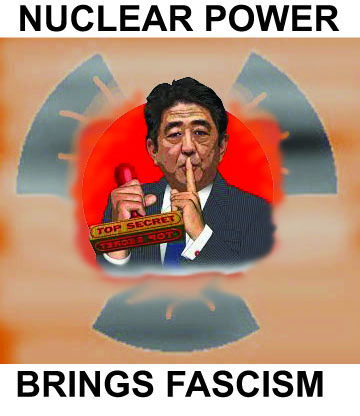
This is the only possible way to put proposed replacements for two outgoing commissioners of the Nuclear Regulation Authority (NRA) into perspective. Continue reading
What are those nasty smells from Hanford’s nuclear waste tanks?
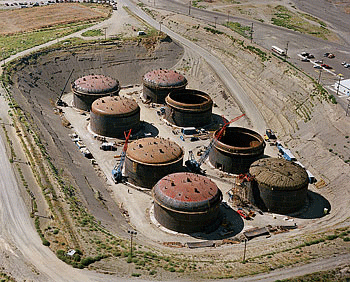 6 Hanford Nuclear Reservation workers report smelling chemical vapors in tank farms http://www.foxnews.com/us/2014/05/29/6-hanford-nuclear-reservation-workers-report-smelling-chemical-vapors-in-tank/ RICHLAND, Wash. – Six workers at the Hanford Nuclear Reservation are receiving medical evaluations after they reported smelling chemical vapors at two underground storage tank farms.
Washington River Protection Solutions, which operates the underground tanks at Hanford, says five of the workers reported symptoms typically related to chemical vapor exposure.
The employees were working in or near Hanford’s AP and SY Tank Farms when the vapors were reported. All workers immediately exited the area and moved upwind.
Hanford officials are taking samples and checking for possible sources of the vapors.
There have been numerous incidents in recent months when Hanford workers have reported smelling chemical vapors while working in the tank farms.
The tanks contain radioactive wastes left over from the production of plutonium for nuclear weapons.
Pro nuclear expert replaces safety conscious seismic expert on Japan’s Nuclear Safety Agency
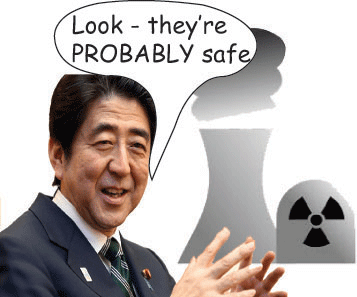 Pro-nuclear expert replacing NRA commissioner who raised flag on quake risk THE ASAHI SHIMBUN 29 May 14, http://ajw.asahi.com/article/behind_news/politics/AJ201405280023 Replacements for two outgoing commissioners of the Nuclear Regulation Authority suggest the Abe administration will find it easier to gain approval for restarts of the nation’s nuclear reactors.Few people in government circles and the nuclear industry will be sorry to see Kunihiko Shimazaki go. His successor is expected to more quickly give the green light to reactivate nuclear power plants.
Shimazaki, who is 68 and a professor of seismology, proved to be a thorn in the side of electric power companies with his calls for a reassessment of the force with which seismic waves and tsunami could pummel nuclear plants being considered for restarts. Kenzo Oshima, 71, a former undersecretary-general at the United Nations, is also stepping down. Both men are leaving because their terms expire in September.
Nuclear Regulatory Commission to end plan to accelerate removal of spent fuel rods
 Nuclear Power Regulator Sticks Its Head Further into the Ground http://blog.ucsusa.org/spent-fuel-decision-nrc-550 Union of Concerned Scientists, David Wright, physicist & co-director, Global Security May 28, 2014 An ostrich is a clichéd symbol of people making bird-brained
decisions that ignore reality. But it’s hard to think of something more apt for the Nuclear Regulatory Commission (NRC) sometimes.
 Take its most recent decision: The commissioners voted 4 to 1 to end consideration of a plan to accelerate the transfer of the growing stocks of nuclear waste at U.S. nuclear plants from spent fuel pools to safer dry casks. (The lone vote for safety was cast by the NRC Chair—Allison Macfarlane.) Moreover, the Commission said it didn’t want to think about it anymore, ordering that “no further generic assessments be pursued related to possible regulatory actions to require the expedited transfer of spent fuel to dry cask storage.”
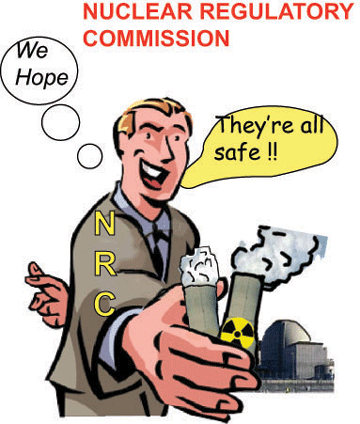
That anti-science position is difficult to fathom. Given the potential consequences of an accident or terrorist attack on a spent fuel pool, you would hope the body responsible for ensuring public safety would want to know all it could, and use that information to reduce nuclear risks.
Risks from Spent Fuel Pools
After all, most spent fuel pools at reactors at U.S. plants contain much more nuclear material than the reactor core itself—in many cases more than 5 times as much. And as I noted in an earlier post, even the NRC believes that poses a huge risk. A recent study by NRC staff considered an accident scenario at the Peach Bottom nuclear plant in Pennsylvania that resulted in a fire of the spent fuel rods and the release of radioactivity that, on average, would lead to more than 17,000 cancer deaths, 9,400 square miles of evacuated territory—an area the size of New Hampshire—and more than 4 million people displaced long-term.
So everyone agrees the consequences of such an accident are potentially huge. And in such a case, transferring spent fuel out of the pools and putting it in dry casks would make an astounding difference.
In particular, the same NRC staff study compared the consequences of an unmitigated spent fuel fire in the Peach Bottom pool today with the consequences assuming all spent fuel that had been in the pool longer than 5 years had been moved to dry casks. It found that after the transfer, the number of cancer deaths would be 10 times smaller and the amount of evacuated territory and number of long-term displaced people would both be 50 times smaller.
The NRC’s “Flawed and Incomplete Analysis”
So, what was behind the Commission’s decision?
 It decided that while the consequences of such an event might be horrific, the probability of it happening was so low that it didn’t need to take additional steps to lessen those consequences. You would think it must have pretty convincing evidence of that fact to make such a decision and decree that it was time to stop looking at it further.
You would be wrong.
People—including staffers at the NRC itself—have identified a lot of problems with the analysis that backs up the NRC’s conclusion (see, eg, here and here). My colleague Ed Lyman calls the analysis “flawed and incomplete.” But you don’t need to get into the details of the study to find a glaring omission that undermines its conclusions: The analysis did not include the possibility of a terrorist attack on a spent fuel pool. Even if a nuclear plant is operating perfectly, such an attack could lead to exactly the kind of “loss of coolant” accident described above. And in a 2006 study, the National Academy of Sciences calls out spent fuel pools as something “knowledgeable terrorists might choose to attack.”
So the crucial piece of logic leading to the NRC’s wrong-headed decision is completely unconvincing—certainly not something you should bet the safety of tens of thousands of Americans on.
Ostriches sticking their heads in the ground appeals to our sense of absurdity—the idea that it thinks it can be safe by refusing to look at whatever risk is at hand. That absurdity becomes tragic when the NRC does the same thing, and people’s lives are at stake. About the author: David Wright is a physicist and the co-director of the Global Security Program. He is a nationally known expert on the technical aspects of missile defense systems, missile proliferation, and space weapons. See David’s full bio.
Risk of further explosions at Waste Isolation Pilot Plant (WIPP)
 Nuclear-waste facility on high alert over risk of new explosions, Nature,
US repository scrambles to seal off barrels containing cat-litter buffer thought to be responsible for February accident. Declan Butler 27 May 2014 Time bombs may be ticking at the United States’ only deep geological repository for nuclear waste. US authorities concluded last week that at least 368 drums of waste at the site could be susceptible to the chemical reaction suspected to have caused a drum to rupture there in February. That accident caused radioactive material to spill into the repository and leak into the environment above ground.
The Waste Isolation Pilot Plant (WIPP) near Carlsbad, New Mexico, is mined out of a salt bed 655 metres underground, and stores low- and medium-level military nuclear waste, containing long-lived, man-made radioactive elements such as plutonium and americium. The suspect drums contain nitrates and cellulose, which are thought to have reacted to cause the explosion in February, and are located in two of the repository’s eight vast storage rooms — 313 in panel 6, which has already been filled, and 55 in the partly filled panel 7, where the February accident occurred.
To mitigate the threat of further exploding drums, the New Mexico Environment Department (NMED) in Santa Fe issued an order on 20 May giving the US Department of Energy (DOE) and the Nuclear Waste Partnership — the contractor that operates the WIPP site — until 30 May to come up with a plan to “expedite” the sealing of panel 6 and part of panel 7. It is not yet clear when the panels will be sealed, as that will depend on how long it takes to ensure that the sealing is done safely, says Jim Winchester, a spokesman for the NMED………
In addition to the drums at the WIPP, another 57 containing the suspect mix are still in temporary storage at the LANL. On 19 May, the NMED told the DOE and the LANL that they had two days to present a plan to secure the drums. In their response on 21 May, the LANL and the DOE said that the drums were being transferred to a tent fitted with fire-control and high-efficiency particulate air filtration to contain any radioactive particles in the event of an accident. They added that air radiation levels and the temperature of the drums were being monitored, and that the drums were being inspected hourly for signs of rupture.
The WIPP has been closed since the February accident and will reopen only “when it is safe to do so”, according to a 22 May statement from the DOE. The accident is still under investigation, and parts of the underground repository are still contaminated with radioactivity. The DOE added that current assumptions and precautions about the hazards of operating the WIPP are being “evaluated and revised”. http://www.nature.com/news/nuclear-waste-facility-on-high-alert-over-risk-of-new-explosions-1.15290
Japan’s nuclear regulator OK’s dodgy government funde plan for ice wall around Fukushima nuke plant
Japan to create underground ice wall at crippled nuclear plant https://au.news.yahoo.com/thewest/world/a/23861341/japan-to-create-underground-ice-wall-at-crippled-nuclear-plant/ Tokyo (AFP) – Japan’s nuclear regulator on Monday approved a plan to freeze the soil under the crippled Fukushima nuclear plant to try to slow the build-up of radioactive water, officials said.
The Nuclear Regulation Authority examined plans by Tokyo Electric Power Co (TEPCO) to construct an underground ice wall at the Fukushima Daiichi nuclear plant starting in June, regulatory officials said.
The wall is intended to block groundwater from nearby hillsides that has been flowing under the plant and mixing with polluted water used to cool reactors that went into meltdown after an earthquake and tsunami in March 2011.
Under the plan, which is funded by the government, the firm will circulate a special refrigerant through pipes in the soil to create the 1.5-kilometre (0.9-mile)frozen wall that will stem the inflow of groundwater.

“We had some concerns, including the possibility that part of the ground could sink,” one official said on condition of anonymity.
“But there were no major objections to the project during the meeting, and we concluded that TEPCO can go ahead with at least part of the project as proposed after going through further necessary procedures.” However, TEPCO may have to review other parts of the project amid fears it might affect existing structures at the plant such as underground drains, he added.
The idea of freezing a section of the ground, which was proposed for Fukushima last year, has previously been used in the construction of tunnels near watercourses.
However, scientists point out that it has not been done on this scale before nor for the proposed length of time.
Coping with the huge — and growing — amount of water at the tsunami-damaged plant is proving to be one of the biggest challenges for TEPCO, as it tries to clean up the mess after the worst nuclear disaster in a generation.
As well as all the water used to keep broken reactors cool, the utility must also deal with the water that makes its way along subterranean watercourses from mountainsides to the sea.
Last week TEPCO began a bypass system that diverts groundwater into the sea to try to reduce the volume of contaminated water.
Full decommissioning of the plant at Fukushima is expected to take several decades. An area around the plant remains out of bounds and experts warn that some settlements may have to be abandoned because of high levels of radiation.
Legal ruling in Japan throws doubt on ANY nuclear reactor restarts
Reflect on Fukui nuclear ruling, Japan Times 23 May 14 The Fukui District Court’s ruling this week that it will not allow the restart of two nuclear power reactors run by Kansai Electric Power Co. challenges the Abe administration’s energy policy of keeping nuclear power as a key source of the nation’s electricity supply despite the safety risks that materialized in the wake of the Fukushima nuclear power plant disaster in March 2011.
The court’s Wednesday ruling was on a lawsuit filed by a group of 189 people from Tokyo, Fukui and other prefectures against the 2012 restart of two of the reactors at
Kepco’s Oi Nuclear Power Plant in Oi, Fukui Prefecture.
The two Oi reactors — the first to have been reactivated after all of the nation’s nuclear reactors were shut down following the triple meltdowns at Tokyo Electric Power Co.’s Fukushima No. 1 plant — were taken offline last year for regular maintenance, leaving the nation again without nuclear power.
 The content of the court’s ruling, in effect, questions the plans by power firms and the government to restart more than a dozen nuclear reactors around the country just three years after the disaster in Fukushima, ……
The district court said the Nos. 3 and 4 reactors at the Oi plant have “structural deficiencies” in their safety measures against severe earthquakes, and determined that restarting their operation would violate the fundamental rights to life of plaintiffs who live within 250 km of the plant — the maximum range where the effects of a worst-case nuclear power plant disaster are estimated to spread in simulations based on the Fukushima case……
The ruling dismissed an argument by Kepco in court, noting that it is legally irrelevant to discuss people’s fundamental rights to life on the same level as the question of rising costs of generating electricity.
It went on to say that even if Japan suffers large trade deficits because of the nuclear power plant shutdowns, the real loss of national wealth is when people become unable to live stable lives on their land — an apparent reference to the shattered lives of those residents around the Fukushima plant who were forced to flee their homes. The court also called the radiation fallout from the Fukushima disaster “the worst environmental contamination” in Japan’s history and brushed aside as completely missing the point the argument that the nation needs to have nuclear power as a clean energy that reduces emissions of global warming gases.
One of the key points of the ruling is that operation of the Oi reactors needs to be stopped if there is “even a slightest chance” that the reactors’ ability to keep cooling their cores and contain radioactivity could be lost — as happened in the case of the Fukushima No. 1 plant — if the plant is crippled by severe earthquakes.
The crucial point of the ruling is its contention that it is inherently impossible to determine on scientific grounds that an earthquake more powerful than assumed in the operator’s worst-case scenario would not happen. It noted that since 2005, four nuclear power reactors around the country have experienced quake shocks more powerful than the maximum level anticipated on their sites. It is “groundless optimism” in this quake-prone country that such a temblor would never hit the Oi plant, the ruling stated……..
The Abe administration and the power companies need to stop and reflect on the Fukui court ruling in the context of what the events of the Fukushima disaster. The core meltdowns at Tepco’s Fukushima plant took place after the operator deliberately underestimated tsunami risks and failed to take necessary precautions. When it hit, Tepco sought to excuse its lack of preparedness by characterizing the tsunami as simply beyond the scope of “conventional assumptions.”
What the ruling called the “groundless optimism” about safety of the Oi plant can be a malady common to all nuclear power plants in this country. The “safety myth” in nuclear power was shattered in the Fukushima disaster. Such a myth should not be resurrected. http://www.japantimes.co.jp/opinion/2014/05/23/commentary/reflect-on-fukui-nuclear-ruling/#.U4ENcHJdWik
Finland’s safety warning on new nuclear, as Olkiluoto boondoggle drags on
 Safety watchdog issues warning on Fennovoima nuclear project http://yle.fi/uutiset 23 May 14, Finland’s nuclear safety watchdog, STUK, says that the Fennovoima consortium does not yet have the know-how needed for the design of a safe nuclear power plant. The company responded saying that the comments had been expected. The Radiation and Nuclear Safety Authority (STUK) on Friday submitted its preliminary safety evaluation of the proposed Fennovoima power plant to the Ministry of Employment and the Economy.
STUK says that Fennovoima, which wants to build its first facility at Hanhikivi near the west-coast town of Rauma, must beef up its organisation and leadership system, as well as the security plans for the proposed plant. STUK says there must be design changes to meet Finnish safety standards to cope with potential dangers at the plant site such as an airplane crash, flooding, fire or a serious accident.
STUK Director General Petteri Tiippana says the consortium must concentrate on strengthening these areas in order to be ready for the construction permit phase. He added that the company must present STUK with comprehensive documentation on the proposed facility’s safety that is complete enough to be decided on in one step.
Avoiding Olkiluoto’s setbacks
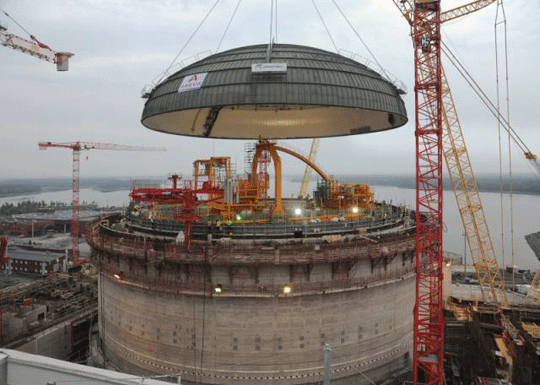
Tiippana says the tougher demands are aimed at preventing the kinds of problems faced by the still-incomplete Olkiluoto 3. That project, by the experienced nuclear utility TVO, is far behind schedule and over budget………..http://yle.fi/uutiset/safety_watchdog_issues_warning_on_fennovoima_nuclear_project/7259738
Britain’s Ministrty of Defence fails in bid to censor report on radioactive contamination
 MoD loses battle to block radioactive waste contamination report, Rob Edwards, Guardian 14 May 14, Report warning contamination of military sites could pose public health risk to be published next week after six-month delay
The report was submitted for publication last October by the 18-memberCommittee on Medical Aspects of Radiation in the Environment (Comare). To the frustration of its authors and the Scottish government, UK ministers have sat on it for the past six months after objections from the MoD.
But after the 75-page report was leaked to the Guardian, a decision was taken in Whitehall on Tuesday to publish it early next week. It will reveal that Comare is concerned about radium contamination from the second world war at Dalgety Bay in Fife and at least 25 other sites across the UK.
The contamination at Dalgety Bay poses “a potential risk to public health”, the report says. It condemns the MoD’s failure to provide a comprehensive list of other potentially contaminated sites as “unacceptable” as it “implies an unknown risk to the general population”.
Because of the “extensive” contamination, parents should be recommended not to allow their children to dig on the beach, the report says. Although it concludes that there is no immediate evidence of increased cancers, it points out that side-effects can take time to appear and recommends a study of cancer rates to be carried out around Dalgety Bay in five or 10 years.
Comare’s report recommends that the Scottish government should ensure that Dalgety Bay is cleaned up as soon as is possible. An evaluation of the best means of remediation should be instituted immediately, “considering efficacy, practicability and cost”, it says.
According to the report, disposal of radium – used to paint aircraft dials so that they could be read in the dark – was “very widespread”. It criticises the MoD for only providing a limited list of sites where this could have happened. Though the only site named in the report is Dalgety Bay, 15 have been previously listed by the MoD.They include the old SAS headquarters at Stirling Lines in Hereford, a former naval air base near Portsmouth and a previous home to the Red Arrows in Gloucestershire. There are also potentially contaminated sites in Hampshire, Bedfordshire, Nottingham, Shropshire, Cumbria, Stirling, Perth and Kinross, Angus, Moray and the Mull of Kintyre.
Comare is demanding authority from the government to force the MoD to draw up a full list of potentially contaminated sites. “The information available for each site should be evaluated and, where deemed necessary, investigation and/or remediation instituted,” it says.
The MoD has been accused of resisting funding an expensive cleanup at Dalgety Bay to avoid setting a precedent for dozens of other sites around the country. “The MoD would rather this report hadn’t existed,” said one insider……….http://www.theguardian.com/environment/2014/may/14/mod-nuclear-waste-contamination-report-dalgety-bay
Chernobyl still a nuclear ticking time bomb
 Chernobyl: Ukraine’s nuclear time bomb still ticking, SMH, May 17, 2014 Jan Villalon Video journalist While the current political tensions in Ukraine continue to threaten stability in the region, an even larger spectre looms in Chernobyl, the site of the world’s worst nuclear accident.
Nearly three decades later, recovery from the disaster continues, with construction currently under way on an immense shield designed to entomb the radioactive remains of the reactor that exploded all those years ago.
At nearly 110 metres high and 275 metres wide, and weighing around 32,000 tonnes, the arch-like New Safe Confinement is one of the most complicated feats of modern engineering that, once complete, will be the largest movable structure ever built. It’s designed to last 100 years – the estimated time to finish clean-up at the site.
But the project is already years behind schedule. Though plans have been in the works to contain the leaky, crumbling reactor since 1992, construction on the New Safe Confinement only began in 2010. Originally slated to be finished 2015, developers have now pushed the date back to 2017.
Half of the arch has been assembled so far, but the future of the $2.2 billion project, funded by the European Bank for Reconstruction and Development, now hangs in the balance. With Ukraine thrown into an economic crisis and Russia at its borders, there are concerns the shelter may not be completed in time – if at all.
“It is unfortunately a situation which can further deteriorate and it’s very difficult, then, to predict what the impacts on our project will be,” said Vince Novak, director of nuclear safety at the EBRD.
“You must not forget that this is a project about nuclear safety,” Novak said in an interview with The Verge. “And its importance transcends borders and transcends political divisions and differences.”
Adi Roche, head of the NGO Chernobyl Children International, recently returned from a trip to study the progress of the shelter’s construction and describes the situation as a “ticking time bomb”.
“Chernobyl is the old Soviet Union’s deadly legacy to Ukraine and the world has very real reason to be extremely concerned about the ongoing threat it poses, especially at a time of great instability and growing hostility between Ukraine and Russia,” she said.
For many Ukrainians, Chernobyl remains a deep wound, a stark reminder of an era during which government policies of secrecy and corruption bred deep mistrust among the public. ………….
Former Soviet leader Mikhail Gorbachev admitted in a 2006 opinion piece that the disaster was a catalyst for the dismantling of the USSR.
“The nuclear meltdown at Chernobyl . . . was perhaps the real cause of the collapse of the Soviet Union five years later. Indeed, the Chernobyl catastrophe was an historic turning point: there was an era before the disaster, and there is the very different era that followed,” he wrote……..
With no warnings of the true dangers of radiation, and no basic safety guidelines in place, firefighters had rushed to the scene at Chernobyl completely unaware they were being exposed to lethal doses of radioactive waste. Many of the first responders, as well as workers sent in to help contain the disaster, suffered severe symptoms of acute radiation poisoning within days.
When calculating the human cost of the Chernobyl disaster, figures vary widely. Two workers were killed in the initial explosion, with a further few dozen more deaths linked to the incident. Many claim thousands more died as a result of the aftermath and clean-up operations.
The wider impact of radiation exposure is difficult to measure, however. Over the years, various reports have pointed to rises in fatal cancers among the population as well as the number of children born with genetic defects linked to radiation. Some estimates put the number of people affected as high as a million across Europe, while more conservative figures hover in the tens of thousands. …..Meanwhile, what remains of reactor four is still at risk. Encased in its shoddy, rusting sarcophagus, Chernobyl’s time bomb is just one spontaneous chain reaction away from another disaster. http://www.smh.com.au/world/chernobyl-ukraines-nuclear-time-bomb-still-ticking-20140517-zrfpn.html#ixzz32C5tLeaw
Accident at US repository highlights need for tougher nuclear safety monitoring
Call for better oversight of nuclear-waste storage Accident at US repository highlights need for tougher safety monitoring, say experts.Nature, Declan Butler 13 May 2014 A serious accident in February at the United States’ only deep-storage repository for nuclear waste might never have happened had the government not disbanded a key independent scientific body charged with oversight of the safety of the facility.
The Waste Isolation Pilot Plant (WIPP), carved out of a salt bed 655 metres below the desert near Carlsbad in New Mexico, is run by the Department of Energy (DOE) and stores low- and medium-level military nuclear waste, containing long-lived, man-made elements such as plutonium and americium. But there are politically controversial plans to store far hotter high-level waste at the site. Nuclear-waste experts say that the accident — in which a container is thought to have ruptured or exploded — along with management errors and a lack of oversight at WIPP, highlight the need for an independent risk assessment of any proposed expansion.
The facility was opened in 1999 and is designed to operate for a few decades, after which it will be sealed forever. The accident on 14 February released moderate levels of radioactivity into the repository, as well as small amounts into the environment, and officials say that the plant will not reopen for at least 18 months.
According to a preliminary report released on 24 April by a DOE-appointed Accident Investigation Board, the root cause of the accident lies with the department’s field office and Nuclear Waste Partnership, the contractor that operates the site, both in Carlsbad. They failed to identify radiological risks and make plans to control them, the report’s authors said. They added that maintenance of safety systems was neglected, and that DOE oversight was “ineffective”………
Ed Lyman, a nuclear expert with the Union of Concerned Scientists in Washington DC, says that he strongly supports exploring the storage of down-blended weapons-grade plutonium at WIPP. Such waste generates much less heat than does spent fuel, he adds. But he rejects storing spent fuel at WIPP, as its likely impacts on the surrounding salt “would be inviting trouble”.
The DOE Field Office in Carlsbad and the Nuclear Waste Partnership had not responded to Naturewhen this article went to press.
Several scientists say that whatever the test results or arguments, the storage of high-level waste at WIPP should be ruled out because of the nature of the site. The area is rich in oil, gas and minerals, and oil and gas wells hug the 41-square-kilometre area. Hydraulic fracturing — fracking — of gas is also carried out nearby. This poses the risk that the WIPP repository could be disturbed by future drilling and mining, for example, by the puncture of the high-pressure brine reservoirs beneath WIPP.
There is no way that the authorities would ever approve such a site for storing high-level waste, says Chaturvedi. http://www.nature.com/news/call-for-better-oversight-of-nuclear-waste-storage-1.15211
Spanner in the works for Fukushima’s planned ice wall against radiation
 Work on frozen soil walls at Fukushima plant hits glitch Asahi Shimbun, May 17, 2014 By AKIRA HATANO/ Staff Writer Plans to start construction in June of frozen underground soil walls at the crippled Fukushima No.1 nuclear power plant are now askew after concerns were raised by the nation’s nuclear watchdog body.
The Nuclear Regulation Authority said plant operator Tokyo Electric Power Co. has yet to submit documents demonstrating the safety and efficacy of the project, which is unprecedented in scale.
Announced in May 2013, the frozen walls are intended to stem the flow of groundwater into the nuclear complex.
“Once the project is started, it will be difficult to turn back,” said Toyoshi Fuketa, an NRA commissioner who is screening the project planned by TEPCO and the central government. “We have to thoroughly examine every aspect of this project because it is such a drastic measure.” TEPCO has been grappling with ways to staunch the daily flow of 400 tons of groundwater into the plant complex. The groundwater mixes with melted nuclear fuel debris and has significantly raised the volume of contaminated water that TEPCO has to deal with, in addition to tons of highly radioactive water used to cool the reactors.
The technique to build the walls of frozen soil is similar to a method used in the construction of tunnels.
A series of steel pipes that contain a liquid at minus 30 degrees spaced at 1-meter intervals will be placed around the buildings housing the four reactors, as well as the turbine buildings.
Stretching 1,500 meters, the frozen walls are expected to cut the inflow of groundwater to 130 tons from the current 400 tons a day.
TEPCO and the government plan to begin the actual freezing of soil in March 2015, with the expectation the walls could last for seven years.
The government has provided 32 billion yen ($313 million) in funding for the project…….
Fuketa pointed out at a review meeting that the document fell far short of providing the necessary safety assurances to pass screening.
The NRA told the utility to provide answers to 24 items that the watchdog is concerned about, such as the possibility of land sinking, leaks of contaminated water and countermeasures in the event the frozen soil thaws.
The NRA is also demanding that TEPCO explain how the construction of the walls of frozen soil will be able to cut the volume of contaminated water…….http://ajw.asahi.com/article/0311disaster/fukushima/AJ201405170031
1 This Month
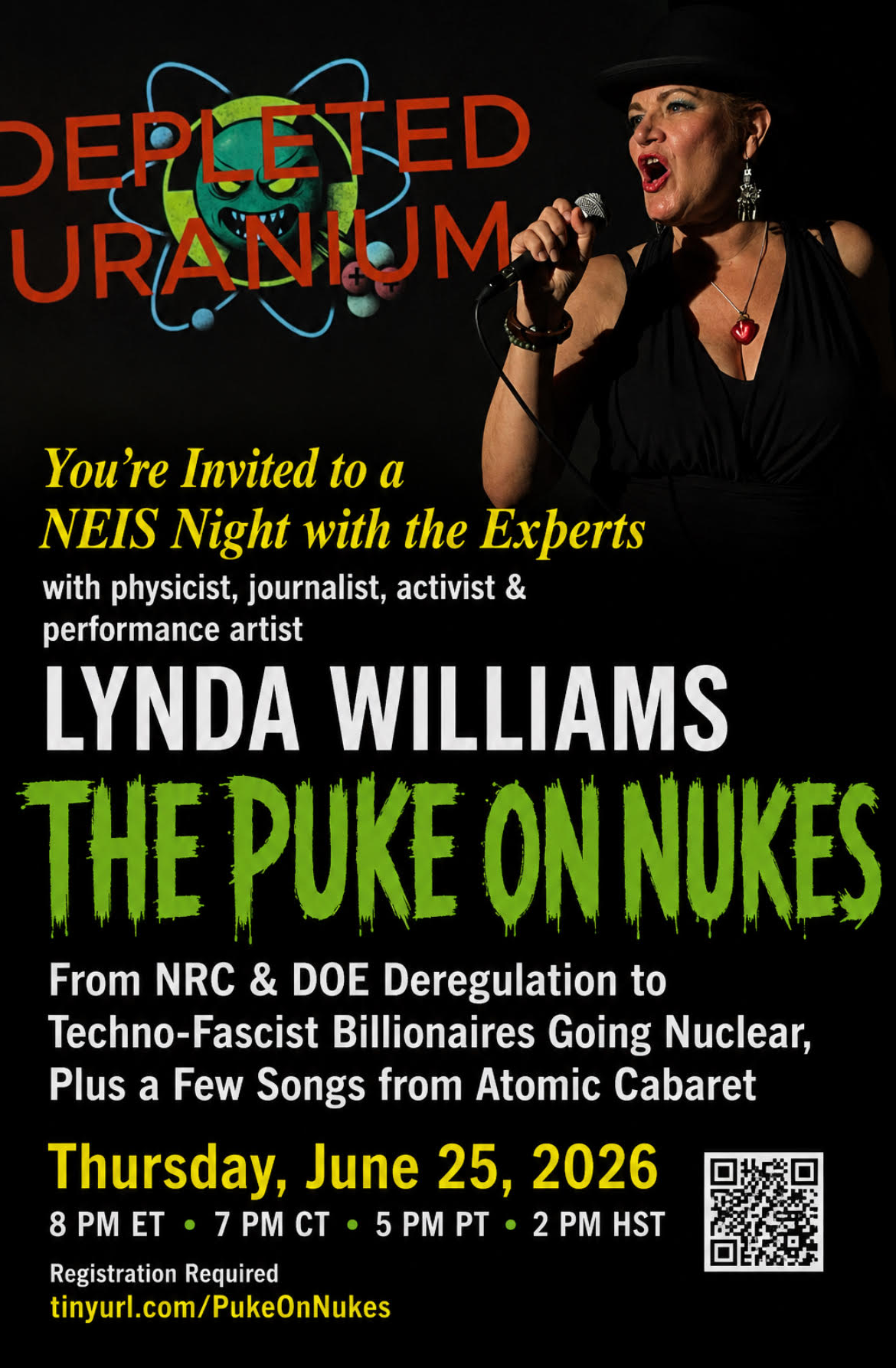
25 June- THE PUKE ON NUKES
Thursday, June 25, 2026
7pm Central Time (8pm ET, 6pm MT, 5pm PT) UTC – 5
From NRC & DOE Deregulation to Techno-Fascist Billionaires Going Nuclear, Plus a Few Songs from Atomic Cabaret REGISTER
26 June – Radiation Trainwreck at the NRC / Join the Protect Better Campaign – https://us02web.zoom.us/meeting/register/4ZlZ5_qLSHGiLSCg8FF6Bg#/registration

1st July – Webinar Waste of Space: The Environmental Harm of Military and Civil Space Activity st July, 7 pm

Report Launch Online: We are seeing an increasing exploitation of space for military and commercial purposes. This must change.

Protect Sazan Island from the Trump family! https://secure.avaaz.org/campaign/en/protect_sazan_island_from_the_trump_family_loc/?bqFCVab&v=174511&cl=22707147157&_checksum=5e9dde668860e8231c33699735e16a1fbf22ab2cb01da50c999fe8732b9775ef&utm_source=email&utm_medium=blast_email&utm_campaign=174511


Cuba Is Not a Failed State – It Is a Besieged State
PETITION: “Global Appeal to Endorse Palestinian Right of Return of Refugees”
To see nuclear-related stories in greater depth and intensity – go to https://nuclearinformation.wordpress.com
-
Archives
- June 2026 (230)
- May 2026 (306)
- April 2026 (356)
- March 2026 (251)
- February 2026 (268)
- January 2026 (308)
- December 2025 (358)
- November 2025 (359)
- October 2025 (376)
- September 2025 (257)
- August 2025 (319)
- July 2025 (230)
-
Categories
- 1
- 1 NUCLEAR ISSUES
- business and costs
- climate change
- culture and arts
- ENERGY
- environment
- health
- history
- indigenous issues
- Legal
- marketing of nuclear
- media
- opposition to nuclear
- PERSONAL STORIES
- politics
- politics international
- Religion and ethics
- safety
- secrets,lies and civil liberties
- spinbuster
- technology
- Uranium
- wastes
- weapons and war
- Women
- 2 WORLD
- ACTION
- AFRICA
- Atrocities
- AUSTRALIA
- Christina's notes
- Christina's themes
- culture and arts
- Events
- Fuk 2022
- Fuk 2023
- Fukushima 2017
- Fukushima 2018
- fukushima 2019
- Fukushima 2020
- Fukushima 2021
- general
- global warming
- Humour (God we need it)
- Nuclear
- RARE EARTHS
- Reference
- resources – print
- Resources -audiovicual
- Weekly Newsletter
- World
- World Nuclear
- YouTube
-
RSS
Entries RSS
Comments RSS
 nuclear-news