Japan’s Nuclear Regulator stands firm on need to close reactor sited over earthquake fault
 Regulatory panel in Japan affirms decision that will force decommissioning of Tsuruga reactor, Enformable, Lucas W Hixson, 5 Sept 14
On Thursday, a panel of experts organized by Japan’s Nuclear Regulation Authority (NRA) determined that it will not change its 2013 judgment that an active geologic fault exists under the Unit 2 reactor at the Tsuruga nuclear power plant.
The determination means that the Japan Atomic Power Company (JAPC), the utility which operates the Tsuruga nuclear power plant, will be forced to decommission one of the two reactors at the nuclear site.
During the meeting, officials from the JAPC attempted to present new data, which they said challenged the decision made by NRA, but many experts at the meeting debated the validity and objective nature of the data and the ability of the new findings to support claims made by the utility.
After hearing the panel’s decision, the vice president of Japan Atomic Power demanded more discussion on the issue, but was rebuffed by NRA Commissioner Kunihiko Shimazaki who stated that “Enough scientific debates have been done.”…….
After NRA experts determined that the D-1 fault zone of pebbles and sediments under the Unit 2 reactor is an active fault in May 2013, the JAPC began actively working to change the regulator’s decision, and the meetings between the two parties have been known to be contentious.
The secretariat of the NRA has told reporters that it plans to file a protest with Japan Atomic Power Company over inappropriate and threatening remarks made by Hiroshima University professor Koji Okumura, who is affiliated with the utility……..
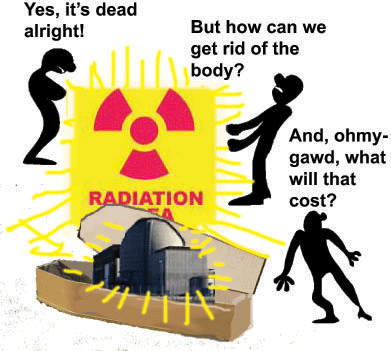 Experts estimate that the costs to decommission a reactor like the Unit 2 reactor at the Tsuruga nuclear site will cost in excess of $650 million.
Fukushima Radiation Continues As Experts Warn Of ‘American Fukushima’

 Experts Warn of ‘Inevitable’ Fukushima Disaster in California Nation of Change ANTHONY GUCCIARDI NATURAL SOCIETY / NEWS REPORT Wednesday 3 September 2014 Since the catastrophic meltdown of the Fukushima nuclear power plant in March of 2011 irreparably altered the state of the planet for the known future, the incident has been shrouded in nothing but bureaucratic cover ups and government-backed disinformation. Now, within our own borders, top experts turned whistleblowers are warning of a nuclear nightmare that could surpass Fukushima and Chernobyl alike by leaps and bounds.
Initially listed as a Level 4 incident on the International Nuclear Event Scale, pressure from scientists on an international level ultimately led to Fukushima’s classification as a maximum Level 7 accident within the INES system — with some suggesting an entirely new level was needed to describe the true impact and atrocity of the nuclear meltdown. Now, even after witnessing what happens when a major power plant is placed within the crosshairs of earthquake activity, a ‘new Fukushima’ is sitting off the Central Coast within California’s Diablo Canyon.
And top level nuclear experts, including a senior federal nuclear inspector turned whistleblower, are warning that the California-based plant is a sitting radioactive duck amid the nearby faults that have actually been found to be more dangerous than previously thought. Back in 2008, a new fault known as the Shoreline fault was discovered just offshore from the Diablo Canyon nuclear facility: a discovery that truly changes everything about the ‘safety’ of the California plant.
The whistleblower and former federal inspector of the plant, Michael Peck, has even presented his case highlighting the serious hazards of the plant he used to oversee to the U.S. Nuclear Regulatory Commission in a highly confidential report. National organizations are already calling attention to Peck’s finding and reports, with senior strategist Damon Moglen of Friends of the Earth International stating:
“We agree with him that Diablo Canyon is vulnerable to earthquakes and must be shut down immediately. Rather than the NRC keeping this a secret, there must be a thorough investigation with public hearings to determine whether these reactors can operate safely.”
Yet it appears that the general public is not even being made aware of what’s really going on, let alone the real threat that they face on a national and international level.
As usual, the general public is not being told about ways in which they can prepare themselves for a nuclear meltdown. Instead, government officials were caught back in February stockpiling iodine stores in excess of 14 million doses in a purchase order that came conveniently after reports began surfacing over another possible meltdown at the Fukushima plant. The doses will be enough for many officials and federal employees, however the public will be forced to fend for themselves — and they will not even be told about the necessity of iodine nor how they can better prepare their families for a radioactive scenario.
The reality is that even getting a hold of low quality potassium iodide, which I would not ever personally take over a higher quality form of pure iodine, is becoming difficult as the population becomes aware of Fukushima’s expansive dangers. Many manufacturers are now stockpiling raw iodine and holding on to the element as a form of investment with the knowledge that Fukushima may very well meltdown in the coming months. For this reason, we have had a very hard time securing nascent iodine formulas that many in the field of preparedness have been stockpiling for quite some time.
Fukushima Radiation Continues As Experts Warn Of ‘American Fukushima’
But even outside out Peck’s analysis and years of experience as a nuclear inspector at the federal level, numerous high level scientists and researchers have been speaking out about the continuation of Fukushima’s devastating effects and the need to further stabilize and shutdown nuclear plants along the fault lines throughout the United States — and California is not the only region in question. Even another earthquake affecting Japan could lead to the ‘evacuation of North America’, according to scientists David Suzuki…………….http://www.nationofchange.org/experts-warn-inevitable-fukushima-disaster-california-1409758143
IN UK 2 important nuclear power stations could be out of action for 2014
The ongoing problems at Heysham 1 and Hartlepool reactors, taken offline last month, forced Centrica, a 20% owner of the atomic fleet with EDF, to issue a profit warning………The power outages following the discovery of a fault on a boiler “spine” at Heysham 1 have already led the National Grid to fast-forward an emergency plan to obtain more electricity from other providers to meet a possible shortfall…….http://www.theguardian.com/environment/2014/sep/04/nuclear-power-stations-out-december-edf
Ukraine’s 15 nuclear reactors – a big danger in the conflict
A worrying factor in Ukraine’s chaos: 15 nuclear reactors WP By Rick Noack September 3 As Ukraine looks like a country teetering on the edge of war, there’s an important factor to keep an eye on: The country’s 15 nuclear reactors.

“There haven’t been many conflicts in states with nuclear power facilities in the past, so we’re really entering unknown territory here,” said Jeffrey Mankoff, Deputy Director of the Center for Strategic and International Studies’ Russia and Eurasia Program. NATO has already shown its concern, sending a small team of civilian experts to Ukraine in April to advise the government on the safety of its infrastructure.
There is a historical component to the anxiety: In April 1986, a reactor of the Ukrainian nuclear power plant at Chernobyl exploded, causing the worst nuclear disaster in history, and a high rate of cancer among emergency workers and people living in the affected areas even today. Chernobyl happened in a time of peace: Today, Ukraine’s reactors operate near a war zone.
Closest to the fighting is Zaporizhia Nuclear Power Station, which houses six separate reactors: There are doubts about the safety mechanisms in place in these power plants. German public broadcaster ARD has warned that “a second Chernobyl disaster will be inevitable if the fighting in Ukraine cannot be stopped.” Sergej Boschko, who heads Ukraine’s nuclear regulatory agency,told ARD that “no nuclear power plant is protected against military attacks. They are not made for war, they are made for peace.”
Nuclear material also presents a problem: ARD reports that 100 containers of burned nuclear fuels were found in the open air 120 miles away from the front line. This waste product is radioactive and dangerous if stored incorrectly. Hans-Josef Allelein, the chairman of Germany’s Institute for Reactor Safety and Reactor Technology, said in an interview that these reports would indicate a “real danger” if true. “Such containers could theoretically be used as dirty bombs,” Allelein explained. “In the end, the area around a nuclear power plant needs to be secured with a reliable air-defense system …….http://www.washingtonpost.com/blogs/worldviews/wp/2014/09/03/a-worrying-factor-in-ukraines-chaos-15-nuclear-reactors/
Why Australia should NOT sell uranium to India
Australian and Indian nuclear trade http://www.dailytimes.com.pk/opinion/29-Aug-2014/australian-and-indian-nuclear-trade Hasan Ehtisham 4 Sept 14 Adding Australian uranium into India’s energy mix would have serious fallouts on prevailing strained relations between India and its nuclear-armed neighbours Australia is expected to sign a civil nuclear agreement with India during the visit of Australian Prime Minister Tony Abbott early next month. Negotiations have been concluded to smooth the path for uranium imports from Australia.

The news came out when hundreds of thousands of Indian men and women protested against the expanding nuclear industry. These protests have been a regular feature in Koodankulam (Tamil Nadu), Jaitapur (Maharashtra) and Gorakhpur (Haryana), and at least five activists have lost their lives since 2010 in their struggle against the Indian government’s decision without taking the affected parties on board. Radioactive waste from uranium mining in the country’s east is reportedly affecting adjacent communities. Thousands of Indians suffer from the effects of uranium mining related to poor technical and management practices.
$30 million grant to protect Washington DC from nuclear threats
 Washington DC gets $30 million grant to protect against nuclear threats THE BLAZE< Sep. 3, 2014 Pete Kasperowicz The Department of Homeland Security announced that it has awarded Washington DC a $30 million grant to expand its ability to detect and deter nuclear and radiological threats.
The grant, which will be distributed to Washington DC over five years, was made by DHS’s Domestic Nuclear Detection Office, which runs a program called Securing the Cities. That program started in 2006 and provided aide to New York City, and was then expanded to the Los Angeles/Long Beach area………http://www.theblaze.com/blog/2014/09/03/washington-dc-gets-30-million-grant-to-protect-against-nuclear-threats/
Ukraine’s huge Zaporizhia Nuclear Power Plant in danger
 Ukrainian nuclear plant vulnerable to Kiev’s artillery strikes – Greenpeace expert Rt.com August 31, 2014 Europe’s largest nuclear power plant is vulnerable to ‘direct bombardment’ in Ukraine if caught in the conflict, a Greenpeace nuclear energy expert told a German newspaper, claiming that its nuclear reactors are not protected from armor-piercing weapons.
Greenpeace nuclear expert Tobias Münchmeyer revealed his concerns over the six-reactor Zaporizhia Nuclear Power Plant in eastern Ukraine to Westdeutsche Allgemeine Zeitung. He said the plant was insufficiently protected against a direct bombardment and that 1.2-meter thick reinforced concrete shells surrounding each reactor are strong enough to withstand only a small aircraft crash.
“There are many armor-piercing weapons in the region, which could penetrate these protective covers,”Münchmeyer said, as cited by Deutsche Welle on Saturday.

The Soviet design reactors at Zaporizhia are largely dependent on Russian expertise and spare parts, the expert also said.
Zaporizhia is the largest nuclear power plant (NPP) not only in Ukraine, but also in Europe and also the fifth largest NPP in the world. It is situated on the bank of the Kakhovka water reservoir on the Dnieper River. This is some 200 kilometers from the warzone in Donetsk region……..http://rt.com/news/184004-greenpeace-zaporizhia-npp-danger/
Western leaders very worried about Ukraine’s nuclear reactors

The West’s Collective Angst About Ukraine’s Crisis-Zone Nuclear Reactors http://www.worldcrunch.com/ukraine-winter/the-west-039-s-collective-angst-about-ukraine-039-s-crisis-zone-nuclear-reactors/nuclear-risks-chernobyl-crimea-zaporizhia-malaysia-airlines/c20s16883/#.VAQSlNddUnk Markus Balser (2014-08-30) BERLIN — For many in Ukraine the city of Enerhodar is known simply as “Atomic City.” It was founded a couple of decades ago to accommodate a power station, and the city with its 50,000 inhabitants in southeastern Ukraine is known today as one of the country’s main energy suppliers. The six reactor blocks of the Zaporizhia Nuclear Power Station spread out over many hundreds of meters along the banks of the Kakhovka Reservoir on the Dnieper River. The power station is not just responsible for most of Ukraine’s electricity, but it is also the city’s biggest employer and Europe’s largest nuclear power plant.

Atomic City’s dimensions were always suspect to critics of atomic energy, but these days even professionals in the nuclear sector are a bit uneasy about Zaporizhia. That’s because the power station is located just 124 miles from the part of Ukraine occupied by separatists, meaning the reactors are located in one of Europe’s most dangerous regions. Continue reading
Refueling crane console dropped into Fukushima Daiichi Reactor 3 spent fuel pool


TEPCO is working to check the 566 spent fuel assemblies in the Unit 3 spent fuel pool to see if any of them have been damaged by the most recent accident. According to decommissioning plans, the utility is scheduled to start removing spent fuel rods from the Unit 3 spent fuel pool in the first half of 2015 at the earliest.Tokyo Electric, who is in charge of cleanup operations at Fukushima Daiichi, told reporters that they have not detected any change in radiation levels around the spent fuel pool after the accident.
This is not the first time that debris and large objects have been accidentally dropped, pulled, or pushed into the Unit 3 spent fuel pool. Between 2012 and 2013, TEPCO workers used the remote control cranes to remove debris from atop the Unit 3 reactor building, and multiple instances were recorded where operators moving cranes via remote control knocked debris into the spent fuel pool or dislodged other materials on the roof.
In February 2013, workers accidentally knocked the 1.5 ton fuel handling machine mast into the Unit 3 spent fuel pool, and it was later found to have come to rest on top of the spent fuel racks after it narrowly avoided damaging the liner of the spent fuel pool.
The post Workers drop refueling crane console into Fukushima Daiichi Reactor 3 spent fuel pool appeared first on Enformable.
400-Kg Control Console Fell Into Fukushima Fuel Pool
 Tepco Says 400-Kg Control Console Fell Into Fukushima Fuel Pool Bloomberg, By Emi Urabe and Peter Langan Aug 29, 2014 Tokyo Electric Power Co. (9501) said it’s detected no change in radiation levels in the Fukushima Dai-Ichi No. 3 reactor building after a 400 kilogram piece of equipment slipped from a crane and fell back into a pool holding spent uranium fuel rods.
The accident happened at around 12:45 p.m. today as the company was attempting to move what it described as a crane control console, according to a statement on its website.
The console, which is about a meter wide and 1.6 meters high, was blown into the pool on March 14, 2011, when the No. 3 reactor building exploded following an earthquake and tsunami that wrecked the Fukushima plant.
Today, the utility known as Tepco was attempting to move the device as part of its cleanup at the site, said spokesman Hiroshi Itagaki. …….http://www.bloomberg.com/news/2014-08-29/tepco-says-400-kg-control-console-fell-into-fukushima-fuel-pool.html
Organization for Security and Cooperation in Europe concerned over USA’s nuclear deal with Ukraine
 OSCE shares Moscow’s concerns over Ukraine’s nuclear deal with US Rt August 28, 2014 The Organization for Security and Cooperation in Europe shares Moscow’s concern on world nuclear safety and the potential threat that possible US atomic fuel supplies to Ukraine might cause as the country remains in crisis.
 The head of the OSCE and Swiss president Didier Burkhalter says he is concerned about nuclear safety in connection with the US intention to supply the country with nuclear fuel, according to a reply letter to Deputy Chairman of the State Duma Committee on Industry Vladimir Gutenev.
Switzerland “shares the view concerning nuclear safety,” Burkhalter wrote, as cited by Itar-Tass,……..
In early June, Gutenev sent a letter to Burkhalter warning of security threats that European nations will face in case of a potential industrial nuclear disaster at one of Ukraine’s power plants, as Kiev is planning to sign a contract with American Westinghouse Electric Company. He highlighted the fact that Soviet made nuclear plants are not compatible with fuel assembly type TBC-W offered by the Americans, as previous trials have shown.
“The nuclear reactors in Ukraine are of Russian (Soviet) design, which are only designed for fuel that has passed a special certification. Therefore, further attempts to use non-adapted fuel assemblies of American production without a corresponding adjustment increase the risk of failure of the Ukrainian reactors and dramatically increase the likelihood of man-made disasters,” Gutenev wrote in June, calling on the OSCE to consider the issue.
In 2005, six experimental Westinghouse fuel assemblies, adopted for use in USSR-developed reactors, were tried at the South Ukraine plant in one reactor together with Russian fuel rods. By 2008 Ukraine signed a contract with Westinghouse on fuel rod supply. However, the experiment showed that Westinghouse assemblies deformed during exploitation and got stuck in the core. The reason is simple – Russian nuclear fuel rods are hexagonal in section, while Americans produce fuel assemblies of square section.
By 2012, after the failed test, exploitation of US nuclear fuel was banned in Ukraine and the fuel rods were returned to the producer “to get fixed” while Russian scientists came to the rescue. The Energoatom Company of Ukraine lost an estimated $175 million in this trial.
Now the Kiev regime has renewed the 2008 nuclear fuel deal till 2020, to replace 25 percent of the Russian-made fuel rods with an option to “provide more if needed.”…….http://rt.com/news/183248-nuclear-ukraine-threat-osce/
Danger to nuclear reactors, of California’s earthquakes
 California earthquakes may pose threat to nuclear plant, expert says http://www.csmonitor.com/Environment/Latest-News-Wires/2014/0826/California-earthquakes-may-pose-threat-to-nuclear-plant-expert-says
By Michael R. Blood, Associated Press AUGUST 26, 2014 LOS ANGELES — A senior federal nuclear expert is urging regulators to shut down California‘s last operating nuclear plant until they can determine whether the facility’s twin reactors can withstand powerful shaking from nearby earthquake faults.
Michael Peck, who for five years was Diablo Canyon‘s lead inspector, says in a confidential report that the Nuclear Regulatory Commission is not applying safety rules it set out for the plant’s operation.
The document, which was obtained and verified by The Associated Press, does not say the plant is unsafe. Instead, according to Peck’s analysis, no one knows whether the facility’s equipment can withstand strong shaking from those faults — the potential for which was realized decades after the facility was built. Continuing to run the reactors, Peck writes, “challenges the presumption of nuclear safety.”
Peck’s 2013 filing is part of an agency review in which employees can appeal a supervisor’s or agency ruling. The NRC, however, has not yet ruled. Spokeswoman Lara Uselding said in emails that the agency would have no comment.
The NRC, which oversees the nation’s commercial nuclear power industry, and Diablo Canyon owner Pacific Gas and Electric Co., say the nearly three-decade-old reactors are safe and that the facility complies with its operating license, including earthquake safety standards.
Israel aimed a stealth drone at Iran uranium enrichment site
 Israeli stealth drone downed at nuclear facility, Iran claims Revolutionary Guard hails act against ‘warmongers’ as incident reported at major uranium enrichment plant Harriet Sherwood in Jerusalem and Saeed Kamali Dehghan in Boston The Guardian, Monday 25 August 2014 Iran‘s Revolutionary Guards claimed on Sunday that an Israeli stealth drone had been brought down above the Natanz uranium enrichment site in the centre of the country.
The semi-official Fars news agency reported that Iran’s elite forces had intercepted and brought down an unmanned aircraft belonging to “the Zionist regime”. The news was announced in a statement published by the guards, but it was not clear when the incident, if true, happened.
“This mischievous act once again reveals the adventurist nature of the Zionist regime [of Israel] and added another black page to this fake and warmongering regime’s file which is full of crimes,” said the Revolutionary Guards’ statement.
The state news agency ISNA reported that the aircraft was “of the stealth, radar-evasive type and it intended to penetrate the off-limits nuclear area in Natanz … but was targeted by a ground-to-air missile before it managed to enter the area.”
A spokesman for the Revolutionary Guards later told Iranian television that parts of the aircraft had been retrieved. Iran claimed to have reverse engineered a drone after capturing an American RQ-170 Sentinel in 2011.
“Major parts of the devices of the drone are intact and have been received by our friends that can be used for further information,” said General Ramazan Sharif. He did not say when the aircraft was shot down, but said it was “identified upon arrival in Iranian airspace”. He said authorities allowed it to fly for a short time to determine its destination.
Israeli political and military officials said they never respond to such claims. They have repeatedly threatened to take military action against Iran’s nuclear installations, but have been reluctant to do so without US backing or participation.
Natanz is Iran’s main uranium enrichment site, housing more than 16,000 centrifuges. About 3,000 more are at the Fordo plant, buried inside a mountain and hard to destroy…….. http://www.theguardian.com/world/2014/aug/24/israeli-stealth-drone-nuclear-facility-iran-natanz
Nuclear facilities: dangerous “assets” in volatile countries
What can be done to reduce nuclear risks in volatile countries? Bennett Ramberg The Daily Star 24 Aug 14 Nobody would dispute the danger inherent in possessing nuclear assets. But that danger becomes far more acute in a combat zone, where nuclear materials and weapons are at risk of theft, and reactors can become bombing targets. These risks – which are most apparent in today’s chaos-ridden Middle East – raise troubling questions about the security of nuclear assets in volatile countries everywhere.
Two recent events demonstrate what is at stake. On July 9, the militant group now known as the Islamic State, formerly the Islamic State of Iraq and Greater Syria, captured 40 kilograms of uranium compounds at Mosul University in Iraq. The captured uranium was not weapons-grade; international inspectors removed all sensitive material from Iraq following the Gulf war of 1991 (which is why it was absent when the United States invaded in 2003). But what international response, if any, would have been initiated if the cache had been highly enriched?
On the same day, Hamas launched three powerful Iranian-designed rockets from Gaza at Israel’s Dimona reactor. Luckily, two missed the target, and Israel managed to intercept the third. But the episode represented a serious escalation of hostilities and served as an important reminder of the vulnerability of nuclear reactors in warzones.
In fact, Hamas made similar attempts to attack the Dimona complex in 2012, as did Iraq in 1991, with the aim of releasing the site’s contents to inflict radiological damage on Israel’s population. (The perpetrators appeared clueless to the fact that certain weather conditions would have concentrated the radioactive debris in the Palestinian-majority West Bank.)……..
Pakistan has a large nuclear weapons program and faces an expansive jihadist insurgency, which previously attacked military bases that were suspected of housing nuclear assets. Though Pakistan has not experienced a nuclear breach, and the government insists that safeguards remain robust, the country’s increasingly frequent and severe bouts of instability raise serious questions about the future.
While North Korea’s nuclear arsenal is much smaller, persistent doubts about the regime’s sustainability make it a matter of grave concern. In the event of the regime’s collapse – which remains a distinct possibility – it would be difficult to prevent the diversion of its assets, or even the use of its weapons………
Bennett Ramberg, a policy analyst in the U.S. State Department’s Bureau of
Politico-Military Affairs under President George H. W. Bush, is the author of “Destruction of Nuclear Energy Facilities in War” and “Nuclear Power Plants as Weapons for the Enemy.” THE DAILY STAR publishes this commentary in collaboration with Project Syndicate © (www.project-syndicate.org). http://www.dailystar.com.lb/Opinion/Commentary/2014/Aug-25/268338-what-can-be-done-to-reduce-nuclear-risks-in-volatile-countries.ashx#axzz3BRnATjln
Cause of radiation accident at Waste Isolation Pilot Plant (WIPP) still unknown
 Cause of New Mexico nuclear waste accident remains a mystery , LA Times, By RALPH VARTABEDIAN contact the reporter 24 Aug 14 A 55-gallon drum of nuclear waste, buried in a salt shaft 2,150 feet under the New Mexico desert, violently erupted late on Feb. 14 and spewed mounds of radioactive white foam.
The flowing mass, looking like whipped cream but laced with plutonium, went airborne, traveled up a ventilation duct to the surface and delivered low-level radiation doses to 21 workers.
The accident contaminated the nation’s only dump for nuclear weapons waste — previously a focus of pride for the Energy Department — and gave the nation’s elite ranks of nuclear chemists a mystery they still cannot unravel.
Six months after the accident, the exact chemical reaction that caused the drum to burst is still not understood. Continue reading
1 This Month
26 September – International Day for the Total Elimination of Nuclear Weapons





PLEASE OPPOSE HR 8255 AND S.3639 – bills would accelerate satellite deployment, with no environmental review or safeguards – https://ncstd5li.quorum.us/campaign/169331/
To see nuclear-related stories in greater depth and intensity – go to https://nuclearinformation.wordpress.com
-
Archives
- September 2026 (323)
- August 2026 (330)
- July 2026 (355)
- June 2026 (287)
- May 2026 (306)
- April 2026 (356)
- March 2026 (251)
- February 2026 (267)
- January 2026 (308)
- December 2025 (358)
- November 2025 (359)
- October 2025 (375)
-
Categories
- 1
- 1 NUCLEAR ISSUES
- business and costs
- climate change
- culture and arts
- ENERGY
- environment
- health
- history
- indigenous issues
- Legal
- marketing of nuclear
- media
- opposition to nuclear
- PERSONAL STORIES
- politics
- politics international
- Religion and ethics
- safety
- secrets,lies and civil liberties
- spinbuster
- technology
- Uranium
- wastes
- weapons and war
- Women
- 2 WORLD
- ACTION
- AFRICA
- Atrocities
- AUSTRALIA
- Christina's notes
- Christina's themes
- culture and arts
- Events
- Fuk 2022
- Fuk 2023
- Fukushima 2017
- Fukushima 2018
- fukushima 2019
- Fukushima 2020
- Fukushima 2021
- general
- global warming
- Humour (God we need it)
- Nuclear
- RARE EARTHS
- Reference
- resources – print
- Resources -audiovicual
- Weekly Newsletter
- World
- World Nuclear
- YouTube
-
RSS
Entries RSS
Comments RSS

