Canada’s public to get iodine pills in wide area around nuclear reactors
 Nuclear plants must give iodine pills to nearby residents, regulator says Radiation protection pills will be pre-distributed to people and businesses located near nuclear plants, according to a new regulation announced by the Canadian Nuclear Safety Commission on Friday. The Star, By: John Spears Business reporter, Oct 10 2014
Residents and businesses near nuclear plants must be given radiation protection pills as a precautionary measure, says Canada’s nuclear regulator.
The pills must be pre-distributed, before any accident occurs, in co-operation with government authorities.
The Canadian Nuclear Safety Commission announced the new measure Friday, as it published a new regulation. The pills, which contain potassium iodide, block the thyroid gland from absorbing radiation.

The regulation requires nuclear operators to pre-distribute the pills to “all residences, businesses and institutions” within the primary area where the plume from a radiation release would likely spread.
The radius of the area may vary from location to location but “is typically sized in the range of eight to 16 kilometres,” according to the regulation. A 10-kilometre radius from the Pickering nuclear plant would extend from the eastern part of Scarborough to Whitby.
In a larger zone — typically 50 to 80 kilometres — nuclear plant operators must make sure that there is a stock of pills “ready for prompt distribution” and “located so that it can be efficiently obtained by, or distributed to, members of the public when required,” the regulation says.
An 80-kilometre zone would embrace all of Greater Toronto………The regulation also requires nuclear plant operators to deliver emergency preparedness information “in hard copy annually to every residence, business and institution” within the pill pre-distribution area. http://www.thestar.com/business/2014/10/10/nuclear_plants_must_give_iodine_pills_to_nearby_residents_regulator_says.html
Whose finger is now on the nuclear button, in North Korea?
 Kim Jong-un Disappearance Leads to Nuclear Weapon Concerns Liberty Voice, by Rebecca Savastio on October 10, 2014. Kim Jong-un’s continuing disappearance has led to speculation about whose finger is on the North Korean nuclear weapon arsenal. The Supreme Leader of the Democratic People’s Republic of Korea has not been seen in over a month. Why should the world care? Does it matter to anyone outside of North Korea if he is vacationing, ill, deposed or dead? The fact that North Korea is a nuclear power, though without the capability to launch nuclear intercontinental ballistic missiles at the United States, makes the tiny communist nation’s stability of interest for everyone…….
……..The true state of politics within North Korea is an impenetrable mystery. It is disconcerting that the world knows so little about a country it fears so much. Given its nuclear capabilities, any change of government needs to be smooth and stable. Many feel that the only scenario worse than a communist dictator who hates America is a rogue element with nothing to lose. Whether orchestrated by Kim or accomplished without his authority, the moves made by the North Korean officials seem to be a small step in the right direction. The world is waiting to see what happens, because Kim Jong-un’s continuing disappearance had led to speculation about whose finger is on the North Korean nuclear arsenal. http://guardianlv.com/2014/10/kim-jong-un-disappearance-leads-to-nuclear-weapon-concerns/#gCOhfjJo3gRiifyJ.99
On anniversary of Windscale nuclear accident, UK plans another untested reactor
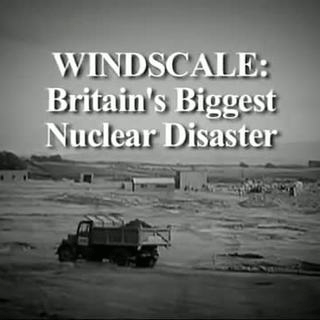
 57 years ago today in 1957 :The Windscale Fire, Radiation Free Lakeland, 10 oct 14 ” ……..10th Oct marks 57 years since the worst nuclear accident in the UK. The bravery of those who fought the 1957 blaze was without question and they are remembered with our gratitude for preventing the far greater catastrophe of a full on Lake Counties nuclear sacrifice zone.
Official estimates point to a possibility of 240 additional cancer cases as a result of the Windscale fire. Studies reveal that the impacts of nuclear accident and routine emissions may be far wider reaching than the public is led to believe. One such study in 1995 by Dr John Bound, a former paediatrician at the Victoria Hospital, Blackpool; Brian Francis, of the Centre for Applied Statistics, Lancaster; and Dr Peter Harvey, pathologist at the Royal Lancaster Infirmary found that the Windscale fire
was followed by a surge in cases of Down’s syndrome. Their studies were poo poohed to protect the vested interests of the nuclear establishment.
This pattern has been repeated time and time again. History is now repeating itself with the plan for untried and untested new build near Sellafield.
The ruthless push towards new nuclear build on the beautiful coastline of West Cumbria mirrors the rush to build Windscale in order to produce plutonium for the atomic bomb. While “safety features” like the last minute addition of filters on the Windscale chimney helped mitigate the impact of the inevitable fire, the dangers from nuclear are inherent and accumulative. Nothing it seems is being learnt from history. The same old uranium burning technology is being proposed now for new build. The reactors being proposed are AP1000, a scaled up version of the commercially unattractive AP600. The AP1000 boasts higher efficiency, in other words it burns the uranium harder and longer producing much hotter wastes, reactors under construction now in America and China have cooling towers 600 – 800 ft. high. The other “alternative” is direct cooling with huge sea installations.
Sellafield is dangerous enough and a big enough terrorist target without putting untried, untested nuclear reactors next to it with the possibility of enormous cooling towers the size of New York sky scapers or huge sea installations.
Please remember the Windscale fire on the 10th. Remember the voluntary bravery of the Windscale workers and the involuntary bravery of all those unacknowledged babies, children, men and women who have died, or suffered health consequences as a result of the Windscale accident. The still highly radioactive chimney which stands 350ft tall has also claimed the life of steeplejack Neil Cannon who died after falling from the ongoing ‘decommissioning’. The death toll will continue without end if new build goes ahead. Surely the time has come for Cumbrians to say enough is enough and to join the resistance to new and more dangerous nuclear build.There is a petition here:
https://you.38degrees.org.uk/petitions/stop-moorside-biggest-nuclear-development-in-europe
South Korea’s nuclear unsafety – 684 Accidents and Failures over 37 Years

 Korean Nuclear Power Plants Exposed to 1,843 Hacks over Five Years– Business Korea 10 OCTOBER 2014The number of hacking attempts against nuclear power plants in Korea was found to have reached 1,843 during the last five years. Experts are calling for special cybersecurity measures for nuclear power stations under the circumstances
…..684 Accidents and Failures over 37 Years
With the situation as it is, the general public’s concerns over aging nuclear power plants as well as hacking attempts are on the rise. The total number of nuclear power generation accidents and breakdowns in Korea has reached 684 since the commercial operation of Gori 1 back in 1978. Out of those, 130 have happened in the oldest facility.
“The government is just repeating that nuclear power generation is a safe way of power supply,” Democratic United Party lawmaker Moon Byung-ho explained, continuing, “However, it would be well advised to reexamine its safety, security, sustainability, and economic advantages by taking this as an opportunity and shutting down the oldest nuclear power stations for a paradigm shift.” http://www.businesskorea.co.kr/article/6718/security-unawareness-korean-nuclear-power-plants-exposed-1843-hacks-over-five-years#sthash.iaBiCo9G.dpuf
Security officer shoots dead three colleagues guarding Kalpakkam nuclear power plant

 3 CISF personnel shot dead by colleague at Kalpakkam atomic plant in Tamil Nadu A Selvaraj, TNN | Oct 8, 2014, CHENNAI: Three Central Industrial Security Force (CISF) personnel guarding the atomic power plant at Kalpakkam near Chennai were killed and two others were injured when one of their colleagues opened fire on them on Wednesday morning.
Police said the incident happened inside the barracks where the security personnel were taking rest early in the morning. The reason for the attack was not known, police said.
The accused, head constable Vijay Pratap Singh, was nabbed and handed over to police……..The CISF head constable used a 9mm carbon rifle to attack his colleagues.
CISF senior officers have rushed to the scene. Further investigations are on. http://timesofindia.indiatimes.com/india/3-CISF-personnel-shot-dead-by-colleague-at-Kalpakkam-atomic-plant-in-Tamil-Nadu/articleshow/44679818.cms
Fire on ship carrying radioactive wastes leads to drift, and evacuation of oil rig

 “It is a serious incident and I think we need to review how we regulate the transportation of nuclear waste in our waters”
WWF Scotland, Comhairle nan Eilean Siar and SNP MSP Rob Gibson have raised concerns about radioactive waste being transported by sea.
Oil rig evacuated after ship carrying radioactive waste drifts BBC News Highlands and Islands 8 Oct 14 An oil platform has been evacuated after a ship carrying radioactive material caught fire and began drifting in the Moray Firth. Continue reading
Volcanoes a rare risk to nuclear reactors, but consequences would be devastating
Difficulties remain in protecting nuclear plants from volcanic eruptions October 05, 2014 THE ASAHI SHIMBUN by Takeshi Nakashima and Chikako Kawahara The deadly eruption of Mount Ontakesan in central Japan has rekindled concerns about whether Japan’s nuclear power plants, such as the Sendai plant in Kagoshima Prefecture, have adequate safeguards for dealing with such a disaster………
Active volcanoes are located near the Sendai plant, with Mount Sakurajima about 50 kilometers away and Mount Kirishima about 60 km away.
In the past, huge volcanic eruptions have led to the formation of large calderas and pyroclastic flows in the area.
Major eruptions occur in Japan about once every 10,000 years. However, nuclear plants have to implement measures depending on the risk even if the frequency of an event is low.
Nuclear plants are not designed to withstand pyroclastic flows at high temperatures. For that reason, if such flows should reach a facility, the consequences could be disastrous.
Kyushu Electric insists that the possibility of an eruption while the Sendai plant is operating is sufficiently low. The utility also says it would be possible to capture signs of a major eruption and remove nuclear fuel beforehand.
The Nuclear Regulation Authority has supported Kyushu Electric’s position.
The removal of the nuclear fuel from the reactors is expected to take several years.
However, the Mount Ontakesan eruption once again demonstrated the limits to accurately predicting volcanic eruptions.
Concerns about the safety measures at the Sendai plant were raised at a Sept. 30 session of a special committee of the Kagoshima prefectural assembly. Some members raised doubts about whether early signs of an eruption could be detected. Others criticized Kyushu Electric’s position………http://ajw.asahi.com/article/behind_news/social_affairs/AJ201410050034
UK’s Atomic Weapons Establishment found unsafe, by regulator
 UK nuclear bomb factories rapped by watchdogs over radioactive waste
Atomic Weapons Establishment issued with non-compliance notice by Environment Agency over handling of hazardous waste Rob Edwards heguardian.com, Thursday 2 October 2014 Britain’s nuclear bomb factories have been reprimanded by two government watchdogs for breaking safety rules on radioactive waste.
AWE, the private consortium that operates Trident nuclear weapons facilities at Aldermaston and Burghfield in Berkshire for the Ministry of Defence, has come under fire from the Environment Agency (EA) and theOffice for Nuclear Regulation (ONR) for failures in managing its hazardous waste.
The EA has issued AWE with a non-compliance notice because key posts meant to ensure the safe handling of wastes have been vacant for months. These include waste officers, radioactive specialists and the head of environment…….
“ONR is continuing to investigate AWE’s failure to meet the requirements of the licence instrument, in accordance with our normal processes,” said an ONR spokesman. “ONR will consider enforcement action in accordance with our enforcement policy when all investigations are completed.”…….
“Since 2010 safety and environmental regulators have increasingly had to take action at the Atomic Weapons Establishment, and it is time to start asking whether AWE are fit to run this complex and hazardous site if they are unable to improve standards.” http://www.theguardian.com/environment/2014/oct/02/uk-nuclear-bomb-factories-rapped-by-watchdogs-over-radioactive-waste
Shambles of Japan’s plans for evacuation after the next nuclear accident
 Not nearly enough buses for mass exodus after nuclear accident THE ASAHI SHIMBUN by Masanobu Higashiyama and Hiroki Koike.27 Sept 14 The gargantuan task of moving residents in a nuclear crisis will fall on chartered buses, according to the local governments’ evacuation plans.
The problem is there may not be nearly enough vehicles to move huge numbers of people to safety.
Some prefectures already realize they would be lucky to assemble just half the number of buses for the job.
There is also opposition from bus companies, which say they will not subject their drivers to hazardous radiation risks.
In a 10-kilometer radius of Kyushu Electric Power Co.’s Sendai nuclear power plant in Kagoshima Prefecture, which has passed safety checks for a restart, surveys show that local governments can charter only one-fourth of buses that would be needed to evacuate residents.
Although the prefecture plans to sign an agreement with the prefectural association of bus companies to preferentially charter vehicles, a local bus drivers’ union said it will oppose the plan unless safety measures for drivers are mapped out.
According to evacuation plans submitted by Satsuma-Sendai, the city hosting the nuclear plant, and surrounding municipalities within a 30-km radius of the plant, people who need nursing care and others without family cars will have to evacuate by bus……..
In addition to the lack of buses, the void of safety measures to prevent bus drivers from being exposed to radiation during an evacuation casts a shadow on plans by local governments to use chartered buses.
Central government guidelines stipulate that ordinary people such as bus drivers must not be exposed to more than 1 millisievert of radiation annually in normal situations. However, there are no measures in place to deal with those who are exposed to higher readings.http://ajw.asahi.com/article/0311disaster/fukushima/AJ201409270012
In addition, rules for distributing potassium iodide tablets to protect against thyroid cancer due to radiation have yet to be devised……..
During an Aug. 29 news conference, Niigata Governor Hirohiko Izumida asked if it is realistic for residents to rely on chartered private buses in a case of a nuclear disaster. The prefecture hosts Tokyo Electric Power Co.’s Kashiwazaki-Kariwa nuclear power plant.
“Is it possible to make drivers from private bus companies work in areas that are highly contaminated with radiation?” Izumida asked.
Officials at Fukushima Prefecture’s Nuclear Power Safety Division said they had not confirmed reports that bus companies refused to send vehicles due to concern for drivers’ safety during evacuation procedures for the Fukushima nuclear disaster.
But some trucks transporting relief goods did refuse to enter areas that were highly contaminated with radiation, according to the officials.
“A private company can face legal charges if its employees are exposed to radiation because of work orders,” said an official of Niigata Prefecture. “Even if we sign an agreement with bus companies, it will not ensure the efficacy of such an evacuation plan.”
USA and Russia co-operate in removing Polish high-enriched uranium
US says cooperates with Russia in removing Polish high-enriched uranium, Thomson Reuters Foundation Source: Reuters – By Fredrik Dahl VIENNA, Sept 22 (Reuters) – The United States said on Monday it had worked with Russia to help remove 50 kg of highly-enriched uranium from Poland as part of a global campaign to reduce the use of nuclear fuel that could also serve as material for bombs.
Washington and Moscow continue to cooperate on a case-by-case basis in areas of mutual nuclear security concern despite a current “substantial strain” in their relations, U.S. Secretary of Energy Ernest Moniz said………
The U.S.-based Arms Control Association, a research and advocacy group, last year said that HEU spent fuel from converted research reactors in Poland would be returned to Russia by the end of 2016.
In mid-2013, the United States and Russia used another IAEA meeting in Vienna to announce that they had helped ship out nearly 16 kg of HEU from Vietnam.
There are about 1,440 tonnes of HEU and 500 tonnes of plutonium stockpiled and in nuclear arms globally, the Nuclear Security Governance Experts Group (NSGEG), which lobbies for action to ensure that such material does not fall into the wrong hands, said last year.
Most of these stockpiles are under military guard but some for civilian uses is less stringently secured.
Analysts say that radical groups could theoretically build a crude but deadly nuclear weapon if they had the money, technical knowledge and materials needed but that merely obtaining sufficient material for an attack poses a formidable challenge.
A fairly simple-to-design bomb would require about 50-60 kg of HEU, the NSGEG said. More sophisticated devices would requires less material.
A message from U.S. President Barack Obama read by Moniz to the IAEA meeting in Vienna said the United States continued to work successfully with Russia to implement the new START treaty, “decreasing our deployed strategic warheads to the lowest levels in nearly 60 years”.
The pact that was agreed in 2010 caps deployed strategic nuclear warheads, those meant to travel long including intercontinental distances, in Russia and the United States at 1,550 each by 2018, down from the previous ceiling of 2,200. http://www.trust.org/item/20140922165343-gvnzt
Major impediments to re-opening New Mexico nuclear waste dump
 Energy Dept. faces major hurdles to reopen New Mexico nuclear dump LA Times, By RALPH VARTABEDIAN 18 SEPT 14, The Energy Department has identified 7,000 steps needed to reopen its badly damaged nuclear waste dump in New Mexico, but cannot say how long it will take or how much it will cost.
The agency was expected to release a written recovery plan Thursday, but instead provided a few details about the plan, which awaits formal approval by the department.
Outside experts say that the dump will probably not reopen until well after the start of 2016 and that the cost of the accident will approach $1 billion. Although they didn’t talk about the cost, Energy Department officials reiterated at a briefing in Carlsbad, N.M., on Thursday that there was “strong support” in Congress for putting up the unspecified amount of money required to restart the plant. A Senate aide declined a request by the Los Angeles Times earlier this month for details about the cost negotiations……..
Don Hancock, nuclear waste program director at the Southwest Research Institute, a watchdog group, said the system of isolating the waste by spraying water on the salt is unproven.
Hancock said the Energy Department has repeatedly told state regulators that the dump would not reopen before early 2016, but he said that estimate is highly optimistic because so much remains unknown about the recovery.
Even if the dump reopens by then, the two-year shutdown would have consumed two years’ worth of the annual budget for the operation, amounting to about $400 million, and at least another $300 million of additional appropriations that have been discussed for repairs.
But that is unlikely to cover the full cost of the repairs, Hancock said. In addition, tons of waste are backing up across the nation, forcing laboratories and other cleanup sites to store radioactive material longer, at an unspecified cost…..http://www.latimes.com/nation/la-na-nuclear-waste-dump-20140919-story.html
Nuclear regulatory Commission rejects expert advice on California earthquake danger
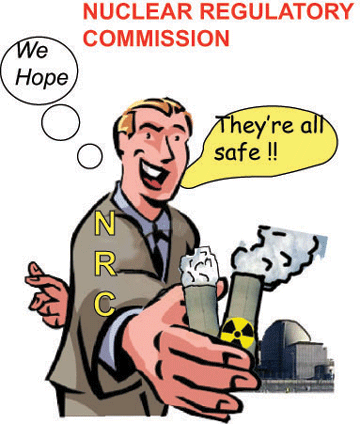 Regulators reject call for nuke plant shutdown By MICHAEL R. BLOOD, Associated Press September 10, 2014 LOS ANGELES (AP) — The Nuclear Regulatory Commission on Wednesday rejected a senior federal expert’s recommendation to shut down California’s last operating nuclear power plant until the agency can determine whether its twin reactors can withstand powerful shaking from nearby earthquake faults……..
Peck, now a senior reactor instructor for the NRC in Tennessee, argued the NRC is not applying safety rules it set out for the plant’s operation……..The agency’s ruling was issued on the same day that PG&E released hundreds of pages of scientific research that found a fault 650 yards from the reactors, known as the Shoreline, is twice as long as initially believed, making it capable of producing potentially stronger earthquakes, and intersections between some faults in the region could create larger earthquakes than previously considered. PG&E said in a statement that the plant remains seismically safe and able to withstand the largest potential earthquakes in the area.
Former California Sen. Sam Blakeslee, a geophysicist who has previously raised seismic concerns at Diablo, said “it’s premature to declare the plant is safe in light of this new information.”…….http://www.sfgate.com/business/energy/article/Regulators-reject-call-for-nuke-plant-shutdown-5746362.php
Masao Yoshida warned Japan of the dangers of large nuclear plants
Late Fukushima manager flagged ‘density danger’ risks plaguing Japan’s big nuclear plants http://rt.com/news/187128-nuclear-japan-reactors-safety/ September 12, 2014 Recently disclosed documents show the late manager of Japan’s destroyed Fukushima plant warned of safety risks in restarting nuclear power stations in the seismic-prone country, which is considering rebooting full-scale nuclear energy production.
Yoshida specifically cited the Kashiwazaki-Kariwa site in northern Japan, also run by Fukushima operator TEPCO. A seven-reactor facility, he said, was difficult to operate as “chaos” ruled the site after the earthquake. He added that grouping numerous nuclear reactors together made it more difficult to manage.
“I thought it wasn’t very good from a risk-diversification standpoint, but [Tepco] had already built this [Fukushima Daiichi] and Kashiwazaki, so I had to work within that [system],” he said, Reuters reported. The Kashiwazaki-Kariwa Nuclear Power Plant was completely shut down for 21 months following an earthquake in 2007.The transcript released by the government is part of a government investigation into the causes of the Fukushima nuclear disaster. Since the 2011 incident, Japan has shut down all of its nuclear facilities.
But on Wednesday, Japan’s Nuclear Regulation Authority (NRA) approved the restart of two reactors of a nuclear power station at Sedai after the plant met safety requirements needed. It is seen as the first step to reopening an industry of 48 reactors.
Under Japanese safety regulations, reactors after 40 years are to be decommissioned, unless they receive a 20-year extension. Reuters estimates that as many as two-thirds of Japan’s 48 idled nuclear units may never restart again.
Prior to March 2011, Japan generated 30 percent of its electrical power from nuclear reactors.
Dangerous Diablo Nuclear Power Plant must be closed
Shut California’s Fukushima: Diablo Must Go, ECoWatch Harvey Wasserman | September 6, 2014 The catastrophe at Fukushima was not an accident. It’s unfolding again in California.
The next west coast quake could easily shake the two reactors at Diablo Canyon to rubble.
They are riddled with defects, can’t withstand potential seismic shocks from five major nearby fault lines, violate state water quality laws and are vulnerable to tsunamis and fire.
Diablo’s owner, Pacific Gas & Electric (PG&E), is in deep legal and financial crisis. The California Public Utilities Commission (CPUC) has just proposed that PG&E be fined $1.4 billion for a 2010 gas explosion and fire that killed eight people and obliterated a neighborhood in San Bruno. The federal government has announced 28 indictments, meaning the CPUC fine may just be the tip of a very expensive iceberg for PG&E. The San Bruno disaster was caused by pipeline defects about which PG&E had been warned for years, but failed to correct. The fines cover 3,798 separate violations of laws and regulations, both state and federal. PG&E was previously fined $38 million for a 2008 pipeline explosion in Rancho Cordova.
Similar defects remain uncorrected at Diablo Canyon, whose radioactive cloud could span the continental U.S. in four days. Mass citizen action recently shut two coastal reactors at San Onofre. It must do the same at Diablo before the next quake hits……
Diablo Canyon’s twin reactors sit eight miles west of San Luis Obispo, between Los Angeles and San Francisco, surrounded by earthquake faults.

The Hosgri, three miles offshore, was found as the reactors were being built. Design specifications were never fully altered to account for it. Nor have they been upgraded for the newly-found Los Osos, San Luis Bay and Shoreline faults. The Shoreline lies just 650 yard from Diablo’s cores.
The massive San Andreas fault is just 45 miles away, about half as far as was the March 11, 2011, Richter-9.0 epicenter from Fukushima.
A shock that size from any of the fault lines near Diablo could reduce it to a seething pile of radioactive hell, far deadlier than Fukushima. Prevailing winds could blanket virtually all of North America with its deadly fallout.
The nuclear industry would immediately deny all health impacts. It would blame “unpredictable” God and nature.
But a 42-page report from NRC inspector Dr. Michael Peck says new fault line discoveries challenge Diablo’s “presumption of nuclear safety.”
Buried by the NRC for at least a year, it was released by Friends of the Earth and reported on by the Associated Press and the great enviro-journalist Karl Grossman, as well as by theNuclear Information & Resource Service and Beyond Nuclear.
Peck has a doctorate in nuclear engineering and was Diablo’s chief on-site inspector for five years. He’s now a senior instructor at the NRC’s Technical Training Center in Tennessee. His status as a current NRC employee makes such a critical report highly unusual—and alarming.
Nuclear engineer Arnie Gundersen has warned about sea-level intake pipes like those at Diablo. When the tsunami struck Fukushima, he writes, “The cooling equipment along the shoreline was turned into a scrap yard of twisted metal.”
Then there is fire.
Diablo Canyon, writes David Lochbaum of the Union of Concerned Scientists, “has never, ever complied with fire safety regulations, not even for a second by mistake.”…….http://ecowatch.com/2014/09/06/california-fukushima-diablo-nuclear/2/
Nuclear Regulatory Commission takes another gamble on nuclear wastes
Punting again on nuclear waste http://www.mycentraljersey.com/story/opinion/editorials/2014/09/06/nuclear-waste/15154565/ MyCentralJersey September 6, 2014 Talk about dropping a hot potato in a way that provides absolutely no incentive for anyone to pick it up — ever. The Nuclear Regulatory Commission recently decided that nuclear waste from power plants can be stored above ground in casks indefinitely. The vote to approve it was 4-0.
Given that spent fuel stored at nuclear power plants will remain dangerous to humans for at least 10,000 years and harmful to the environment for 1 million years more, the mere suggestion that the waste will be properly stored, maintained and protected is ludicrous. And the problem, now exacerbated by the NRC finding, is not a distant one.
Jersey Shore residents are living cheek by jowl with more than 750 metric tons of radioactive waste stored in Lacey in the spent fuel rod pool at the Exelon-owned Oyster Creek plant.
The pool sits 70 feet in the air, and is covered by a box-store type metal roof. Used fuel assemblies containing a cocktail of radioactive isotopes are jam-packed into the pool, holding about eight times more than its original design capacity. An NRC report on the Peach Bottom plant in Pennsylvania indicated that even a small nuclear reactor fuel pool fire could leave 9,400 square miles uninhabitable and indefinitely displace 4.1 million people. Just imagine what such a report would reveal about a similar reactor fire at Oyster Creek. And try to imagine thousands of Jersey Shore residents fleeing the area given its limited evacuation routes.
Still, the Oyster Creek plant is not scheduled to close until 2019 and the spent fuel rods will be able to sit there until half-past “Who knows when?”

And then what? A whole lot of nothing, given this NRC finding.
At the very least, the state should insist that work begin on moving the rods into state-of-the-art dry casks — sealed metal cylinders containing the spent fuel enclosed within a metal or concrete outer shell — as soon as Oyster Creek ceases operation. That would be better than the current state of affairs, but real progress is a long way off.
The Energy Department is now saying that a burial site for the nation’s nuclear waste will be established by 2048, but the agency has no plan for finding one.
And we certainly can’t depend on Congress to get the ball rolling. The NRC ruling last week pretty much guarantees that.
Even Allison M. Macfarlane, chairwoman of the NRC, admitted as much: “If you make the assumption that there will be some kind of institution that will exist, like the Nuclear Regulatory Commission, that will assure material stays safe for hundreds or thousands of years, there’s not much impetus for Congress to want to deal with this issue.”
The unanimous vote essentially gave Congress the green light to do what it does best: Ignore the problem and continue to do absolutely nothing to find a solution.
1 This Month
26 September – International Day for the Total Elimination of Nuclear Weapons





PLEASE OPPOSE HR 8255 AND S.3639 – bills would accelerate satellite deployment, with no environmental review or safeguards – https://ncstd5li.quorum.us/campaign/169331/
To see nuclear-related stories in greater depth and intensity – go to https://nuclearinformation.wordpress.com
-
Archives
- September 2026 (323)
- August 2026 (330)
- July 2026 (355)
- June 2026 (287)
- May 2026 (306)
- April 2026 (356)
- March 2026 (251)
- February 2026 (267)
- January 2026 (308)
- December 2025 (358)
- November 2025 (359)
- October 2025 (375)
-
Categories
- 1
- 1 NUCLEAR ISSUES
- business and costs
- climate change
- culture and arts
- ENERGY
- environment
- health
- history
- indigenous issues
- Legal
- marketing of nuclear
- media
- opposition to nuclear
- PERSONAL STORIES
- politics
- politics international
- Religion and ethics
- safety
- secrets,lies and civil liberties
- spinbuster
- technology
- Uranium
- wastes
- weapons and war
- Women
- 2 WORLD
- ACTION
- AFRICA
- Atrocities
- AUSTRALIA
- Christina's notes
- Christina's themes
- culture and arts
- Events
- Fuk 2022
- Fuk 2023
- Fukushima 2017
- Fukushima 2018
- fukushima 2019
- Fukushima 2020
- Fukushima 2021
- general
- global warming
- Humour (God we need it)
- Nuclear
- RARE EARTHS
- Reference
- resources – print
- Resources -audiovicual
- Weekly Newsletter
- World
- World Nuclear
- YouTube
-
RSS
Entries RSS
Comments RSS

