Despite volcano warnings, Japanese Officials Vote to Reopen Nuclear Power Plant

 Japanese Officials Vote to Reopen Nuclear Power Plant, Despite Volcanic Warnings, Newsweek, By Madeline Grant 10/28/14 Local officials have voted to reopen a nuclear plant in Japan, despite warnings of increased volcanic activity in the region from scientists.
The decision comes despite a warning on Friday that Japan’s Seismological Agency had documented an increase of activity in the Ioyama volcano, located 40 miles away from the power station……….
Japan sits on the ‘Pacific Ring of Fire’, an area of great instability in the earth’s crust, which is home to 75% of the world’s volcanoes.
Minor tremors were reported on Friday morning and soon after, Japanese officials warned of a potential eruption and called for hikers to avoid the area, which is popular with tourists.
The Sendai plant is also situated only 31 miles from Mount Sakurajima, an extremely active volcano which erupts on a regular basis. The documentation of new activity comes barely a month after the eruption of Mount Ontake, when 57 hikers were killed on its slopes. There were no accompanying signs of seismic activity prior to the eruption which might have alerted Japanese authorities to the impending disaster.
The vote has been seen as an attempt to resurrect the country’s nuclear industry, which the Japanese government hopes to restart despite public opposition to nuclear energy in the wake of the Fukushima disaster. Prior to the disaster, the Japanese had derived 30 percent of their electricity from atomic power.
Japan’s Nuclear Regulation Authority (NRA) approved Sendai’s safety features in September, but the plant must still pass operational safety checks before it will be able to reopen. http://www.newsweek.com/japanese-officials-vote-reopen-nuclear-power-plant-despite-volcanic-warnings-280462
Uranium hexafluoride leak at Honeywell uranium plant, USA
 U.S. nuclear regulators probing leak at Honeywell uranium plant BY LEWIS KRAUSKOPF Tue Oct 28, 2014 Oct 28 (Reuters) – U.S. nuclear regulators are investigating a leak of uranium hexafluoride that occurred on Sunday at an Illinois plant operated by Honeywell International Inc where union workers have been locked out.
Honeywell confirmed the Sunday evening leak at its Metropolis, Illinois plant, saying it was due to an equipment failure. There were no injuries and no reason to believe anyone was endangered by the leak, according to Honeywell.
An inspector from the Nuclear Regulatory Commission started an investigation at the plant on Tuesday, said NRC spokesman Roger Hannah.
“At this point we’re still in a fact-finding mode,” Hannah said. “We haven’t come to any conclusions about whether processesweren’t followed.” He said the investigation could take a few days to a week. Honeywell’s Metropolis plant is the only U.S. facility that converts uranium oxide into to uranium hexafluoride, or UF6, which is then enriched to be used as fuel in nuclear power plants.
Uranium hexafluoride is radioactive, and if released into the air can be chemically toxic……..http://www.reuters.com/article/2014/10/28/honeywell-intl-uranium-idUSL1N0SN0ZX20141028
Japan’s Sendai nuclear power plant may be at risk from volcanoes
Ioyama volcano raises fears Japan’s Sendai nuclear power facility may be at risk, news,com,au 28 Oct 14
“……….The waking of Mount Ioyama on the island of Kyushu comes after a recent warning from a prominent Japanese volcanologist about the Sendai nuclear plant’s vulnerability.
A cauldron eruption at one of several volcanoes surrounding the Sendai nuclear power plant could hit the reactors and cause a nationwide disaster, said Toshitsugu Fujii, head of a government-commissioned panel on volcanic eruption prediction.
Mount Ioyama sits virtually next door to the power plant. In recent weeks it has started experiencing tremors, the Japanese Metrological Agency’s volcano bureau says.
The implications for restarting the repaired Sendai nuclear power plant are serious……..
Now Mount Ioyama has suddenly gone from the dormant end of the threat scale to the second-highest. This means the area around the crater can be regarded as dangerous, and that small-scale eruptions are likely.
Another volatile giant, Mount Sakurajima, sits some 40km from the Sendai facility. This is a very active volcano with frequent minor eruptions. http://www.news.com.au/technology/environment/ioyama-volcano-raises-fears-japans-sendai-nuclear-power-facility-may-be-at-risk/story-fnjww1r5-1227102573947
USA and Russia CAN co-operate – to block Europe’s nuclear safety moves!
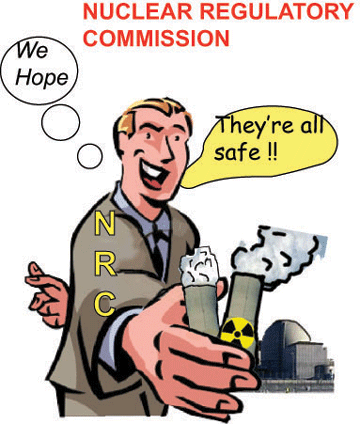
 U.S. Said to Join Russia in Blocking Nuclear Safety Moves, Bloomberg By Jonathan Tirone Oct 23, 2014 The U.S. and Russia are joining forces to block a European plan to raise the protection of nuclear reactors against natural disasters after the meltdowns at Japan’s Fukushima Dai-Ichi power plant, diplomats say.
Envoys from both countries are trying to derail a Swiss-led initiative that would force nuclear operators to invest more on safety, undermining attempts to harmonize global safety regulation, according to eight European and U.S. diplomats who attended meetings in Vienna last week. All asked not to be named in line with rules kept by the Convention on Nuclear Safety, the legal body overseeing the talks……….
Nuclear Secrecy
The U.S.-Russia collaboration reflects a nuclear-safety convention whose secrecy is laid bare in documents obtained by Bloomberg News under a Freedom of Information Act request.
It also underscores the high stakes for an industry trying to bounce back after the Fukushima accident. European attempts to impose higher safety standards would make nuclear power more costly just as plant operators come under price pressure from cheaper natural gas………
Less Stringent
U.S. regulators aren’t requiring the same stringent modifications, according to Edwin Lyman of the Cambridge, Massachusetts-based Union of Concerned Scientists, an advocacy group. European utilities pay as much as five times more to fit out plants to withstand earthquakes and floods as a result, he said………..
While nuclear meltdowns are considered cross-border incidents because of the radioactive fallout that can result, no international authority exists to compel countries to adopt safety standards. Instead, regulators from around the world routinely review each other’s practices to figure out which works best. Laggards face peer criticism that can make them look bad in forums like the convention.
Falsified Data
At the convention’s 2008 meeting — the last before Fukushima — Japan was criticized by peers for being slow to overhaul a reporting system that had been caught using “falsified inspection data,” the documents show. Participants also urged Japan, then the world’s third-largest nuclear-power generator, to review how safe its reactors were against earthquakes……..http://www.bloomberg.com/news/2014-10-23/u-s-said-to-join-russia-in-blocking-nuclear-safety-moves.html
UK Navy’s nuclear facilities at Faslane and Coulport have appalling safety record
 Revealed: chilling nuclear safety blunders plague Scots bomb base, Questions to be raised in house of commons as Mod comes under fire Herald Scotland, by Rob Edwards Environment Editor Saturday 25 October 2014 There has been a sharp rise in the number of “chilling” safety blunders at the nuclear bomb and submarine bases on the Clyde, according to internal reports from the Ministry of Defence (MoD). In the last five years there have been 316 “nuclear safety events”, 2044 fire alarm incidents and 71 fires at the Royal Navy’s controversial facilities at Faslane and Coulport near Helensburgh.
There have also been more than 3000 “near miss” industrial accidents, a positive test for illegal drugs and a series of difficulties with wild animals.
The revelations have been described as “chilling” by Angus Robertson MP, the Scottish National Party’s leader at Westminster and its defence spokesman. He is planning to raise them urgently in the House of Commons, and is demanding action from the MoD.
The new figures showed that nuclear safety breaches at the Clyde bases were “widespread”, he said……….
Independent nuclear expert John Large was scathing about the MoD’s safety standards. He said: “From these reports, one gets the distinct impression that health and safety operations at HMNB Clyde are more akin to those practiced in a backstreet car repair shop than a naval base servicing advanced and armed warships, some of which are carrying nuclear weapons and propelled by nuclear reactors.”
Safety problems were increasing, the number of false fire alarms was “totally unacceptable” and the MoD reports were “muddled and at times misleading”, Large alleged.
He added: “The regulation of health and safety matters at the base should be taken from the military and put squarely under the control of a civilian operated regulatory regime.”
The Scottish Campaign for Nuclear Disarmament accused the MoD of failing to gain control of the risks of handling nuclear weapons and submarines.
“The sharp rise in nuclear weapons safety events is particularly worrying,” said the campaign’s co-ordinator, John Ainslie. “If the safety record continues to decline, then it is only a matter of time before there is a major problem.”…….http://www.heraldscotland.com/news/environment/revealed-chilling-nuclear-safety-blunders-plague-scots-bomb-base.25691690
For US government, exporting nuclear technology is more important than public safety
 US opposes pos t-Fukushima nuclear safety proposal http://rt.com/usa/199024-cns-nuclear-safety-proposal/
But while Reuters says the Swiss-led initiative is tentatively being backed by other European countries, the newswire alleges that energy officials in the US, Russia and Canada are all opposed to the measure, which would likely increase industry costs.
Although details of the proposed pact have not been made public, Bloomberg reported that it would involve rewriting “international standards to ensure nuclear operators not only prevent accidents but mitigate consequences if they occur, by installing costly new structures built to survive natural disasters.” In a report published on Thursday this week by Reuters, the newswire said that the proposed changes would not only apply up-to-date safety standards for new reactors, but also carry out back-fitting measures on sites that are already in operation.According to this week’s reports, however, some of the world’s top energy powers are opposed because, as Reuters’ Fredrick Dahl wrote, any changes to the CNS could take years to be installed if, of course, they are ratified by the dozens of nations involved. “You are trying to drop a Ferrari engine into a Volkswagen. If you want a new car, let’s go to the show room” and buy one, a senior but unnamed Department of State official said to Dahl.
But experts have previously said American facilities, in particular, are in need of upgrades, with a July 2014 report published by the National Academy of Science that said the US “should access their preparedness for severe nuclear accidents associated with offsite-scale disasters.” Additionally, the authors of that study wrote that America’s current approach to nuclear safety is “clearly inadequate for preventing core-melt accidents and mitigating their consequences,” yet newly-initiated upgrades in the US are being conducted on a scale hardly comparable to what’s occurring overseas: according to Bloomberg, Electricite de France SA is spending around $13 billion on implementing safety measures on its 59 reactors, whereas American utilities will spend only $3 billion on portable generators and cooling reserves for roughly 100 reactors.
Nevertheless, officials in Berne remain optimistic that the countries currently opposed to the proposed changes will come to an agreement that makes facilities around the world more secure.
“Switzerland, as the initiator of the proposal, will continue to collaborate with all delegations and do everything to find a solution that is acceptable to all of us,” Georg Schwarz, deputy director general of the Swiss nuclear-safety regulator, ENSI, wrote to Bloomberg Business Week.
Russian officials did not immediately respond to Bloomberg’s requests for comment, and neither BusinessWeek nor Reuters included remarks from Canada in their report.
Volcanic activity increasing in area near Japan’s nuclera power plant
Japan warns of increased activity at volcano near nuclear plant TOKYO Fri Oct 24, 2014 (Reuters) Reporting by Elaine Lies; Editing by Michael Perry– Japan warned on Friday that a volcano in southern Japan located roughly 64 km (40 miles) from a nuclear plant was showing signs of increased activity that could possibly lead to a small-scale eruption and warned people to stay away from the summit.
The warning comes nearly a month after another volcano, Mt Ontake, erupted suddenly when crowded with hikers, killing 57 people in Japan’s worst volcanic disaster in nearly 90 years.
Ioyama, a mountain on the southwestern island of Kyushu, has been shaken by small tremors and other signs of rising volcanic activity recently, including a tremor lasting as long as seven minutes, an official at the Japan Meteorological Agency’s volcano division said……..
Ioyama lies in the volcanically active Kirishima mountain range and is roughly 64 km from the Sendai nuclear plant run by Kyushu Electric Power Co, which the Japanese government wants to restart even though the public remains opposed to nuclear power following the Fukushima crisis.
Critics point out that the Sendai plant is located about 50 kms (31 miles) from Mount Sakurajima, an active volcano that erupts frequently. Five giant calderas, crater-like depressions formed by past eruptions, are also in the region, the closest one 40 kms (25 miles) away.
The plant still needs to pass operational safety checks as well as gain the approval of local authorities and may not restart till next year……..http://www.reuters.com/article/2014/10/24/us-japan-volcano-idUSKCN0ID0A320141024?feedType=RSS&feedName=worldNews
USA’s nuclear lobby wants to extend life of reactors to 80 years: others not so sure.
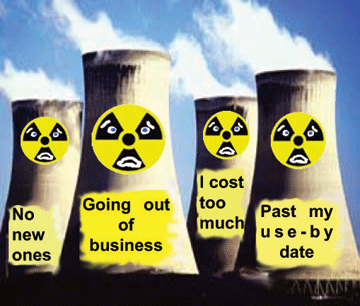 Power Plants Seek to Extend Life of Nuclear Reactors for Decades NYT, By MATTHEW L. WALD OCT. 19, 2014 The prospects for building new nuclear reactors may be sharply limited, but the owners of seven old ones, in Pennsylvania, Virginia and South Carolina, are preparing to ask for permission to run them until they are 80 years old.
Nuclear proponents say that extending plants’ lifetimes is more economical — and a better way to hold down carbon dioxide emissions — than building new plants, although it will require extensive monitoring of steel, concrete, cable insulation and other components. But the idea is striking even to some members of the nuclear establishment.
At a meeting of the Nuclear Regulatory Commission in May, George Apostolakis, a risk expert who was then one of the five commissioners, pointed out that if operation were allowed until age 80, some reactors would be using designs substantially older than that.“I don’t know how we would explain to the public that these designs, 90-year-old designs, 100-year-old designs, are still safe to operate,” he said. “Don’t we need more convincing arguments than just ‘We’re managing aging effects’?”
“I mean, will you buy a car that was designed in ’64?” he asked……. Continue reading
Funds running out for completion of massively expensive cover over crumbling Chernobyl nuclear reactor
Funding woes delay new Chernobyl cover, DW 17 Oct 14 The casing around the ruined nuclear reactor at Chernobyl is crumbling, causing a renewed radioactive contamination risk. A new cover for the site is under construction – but the project is running out of funding. “There’s no precedent for this anywhere in the world,” Jochen Flasbarth said. “Of course there is uncertainty.”
The German Ministry of the Environment’s senior civil servant was talking about the New Safe Confinement – a new protective cover that is to be built over the stricken reactor at the Chernobyl nuclear power plant in Ukraine: 100 meters high, 165 meters long, built at a safe distance from the still radioactive ruin.
The cover will slide over the reactor on rails. It will be three times as large as St. Peter’s Basilica in Rome – if it is finished. But at the moment there is no money – that’s the “uncertainty” Flasbarth was talking about.
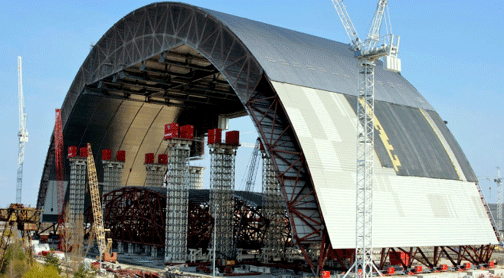
There will be a shortfall of 600 million euros by the end of the year. Construction is proving to be more expensive than expected, and funding more difficult to obtain. A Ukrainian government construction freeze now threatens the project.
New containment, new money
Flasbarth, who is responsible for energy issues at his ministry, intends to speak with his counterparts from the G7 Group on Nuclear Issues in Bonn in mid-October. The G8 – as it was known before Russia was ejected from the group earlier in 2014 – had promised years ago to help Ukraine build the containment system. Now new money is required……….
The total damage has been estimated at 180 billion dollars. The area around the stricken reactor is still highly contaminated, and the concrete sarcophagus poured over the reactor in a rush after the accident has become unstable.
Years of effort
That’s why a French consortium has spent the last few years building the new protective cover. One part is finished, and a second is still being worked on. Meanwhile, Reactor 4 is crumbling – and threatening to expose 200 tons of highly radioactive material to the environment, including the destroyed fuel rods.
The removal of these materials can begin only when the New Safe Confinement is finished, which means over 30 years will have passed since the accident. No one now expects the construction to be finished next year as planned……..http://www.dw.de/funding-woes-delay-new-chernobyl-cover/a-17997493
With Fran ce’s nuclear reactors all too close, Luxembourg hands out iodine pill sto 500,000 residents
 Luxembourg hands out iodine pills over fears of French nuclear mishap TONY PATERSON http://www.independent.co.uk/news/world/europe/luxembourg-hands-out-iodine-pills-over-fears-of-french-nuclear-mishap-9802668.html FRIDAY 17 OCTOBER 2014 A series of accidents at France’s controversial Cattenom nuclear power station has prompted the government in neighbouring Luxembourg to take the unprecedented step of issuing free iodine pills to its half a million citizens to help protect them in the event of a serious nuclear incident at the plant. Continue reading
South Korea monitors products, very aware of nuclear radiation from Japan
 South Koreans Still Fear Radiation From Japan WSJ, 17 Oct 14 More than three years have passed since the nuclear disaster in Fukushima, Japan, but some South Koreans are still leery over possible radioactive contamination from their neighbor.
Environmental activists and residents of Changwon, a city on South Korea’s southeastern coast, staged a rally Tuesday in front of a steel company to protest its import of scrap steel from Japan through a nearby port of Masan.
The protesters demanded local steel companies stop importing Japanese steel for recycling through seaports that aren’t equipped with radioactive detection devices, such as Masan.
“A case in August, in which imports of scrap steel from Japan were found to contain radioactive material and sent back to Japan clearly shows we’re exposed to a real risk,” said Park Jong-kwon, chairman of the Masan Changwon Jinhae Korea Federation of Environmental Movements.
Mr. Park said his group will continue to demand the government divert such imports to other ports until Masan has a radiation detection system.
Concerns have heightened after the Seoul government in August found some imported scrap metal from Japan bore traces of radiation and ordered the importer to return the items to Japan.
The protest in Changwon followed similar complaints earlier this week by a civic group in another port city of Gunsan, southwest of Seoul, that the country should stop steel imports from Japan.
The Nuclear Safety and Security Commission said Aug. 11 that it had returned some steel scrap imported from Japan due to radiation contamination, the first returned shipment since Seoul heightened nuclear safety checks in 2012………
One of Korea’s industries hit hardest by Japan’s latest nuclear disaster was seafood as domestic sales of marine products plummeted following leaks of radioactive water from the Fukushima Daiichi nuclear power plant in 2011.
Since September last year, the Seoul government has blocked all fishery imports from prefectures surrounding the Fukushima plant. http://blogs.wsj.com/korearealtime/2014/10/15/south-koreans-still-fear-radiation-from-japan/
UK plants turn down energy out put because of cracks developing
 Nuclear reactor heat turned down to stop boilers cracking Two nuclear plants shut amid safety fears may be restarted at just 75pc usual power output to prevent more cracks developing, EDF says Telegraph, By Emily Gosden, Energy Editor 17 Oct 14, Power output at two UK nuclear plants will be curbed for up to two years in order to reduce the heat in their boilers and prevent cracks developing, EDF has announced.
The two twin-reactor plants at Heysham 1 and Hartlepool have been shut down since August amid safety fears following the discovery of cracks in one boiler structure at Heysham.
The ageing reactors are likely to be restarted in coming months at just 75pc-80pc of their usual output in order to prevent high temperatures causing further cracks, EDF said on Friday.
The move will further worsen the risk of power shortages this winter and next.
The temporary closure of the plants, which produce enough power to meet about 4pc of peak winter demand, has already forced National Grid to invoke emergency measures to bolster power supplies this winter, by paying mothballed power stations to fire up.
EDF warned in September that the reactors – initially expected to be shut for two months – would only be restarted gradually between the end of October and late December, once safety checks on each reactor’s eight boilers were finished.
On Friday it further revised the likely dates of the restarts. The restart of the reactor with cracks has been pushed back a month, from the end of November to the end of December. Two other reactors have been pushed back from the end of October to November 9, and the fourth reactor has been brought forward from November 30 to November 22………
The cracks at Heysham 1 are in a “boiler spine”. The Office for Nuclear Regulation said that the spine “supports the weight of an entire boiler and its failure could lead to water entering the reactor vessel”.
“The potential worst consequences of water entering the reactor vessel is an over-pressurisation of the reactor which could result in lifting of the reactor pressure relief valves. If this was to occur co-incidentally with fuel damage then there could be a direct path to the environment and a release of radiation,” it said……..
As well as firing up mothballed power plants, National Grid is also using emergency plans to pay factories to switch off on winter weekdays to ease demand to help ensure households’ lights are kept on. http://www.telegraph.co.uk/finance/newsbysector/energy/11169625/Nuclear-reactor-heat-turned-down-to-stop-boilers-cracking.html
Bangladesh’s dangerous nuclear power program
Is a nuclear disaster looming in Bangladesh? http://www.thedailystar.net/is-a-nuclear-disaster-looming-in-bangladesh-46005 Abdul Matin 16 Oct 18, The writer is a former chief engineer of Bangladesh Atomic Energy Commission.
The Bangladesh Atomic Energy Regulatory (Amendment) Bill, 2014 was passed by the parliament on September 14. Surprisingly, instead of bringing the qualifications and experience in conformity with the IAEA guidelines, the amendment further relaxed the qualifications of the top brass of BAERA to “adequate qualification and experience about nuclear energy management.” “Adequate qualification and experience” is a vague term subject to interpretations. In technical terminology, it carries little significance. Moreover, management of nuclear energy does not necessarily imply nuclear safety. The door has thus been opened, perhaps deliberately, to any Tom and Harry to occupy the top positions of BAERA. It shows that the authorities are least concerned about the safety of the proposed nuclear plant at Rooppur.
The real motive for making the amendment is a mystery. It is probable that the changes were made because of unavailability of sufficiently qualified and trained engineers. In that case, our priority should have been to train necessary manpower first before embarking on an ambitious nuclear power programme. Furthermore, the concerned authorities are solely responsible for creating this crisis. They, perhaps due to negligence or incompetence, did not initiate any serious programme of recruitment and training of nuclear engineers during the last six years in spite of our strong recommendations at a round table organised by The Daily Star and ABUETA (DS, May 10, 2009) and attended by the adviser on power and energy and the state minister of science and technology. Did we not have enough time to train at least fifty nuclear engineers with MS degrees by now if we had acted promptly at that time?
The recent amendment could partly relax the experience only in selected cases but certainly not the requirements of qualifications or training. How can one ensure nuclear safety without a solid background (at least at MS level) in nuclear engineering and nuclear reactor safety? It is inconceivable and unacceptable in the nuclear industry. By relaxing the qualifications and experience of the top officials of the BAERA, the authorities have acted most irresponsibly and put the country at the risk of a likely ‘man-made’ nuclear disaster.
Russia protects nuclear weapons stockpiles from cyber sabotage
 Cyber security units to protect Russia’s nuclear weapons stockpiles RT.com October 17, 2014 The IT systems of all Russian nuclear weapons stockpiles will be protected by a new team of anti-hackers, the Defense Ministry said after a year-long “hunting season” for programmers.
Special units of the Russian Strategic Missile Forces (SMF), responsible for the country’s nuclear weapons, will reduce the vulnerability, should it be found, in their brand-new information systems, according to the Defense Ministry’s spokesman……..http://rt.com/news/196720-russia-missile-forces-cybersecurity/
Radiation samples falsified to make Hunters Point look clean
 Contractor Submitted False Radiation Data at Hunters Point, NBC Bay Area In an internal report uncovered by the Investigative Unit, Tetra Tech says it provided the Navy false soil samples while working on the radiological cleanup of the Hunters Point shipyard By Vicky Nguyen, Liz Wagner and Felipe Escamilla Monday, Oct 13, 2014
A Navy contractor tasked with cleaning radioactive soil at the Hunters Point Naval Shipyard in San Francisco admitted in an internal report obtained exclusively by the NBC Bay Area Investigative Unit that it mishandled soil samples and submitted false data.
Tetra Tech, a multinational engineering, construction and environmental corporation details in an April 2014 report how it was caught submitting false soil samples to the Navy in an apparent effort to declare the soil free of radiological contamination when it may not have been. The Pasadena-based company is a $2.7 billion per year business that has won more than $300 million worth of contracts for cleanup work at Hunters Point………
“If the Navy had not caught this,” Bowers said, “there would be very, very high levels of contaminated soil, radioactive soil in the ground, where the plans are in place to build homes for the general public to live in, with yards for children to play in.”
Bowers is one of four radiation specialists who blew the whistle on Tetra Tech’s practices and are now suing the company for retaliation, claiming they were fired after questioning the company’s actions. Bowers first spoke with the Investigative Unit earlier this year saying the cleanup of Hunters Point had been compromised and that Tetra Tech cut corners on safety to save money……..http://www.nbcbayarea.com/investigations/Contractor-Submitted-False-Radiation-Data-at-Hunters-Point-279025911.html
1 This Month
26 September – International Day for the Total Elimination of Nuclear Weapons





PLEASE OPPOSE HR 8255 AND S.3639 – bills would accelerate satellite deployment, with no environmental review or safeguards – https://ncstd5li.quorum.us/campaign/169331/
To see nuclear-related stories in greater depth and intensity – go to https://nuclearinformation.wordpress.com
-
Archives
- September 2026 (323)
- August 2026 (330)
- July 2026 (355)
- June 2026 (287)
- May 2026 (306)
- April 2026 (356)
- March 2026 (251)
- February 2026 (267)
- January 2026 (308)
- December 2025 (358)
- November 2025 (359)
- October 2025 (375)
-
Categories
- 1
- 1 NUCLEAR ISSUES
- business and costs
- climate change
- culture and arts
- ENERGY
- environment
- health
- history
- indigenous issues
- Legal
- marketing of nuclear
- media
- opposition to nuclear
- PERSONAL STORIES
- politics
- politics international
- Religion and ethics
- safety
- secrets,lies and civil liberties
- spinbuster
- technology
- Uranium
- wastes
- weapons and war
- Women
- 2 WORLD
- ACTION
- AFRICA
- Atrocities
- AUSTRALIA
- Christina's notes
- Christina's themes
- culture and arts
- Events
- Fuk 2022
- Fuk 2023
- Fukushima 2017
- Fukushima 2018
- fukushima 2019
- Fukushima 2020
- Fukushima 2021
- general
- global warming
- Humour (God we need it)
- Nuclear
- RARE EARTHS
- Reference
- resources – print
- Resources -audiovicual
- Weekly Newsletter
- World
- World Nuclear
- YouTube
-
RSS
Entries RSS
Comments RSS

