Disturbing information about Rosatom’s nuclear reactors – a warning to Finland

 Writer warns MPs about nuclear contractor Rosatom, YLE UUTISET, 5 DEc 14, Finnish author Risto Isomäki issued a warning letter about the Russian nuclear contractor Rosatom to MPs as they prepared to vote on granting a new permit for a nuclear power project in the country’s northwest. The missive paints a disturbing picture about a nuclear plant constructed by Rosatom in India. Environmentalist and science fiction writer Risto Isomäki’s letter to MPs centres on Rosatom’s turnkey nuclear power plant project in India and has been reproduced in the Social Democratic Party organ, Demari, as well as in social media.
According to Isomäki the first reactor of a nuclear power facility constructed by Rosatom in Kudankulam in India has suffered 14 spontaneous power outages in the year since it has been completed. It has also been taken offline five times for repair and maintenance work in the same one-year period, he writes. The author claimed that according to his information the reactor has now been shut down because it has not passed final commissioning tests.
One of the recipients of the letter was National Coalition Party MP, Harri Jaskari, who also sits on the Parliament’s Finance Committee. Jaskari said that the claims made by Isomäki about the Indian facility were not previously known to committee members……..http://yle.fi/uutiset/writer_warns_mps_about_nuclear_contractor_rosatom/7673069
Ukraine government had to admit to nuclear accident at Zaporizhzhya power plant
Nuclear Accident In Ukraine: Largest Nuke Plant In Europe Shut Down, But ‘No Threat,’ Gov’t Claims, INQUISITR, 3 Dec 14 A nuclear accident at a power plant in Ukraine, the largest nuclear power plant in Europe, shut the plant down last Friday, but the Ukraine government did not reveal the alarming mishap until Wednesday, claiming that the accident posed “no threat” to the public from radiation.

The nuclear plant is located just 120 miles from the war-torn eastern Ukraine region of Donetsk, a stronghold of pro-Russian separatist rebels who have battled the Ukraine government in heavy fighting for much of 2014.
Donetsk is the region where on July 17, Malaysia Airlines Flight MH17 was shot down by, it is widely believed, a rebel anti-aircraft missile, killing all 298 people on board.
Nuclear experts have raised the alarm that the power plant could be vulnerable to artillery fire from the war zone nearby………http://www.inquisitr.com/1652271/nuclear-accident-in-ukraine/
Japan’s political gamble; they cannot be sure that nuclear restart will be safe

 Japan’s nuclear dilemma 03 December 2014 by Robert J. Geller Some Japanese nuclear reactors, mothballed since the 2011 Tohoku quake, may soon restart. But nature can outpace new safety precautions, warns a geophysicist “………The Sendai plant faces some specific risks. The site is about 50 kilometres from a large active volcano, Sakurajima, and there are several other active volcanoes on Kyushu. A large eruption would pose obvious safety issues for the plant, but its operator has said that advance warnings of an impending eruption would allow them to take appropriate measures. Doubts about this sanguine view were reinforced by the eruption of Mount Ontake on Honshu, without warning, in September. It killed more than 50 climbers out for a weekend stroll.
A variety of natural hazards, including earthquakes and subsequent tsunamis, pose risks to reactors throughout Japan. I have written extensively about the lack of success of both short and long-term earthquake prediction (Nature, vol 472, p 407). It is well known that accurate predictions of fracture and failure phenomena such as earthquakes are, in general, impossible. Intellectually honest discussions of nuclear safety with regard to earthquakes must start by acknowledging this.
Before Tohoku, the Japanese government’s seismic hazard map assumed that earthquakes off that coast would not exceed magnitude 7.5 to 8.0. The most authoritative estimate for the size of the Tohoku quake is magnitude 9.1. Given that the energy released by an earthquake increases 30-fold for every 1.0 increase in magnitude, this is a huge discrepancy………
- And although advice from specialists is necessary, it is Japan’s political leaders, as well as the voters who elect them, who must take ultimate responsibility for the decision to restart its nuclear plants.Robert J. Geller is professor of geophysics at the University of Tokyo http://www.newscientist.com/article/mg22429972.800-total-safety-an-illusion-for-japans-nuclear-restart.html#.VIJRwNLF8nn
Britain’s aging nuclear reactors getting near to closing time
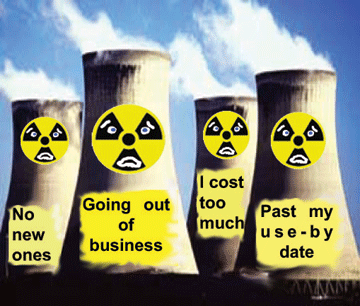
 The coming nuclear crisis: All but one of Britain’s ageing reactors ‘will need to close in 15 years’ , The Independent, 5 Dec 14 All but one of Britain’s ageing fleet of nuclear reactors will have to be closed down within 15 years due to concerns over their economic viability or safety, a panel of experts has warned…….. Professor Williams warned that there will be a point when either it will be uneconomic to continue operating a given nuclear reactor, due to the additional maintenance work needed, or if it becomes too unsafe……http://www.independent.co.uk/news/uk/politics/the-coming-nuclear-crisis-all-but-one-of-britains-ageing-reactors-will-need-to-close-in-15-years-9896597.html
Ineffective parts in 14 South Korean nuclear reactors
|
’14 reactors have ineffective parts’ http://www.koreatimes.co.kr/www/news/nation/2014/12/116_169248.html
|
USA’s Nuclear Waste Isolation Pilot Project (WIPP) has now its ‘Worst Case Scenario’

 ‘Worst Case Scenario’ has happened at US nuclear site — Robert Redford film predicted 2014 WIPP disaster: Plutonium release due to chemical reaction in burst nuclear drum is ultimate catastrophe… Most significant issue is combustible waste exposed to high heat, everyone understands that (VIDEO) http://enenews.com/worst-case-scenario-nuclear-site-1989-robert-redford-film-predicted-2014-disaster-wipp-plutonium-release-due-chemical-reaction-burst-nuclear-drum-ultimate-disaster-significant-issue-combustible-was?utm_source=feedburner&utm_medium=email&utm_campaign=Feed%3A+ENENews+%28Energy+News%29
Sante Fe New Mexican, Nov 30, 2014: [D]ocuments obtained by The New Mexican… raise questions about the stability of dozens of other nuclear waste drums that were in the same chamber as the drum that ruptured [after a] chemical reaction… Radiation leaked into the air, and temperatures in the underground chamber peaked at nearly 1,600 degrees… One internal lab report described the [contents] as similar to plastic explosives… Investigators believe the organic material may be one reason temperatures in the chamber rose so high… Internal emails… detail concerns about the stability of drums… exposed to the extreme temperatures… June 17 draft of a LANL report… suggested the high temperatures may have made other nuclear waste drums in the chamber more unstable than ever…
Albuquerque Journal, guest column by Harish C. Sharma, retired engineer, Nov 30, 2014: Department of Energy’s Office of Inspector General… report mentions that the use of “kitty litter/Zeolite clay”… may have been the cause of the fire and release of radiation… What is the real cause of the incident? No one is sure… What if the real reason for the fire and release of radiation was not the “kitty litter”?… Without finding the real cause, DOE and LANL’s actions only assure that this incident will occur again.
The WIPP Trail, narrated by Robert Redford, 1989 (at 17:00 in):
- Robert Redford: We now know that 40% of the [WIPP] hazardous waste is combustible, thus posing a more serious and immediate threat.
- Bruce Throne, New Mexico State Attorney: I think the combustible waste is perhaps the most significant because even a layman can understand that when combustible waste is exposed to high levels of heat, there may be some effectinside the TRUPAC [containers].
- Redford: Wind is a critical factor that must be considered. The worst case scenario would be if a fire occurs within a breach of a container. The wind could then carry plutonium particles through the atmosphere, traveling considerable distances.
- Oxford Dictionary’s definition of fire: “Combustion or burning, in which substances combine chemically with oxygen from the air and typically give out bright light, heat, and smoke”
Belgian nuclear reactor shut down due to fire: Belgium phasing out nuclear power
 Fire shuts down Belgian nuclear reactor https://au.news.yahoo.com/world/a/25650869/fire-shuts-down-belgian-nuclear-reactor/A Belgian nuclear reactor has shut down after a fire broke out at the plant in the east of the country, the Belga news agency reported. The incident on Sunday could put a further strain on Belgium’s electricity grid, after warnings in August that outages at other nuclear plants could lead to power cuts in the approaching winter.
The Tihange 3 power station, situated 70 kilometres south-west of the German town of Aachen, shut down automatically after one of its transformers reportedly caught fire. The fire, which has since been extinguished, was caused by an explosion, Sudpresse newspaper group reported on its website.
It was unclear Sunday how long the 1,048-megawatt reactor will remain out of service.Tihange 3 is now the fourth Belgian nuclear reactor to be out of service, as another plant at Tihange and two at Doel have been shut down due to defects or security concerns.
The Tihange 1 reactor was not affected by Sunday’s incident, however. Belgium has adopted a nuclear phaseout plan that foresees the complete abandonment of nuclear energy by 2025.
British jihadi claims that Islamic State has a ‘dirty bomb’
Islamic State has a ‘dirty bomb’ says British jihadi, amid claims 40kg of URANIUM was taken from Iraqi university, Daily Mail,
- Chemical was stolen from Mosul University, northern Iraq, in July
- UN ambassador wrote letter at time of theft fearing ‘mass destruction’
- Hamayun Tariq among jihadis to boast of explosives on Twitter
- Hinted at the potential destruction of such a bomb if detonated in London
- British 37-year-old had social media account suspended afterwards
By JENNIFER SMITH FOR MAILONLINE, 30 November 2014 |slamic State fanatics claim to have constructed a dirty bomb after stealing 40kg of uranium from an Iraqi university.

Militants boasted of the device on social media, with one even commenting on the destruction such a bomb would wreak in London, four months after the chemical was reported missing from Mosul University.
Among extremists making online threats to the West is British explosives expert Hamayun Tariq, who fled his home in Dudley, West Midlands, for the Middle East in 2012.
Scroll down on original page for video ………http://www.dailymail.co.uk/news/article-2854729/Islamic-State-dirty-bomb-says-British-jihadi-amid-claims-40kg-uranium-taken-Iraqi-university.html
IAEA tells France to smarten up on nuclear power safety
IAEA recommends France raises funds, workforce for nuclear safety, Reuters, PARIS Fri Nov 28, 2014 “……..As the reactors age, approaching 40-years old in the next decade, French nuclear watchdog ASN will need more frequent safety checks requiring more staff and funds, both hard to obtain given government budget constraints……..The head of ASN, Pierre-Frank Chevet, has regularly warned officials of the need to increase the authority’s budget and workforce, but has so far obtained only a fraction of its estimates…….
Chevet also called for a new tax on nuclear operators that would be ringfenced for nuclear safety.
The IAEA mission, which did not disclose the draft report to reporters, also identified issues in need for improvement in the regulatory framework for the control of medical exposure to radiation and in “processes needed to deliver ASN’s mandate.”………
The final report will be given to the French government and made public in about three months. (Reporting by Michel Rose Editing by Jeremy Gaunt) http://www.reuters.com/article/2014/11/28/us-france-nuclear-safety-idUSKCN0JC1LF20141128
Pickering nuclear power station has radioactive leak
Radioactive leak at Pickering nuclear station, Caledon Enterprise, 26 Nov 14
Heavy water contained inside reactor; no impact to public, environment Pickering News Advertiser
PICKERING — Thousands of litres of radioactive heavy water leaked in a reactor at the Pickering nuclear station Friday.
The incident happened in Unit 7, which was undergoing a scheduled maintenance outage, at about 4 p.m. on Nov. 21.
A valve on the moderator system opened inside the reactor building, Ontario Power Generation reported on Twitter….. 6,900 litres of heavy water leaked……http://www.caledonenterprise.com/news-story/5154334-updated-radioactive-leak-at-pickering-nuclear-station/
Powerful earthquake hits Japan
Powerful quake rocks Japan, 6- out of 7 on intensity scale — Officials warn of strong aftershocks, around 50 so far — Helicopters find “more extensive damage than earlier thought” — Major roads collapsed, buildings flattened — Witnesses: “Strongest ever felt… Shaking was enormous” (VIDEOS) http://enenews.com/powerful-quake-rocks-japan-6-7-intensity-scale-officials-warn-landslides-strong-aftershocks-50-helicopters-find-extensive-damage-earlier-thought-major-roads-collapsed-buildings-flattened?utm_source=feedburner&utm_medium=email&utm_campaign=Feed%3A+ENENews+%28Energy+News%29
Reuters: 6.8 [quake] jolted central Japan on Saturday evening… felt in the capital Tokyo 180 km away… an advanced party of Japan’s military had been sent… “the tremor was too strong to stand,” said… an NHK employee.
AP: Helicopter surveys on Sunday showed more extensive damage than earlier thought from an overnight earthquake… footage showed buildings in various states of collapse, some flattened and others leaning… and deep cracks in the roads… The quake was followed by more than 45 aftershocks… [Officials] urged residents to watch out for landslides.
Voice of America: A powerful 6.8-magnitude earthquake… halted high-speed train service, caused several major roads to collapse and shut down others because of landslides.
Xinhua: Nagano prefecture government has enforced the disaster relief law… [Officials] warned of possible strong aftershocks… the government has set up a disaster relief office.
AP: One of the strongest ever felt in recent years by residents… Ryo Nishino, a restaurant owner… “never experienced a quake that shook so hard… shaking was enormous.”… The earthquake was felt across much of northern Japan… the Meteorological Agency… warned of further aftershocks.
ABC Australia: 21 aftershocks in the 90 minutes following the quake [and] tremors continued… “an aftershock registering upper 5 could occur in the coming week,” an agency official said… The quake was felt in wide areas from [including] Tohoku in north-eastern Japan… train systems in… Tohoku, Yamagata, Akita, Joetsu and Nagano… temporarily stopped.
AFP: Footage showed flattened wooden houses… “It’s quite a strong earthquake for an inland one,” an official at the Japanese agency told a midnight press conference. “We are worried about the extent of damage to houses and buildings,” he said… police and municipal officials said they were still scrambling to collect information as they were operating in the dark… The meteorological agency warned strong aftershocks could still occur in the coming week.
NHK: Japanese officials warn of quake aftershocks — Officials at Japan’s Meteorological Agency are warning people to be on the alert for aftershocks in the days ahead after a magnitude 6.7 earthquake… The tremor registered intensities of 6-minus on the Japanese scale of 7.
Fox News: Fukushima is about 155 miles northeast of where Saturday’s earthquake occurred.
Video: NHK here | CBS here | Fox News here
Security problems surround mysterious drone flights over France’s nuclear power plants
Drone flights were first reported over at least 13 nuclear facilities in October. The flights have taken place mostly at night, involving drones of different sizes and capability, from smaller models that would need to be operated within the immediate vicinity to larger ones around two meters in size, which could be controlled from kilometres away. Flights have been carried out both in isolation and concurrently, with drones flown simultaneously over nuclear facilities hundreds of miles apart.

Risk assessment
It is difficult to assess the risk posed by the recent drone flights as at this point it is unclear who is behind them and crucially what their intentions and capabilities are…….
worryingly, drones could be used to carry explosives for detonation close to the reactor or other sensitive parts of a nuclear site, although there have been no reports to date that these drones have been carrying a malicious cargo…….
Drones could also have other malicious uses. When mounted with small cameras, they could be used to conduct reconnaissance or to test security provisions before carrying out a follow-up attack by other means. Or they could be potentially used to drop equipment onsite to help out a malicious insider. A recent case in Belgium involving the sabotage of non-nuclear systems of a power station by an employee highlights that insiders can pose a real threat……..http://theconversation.com/mystery-drones-are-buzzing-around-french-nuclear-plants-should-we-be-worried-34447
Radioactive release to air resulting from fire at Dounreay nuclear power station.
 Dounreay nuclear plant fire led to ‘unauthorised’ radioactivity release Investigation identifies ‘unacceptable practices by staff’ relating to 7 October fire at site being decommissioned , Guardian, Terry Macalister, 22 Nov 14
 The nuclear plant has been censured by safety regulators after admitting human error led to the release of radioactivity into the atmosphere.
The criticism comes just weeks after another nuclear plant, Sellafield in Cumbria, was also tackled by the safety regulator over its management of asbestos while pictures emerged of badly corroded storage ponds there.
Environmentalists said the problems highlighted dangers from building a new generation of nuclear plants which however well designed would be vulnerable to human fallibility………
Dounreay Site Restoration Limited (DSRL), controlled by a consortium involving the engineering group Babcock, is involved in a £1.6bn contract to dismantle Dounreay, a prototype “fast reactor” built to experiment with nuclear fission in the 1950s and 60s……….

John Sauven, executive director of Greenpeace UK, said the problems at Dounreay were disturbing. “Until we can clone enough popes to staff all the world’s nuclear reactor control rooms, there will always be a fallible human component in nuclear power stations. This worrying news demonstrates why it’s important to remember that even a reactor design which looks safe on paper can never completely design out the actions of human beings. Its why renewable energy always scores better on safety, because far less can go wrong.”
The Nuclear Free Local Authorities Secretariat, the local government voice on nuclear issues, described the Dounreay incident as “alarming” and called for more information.
“To hear that critical staff were not fully conversant in fire safety procedures and that a release of tritium occurred; putting into danger staff and the wider public; is quite disgraceful at such a sensitive nuclear site like Dounreay,” said councillor Mark Hackett, the NFLA’s chair.
The nuclear industry has had a difficult week after Areva, one of the companies involved in the management of Sellafield, issued a profit warning and said it might need a cash injection……..http://www.theguardian.com/environment/2014/nov/21/dounreay-nuclear-plant-fire-radioactivity
Earthquake fault under Tsuruga nuclear reactor is active – say’s Japan’s Nuclear Regulator
 Nuclear watchdog panel: Fault under Tsuruga reactor is active THE ASAHI SHIMBUN, 20 Nov 14
A fault line beneath the No. 2 reactor of the Tsuruga nuclear power plant is indeed active, an expert panel of the Nuclear Regulation Authority concluded Nov. 19, drawing criticism from the plant’s operator.
Japan Atomic Power Co. vowed to challenge the panel’s conclusion, which, if it stands, would force the company to decommission the reactor under new safety rules……..
The NRA’s assessment of the fault last year came when Kunihiko Shimazaki, a seismologist known for his tough attitude toward power companies, was a deputy chairman of the watchdog. Utilities and ruling coalition officials criticized Shimazaki over his “hurried conclusion” on the Tsuruga plant.
Although Shimazaki’s term ended in September and he was replaced, the NRA’s position on the fault was not overturned.
The fault line survey at the Tsuruga plant was originally started at the request of the now-dissolved Nuclear and Industrial Safety Agency.
Fault inspections are a separate process from the safety screenings required to restart reactors, so Japan Atomic Power can still submit an application to resume operations at the reactor.
However, NRA Chairman Shunichi Tanaka has said he would respect the expert panel’s conclusion when deciding whether to allow reactors to restart.
(This article was written by Chikako Kawahara and Daiki Koga.) http://ajw.asahi.com/article/0311disaster/fukushima/AJ201411200043
St Lucie Nuclear Power Plant flooding raises safety problems
Flooding at St. Lucie nuclear plant prompts more oversight from regulators TCPALM, Will Greenlee, Nov 21, 2014 ST. LUCIE COUNTY — The Nuclear Regulatory Commission is stepping up oversight of one of two units at Florida Power & Light Co.’s St. Lucie Nuclear Power Plant after about 50,000 gallons of water entered a reactor auxiliary building during heavy rains in January, according to the NRC.
The incident at the nuclear plant on Hutchinson Island occurred Jan. 9, when more than 7 inches of rain fell on the site, a report states. A blocked storm drain system played a role.
“During the event, stormwater entered the reactor auxiliary building … through degraded electrical conduits that were later found not to have internal flood seals,” a report states………50,000 gallons is about the amount held by a 25-by-45-foot swimming pool with an average depth of 6 feet…….http://www.tcpalm.com/news/local-news/st-lucie-county/flooding-at-st-lucie-nuclear-plant-prompts-more-oversight-from-regulators_24283175
1 This Month
26 September – International Day for the Total Elimination of Nuclear Weapons





PLEASE OPPOSE HR 8255 AND S.3639 – bills would accelerate satellite deployment, with no environmental review or safeguards – https://ncstd5li.quorum.us/campaign/169331/
To see nuclear-related stories in greater depth and intensity – go to https://nuclearinformation.wordpress.com
-
Archives
- September 2026 (323)
- August 2026 (330)
- July 2026 (355)
- June 2026 (287)
- May 2026 (306)
- April 2026 (356)
- March 2026 (251)
- February 2026 (267)
- January 2026 (308)
- December 2025 (358)
- November 2025 (359)
- October 2025 (375)
-
Categories
- 1
- 1 NUCLEAR ISSUES
- business and costs
- climate change
- culture and arts
- ENERGY
- environment
- health
- history
- indigenous issues
- Legal
- marketing of nuclear
- media
- opposition to nuclear
- PERSONAL STORIES
- politics
- politics international
- Religion and ethics
- safety
- secrets,lies and civil liberties
- spinbuster
- technology
- Uranium
- wastes
- weapons and war
- Women
- 2 WORLD
- ACTION
- AFRICA
- Atrocities
- AUSTRALIA
- Christina's notes
- Christina's themes
- culture and arts
- Events
- Fuk 2022
- Fuk 2023
- Fukushima 2017
- Fukushima 2018
- fukushima 2019
- Fukushima 2020
- Fukushima 2021
- general
- global warming
- Humour (God we need it)
- Nuclear
- RARE EARTHS
- Reference
- resources – print
- Resources -audiovicual
- Weekly Newsletter
- World
- World Nuclear
- YouTube
-
RSS
Entries RSS
Comments RSS

