The myth of the “safety” of new nuclear power designs
 Fukushima and the institutional invisibility of nuclear disaster, Ecologist, John Downer 20th December 2014 “………….Complex systems’ ability to keep on surprising
Finally, and most fundamentally, there are many a priori reasons to doubt that any reactor design could be as safe as risk analyses suggest. Observers of complex systems have outlined strong arguments for why critical technologies are inevitably prone to some degree of failure, whatever their design.
The most prominent such argument is Perrow’s Normal Accident Theory (NAT), with its simple but profound probabilistic insight that accidents caused by very improbable confluences of events (that no risk calculation could ever anticipate) are ‘normal’ in systems where there are many opportunities for them to occur.
From this perspective, the ‘we-found-the-flaw-and-fixed-it’ argument is implausible because it offers no way of knowing how many ‘fateful coincidences’ the future might hold.
‘Lesson 1’ of the IAEA’s preliminary report on Fukushima is that the ” … design of nuclear plants should include sufficient protection against infrequent and complex combinations of external events.”
NAT explains why an irreducible number of these ‘complex combinations’ must be forever beyond the reach of formal analysis and managerial control.
A different way of demonstrating much the same conclusion is to point to the fundamental epistemological ambiguity of technological knowledge, and to how the significance of this ambiguity is magnified in complex, safety-critical systems due to the very high levels of certainty these systems require.
Judgements become more significant in this context because they have to be absolutely correct. There is no room for error bars in such calculations . It makes little sense to say that we are 99% certain a reactor will not explode, but only 50% sure that this number is correct.
Perfect safety can never be guaranteed
Viewed from this perspective, it becomes apparent that complex systems are likely to be prone to failures arising from erroneous beliefs that are impossible to predict in advance, which I have elsewhere called ‘Epistemic Accidents’.
This is essentially to say that the ‘we-found-the-flaw-and-fixed-it’ argument cannot guarantee perfect safety because it offers no way of knowing how many new ‘lessons’ the future might hold………
The reliability myth
This is all to say, in essence, that it is misleading to assert that an accident of Fukushima’s scale will not re-occur. For there are credible reasons to believe that the reliability required of reactors is not calculable, and there are credible reasons to believe that the actual reliability of reactors is much lower than is officially calculated.
These limitations are clearly evinced by the actual historical failure rate of nuclear reactors. Even the most rudimentary calculations show that civil nuclear accidents have occurred far more frequently than official reliability assessments have predicted.
The exact numbers vary, depending on how one classifies ‘an accident’ (whether Fukushima counts as one meltdown or three, for example), but Ramana (2011) puts the historical rate of serious meltdowns at 1 in every 3,000 reactor years, while Taebi et al. (2012: 203fn) put it at somewhere between 1 in every 1,300 to 3,600 reactor years.
Either way, the implied reliability is orders of magnitude lower than assessments claim………..http://www.theecologist.org/News/news_analysis/2684383/fukushima_and_the_institutional_invisibility_of_nuclear_disaster.html
USA not ready to cope with a nuclear disaster – watchdog agency report
Report: US Unprepared To Handle Nuclear Disaster The Daily Caller, JONAH BENNETT, 19 DEC 14 According to a watchdog agency, the U.S. government is woefully under-prepared for handing a nuclear attack or natural disaster because of a basic lack of coordination and medical resources, The Washington Times reports.
The Government Accountability Office (GAO) report, obtained by The Associated Press before being released to the public, has blasted the Federal Emergency Management Agency (FEMA) for not keeping track of disaster efforts and not availing itself of all the information necessary to make good decisions in the event of catastrophes.

“This report makes clear that there are some areas of our country’s preparedness that need strengthening up,” said Sen. Bob Casey, who co-chairs the Senate Caucus on Weapons of Mass Destruction Terrorism.
FEMA’s dearth of information has left the agency dangerously in the dark, and the situation hasn’t improved since Superstorm Sandy hit large parts of the eastern seaboard in 2012, causing significant damage in New Jersey, from which the state is still recovering. Instead of taking the lead and coordinating efforts between different federal agencies, both FEMA and the Energy Department failed to effectively communicate during Sandy and received strong criticism for the 182 deaths and $65 billion dollars worth of damage which followed the storm.
More generally, the GAO noted that assuming a nuclear attack struck tomorrow, it would take at least five years for the agency to even formulate a strategy to detect unsafe radiation levels. It would take longer still — between five and ten years — to come up with an adequate medical response. According to GAO, FEMA needs to do a much better job at leading cooperation and setting objectives with clear deadlines and clear costs…………http://dailycaller.com/2014/12/19/report-us-unprepared-to-handle-nuclear-disaster/
Declassified report on North Korea’s plans to attack USA nuclear power plants
DIA: North Korea Planned Attacks on US Nuclear Plants, Washington Free Beacon 18 Dec 14 Bill Gertz Five commando units trained for strikes, sabotage North Korea dispatched covert commando teams to the United States in the 1990s to attack nuclear power plants and major cities in a conflict, according to a declassified Defense Intelligence Agency report. The DIA report, dated Sept. 13, 2004, reveals that five units of covert commandos were trained for the attacks inside the country.
According to the report, the “Reconnaissance Bureau, North Korea, had agents in place to attack American nuclear power plants.”
The document states that the North Korean Ministry of People’s Armed Forces, the ministry in charge of the military, “established five liaison offices in the early 1990s, to train and infiltrate operatives into the United States to attack nuclear power plants and major cities in case of hostilities.”…….
Disclosure of the report, obtained under the Freedom of Information Act, comes amid threats by presumed North Korean agents to conduct September 11-style terrorist attacks against U.S. movie theaters……….http://freebeacon.com/national-security/dia-north-korea-planned-attacks-on-us-nuclear-plants/
Japan’s nuclear regulator ignores major risks for reactors in Kansai region.
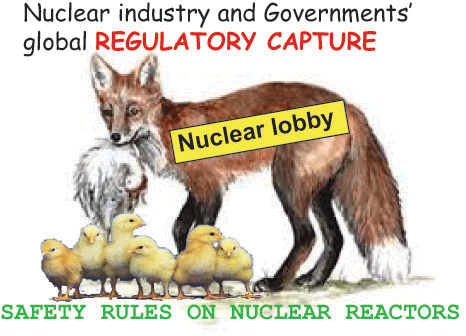
 Japan nuclear regulator ignores its duty to protect the people Greenpeace, Justin McKeating – 17 December, 2014 With today’s draft decision to approve the safety measures of two currently closed nuclear reactors, Japan’s Nuclear Regulation Authority (NRA) is ignoring public concerns and the major nuclear risks in the Kansai region. The decision to give backing to two reactors at the Takahama nuclear power plant puts millions of people at risk. Any severe accident at Takahama would be devastating for Kansai’s people and economy – there are no effective emergency plans existing that could protect the people in the region from radiation exposure.
But Kansai Electric Power Co (KEPCO) is keen to restart its reactors and the regulator is doing all it can to help them.
The thing is, KEPCO’s reactors have been offline for years which shows that they are completely unnecessary for Japan’s energy future.
The thirty-year-old Takahama 3 and 4 reactors in Fukui prefecture have been shut down for 34 and 41 months respectively. Seven of KEPCO’s eleven reactors are nearly or over 40 years old with decisions on the horizon on whether they should be closed permanently.
The Shiga Prefectural Government undertook risk analyses on nuclear accidents at KEPCO’S Ohi plant near Takahama in November 2011. They showed that the neighbouring Kyoto prefecture would be severely contaminated in the event of an accident. The area includes Lake Biwa, Japan’s largest sea and the source of drinking water for 15 million people.
This decision doesn’t mean the Takahama reactors will be restarting immediately, however. The NRA’s draft decision is merely the start of a multi-step process that will reach far into 2015…….
There is both public and political resistance against the restart of the two Takahama reactors. It comes from within the Kansai region as well as the three prefectures neighbouring Fukui.
The governor of Shiga wants the right to have a say over any restart decision. The governor of Kyoto disapproves of a restart. However, a decision on a local level is likely to be delayed as the Abe government is facing regional elections in April 2015, including for the governorship of Fukui.
At this stage, the NRA draft approval will only increase public and political opposition to any nuclear restart in Takahama……http://www.greenpeace.org/international/en/news/Blogs/nuclear-reaction/japan-nuclear-regulator-ignores-its-duty-to-p/blog/51721/
Y-12 nuclear weapons plant has chemical spill, causing evacuation
Chemical spill at Y-12; building evacuated as part of emergency response http://www.knoxnews.com/news/local-news/chemical-spill-reported-at-y12-personnel-evacuated_18047765
Spill has been contained Frank Munger Dec 16, 2014 OAK RIDGE — Federal spokesman Steven Wyatt confirmed that a chemical spill occurred Tuesday morning inside a building at the Y-12 nuclear weapons plant.
The building has been evacuated, but Wyatt could not immediately say how many people had been evacuated. He confirmed that the chemical involved was acetonitrile, a flammable and toxic solvent that can cause respiratory problems if breathed.
Wyatt said the building was the Purification Facility. He said the chemical had been contained in the “affected area.” All employees have been accounted for, with no injuries reported, he said.
The Purification Facility is known to be the facility where Fogbank — a classified substance used in some thermonuclear weapons — is produced. But Wyatt declined to say whether or not the spill was associated with that mission.
Torness nuclear power station needs safety probe: too many faults in UK nuclear reactors

 Calls for nuclear safety probe over station faults http://www.edinburghnews.scotsman.com/news/calls-for-nuclear-safety-probe-over-station-faults-1-3634131 14 Dec 14, Torness is one of 15 nuclear power stations across the UK that have been forced to shut down due to faults over the last three years – with campaigners calling for an urgent review into the reliability of nuclear energy.
Analysis for local councils revealed that 15 reactors have had 62 unplanned shut-downs since 2011, with Torness near Dunbar forced to close twice last year due to the build-up of seaweed clogging the plant’s filters.
The research – which was carried out by Edinburgh-based nuclear consultant Pete Roche – found plants hit by a range of faults including cracks and electrical, boiler and valve defects.
And now the 50-strong group of local authorities who commissioned the report are raising fears over safety and the UK’s future energy supply.
Manchester councillor Mark Hackett, who chairs the group, said: “I call upon the UK Government, the National Grid and the nuclear regulators to urgently review the safety issues around such a large number of unplanned shutdowns.
“The Government also has to prioritise alternatives over the next 12 months to ensure the unreliability of nuclear power does not lead to the lights going off around the country.”
Dungeness nuclear power station in Kent had to be shut down 21 times between 2012 and 2014.
In secret project Oak Ridge nuclear workers exposed to radiation
Oak Ridge workers exposed to radiation during secret project, The Tennessean Associated Press OAK RIDGE, Tenn. — A top official at Oak Ridge National Laboratory says at least eight workers received internal radiation while carrying out a classified project earlier this year at the facility.
The Knoxville News Sentinel (http://bit.ly/1xdVbpH) reports that ORNL Deputy Director Jeff Smith confirmed the Aug. 25 incident, which involved an unexpected airborne release of radioactive material…………Smith said some employees at ORNL have jobs in which it’s anticipated they’ll receive some low-level radiation exposures. The lab tries not to have any unplanned radiation exposures, but it’s not unusual for there to be one or maybe two per year, he said.http://www.tennessean.com/story/news/local/2014/12/14/oak-ridge-workers-exposed-radiation-secret-project/20400333/
Record breaking Radiation detection in Texas Panhandle!
A repost from NukePro:
“Breaking …
Quote: “Update: 12/14/14, 8:06 A.M. – Record breaking Radiation detection in Texas Panhandle!
On the late afternoon of December 4th, a long time running station located in Bolger, Texas, northeast of Amarillo, set off our Alert system, recording readings as high as 25,000 CPM!!! In fact, the radiation levels were well into the 000’s for so many minutes that the software almost could not keep up. ( graph ). For context, he is operating the pancake-tubed Inspector Alert indoors from the second story of his home. His normal baseline background is about 40 CPM.
A storm was rolling through at the time, accompanied by rain, and the Jet Stream map shows its active precipitating fringe directly over the panhandle at the time of the alert – see map below. Wind was from the south. The fact that it was raining set up an opportunity to collect a water sample to confirm that the radiation was related to the storm. So the operator did successive 10 minute average scans of the exact same sample of rainwater to first confirm its radioactive nature, then secondly to measure its radiation level, and thirdly (and of critical importance) to measure the decay rate to to the end of ruling in or out various isotopes of known half life. i.e. the “Poor Man’s Isotope Identifying Test”, using a Geiger counter.
Results: The rainwater was in fact radioactive, starting out around 300 CPM, and its radioactive constituent decayed very rapidly, indicating a half life of a few hours, such that by the following morning, the same rainwater sample measured no more than background.
Conclusions: Because of the short half life, many fission by-products can be ruled out, and so the initial tendency would be to implicate naturally occurring Radon washout. However, we have never seen raw environmental readings of Radon daughters this high – yes, commonly in the 00’s of CPM, even over 1,000 CPM, but never to our knowledge averaging well into the 000’s and in this case, as high as 25,000 CPM.
So the working theory we have now, (if not Radon washout), among the station operator and a few of our members involved in the analysis that evening, is a possible detection of some sort of radioactive release from the Pantex plant located only 25 miles to the southwest. Pantex is involved in the disassembly of nuclear weapons at that site. Interestingly, this same Texas monitoring station recorded a possible radiation detection from Pantex on a couple of previous occasions – search the Archives for the Updates of 4/15/13 and 11/24/12″
Quoted from: http://www.radiationnetwork.com/Message.htm
Credit for my relay: http://optimalprediction.com/wp/recent-health-issues/comment-page-8/#comment-56455
Quote of Bobby1: “I am having a severe relapse of ME. It is possible this is being triggered by radiation. But it’s hard to tell with this damned disease.”
He could probably use some friendly visitors to his site to warm his heart.”
Radioactive waste storage ponds in a shocking state of neglect at the UK’s Sellafield
One of the main ways of covering up the true cost to society of nuclear power has been downplaying the difficulty, danger and cost of nuclear reprocessing and safe storage of the unwanted byproducts. In Britain, this was made the responsibility of private companies with a strong motivation to cut corners in order to maximize profits.
The results of such behind-the-scenes agreements between governments and private companies are now visible in these photographs. Far from having a coherent plan for dealing with the medium-and high-level radioactive waste, the authorities have allowed the site to become a ticking time bomb.
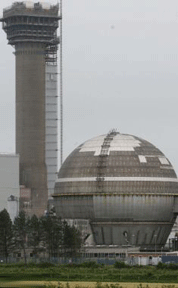 Leaked Photos Show UK Nuclear Plant Poses Public Safety Threat By Trevor Johnson Global Research, December 10, 2014 World Socialist Web Site Photos of radioactive waste storage ponds in a shocking state of neglect at the UK’s Sellafield (previously Windscale) nuclear reprocessing plant reveal that they have been severely neglected for decades.
Cracked concrete tanks—the largest measuring 20m by 150m with a depth of 6m—have been left open to the elements since the mid-1970s despite high levels of radioactivity.
After being left derelict for nearly 40 years, the radioactive material from hundreds of tons of spent fuel rods left in the ponds is now in danger of being exposed to the air, which could set off a nuclear explosion. This poses a major threat to public safety at the plant in Cumbria, northwest England.
The photos were published on the web site of the Ecologist magazine. Continue reading
USA resists tightening international safety rules on nuclear reactors

 Russian Nuclear Safety Proposal Put Focus on U.S. Reactors Bloomberg, By Jonathan Tirone Dec 10, 2014 Russia scaled back opposition to European proposals to improve the safety of nuclear power, leaving the U.S. as the main dissenter to new rules intended to avoid a repeat of Japan’s 2011 meltdown in Fukushima.
Russia changed its stance at a Dec. 4 meeting of nuclear diplomats, setting out the Moscow government’s view of new rules to limit radioactive contamination in the event of a nuclear accident, according to a copy of the 13-page presentation seen by Bloomberg. The move raised the chances of a deal to strengthen the Convention on Nuclear Safety, according to three Western diplomats present at the meeting, who asked not to be identified because the talks were private.
The European Union is trying to find a path to tighter safety rules for the world’s aging nuclear reactors with its relationship with Russia overshadowed by the conflict in Ukraine. Yet it’s the U.S., the world’s biggest nuclear-power generator, that is proving the biggest obstacle, the diplomats said, as company investments in reactor safety lag those of European peers.
U.S. resistance to the European safety proposals is a “serious concern,” Senators Barbara Boxerand Edward Markey said in a Dec. 1 letter to Nuclear Regulatory Commission chairman Allison Macfarlane. The Democrats urged U.S. diplomats to work with “international partners” to amend safety flaws exposed by the 2011 Fukushima Dai-Ichi meltdowns.
Two Proposals
Russia abandoned its opposition to tightening international rules on reactor safety the day after reports of a nuclear accident in Ukraine. The reported mishap — which ultimately proved to be false — roiled markets and sent Ukrainian bond yields to a record high. The 1986 meltdown of a Soviet-built reactor in Chernobyl, about 80 miles north of the capital Kiev, weighed on Ukraine’s budget for decades and resulted in a 2,600 square kilometer (1,000 square miles) exclusion zone.
The European proposal would compel nuclear operators to both prevent accidents and, should they occur, mitigate the effects of radioactive contamination. Most controversially, the treaty change would also force potentially costly upgrades at existing plants.
More than half of the world’s 438 reactors were built at least 30 years ago and are nearing the age when they’ll need special attention, according to International Atomic Energy Agency statistics………
“People in the U.S. don’t realize that in many ways our nuclear safety standards lag behind those inEurope,” former NRC commissioner Victor Gilinsky said in a written reply to questions. “The German and French containment structures are generally more formidable than ours and those reactors generally have more protection systems.”……
Regulators worldwide have tried to boost safety standards in response to the Fukushima meltdown, which forced 160,000 people to flee radioactive contamination after a tsunami flooded safety back-up systems.
The NRC is still working out the parameters on how it values human lives at risk from a nuclear accident, spokesman Scott Burnell said. The value helps determine how much nuclear-plant operators need to spend on backfitting reactors with new safety gear. The NRC was criticized Dec. 3 by Boxer, chairman of the Senate’s Environment and Public Works committee, for being slow to ensure plant safety improvements.
“Some reactor operators are still not in compliance with the safety requirements that were in place before the Fukushima disaster,” Boxer said. “This is unacceptable.”
To contact the reporter on this story: Jonathan Tirone in Vienna at jtirone@bloomberg.net http://www.bloomberg.com/news/2014-12-10/russian-concessions-on-nuclear-safety-put-focus-on-u-s-reactors.html
Palisades Nuclear Plant safety violation
NRC finds Palisades Nuclear Plant safety violation involving monitoring workers for radiation By Emily Monacelli | emonacel@mlive.com COVERT TOWNSHIP, MI, 11 Dec 14 — Federal regulators found a safety violation involving monitoring of workers for radiation exposure at the Palisades nuclear power plant inCovert Township early this year, according to a report……. David Lochbaum, director of the Union of Concerned Scientists’ Nuclear Safety Project, expressed concern Thursday about a report recently released that showed NRC inspectors examined 20 components at Palisades and found 10 low-level safety violations. Lochbaum said it is alarming that the problems were found by NRC inspectors and not first by Entergy workers.
“You have to do more than fix these violations,” Lochbaum said, adding that to prevent recurrences requires that Palisades operators get to the root of the problems. http://www.mlive.com/news/kalamazoo/index.ssf/2014/12/palisades_safety_violation.html
Potential for drones to carry explosive devices over nuclear reactors
With concerns about terrorism ever-present, the fear that drones carrying explosive devices could potentially fly over such sites looms large.
Drones Flying Over Nuclear Power Stations in France Raise Concerns Global Voices, byAbdoulaye Bah Translated byDanielle Martineau 9 December 2014

With 58 nuclear reactors spread out over 19 plants, France is the highest user of nuclear energy in Europe, and the second highest in the world, after the United States.
In a blog post published on the website Géneration NT, Jérôme G. gives some insight into the matter:…….
Drones have successfully evaded all the power stations’ defenses. EDF also reports a number of drone overflights that differs from Greenpeace’s count. Pascal Riché, co-founder of rue89.nouvelobs.com, notes: Continue reading
France’s nuclear security problem: no way to detect small drones at low altitudes
France Backs Anti-Drone Research After Mystery Nuclear Flights, Bloomberg, By Tara Patel tpatel2@bloomberg.net Dec 9, 2014, Paris France is backing research on how to track and destroy drones as the mystery of who is behind a series of illegal flights over atomic sites remains unsolved.
The French National Research Agency will start a tender later this month for systems to “detect and even neutralize” drones, according to a statement from the Secretariat for Defense and National Security, which advises the president and prime minister.
Areva SA (AREVA), Electricite de France SA and Commissariat a l’Energie Atomique et aux Energies Alternatives confirmed some 20 incidents since the middle of September of remote-controlled drone-like objects violating protected zones around their nuclear installations. The government vowed to put an end to the flights, which haven’t inflicted damage. No one has publicly claimed responsibility.
“The use of drones is bringing progress but with it new risks,” the national security committee said in yesterday’s statement.
The flights exposed a security weakness described by speakers at a parliamentary hearing last month in Paris. Top military and police officials joined experts from the nuclear industry and research organizations to testify before lawmakers on the kinds of drone technology that may be at work and the risks they pose. French radar systems aren’t adapted to detect so-called mini-drones weighing a few kilograms and flying at low altitudes, Denis Mercier, Chief of Staff of the French Air Force, told the hearing.
Drone industry representatives gave evidence on the sector’s exponential growth and lack of adequate supervision……http://www.bloomberg.com/news/2014-12-09/france-backs-anti-drone-research-after-mystery-nuclear-flights.html
Uranium smuggling gang arrested in Moldova
Moldova police arrest ‘uranium-smuggling gang’ http://www.bbc.com/news/world-europe-30402104
Moldovan police say they have arrested seven people suspected of smuggling uranium from Russia to sell it on.About 200g (7oz) of the material was seized in a raid last week, with a black market value of about $2.1m (£1.3m; €1.7m).It was allegedly smuggled into Moldova in a special container on a train.
Those arrested had experience of handling radioactive substances, and have admitted their guilt, Moldovan police added.A kilogram of another hazardous material, mercury, was also seized.
The US Federal Bureau of Investigation aided the police in their investigation, the Associated Press news agency reports.In 2011, Moldovan police arrested six people trying to sell a kilogram of uranium to buyers in Africa.
Nuclear Regulatory Commission reveals that workers inhaled uranium during spill at an in-situ mine
 Nuclear regulatory agency: 6 workers inhaled uranium at Wyoming mine after yellowcake spill, Star Tribune by: MEAD GRUVER , Associated Press : December 5, 2014 CHEYENNE, Wyo. — Six workers at a Wyoming uranium mine inhaled the radioactive element while cleaning up a spill inside a processing building just days before the mine delivered its first shipment last year, according to the Nuclear Regulatory Commission.
The workers’ urine tested positive for uranium at close to seven times the federal agency’s permissible level, the federal agency alleges in a Nov. 14 violation notice against Lost Creek LLC ISR, a subsidiary of Littleton, Colorado-based Ur-Energy.
The spill happened Nov. 28, 2013, at the Lost Creek in-situ uranium mine in south-central Wyoming. In-situ mining involves pumping fluids underground to release uranium into a solution that is pumped to the surface. No shafts or tunnels are dug.
Some 1,500 pounds of yellowcake, a precursor of enriched uranium, surged onto the floor of a processing building while a worker was filling a 55-gallon drum with the dry, powdery substance, according to the notice…….http://www.startribune.com/lifestyle/health/284909581.html
1 This Month
26 September – International Day for the Total Elimination of Nuclear Weapons





PLEASE OPPOSE HR 8255 AND S.3639 – bills would accelerate satellite deployment, with no environmental review or safeguards – https://ncstd5li.quorum.us/campaign/169331/
To see nuclear-related stories in greater depth and intensity – go to https://nuclearinformation.wordpress.com
-
Archives
- September 2026 (323)
- August 2026 (330)
- July 2026 (355)
- June 2026 (287)
- May 2026 (306)
- April 2026 (356)
- March 2026 (251)
- February 2026 (267)
- January 2026 (308)
- December 2025 (358)
- November 2025 (359)
- October 2025 (375)
-
Categories
- 1
- 1 NUCLEAR ISSUES
- business and costs
- climate change
- culture and arts
- ENERGY
- environment
- health
- history
- indigenous issues
- Legal
- marketing of nuclear
- media
- opposition to nuclear
- PERSONAL STORIES
- politics
- politics international
- Religion and ethics
- safety
- secrets,lies and civil liberties
- spinbuster
- technology
- Uranium
- wastes
- weapons and war
- Women
- 2 WORLD
- ACTION
- AFRICA
- Atrocities
- AUSTRALIA
- Christina's notes
- Christina's themes
- culture and arts
- Events
- Fuk 2022
- Fuk 2023
- Fukushima 2017
- Fukushima 2018
- fukushima 2019
- Fukushima 2020
- Fukushima 2021
- general
- global warming
- Humour (God we need it)
- Nuclear
- RARE EARTHS
- Reference
- resources – print
- Resources -audiovicual
- Weekly Newsletter
- World
- World Nuclear
- YouTube
-
RSS
Entries RSS
Comments RSS

