Entergy’s Arkansas nuclear plant requires highest level of inspection oversight from NRC
Nuclear One earns worst rating Entergy’s Russellville plant in line for intense inspections, Arkansas Online, 10 May 15 By David Smith Arkansas Nuclear One has the worst performance rating out of all 100 nuclear power plants in the country, the federal Nuclear Regulatory Commission says.
The power plant is the only one in the country in the “column four” category of the commission’s rating of overall plant performance. The column four designation means the plant gets the highest level of inspection oversight from the commission.
Column one power plants require the fewest inspections. Plants in column five aren’t permitted to operate, the commission said.
It is rare for a plant to be in column four, said Victor Dricks, a spokesman for the commission.
“Sometimes there are one or even two plants in column four,” Dricks said. “It generally takes several years of very concerted effort on the part of a nuclear power plant operator to address issues and then be returned to column one.”
No nuclear plant has ever been placed in column five, Dricks said.
Representatives from the NRC and Entergy Arkansas will discuss the plant’s “significant decline in performance” at a meeting Tuesday in Russellville. The plant’s two nuclear reactors account for about 61 percent of the electricity that Entergy Arkansas generates in a year.
The public meeting at Lakepoint Conference Center, 61 Lake Point Lane near the nuclear plant, begins at 6 p.m.
Arkansas Nuclear One has received two findings of “substantial safety significance” that pushed its performance rating down into column four.
The first was filed in June last year in connection with the March 2013 handling of a 1 million-pound turbine stator, which fell 30 feet while it was being moved by a contractor, killing of one worker and injuring eight others. The accident occurred in a non-nuclear part of the plant.
The second finding, filed in January, is related to the 2013 accident. It involved Entergy’s failure to design, construct and maintain the seals that protect safety-related equipment in the emergency diesel fuel storage building from flooding.
When the stator fell, it damaged a water main, Dricks said. “The fire pump started and discharged thousands of gallons of water into the turbine building,” Dricks said. “There are floor seals that should prevent the water from flowing down into an auxiliary building. But the seals were defective, so water flowed into areas where it shouldn’t have been.”
Commission inspectors later discovered there were more than 100 unsealed conduits that allowed the water into the auxiliary building, Dricks said.
“They also found some degraded hatches,” Dricks said.
The cumulative effect of these two violations moved the plant into column four, the commission said……..http://www.arkansasonline.com/news/2015/may/10/nuclear-one-earns-worst-rating-20150510/?f=business
USA spending $60 Mln on Multilateral Nuclear Environmental Program in Russia (MNEPR)
 US to Spend $60 Mln on Russian Nuclear Security Despite Sanctions http://sputniknews.com/us/20150508/1021898724.html The United States Department of Energy might spend over $60 million on nuclear security activities in Russia.
The DOE National Nuclear Security Administration (NNSA) “has budgeted the funds to be spent this year through an international organization called the Multilateral Nuclear Environmental Program in Russia (MNEPR),” news website read, citing administration sources. NNSA spokesperson Derrick Robinson did not reject this information and said that US-Russian dialogue on nuclear security issues plays a great role in diminishing the level of nuclear terrorism threat.
He added that the United States has worked with Russia for a long time in order to stop the spread of weapons of mass destruction.
The United States and the European Union, as well as some other Western nations, have accused Moscow of escalating the crisis in Ukraine, and imposed economic sanctions on Russia to exert a change in Kremlin policy. Moscow r
Another shutdown at Oyster Creek Nuclear Plant
he NRC ’s performance indicator for unplanned scrams for each 7,000 hours of operation changes from green to white if a nuclear plant has more than three unplanned shutdowns. Oyster Creek crossed the green/white threshold on July 11, 2014, when the plant had a fourth unplanned shutdown, the NRC has said.
Japan’s earthquake risk to nuclear reactors is being ignored, says seismic expert
Japan Earthquake Expert Says Nuclear Watchdog Ignoring Risk, Bloomberg, byYuriy Humber 3 May 15 Japan’s nuclear regulator ignored earthquake risk and its own rules in approving the safety of a nuclear power plant on the western island of Kyushu, said Kobe University professor and seismologist Katsuhiko Ishibashi.
Ishibashi, well-known in Japan for books and papers on earthquake threats that later became reality, said he has filed a formal complaint to the Nuclear Regulation Authority challenging the legality of its decision………
Ishibashi has seen his warnings of earthquake dangers come true in devastating fashion at least twice in a country that accounts for about 10 percent of the world’s quakes.
In a 1994 book “A Seismologist Warns” he said building codes were putting Japan’s cities at risk. The following year, the Kobe earthquakebuckled bridges, highways, and brought down buildings, killing more than 6,000 people.
Then in 1997, he wrote a report in Japan’s Science Journal where he coined the term “nuclear earthquake disaster.” The paper was written about 14 years before the Fukushima catastrophe, yet reads like a post-mortem of what happened: A major quake knocks out external power to the plant’s reactors and unleashes a tsunami that overruns its defenses, leading to loss of cooling and meltdowns.
Nuclear Restarts
Ishibashi says he doesn’t want his forecasts to play out again………Amid pressure from Prime Minister Shinzo Abe’s government to process applications for nuclear plant restarts to help the economy, the NRA is under pressure to give utilities a pass, Ishibashi said. That makes the watchdog less rigorous in examining the safety assessments of utilities’ reactors, he said…..
Sendai Case
In the case of the Sendai plant, the NRA has allowed the operating company to ignore the risk of an earthquake in the tectonic slab underneath Kyushu, the seismologist said.
Kyushu Electric has also not factored in the risk from a so-called Nankai trough earthquake, Ishibashi said. A Nankai quake is one that could originate in the seas south of Japan’s main island, an eventuality that’s considered high-risk and constantly monitored by the government.
“Kyushu Electric was allowed to select their own criteria for quakes that could hit the plant and they ignored several as outliers — including a Nankai one,” Ishibashi said. “Taking the Nankai trough earthquake into account is indispensable” in modeling the dangers facing the Sendai plant, he said.
In terms of impact, a Nankai trough quake would cause tremors and ground motion that would last almost ten times as long as Kyushu Electric’s estimates applied for its Sendai plant assessment, Ishibashi said.
The government’s billing of the NRA, formed in the aftermath of the Fukushima disaster, as the world’s most stringent nuclear regulator is simply not true, Ishibashi said. The regulator feels beholden to government policy, which is pro-nuclear and supports restarts, he said.
“The NRA certainly seems to be feeling the pressure from the current administration,” Ishibashi said. http://www.bloomberg.com/news/articles/2015-04-30/japan-earthquake-expert-says-nuclear-watchdog-ignoring-risk
370 Billion Bq of Plutonium equivalent may have escaped from WIPP
Gov’t: Radioactive release “orders of magnitude” worse than predicted at US nuclear dump — 370 Billion Bq of Plutonium equivalent may have escaped from WIPP drum during “thermal runaway” & multiple fires — For amount to be that high, a “significant number” of breached drums is expected (VIDEO) http://enenews.com/govt-actual-radioactive-release-nuke-dump-orders-magnitude-predicted-370-billion-bq-plutonium-equivalent-escaped-wipp-drum-significant-number-nuclear-waste-containers-expected-be-breached-amount?utm_source=feedburner&utm_medium=email&utm_campaign=Feed%3A+ENENews+%28Energy+News%29
Sante Fe New Mexican, Apr 23, 2015 (emphasis added): The head of a team of federal investigators [said] he’s not certain whether more than one drum of nuclear waste contributed to contamination of [WIPP]… The reaction pushed temperatures inside the container to nearly 1,600 degrees, ripping open the drum and scattering radioactive material thatbreached not only the fortified room that held the waste, but WIPP itself, which was designed to never leak… [Officials] would not rule out minor seepage from other drums.
U.S. DOE Accident Investigation Report Phase 2, Radiological Release at WIPP, Apr 2015:
6.4.1 Analysis Summary
- The radiological release… resulted from an exothermic reaction that led to a thermal runaway in drum 68660 [that] exhibited the following fire behaviors: Expanding flame front of material expelled from drum… Ignition of exposed combustibles… Propagation within the waste array by flame impingement… Melting and burning of exposed plastics.
- The combustibles external to the waste containers were ignited… direct fire effectswere limited to Rows 8 through 18… there were multiple small fires that caused direct flame impingement on several waste packages… the fire… caused the migration of contamination throughout Panel 7 [and] significant fire damage.
- A thermal runaway is characterized as a very rapid temperature rise within the container… [This] ultimately… led to failure of the lid… permitting a rapid release of combustible gases and combustible solids.
7.1 Accident Scenarios and Source Term Evaluation
- Source term at Station A should be 10 to 100 times lower than the source term in Panel 7 Room 7… Station A source term is estimated [at] 0.1 plutonium equivalent curies (PE-Ci).
- DOE-STD-5506-2007… recommends a bounding estimate of 1E^-4 ARF [0.0001 Airborne Release Fraction] for a drum over-pressurization without a fire… This release estimate, when applied to the… drum inventory of 2.84 PE-Ci, results in an initial source term released to the room of 2.8E^-4 PE-Ci [0.000284 PE-Ci]… less than 1 percent of the 0.1 PE-Ci source term at Station A.
- The chemical reaction resulting in over-pressurization of the drum described above is similar to the… evaluation of a drum deflagration from hydrogen buildup from radiolysis which assumes burning of material expelled from the drum and a contained burning of material remaining within the drum… [The modeled] release estimate from a drum deflagration is about 3 percent of the 0.1 PE-Ci source term at Station A… the actual amount of material released as measured at Station A was larger than the amount predicted… by almost two orders of magnitude… For either the drum over-pressurization or drum deflagration scenarios discussed above, a much greater airborne source term is possible if the nitrate salts behaved as a combustible dust ignited in air or if a greater fraction of material were ejected and burned.
- The 0.1 PE-Ci source term at Station A can be divided by the range of 0.01 to 0.05 LPFs [Leakpath Factor] to estimate the range of source terms initially released… This results in a range of 2 to 10 PE-Ci [74 to 370 billion Bq] airborne in the room… [I]nventory in drum 68660 [was] 2.84 PE-Ci.
- If drum 68660 released a source term as modeled… a significant number of waste containers would be expected to be breached to cause the 2 to 10 PE-Ci source term estimate… Based on the above estimates… release fractions and deposition in the underground, indicated the release from drum 68660 alone was much larger than what would be modeled… [T]he source term evaluation, using conventional release modeling assumptions, could not conclusively affirm that container 68660 was the sole contributor to the release.
Wide spread of radiation could result from smoke from fires in Chernobyl exclusion zone
Smoke from Chernobyl fire could spread radiation far and wide – experts Rt.com April 29, 2015 Smoke from burning forests in the  is capable of spreading contaminants across great distances, even after the fire has been stopped, ecology experts told RT.
The forest fire near the crippled Chernobyl nuclear power plant started on Tuesday and triggered an emergency alert, with police and National Guard mobilized to bring the flames under control……
Although the sarcophagus remains untouched by the fire, decades-old contaminants could still be released and travel far and wide, borne aloft by the smoke, nuclear safety expert John H. Large told RT:
“Brush fires and forest fires were the greatest concern in terms of the means by which you can disperse a secondary radiological impact from the original dissipation that occurred in 1986,” he said. John went to Chernobyl in 2006 to assess the situation there and spoke to dozens of scientists working on containing the contamination.
“In the exclusion zone and further away you have an area that has been abandoned for farming, abandoned for man management,” John says. “That means you’ve got lots of brush and young wood growing out of control, and that means there’s a big fuel load to have a fire.”
He says the high temperatures and volumes of smoke produced in a forest fire can take contaminants hundreds of kilometers away from the exclusion zone: “Radiation really doesn’t respect any international boundaries.”
Forest fires have happened in the area before, but have never been so serious, Timothy Mousseau, biology professor at the University of South Carolina, told RT:
“Previous forest fires had re-released about eight percent of the radiation from the original catastrophe. The fire that we’re seeing today seems to be on a much larger scale, and so we could see a re-dispersion of a very significant component of the original radiation.”
Another problem is that as the trees that have absorbed contaminants burn up and release smoke, this turns radioactive particles into a much more dangerous form than if they simply lie in the ground….http://rt.com/news/254193-chernobyl-fire-radiation-spread/
Forest fires threatening Chernobyl nuclear plant
Forest fires heading for Chernobyl nuclear plant – Ukraine Interior Ministry, Rt.com April 29, 2015 The Ukrainian National Guard has been put on high alert due to worsening forest fires around the crippled Chernobyl nuclear power plant, according to Ukraine Interior Minister Arsen Avakov.
“The forest fire situation around the Chernobyl power plant has worsened,” a statement on Avakov’s Facebook page says.
“The forest fire is heading in the direction of Chernobyl’s installations. Treetop flames and strong gusts of wind have created a real danger of the fire spreading to an area within 20 kilometers of the power plant. There are about 400 hectares [988 acres] of forests in the endangered area.”
Police and National Guard units are on high alert. Ukraine’s Prime Minister personally went to the affected area to oversee the firefighting. He says the situation is under control, “but this is the biggest fire since 1992.”
However, in comments to Russia’s Moscow Speaks radio, a representative of Greenpeace Russia said that the situation is much worse: “A very large, catastrophic forest fire is taking place in a 30-km zone around the Chernobyl power plant. We estimate the real area of the fire to be 10,000 hectares; this is based on satellite images. This hasn’t been officially acknowledged yet.”
The potential danger in this fire comes from the radioactive contaminants the burning plants have absorbed, ecologist Christopher Busby told RT. “Some of the materials that were contaminating that area would ahve been incorporated into the woods. In other words, they land on the ground in 1986 and they get absorbed into the trees and all the biosphere. And when it burns, they just become re-suspended. It’s like Chernobyl all over again. All of that material that fell on the ground will now be burned up into the air and will become available for people to breathe.”Christopher Busby is the scientific secretary of the European Committee on Radiation Risks………http://rt.com/news/253897-chernobyl-fires-rage-ukraine/
Money running out for safety cover, as dangerous Chernobyl nuclear wreck reaches 29th anniversary
The reactor itself is still too contaminated for workers to approach. Removal of radioactive materials there will only begin once the new confinement structure has been finished.
Chernobyl arch faces €265m funding gap ahead of disaster’s 29th anniversary, Arthur Neslen, Guardian 24 Apr 15 World must plug funding gap for massive 100-metre steel arch being built to contain remaining radioactive waste at the site. A massive engineering project to make the Chernobyl nuclear power plant safe is facing a €265m (£190m) funding shortfall.
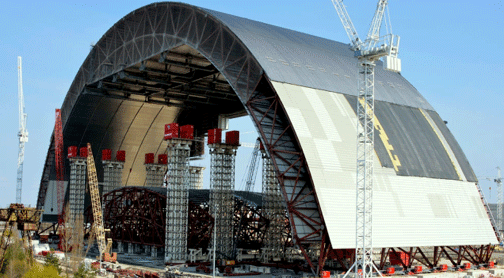
Next week a conference held by Germany in London will call on countries to make up the gap, but the European Bank for Reconstruction and Development (EBRD) has said it may have to ask its shareholders to make up the shortfall if donations dry up.
This Sunday marks the 29th anniversary of the world’s worst nuclear disaster, when a power surge blew the roof off a reactor, spewing radioactive clouds across Russia, and eastern Europe.
A makeshift sarcophagus built in the explosion’s aftermath was supposed to protect the environment from radiation for at least 30 years. But it has since developed cracks.
The project to build a new radiation container had been due for completion this year but the deadline slipped to November 2017, as costs mushroomed from an initial estimate of €800m (£572m) to more than €2.15bn today.
Over 40 governments and the European commission have committed to help a Chernobyl Shelter Fund tasked with sealing off the 100 tonnes of uranium and one tonne of plutonium that remain within the site.
“If countries recognise the nature of the problem in Chernobyl and its importance for human security in Ukraine and ecological security in Europe, there is a hope that the gap could be closed at the donor conference on April 29,” Anton Usov, an EBRD spokesman told the Guardian. “Verbally the donors are committed to contribute more funds.”
The bank believes there is a broad understanding among nations of the threat that radioactive dust on the site still poses to Kiev, around 70km away……..
The reactor itself is still too contaminated for workers to approach. Removal of radioactive materials there will only begin once the new confinement structure has been finished. http://www.theguardian.com/environment/2015/apr/24/chernobyl-arch-faces-265m-funding-gap-ahead-of-disasters-29th-anniversary
Drone supposedly containing radiation landed on Shinzo Abe’s roof
 Drone containing radiation lands on Japanese prime minister Shinzo Abe’s roof, Straight.com by Charlie Smith on April 22nd, 2015 Shortly after a Japanese court has approved restarting a shuttered nuclear power plant, an unmanned aerial vehicle landed on the roof of the prime minister’s home.
It has sparked discussions in Japan about the prospect of terrorists using drones to launch attacks during the 2020 Summer Games, which will be hosted in Tokyo.
The levels of radiation in this instance were not deemed harmful.
There’s no evidence at this point that the drone was placed there as a protest against Abe’s desire to restart nuclear reactors in Japan.
Public opinion is strongly against the use of nuclear power in Japan four years after a meltdown in Fukushima………
Tokyo police have reportedly revealed that there was a camera on the drone, which was decorated with a sticker carrying a symbol indicating it was radioactive.
“The police also said traces of radioactive cesium were detected on the roof near the drone, though it was unclear if they came from the drone,” the New York Timesreported. “Cesium is not usually found in nature, but large amounts of it were released into the atmosphere during the Fukushima nuclear disaster in 2011.” http://www.straight.com/news/435371/drone-containing-radiation-lands-japanese-prime-minister-shinzo-abes-roof
Meticulous research indicates much greater likelihood of another Chernobyl-scale nuclear accident
Wheatley and co’s work suggests that a Chernobyl-scale accident is worryingly likely to occur within the working lifetime of the reactors now being built. And when that happens, a once obscure place will enter the lexicon as a synonym for catastrophe, just like Chernobyl, Windscale and Fukushima.
These risks will have to be carefully weighed against the advantages. The question for engineers, policy makers and the general public alike is whether that risk is worth taking, given what’s at stake.
 The Chances of Another Chernobyl Before 2050?
  50%, Say Safety Specialists, MIT Technology Review April 17, 2015 “…..And there’s a 50:50 chance of a Three Mile Island-scale disaster in the next 10 years, according to the largest statistical analysis of nuclear accidents ever undertaken……..
Today, we get an answer thanks to the work of Spencer Wheatley and Didier Sornette at ETH Zurich in Switzerland and Benjamin Sovacool at Aarhus University in Denmark. These guys have compiled the most comprehensive list of nuclear accidents ever created and used it to calculate the likelihood of other accidents in future.
Their worrying conclusion is that the chances are 50:50 that a major nuclear disaster will occur somewhere in the world before 2050. “There is a 50 per cent chance that a Chernobyl event (or larger) occurs in the next 27 years,” they conclude.
The nuclear industry has long been criticised for its over-confident attitude to risk. But truly independent analyses are few and far between, partly because much of the data on accidents is compiled by the nuclear industry itself, which is reluctant to share it.
The International Atomic Energy Agency rates accidents using a system called the International Nuclear Event Scale, which is related to the amount of radiation released. However, the Agency does not publish a historical database of these accidents, probably because it has a dual role of both regulating the nuclear industry and promoting it. Continue reading
USA and Russian generals warn of danger of cyber criminals causing a nuclear disaster
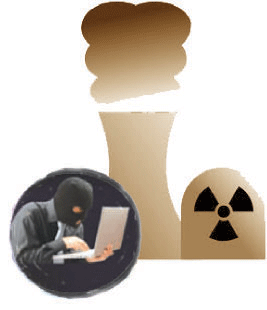 Сybercriminals may provoke nuclear disaster – US, Russian generals, Rt.com April 20, 2015 Modern technologies, coupled with Cold War-era nuclear doctrines and increasing tensions between the US and Russia make a nuclear war a real threat, say high-ranking retired officers from both countries.
The two generals say this system is susceptible to provocations and malfunctions. With the advent of precise computer technologies, the chance of such an error occurring has been decreasing. However, at a time when cyberattacks are becoming increasingly common, the danger of someone deliberately triggering a false warning has jumped.“This makes it all the more critical for Russia and the United States to talk, to relieve the pressures to “use or lose” nuclear forces during a crisis and minimize the risk of a mistaken launch,” their article reads.
The US and Russia have signed a joint nuclear arsenal reduction treaty called New START (Strategic Arms Reduction Treaty), in April 2010. It is aimed at drastically decreasing the number of nuclear weapons available to both nations.
Despite both Russia and the US complying with the treaty and reducing their arsenals to about 1,500 warheads each, they remain in possession of two of the world’s largest atomic payloads.
Cooperation on the treaty remains “a silver lining” amid growing Russia-US tensions, Assistant Secretary of State Frank Rose said on Thursday: “At such a hard time it is highly important to maintain transparency in the displacement and deployment of strategic nuclear weapons… The two sides have made a significant progress over the restrictions presumed by the treaty by February 2018”.http://rt.com/news/251361-nuclear-apocalypse-possible-warning/
Schools near Pilgrim Nuclear Power Station updating potassium iodide protocols
 With Nuclear Station Close By, Schools Look To Update KI Protocol Cape News, MARY PETIET | 19 Apr 15 The Bourne School District has policies and procedures in place to administer potassium iodide pills to students and staff in the event of a nuclear disaster at the Pilgrim Nuclear Power Station in the neighboring town of Plymouth.
The school committee is taking steps to help streamline the permission protocol that allows parents to authorize the schools to administer the pills to their children. The district is also breaking apart the policy and procedures so that the procedures will be readily available to parents as part of the district’s online student handbook.
According to the state Department of Public Health, “Those within 10 miles of a nuclear power plant and may be exposed to radiation from a nuclear emergency should take a drug [KI] that would help protect them from thyroid cancer.”
The Bourne school Policy for the Preparation and Distribution of KI states, “Upon recommendation of the Massachusetts Department of Public Health and the Massachusetts Emergency Management Agency, The Bourne Public Schools agree to stockpile Potassium Iodide (KI) tablets for administration to students and employees in the event of a nuclear emergency during school hours. All efforts will be made to administer the Potassium Iodide in a timely manner, however prompt evacuation is of the utmost priority.”
The school committee is currently considering a change in the policy and the procedure around the possible administration of KI. Previously, these have been bound together, but Bourne High School nurse and lead nurse for the district Catherine Crosby-Norton said that Bourne schools are currently seeking to separate KI policy from procedure.
“The policy and the procedure don’t belong together. The policy in the case of a nuclear emergency is to treat students and staff with KI. The procedure outlines how this is done,” Ms. Crosby-Norton said………
Also under consideration by the school committee is the annual signing of permission slips by parents for possible administration of KI in the case of a nuclear mishap during school hours.
Ms. Siroonian said the district will continue to notify parents of KI procedures, but that the permission slip allowing students to receive KI will now need to be signed only once………
If the unimaginable should occur, trained school nurses would administer the dosage of “One (1) KI tablet for each registered student who has parent/guardian consent on file in the nurse’s office to receive KI,” the school policy states. After the dosage the recipient’s hand would be marked with a K in permanent black marker. The policy notes that the best location to administer the dosage is in the classroom, but adds that in case the recommendation is not received prior to an evacuation, the kits, including the tablets and permission sheets, must accompany the student body.
According to the Massachusetts Emergency Management Agency, “It is important to note that KI only protects the thyroid. Numerous other radionuclides may be released in an accident situation and KI would not protect individuals from these other types of radioactivity. The primary method of protection is evacuation and sheltering-in-place, and KI should be viewed as an adjunct to these primary measures.”………http://www.capenews.net/bourne/news/with-nuclear-station-close-by-schools-look-to-update-ki/article_fc9f29e2-e478-11e4-814a-e71ceb8dd4c2.html
Finland’s nuclear regulator demands safety check for Olkiluoto 3 nuclear reactor’s pressure vessel
Nuclear watchdog seeks re-check of Olkiluoto 3 reactor yle 18 Apr 15 The Finnish Radiation and Nuclear Safety Authority (STUK) is demanding that energy utility TVO carry out new tests of the durability of the pressure vessel planned for the Olkiluoto 3 nuclear reactor. This follows a recent discovery by French officials of inconsistencies in the mechanical toughness of a vessel made for a similar reactor, also being built by the French company Areva.

The third unit for the Flamanville, France reactor was built by Areva in France, while the one to be used in the Finnish reactor has been assembled in Japan. Both units are of the European Pressurised Reactor (EPR) type.
“There are inconsistencies in the material that the reactor vessel is made of,” Tapani Virolainen, Deputy Director of STUK’s Nuclear Reactor Regulation Department, confirmed to Yle…….Virolainen explains that anomalies were found in both the reactor vessel head and reactor vessel bottom head. He says STUK will ask TVO to re-check the reactor vessel’s manufacturing process…….http://yle.fi/uutiset/nuclear_watchdog_seeks_re-check_of_olkiluoto_3_reactor/7937448
UK’s £14bn Hinkley project – future now in doubt, as faults found in identical French project
 UK nuclear strategy faces meltdown as faults are found in identical French project The faults could also scare off the Chinese state investors who are supposed to cover part of the cost of the £14bn Hinkley project Independent JOHN LICHFIELD
  PARIS Friday 17 April 2015 A “very serious” fault has been discovered in a French nuclear power station which is at the heart of David Cameron’s strategy to “keep the lights on” in Britain in the next decade.
The future of two nuclear reactors planned for Hinkley Point in Somerset has been thrown into doubt by the discovery of a potentially catastrophic mistake in the construction of an identical EPR power plant in Normandy.
“It is a serious fault, even a very serious fault, because it involves a crucial part of the nuclear reactor,” said Pierre-Franck Chevet, head of France’s nuclear safety inspectorate.
A second investigation has been ordered into the quality of the steel used to make a 50ft-high safety casing, or “pressure vessel”, which encloses the groundbreaking new reactor at Flamanville, near Cherbourg. If the steel proves to be defective, the completion of the prototype EPR plant – already behind schedule and nearly three times over budget – could be delayed for several years.
Mr Chevet also revealed that the same manufacturing techniques had been used in the steel for the identical safety casings destined for Hinkley Point, which “have already been manufactured”.
The fault could undermine the already fragile finances of the French state-owned nuclear construction company Areva, which is supposed to build two EPR reactors at Hinkley by 2023 and a third at Sizewell in Suffolk. It could also scare off the Chinese state investors who are supposed to cover part of the cost of the £14bn Hinkley project, intended to supply six per cent of Britain’s energy needs for six decades.
A final “investment” decision for Hinkley, several times delayed, is now expected in June. The French Prime Minister Manuel Valls called a crisis meeting on 17 April to discuss the threat posed by the fault to France’s nuclear construction industry – the largest in the world.
Mark Hackett, a councillor in Manchester who chairs Nuclear Free Local Authorities, said: “This is a devastating blow to proponents of new-build nuclear power stations in the UK. It is likely to scare off the Chinese backers. If I was a betting man, I would now bet that Hinkley Point will never be built.”
Yannick Rousselet, of Greenpeace France, said the latest problems to beset the prototype power station in Normandy are “clearly the coup de grâce for the EPR idea”. He asked: “What foreign client would want to buy this reactor when France itself is not capable of completing its construction?”
Apart from Britain, the United States and China are in the process of buying versions of the new generation of European Pressurised Reactor (EPR) – supposedly safer and more efficient – from France. Both Areva and Eléctricité de France (EDF), the French energy giant which will own and operate Hinkley Point, have refused to comment in detail………
Sources in the French nuclear industry told the newspaper Le Parisien yesterday that dismantling the faulty pressure vessel and ordering and manufacturing a new one could take several years. “If the weakness of the steel is proved, I don’t hold out much hope for the survival of the EPR project,” a former senior nuclear safety official told Le Parisien………..http://www.independent.co.uk/news/uk/home-news/uk-nuclear-strategy-faces-meltdown-as-faults-are-found-in-identical-french-project-10186163.html
Future of the entire Flamanville-3 project with more problems at EPR nuclear reactor

 More Problems for the EPR, NuClear News April 15 The French Nuclear Safety Regulator, ASN, announced on 7th April that it had been informed by AREVA of an anomaly in the composition of the steel in certain zones of the reactor vessel head and reactor vessel bottom head of the Flamanville EPR. (1) These fabrication defects are very serious mechanical faults. Quality inspectors found an abnormally high concentration of carbon in steel parts capping the reactor vessel’s top and bottom during a series of tests carried out
 by French nuclear company Areva, which is building the reactor. The excessive carbon would lead to “lower than expected mechanical toughness values”, nuclear regulator ASN said in a press statement on its website. This obviously raises a question-mark over the safety case for the EPR (European Pressurized Water Reactor) currently under construction in Normandy. The reason why a well‐known material heterogeneity problem was not mastered during the forging of the pieces at Areva’s Le Creusot plant has yet to be investigated. The reason why the defects were detected or publicly released so late, at a moment when the pressure vessel was already in place in the reactor building, also needs to be scrutinised.
1 This Month
26 September – International Day for the Total Elimination of Nuclear Weapons





PLEASE OPPOSE HR 8255 AND S.3639 – bills would accelerate satellite deployment, with no environmental review or safeguards – https://ncstd5li.quorum.us/campaign/169331/
To see nuclear-related stories in greater depth and intensity – go to https://nuclearinformation.wordpress.com
-
Archives
- September 2026 (313)
- August 2026 (330)
- July 2026 (355)
- June 2026 (287)
- May 2026 (306)
- April 2026 (356)
- March 2026 (251)
- February 2026 (267)
- January 2026 (308)
- December 2025 (358)
- November 2025 (359)
- October 2025 (375)
-
Categories
- 1
- 1 NUCLEAR ISSUES
- business and costs
- climate change
- culture and arts
- ENERGY
- environment
- health
- history
- indigenous issues
- Legal
- marketing of nuclear
- media
- opposition to nuclear
- PERSONAL STORIES
- politics
- politics international
- Religion and ethics
- safety
- secrets,lies and civil liberties
- spinbuster
- technology
- Uranium
- wastes
- weapons and war
- Women
- 2 WORLD
- ACTION
- AFRICA
- Atrocities
- AUSTRALIA
- Christina's notes
- Christina's themes
- culture and arts
- Events
- Fuk 2022
- Fuk 2023
- Fukushima 2017
- Fukushima 2018
- fukushima 2019
- Fukushima 2020
- Fukushima 2021
- general
- global warming
- Humour (God we need it)
- Nuclear
- RARE EARTHS
- Reference
- resources – print
- Resources -audiovicual
- Weekly Newsletter
- World
- World Nuclear
- YouTube
-
RSS
Entries RSS
Comments RSS

