Turbulent activity of the sun – a threat to nuclear power plants
 “Very chilling warning” from Japan expert who foretold Fukushima meltdowns: “The Gods are warning us of something even more serious… incredibly disastrous” — Professor: Suddenly, our sun is doing very strange things… Crisis much worse than Carrington Event possible… Most unstable period since ice age, I’m very concerned about nuclear plants (VIDEO) http://enenews.com/very-chilling-warning-japan-expert-foretold-fukushima-meltdowns-gods-warning-serious-incredibly-disastrous-professor-all-sudden-sun-doing-very-strange-very-unusual-could-stronger-carrington-event-u?utm_source=feedburner&utm_medium=email&utm_campaign=Feed%3A+ENENews+%28Energy+News%29
Interview with Dr. Robert Schoch, Boston Univ. (PhD Geology & Geophysics, Yale Univ.), Dec 2013 (8:15 in, emphasis added) “At the end of the last ice age our sun was incredibly active… all the data points to the fact that this is actually what brought the last ice age to a close, with dramatic climate changes, dramatic changes on the surface the earth [and] incredible geological changes… The sun had this turbulent period about 10,000 BC [and] is going through this turbulence once again. This has been well documented by astrophysicists — that all of a sudden our sun is doing very strange, very unusual things… our sun is now more turbulent, more active, than it’s been since the end of the last ice age.”
Katsuhiko Ishibashi, Seismologist and Emeritus professor at Kobe Univ., Apr 28, 2015 (at 38:00 in): “This really is what I think… The Gods of this huge nature are actually warning the people of the Japanese archipelago in steps… In 2003, there was an earthquake that shook a nuclear plant where the design basis went over the standard seismic motion… Then 2007 at Kashiwazaki-Kariwa… a direct, serious hit — and yet the Japanese people did not listen. Then it gave us Fukushima… The Gods are warning us that something even more serious can happen in this Japanese archipelago. And of course nuclear power plant accidents can result not just by earthquake. It could have an incredible, serious effect. It has been dishing it out step-by-step, warning us toward something that actually could be incredibly disastrous” … Moderator: “Very chilling warning” (Japan Times, May 1, 2015: “In 1997, [Ishibashi] wrote a report… where he coined the term “nuclear earthquake disaster.” The paper was written about 14 years before the Fukushima disaster, yet reads like a post-mortem of what happened: A major quake knocks out external power to the plant’s reactors and unleashes a tsunami… leading to loss of cooling and meltdowns.”)
Dr. Schoch, Oct 2014 (55:30 in): “There’s very strong evidence [of] a major solar outburst at the end of the last ice age… Our sun is again going through a period of instability, similar to what we saw 12,000 years ago… We may be due… for some major surprises… The Carrington event of 1859 [largest geomagnetic storm on record] may have just been the start of things to come… I don’t want to be a fear monger… but I think we have to look at the data, I think we have to look at it realistically, and I do think we have to be prepared… We’re incredibly vulnerable with our modern electronics and our dependence on electricity and electrical grid systems… It’s well understood by those people who have studied it, if we had a Carrington event today it would be devastating… we could well have something much stronger than a Carrington event.”
Dr. Schoch, Nov 2013 (12:00 in): “The sun is more active now than it’s been for the last 8,000 or more years… There have been very reputable papers published for instance in the journal ‘Nature’, arguably the most prestigious science journal… that we are going into a period of major solar activity… There’s a saying ‘shot across the bow’… The first real evidence of this increased activity may be the 1859 Carrington event… a major solar outburst.”
Dr. Schoch, Nov 2013 (4:30 in): “I hate to bring it up, but I will because I think it’s serious — the nuclear power plants that we have around the world, we’ve seen what can happen. Fukushima was not that long ago. When you knock out power to a nuclear power plant, the cooling systems don’t necessarily function… If you lose power to a nuclear power plant, we’ve seen what the results can be — and it could be a lot worse than Fukushima.… I don’t want to be alarmist, but on the other hand, I think we have to call it the way we see it. I think we really need to be talking about the evidence — which I believe is very good evidence — of what’s happened in the past, and the ramifications for this in the present and future.”
Dr. Schoch, Dec 2013 (17:00 in): “Something that I’m very concerned about is… we saw a little foreshadowing [at] Fukushima… a nuclear power plant loses electricity… If that happens to hundreds of nuclear power plants… or even just a couple, you’ve got major concerns.”
Ishibashi’s press conference here — Interviews with Dr. Schoch here (1 | 2 | 3 | 4)
Japan’s Nuclear Regulation Authority gives approval for restart of Sendai reactors
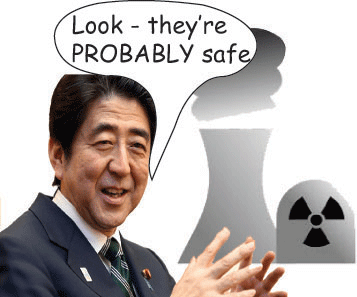 Japan Nuclear Plant Obtains Final Permit Needed To Restart, Huffington Post By MARI YAMAGUCHI 05/27/2015 TOKYO (AP) — A nuclear plant in southern Japan on Wednesday obtained the final permit needed to restart its reactors, paving the way for it to become the first to go back online under new safety standards introduced after the 2011 Fukushima disaster.
All of Japan’s more than 40 reactors are currently offline for repairs or safety inspections. The two units at the Sendai nuclear power plant are among 24 reactors seeking to restart, as Prime Minister Shinzo Abe’s pro-business government tries to put as many back online as possible.
The Nuclear Regulation Authority approved the Sendai plant’s operational safety plans, the last step of a three-part screening process. The plant’s safety program includes emergency response plans in case of fire, floods or other natural disasters, or a serious accident…… While local municipalities have already approved the Sendai plant’s restart, many residents oppose the plan, citing potential danger from active volcanos in the region.
Kyushu Electric hopes to restart one reactor at the Sendai plant in late July after on-site tests and training and the other in late September, though there could be some delays………http://www.huffingtonpost.com/2015/05/27/japan-nuclear-plant-restart_n_7450350.html
Chinese scientist warns on dubious safety of China’s nuclear power programme
 China warned over ‘insane’ plans for new nuclear power plants, Guardian, Emma Graham-Harrison , 25 May 15 He Zuoxiu, a leading Chinese scientist, says the country is not investing enough in safety controls after lifting of post-Fukushima disaster reactor ban. China’s plans for a rapid expansion of nuclear power plants are “insane” because the country is not investing enough in safety controls, a leading Chinese scientist has warned.
Proposals to build plants inland, as China ends a moratorium on new generators imposed after the Fukushima disaster in March 2011, are particularly risky, the physicist He Zuoxiu said, because if there was an accident it could contaminate rivers that hundreds of millions of people rely on for water and taint groundwater supplies to vast swathes of important farmlands.
China halted the approval of new reactors in 2011 in order to review its safety standards, but gave the go-ahead in March for two units, part of an attempt to surpass Japan’s nuclear-generating capacity by 2020 and become the world’s biggest user of nuclear power a decade later.
Barack Obama recently announced plans to renew a nuclear cooperation deal with Beijing that would allow it to buy more US-designed reactors, and potentially pursue the technology to reprocess plutonium from spent fuel…..
He, who worked on China’s nuclear weapons programme, said the planned rollout was going too fast to ensure it had the safety and monitoring expertise needed to avert an accident.
“There are currently two voices on nuclear energy in China. One prioritises safety while the other prioritises development,” He told the Guardian in an interview at the Chinese Academy of Sciences.
He spoke of risks including “corruption, poor management abilities and decision-making capabilities”. He said: “They want to build 58 (gigawatts of nuclear generating capacity) by 2020 and eventually 120 to 200. This is insane.”
He’s challenge to the nuclear plans is particularly powerful because of his scientific credentials and a long history of taking a pro-government stance on controversial issues, from the 1950s destruction of Beijing’s city walls to the crackdown in the 1990s on the religious group Falun Gong.
He would like to see China stop its expansion once the plants that have been approved or are now under construction are finished, and then gain a few decades experience of running them safely before expanding again. Almost all the country’s working reactors started up after 2000.
“China currently does not have enough experience to make sound judgments on whether there could be accidents,” he said. “The number of reactors and the amount of time they have been operating safely both matter.
“The safety reviews after Fukushima found some problems, but only minor ones, and the final conclusion is that China’s nuclear power is safe. But the safety checks were carried out under the old standards and the standards themselves clearly need big improvements.”………
“Japan has better technology and better management, and yet it couldn’t avoid an accident despite the fact that it tried very hard to learn from the US and USSR,” He said, adding that China’s nuclear monitor has sparser staffing than Japan’s, and offers low salaries that will not attract the best young scientists.
China had considered and then rejected stronger standards, He said, because of the huge pressure for a rapid expansion and companies powerful enough to put corporate profits ahead of national security.
“There were internal discussions on upgrading standards in the past four years, but doing so would require a lot more investment which would affect the competitiveness and profitability of nuclear power,” He said. “Nuclear energy costs are cheap because we lower our standards.”
Rather than encouraging debate to expose weaknesses, the government tries to stamp it out, and in a country where challenging officials is risky, there is no mechanism to encourage or protect whistleblowers.
He said: “At the moment, the ministry of environmental protection is considering a new watchdog. When they invited me over for a discussion, I told them: ‘Your safety watchdog is not independent. It listens to the national nuclear corporation and hence the scrutiny is fake’.”…….http://www.theguardian.com/world/2015/may/25/china-nuclear-power-plants-expansion-he-zuoxiu
Tokyo hit by 5.6y mag earthquake
Quake Hits Tokyo Days After Japan OK’s Third Nuclear Restart BY HENRY AUSTIN NBC NEWS 25 MAY 15 An earthquake shook buildings and halted train lines in Tokyo early Monday, days after Japan’s nuclear regulator green-lighted the restarting of atomic energy at a third plant.
The quake, with a preliminary magnitude of 5.6, was centered in Ibaraki prefecture just northeast of the country’s capital, the Japan Meteorological Agency said. There was no tsunami warning.
Narita airport closed both runways for checks shortly after the quake, but the capital’s Haneda airport was operating as normal.
There were no immediate reports of damage or injuries, and no reports of abnormalities at any nuclear facilities.
But the quake is likely to reignite the debate about whether the country should use nuclear power in one of the world’s most seismically active nations……….http://www.nbcnews.com/news/world/quake-strikes-japan-days-after-nuclear-reactor-signed-n364071
The emergencies at North Anna Nuclear Power Station
Japan Nuclear Engineer: US reactor at risk of ‘supercriticality’ during recent emergency… “That’s something scary” — Damaged nuclear fuel rods and fuel fragments found at plant, conditions reported as “seriously degraded” (VIDEO)http://enenews.com/japan-nuclear-engineer-reactor-risk-supercriticality-during-recent-emergency-big-spike-neutron-flux-scary-fragments-nuclear-fuel-later-found-plant-conditions-reported-be-seriously-degraded-video?utm_source=feedburner&utm_medium=email&utm_campaign=Feed%3A+ENENews+%28Energy+News%29
Satoshi Sato, Nuclear Engineer, April 28, 2015 (emphasis added): “I don’t know if you remember, there was the earthquake in 2011 in Virginia. That was a big one… enough to cause vibration to the North Anna reactor resulting in a big spike of neutron flux — or reactor power… and somehow caused the additional radioactivity into the core. So that’s something scary, potentially resulting in a supercriticality.” (IEER: “The neutron spike accompanying a sudden supercriticality can lead to an explosion of the reactor core. It is this sort of event which occurred at the Chernobyl reactor”)
U.S. NRC Event Notification, Aug 29, 2011: EMERGENCY DECLARED… North Anna Power Station declared an Alert [“actual or potential substantial degradation of the level of safety”] due to significant seismic activity… This notification is to report… a condition existed which met the emergency plan criteria but was not declared… Design Basis Earthquake limits may have been exceeded.
U.S. NRC, 2012: Reactor trips at both North Anna 1 and 2, were caused by a “Power RangeHigh Negative Neutron Flux Rate”… four possible causes [were identified] (1) loss of power to the control rod motor generator sets, (2) a dropped control rod, (3) movement of the nuclear instrumentation detectors, and (4) core barrel movement… Analysis included a third-party evaluation of the potential response of the core nucleate boiling… [Physics Forum: “nucleate boiling… reduces the heat transfer capability of the coolant… which leads to even more boiling, etc, until the fuel becomes ‘dry’… the cladding will burn and/or fuel will will melt”]
U.S. NRC email, Sept 2011: RE: North Anna… At this point, it appears that the grippers for several of the control rods deenergized and dropped.
Westinghouse patent: A dropped rod… will initially result in a reduction in the total powergenerated by the core. The reactor will then attempt to meet the load… by increasing powerin the remainder of the core which could lead to local overheating elsewhere in the core.
ASEE 2003 Conference: If a critical reactor is over moderated… the reactor can rapidly reach and exceed the prompt critical condition… Chernobyl started at a low power level, which corresponded to a positive void coefficient.
North Anna Root Cause Evaluation, Oct 2011: The last power decreases prior to the trips were of sufficient magnitude and rate to generate the negative rate trip… Root Cause Evaluation Team has postulated that the major cause of the power oscillations was void defect created by bursts of bubbles… which caused the power increases which followed the power decreases… It is postulated that [as] the seismic waves shake… a large portion of the [fuel] cladding surface is suddenly in the nucleate boiling region [and] causes the bubble burst… [I]t may not be plausible to generate sufficient void to decrease the core power up to 10% [therefore it] can be concluded that the bubble burst theory alone does not explain the magnitude of change [in] Units 1 and 2.
Enformable, Oct 2011: “It is likely that the North Anna Operators are going to be shocked… when they open the reactor to attempt to refuel it, and find that they cannot retrieve the fuel”
3 years later >> Richmond Times-Dispatch, Sept 30, 2014: Dominion Virginia Power has foundtwo damaged nuclear fuel rods in its North Anna 2 power plant [NRC in 2011: “It is noteworthy that the power oscillations were more pronounced on Unit 2“]… 15 uranium fuel pellets came out of two rods… [CEO David Heacock said] rods rubbed against the support structure, cutting grooves in them and eventually causing their tops to crack off… “We have accounted for about eight of the pellets”… The failed fuel assembly had been used during three 18-month operating cycles at North Anna…
U.S. NRC Event Notification Report, Sept 15, 2014: FAILED FUEL ASSEMBLY IDENTIFIED DURING CORE OFF-LOAD… North Anna Unit 2… Video inspection of the reactor vessel identified debris that has the potential to be fragments of fuel pellets resting on the core plate… this event is being reported [as an] event or condition that results in the condition of the nuclear plant, including its principle safety barriers, being seriously degraded.
Australians the suckers as AREVA tries to sell its failed nuclear technology down under
A negative learning curve on steroids What to make of the EPR saga? Areva is backing the wrong horse − the outcome of current political debates will result in a declining role for nuclear power in France, coupled to the growth of renewables.
A new report by ADEME, a French government agency under the Ministries of Ecology and Research, concludes that a 100% renewable electricity supply scenario is feasible in France. The report estimates that the electricity production cost would be €119 per megawatt-hour in 2050 in the 100% renewables scenario, compared with a near-identical figure of €117/MWh with a mix of 50% nuclear, 40% renewables, and 10% fossil fuels.
 Areva has also backed the wrong-sized wrong horse: a giant reactor with a giant price-tag. That said, the backers of ‘small modular reactors‘ are having no more success than Areva. And Areva isn’t having much luck with its mid-sized ATMEA pressurised water reactor………
The EPR saga shows that developing modified versions of conventional reactors (in this case pressurised water reactors) can be complicated and protracted and can end in failure. How much more difficult will it be to develop radically new types of reactors? The French government’s Institute for Radiological Protection and Nuclear Safety has recently produced an important critique of Generation IV nuclear power concepts. It states that there “is still much R&D to be done to develop the Generation IV nuclear reactors” and it is sceptical about the safety claims made for Generation IV concepts.
Feeling the pressure: Bumbling nuclear’s negative learning curve Jim Green, 21 May 2015, Climate Spectator http://www.businessspectator.com.au/article/2015/5/21/energy-markets/feeling-pressure-bumbling-nuclears-negative-learning-curve
French state-owned nuclear giant Areva is offering to sell its ‘world leading’ nuclear technology to South Australia. The offer is being reported in the South Australian media without a hint of irony. A reality check is in order.
Areva has posted losses in each of the past four years including a €4.83 billion loss in 2014. Continue reading
Sadety investigation opened by NRC at Indian Point Nuclear Plant
Nuclear Regulatory Commission Opens Probe at Indian Point Federal agency’s involvement follows fire at plant WSJ By JOSEPH DE AVILA May 19, 2015 New York state is renewing its call for tougher oversight of electrical transformers at the Indian Point Energy Center after the third failure in eight years of one of the power-transfer devices at the nuclear plant.
A transformer for Indian Point’s unit 3 exploded and caught fire May 9 in the nonnuclear section of the power plant 30 miles north of New York City. No one was hurt and no other equipment damaged.
The state’s call for more intensive inspections comes as EntergyCorp., the owner of Indian Point, seeks to renew its operating licenses for units 2 and 3 with the federal Nuclear Regulatory Commission. The state has opposed the renewal……..http://www.wsj.com/articles/nuclear-regulatory-commission-opens-probe-at-indian-point-1432054561
Danger to Jaitapur Nuclear Plant In Earthquake Zone
Nothing can be done to prevent earthquakes, considering that the Indian subcontinent is on a moving tectonic plate that is constantly crashing into the Himalayan range and pushing under the Eurasian plate at the rate of 5cm per year. Some areas are thus seriously earthquake-prone owing to aggravated faultlines and fissures in the earth.
Mixing earthquakes and nuclear power plants, therefore, would seem like courting a nightmare, which is what Jaitapur may be facing. This town, located on the unspoilt Ratnagiri coast of Maharashtra, is at the confluence of seismic zones 3 and 4, the latter the penultimate category in the national system for assessing earthquake-sensitive areas and identified as a “High Damage Risk Zone”. It is also the site prospectively for the largest nuclear power complex in the world, expected to pump 9,900 MW of electricity into the national grid………http://www.huffingtonpost.in/bharat-karnad-/post_9370_b_7303336.html
Britain outsources guarding of its nuclear facilities to private company
Command and control contract for Britain’s armed nuclear police outsourced to Capita The Independent 19 May 15 A contract for the command and control centre of Britain’s heavily armed nuclear police is being outsourced to the private company Capita.
The outsourcing giant is to play a technology support role at the command centre of the Civil Nuclear Constabulary, a heavily-armed special police service that protects nuclear power plants, waste dumps, and nuclear material in transit.
The deal will see Capita provide specialist support staff for the command centre’s systems and provide “enhanced support” to firearms commanders.
Most of the CNC’s officers are trained in the use of firearms and its officers are routinely equipped with assault rifles in their regular line of duty.
The force is not involved in Britain’s Trident nuclear weapons system, which comes under the jurisdiction of the armed forces.
Last year it was reported that a Capita-run army recruitment project beset by IT disasters and missed targets had made the firm over £100m of public money in a two-year period……….http://www.independent.co.uk/news/uk/politics/command-and-control-contract-for-britains-armed-nuclear-police-outsourced-to-capita-10258611.html
UK Navy investigating Trident nuclear submatine whistle-blower William McNeilly

 Royal Navy investigates Trident whistle-blower William McNeilly who claims nuclear programme is a ‘disaster waiting to happen’ , The Independent 17 May 15 The Royal Navy is investigating claims by an apparent whistle-blower that there is a “complete lack of concern for security” that makes the Trident nuclear weapons programme vulnerable to terror attack.
The claims were made in an online post by 25-year-old William McNeilly, and included a photograph of his Navy ID card.
McNeilly said he had “sacrificed” his freedom and a well-paid career to make the claims in an 18-page report entitled “The Secret Nuclear Threat”, and that after posting it he had gone on the run.
The Ministry of Defence confirmed that McNeilly was a member of the naval service, and a source said the Navy was “concerned for the whereabouts and wellbeing of AB (able seaman) McNeilly and working closely with civilian police to locate him”.
In his report, McNeilly claimed he had witnessed a host of inadequate systems and checks while training with the Trident programme, from “things like food hygiene” to failed launch tests, flooding on board submarines, fires in the missile compartment and “a complete lack of security”.
“If airport security and nuclear weapon security were both compared to prisons,” McNeilly writes, “the airport would be Alcatraz and base security would be house arrest.”
McNeilly’s report: Key claims
• Missile launch tests failed on three occasions
• Collision with French nuclear sub covered up
• Failures to carry out security checks on bags
• Computer waste representing major fire risk
• Missile safety alarms muted and ignored
• Accidental flooding of torpedo compartment
• Failure to question recording of top-secret info
McNeilly described the state of Trident security as “the biggest threat the UK faces”, and said he was only releasing “selected information” in order to avoid damaging security further.
“I’m releasing this information in this way because it’s the only way I can to be sure it gets out,” he said, adding that he had “raised concerns through the chain of command on multiple occasions” and got nowhere……….http://www.independent.co.uk/news/uk/home-news/royal-navy-investigates-trident-whistleblower-william-mcneilly-who-claims-nuclear-programme-is-a-disaster-waiting-to-happen-10256148.html
Trident nuclear submarines plagued by security lapses: whistleblower claims “high risk”
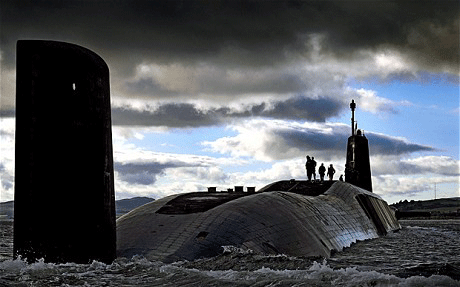 Trident whistleblower says nuclear subs are insecure, unsafe and ‘a disaster waiting to happen’, Herald Scotland Sunday 17 May 2015 TRIDENT submarines are plagued by serious security lapses, beset by multiple safety blunders and are “a disaster waiting to happen”, according to a nuclear weapons engineer turned whistleblower who is now being hunted by the police. William McNeilly, who says he was on patrol with HMS Victorious from January to April this year, alleges that the Trident missiles it carries are vulnerable to a terrorist attack that “would kill our people and destroy our land”. Infiltrators have “the perfect opportunity to send nuclear warheads crashing down on the UK”, he claims.
He has written a detailed 18-page report called The Nuclear Secrets, which claims to lift the lid on the alarming state of the UK’s ageing and short-staffed nuclear deterrent. He went absent without leave from the Royal Navy last week, is on the run and expects to be arrested. “This is bigger than me, it’s bigger than all of us,” he says. “We are so close to a nuclear disaster it is shocking, and yet everybody is accepting the risk to the public. If we don’t act now lives could be lost for generations.”
The risk was “extremely high”, he told the Sunday Herald. “My information comes from good sources and I have no reason to lie. If change isn’t made, a nuclear catastrophe almost certainly will happen.”
McNeilly’s report alleges 30 safety and security flaws on Trident submarines, based at Faslane on the Clyde. They include failures in testing whether missiles could be safely launched, burning toilet rolls starting a fire in a missile compartment, and security passes and bags going unchecked.
He also reports alarms being muted because they went off so often, missile safety procedures being ignored and top secret information left unguarded.
“It’s just a matter of time before we’re infiltrated by a psychopath or a terrorist,” he says. “There were some people that I served with on that patrol who showed clear psychopathic tendencies.”
The Royal Navy has launched an investigation into McNeilly’s report, and is working with the civilian police to find him. It describes his criticisms as “subjective and unsubstantiated”, stressing that submarines never go to sea unless they are completely safe.
The SNP’s Westminster leader, Angus Robertson MP, is demanding a full explanation and action to rectify all the failings. “These revelations, if true, are extremely concerning. It reads as a nightmare catalogue of serious safety breaches,” he said.
“They add to what appears to be a chaotic, shambolic safety culture on these aged subs. Broken or faulty equipment with no spares leading to slapdash patch-up jobs have no place in the Navy and just shows how utterly stretched it is.”
Robertson added: “Failure to follow standard safety procedures is unacceptable in any workplace but on a Trident submarine on patrol it could result in extreme tragedy, not just for those on board but indeed for the entire planet.”
McNeilly claims that there was a “massive cover-up” of what happened when HMS Vanguard collided with the French nuclear submarine, Le Triomphant, in the Atlantic in February 2009. He quotes a senior officer who was on Vanguard at the time as saying: “We thought, this is it, we’re all going to die.”
The crash dislodged high-pressure air (HPA) bottles, he says. “They had to return to base port slowly, because if one of HPA bottle groups exploded it would have created a chain reaction and sent the submarine plummeting to the bottom.”
McNeilly also outlines a litany of equipment problems, including a seawater leak, a flooded torpedo compartment and defective toilets. A missile compartment was used as an exercise gym, he alleges, and the submarine speaker system was difficult to understand.
He insists that he has been careful about what he has said publicly in order to avoid prejudicing security. He repeatedly raised concerns with his superiors but they were ignored, he says………….
“Most people know the Trident programme is a disaster waiting to happen, but they never tell the public. You’re guaranteed to lose everything, if you talk. Career, money, everything you own, your freedom, contact with family and friends.
I believe it’s in the Prime Minister’s best interest to pardon me. Prosecuting someone for alerting the people and the government to a major threat isn’t a good image for someone who serves the people.
I raised my concerns about the safety and security of the weapon system through the chain of command on multiple occasions. My concern couldn’t have been any clearer. Not once did someone even attempt to make a change.
I strongly believe that the Prime Minister and most people that defended Trident have no idea about how dire the situation is. This is not the time to judge on what they did when they didn’t know. It’s about what they do now that they know”. http://www.heraldscotland.com/news/home-news/trident-whistleblower-says-nuclear-submarimes-are-insecure-unsafe-and-a-disaster-wait.1431860917
More research needed on earthquake risk at nuclear plants- Nuclear Regulatory Commission
Among commercial U.S. nuclear plants, the Diablo Canyon reactors near San Luis Obispo and the Columbia generating station in Richland, Washington, face “the highest … hazard” when potential strong shaking is evaluated against the plants’ designs, the Nuclear Regulatory Commission found…………..
Diablo Canyon, which sits within a web of earthquake faults on the California coast, one 650 yards away from the reactors, has faced questions for decades about its ability to withstand a strong earthquake. Last year, a former chief NRC inspector at the plant urged regulators to shut down the reactors until they can determine whether they can withstand shaking from nearby faults, a recommendation rejected by the NRC.
Last year, two Seattle-based groups, Heart of America Northwest and Washington Physicians for Social Responsibility, called for shutting down the Columbia plant, citing a report by a nuclear power critic on risk posed by a stockpile of spent nuclear fuel and a potential earthquake. Operator Energy Northwest said the report was marred by errors.
Anti-nuclear activists said the NRC directive confirms concerns that Diablo Canyon’s design might not account for the threat of nearby faults discovered after the twin-reactor plant was constructed decades ago.
“The order is yet more evidence that earthquakes surrounding Diablo Canyon are capable of more ground motion than the reactors were built to withstand,” Friends of the Earth said in a statement…………..http://www.sfgate.com/business/energy/article/NRC-orders-more-research-on-earthquake-risk-at-6261739.php
Japan: Expert panel says 3 faults beneath Shika nuclear power plant may be active
Shika N-plant faults not ‘inactive’ / Power firm to challenge findings of NRA expert panel The Yomiuri Shimbun 15 May 15, An expert panel of the Nuclear Regulation Authority said Wednesday three faults running beneath the No. 1 reactor and other facilities of Hokuriku Electric Power Co.’s Shika nuclear power plant in Shika, Ishikawa Prefecture, may be active.
Members of the panel agreed on the view that “the possibility that the faults are active cannot be denied.”
The NRA’s new safety standards prohibit the construction of key nuclear facilities such as reactor buildings over active faults.
The No. 1 reactor may have to be decommissioned if the NRA concludes the faults are active. In addition, it also will become difficult to reactivate the No. 2 reactor.
There are eight faults under the nuclear facility site. Among them, it is said that three faults — one called S-1 running beneath the No. 1 reactor and others called S-2 and S-6 located beneath the plumbing system to deliver cooling seawater, which is a key facility — may be active……..
The panel has concluded so far that the No. 2 reactor at Japan Atomic Power Co.’s Tsuruga nuclear power plant in Fukui Prefecture sits on an active fault, while it has denied possibilities that faults located beneath Kansai Electric Power Co.’s Oi nuclear power plant and Mihama nuclear power plant, both in the same prefecture, are active……..http://the-japan-news.com/news/article/0002149236
Norh East Japan rocked by M6.8 earthquake
Powerful M6.8 quake rocks NE Japan — Strongest to hit nation since 2011 — Official warns of upcoming aftershocks & tsunami, says tectonic plate is subducting in Pacific — CBS: Scientists detect month-long shaking on seafloor that could foreshadow mega quake similar to 3/11 (VIDEO) http://enenews.com/powerful-m68-quake-rocks-ne-japan-strongest-hit-country-2011-cbs-scientists-recorded-shaking-seafloor-could-foreshadow-mega-quake-similar-311-official-warns-upcoming-aftershocks-tsunami-tecton?utm_source=feedburner&utm_medium=email&utm_campaign=Feed%3A+ENENews+%28Energy+News%29
Kyodo News, May 12, 2015 (emphasis added): A magnitude 6.8 earthquake rocked a wide area of Japan centering on the northeast early Wednesday [and] observed in areas ranging from Hokkaido in the north to Gifu Prefecture in central Japan.
UPI, May 12, 2015: According to NHK [it’s] the strongest earthquake to hit Japan since 2011.
NBC News, May 13, 2015: “We consider this morning’s earthquake to be an aftershock” [of the 3/11 quake] said Yohei Hasegawa, an official at the Japanese meteorological agency. The temblor, which struck just after 6 a.m. local time, was sparked by the Pacific tectonic plate “subducting,” or moving under, the main land plate, he added. Hasegawa warned that more tremors may be on the way. “It’s not just limited to this area alone.”
Japan Times, May 13, 2015: Moderate tremors were also felt in Tokyo… [Hasegawa] warned that another strong tremor could strike within a week, adding “if it happens (beneath) the sea, it could trigger a tsunami.”… a 78-year-old woman [said] “It reminded me of the disaster”… Kayoko Tamura [said] “It was the first time I felt such a strong earthquake here.”
NHK transcript, May 12, 2015: Officials… say it was the first strong earthquake to hit the region since July 2011 [and] aftershocks of a similar scale might come in the next week. >> Watch the broadcast here
CBS San Francisco, May 12, 2015 at 2:42pm: Earlier this week, scientists said they’ve recorded low frequency shaking on the ocean floor that may have been foreshadowing a larger earthquake similar towhat was released during the 2011 earthquake.
CBS San Francisco, May 12, 2015 at 12:42pm: Mega Quake Warning In Rumblings Off Japan’s Coast Alarms Scientists… [A] team of researchers says a similar pattern is emerging in a subduction zone where two tectonic plates are engaged… “Monitoring of offshore seismicity off southern Kyushu, Japan, recorded a complete episode of low-frequency tremor, lasting for 1 month”… These quakes moved in waves along the tectonic ridge and stopped abruptly… potentially increasing stress that could be released in a “mega thrust” earthquake.
France’s nuclear safety worries as fires break out close to 3 nuclear power plants

 French police investigate fires near three nuclear sites http://uk.reuters.com/article/2015/05/12/uk-france-nuclear-fires-idUKKBN0NX1HD20150512 PARIS French police are investigating fires that caused minor damage near three nuclear installations, state-owned utility EDF (EDF.PA) and atomic research agency CEA said on Tuesday.
Fires broke out on Monday morning at a weather station near EDF’s former Brennilis nuclear power station in Brittany and another near its Belleville nuclear plant on the Loire river, a spokeswoman said.
She said the fire had damaged equipment belonging to the IRSN nuclear research institute used to measure pollution and radioactivity at the weather stations, which are each about 1.5 kilometres away from the nuclear plants. “Police investigations are ongoing,” the EDF spokeswoman said.
Another fire was started on Monday evening at a weather station close to atomic research institute CEA’s Valduc site in Burgundy where nuclear weapons are manufactured and dismantled.
“There was the beginning of a fire, but it was quickly put out and there were no real consequences,” a CEA spokesman said, adding that a complaint had been filed with police.
The simultaneous incidents are reminiscent of drones that flew over French nuclear plants last year which raised safety concerns. [ID:nL5N0SR0DY] (Reporting by Michel Rose; editing by Jason Neely)
1 This Month

of the week – THE ONENESS of HUMANITY
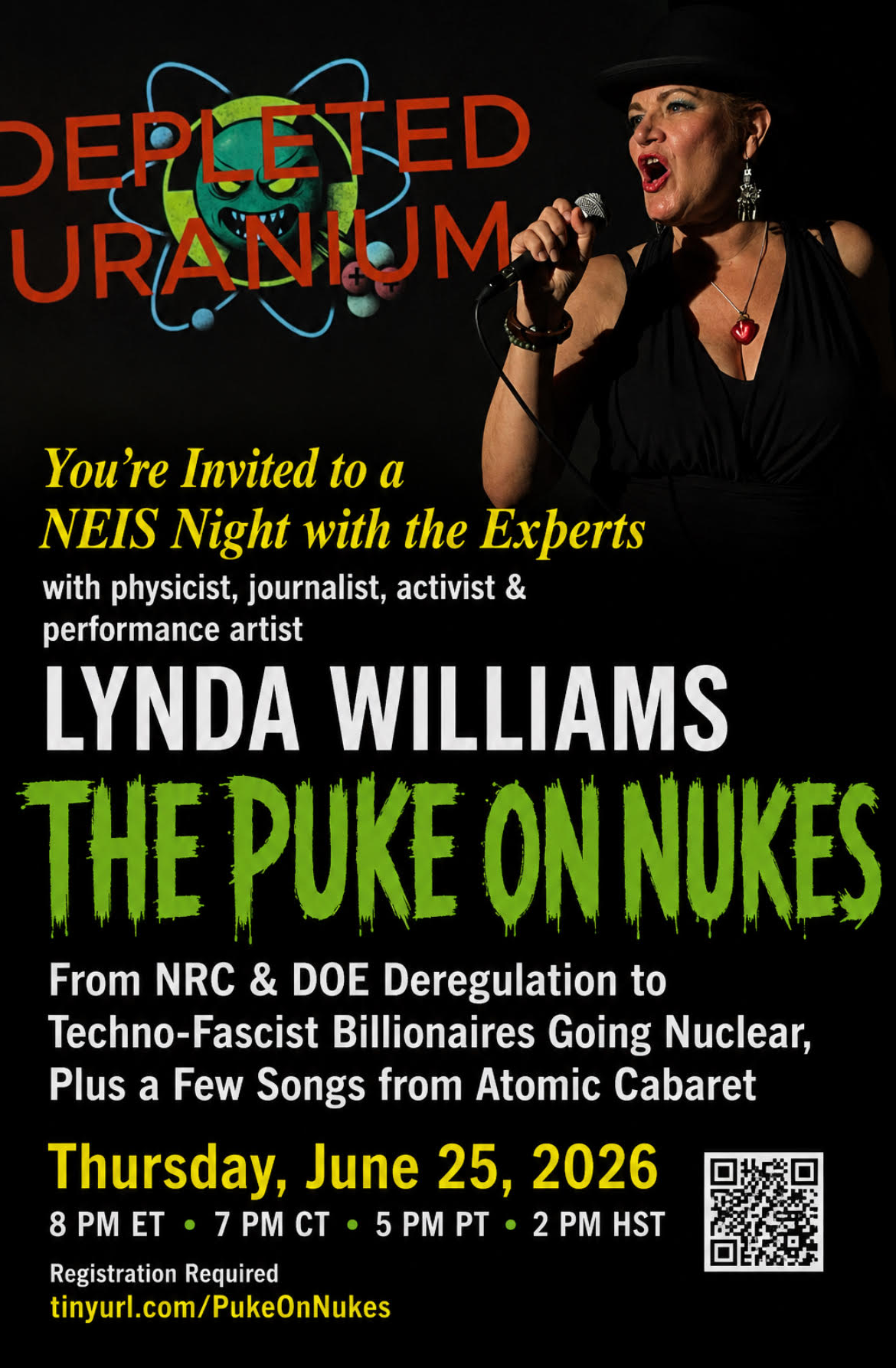
25 June- THE PUKE ON NUKES
Thursday, June 25, 2026
7pm Central Time (8pm ET, 6pm MT, 5pm PT) UTC – 5
From NRC & DOE Deregulation to Techno-Fascist Billionaires Going Nuclear, Plus a Few Songs from Atomic Cabaret REGISTER
26 June – Radiation Trainwreck at the NRC / Join the Protect Better Campaign – https://us02web.zoom.us/meeting/register/4ZlZ5_qLSHGiLSCg8FF6Bg#/registration

1st July – Webinar Waste of Space: The Environmental Harm of Military and Civil Space Activity st July, 7 pm

Report Launch Online: We are seeing an increasing exploitation of space for military and commercial purposes. This must change.

Protect Sazan Island from the Trump family! https://secure.avaaz.org/campaign/en/protect_sazan_island_from_the_trump_family_loc/?bqFCVab&v=174511&cl=22707147157&_checksum=5e9dde668860e8231c33699735e16a1fbf22ab2cb01da50c999fe8732b9775ef&utm_source=email&utm_medium=blast_email&utm_campaign=174511


Cuba Is Not a Failed State – It Is a Besieged State
PETITION: “Global Appeal to Endorse Palestinian Right of Return of Refugees”
To see nuclear-related stories in greater depth and intensity – go to https://nuclearinformation.wordpress.com
-
Archives
- June 2026 (241)
- May 2026 (306)
- April 2026 (356)
- March 2026 (251)
- February 2026 (268)
- January 2026 (308)
- December 2025 (358)
- November 2025 (359)
- October 2025 (376)
- September 2025 (257)
- August 2025 (319)
- July 2025 (230)
-
Categories
- 1
- 1 NUCLEAR ISSUES
- business and costs
- climate change
- culture and arts
- ENERGY
- environment
- health
- history
- indigenous issues
- Legal
- marketing of nuclear
- media
- opposition to nuclear
- PERSONAL STORIES
- politics
- politics international
- Religion and ethics
- safety
- secrets,lies and civil liberties
- spinbuster
- technology
- Uranium
- wastes
- weapons and war
- Women
- 2 WORLD
- ACTION
- AFRICA
- Atrocities
- AUSTRALIA
- Christina's notes
- Christina's themes
- culture and arts
- Events
- Fuk 2022
- Fuk 2023
- Fukushima 2017
- Fukushima 2018
- fukushima 2019
- Fukushima 2020
- Fukushima 2021
- general
- global warming
- Humour (God we need it)
- Nuclear
- RARE EARTHS
- Reference
- resources – print
- Resources -audiovicual
- Weekly Newsletter
- World
- World Nuclear
- YouTube
-
RSS
Entries RSS
Comments RSS
 nuclear-news