Memo to Trump: Address the new threat of drone-vulnerable nuclear reactors

By Henry Sokolski | January 17, 2025,
https://thebulletin.org/2025/01/memo-to-trump-address-the-new-threat-of-drone-vulnerable-nuclear-reactors/
Mr. President, in the closing days of your first administration, you issued an executive order spotlighting the growing dangers of drone attacks against America’s critical energy infrastructure. Your order asked the Federal Aviation Administration to propose regulations restricting overflights of critical infrastructure. Four years later, large drones overflying nuclear plants both here and abroad demonstrate your request was spot on.
Our government, however, continues to discount the dangers such overflights pose. As for the threats facing the most frightening of civilian targets—nuclear power plants—Washington has been all too silent. While there are many other infrastructure nodes drones can hit, the effects of striking nuclear plants exceed that of almost any other civilian target set. Your second administration urgently needs to address this new threat.
Background
Your January 2021 order followed an October 2020 Nuclear Regulatory Commission (NRC) report that downplayed the dangers posed by nearly 60 previous drone overflights of US nuclear plants. The commission based its conclusion on a Sandia Laboratory technical analysis that focused on “commercially available” drones. The NRC insisted that attacks against reactors with such aircraft posed no risk of inducing a major radiological release.
Since then, drones—far larger than those commercially available to hobbyists—have overflown US dams, power lines, and nuclear reactors. Recently, the NRC itself has observed a sharp increase in the number of drone sightings over nuclear plants, with drone reports nearly doubling in just one week in December. This led the 10th largest electrical utility company in the United States to urge the Federal Aviation Administration to ban all air traffic over its two nuclear plants after drones were sighted flying over its reactors. Now, Republican governors, including Jeff Landry of Louisiana, are asking you to do something about drones overflying reactors in Louisiana and other states. Overseas, Russian military drones overflew a German nuclear plant in August, prompting the German government to announce a formal investigation.
Security implications
All of this comes as the United States, South Korea, and Russia are pushing the export and construction of scores of large and small reactors in Eastern Europe, Africa, the Middle East, and East Asia. You and your cabinet should understand that new and existing nuclear plants are potential military targets—now and in the future. Certainly, Russia’s targeting of Ukrainian nuclear reactors and their critical electrical supply systems demonstrates a willingness to attack these dangerous targets.
Meanwhile, several recent war games graphically detailed how China, North Korea, and Russia could use such attacks against Taiwan, Europe, and South Korea to disrupt US military operations and force the evacuation of millions to help achieve their military objectives.
Recommendations
If nuclear power is to have the promising future that you and previous administrations have pledged to promote, your administration needs to address the vulnerability of its reactors to drone attacks.
Your administration should start by refocusing on the concerns you rightly raised in 2021. In specific, within your first 100 days in office, you and your cabinet should:
- Again ask the Federal Aviation Administration to update its regulations under the FAA Extension, Safety, and Security Act of 2016 (Public Law 114-190). At the very least, the United States needs clearer protocols restricting and countering the use of drones on or over critical infrastructure and other sensitive sites, including nuclear plants, which, if hit, risk a significant release of harmful radiation. Currently, shooting suspect drones down is all but prohibited.
- Have the Secretary of Defense, the Secretary of Homeland Security, and the Director of National Intelligence assess within 90 days the threat that drone and missile attacks pose to US and allied electrical supply systems, nuclear plants, and other key infrastructure nodes. This report should be published both in classified form—to you, key members of your cabinet, and the national security leadership in the House and Senate—and in unclassified form to the public.
- Ask the Defense Department, National Nuclear Security Administration, and the Department of Homeland Security to explain how they will either require or provide active and passive defenses for existing and planned US civilian and military nuclear plants here and abroad. This report should also describe how the US government should respond to drone and missile attacks on such plants which, if hit, could release harmful amounts of radiation.
- Direct the Energy Department and the Federal Aviation Administration to contract JASON (the government’s scientific advisory group), to explore what technologies might better detect and counter hostile drone and missile attacks and mitigate the effects of such attacks. These technologies could include hardening nuclear reactors, active and passive defenses, and research on nuclear fuels that might be able to survive advanced conventional attacks with thermobaric and other advanced conventional explosives.
- Direct the Energy Department, the Department of Homeland Security, and the Defense Department to devise a program of realistic testing to clarify the military vulnerabilities and safety thresholds of reactors and other nuclear plants against missile and drone attacks.
These Are The Six Times The USA Lost Nuclear Weapons
The US military has had at least 32 “Broken Arrow” incidents.
Tom Hale, Senior Journalist, FL Science 17th Jan 2025, https://www.iflscience.com/these-are-the-six-times-the-usa-lost-nuclear-weapons-77661
Keys, phones, headphones, socks, thermonuclear weapons – some things just always seem to go missing. Believe it or not, there were at least six instances when the US lost atomic bombs or weapons-grade nuclear material during the Cold War.
Not only that, but the US is responsible for at least 32 documented instances of a nuclear weapons accident, known as a “Broken Arrow” in military lingo. These atomic-grade mishaps can involve an accidental launching or detonation, theft, or loss – yep loss – of a nuclear weapon.
February 13, 1950
The first of these unlikely instances occurred in 1950, less than five years after the first atomic bomb was detonated. In a mock nuclear strike against the Soviet Union, a US B-36 bomber en route from Alaska to Texas began to experience engine trouble. An icy landing and stuttering engine meant the landing was going to be near-impossible, so the crew jettisoned the plane’s Mark 4 nuclear bomb over the Pacific. The crew witnessed a flash, a bang, and a sound wave.
The military claims the mock-up bomb was filled with “just” uranium and TNT but no plutonium core, meaning it wasn’t capable of a conventional nuclear explosion. Nevertheless, the uranium and the weapon have reportedly never been recovered.
March 10, 1956
On March 10, a Boeing B-47 Stratojet set off from MacDill Air Force Base Florida for a non-stop flight to Morocco with “two nuclear capsules” onboard. The jet was scheduled for its second mid-flight refueling over the Mediterranean Sea, but it never made contact. No trace of the jet was ever found.
February 5, 1958
In the early hours of February 5, 1958, a B-47 bomber with a 3,400-kilogram (7,500-pound) Mark 15 nuclear bomb on board accidentally collided with an F-86 aircraft during a simulated combat mission. The battered and bruised bomber attempted to land numerous times, but to no avail. Eventually, they made the decision to jettison the bomb into the mouth of the Savannah River near Savannah, Georgia, to make the landing possible. Luckily for them, the plane successfully landed and the bomb did not detonate. However, it has remained “irretrievably lost” to this day.
January 24, 1961
On January 24, 1961, the wing of a B-52 bomber split apart while on an alert mission above Goldsboro, North Carolina. Onboard were two nuclear bombs. One of these successfully deployed its emergency parachute, while the other fell and crashed to the ground. It’s believed the unexploded bomb smashed into farmland around the town, but it has never been recovered. In 2012, North Carolina put up a sign near the supposed crash site to commemorate the incident
December 5, 1965
An A-4E Skyhawk aircraft loaded with a nuclear weapon rolled off the back of an aircraft carrier, USS Ticonderoga, stationed in the Philippine Sea near Japan. The plane, pilot, and nuclear bomb have never been found.
In 1989, the US eventually admitted their bomb was still sitting on the seabed around 128 kilometers (80 miles) from a small Japanese island. Needless to say, the Japanese government and environmental groups were pretty annoyed about it.
Spring, 1968
At some point during the Spring of 1968, the US military lost some kind of nuclear weapon. The Pentagon still keeps information about the incident tightly under wraps. However, some have speculated that the incident refers to the nuclear-powered Scorpion submarine. In May 1968, the attack submarine went missing along with its 99-strong crew in the Atlantic Ocean after being sent on a secret mission to spy on the Soviet Navy. This, however, remains conjecture.
‘Alarming’ environmental breaches at nuclear sites spark calls for tougher action

Paul Dobson, Rob Edwards, January 12, 2025
The Dounreay nuclear facility in Caithness was found to be in breach of
rules on eleven occasions in recent years, making it one of the most
frequent offenders in Scotland. Dounreay – which houses radioactive waste
– was a hub of nuclear research between the 1950s and 1990s but is now
the site of the largest nuclear clean up in Scotland.
There was also a breach at the Faslane naval base, although this did not involve
radioactivity. The findings come from data released to The Ferret by the
Scottish Government’s green watchdog, the Scottish Environment Protection
Agency (Sepa). The agency kept a further 25 sites which had broken rules
secret. The Ferret understands this is because they house radioactive
materials which governments fear could be targeted by terrorists aiming to
build a dirty bomb.
The Ferret 12th Jan 2025,
https://theferret.scot/environmental-breaches-spark-calls-tougher-action/
Now By Fire, Next by Quake, then by Apocalyptic Radiation: Will Gavin Newsom’s Diablo Canyon Atomic Folly Kill Us All?

Los Angeles is now being destroyed by fire.
by Harvey “Sluggo” Wasserman, January 11, 2025, more https://freepress.org/article/now-fire-next-quake-then-apocalyptic-radiation-will-gavin-newsoms-atomic-folly-kill-us-all-0
Los Angeles is now being destroyed by fire.
Next will be the “Big One” earthquake everyone knows is coming.
And then—unless we take immediate action—Diablo Canyon’s radioactive cloud will make this region a radioactive dead zone.
My family is now besieged by four fires raging less than four miles away. We don’t know how long our luck will hold.
We are eternally grateful to the brave fire-fighters and public servants who are doing their selfless best to save us all.
We are NOT grateful that Gavin Newsom has recklessly endangered us by forcing continued operation at two unsafe, decrepit nuclear power plants perched on active earthquake faults, set to pour radioactive clouds on us from just four hours north of here.
The Nuclear Regulatory Commission’s resident site inspector—Dr. Michael Peck—after five years at Diablo warned that it cannot withstand the earthquakes we all know are coming.
In 2006 the NRC confirmed that Unit One was already seriously embrittled. Its fragile core makes a melt-down virtually certain to cause a catastrophic explosion, shooting a lethal apocalyptic cloud right at us…and then across the state and continent.
These wildfires make clear that these city, state and federal governments—maybe NO government ANYWHERE—can begin to cope with these kinds of mega-crises.
Imagine watching our public servants trying to cope while dressed in radiation suits, knowing everything around us has been permanently contaminated.
Imagine leaving all you own forever behind while racing to get yourself and your family out of here under the universal evacuation order demanded by radioactive clouds like those that decimated the downwind regions from Chernobyl and Fukushima, not to mention Santa Susanna and Three Mile Island, Windscale and Kyshtym.
Pre-empting such a catastrophe was a major motivation for the 2018 plan to phase out the two Diablo nukes in 2024 and 2025,
That landmark blueprint was crafted over a two-year period with hundreds of meetings, scores of hearings involving the best and brightest in energy, the economy, the ecology and the hard engineering realities of aging atomic power reactors.
It was signed by the then-Governor (Jerry Brown), Lieutenant Governor (Gavin Newsom), state legislature, state regulatory agencies, the Nuclear Regulatory Commission, plant owner (PG&E), labor unions, local governments, environmental groups and many more, .
The economic and energy security goals of this plan have been far exceeded by advances in renewable generation and battery storage. California now regularly gets 100% of its electricity from solar, wind and geothermal. Battery back-up capabilities exceed Diablo’s capacity by a factor of four or more. Its inflexible baseload productions unfortunately interferes with far cheaper renewables filling our grid.
The grid’s most serious blackout threats now come from disruptive malfunctions and potential disasters at Diablo Canyon.
All this has been well known since 2018, when Newsom signed the Diablo agreement.
The phase-out proceeded smoothly for four years, largely exceeding expectations.
But in 2022, Newsom strongarmed the legislature into trashing the phase-out plan. His Public Utilities Commission decimated the statewide rate structure, costing our solar industry, billions in revenues and at least 17,000 jobs.
Instead Newsom fed PG&E about $1.4 billion in public subsidies and $11 billion in over-market charges to keep Diablo running through 2030.
Neither the NRC nor state nor PG&E have done the necessary tests to guarantee Diablo’s safety, refusing to re-test for embrittlement even though such defects forced the NRC to shut the Yankee Rowe reactor in 1991.
Diablo has no private liability insurance. Should it irradiate Los Angeles, NONE of us can expect compensation.
So as we shudder amidst the horrors of this firestorm, we know that our loss of life, health and property will be orders of magnitude—literally, infinitely—more devastating when, by quake or error, the reactors at Diablo Canyon melt and explode.
Responsibility for this needless, unconscionable threat lies strictly with Gavin Newsom. There is no sane economic, electric supply or common sense reason for him to impose this gamble on us.
Governor Newsom: NOTHING can make public sense of this radioactive throw of the dice.
We respectfully beg, request, demand, beseech that you honor the sacred word you gave in 2018 to phase out the Diablo Canyon atomic reactors.
As we see the devastation engulfing us, and the inability of government to make it right, there is zero mystery as to why these nukes must shut.
NOW!!!
US to study proliferation risk of HALEU nuclear fuel, after warning by scientists

By Timothy Gardner January 10, 2025
WASHINGTON, Jan 8 (Reuters) – The U.S. agency in charge of nuclear security is commissioning a study on the proliferation risks of a more-enriched uranium fuel that nuclear power developers want to fuel new high-tech reactors, the head of the agency said this week.
Jill Hruby, administrator of the National Nuclear Security Administration, said in a statement published in the journal Science that it is important to address proliferation concerns of so-called high assay, low-enriched uranium fuel, or HALEU.
“NNSA recognizes that reactor type, fuel enrichment level, fuel quantity, and fuel form are important factors in evaluating proliferation risks and believes that risk-informed and adaptive approaches to the proliferation challenges inherent in nuclear energy are warranted,” Hruby said.
Planned new nuclear plants, known as small modular reactors, or advanced reactors, must set high standards for safety and security, “especially considering Russia’s takeover of Ukraine’s largest nuclear power plant,” she said.
Russia in 2022 took the Zaporizhzhia plant, the largest nuclear plant in Europe, by force after it invaded Ukraine.
Hruby’s statement was in response to an article published last year in which scientists said HALEU poses a security risk because it can be used without further enrichment as fissile material in a crude nuclear weapon.
HALEU is uranium fuel enriched up to 20% instead of the 5% level of uranium fuel used in today’s commercial reactors.
Several companies are hoping to develop a wave of reactors that would use HALEU, including the Bill Gates-backed TerraPower, which wants to build a $4 billion plant in Wyoming by 2030. Nuclear has gotten attention from technology companies seeking new ways to power data centers and as U.S. power demand is growing for the first time in decades. None of the plants have yet to be built.
TerraPower did not immediately respond to a request for comment.
In October, the U.S. Energy Department rolled out initial contracts to four companies hoping to produce HALEU domestically. Currently, commercial amounts of HALEU are only produced in Russia. The U.S. contracts will last up to 10 years and each awardee received a minimum of $2 million, with up to $2.7 billion available subject to congressional appropriations.
Hruby said NNSA has regularly collected data and evaluated HALEU risks, and is finalizing plans to commission a National Academies report. The reports are largely classified, she said. But the information will be used to inform programs, develop actions, and make recommendations to stakeholders.
Edwin Lyman, a physicist at the Union of Concerned Scientists and an author of last year’s report, said he appreciated that Hruby is asking for the independent review of HALEU by the National Academies. “We are hopeful that this effort will lead to tighter security controls on HALEU to prevent its misuse by proliferators and terrorists.”
The authors had written that if HALEU enrichment is limited to 10% to 12%, the supply chain would be far safer with only modest costs.
Jimmy Carter hailed as ‘action’ hero for stopping nuclear meltdown at 28

Jimmy Carter hailed as ‘action’ hero for stopping nuclear meltdown at 28 https://nypost.com/2021/12/16/jimmy-carter-is-action-hero-for-stopping-nuclear-disaster/
By Hannah Sparks, December 16, 2021 Who needs action movies when there are real-life superheroes like Jimmy Carter among us?
A viral Twitter thread is reminding the world that the 39th US President James Earl Carter Jr., now 97, actually rescued Ottawa, Ontario, from nuclear destruction as a 28-year-old way back on Dec. 12, 1952.
“Do you remember the world’s very first nuclear meltdown? That time the US President, an expert in nuclear physics, heroically lowered himself into the reactor and saved Ottawa, Canada’s capital?” asked Canadian physicist University of Ottawa professor Jeff Lundeen in his now-viral thread, originally posted Tuesday but officially trending two days later.
Sounds like schlocky action movie, but it actually happened!”
Lundeen’s revelatory tweet to his modest 1,078 followers now boasts nearly 50,000 likes, more than 20,000 retweets and hundreds of cheerfully shocked comments. He included data from the Ottawa Historical Society and a snippet of a 2011 report documenting Carter’s heroics, and he followed up with several other media sources that recount the historic tale.
As the story goes, the Plains, Ga., native planned his entire life to join the Navy — and did so when he received his appointment to the Naval Academy in 1942. After graduating with distinction, Carter spent two years completing his service ship duty before signing on to the Submarine Force. Following a series of relocations and promotions, the young lieutenant would request to join Captain Hyman G. Rickover’s nuclear sub program, where they were developing the world’s first atomic subs.
Rickover then sent Carter to work for the US Atomic Energy Commission, where he served on temporary duty with the Naval Reactors Branch. Meanwhile, a few months later, an accidental power surge at Chalk River Laboratories in Ottawa caused fuel rods within a nuclear research reactor to rupture and melt — risking a full nuclear meltdown.
It was the first such incident of its kind, and Carter’s team of 23 men was ordered to clean it up.
I
n a scene straight out of modern-day blockbusters, the operation would require the brave men to descend into the core by rope and pulley so they could deconstruct the reactor bolt by bolt. The lab had set up a duplicate reactor as a training field for Carter’s team, who would get only one shot at the real thing. Each man would have to descend into the core and complete their high-flying tasks in 90-second spurts, as exposure to toxic radiation within the reactor posed a high risk to their long-term health.
Their plan went off without a hitch. The core was shut down and then rebuilt. From there, Carter went on to become the engineering officer for the USS Seawolf, one of the first submarines to operate on atomic power. By 1961, he retired from the Navy and Reserves, and, in 1963, ran for his first political office.
For those who admire the single-term Democratic president, Lundeen’s tweet was just another reminder of Carter’s selfless service — and good jokes.
One top Twitter response included a quote from the president, who visited Pennsylvania’s Three Mile Island power plant in 1979, during their disastrous partial meltdown.
When asked by media if he thought it too dangerous to visit the radioactive site, he reportedly quipped, “No, if it was too dangerous they would have sent the vice president.”
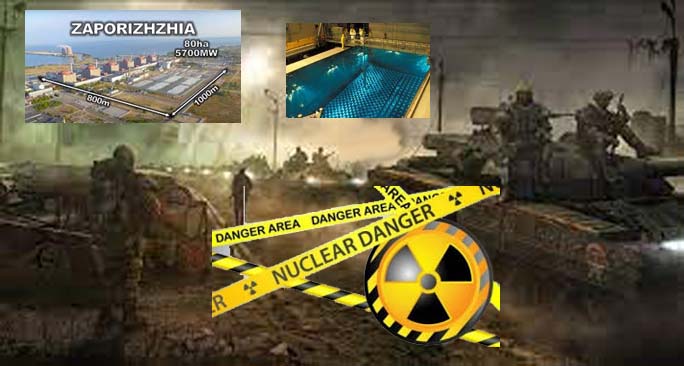
International Atomic Energy Agency (IAEA) staff reported hearing loud blasts near Ukraine’s Zaporizhzhya Nuclear Power Plant (NPP)
IAEA 5th Jan 2025,
https://www.iaea.org/newscenter/pressreleases/update-269-iaea-director-general-statement-on-situation-in-ukraine
International Atomic Energy Agency (IAEA) staff reported hearing loud blasts near Ukraine’s Zaporizhzhya Nuclear Power Plant (NPP) today, coinciding with reports of a drone attack on the plant’s training center, marking yet another threat to nuclear safety at Europe’s largest NPP, according to Director General Rafael Mariano Grossi.
The IAEA Support and Assistance Mission to Zaporizhzhya (ISAMZ) team stationed at ZNPP reported hearing two loud explosions coming from outside the perimeter of the site at approximately 12:45 and 15:45. For now, the IAEA has not yet been able to confirm any impact. The IAEA team also reported hearing machine gun fire coming from the site on multiple occasions.
The IAEA is aware of reports of an alleged attack by a drone at the ZNPP training center today, just outside of the site’s perimeter. Reports state that there were no casualties and no impact on any NPP equipment.
The ISAMZ team has reported that the intensity of military activities in the vicinity of Europe’s largest NPP – including multiple explosions at various distances from the site – has increased over the last 24 hours. “An attack on any nuclear power plant is completely unacceptable,” Director General Grossi stated. “In light of the increased military activity at ZNPP, I once again call for maximum restraint to avert the clear danger to its safety, and for the strict adherence to the five concrete principles established by the IAEA at the United Nations Security Council to protect the facility and the seven indispensable pillars of nuclear safety during an armed conflict also defined by the IAEA”.
Faslane Peace Camp warns of growing nuclear risks amid rising tensions
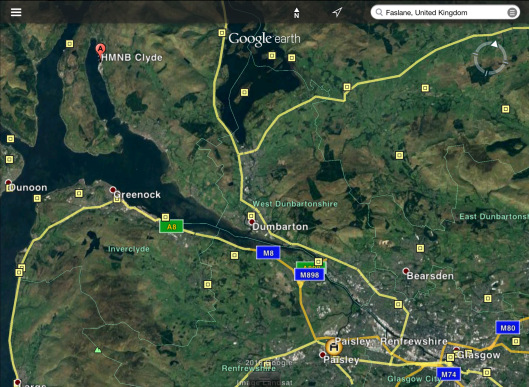
SCOTLAND is on the front line of a new international arms race spurred on
by a rise in frosty nuclear rhetoric. Just last month, the UK was declared
to be “directly involved” in the Ukraine war, meaning HM Naval Base
Clyde at Faslane – only 25 miles outside Glasgow – could be seen as a
“legitimate target”.
For the occupiers of Faslane Peace Camp,
site-sitting over the festive period, action and awareness are needed now
more than ever to pull us back from the brink of a nuclear winter just one
year before the 80th anniversary of the Hiroshima and Nagasaki bombings.
Acknowledging the risk of dealing in nuclear currency, Pete Roche, director
at Edinburgh Energy and Environment Consultancy, advocates for an energy
system throughout Scotland and the UK that runs entirely on renewables. The
previous Greenpeace campaigner said: “It is perfectly feasible to run
Scotland and the UK’s energy system on 100% renewables. This could save
well over £100 billion by 2050 compared to business as usual.”
The National 4th Jan 2025
https://www.thenational.scot/news/24832799.faslane-peace-camp-warns-growing-nuclear-risks-amid-rising-tensions/
The Time Navy Lt. Jimmy Carter Was Lowered Into A Partially Melted-Down Nuclear Reactor
The recently deceased 39th president had a hand in the dawn of the nuclear submarine age, including one especially dangerous mission.
The War Zone, Geoff Ziezulewicz, 30 Dec 24
resident Jimmy Carter’s time as a U.S. Navy officer might have been brief, but it served to inform the rest of his days before passing away Sunday at the age of 100. Prior to his political career and Nobel Prize-winning peacemaking efforts, Carter stood at the side of the father of the nuclear Navy during its infancy, and even got lowered into a melted-down nuclear reactor as a junior officer. Decades later, the former president was stunned to learn of the capabilities carried by the secretive spy submarine that bears his name to this day.
Ensign James Earl “Jimmy” Carter graduated from the U.S. Naval Academy in 1946, and applied to join the Navy’s nuclear submarine community a few years later, according to the Navy…………………………………………………………………………………………………………………………….
After Carter joined the Navy’s nuclear efforts, the 28-year-old and his crew were sent to repair the Chalk Water nuclear reactor near Ottawa, Canada, in late 1952. The reactor had suffered a partial meltdown, and a team was needed to shut it down, take it apart and replace it. Carter and the rest of the team took a train up north and soon got to work.
“They built an identical replica of the reactor on an adjacent tennis court to precisely run through the repair procedures, due to the maximum time humans could be exposed to the levels of radiation present in the damaged area,” a Navy history recounts. “Each member of the 22 member team could only be lowered into the reactor for 90-second periods to clean up and repair the site.”
Official accounts don’t clarify whether Carter was in command during the mission, or his precise role. Still, the future president did his part, Canadian journalist Arthur Milnes later recounted.
“He was lowered into the building … with his wrench, and he had to run over to the reactor casing and he had one screw to turn,” Milnes said after interviewing Carter about the incident. “That was all the time he had. And then, boom, back up.”
Carter and the others were regularly tested after the mission was finished to look for long-term health effects.
“They let us [crew members] get probably a thousand times more radiation than they would now.” Carter told CNN in 2008 while reflecting on the incident. “We were fairly well-instructed then on what nuclear power was, but for about six months after that, I had radioactivity in my urine.”
In his autobiography, “A Full Life, Reflections at Ninety,” Carter recounted the distinctive perils of being a submarine officer:
“Although some enlisted men could concentrate almost exclusively on their own fields of responsibility as engine men, electricians, torpedo experts, boatswains, quartermasters, gunners or operators of navigation and fire control equipment, every officer was expected to master all of these disciplines…we knew one mistake could endanger everyone aboard.”…………………………………………………………………………
Carter lived an extraordinary life, by all accounts. His time in the submarine community played a critical role in all that came after, and he remained a Navy man until the end.
You and I leave here today to do our common duty—protecting our Nation’s vital interests by peaceful means if possible, by resolute action if necessary,” Carter told the graduating class of Naval Academy midshipmen in 1978. “We go forth sobered by these responsibilities, but confident of our strength. We go forth knowing that our Nation’s goals—peace, security, liberty for ourselves and for others—will determine our future and that we together can prevail.”
RIP President Jimmy Carter, 1924-2024, https://www.twz.com/sea/the-time-navy-lt-jimmy-carter-was-lowered-into-a-partially-melted-down-nuclear-reactor
Earthquake-prone Indonesia considers nuclear power plan as 29 possible plant sites revealed
ABC News, By Natasya Salim, Tri Ardhya and Sally Brooks, 28 Dec 24
In short:
Indonesia’s energy council has proposed 29 sites for nuclear power plants in a bid to secure reliable energy sources and reduce carbon emissions.
Environmental groups say the plan is “dangerous”, partly because the country is prone to earthquakes.
What’s next?
The energy council is searching for foreign investors to back the plan.
…………………………………………………………………………………………………………………….. The new detail on plant site locations has renewed safety concerns among environmental advocates in part because Indonesia is prone to natural disasters.
The archipelago mostly sits along the Pacific Ring of Fire where tectonic plates frequently collide and cause earthquakes and other disasters.
Twenty years ago, a magnitude-9.1 earthquake struck off the coast of Indonesia’s Aceh province and triggered the 2004 Boxing Day tsunami, that killed some 230,000 people across Indonesia, Sri Lanka, India, Thailand, and nine other countries.
Hendrikus Adam, from environmental not-for-profit organisation WALHI, said authorities needed to learn from past nuclear power disasters, including those caused by earthquakes and tsunamis like the Fukushima accident in Japan in 2011.
“We think nuclear plants are risky, dangerous and harmful for humans and the environment,” said Mr Adam.
“The development of a nuclear plant itself is also very expensive and hazardous.”
……………………………………………. Last month, National Development Planning Deputy Minister Vivi Yulaswati said Indonesia was in talks with the US and Russia about acquiring technology to develop nuclear power plants.
Separately, Indonesia’s state-owned electricity firm PLN has reportedly signed agreements with companies in the US and Japan to build small modular reactors, Coordinating Economic Minister Airlangga Hartarto said earlier this month……….
Details of the agreements are scarce and PLN declined to comment for this story………….
Currently none are in commercial operation in any Organisation for Economic Co-operation and Development (OECD) country….. https://www.abc.net.au/news/2024-12-27/earthquake-prone-indonesia-plans-for-nuclear-power/104758008
There’s a Major Problem With the Nuclear War Bunkers The Rich Are Buying

“Bunkers are, in fact, not a tool to survive a nuclear war.
https://futurism.com/the-byte/nuclear-war-bunkers-problem 24 Dec 24
Truth Bomb
As more and more rich people rush to buy and build bomb shelters, experts suggest they’re little more than a psychological defense mechanism for wealthy people who want to feel a shred of control in an unpredictable world.
As the Associated Press reports, the bunker business was worth $137 million last year and is slated to grow to $175 million by the end of the decade, per analysis from BlueWeave Consulting.
According to experts who spoke to the outlet, however, these shelters do more to address atomic anxieties than nuclear realities. After all, you’re eventually going to need to crawl out of your bunker and face the horrific situation back on the surface.
“Bunkers are, in fact, not a tool to survive a nuclear war, but a tool to allow a population to psychologically endure the possibility of a nuclear war,” explained Alicia Sanders-Zakre of the International Campaign to Abolish Nuclear Weapons.
Radiation after a nuclear bomb detonation, as Sanders Zakre described it, is a “uniquely horrific aspect of nuclear weapons.” Even those who survive the fallout, which involves radioactive particles raining down on the area surrounding the blast, will be unable to escape its long-lasting, intergenerational health effects like those seen in Chernobyl after its reactor meltdown nearly 40 years ago. And that’s without getting into starvation, thirst, and the breakdown of social order.
“Ultimately,” she said, “the only solution to protect populations from nuclear war is to eliminate nuclear weapons.”
Shelter Skelter
Despite the promises made by companies catering to so-called “doomsday preppers,” nonproliferation expert Sam Lair told the AP that such efforts are likely futile.
“Even if a nuclear exchange is perhaps more survivable than many people think, I think the aftermath will be uglier than many people think as well,” Lair, a researcher at the James Martin Center for Nonproliferation Studies, said. “The fundamental wrenching that it would do to our way of life would be profound.”
As Lair pointed out, politicians used to urge the citizenry to build their own bomb shelters half a century ago. Now, the “political costs incurred by causing people to think about shelters again is not worth it” — though that sort of concern clearly doesn’t extend to the big business of bunkers.
While doomsday prepping is now as American as apple pie, the revival of bunker culture isn’t limited to our shores: over in Switzerland, where each resident is guaranteed a spot in a bomb shelter in the case of nuclear war, the government is investing hundreds of millions of dollars to update its vast array of Cold War-era bunkers.
U.S. Nuclear Regulatory Commission Releases Report Confirming Radioactive Material Lost in Transit — Shipping Container Arrives Damaged and Empty in New Jersey
WCBM: Dec. 18, 2024,
The U.S. Nuclear Regulatory Commission (NRC) has confirmed that radioactive material was lost in transit earlier this month, heightening fears about public safety and sparking theories about mysterious drone activity in New Jersey.
Officer Lew, a prominent political commentator, highlighted the NRC’s event report during a review of regulatory alerts.
“While looking at the Nuclear Regulatory Commission Alerts. I can confirm that there is radioactive material that has gone missing on Dec 2nd, 2024 out of New Jersey. This might be the reason for the drones… just speculation at this point,” he wrote.
The missing material, identified as a Ge-68 pin source manufactured by Eckert & Ziegler, was reported lost by its licensee on December 3, 2024. Shipped for disposal, the container arrived at its destination severely damaged and empty.
According to the NRC’s report, the radioactive source, while classified as “Less than IAEA Category 3,” still poses potential risks if mishandled or exposed for prolonged periods.
According to the report:………………………………………….more https://wcbm.com/national-headline/u-s-nuclear-regulatory-commission-releases-report-confirming-radioactive-material-lost-in-transit-shipping-container-arrives-damaged-and-empty-in-new-jersey/?fbclid=IwY2xjawHUIsVleHRuA2FlbQIxMQABHaC7ofrCr2kLP94TcSi7EYfOtaubssy-0TKBwUEdQvNgm4uJEV2_JCc9yQ_aem_BLSGE-89x-qjcSu3l2UQqw
Nuclear Power Plants Report Massive Uptick In Drone Sightings
The drone reports filed by nuclear power plant operators for the entire year nearly doubled in just the week after Dec. 10.
Howard Altman, The War Zone 21st Dec 2024
he number of drone flyovers of nuclear plants for the entire year nearly doubled in one week, from December 10th to December 17th, according to data provided to The War Zone by the Nuclear Regulatory Commission (NRC).
Between Jan. 1 and Dec.10, nuclear facility licensees reported a total of 15 drone events. As of about 1 p.m. Dec., 17, that number had jumped to 26, NRC spokesman Dave McIntyre told The War Zone on Friday in response to our query. While the timeline overlaps with a rash of drone sightings across the country and especially in the New Jersey area – including over military installations and energy infrastructure – it is unclear at the moment what, if any, connection there is to the dramatic increase in suspicious drone events over nuclear facilities…………………………………………………………………………………………………………………………… https://www.twz.com/news-features/massive-uptick-in-official-drone-sightings-by-nuclear-power-plants
Aldermaston nuclear bomb factory makes explosives error
By Niki Hinman, Local Democracy Reporter, 21 Dec 24
Aldermaston’s nuclear bomb making factory AWE has been ordered to
improve procedures after damaging an explosives component. The Office for
Nuclear Regulation (ONR) has served an improvement notice on the Atomic
Weapons Establishment following an incident at its Aldermaston site.
Newbury Today 21st Dec 2024 https://www.newburytoday.co.uk/news/awe-told-to-improve-by-nuclear-regulator-after-explosives-er-9397154/
Regulator warns against delays in work on Chernobyl’s shelter

“Further delays in the implementation of the project to dismantle the unstable structures of the Shelter under the NSC shell increase the risk of their collapse, which could lead to extremely negative consequences.“
WNN, 20 December 2024
The head of the State Nuclear Regulatory Inspectorate of Ukraine, Oleg Korikov, has urged against any further delays in the project to dismantle the unstable shelter facility, which was built at speed in 1986 to cover Chernobyl’s damaged unit 4.
He was speaking during a meeting of backers of the International Cooperation Account for Chernobyl, which was established in November 2020 by the European Bank for Reconstruction and Development (EBRD) at the Ukrainian government’s request to support a comprehensive plan for Chernobyl. The EBRD had already led the project to fund and construct the New Safe Confinement building which is now in place covering the whole of the reactor involved in the accident, including the initial shelter built around it in a matter of months.
Korikov said that equipping the New Safe Confinement with the necessary equipment and the dismantling of the unstable structures of the original shelter had already been postponed because of funding issues. This work was an integral part of the three-stage international Shelter Implementation Plan, which was firstly to stabilise it – the 2008 work gave it a design life to 2023 – and secondly to build a larger secure construction to enclose it – the New Safe Confinement (NSC) which was completed in 2017 – which would then pave the way for the dismantling and decommissioning stage.
“Further delays in the implementation of the project to dismantle the unstable structures of the Shelter under the NSC shell increase the risk of their collapse, which could lead to extremely negative consequences. This state of affairs causes serious concern for the State Nuclear Regulatory Inspectorate of Ukraine,” he said.
The Shelter Object – also known as the ‘sarcophagus’ – still contains the molten core of the reactor and an estimated 200 tonnes of highly radioactive material. The stability of the structure has developed into one of the major risk factors at the site.
The licence for the storage of radioactive waste within the shelter was extended last year from 2023 to 2029, with a 2025 deadline for the development of a new design for the dismantling of “unstable structures with an unacceptably high probability of collapse”, and a 31 October 2029 deadline for completion of the dismantling.
In October it was announced that a new study was being funded by the International Chernobyl Cooperation Account which aims to determine the scope of deconstruction work for unstable Shelter structures and provide an initial cost estimate and enable the beginning of design work for the dismantling of the unstable Shelter structures………………………………………………………………………………………………………………
The New Safe Confinement is the largest moveable land-based structure built – with a span of 257 metres, a length of 162 metres, a height of 108 metres and a total weight of 36,000 tonnes equipped…………….. https://www.world-nuclear-news.org/articles/warning-against-delays-in-work-on-chernobyls-old-shelter
1 This Month

of the week – Shut Down Drone Warfare!


Tell the Ukrainian Government to Drop Prosecution of Peace Activist Yurii Sheliazhenko

Petition to revoke the licensing of the Near Surface Nuclear Disposal Facility (NSDF) at Chalk River. https://www.ourcommons.ca/petitions/en/Petition/Details?Petition=e-7247
To see nuclear-related stories in greater depth and intensity – go to https://nuclearinformation.wordpress.com
-
Archives
- April 2026 (68)
- March 2026 (251)
- February 2026 (268)
- January 2026 (308)
- December 2025 (358)
- November 2025 (359)
- October 2025 (376)
- September 2025 (257)
- August 2025 (319)
- July 2025 (230)
- June 2025 (348)
- May 2025 (261)
-
Categories
- 1
- 1 NUCLEAR ISSUES
- business and costs
- climate change
- culture and arts
- ENERGY
- environment
- health
- history
- indigenous issues
- Legal
- marketing of nuclear
- media
- opposition to nuclear
- PERSONAL STORIES
- politics
- politics international
- Religion and ethics
- safety
- secrets,lies and civil liberties
- spinbuster
- technology
- Uranium
- wastes
- weapons and war
- Women
- 2 WORLD
- ACTION
- AFRICA
- Atrocities
- AUSTRALIA
- Christina's notes
- Christina's themes
- culture and arts
- Events
- Fuk 2022
- Fuk 2023
- Fukushima 2017
- Fukushima 2018
- fukushima 2019
- Fukushima 2020
- Fukushima 2021
- general
- global warming
- Humour (God we need it)
- Nuclear
- RARE EARTHS
- Reference
- resources – print
- Resources -audiovicual
- Weekly Newsletter
- World
- World Nuclear
- YouTube
-
RSS
Entries RSS
Comments RSS
 nuclear-news