Tripling nuclear brings challenges for nuclear transport

the back-end of the fuel cycle as an “intractable” issue that could hinder nuclear expansion plans: “In the US, one of the big challenges is that no matter what solution you have – interim storage or repository – you’re gonna have to transport hundreds of thousands of tonnes of spent fuel from somewhere to somewhere else
Monday, 14 April 2025, https://www.world-nuclear-news.org/articles/tripling-nuclear-brings-challenges-for-nuclear-transport
Issues such as tariffs, taxes and regulation facing the transport sector as it prepares for the coming growth in nuclear capacity worldwide were highlighted by a panel at the World Nuclear Fuel Cycle 2025 conference.
Transport has always faced challenges with too few ports and carriers willing to accept Class 7 radioactive materials, said panel moderator and Energy Resources International President Eileen Supko, who is also the World Nuclear Transport Institute’s principal representative for North America. (Radioactive materials are Class 7 materials under UN regulations on the transport of dangerous goods).
Panelist George Kargopolov, transportation and special projects director of Montreal-based CIS Navigation agreed. The company operates a fleet of six ships transporting radioactive and nuclear materials including radioisotopes such as cobalt-60 and natural uranium, and has provided nuclear material transport services for almost three decades.
With more and more nuclear power plants around the world, the demand for nuclear transport is growing, but there are not many carriers that are willing to accept nuclear materials for transportation and there are few ports, especially in the USA, that are capable and willing to handle nuclear materials, he said: “The industry is expanding, but the shipping capacity is not.”
He identified four key challenges for nuclear sea transportation: nuclear liability concerns; stowage limitations; port acceptance issues; and political and regulatory challenges, specifically proposals by the USA to levy charges on Chinese-built or linked ships for each port call they make in the USA (known as USTR Section 301). “Nuclear materials carriers are niche carriers, and they will be definitely affected if the [proposed] flat fee of USD1.5 million [per port call] will be applied,” he said.
Kurtis Hinz, president and CEO of Canadian headquartered transporter TAM International, said USTR Section 301 tariffs could lead to a further restrictions and limitations on carriers of Class 7 materials and result in “rate volatility” for the transport of such materials.
For every Chinese-built vessel in its fleet, the shipping line will be charged up to USD1.5 million per port call, Hinz said. “So let’s say the vessel calls into the west coast of the US. That’s USD1.5 million in LA, USD1.5 million in Oakland, USD1.5 million in Seattle tagged on to that vessel,” he said.
“If you’re a big carrier that has 15,000 containers on it, you can spread that cost out. If you’re chartering for small amounts of uranium ore, EUP (enriched uranium product) or things like that, that number hits pretty hard,” he said.
“At the end of the day, we are the last in line on those liner services to try and move material. We have to make alliances … but they will restrict their capacities to make sure they’re running as efficiently into the places they work.”
Transporters of Class 7 materials are facing growing risks of delays and denial of shipments…………………………………………..
Lynch pin
Michael McMahon is vice president of Transportation and Strategic Projects at NAC International, part of the Kanadevia Corporation (formerly Hitachi Zosen Corporation), with more than 30 years’ experience in nuclear materials transportation services, especially in the back-end of the fuel cycle.
“I would say without transportation, there’s no nuclear because the materials have to get from where they are to where they need to be. And that’s not the same place. Without that lynch pin, you really don’t have an industry,” he said.
He also highlighted HALEU fuels as a challenge for the transport sector. Current volumes of HALEU requiring transport are low but this is set to change and become an area of concern over the coming years, he said. The packages that exist today for shipping HALEU are geared towards smaller quantities and are not going to be economically efficient for larger demand in future.
It still takes time and money to get a new package designed now that is going to economically address this market,” he said.
Back-end transport issues should not be forgotten, he added, describing the back-end of the fuel cycle as an “intractable” issue that could hinder nuclear expansion plans: “In the US, one of the big challenges is that no matter what solution you have – interim storage or repository – you’re gonna have to transport hundreds of thousands of tonnes of spent fuel from somewhere to somewhere else … we’re gonna need to address that.
Statistics show that “transportation is absolutely the safest thing we do in nuclear right now”, McMahon said, but a gap between public perception of risks versus the reality of the thousands of nuclear fuel transports completed safely every year present a potential barrier to new nuclear plans. “I think this is going to be a big challenge for us,” he said, calling for a demonstration of the safety of these future transports. “That would be a key aspect for us.”
World Nuclear Fuel Cycle 2025, co-organised by the Nuclear Energy Institute and World Nuclear Association, took place in Montreal, Canada on 9-10 April.
Terrifying report warns UK’s nuclear facilities face rising military threat
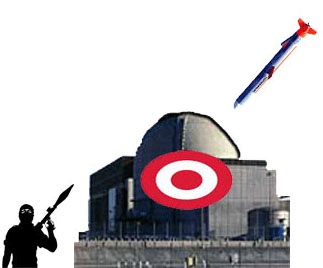
RUSI also points to the likelihood of increased targeting as more countries adopt nuclear power.
The use of military force near or against nuclear facilities represents an under-addressed threat to international peace and civilian safety, the report warns.
By Ciaran McGrath, Senior News Reporter,
https://www.express.co.uk/news/uk/2046553/terrifying-report-warns-uks-nuclear
Britain’s nuclear infrastructure is increasingly vulnerable to military attack as global tensions rise, a worrying new report has warned. The Royal United Services Institute (RUSI) study, published on Friday, highlights the growing risk of nuclear power plants being targeted deliberately or incidentally during armed conflict.
While the threat is not new, Russia’s occupation of Ukraine’s Zaporizhzhia Nuclear Power Plant (ZNPP) has shown how such facilities can become strategic objectives in modern warfare, with devastating consequences for civilian populations. Written by RUSI research fellow Darya Dolzikova, the report examines the “strategic and operational logic” behind targeting nuclear installations and urges military and political leaders to prepare for scenarios in which nuclear infrastructure comes under direct threat. It further warns that the use of military force near or against nuclear facilities represents an under-addressed threat to international peace and civilian safety.
Key motivations for attacks include disrupting an enemy’s energy supply, generating public fear, denying access to contested territory through radioactive contamination and halting nuclear weapons programmes.
In each case, the consequences for civilian safety, the environment and regional stability are severe.
RUSI also points to the likelihood of increased targeting as more countries adopt nuclear power.
Ms Dolzikova explains: “The expected growth of nuclear power in the global energy mix may increase the likelihood that future armed conflict will see greater targeting of nuclear energy infrastructure.”
The report outlines several recent examples of nuclear facilities being exposed to military activity, with Zaporizhzhia cited as the most significant.
It warns that even where nuclear plants are not the primary objective, they may lie on key axes of advance and become flashpoints by default.
In response, the think tank calls for urgent measures to improve such sites’ physical protection and operational resilience.
Recommendations include reinforcing legal prohibitions on attacks, integrating counter-CBRN (chemical, biological, radiological and nuclear) and air defence capabilities, and decentralising energy systems through smaller, modular reactors.
Crucially, the report highlights the psychological impact of nuclear threats.
t points out: “Such threats may be used as a ‘half-step’ between conventional and nuclear weapons – despite key differences in their normative and operational significance.”
The UK operates several nuclear power stations, including Sizewell B and Hinkley Point B, with new projects under development.
While no specific intelligence suggests they are under imminent threat, the report stresses the need for military planners to take the risks seriously and integrate safeguards into all aspects of defence strategy.
RUSI also urges governments to engage the public, building trust and preparing communities for possible emergencies without causing panic.
The report concludes: “Efforts must prioritise the establishment of trust between the population and authorities, and offer clear information and instructions.”
On Chernobyl Disaster Anniversary, Repairing Damaged Shield Poses ‘Enormous Challenge’
April 26, 2025 ,By RFE/RL’s Ukrainian Service, Stuart Greer and Oleh Haliv, https://www.rferl.org/a/ukraine-chernobyl-nuclear-disaster-anniversary-russia/33397012.html?fbclid=IwY2xjawJ6SqxleHRuA2FlbQIxMQBicmlkETE3RG9aSkhxNzhYNndQMGFFAR4zqGfz15XQZ8lgJtOhc7sSWq1aQn8M_cCUwEQ8_iwc4gjbpLOjfLqY7ftG6g_aem_uTOf_f4ZB8kKArzvpkNfYQ
As Ukraine marks the 39th anniversary of the world’s worst civilian nuclear accident at the Chernobyl power plant, engineers are struggling to find ways to repair the complex’s protective shield more than two months after a Russian drone left a large hole in the structure.
The massive steel dome was designed to protect and confine the radioactive remains of crippled reactor number four that exploded when a routine safety test went wrong on April 26, 1986.
Radiation levels outside the punctured shield have stayed normal since the drone attack, officials say.
But sealing the hole hasn’t been possible because it sits above the crumbling sarcophagus that encases radioactive debris from the reactor.
“How can you fix a roof space where the higher you go up in the building, the higher the radiation levels? They’re so high next to the actual sarcophagus, the reactor unit, that you can’t work above it,” says Shaun Burnie, a nuclear expert with Greenpeace.
Burnie was part of a Greenpeace team invited to Chernobyl to inspect the damage shortly after the February 14 drone strike which Moscow denied it was responsible for.
“It’s a very, very serious, enormous challenge for Ukraine at a time when it’s faced with so many other challenges, and so the international community really needs to step in and support.” says Burnie.
It took emergency crews three weeks to locate and extinguish fires that spread and smoldered through the membrane of the shield’s outer shell.
The new confinement structure was completed in 2019 as part of a $2.2 billion international project involving 45 countries. The temporary rail track used to install it over the reactor has since been dismantled, meaning the massive structure can’t be moved safely to the side for repairs.
The United Nations predicted the shield would “make the reactor complex stable and environmentally safe for the next 100 years.”
But long-term plans to safely dismantle the sarcophagus to allow the removal of radioactive ruins of the reactor are no longer possible following damage to the shield, according to Dmytro Humeniuk, an expert from Ukraine’s State Scientific and Technical Center for Nuclear and Radiation Safety.
The European Bank for Reconstruction and Development has earmarked $450,000 to assess the drone damage to the confinement structure.
Ukrainian Environment Minister Svitlana Hrynchuk estimates the preliminary results of the analysis should be completed sometime in May.
Repairs to the shield will be costly and Ukraine will need significant funding from international donors, predicts Burnie.
“They have to come up with a longer-term plan, which will be very extensive, very complicated, and potentially horrendously expensive.”
‘I guarded Britain’s nuclear sites – our security can’t cope with new mini reactors’

mini reactors do not pose miniature hazards. “On security, size doesn’t matter. When it comes to the fuel and the byproducts, they are equally dangerous.”
“You get less energy, but you’re still going to have exactly the same security concerns,” says Okuhara. “How enthusiastic is a site operator going to be paying for security when that’s eating into their bottom line?”
INTERVIEW . Matthew Okuhara, a former armed officer with the Civil Nuclear Constabulary, fears that current security plans will be inadequate to protect the UK’s next generation of nuclear power plants..
Rob Hastings, Special Projects Editor , April 22, 2025
Sometimes he would patrol rural lanes on foot, carrying his assault rifle, looking out for any terrorists hiding in the countryside. On other assignments he would man machine guns mounted on armoured ships, watching for any sign of hostile vessels coming his way. Or he would drive in weapons-laden road convoys, monitoring potential threats from vehicles.
While serving as an armed officer with the Civil Nuclear Constabulary (CNC), Matt Okuhara saw every aspect of how the UK’s nuclear power stations and their radioactive fuel are protected from terrorists.
He spent years escorting the transport of uranium fuel to and from plants, which would be planned for months in advance. “Nuclear material is at its most vulnerable when it’s in transit,” he explains. “You’ve got to move it as secretly as possible.”
Working for the specialist force, Okuhara always felt confident the country’s civil nuclear programme was in safe hands. “Any threat has been detected long before it’s been able to cause any problems,” he says.
However, he believes the situation is “definitely more dangerous now” than when he was serving. Terrorism has become more advanced and there are new fears about so-called hybrid warfare from geopolitical adversaries including Russia.
“You don’t have to be a James Bond super-villain to realise where the vulnerable parts of a site are. You can just look on Google Maps and say, ‘We’ll attack that bit,’ especially now we’ve got drones. The threat has really shot up.”
With new technology also on the horizon, he believes the nuclear industry must face up to big security questions.
The CNC currently guards just a handful of sites, all in relatively remote locations. But experts believe the Government’s planned array of cutting-edge mini nuclear power stations could lead to a “proliferation” of reactors around the country, potentially much closer to towns and cities. This may also lead to their fuel being transported more often.
Small modular reactors (SMRs) are seen as an essential source of green energy for the UK in decades to come. Proponents say they will be quicker and cheaper to build than conventional plants, because they will be largely prefabricated.
But security experts are worried about the complex implications for how SMRs will be policed and protected, as The i Paper revealed this week. Analysts say that thousands more armed officers would have to be recruited, co-ordination with local police would have to be strengthened, and a new national infrastructure force may even have to be created.
Okuhara shares these concerns. “I don’t think the CNC’s current policing model would be able to cope with any more sites,” he says. “The generating sites, they’re kept well away from the public for good reasons.
“One, they’re easier to protect. And two, if something goes wrong, the contingency engineers have got some space to work with.”
What is the Civil Nuclear Constabulary?
- The CNC is a specialist armed force with about 1,600 officers and staff. It was created in 2005 to guard civil nuclear sites and material.
- “The CNC will deter any attacker whose intent is the theft, sabotage or destruction of nuclear material, whether static or in transit, or the sabotage of high consequence facilities,” its web page explains.
- It adds: “If an attack occurs, CNC will defend that material and those facilities and deny access to them. If material is seized or high consequence facilities are compromised, the CNC will recover control of those facilities and regain custody of the material.”
New small reactors, same big risks
After fighting in the Iraq War with British infantry, Okuhara joined the CNC in 2006 and served for six years. He describes how he helped to protect Gloucestershire’s Oldbury Power Station – which is now undergoing decommissioning – in his new book, Nuclear Copper. “Based within the high metal fences and fortress-like security measures of the power station, there was a heavily armed police presence on duty at any given time,” he writes.
To deter and prevent terrorism, the team patrolled surrounding roads and villages, wearing body armour and carrying G36C assault rifles. They benefited from the rural location by building relationships with local farmers and villagers, who “could recognise an unfamiliar car or person instantly” and knew to inform officers.
Rules currently state that nuclear power stations can only be placed in “semi-urban” settings. A spokesperson for the Department for Energy Security & Net Zero insists: “All new nuclear projects, including SMRs, are prevented from being built in densely populated areas.” The Government is loosening restrictions on them being built in the countryside.
But a majority of industry figures believe that “new nuclear technologies could be safely located closer to densely populated areas,” according to an official consultation paper.
The Whitehall document says that the semi-urban restriction will be reviewed every five years “to ensure it remains relevant and effective,” and the Government is “open to revising” this rule in future……………………….
The nuclear industry argues that SMRs will be small enough to build in urban settings, but Okuhara argues this would rob officers of a key advantage. “An intervention zone around a site gives you plenty of space where you can detect things,” he explains.
And he underlines that mini reactors do not pose miniature hazards. “On security, size doesn’t matter. When it comes to the fuel and the byproducts, they are equally dangerous.”
At the moment, energy companies cover much of the CNC’s costs. But having many smaller sites is likely to make security operations proportionately more expensive.
He continues: “If you think about the largest sites in the UK, places like Sellafield or Dounreay, they’ve got hundreds of officers. There are plenty of people out on patrol. Are these SMRs going to be given sufficient resources? Or are the companies going to be saying: ‘It’s a small reactor, we don’t need as many bodies on the ground’?”
The Government offers reassurance that any SMR will “need to have the highest levels of security in place.” A spokesperson said: “All operators are answerable to a robust and independent regulator – the Office for Nuclear Regulation – which must approve their security plan covering physical, personnel and cyber security.” The CNC declined to comment.
Vetting failures
If potentially thousands more armed officers must be recruited to guard SMRs, the CNC must improve its vetting procedures. That much is clear because of one man: Wayne Couzens.
Couzens’ name became infamous after he raped and murdered Sarah Everard in Surrey in 2021, having used his Metropolitan Police ID to falsely arrest her.
Couzens had previously been an authorised firearms officer with the CNC, serving at Sellafield and Dungeness. He had passed the CNC’s vetting procedures in 2011 despite previously being accused of numerous sexual offences, including harassment, assault and indecent exposure. He transferred to the Met in 2018.
The CNC’s Chief Constable, Simon Chesterman, apologised “unreservedly” on behalf of the force in 2024, “for the part CNC played in his entry as a full-time police officer.”………………………………………………
No matter whether they’re protecting groundbreaking SMRs, or conventional nuclear sites, or convoys of radioactive fuel, “every officer in the CNC should have the top level of vetting,” he says. “They’ve got access to firearms. They can access some of the most toxic material that has ever existed.”
It’s a reminder that when it comes to nuclear security, sometimes the biggest threats can come from insiders.
‘Nuclear Copper: The Secret World of Nuclear Policing’ by Matt Okuhara is out now (£22.99, Amberley Publishing) @robhastings.bsky.social https://inews.co.uk/news/crime/i-guarded-britains-nuclear-sites-security-mini-reactors-3649782
World’s first AI-powered nuclear power plant Diablo Canyon worries experts after Trump plan

AI technology being used to aid the running of a nuclear power plant has experts worried as Trump scraps AI regulation labelling them it ‘as barriers to American AI innovation’.
Daily Star 21st April 2025
Fears AI technology powering nuclear power plants could lead to catastrophe have been sparked experts caution the emergence of AI in the nuclear energy industry.
These fears come after Trump scraps AI regulation labelling it “as barriers to American AI innovation” as experts have begun to deploy AI to help run a once dead nuclear power plant.
Boffs at the Diablo Canyon, California’s sole remaining nuclear power plant, has begun exploring the frontier of AI to help aid them running the powerplant. In a venture with artificial intelligence start-up Atomic Canyon, a brand-new artificial intelligence tool designed for the nuclear energy industry.
Pacific Gas and Electricity who runs Diablo Canyon have announced a deal with the artificial intelligence start-up declaring the development of “the first on-site generative AI deployment at a U.S. nuclear power plant”.
Currently the artificial intelligence tool, dubbed Neutron Enterprise, is meant to help workers navigate extensive technical reports and regulations. Due to Neutron Enterprise’s use at the Diablo Canyon, both lawmakers and AI experts are requesting strong guardrails…………………..
Tamara Kneese, the director of tech policy non-profit Data & Society’s Climate, Technology, and Justice program commented on the use of AI in the field. “AI can be helpful in terms of efficiency,” the director said, praising the initial implementation.
“The idea that you could just use generative AI for one specific kind of task at the nuclear power plant and then call it a day, I don’t really trust that it would stop there. And trusting PG&E to safely use generative AI in a nuclear setting is something that is deserving of more scrutiny,” Kneese added…………………… https://www.dailystar.co.uk/news/world-news/worlds-first-ai-powered-nuclear-35093367
Russia’s Rosatom says will proceed with Myanmar nuclear plant despite quake.
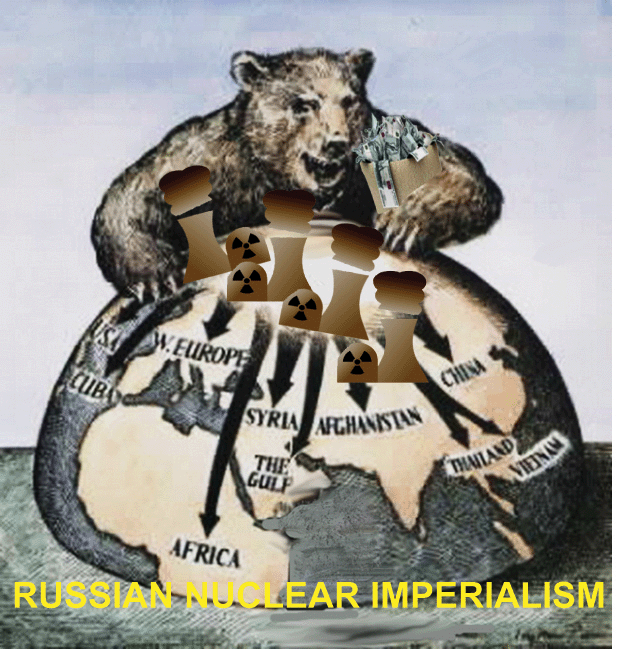
Myanmar lies on the boundary between two tectonic plates and is one of the world’s most seismically active countries.
Reuters, By Panu Wongcha-um, April 22, 2025
Summary
Myanmar is one of the world’s most seismically active countries
Myanmar and Russia agreed in early March to build small-scale nuclear facility
Construction timeline and location have not been announced
Thousands were killed in March 28 earthquake
BANGKOK, April 22 (Reuters) – A plan to build a nuclear power plant will continue in Myanmar, a war-torn Southeast Asian country partly devastated by a massive earthquake in March, the Russian state-owned firm leading the project told Reuters.
Myanmar’s junta chief Min Aung Hlaing and Russian President Vladimir Putin last month signed an agreement for a small-scale nuclear facility, three weeks before the 7.7 magnitude quake flattened communities and left more than 3,700 people dead – the country’s deadliest natural disaster in decades.
The agreement involves cooperation to build a Small Modular Reactor (SMR) in Myanmar with an initial 110 MW capacity, consisting of two 55 MW reactors manufactured by Russia’s state nuclear corporation Rosatom.
“The recent earthquake has not affected Rosatom’s plans in Myanmar,” the company’s press office said in an email.
“Rosatom adheres to the highest international safety and reliability standards, including strict seismic resistance requirements.”
The company’s intention to go ahead with the nuclear plan despite the quake, which crippled critical infrastructure, has not been previously reported.
Rosatom declined to provide any construction timeline or details of the location of the proposed nuclear facility that will be powered by RITM-200N reactors, which were made by the company for use initially on icebreaker ships.
A Myanmar junta spokesman did not respond to calls from Reuters seeking comment.
The push for nuclear power in Myanmar comes amid an expanding civil war triggered by a 2021 military coup that removed the elected government of Nobel laureate Aung San Suu Kyi.
Facing a collection of established ethnic armies and new armed groups set up in the wake of the coup, the ruling junta has lost ground across large parts of the country and increasing leaned on its few foreign allies, including Russia.
The conflict, which stretches from the border with China to the coast along the Bay of Bengal, has displaced more than 3.5 million people and left Myanmar’s mainly agrarian economy is tatters.
Myanmar is currently evaluating options for financing the Russia-backed nuclear power project. “This may involve both own and borrowed funds,” Rosatom said. In places such as Bangladesh and Egypt, Russia has funded conventional nuclear power projects through low interest loans.
Authorities in neighbouring Thailand, which is closely monitoring Myanmar’s nuclear developments, assess that a plant could be built in Naypyitaw, a fortified purpose-built capital that was heavily damaged by the earthquake, according to a security source briefed on the matter.
Two other potential sites include a location in the central Bago region and the Dawei special economic zone in southern Myanmar, where the junta and Russia have announced plans to build a port and an oil refinery, according to the Thai assessment.
Myanmar lies on the boundary between two tectonic plates and is one of the world’s most seismically active countries.
MONEY AND MANPOWER
Southeast Asia’s first nuclear facility – the 621 MW Bataan Nuclear Power Plant in the Philippines – was finished in 1984 with a price tag of $2.3 billion but mothballed in the wake of the Chornobyl disaster, opens new tab in the then Soviet Union two years later.
The Philippines and other regional countries have since mounted repeated efforts to explore nuclear energy but made limited progress.
Vietnam is, however, renewing a bet on nuclear power after it suspended its programme in 2016.
Russia and Myanmar have been collaborating in the sector for years, with Burmese students studying nuclear energy and related subjects in Russian universities under government quotas since 2019, according to Rosatom…………………
With the Myanmar junta prioritising exports of natural gas, which could be used to fuel cheaper domestic power generation, to earn foreign exchange, the nuclear plan makes no economic sense for a cash-strapped administration, said Richard Horsey, senior Myanmar adviser at International Crisis Group.
“Nuclear power is very expensive, and Myanmar simply can’t afford it,” he said.
Reporting by Panu Wongcha-um; Editing by Devjyot Ghoshal and Kate Mayberry, https://www.reuters.com/business/energy/russias-rosatom-says-will-proceed-with-myanmar-nuclear-plant-despite-quake-2025-04-22/
Locals call for transparency after nuclear drill
Vikki Irwin, BBC political reporter, Suffolk, Matt Precey, Suffolk,
BBC 22nd April 2025
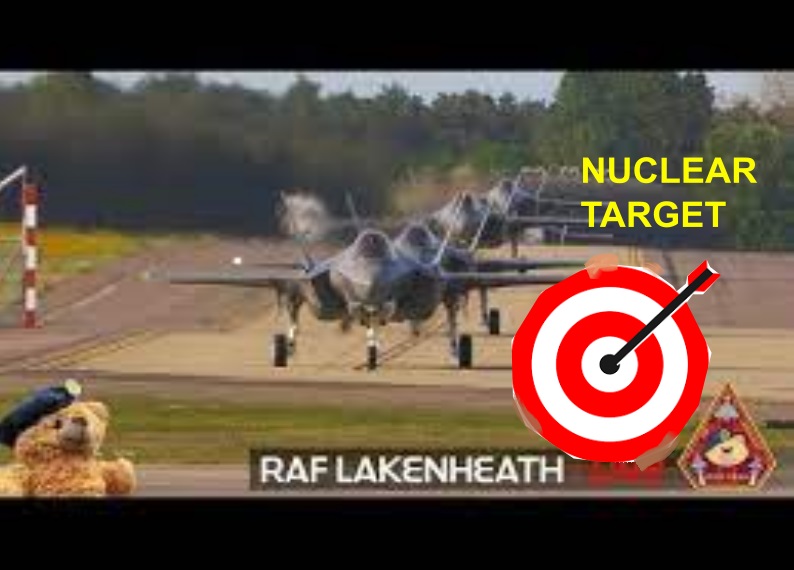
People living near a US airbase earmarked to house nuclear weapons say they are being left in the dark about what would happen in the event of a radiation alert.
It comes after a drill simulating an accident involving such material was held, with personnel from RAF Lakenheath in Suffolk taking part.
Nick Timothy, Conservative MP for West Suffolk, said while the US military was “welcome”, there needed to be “transparency as far as possible on issues like this exercise”.
A Ministry of Defence (MoD) spokesman said: “Exercise Diamond Dragon demonstrated our preparedness to respond to any incident, no matter how unlikely”……………………………………….
The Suffolk Resilience Forum, which leads on emergency planning in the county, confirmed the scenario in both instances was a simulated crash in the UK of a US aircraft carrying “defence nuclear materials”.
Lakenheath Parish Council chairman Gerald Kelly said he had been told informally about the latest drill.
He said the area had an emergency plan, but added: “There is nothing in there about this sort of incident.”
The MoD should inform residents “what it wants us to do” if the event of an incident, he said.
Mr Kelly called for a siren system to be installed and for the local community to be involved in any future exercises.
https://www.bbc.co.uk/news/articles/cde2dyk5rjpo
Security fears over mini nuclear plant network with ‘1,000s more police needed’.

Keir Starmer’s plans for a ‘proliferation’ of small reactors – potentially nearer UK towns – would require an urgent rethink of how armed officers protect them, experts warn.
Government plans to build a network of
“mini” nuclear power stations across the country have failed to
adequately assess major security threats to the public, top policing
experts have warned.
Sir Keir Starmer has pledged to “rip up the rules”
governing the nuclear industry to fast-track so-called Small Modular
Reactors (SMRs) to generate affordable low-carbon electricity, boosting the
economy and powering energy-intensive technology such as AI data centres.
However, security analysts caution that arrangements for guarding SMRs from
terrorists, enemy states and criminal groups need radical rethinking to
protect the public. They told The i Paper that thousands more armed
officers could be required to defend these facilities – which may be
located nearer towns and cities – plus the vehicles carrying their
radioactive fuel.
They believe these policing operations would be so much
larger, more complex and more costly than existing arrangements that a new
force may be required – yet fear ministers are overlooking or
underestimating the challenges ahead.
The Government hopes the first SMRs
will open in less than 10 years, probably at some of the country’s eight
existing nuclear sites, but the network may later expand to other locations
in England and Wales. Professor Fraser Sampson, a national security expert
at Sheffield Hallam University, said these will necessitate “a very
different policing and security model,” especially if they are located
“much nearer or even within areas of significant population, and you have
many more of them.”
Sampson, a former solicitor and police officer who
recently served as the UK’s biometrics and surveillance camera
commissioner, worries the Government is not focusing enough on security.
Anticipating a “proliferation of smaller sites,” he said: “The thing
that I think is missing, and Two researchers at King’s College London, Dr
Zenobia Homan and Dr Ross Peel, have warned that SMRs increase the
possibility of “insider threat.”
iNews 20th April 2025
https://inews.co.uk/news/crime/security-fears-mini-nuclear-plant-network-police-3648464
INSIDER THREAT SECURITY CONSIDERATIONSFOR ADVANCED AND SMALL MODULAR REACTORS.
The wide range of nuclear power plant technologies currently in design
globally have an assortment of unique characteristics that create novel
security considerations compared to large conventional nuclear power
plants.
Some of these characteristics create “insider threat”
considerations for nuclear security, where insiders are defined as
individuals with legitimate access to nuclear facilities and materials who
use this access to carry out sabotage or theft of nuclear material.
These include a lack of mature security culture in developer organisations,
serial plant manufacturing in a production line environment, plant siting
in remote and isolated areas, minimised staff numbers, teleoperation of
plants by offsite staff, the increased reliance on digital instrumentation
and control systems, and the potential for greater involvement of foreign
experts and third-party suppliers, especially on short-term bases for, e.g,
refuelling and maintenance.
The paper takes a technology agnostic approach
to examine what these factors may mean for insider threat risks and
suggests that plant designers should be identifying and minimising the
opportunities of insiders to act throughout the engineering design process.
Doing so is anticipated to strengthen effective insider threat mitigation
in deployed small and advanced reactors.
Kings College 21st April 2025 – https://kclpure.kcl.ac.uk/ws/portalfiles/portal/311074601/Paper_381_Insider_Threat_for_SMR.pdf
The core of the Flamanville EPR reactor will be completely rebuilt
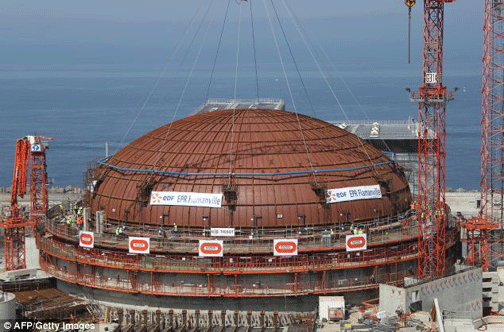
To prevent potential fuel rod leakage problems, EDF has decided to completely
rebuild the core of the Flamanville EPR reactor (Manche). This decision is
based on feedback from the Taishan reactor in China, which experienced
similar problems during the second production cycle.
As the Flamanville EPR
prepares to be reconnected to the electricity grid on Monday, April 21,
2025 , after more than two months of shutdown, EDF has also announced the
future change of part of the fuel. As a precaution, the Flamanville EPR
reactor core will be recomposed with reinforced fuel after its first unit
outage, in late 2026 or early 2027. “This is a precautionary measure,” EDF
emphasizes. ” To date, there have been no leak-tightness issues. We are
simply taking into account international feedback.”
Ouest France 18th April 2025 https://www.ouest-france.fr/environnement/nucleaire/le-cur-du-reacteur-de-lepr-de-flamanville-sera-entierement-recompose-5262993e-1b70-11f0-a759-74724e64dd56
Ukraine is seeking solutions to the Chernobyl nuclear reactor’s damaged confinement vessel .
Ukraine is seeking solutions to repair the damage caused by a Russian
drone attack to the confinement vessel at the stricken Chornobyl nuclear
power plant, a government minister said on Saturday. Minister of
Environmental Protection and Natural Resources Svitlana Hrynchuk was
speaking outside the decommissioned station during the inauguration of a
0.8-megawatt solar power facility ahead of two conferences due to discuss
Chornobyl and other issues related to nuclear power operations.
Reuters 12th April 2025, https://www.reuters.com/world/europe/ukraine-seeking-solutions-damaged-chernobyl-confinement-vessel-minister-says-2025-04-12/
Ukraine works to repair Chornobyl containment structure damaged in Russian drone strike
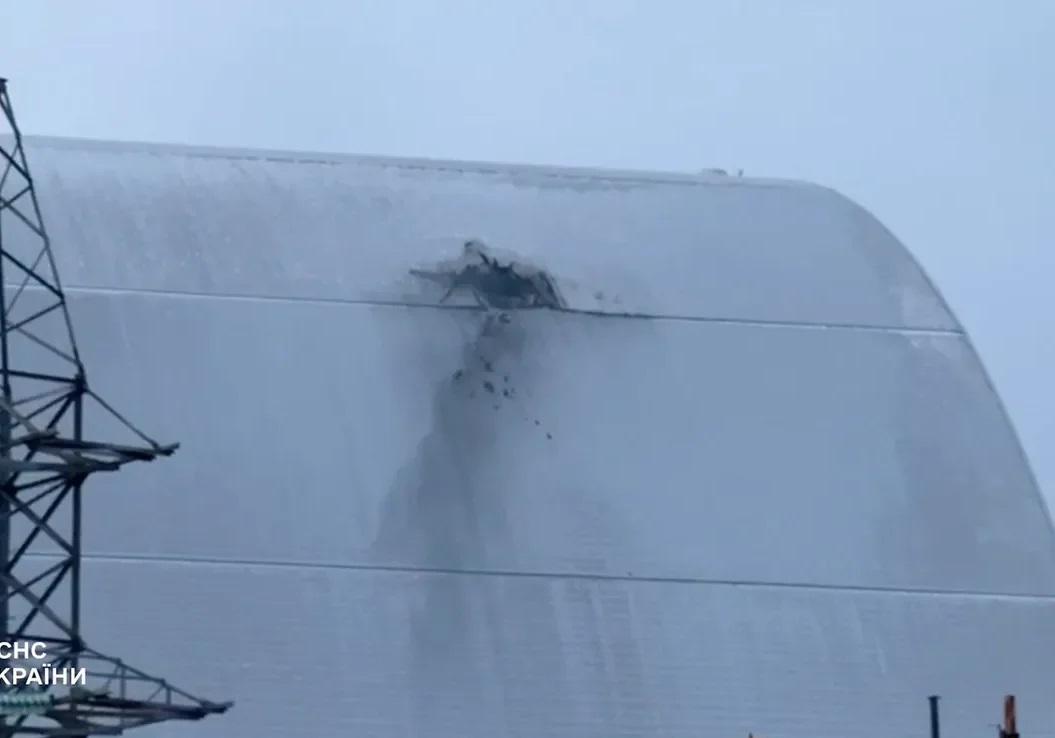
by Olena Goncharova, Kyiv Independent 13th April 2025 https://kyivindependent.com/ukraine-works-to-repair-chornobyl-containment-structure-damaged-in-russian-drone-strike/
Ukraine is working to repair damage to the containment structure at the Chornobyl nuclear power plant following a Russian drone strike in February, Environment Minister Svitlana Hrynchuk said on April 12.
Speaking at the site of the decommissioned plant, Hrynchuk noted that the strike had compromised the functionality of the massive protective arch installed in 2019 to prevent radioactive leaks.
The minister commented during the launch of a new 0.8-megawatt solar power station near Chornobyl ahead of two upcoming nuclear safety and energy conferences. She said that Ukraine is cooperating with international experts to assess the extent of the damage and determine the necessary steps to restore the arch’s integrity.
“Unfortunately, after the attack, the arch partially lost its functionality. And now, I think, already in May, we will have the results of the analysis that we are currently conducting …,” Hrynchuk said. “We are actively working on this … We, of course, need to restore the “arch” so that there are no leaks under any circumstances because ensuring nuclear and radiation safety is the main task.”
She added that the European Bank for Reconstruction and Development, as well as scientific institutions and companies involved in the arch’s original installation, are contributing to the analysis.
According to plant officials, the February 14 drone attack created a hole in the containment vessel’s outer layer and exploded inside. The Russian Foreign Ministry dismissed the incident as “a provocation.”
The structure was designed to enclose the unstable sarcophagus hastily built after the 1986 reactor explosion—the worst nuclear accident in history.
Hrynchuk also emphasized the importance of renewable energy in the Chornobyl exclusion zone, saying the new solar facility would support the site’s power needs.
“We have been saying for many years that the exclusion zone needs to be transformed into a zone of renewal,” she said. “And this territory, like no other in Ukraine, is suitable for developing renewable energy projects.”
Assessment result on the condition of the shelter at the Chornobyl Nuclear Power Plant (ChNPP) is due in May
The first results of an assessment on the condition of the shelter at the
Chornobyl Nuclear Power Plant (ChNPP), following a Russian drone attack,
will be available in May. In June, Ukraine plans to present proposals for
restoring the New Safe Confinement (NSC or the Arch) at the donor assembly
in London.
As reported by Ukrinform, this was announced by Ukraine’s
Minister of Environmental Protection and Natural Resources, Svitlana
Hrynchuk. “It’s currently hard to say how much the project timeline has
been delayed, because certain works at the site cannot be performed right
now. However, I want to assure everyone that the radiation background has
not changed in any way — even after the attack,” said Hrynchuk.
Ukrinform 13th April 2025, https://www.ukrinform.net/rubric-society/3981370-ministry-of-environment-results-of-chornobyl-shelter-assessment-following-russian-drone-attack-expected-in-may.html
Newest French reactor faces further delays due to new issues.
By Reuters, April 11, 2025
EDF’s Flamanville 3 reactor outage was extended for an additional week to
carry out maintenance on three more components in the nuclear part of the
reactor, an EDF spokesperson told Reuters on Friday. The extension comes
after a two-month delay for maintenance on the cooling circuit and rotors
of the turbo alternator group.
The reactor is currently in the ramp-up
phase and has only produced a minimal amount of power since starting last
December. EDF said it could not provide specific details on the components
that require maintenance or the cost, but said that the summer date to
reach full power has not changed.
The maintenance to the turbo alternator
will only be measurable when the reactor is next connected to the grid, the
EDF spokesperson said, meaning that there could be an additional shutdown
if additional problems are found during the ramp up. EDF said that the
shutdown is a normal part of the ramp-up process where the equipment is
stress-tested before operating at full power and will be repeated several
times in the coming weeks and months. https://www.reuters.com/business/energy/newest-french-reactor-faces-further-delays-due-new-issues-2025-04-11/
Starmer appoints ex-Office of Fair Trading chief to lead nuclear regulatory taskforce
The prime minister has appointed ex-Office of Fair Trading boss John Fingleton to head up the country’s nuclear taskforce
Energy Voice, By Jessica Mills Davies, 10/04/2025
The UK government’s nuclear taskforce will be led by John Fingleton, formerly the boss of the Office of Fair Trading, following his appointment to spearhead the unit.
The Nuclear Regulatory Taskforce, which was set up to accelerate the development of new nuclear power stations across the country, is poised to embark on an overhaul of UK planning regulation.
In February, Keir Starmer moved to slash “red tape” in the industry to enable more nuclear power plants to be approved across England and Wales.
Those reforms are designed to enable small modular reactors to be built for the first time. That is the intended result of the government abolishing a set list of approved sites for nuclear development so that nuclear power stations can be built anywhere in the country.
The energy department said that contract negotiations to progress a competition for these small reactors, held by Great British Nuclear, are “currently underway”, and that a panel of nuclear experts will be appointed to the taskforce in due course.
In a controversial move, the government is also getting rid of expiry dates on nuclear planning rules, in an effort to avoid projects timing out.
These changes to nuclear planning rules were proposed after the pre-development stage Sizewell C nuclear plant in Suffolk was taken to court by local activists.
The Department for Net Zero and Energy Security said that the government committed a further £2.7 billion in public funding to Sizewell C last month………………………..
The independent taskforce will seek to identify how nuclear power regulation can incentivise investment in new projects more quickly and cost efficiently, it said………….
Fingleton said he will “work closely with business, regulators and other interested individuals and groups to identify how regulation can better enable and incentivise investment in this area”…………………. https://www.energyvoice.com/renewables-energy-transition/570966/starmer-selects-fingleton-to-head-up-nuclear-taskforce/
1 This Month

To see nuclear-related stories in greater depth and intensity – go to https://nuclearinformation.wordpress.com
-
Archives
- September 2026 (194)
- August 2026 (330)
- July 2026 (355)
- June 2026 (287)
- May 2026 (306)
- April 2026 (356)
- March 2026 (251)
- February 2026 (267)
- January 2026 (308)
- December 2025 (358)
- November 2025 (359)
- October 2025 (375)
-
Categories
- 1
- 1 NUCLEAR ISSUES
- business and costs
- climate change
- culture and arts
- ENERGY
- environment
- health
- history
- indigenous issues
- Legal
- marketing of nuclear
- media
- opposition to nuclear
- PERSONAL STORIES
- politics
- politics international
- Religion and ethics
- safety
- secrets,lies and civil liberties
- spinbuster
- technology
- Uranium
- wastes
- weapons and war
- Women
- 2 WORLD
- ACTION
- AFRICA
- Atrocities
- AUSTRALIA
- Christina's notes
- Christina's themes
- culture and arts
- Events
- Fuk 2022
- Fuk 2023
- Fukushima 2017
- Fukushima 2018
- fukushima 2019
- Fukushima 2020
- Fukushima 2021
- general
- global warming
- Humour (God we need it)
- Nuclear
- RARE EARTHS
- Reference
- resources – print
- Resources -audiovicual
- Weekly Newsletter
- World
- World Nuclear
- YouTube
-
RSS
Entries RSS
Comments RSS
 nuclear-news