Nuclear attack was the original plan of the Brussels bombers
 Brussels attackers initially considered nuclear site: Report http://www.torontosun.com/2016/03/24/brussels-attackers-initially-considered-nuclear-site-report REUTERS, MARCH 24, 2016 BRUSSELS – Suicide bombers who blew themselves up in Brussels were originally considering an attack on a nuclear site in Belgium, but arrests started last week may have forced them to switch to targets in the Belgian capital, the DH newspaper said.
Referring to an incident in December that prosecutors confirmed in which militants covertly filmed the home of an unidentified senior official in the nuclear industry, the paper quoted a police source as saying two of the suicide bombers, brothers Khalid and Ibrahim Bakraoui, had filmed the daily routine of the head of Belgium’s nuclear research and development programme.
The police source did not address why investigators thought they had continued to plan to go through with the plan despite the discovery of the covert video three months ago and the ramping up of security around nuclear plants as a result. The sensitive inner high-security areas of a nuclear power station would almost certainly have been beyond the reach of militants such as the Bakraouis.
A 10-hour video from a camera hidden in front of the nuclear official’s house was found in December during a police raid in Belgium, linked to the Paris attacks a month before.
On February 17, Belgian prosecutors confirmed the existence of the video seized in December and said the man in it was linked to the country’s nuclear industry. Earlier this month, 140 soldiers were dispatched to guard the country’s three nuclear sites. On Tuesday after the Brussels bombings, the sites were sealed and non-essential staff evacuated as a precaution.
While investigators had known the camera with the video had been removed from its concealment by two men, they did not know their identity. DH said it was now clear that it was the two brothers.
Investigators were not available for comment.
Any plans for an assault on a nuclear site, even a symbolic operation on the perimeter, might have been foiled by a police operation last week in the Brussels borough of Forest, the newspaper said. In that raid, officers unexpectedly stumbled upon armed men in a flat that was searched in connection to the Paris attacks investigation.
One of the men in the flat, later identified as an Algerian national called Mohammed Belkaid, was killed by police in a shootout and police believe one or two others may have escaped.
But clues found in the flat led the police to the arrest three days later of the prime surviving suspect in the Paris attacks Salah Abdeslam and another suspected militant Amine Choukri also using the name of Monir Ahmed Alaaj.
The arrests may have forced the hand of the attackers who decided to shift to targets in Brussels, focusing on the airport and metro: “There is no doubt that they rushed their operations because they felt under pressure,” the police source was quoted by DH as saying.
“Even if one couldn’t prevent these (Brussels) attacks, one can say that their magnitude could have been much bigger if the terrorists had been able to implement their original plan and not opted for easier targets,” said the police source.
Danger of terror attacks on Germany’s nuclear stations
 German nuclear plants are vulnerable to terrorist attacks – study Rt.com 24 Mar, 2016 Germany’s nuclear power plants are insufficiently protected against potential terror attacks, including 9/11-style ones, according to a newly-released study.
A nuclear plant’s smokescreen designed to prevent any attacks on it from air provides only minimal protection for the facility, Deutsche Presse-Agentur (DPA) news agency reported, citing findings presented by Oda Becker, a physicist and independent expert on nuclear plants, at the German Federation for the Environment and Nature Conservation (BUND) congress in Berlin on Thursday.
Such smokescreen “only slightly diminishes a chance of collision with a plane,” hijacked by terrorists. Additionally, only two out of eight currently operating nuclear plants in Germany are equipped with such systems, the report points out.
According to Becker’s research, another significant threat to German nuclear plants is posed by a possible terrorist attack using helicopters filled with explosives. A fall of an aircraft rigged with explosives on a nuclear plant could lead to a “massive release of radiation,” as nuclear facilities in Germany are not designed to withstand explosions of such scale.
Reliability tests have demonstrated that the plants’ personnel cannot possibly prevent terrorists from infiltrating the facility and committing a terrorist act there, the study adds.
In another study published March 8 and titled “Nuclear power 2016 – secure, clean, everything under control?” Becker listed insufficient security standards, natural disasters, terrorist attacks and emergencies caused by the deterioration of the German nuclear plants’ security systems as major threats to the industry.
“A serious accident is possible in case of every German nuclear plant,” she said at that time, adding that “there are no appropriate accident management plans.” Becker added that temporary nuclear waste storage sites can also pose a serious threat to people, as they can also be targeted by terrorists and lack relevant security systems.
“The interim [nuclear waste] storages lack protection against aircraft crashes and dangers posed by terrorists,” Becker said, adding that security aspects of the future nuclear waste storage should be discussed, including possible security upgrades of the existing storage sites and the establishment of new facilities.
According to Belgian media, Brussels suicide bombers Khalid and Ibrahim El-Bakraoui were already planning attacks on nuclear plants, although not in Germany but in Belgium. The arrest of Paris attacker Salah Abdeslam allegedly thwarted their plans and forced them to choose another target………
The recent news from Belgium has given some German politicians and activists additional cause for concern. Hubert Weiger, the head of the BUND, said that the Brussels attacks became another reason for immediate nuclear phase-out. “It is even more necessary than ever to abandon this technology,” he said, as quoted by DPA.
Eight nuclear plants remain operational in Germany, after Angela Merkel’s government decided to abandon the use of nuclear energy and immediately halt all operations on the country’s eight oldest nuclear plants in March 2011. Another plant was shut down in 2015. The remaining nuclear stations are due to be closed by 2022.
At the same time, Simone Peter, a co-chair of the German Green Party, demanded additional security checks at all European nuclear plants.
“EU nuclear power plant stress tests did not include [the possibility] of a terrorist attack. It is time to reassess [our] approach to security,” she tweeted. https://www.rt.com/news/337092-german-nuclear-plants-terrorists/
Chernobyl’s anti radiation sarcophagus
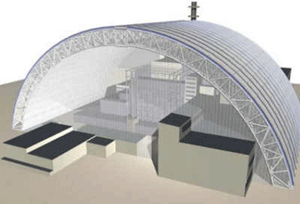 $1.7B Giant Arch to Block Chernobyl Radiation For Next 100 Years by REUTERS, 24 Mar 16 In the middle of a vast exclusion zone in northern Ukraine, the world’s largest land-based moving structure has been built to prevent deadly radiation spewing from the Chernobyl nuclear disaster site for the next 100 years.
A concrete sarcophagus was hastily built over the site of the stricken reactor to contain the worst of the radiation, but a more permanent solution has been in the works since late 2010.
Easily visible from miles away, the 30,000 tonne ‘New Safe Confinement’ arch will be pulled slowly over the site later this year to create a steel-clad casement to block radiation and allow the remains of the reactor to be dismantled safely……..
The EBRD has managed the funding of the arch, which has cost around 1.5 billion euros ($1.7 billion) and involved donations from more than 40 governments. Even with the new structure, the surrounding zone, which at 1,000 square miles is roughly the size of Luxembourg, will remain largely uninhabitable and closed to unsanctioned visitors…….
The upcoming 30th anniversary of the disaster has shone a new light on the long-term human impact of the worst nuclear meltdown in history.
The official short-term death toll from the accident was 31 but many more people died of radiation-related illnesses such as cancer. The total death toll and long-term health effects remain a subject of intense debate.
On Wednesday, Ukrainians who were involved in the cleanup of Chernobyl – the so-called “liquidators” – protested in central Kiev to demand the government acknowledge their sacrifice with improved social benefits.
“Thirty years ago, when we were young, we were saving the whole earth from a nuclear explosion. And now no one needs us. Absolutely no one,” said one of the protesters, former liquidator Lidia Kerentseva. http://www.nbcnews.com/tech/tech-news/1-7b-giant-arch-block-chernobyl-radiation-next-100-years-n544721
Taiwan lawmakers slam Atomic Energy Council’s (AEC) nuclear disaster drill
Legislators question nuclear safety, Taipei Times, By Chen Wei-han / Staff reporter, 24 Mar 16, Legislators slammed the Atomic Energy Council’s (AEC) nuclear disaster drill as “role-playing” and questioned the extent of evacuation zones during a review of the council’s nuclear emergency response fund yesterday.
The Education and Culture Committee reviewed the council’s budget proposal related to nuclear emergency prevention and response measures, saying some items were poorly executed and some were bloated.
Democratic Progressive Party (DPP) Legislator Chung Chia-pin (鍾佳濱) said he had taken part in four nuclear disaster drills, but they were like “role-playing,” in which soldiers were ordered to put on swimming trunks and pretend to be tourists, instead of actual residents participating in the drills.
“The council’s drill plan failed to simulate the accommodation of tens of thousands of people evacuated from New Taipei City and Taipei, which would be a major problem in the event of a nuclear disaster,” Chung said.
DPP Legislator Cheng Li-chun (鄭麗君) questioned the scope of the evacuation zones, which the council set within an 8km radius from nuclear plants.
“Immediately after the Fukushima Dai-ichi nuclear disaster in 2011, the Japanese government instructed residents living within 3km of the power plant to evacuate, but later expanded the area of evacuation to within a 20km radius of the reactor,” Cheng said, asking whether the AEC’s planned evacuation areas are large enough…….About 2 million people would need to evacuate if areas of evacuation were expanded to 20km from the two New Taipei City power plants, Chou said…….http://www.taipeitimes.com/News/taiwan/archives/2016/03/25/2003642398
China must improve its nuclear security framework

 How China needs to improve its legal framework on nuclear security, Bulletin of the Atomic Scientists, Hui Zhang, 24 Mar 16, Hui Zhang is a physicist and a senior research associate at the Project on Managing the Atom in the Belfer Center for Science and International Affairs at Harvard University’s John F. Kennedy School of Government, where he leads a research initiative on China’s nuclear policies. He is co-author, with Tuosheng Zhang, of Securing China’s Nuclear Future.
On March 31, Chinese President Xi Jinping will be among world leaders attending the fourth and last Nuclear Security Summit in Washington, D.C., where they will try to strengthen nuclear security to deal with the evolving threat of nuclear terrorism. Such efforts are badly needed, in light of the facts that there have been approximately 20 documented cases of theft or loss of highly enriched uranium or plutonium (although more may have occurred) since the early 1990s,and that there are nearly 2,000 metric tons of dangerous nuclear materials scattered across hundreds of sites around the globe.
Chinese leaders have actively participated in the last three summits, and pledged at each of them to act to strengthen nuclear security. But how successful have they been so far?
On the one hand, largely due to these earlier summits, nuclear security issues have received greatly increased national attention and awareness in China, from both national leaders and the general public. China has actively worked on several national laws and regulations related to nuclear security, and invested significant money to improve the physical protection of its nuclear facilities—including the updating of its monitoring devices, and otherwise accounting for and controlling every bit of nuclear material in China’s possession. A “center of excellence” on nuclear security—a joint US-China project initiated at the first nuclear security summit—was just commissioned on March 18 in Beijing, marking a milestone in summit outcomes. In short, China’s commitment to nuclear security is seemingly now well-established.
But on the other hand, in spite of these advances, there are still significant gaps in China’s nuclear security, which leave room for improvement. For example, the country has yet to build an overall legal framework that would govern the use of nuclear energy and related safety and security issues. In particular, China needs to update its nuclear regulations and guidelines, especially those that oversee tests of the ability of China’s nuclear facility designs to resist attacks from large-scale and well-organized armed terrorist groups; such tests are vital for identifying the strengths and weaknesses of security procedures. And cybersecurity is yet to be addressed.
So what major gaps remain, and what steps does China still need to take to improve the legal framework behind its nuclear security—a framework that is vital to making any substantial changes on the ground?
Progress on China’s nuclear laws and regulations. In China, legal documents are classified into four tiers. From high to low, these are laws, regulations, rules, and guidelines. Or, to be more precise: statutory law requiring approval by the National People’s Congress; State Council regulations; departmental rules; and regulators’ guidance or publications.
To further complicate matters, some laws and regulations are directly relevant to nuclear security, while others are much more indirect. The most direct ones are the Atomic Energy Law, the Nuclear Safety Law, and the Nuclear Security Regulations, while the ones that are indirectly relevant to nuclear security are the National Security Law and the National Counterterrorism Law.
Currently, the only major regulations on fissile material controls can be found in a document called the “Regulations for Control of Nuclear Materials,” issued in 1987, or 29 years ago—a time when the Berlin Wall was still up, Ronald Reagan was president, the World-Wide Web was not even a glint in a computer scientist’s eye, and the word “cybersecurity” was yet to be coined. Obviously, much has changed since then. Yet China’s only updating of these regulations was its “Rules for Implementation of the Regulations on Nuclear Materials Control”—issued in 1990.
In comparison, the most updated guidelines regarding the physical protection of nuclear facilities were issued in 2008—which is much more current, although itself now eight years old………..
Major gaps remain. While China has been making progress at improving the legal framework surrounding its nuclear laws and regulations, there have not been many updates of nuclear regulations and rules on the security of nuclear materials and facilities. All the existing regulations and rules were written before the attacks on New York and Washington in September 11, 2001, and the threat of nuclear terrorism was not specifically mentioned.
Although the 2008 guidelines require all civilian nuclear facilities to be designed in such a way that they consider threats to their security coming from outsiders, insiders, or a collusion of both—technically known as a “design basis threat”—they contain no clearly defined standards for how each nuclear facility should be designed for local conditions……..
while operators currently are required to do in-depth vulnerability assessments and performance tests of the individual components in their security systems, these tests do not include the realistic force-on-force exercises recommended by the International Atomic Energy Agency (IAEA). No Chinese regulations and guidelines require such tests, which are vital for identifying the strengths and weaknesses of security procedures.
Finally, China’s existing nuclear regulations and guidelines have not yet specifically addressed cybersecurity issues. Strengthening cybersecurity at nuclear facilities has become an important topic in the area of nuclear security, due to operations and security systems becoming increasingly reliant on digital control—and digitization invites cyber-attack. In practice, a number of countries like the United States and Russia have recently updated their regulations or rules regarding cybersecurity at nuclear facilities.
But China has not yet written nuclear regulations and guidelines with provisions specific to cybersecurity at nuclear facilities……..
Steps for improvement. At the 2014 nuclear security summit, President Jinping stated that “the more we do to enhance nuclear security, the less chance we will leave to terrorists.” Converting the top Chinese leader’s stated commitment into practical, sustainable reality, however, will require China to undertake several steps. In particular, China should speed the updating and issuing of any new laws, regulations, rules, and guidelines on nuclear security, especially those that have not been touched since the regulations of 1987 and the rules of 1990.
Clearer and more stringent rules and guidelines would establish a national-level design basis threat, with clarifying requirements for all military and civilian nuclear facilities. China should have at least a minimum standard for any design basis threat that includes protection against a modest group of well-armed and trained outsiders, a well-placed insider, and outsiders and an insider working together, using a broad range of possible tactics.
Moreover, China should incorporate IAEA principles and guidelines regarding nuclear security into its national laws and regulations, as suggested by a recent pledge by 35 countries to observe the terms of a joint agreement—known as Strengthening Nuclear Security Implementation—initiated at the 2014 summit at The Hague.
China should update and issue new nuclear regulations and guidelines incorporating cybersecurity explicitly. Cybersecurity should be integrated strongly and fully into the physical protection and accounting systems, and they should be an integrated component of any nuclear power plants design basis threat.
Soon, China should be issuing the Atomic Energy Law, Nuclear Safety Law, and Nuclear Security Regulations that have been under review for quite a while now. As a faster way of making progress, China should also update its 2008 guidelines on physical protection to integrate new IAEA guidelines, including the conduct of force-on-force exercises.
To ensure that the new regulations and rules are effectively implemented for facilities and transporters of nuclear weapons and weapon-usable fissile materials, China needs an effective system of enforcement and a constantly developing and improving nuclear security system that will not stagnate. http://thebulletin.org/how-china-needs-improve-its-legal-framework-nuclear-security9276
Nuclear staff evacuated in Belgium, after terrorist attacks
 Belgium evacuates nuclear plant staff after attacks http://www.cbsnews.com/news/belgium-attacks-evacuation-tihange-nuclear-plant-staff-isis-dirty-bomb/ 22 Mar 16 Hours after bombs tore through Belgium’s international airport and a subway station in central Brussels, the government asked the operator of one of the country’s nuclear energy plants to evacuate most staff.
ENGIE, the French electric company that runs the Tihange nuclear plant about 50 miles southeast of Brussels, confirmed that all non-essential staff had left the facility.
There was no indication Belgian authorities had received information about any direct threat to the facility, and there was no word of evacuations at the country’s other nuclear power plant or research facilities, but earlier this year police did learn that ISIS seems interested in breaching Belgium’s nuclear security.
In February, Belgian security services discovered two men had been secretly videotaping one of the country’s senior nuclear scientists.
In the process of searching the home of Mohamed Bakkali, who was arrested and charged with terrorist activity and murder over alleged links to the Nov. 13, 2015, Paris terror attacks, police found 10 hours of secretly recorded video showing the unnamed nuclear official coming and going from his home in Belgium’s Flanders region.
Investigators said the camera used to record the official was left at a static location under a bush, and was picked up by the two unidentified assailants.
Belgian Interior Minister Jan Jambon said at the time that authorities had determined there was a threat “to the person in question, but not the nuclear facilities,” according to The Independent.
Sources told the British newspaper that investigators suspected the militants had hoped to kidnap the nuclear official and use him to access secure areas of a Belgian nuclear research facility in Mol, in the country’s north. The presumed goal of the suspected ISIS operatives was to obtain enough radioactive material to build a “dirty bomb.”
In light of the ISIS surveillance earlier this year, CBS News senior national security analyst Juan Zarate called the evacuation order Tuesday at Tihange a “chilling development.”
“This lends itself to concerns that ISIS is adapting very quickly, looking for key vulnerabilities, and even potentially considering how to use dirty bombs — weapons of mass destruction,” Zarate said on “CBS This Morning.”
“We’ve seen in Iraq and Syria, they’ve used chemical weapons. We know they have a chemical weapons unit. And so the concern over ISIS developing quickly a desire and appetite for the use of weapons of mass destruction has to be a chilling moment for Europe, and certainly, I think the Belgian authorities are going to take every prophylactic step possible to protect their infrastructure and research sites,” he added.
In March, the Global Risk Insights journal concluded: “ISIS nuclear espionage in Belgium demonstrates a focused intention to acquire radioactive substances,” again, likely with the intention of making a bomb to spread radioactive material.
“With nuclear substances found in radiological devices, laboratories, and nuclear power plants around the world, the risk is present both within its base of operations in the Middle East and North Africa as well as in any number of countries where ISIS members are active,” said Global Risk Insights analyst Ian Armstrong.
Nuclear weapons and nuclear power races on, despite serious safety risks
Plutonium Pie in the Sky: the Dangerous Delusion of New Nukes CounterPunch by JAMES HEDDLE MARCH 22, 2016
“……Faith-Based Nuclear Policy According to a recent Cornell University study, there have been nuclear reactor 174 accidents worldwide since 1946. The researchers rate the accidents in 2013 dollars and define an accident as “an unintentional incident or event at a nuclear energy facility that led to either one death (or more) or at least $50,000 in property damage.”
Based on their extensive data, they predict
*a 50% chance that a Fukushima event (or larger) will occur in the next 50 years
*a Chernobyl event (or larger) will occur in the next 27 years
*a TMI event (or larger) will occur in the next 10 years.
According to a Guardian study, a major nuclear accident has happened on average every 5 years since 1952.
Recently, alarmed at the failure of their repeated attempts to go through ‘proper channels,’ seven engineers at America’s Nuclear Regulatory Commission (NRC) – which then Senator Obama dubbed in 2007 ‘a moribund agency’ – filed a petition as private citizens.
They stated that they have identified a long-undiscovered electrical design flaw common to virtually all U.S. nuclear plants that could prevent cooling and allow meltdowns to occur. Their petition asks that the NRC mandate that plant operators either fix the problem or shut down the reactors.
Not to mention that twenty-three U.S. reactors share the same design flaws as those that melted down at Fukushima.
The obvious take-home lesson: because of the dependence of their cooling systems on off-site power supplies, every nuclear facility, wherever its geographic location, is vulnerable to grid blackouts from cyber attacks and extreme weather events, and constitutes both a potential terrorist weapon-in-place and danger to the entire planet, and should be treated as such by the ‘international community.’ Yet, a New Nuclear Weapons race and a New Nuclear Power race are both currently in progress………….http://www.counterpunch.org/2016/03/22/plutonium-pie-in-the-sky-the-dangerous-delusion-of-new-nukes/
India’s poor nuclear safety record is alarming
This is not the first time that India is facing safety issues regarding its nuclear program. In historical context one can generate a list of leaks, fires and structural damages that have been faced by India’s civilian nuclear power sector. There are abundant examples of oil leaks, hydrogen leaks, fires and high bearing vibrations which often shut down numbers of nuclear reactors in India.
 Lack Of Nuclear Sanity In India Anaya Shahid Mar 20 16, http://www.eurasiareview.com/19032016-lack-of-nuclear-sanity-in-india-oped/ Ironically on March 14, 2011 after the Japan’s nuclear disaster, India was the first country to announce that Fukushima reactors were safe. Top officials of the Department of Atomic Energy (DAE) were of the view that Indian nuclear reactors will continue to work as they are safe and also claimed that what happened in Fukushima was not a “nuclear accident”.
S.K. Jain, the Chairman and Managing Director of Nuclear Power Corporation was propagating on Fukushima accident that, “There is no nuclear accident or incident in the Japan’s Fukushima plants. It is a well-planned emergency preparedness program which the nuclear operators of the Tokyo Electric Power company are carrying out to contain the residual heat after the plants had an automatic shutdown following a major earthquake.”
Now it is really scary that on the 5th anniversary of Fukushima, an emergency has been declared at the Kakrapar nuclear plant in Gujarat near Surat after a major heavy water leak in a nuclear reactor. The authorities are disseminating the situation by saying that all safety systems worked fine and the technicians has successfully been able to shut down the unit. The declaration of an on-site emergency and the fact that the heavy water leak affected the reactor’s cooling system, which also has high radioactivity, raises many questions on Indian nuclear expertise.
The Fukushima disaster forced Indian nuclear establishment to initiate a safety audit process and it was conducted within by NPCIL. After the extensive review, Indian auditor general informed that the nuclear program of the country is insecure and unregulated with many disorders. Furthermore the parliamentary report on nuclear safety regulation in India had pointed out serious organizational flaws and numerous failings relative to international norms.
When in opposition, the Bharatiya Janata Party was the major contrasting party to civil nuclear expansion and had strong reservations on limiting nuclear liability. It was also supporting the just protests in Kudankulam and wanted environmental clearance for Jaitapur nuclear power plants. Now in government, it has taken a complete U-turn and seeks to bring same old vine in new bottles. This year, Dr. A Gopalakrishnan labeled the Indian government plans punier than the existing regulatory framework and despite this the government is introducing the Nuclear Safety Regulatory Authority bill in Parliament.
This is not the first time that India is facing safety issues regarding its nuclear program. In historical context one can generate a list of leaks, fires and structural damages that have been faced by India’s civilian nuclear power sector. There are abundant examples of oil leaks, hydrogen leaks, fires and high bearing vibrations which often shut down numbers of nuclear reactors in India.
- March 1991: Heavy water leak at Madras Atomic Power Station takes four days to clean up.
- July 1991: A contracted laborer mistakenly paints the walls of Rajasthan Atomic Power Station (RAPS) with heavy water before applying a coat of whitewash.
- December 1991: A leak from pipelines in the vicinity of CIRUS and Dhruva research reactors at the Bhabha Atomic Research Centre (BARC) in Trombay, Maharashtra, results in severe Cs-137 soil contamination of thousands of times the acceptable limit.
- January 1992: Four tons of heavy water spilt at RAPS.
- May 1992: Tube leak causes a radioactive release of 12 Curies of radioactivity from Tarapur Atomic Power Station.
- March 1993: Two blades of the turbine in Narora Atomic Power Station’s (NAPS) Unit I break off, slicing through other blades and indirectly causing a raging fire, which catches onto leaked oil and spreads through the turbine building. The smoke sensors fail to detect the fire, which is only noticed once workers see the flames.
- February 1994: Helium gas and heavy water leak in Unit 1 of RAPS. The plant is shut down until March 1997.
- May 1994: The inner surface of the containment dome of Unit I of Kaiga Generating Stationcollapses (delaminates) while the plant is under construction.
- March 1999: Somewhere between four and fourteen tons of heavy water leaks from the pipes at MAPS at Kalpakkam, Tamil Nadu, during a test process. The pipes have a history of cracks and vibration problems. Forty-two people are reportedly involved in mopping up the radioactive liquid.
- April 2000: A leak of about seven tons of heavy water from the moderator system at NAPS Unit II.
- November 2001: A leak of 1.4 tons of heavy water at the NAPS I reactor, resulting in one worker receiving an internal radiation dose of 18.49 mSv.
- May 2002: Tritiated water leaks from a downgraded heavy water storage tank at the tank farm of RAPS 1&2 into a common dyke area.
- January 2003: The failure of a valve in the Kalpakkam Atomic Reprocessing Plant in Tamil Nadu results in the release of high-level waste, exposing six workers to high doses of radiation.
- April 2003: Six tons leak of heavy water at reactor II of the NAPS in Uttar Pradesh.
- November 2009: Fifty-five employees consumed radioactive material after tritiated water finds its way into the drinking water cooler in Kaiga Generating Station.
- April 2011: Fire alarms blare in the control room of the Kaiga Generating Station in Karnataka.
India’s nuclear establishment is hasting for nuclear energy though it has obstinately missed targets and delivered a portion of the promised electricity with uncertain safety. The Indian government is irrationally pursuing for nuclear power without explaining its destructive potential and answering critiques. Nowadays, the U.S. and major powers are trying to “normalize” India’s nuclear weapons through special waivers and numerous nuclear deals. Therefore, France is using such normalizing strategy to bargain for cash-strapped Areva. Meanwhile, its complement is the disaster-in-waiting called Jaitapur. The secrecy shrouded to Indian nuclear program has subjugated its energy policy and budgets to an unaccountable, self-propagating, pampered technocracy and degrading their democracy.
*Anaya Shahid graduated from Defense & Diplomatic Studies, Fatima Jinnah Women University Rawalpindi.
Sendai nuclear station has useless radiation tools installed for evacuation orders
Useless radiation tools installed for evacuations near Kagoshima plant THE ASAHI SHIMBUN, 20 Mar 16,
Nearly half of the radiation monitoring posts installed for issuing evacuation orders around the Sendai nuclear plant in Kagoshima Prefecture are actually useless for that purpose, The Asahi Shimbun has learned.
In the event of a nuclear accident, evacuation orders are issued immediately when airborne radiation levels reach 500 microsieverts per hour. But 22 of the 48 monitoring posts around the Sendai plant can only measure radiation levels up to 80 microsieverts per hour, according to a survey on the equipment……..http://ajw.asahi.com/article/behind_news/social_affairs/AJ201603140026
Armed UK vessels secretly take weapons grade plutonium from Japan to USA
The Pacific Egret and its escort ship Pacific Heron are reportedly lightly armed UK flagged vessels and arrived in Kobe port from Barrow-in-Furness, England on March 4th. The Egret docked in Tokai for pre-transport logistics last week. Both ships after departing Tokai port will sail together most likely through the South Pacific to the east coast of the United States.
 NPT and Nuclear Security Risks’ Exposed by Secret Plutonium Shipment: NGOs, March 18, 2016 Tokyo- (PanOrient News) A coalition of five non-governmental organizations warned today that a shipment of weapons-grade plutonium scheduled to
depart the port of the Japanese Tokai nuclear station in Ibaraki prefecture this coming weekend highlights the failure, but also the proliferation risks, of the current Japanese nuclear policy.
A cargo of 331kg of plutonium will be loaded on to the Pacific Egret, an armed British nuclear transport ship, prior to departure under armed escort to the United States. It will be the largest shipment of separated plutonium since 1.8 tons of plutonium was delivered to Japan by controversial Akatsuki-maru in 1992. The two month voyage to the Joint Base Charleston-Weapons Station will then see the plutonium dumped at the Department of Energy Savannah River Site (SRS) in South Carolina. The U.S. National Nuclear Security Administration, which is responsible for the shipment, has identified that storage in Japan poses a security risk justifying its removal.
The organizations, Citizen Nuclear Information Center (Japan); Green Action (Japan); Savannah River Site Watch (U.S.); CORE (England), and Greenpeace, said in a statement they condemn the shipment as a dangerous distraction from the major problem in Japan which is its overall nuclear energy policy, where over 9 tons of plutonium remains stockpiled and there are plans to produce many tons more during the coming decade. The representatives of the five organizations have worked together over the past quarter century against Japan`s plutonium and nuclear fuel cycle program.
For the U.S. and Japanese government, the Tokai shipment will be mistakenly hailed as demonstrating their commitment to reducing the threat from fissile materials, the statement noted. Both Prime Minister Abe and President Obama plan to announce the ‘success’ of the removal from Japan, at the fourth Nuclear Security Summit from March 31st -April 1st in Washington, D.C., while Japan will be desperate to avoid any discussion of the proliferation and security threat posed by its plutonium fuel cycle program.
“If 331 kg of plutonium warrants removal from Japan on the grounds of its vulnerability and in the interests of securing nuclear weapons material, then there is no credible justification for Japan’s current program and future plans to increase its plutonium stockpiling. Hailing a shipment of hundreds of kilograms of plutonium as a triumph for nuclear security, while ignoring over 9 tons of the weapons material stockpiled in Japan and in a region of rising tensions, is not just a failure of nuclear non proliferation and security policy but a dangerous delusion,” said Shaun Burnie, senior nuclear specialist at Greenpeace Germany, who is currently in Japan. ……..
Cocaine use among staff at Nuclear Missile Base
Air Force Investigating Cocaine Use at Nuclear Missile Base http://gawker.com/air-force-investigating-cocaine-use-at-nuclear-missile-1765720042 Sam Biddle 18 Mar 16, Cocaine and nuclear weapons: A good mix? That’s what an official probe into coke abuse by “about a dozen airmen” at the F.E. Warren Air Force Base in Wyoming will investigate, the AP reports.
The coked-up airmen in question are, reassuringly, not the people who have their fingers on the literal button required to begin a nuclear war. But they are, scarily, the people tasked with defending the 150 Minuteman III ICBMs (each with an explosive yield roughly eight times greater than the bomb that leveled Hiroshima, easily capable of destroying an entire large modern city) from the rest of the world. As the AP notes, they’re crucial to the operation and safety of America’s vast nuclear stockpile:
Security forces at nuclear missile bases are entrusted to patrol the missile fields and respond to any security emergencies. They are highly trained and given enormous responsibility. Just last month, Deputy Defense Secretary Robert Work visited F.E. Warren and observed a demonstration by security forces of the techniques and equipment they would use to recapture a missile silo that had been taken over by intruders.
In other words, not the kind of people you want doing key bumps in the bathroom. This is the second time in two years that F.E. Warren has been under investigation: In 2014, missile officers responsible for actually launching those ICBMs were caught cheating on their proficiency tests and also doing a lot of illegal drugs.
This sounds like it would be a very fun job were it not for the possibility of fucking up and beginning a nuclear holocaust.
Union of Concerned Scientists Annual Review of U.S. Nuclear Plant, Near Misses
A near miss incident is an event or condition that could increase the chance of reactor core damage by a factor of 10 or more, prompting the NRC to send an inspection team to investigate. The number of near miss incidents has declined since UCS initiated its annual review in 2010. In 2010, there were 19; last year there were nine. All told, from 2010 through 2015 there were 91 near misses………
Nuclear Disaster by Design – Nuclear Safety inFLEXibility
For the NRC’s Fukushima fixes to reach their target destination, the NRC must determine why Pilgrim procured an inadequate FLEX air compressor, why River Bend thought it had 24 hours to handle a one-hour problem, and how dozens of flood protection problems remaining invisible during the NRC-mandated walkdowns at Arkansas Nuclear One.
 Nuclear Safety inFLEXibility http://allthingsnuclear.org/dlochbaum/nuclear-safety-inflexibility Dave Lochbaum, director, Nuclear Safety Project | March 15, 2016, Disaster by Design/Safety by Intent #23
Disaster by Design
Among the actions taken by the Nuclear Regulatory Commission (NRC) in response to the March 11, 2011, accident at Fukushima was to issue an order on March 12, 2012, to all U.S. nuclear plant owners requiring them to procure equipment and implement measures to enable their facilities to cope with an extended loss of normal and backup power supplies to emergency equipment.
The NRC required that owners develop a phased response capability (Fig. 1). The initial response is by permanently installed equipment. Recognizing that this equipment may become unavailable (as happened at Fukushima), the NRC required a followup response capability by portable equipment stored in places not likely to be affected by the accident. Recognizing that portable equipment provides an interim response, the NRC required a longer term response capability to be provided by the “nuclear cavalry” (equipment and staffing resources arriving from offsite locations). The Nuclear Energy Institute developed the Diverse and Flexible Coping Strategies (FLEX) Implementation Guide for use by plant owners in complying with the NRC’s order.
Safety Detour?
There can be a big difference between the course plotted and the road taken. For example, a family heading out by car from their home in Atlanta, Georgia for a relaxing vacation on Sanibel Island in Florida should become a little troubled upon seeing the Washington Monument through the windshield.
If the following examples are any indication, the road to the Fukushima fixes ordered by the NRC might have taken a detour or three. Continue reading
USA’s nuclear regulator ineffective, as radiation leaks continue
 Nuclear Plants Leak Radiation, and Regulator Faces Scrutiny Five years after one of the worst nuclear disasters in history, America’s nuclear plants still face safety issues. Indian Point nuclear power plant sits on the Hudson River outside New York City.USA News, By Alan Neuhauser March 15, 2016
Yet it’s radioactive, and in the past two months, two nuclear power plants outside New York City and Miami were found to be leaking tritium: the former into groundwater within the facility’s confines, the second straight into Biscayne Bay.
The leaks, revealed in news reports, apparently haven’t contaminated drinking water and don’t pose a threat to human health. But tritium, while less potent than other substances like cesium or strontium or radium, can still be harmful in high enough concentrations, even lethal. And that’s before taking the public reaction into account: The New York incident made headlines across the region, anti-nuclear groups warned the state was “flirting with catastrophe,” and Gov. Andrew Cuomo ordered an investigation.
The incidents came just a few weeks before the fifth anniversary of the meltdown at Japan’s Fukushima Daiichi nuclear plant, which was sparked by a tsunami and earthquake and became the world’s worst nuclear disaster since Chernobyl. They also occurred as the industry was working to burnish its image on safety: All of the nation’s 61 nuclear plants are at least 20 years old, many are over 40, and at least one plant operator has announced it hopes to extend its reactors’ licenses to 80 years.
Yet more than three-quarters of the country’s commercial nuclear power sites have reported some kind of radioactive leak in their life spans, an investigation by the Associated Press found in June 2011 – three months after Fukushima. At the same time, the U.S. Nuclear Regulatory Commission has repeatedly weakened federal regulations to allow plants to keep operating, despite thousands of problems ranging from corroded pipes to cracked concrete and radioactive leaks.
Late last month, seven NRC engineers went public with a petition urging the agency to fix a critical design flaw in the electrical systems of all but one of the nation’s nuclear plants – a highly unusual move for federal employees.
“We have a very ineffective regulator that will not impose any costs that will jeopardize the economics of these plants,” says Paul Blanch, a longtime engineer and industry worker turned watchdog. While a tritium leak may not imperil human health, “it indicates a very sloppy operational environment of aging management and fixing obvious sources of leaks.”………
since finalizing the new standards, the agency has reportedly inspected and approved just two of the country’s 61 plants for compliance: one in Tennessee, the other in Virginia, Bloomberg BNA found. It’s also unclear whether new equipment for maintaining power at the plant during a prolonged outage will even work, experts say: while the NRC’s mandate called for buying the new equipment, it apparently lacked minimum performance standards.
Meanwhile, last fall, Indian Point in New York – the plant leaking tritium – suffered four unplanned outages in two months………http://www.usnews.com/news/articles/2016-03-15/nuclear-plants-leak-radiation-and-regulator-faces-scrutiny
Arkansas Nuclear Reactors found by regulator to need more oversight
Feds Say Entergy’s Arkansas Nuclear Reactors Need More Oversight, NPR By WESLEY BROWN/ TALK BUSINESS & POLITICS 14 Mar 16 In an annual evaluation of the nation’s commercial nuclear plants, the federal Nuclear Regulatory Commission said Entergy Arkansas’ Nuclear One and Two units in Russellville were among three reactors that require increased oversight because of two safety findings of “substantial significance” in 2015…….
Eleven reactors need to resolve one or two items of low safety significance. For this performance level, regulatory oversight includes additional inspections and follow-up of corrective actions. Plants in this level are: Clinton (Illinois); Davis Besse (Ohio); Dresden 2 (Illinois); Duane Arnold (Iowa); Indian Point 3 (New York); Millstone 3 (Connecticut); Prairie Island 2 (Minnesota); River Bend (Louisiana); Sequoyah 1 (Tennessee); and Susquehanna 1 and 2 (Pennsylvania). Duane Arnold, Millstone 3, and Susquehanna 1 and 2 have resolved their issues since the reporting period ended and have transitioned to the highest performing level, NRC officials.
There were three reactors in the fourth performance category, or Column 4, including Entergy’s Arkansas Nuclear One and Two units in Russellville, and Entergy Corp.’s Pilgrim Nuclear Power Station in Plymouth, Mass. Pilgrim is in the fourth performance Column 4 category because of long-standing issues of low-to-moderate safety significance, NRC officials said.
Nuclear reactors in Column 4 receive additional inspections and increased NRC management attention to confirm performance issues are being addressed. Later this year, the NRC will host a public meeting in the vicinity of each plant to discuss the details of the annual assessment results………
ISSUES ARISE FROM 2013 ACCIDENT
The issues relating to the Entergy nuclear reactors in Russellville stem back to the events surrounding the industrial accident that occurred at the plant on March 31, 2013, which resulted in one fatality and eight injured personnel. At the time of the event, Unit 1 was shut down in a refueling outage with the reactor vessel head off and fuel in the vessel. Beginning in 2013, Entergy Operations officials and the NRC began extensive inspections of the flood protection program at ANO.
All told, more than 100 previously unknown flood barrier deficiencies creating flooding pathways into the site’s two auxiliary buildings were found. These included defective floor seals, flooding barriers that were designed, but never installed, and seals that had deteriorated over time. In one case, a special hatch that was supposed to close a ventilation duct in the Unit 1 auxiliary building in the event of flooding had never been installed.
In June 2014, ANO Units 1 and 2 received yellow violations because electrical equipment damaged during an industrial incident increased risk to the plant. Workers were moving a 525-ton component out of the plant’s turbine building when a temporary lifting rig collapsed on March 13, 2013, damaging plant equipment. Those violations moved both units from Column 1 to Column 3 of the NRC’s Action Matrix, which the agency increases its oversight of plants as performance declines.
Bowling said the NRC placed Arkansas Nuclear One in Column 4 in March 2015 after issuing the two “yellow findings” for each nuclear unit related to the 2013 heavy equipment handling incident in which a lift operated by a contractor failed. Two subsequent yellow findings for Arkansas Nuclear One and Two related to flood barrier effectiveness had the cumulative effect of moving the plant to Column 4………http://ualrpublicradio.org/post/feds-say-entergy-s-arkansas-nuclear-reactors-need-more-oversight#stream/0
1 This Month
26 September – International Day for the Total Elimination of Nuclear Weapons





PLEASE OPPOSE HR 8255 AND S.3639 – bills would accelerate satellite deployment, with no environmental review or safeguards – https://ncstd5li.quorum.us/campaign/169331/
To see nuclear-related stories in greater depth and intensity – go to https://nuclearinformation.wordpress.com
-
Archives
- September 2026 (313)
- August 2026 (330)
- July 2026 (355)
- June 2026 (287)
- May 2026 (306)
- April 2026 (356)
- March 2026 (251)
- February 2026 (267)
- January 2026 (308)
- December 2025 (358)
- November 2025 (359)
- October 2025 (375)
-
Categories
- 1
- 1 NUCLEAR ISSUES
- business and costs
- climate change
- culture and arts
- ENERGY
- environment
- health
- history
- indigenous issues
- Legal
- marketing of nuclear
- media
- opposition to nuclear
- PERSONAL STORIES
- politics
- politics international
- Religion and ethics
- safety
- secrets,lies and civil liberties
- spinbuster
- technology
- Uranium
- wastes
- weapons and war
- Women
- 2 WORLD
- ACTION
- AFRICA
- Atrocities
- AUSTRALIA
- Christina's notes
- Christina's themes
- culture and arts
- Events
- Fuk 2022
- Fuk 2023
- Fukushima 2017
- Fukushima 2018
- fukushima 2019
- Fukushima 2020
- Fukushima 2021
- general
- global warming
- Humour (God we need it)
- Nuclear
- RARE EARTHS
- Reference
- resources – print
- Resources -audiovicual
- Weekly Newsletter
- World
- World Nuclear
- YouTube
-
RSS
Entries RSS
Comments RSS

