France is dangerously ill-prepared to deal with a nuclear accident – report
France is ‘not prepared for a nuclear accident’, report says http://www.thelocal.fr/20160407/france- unprepared-for-nuclear-accident
  , according to a worrying new report, that the Swiss and Germans will want to read with interest.
- France’s oldest nuclear plant ‘to close this year’ (06 Mar 16)
- Germany demands France shut old nuclear plant (04 Mar 16)
- Swiss sue French over ‘dangerous’ nuclear plant (03 Mar 16)
That’s the conclusion of a new report by France’s ANCCLI commission that reports on the state of the country’s nuclear facilities.
“France is not ready to face a serious nuclear accident,” warned the commission’s president Jean-Claude Delalonde. “Even though a national response plan was made public in February 2014, nothing has been put in place,” he said.
The report comes after both Switzerland and Germany have expressed concerns about the safety of some of France’s 19 nuclear power stations, with authorities in Geneva even launching legal action.
According to Delalonde’s association the French government has not learned the lessons from previous disasters like Chernobyl that was presented as a “Soviet” accident.
The Fukushima disaster in Japan prompted the French to improve certain safety measures around nuclear reactors but ANCCLI want more.
They want the “emergency zone” around nuclear power stations, where measures are put in place in the event of accident, extended from the current 10km radius to 80 km.
The fact this hasn’t been done already creates a dangerous situation for Europe, the report says.
For example France distributes iodine tablets, which protect against the potentially cancer-causing effects of radioactivity, to those living within the 10km radius of a nuclear reactor, but in Belgium the same measure is taken within a 20km radius.
After Fukushima, the radius was extended to between 20km and 50km in Switzerland. The entire state of Luxembourg is part of an emergency zone even though there are no nuclear power stations on its territory. It’s due to the fact the Cattenom reactor in France is close to the border.
The duchy has previously forwarded to the European Commission a study commissioned by Germany’s Greens party, which according to Luxembourg “listed the Cattenom plant’s security problems”.
ANCCLI wants French authorities to work out a plan and carryout “digital simulations” for how Iodine tablets would be distributed to the whole of France before a radioactive cloud passes and also how the population would be evacuated in the event of a disaster.
The extent of the problems France would face in the event of a disaster are made clear by the fact more than 1.25 million people live within 30km of the Bugey power plant near Switzerland and over one million live around the Fessenheim power station – the oldest in the country.
Delalonde points out that India’s contingency plans are far more developed than they are in France.
“They anticipate the amount of food that will be needed, the number of emergency beds needed, blankets and even how many saris would be needed,” he said.”This power plant is very old, too old to still be in operation,” said a spokesman for Germany’s Environment and Nuclear Safety Minister Barbara Hendricks.
Meanwhile, the Swiss canton of Geneva on Wednesday filed a complaint against French nuclear plant Bugey located in the neighbouring French region of Ain, claiming that it “deliberately puts in danger the life of others and pollutes the waters”.
Threat of Islamic State and al Qaeda getting nuclear weapons is real
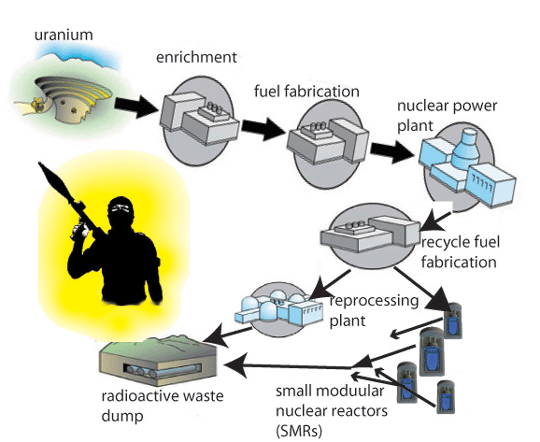 Islamic State, al Qaeda and nuclear madness, Reuters By John Lloyd April 8, 2016 “……..Earlier this month, President Barack Obama invoked the need for world leaders to cope with “the danger of a terrorist group obtaining and using a nuclear weapon.” In his speech at the Nuclear Security Summit, he had much success to report: earlier commitments to secure or eliminate nuclear material had been followed by most of the world’s states.
A “but” was coming, and it was large: both al Qaeda and Islamic State actively seek nuclear weaponry, Obama said, and “there is no doubt that if these madmen ever got their hands on a nuclear bomb or nuclear material they most certainly would use it to kill as many innocent people as possible.” That seems likely to be true: both groups have said so, and a member of Islamic State — which has already used chemical weapons — obtained surveillance footage of a manager at a nuclear facility in Belgium, with a view, officials say, of possibly developing a “dirty” bomb (a conventional explosive device packed with radioactive material).
The head of U.S. National Intelligence, James Clapper, told a Senate committee last month that “the threat of WMD is real. Biological and chemical materials and technologies, almost always dual use, move easily in the globalized economy, as do personnel with the scientific expertise to design and use them.” The veteran commentator on terrorism, Bruce Hoffman, wrote in March that Islamic State is moving towards the “final Definitive Victory State… when the caliphate ultimately triumphs over the rest of the world.” For that, it will need nuclear weapons.
Hoffman also believes that the two groups most hungry for global domination — Islamic State and al Qaeda — may merge, in spite of their leaders’ mutual hostility. This possibility, he said, quoting an unnamed senior U.S. official, “would be an absolute and unprecedented disaster for (the United States) and our allies.”
More cheer? Russia didn’t attend the nuclear summit. Moscow had said last November that it thought the United States was trying to “take the role of the main and ‘privileged’ player in this sphere” — so it didn’t show. Russia, Obama said to reporters, had made little, if any, progress on the Security Summit’s goals — because Putin has been pursuing a vision of of “emphasizing military might.”
The United States and Russia are estimated to have between them 95 percent of the world’s 15,000 nuclear warheads: the United States 6,970, Russia, 7300. The United States has been slightly reducing its stock; Russia has not. Obama, in a speech in Prague near the beginning of his first presidency seven years ago, called for a nuclear-free world — as Ronald Reagan had done before him.
By contrast, Putin has threatened to use nuclear weapons on Islamic State, on Turkey and as a response to Western protests when Russian forces seized Crimea. In the summer of 2014, in a more veiled threat, he told a youth group that “Let me remind you that Russia is one of the world’s biggest nuclear powers. These are not just words — this is the reality. What’s more, we are strengthening our nuclear deterrent capability and developing our armed forces.”
The United States, like Russia, modernizes and upgrades its nuclear forces continually, and islikely to sell Patriot interceptor missiles to Poland — much to Russia’s fury. But somehow, the widening gulf between the nations has to be bridged, or we face the largest problem of all: a widely-dispersed ability to annihilate much of the world.
The news should not just be “depressing,” but rather a prompt for greater engagement and understanding of its complexity. And with understanding comes the need to support those politicians, officials and organizations seeking compromise and solution. If the 20th was the American century, the 21st must be the world’s, in which the facts of multiple threats prompt a mutual response. Without it, the cocoons we seek to hide from bad news crumble more by the year. http://blogs.reuters.com/great-debate/2016/04/08/islamic-state-al-qaeda-and-nuclear-madness/
Bulletin of the Atomic Scientists analyses outcome of The Nuclear Security Summit
On the progress side:
- Enough states ratified the 2005 amendment to the physical protection convention to finally bring the amendment into force. That will provide a somewhat stronger legal foundation for nuclear security efforts – and will trigger a review conference that some hope could be a key new element of the nuclear security architecture.
- China joined in the strengthening nuclear security implementation initiative, thereby committing to achieve the objectives of International Atomic Energy Agency (IAEA) nuclear security recommendations and accept peer reviews of its nuclear security arrangements. Just after the summit ended India announced that it too is joining.
- Japan and the United States removed hundreds of kilograms of weapon-grade plutonium and highly enriched uranium (HEU) from the Fast Critical Assembly in Japan, as promised at the last summit. Japan also committed to eliminate the HEU at the critical assembly at Kyoto University.
- States agreed to 18 new group commitments or “gift baskets,” on topics ranging from protecting against insider threats to replacing radiological sources with less dangerous technologies. Probably the most important of these was the commitment to create a “Nuclear Security Contact Group–a set of senior officials who will keep meeting on the margins of the IAEA General Conference, to keep at least moderately high-level attention focused on nuclear security.
On the missed opportunity side:
- We still have no progress toward building a global commitment that all nuclear weapons and weapons-usable nuclear materials, wherever they may be, need to be secured against the full spectrum of plausible adversary threats. (See discussion inManaging the Atom’s new report.)
- The communiqué, as expected, offers no firm new commitments (though it does more firmly establish the goal of continuous improvement in nuclear security). More disappointing, the “action plans” for five international institutions offer few steps beyond what those institutions are already doing–certainly less than is needed to fill the gap left by the end of the summit process.
- Many of the gift baskets have few specifics or deadlines; how much they will actually do to accelerate progress toward their objectives remains unknown.
- Many key countries – including Pakistan, Russia, and others – are still not participating in the initiative on strengthening nuclear security implementation that China and India joined.
The question now is: where do we go from here? ………. http://thebulletin.org/nuclear-security-summit-wins-losses-and-draws9310
Global nuclear security rules made more strict
Tighter global nuclear security rules to take effect in May http://www.reuters.com/article/us-nuclear-security-idUSKCN0X51NI More than 100 countries will have to meet higher standards on the protection of nuclear facilities and materials from next month, the U.N. nuclear watchdog said on Friday.
Nicaragua on Friday formally completed ratification of an amendment to the Convention on the Physical Protection of Nuclear Material, meaning enough states have ratified it for it to go into force, the International Atomic Energy Agency said.
“(The amendment) will help reduce the risk of a terrorist attack involving nuclear material, which could have catastrophic consequences,” IAEA chief Yukiya Amano said in a statement.
The convention was adopted by 152 countries a decade ago, and had to be ratified by two thirds of them to go into effect.
The amendment, intended to guarding against threats such as smuggling and sabotage, makes it legally binding for countries to protect nuclear facilities as well as the domestic use, storage and transportation of nuclear material.
It also provides for broader cooperation among countries on finding and recovering stolen or smuggled nuclear material.
The convention and amendment are only binding on countries that have ratified them, an IAEA spokesman said. Amano said last month more work was needed to make the requirement universal.
The United States, Russia, India, Pakistan and former Soviet republics including Kazakhstan, Ukraine and Uzbekistan are among the countries that have ratified the amendment, according to the IAEA. Those that have not include Iran and North Korea.
(Reporting by Francois Murphy; editing by Andrew Roche)
Eurasian conflicts undermine nuclear security
 Frozen Conflicts Undermine Nuclear Security http://www.eurasianet.org/node/78126
April 5, 2016 , by Richard Weitz The renewal of armed conflict between Armenian and Azerbaijani forces over the Nagorno-Karabakh enclave can potentially have global ramifications, participants at the recent nuclear security summit in Washington cautioned.
A concern articulated in national progress reports prepared for the March 31-April 1 summit by several Eurasian governments was how corrosive the region’s ethnic and border disputes are to global nuclear security. The chaotic conditions that accompany such conflicts can make it easier for terrorists and criminal groups to get their hands on, and transport, nuclear or radioactive materials that can subsequently be used in a terror operation.
Warning that this situation “may lead to dire consequences not only for Ukraine, but for many European nations,” Ukrainian authorities called for “establishing international control over nuclear facilities that can be seized or damaged as a result of military actions.”
Azerbaijan’s report likewise observed that the unresolved Karabakh conflict means that “Azerbaijan is unable to provide proper border control along the substantial part of its borders.”
The nuclear security summit had a global scope, but Eurasia was one of the focus areas of the event. The presidents of Armenia, Azerbaijan, Georgia, Kazakhstan, and Ukraine all attended the gathering.
The fighting in Karabakh erupted just hours after Armenian President Serzh Sargsyan and his Azerbaijani counterpart, Ilham Aliyev, each met separately with US Vice President Joe Biden on the margins of the summit. In identical language describing each meeting, Biden cautioned both presidents about the need for restraint.
Although representatives of Moldova were not at the summit, there have been reports of alleged Russian-linked smugglers attempting to exploit governance lapses and security gaps connected with the country’s separatist region of Transnistria to try to sell nuclear materials to suspected terrorist organizations. Elsewhere, Georgia’s breakaway territories of Abkhazia and South Ossetia have also been associated with reports of nuclear smuggling attempts.
Russian government has provided technical and financial assistance to fellow members of the Commonwealth of Independent States and the Eurasian Economic Union to help address nuclear security threats. Despite supplying such assistance, Russian officials boycotted the Washington meeting and demanded an end to the summits, which have met every other year since 2010.
Richard Weitz is Senior Fellow and Director of the Center for Political-Military Analysis at Hudson Institute.
Europe’ s Nuclear Illustrative Programme (PINC) report on investments in nuclear safety
 Commission presents report on investments in nuclear safety https://ec.europa.eu/energy/en/news/commission-presents-nuclear-illustrative-programme 05 April 2016
This is the first report since Fukushima in 2011, focusing on the investments related to post-Fukushima safety upgrades and to the safe operation of existing facilities. In addition, this Nuclear Illustrative Programme (PINC) highlights the estimated financing needs related to nuclear power plants’ decommissioning and to the management of radioactive waste and spent fuel. The Nuclear Illustrative Programme provides a basis for discussion and aims to include all stakeholders, especially civil society, in the discussion on the role of nuclear energy trends and related investments for the period up to 2050.
While EU countries are free to decide their energy mix, the Energy Union Strategy and the European Energy Security Strategy stressed that EU countries who decide to use nuclear energy in their own energy mix have to apply the highest standards of safety, security, waste management and non-proliferation as well as diversify their nuclear fuel supplies.
Vice-President responsible for Energy Union, Maroš Šefčovič said: “Based on Member States input, the Nuclear Illustrative Programme of the Commission provides a useful photograph of the whole lifecycle of nuclear power in Europe: from the front-end of fuel fabrication, to safety upgrades and long-term operations, to the back-end of the cycle, including waste management and decommissioning. The PINC contributes to the implementation of the Energy Union strategy, by looking into relevant Member States’ investments from the perspective of safety, security of supply, diversification, technological and industrial leadership”
Commissioner for Climate Action and Energy, Miguel Arias Cañete said: “Five years after the accident at Fukushima Daiichi, Europe has learnt the lessons. The Nuclear Illustrative Program brings together for the first time an overview of all investment aspects of nuclear energy in a single document. It thus contributes to the public discussion on nuclear matters. Together we should be able to identify ways to cooperate across Europe to ensure that knowledge about the safest use of nuclear power plants is shared, rather than done separately by each regulator, and that the management of radioactive waste is secured financially by Member States until its final disposal.“
Today, the Commission also presented a recommendation to EU countries concerning the application of Article 103 of the Euratom Treaty. The recommendation requires EU countries to have the Commission’s opinion on agreements with non-EU countries on nuclear matters (Intergovernmental Agreements) before concluding them. This recommendation aims to make that process more efficient by clarifying the key aspects and requirements that EU countries have to take into account when negotiating such agreements, in particular regarding the new directives on nuclear safety and the safe management of spent fuel and radioactive waste. The application of this recommendation should reduce the need for the Commission to object to the conclusion of agreements, and thereby reduce the risk of delay in their conclusion.
Warns of persistent threat of nuclear terrorism
US President Barack Obama holds nuclear summit, focusing on Islamic State and North Korea APRIL 2, 2016 Anna Caldwell in Washington DC news.com.au News Corp Australia Network US President Barack Obama has warned of a persistent threat of terrorists getting their hands on nuclear materials despite progress in reducing such risks, and called on world leaders to do more to safeguard nuclear facilities.
Obama cited concerns about groups such as al-Qaeda and Islamic State trying to obtain nuclear materials, saying this was no time for the international community to be complacent.
Obama was hosting more than 50 world leaders for his fourth and final summit focused on efforts to lock down vulnerable atomic materials to prevent nuclear terrorism……
US President Barack Obama has warned of a persistent threat of terrorists getting their hands on nuclear materials despite progress in reducing such risks, and called on world leaders to do more to safeguard nuclear facilities.
“There is no doubt that if these madmen ever got their hands on a nuclear bomb or nuclear material, they would certainly use it to kill as many people as possible,” he told a global nuclear security summit in Washington DC.
Obama cited concerns about groups such as al-Qaeda and Islamic State trying to obtain nuclear materials, saying this was no time for the international community to be complacent.
Obama was hosting more than 50 world leaders for his fourth and final summit focused on efforts to lock down vulnerable atomic materials to prevent nuclear terrorism…….http://www.news.com.au/world/us-president-barack-obama-tells-world-leaders-to-stand-against-north-koreas-nuclear-strength/news-story/80c17b166c9c1974b042b04d9af7eda8
Transatlantic flights with nuclear waste cargo – an unacceptable danger
“Nuclear waste should be dealt with as close to where it is produced as possible rather than risking transporting it in ships or planes. This waste will remain dangerous for tens of thousands of years. The consequences of an accident during transit would be horrific.”
the proposed shipment sent an “open invitation to terrorists keen to get their hands on this prime terrorist material”.

Campaigners condemn UK Government for playing transatlantic nuclear ping-pong,
Herald Scotland, MICHAEL SETTLE, 31 Mar 16 CAMPAIGNERS have denounced the UK Government’s decision to play “transatlantic nuclear ping-pong” by agreeing a deal to transport 700 kilograms of weapons-grade uranium fuel from Dounreay in Caithness to the US.
The SNP’s Paul Monaghan, the local MP, said he too was deeply concerned by the development and is to demand assurances from David Cameron about the safety of the transportation, which he believes will involve up to nine flights from Wick airport using huge American c-130 Galaxy aircraft.
“Wick airport is not built for that kind of aircraft. I’m very concerned about the prospect of the planes flying over the town,” declared the backbencher.
Mr Monaghan stressed that the highly-enriched uranium fuel, which he said had originated from the former soviet state of Georgia, could only be used for nuclear weapons.
Claiming the Prime Minister had “obfuscated” in his replies when asked previously about the planned shipment of nuclear fuel from Dounreay to the US, the Nationalist MP said the safety of local people was his “paramount concern” and that the UK Government, through its lack of clarity, was “abrogating its responsibility to the people of Scotland”.
Mr Cameron is due formally to announce the deal when he attends an international nuclear security summit in Washington DC tomorrow. It will involve the largest ever shipment of radioactive material from the UK to America, which in turn will send a different form of the nuclear element to Euratom, the European atomic agency, for conversion in France into medical isotopes to be used in European hospitals for the diagnosis and treatment of cancer.
A UK Government source said: “It’s a win-win; we get rid of waste and we get back something that will help us to fight cancer.”
But Richard Dixon, director of Friends of the Earth Scotland, said: “Only the nuclear industry could think it was a good idea to risk playing ping pong with large quantities of one of the most dangerous materials on the planet across the Atlantic.
He added: “Nuclear waste should be dealt with as close to where it is produced as possible rather than risking transporting it in ships or planes. This waste will remain dangerous for tens of thousands of years. The consequences of an accident during transit would be horrific.”
John Finnie, justice spokesman for the Scottish Greens, dismissed the UK Government’s attempt to present the proposal to send dangerous nuclear waste across the Atlantic as helping in the fight against cancer as “at best misleading and at worst cynical”.
He added: “Moving such a large amount of toxic waste shows callous disregard for the safety of people in the Highlands. There must be better ways to fight cancer than sending dangerous uranium on an 11,000 kilometre round trip.”
Whitehall has, for security reasons, not confirmed the details of the transportation or the timescale.
Last year, the Sunday Herald broke the story about a “secret plan” to ship nuclear material from Dounreay to America.
The report said the plan was for nearly five kilograms of enriched uranium to be transported by sea from Caithness to the US Government’s nuclear complex at Savannah River in South Carolina.
The material was said to have come from a research institute in Mtskheta, some six miles from the Georgian capital, Tbilisi, in a secretive US operation codenamed Auburn Endeavour in April 1998. Washington was said to have been worried at the time that it could have fallen into the hands of Chechen gangs or Iran.
However, the proposed UK Government plan is to ship not five kilograms but 700kg or more than 110 stones of the nuclear material.
At the time of “secret plan” report one anti-nuclear campaigner warned the proposed shipment sent an “open invitation to terrorists keen to get their hands on this prime terrorist material”……..http://www.heraldscotland.com/news/14395623.Campaigners_condemn_UK_Government_for_playing_transatlantic_nuclear_ping_pong/
Four dangers overlooked in nuclear security summit
Overlooked –
- Accidental explosions…..
- Many other nuclear thefts or sabotage……
- Military stocks of nuclear fuel plus civilian plutonium…..
- These efforts don’t include plutonium reprocessing
 Four dangers the nuclear talks will overlook http://www.usatoday.com/story/news/world/2016/03/30/what-nuclear-summit-discuss-and-overlook-nuclear-terrorism/82436156/
Here are four nuclear security vulnerabilities they will discuss Thursday and Friday — and four that are not on the agenda:
1.TERRORISM AND DIRTY BOMBS
What they’ll discuss: The recent uptick in terrorist attacks in Europe have made world leaders more worried about terrorists using conventional bombs combined with nuclear material to explode radioactive “dirty bombs” that could cause injuries, panic and economic damage over a large area.
The leaders will discuss safeguards at facilities such as hospitals and research labs that use nuclear materials, ways to improve intelligence to better detect plots to use dirty bombs, and responses to a potential dirty-bomb attack, said Bruce Blair, co-founder of Global Zero, the international movement for eliminating nuclear weapons.
Overlooked: Accidental explosions. More recent nuclear weapons countries, such as India, Pakistan and North Korea, are decades behind the United States and Russia in terms of safeguarding their nuclear weapons in case of a mishap, Blair said. If a weapon falls from an aircraft that is crashing and is hit by an explosive force, “chances are there’d be a chain reaction and the weapons would explode,” he said.
Also, those countries along with China are moving toward a state of nuclear readiness that raises the risk of accidental nuclear launches and detonations. “That whole agenda is being ignored,” Blair said.
2. NUCLEAR THEFT
What they’ll discuss: The summit will address the possible theft of highly enriched uranium and plutonium in civilian facilities, such as research reactors, that can be used to fuel a nuclear device, Blair said.
Previous summits have focused on converting nuclear reactors to use less harmful low-enriched uranium or sending it back to Russia or the United States, where it would be more secure.
Overlooked: Many other nuclear thefts or sabotage, such as rogue military insiders working with outside groups to steal nuclear material or detonate a device, Blair said.
3. NUCLEAR MATERIAL UNDER CIVILIAN CONTROL
What they’ll discuss: The summit deals with highly enriched uranium and plutonium that are under civilian control, mainly nuclear power authorities around the world, but also some medical and research facilities. They oversee 2% of the world’s total stock of highly enriched uranium and plutonium — enough to produce 4,000 nuclear weapons.
Overlooked: Military stocks of nuclear fuel plus civilian plutonium, which represent 98% of the world’s supply of weapons-grade material. Ben Rhodes, Obama’s deputy national security adviser for strategic communication, told reporters that military programs will be discussed. But they can’t be specific because the United States is the only nuclear power that has declared the size of its nuclear stockpile. Plus, Russia, which has the world’s largest nuclear stockpile, is boycotting the summit because of displeasure over how the U.S. organizers prepared the agenda. “So how can they focus on it with any specificity?” Blair said.
4. NUCLEAR WATCHDOGS
What they’ll discuss: The White House says international attention has focused on improving institutions that deal with nuclear security around the world. This includes improving the capabilities of the U.N. nuclear watchdog, the International Atomic Energy Agency; the international law-enforcement agency, INTERPOL, which combats nuclear smuggling; and the Global Initiative to Combat Nuclear Terrorism, an 86-nation group. All have been reinvigorated in recent years.
“We will look for ways to enhance the global nuclear security architecture,” Rhodes said.
Overlooked: These efforts don’t include plutonium reprocessing, which countries use to recycle spent nuclear fuel. It can be used to produce fuel for nuclear weapons.
Japan now has 10 tons of civilian plutonium on its soil, enough to build 2,500 nuclear bombs, Blair said. But it’s not being discussed for diplomatic reasons.
Japan could convert that material into nuclear fuel and produce nuclear weapons if it decided it needed to deter North Korea, a nuclear state that repeatedly has threatened to launch nuclear missiles targeting Japan, South Korea and the United States. “We’re not talking to Japan about that because it’s a proliferation risk,” Blair said. To do so is too sensitive, he said. It “would be a clear statement of concern that Japan would go nuclear.”
US and UK to do cyber attack tests on a nuclear power plant
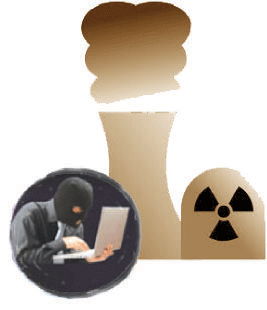 UK and US to simulate cyber-attack on nuclear plants to test resilience UK and US to simulate cyber-attack on nuclear plants to test resilienceCountries plan to cooperate by exploring the resilience of nuclear infrastructure to a terrorist attack, Guardian, Heather Stewart, 31 Mar 16 Britain and the US will stage a war-game later this year, simulating a cyber attack on a nuclear power plant, to test the readiness of the government and utility firms.As David Cameron prepares to fly to Washington to attend a nuclear security summit, convened by Barack Obama, government sources said the two countries plan to cooperate on exploring the resilience of nuclear infrastructure to a terrorist attack……. Separately, Cameron is also set to announce an exchange deal with the US, which will see the UK ship 700kg (110st) of nuclear waste, most of it currently stored at Dounreay, in Scotland, to be processed in America.
Cameron will also commit to spend £10bn this year to fund the world of agencies including the IAEA, on improving the security of civil nuclear infrastructure worldwide. Over lunch on Friday, the world leaders will discuss “scenario-planning” for protecting their nuclear facilities, and preventing volatile nuclear materials falling into the wrong hands…….http://www.theguardian.com/uk-news/2016/mar/31/uk-us-simulate-cyber-attack-nuclear-plants-test-resilience
|


Nuclear power plants: all ready to be used by enemies, as weapons of war
Nuclear Power Plants: Pre-Deployed WMDs, CounterPunch 28 Mar 16, by KARL GROSSMAN Pre-deployed weapons of mass destruction.
That’s what nuclear power plants are. And that’s another very big reason—demonstrated again in recent days with the disclosure that two of the Brussels terrorists were planning attacks on Belgian nuclear plants—why they must be eliminated.
Nuclear power plants are sitting ducks for terrorists. With most positioned along bays and rivers because of their need for massive amounts of coolant water, they provide a clear shot. They are fully exposed for aerial strikes.
The consequences of such an attack could far outweigh the impacts of 9/11 and, according to the U.S. 9/11 Commission, also originally considered in that attack was the use of hijacked planes to attack “unidentified nuclear power plants.” The Indian Point nuclear plants 26 miles north of New York City were believed to be candidates…….

a main mission of the IAEA, ever since it was established by the UN in 1957 has been to promote nuclear power. It has dramatically minimized the consequences of the catastrophic accidents at Chernobyl and Fukushima and routinely understated all problems with atomic technology.
The “Nuclear Security Summit,” with the IAEA playing a central role, is part of a series of gatherings following a speech made by President Barack Obama in Prague in 2009 in which he said “I am announcing a new international effort to secure all vulnerable nuclear material around the world.”……..
Like the IAEA—formed as a result of a speech by U.S. President Dwight Eisenhower promoting “Atoms for Peace” at the UN—officials involved with nuclear power in the U.S. government and the nation’s nuclear industry have long pushed atomic energy and downplayed problems about nuclear power and terrorism.
As the Union of Concerned Scientists (UCS) says in its “Nuclear Security” statement, “The adequacy of a security system depends on what we think we are protecting against. If we have underestimated the threat, we may overestimate our readiness to meet it. The NRC [U.S. Nuclear Regulatory Commission] has sometimes used unrealistically modest assumptions about potential attackers. The design basis threat (DBT) is the official definition of the security threats power plant management is required to protect against….After 9/11, UCS criticized the DBT for nuclear plants on these grounds, among others.”
UCS says the NRC “ignored the possibility of air-and water-based attacks…it did not address the possibility of large attacking groups using multiple entry points, or of an attack involving multiple insiders…it concentrated on threats to the reactor core, failing to address the vulnerability of spent fuel storage facilities.” Since 2011, says the UCS, the NRC “finally revised its rules to address the threat of aircraft attack for new reactor designs—but at the same time has rejected proposed design changes to protect against water- and land-based attacks.”
There is “also concern about the testing standard used,” notes UCS. “In July 2012, the NRC adopted the new process. However, as a result of industry pressure, the standards were watered down..”
Further, says UCS, testing is “currently required only for operating reactors, leaving questions about the adequacy of protection against attacks on reactors that have shut down, but still contain radioactive materials that could harm the public if damaged.”
 A pioneer in addressing how nuclear power plants are pre-deployed weapons of mass destruction has been Dr. Bennett Ramberg. As he wrote in his 1980 landmark book, Nuclear Power Plants as Weapons for the Enemy: An Unrecognized Military Peril, despite the “multiplication of nuclear power plants, little public consideration has been given to their vulnerability in time of war.”
As he writes in a piece in the current Foreign Affairs, “Nuclear Power to the People: The Middle East’s New Gold Rush,” spotlighting the push now by many nations in the Middle East to build nuclear power plants, “Whatever the energy promise of the peaceful atom, evidently lost in the boom are the security risks inherent in setting up reactors in the Middle East—and not just the commonly voiced fear that reactors are harbingers of weapons. The real risk is the possibility that the plants themselves will become targets or hostages of nihilist Middle East militants, which could result in Chernobyl and Fukushima-like meltdowns.”
“Given the mayhem that Islamic State (also called ISIS) and kindred groups have sown in the region and their end-of-days philosophy, the plausibility of an attempted attack on an operating nuclear power plant cannot be denied,” writes Ramberg.
In fact, the plausibility of an attempted attack cannot be denied in the Middle East—or anywhere in world…..http://www.counterpunch.org/2016/03/28/nuclear-power-plants-pre-deployed-wmds/
Obama’s role in nuclear security summit – but who will take over from him?
 Obama’s Last Chance to Bolster Nuclear Security, VOA March 29th, 2016 By Barbara SlavinTerrorist attacks in Belgium and Pakistan lend a greater sense of urgency to President Barack Obama’s final nuclear security summit, set to open on Thursday in Washington.
Leaders of more than 50 nations will discuss further steps to reduce and safeguard stockpiles of nuclear materials that would pose an even more serious threat to civilians than suicidal fanatics armed with guns and conventional explosives.
The concern is less about terrorists obtaining an actual nuclear weapon than stealing components for a so-called dirty bomb that could contaminate urban centers. Another frightening possibility is that terrorists could infiltrate and sabotage a nuclear power plant in an attempt to cause a catastrophic meltdown.
Belgian authorities found troubling evidence that the Islamic State network responsible for last week’s attacks on Brussels airport and the metro had been conducting surveillance of the home of a senior official at a local nuclear power plant. Two employees at another nuclear facility went to Syria as foreign fighters in 2012. One died in Syria, but the other returned to Belgium and was released from jail last year.
Long before the Syrian conflict and the advent of ISIS, the Obama administration made nonproliferation and nuclear security major priorities.
Since Obama started holding nuclear summits in 2010, 14 countries plus Taiwan have given up highly enriched uranium (HEU) once used in civilian reactors. An additional 2,697 kilograms of nuclear material has been moved or blended down to less potent forms and radiation detection equipment has been installed at 250 airports, seaports and land border crossings, according to Robert Manning of the Atlantic Council.
But there are still about 1,800 tons of nuclear material in military and civilian sites around the world, enough for thousands of weapons. The stockpile includes 61 tons of HEU at 100 civilian nuclear facilities in 25 countries. That’s enough for nearly 2,000 bombs.
China, whose president Xi Jinping will be attending the summit, has made a significant contribution to nuclear security by agreeing to take back HEU it provided as fuel for research reactors in several countries including Syria and Ghana. These reactors, developed in the 1950s and 60s, typically produce medical isotopes for use in treating cancer and other diseases, and were provided to many developing nations without much thought about their potential proliferation risk……..
A key question is how to institutionalize nonproliferation after Obama leaves office. There are real concerns about American nuclear policy under Obama’s successor, particularly if the winner of the November elections is the current frontrunner for the Republican presidential nomination, Donald Trump.
The bombastic real estate mogul, who revealed in an early debate that he did not know what the nuclear triad is (it is the three means of delivering a nuclear weapon from land, sea or air) envisions a drastic retrenchment of U.S. foreign policy commitments that could spur more countries to develop nuclear weapons.
Reversing more than 70 years of U.S. strategic thinking, Trump told The New York Times recently that the United States might be “better off” if Japan developed nuclear arms to deter a nuclear North Korea and if Tokyo did not have to continue to rely on the U.S. nuclear umbrella against both North Korea and China……..http://blogs.voanews.com/us-opinion/2016/03/29/obamas-last-chance-to-bolster-nuclear-security/
New York Governor Andrew Cuomo blasted security conditions at Indian Point Nuclear plant
 New York’s governor just slammed the state of a nuclear power plant 40 miles from Manhattan, Business Insider MICHELLE MARK 30 MAR 16 New York Governor Andrew Cuomo blasted the troubling conditions at the Indian Point Nuclear plant Tuesday evening, announcing in a statement that hundreds of faulty bolts were found within one of the plant’s reactors.
The plant poses no immediate danger to public health and safety, but the bolts are the latest incident in a series that “raise deep concerns” about the plant’s operations and further the state’s argument that the plant should not be re-licensed, Cuomo said.
The plant is located in Buchanan, New York, approximately 40 miles from New York City.
The two working reactors at the plant opened in the 1970s, and have worried many of the 2,100 residents who live around the facility for years. The licenses for both reactors have expired, but the Nuclear Regulatory Commission determined that the amount of complaints lodged against the plant warrant its continuing operations until all the grievances are addressed, according to the Guardian.
The Indian Point facility has a long history of issues. Just a few:……http://www.businessinsider.com.au/the-ny-governor-just-slammed-the-state-of-a-nuclear-power-plant-2016-3?r=US&IR=T
Spanner in the works of Japan’s planned nuclear power revival

 Japan’s Nuclear Energy Comeback Takes a Tumble IEEE Spectrum, By John Boyd, 29 Mar 16, Just when it seemed Japan was poised to get its nuclear plants up and running again after the 2011 accident at Fukushima Daiichi brought about the shutdown of all the country’s nuclear operations, a series of mishaps has raised doubts over the government’s ability to achieve its goal of supplying 20-22 percent of Japan’s energy needs with nuclear power by 2030.
Last month, TEPCO, the regional electric utility that operated the Fukushima plant, issued a press release admitting that according to the results of a recent investigation, staffers had not followed guidelines requiring them to quickly declare a meltdown following the Daiichi accident.
“In the course of our investigations, it was discovered that TEPCO’s internal manual at the time clearly stated that a core meltdown was to be determined if the percentage of core damage exceeded 5%,” states the release. It goes on to say that, “We have confirmed that there were events where it may have been possible to issue notifications and reports more promptly immediately after the tsunami hit on March 11, 2011.”
Two days before last month’s TEPCO announcement, Kansai Electric Power Co. (KEPCO, which serves the Osaka and Kyoto regions) revealed that it had found a leak on 20 February in the filtering system of the Unit 4 reactor at its Takahama Nuclear Plant in Fukui Prefecture, some 500 kilometers west of Tokyo. A contaminated pool of water was also discovered. The incident happened during preparations to restart the reactor after Japan’s Nuclear Regulatory Authority’s (NRA) had deemed it safe to go back on line.
“Subsequently, the puddle was wiped [up] and it was confirmed that there was no remaining contamination,” the KEPCO announcement explained.
Convinced that all was well, KEPCO started up the reactor on 26 February. It shut down automatically three days later due to a “main transformer/generator internal failure,” the company reported.
But the biggest blow came on 9 March, when the District Court in Otsu, Shiga Prefecture, located near the Takahama plant—though unprecedentedly not in the same prefecture—ordered the immediate shutdown of Units 3 and 4. The decision came after it agreed with a group of local plaintiffs that the plant did not satisfy all the NRA safety requirements. The Unit 3 reactor had gone back online in January………
, says the University of Tokyo’s Terai, “Should there be more legal actions of this kind inside and outside the prefectures where the plants are located, the power companies would face serious problems in starting up their nuclear power plants.”
Given that some 30 lawsuits and petitions for injunctions have been reported in the press, such an outcome seems likely. Currently, the NRA is reviewing 20 nuclear reactors in 16 power stations to see if they meet the new regulatory rules. Meanwhile, the Takahama closures leave just two reactors in operation—both at the Sendai plant run by Kyushu Electric Power Co., also in western Japan.
Clearly, the power companies’ missteps are not helping the NRA’s efforts to rebuild trust with citizens—a critical factor in winning the necessary approval of local governments……http://spectrum.ieee.org/energywise/energy/nuclear/japans-nuclear-energy-comeback-takes-a-tumble
Troubled history of New York’s Indian Point nuclear power station
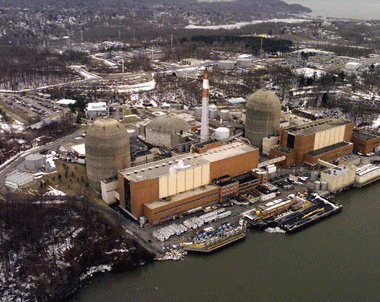 Indian Point nuclear plant reeks of troubled history As New York’s governor and other critics wage an ongoing campaign to shut the facility down citing leaks and old age, nearby residents explain complicated tale, Guardian, Sam Thielman, 29 Mar 16 Outside the Westchester Diner in Peekskill, New York, about 40 miles from New York’s Central Park, a reactor dome crests the trees behind an overpass like a giant’s bald head.
It’s one of two at Indian Point Energy Center, at the bank of the Hudson river in neighboring Buchanan, among the oldest nuclear power plants still in operation, and a monument to the energy industry’s resistance to years of work by concerned scientists, locals and state officials to close down a facility that only last month dumped a plume of radioactive waste into their groundwater.
Indian Point’s two working reactors opened in the early 1970s and have had a lot of people worried for a long time. Five years ago the New York Times wondered if it was “America’s Fukushima” – the Japanese site of the world’s worst radiation crisis since Chernobyl. In February the New York governor, Andrew Cuomo, called its operation “unacceptable” – he wants the plant closed.
It’s easy to see the source of his concern. The population density around Indian Point is of more than 2,100 people per square mile, by far the greatest for any of the US’s 61 nuclear power plants. Many of those people live and work in the plant’s shadow with growing unease.
In May 2015, an electrical transformer in the reactor called Unit 3 exploded, causing water to flood a room near the explosion where electrical distribution panels are housed and pouring 3,000 gallons of oil into the Hudson. The Union of Concerned Scientists classified the incident as a “near miss” in its annual review.Last year near misses occurred at eight nuclear facilities in the US. “Had the flooding not been discovered and stopped in time, the panels could have been submerged, plunging Unit 3 into a dangerous station blackout, in which all alternating current (AC) electricity is lost,” the report’s authors wrote. “A station blackout led to the meltdown of three nuclear reactor cores at Fukushima Dai-ichi in 2011.”
In February, radiation levels at three monitoring wells around the plant spiked, in one spot by 65,000%. Patricia Kakridas, a spokeswoman for Entergy, said the source was likely “water which exited a temporary filtration system that was set up and dismantled in late January 2016” in preparation for refueling; the company said radioactive material won’t leach into drinking water.
And in March, when the plant was being refueled, a breaker tripped and cut power in one of the reactors; when the diesel generators kicked in, they died while trying to restart the first electrical system. Fortunately a second backup worked.
Because the plant is cooled in large part by water from the Hudson – up to 2.5bn gallons a day – it kills about 1 billion fish and other aquatic organisms a year.
Incidents such as these are among the reasons Cuomo wants it closed, and Indian Point is now in a vulnerable position. The operating license for Indian Point 3 expired in December. The license for Indian Point 2 expired in 2013 (Indian Point 1 was decommissioned in 1974). Yet both remain active as the company pursues a license renewal and in the meantime Spectra, a pipeline company, is planning to add a gas pipeline that runs underneath the property to the two that have been there since the plant was built………
The fuel remains onsite at Indian Point, as it does at most nuclear power plants, and must be carefully maintained, for example it must be cooled for at least a decade before it can be sealed in concrete “dry casks”. Sheehan (and others) point out that moving it out of the state along Interstate 95 is impractical given the population density along the busy transport corridor. The plant has produced about 1,500 tons of waste and continues to produce more.
At this point, the license renewal process for Indian Point is scheduled through at least September of 2016 but the legacy of Indian Point, whether it closes or no, has a half-life of far, far longer.http://www.theguardian.com/us-news/2016/mar/28/indian-point-nuclear-plant-new-york-troubled-history
1 This Month
26 September – International Day for the Total Elimination of Nuclear Weapons





PLEASE OPPOSE HR 8255 AND S.3639 – bills would accelerate satellite deployment, with no environmental review or safeguards – https://ncstd5li.quorum.us/campaign/169331/
To see nuclear-related stories in greater depth and intensity – go to https://nuclearinformation.wordpress.com
-
Archives
- September 2026 (308)
- August 2026 (330)
- July 2026 (355)
- June 2026 (287)
- May 2026 (306)
- April 2026 (356)
- March 2026 (251)
- February 2026 (267)
- January 2026 (308)
- December 2025 (358)
- November 2025 (359)
- October 2025 (375)
-
Categories
- 1
- 1 NUCLEAR ISSUES
- business and costs
- climate change
- culture and arts
- ENERGY
- environment
- health
- history
- indigenous issues
- Legal
- marketing of nuclear
- media
- opposition to nuclear
- PERSONAL STORIES
- politics
- politics international
- Religion and ethics
- safety
- secrets,lies and civil liberties
- spinbuster
- technology
- Uranium
- wastes
- weapons and war
- Women
- 2 WORLD
- ACTION
- AFRICA
- Atrocities
- AUSTRALIA
- Christina's notes
- Christina's themes
- culture and arts
- Events
- Fuk 2022
- Fuk 2023
- Fukushima 2017
- Fukushima 2018
- fukushima 2019
- Fukushima 2020
- Fukushima 2021
- general
- global warming
- Humour (God we need it)
- Nuclear
- RARE EARTHS
- Reference
- resources – print
- Resources -audiovicual
- Weekly Newsletter
- World
- World Nuclear
- YouTube
-
RSS
Entries RSS
Comments RSS

