German State close to Belgium prepares iodine tablets, in concern about neighbouring nuclear stations
North Rhine-Westphalia prepares for Belgium nuclear accident with iodine tablets, DW, 24 May 16 Amid growing safety concerns over Belgium’s aging nuclear reactors, Germany’s most populous state has purchased iodine tablets in case of a nuclear accident. Activists insist the best solution is to close the plants. With plans already in place to end its domestic use of nuclear power by 2022, Germany has taken a clear stance on its use of nuclear energy since the 2011 Fukushima disaster.
But while Berlin pushes forward with alternative renewable energy sources at home, across the border in Belgium, its efforts are overshadowed by two controversial nuclear power plants.
Tihange 2 and Doel 3 were both scheduled to be shut down in 2015. Under a deal to preserve jobs and invest in clean energy, however, Belgian officials decided to extend their operation until 2025.
Following reports that pressure vessels at both reactor sites have shown signs of metal fatigue, the two reactors have become a source of growing tension between Germany and Belgium in recent months. Just 60 kilometers (37 miles) away from Tihange, lies the German city of Aachen – home to some 240,000 people and best known as the residence of ninth century emperor, Charlemagne.
In April, German Environment Minister Barbara Hendricks called on Brussels to carry out more teststo at the plant to show that Belgium “takes the concerns of its German neighbors seriously.” The 40-year-old reactors should be closed “until outstanding safety issues are resolved,” the minister said.
Fears have also grown over the possibility of terrorists targeting nuclear power plants, particularly after the March 22 terrorist attacks in the Belgian capital.
Brussels rejected Berlin’s request, claiming that the two plants “respond to the strictest possible safety requirements.” Less than a month later, however, Belgian Health Minister Maggie De Block announced that in the case of a nuclear disaster, people living within a 100-kilometer (60-mile) radius of the reactor would be provided with iodine tablets in a bid to minimize the effects of radiation. With Belgium only 300 kilometers at its widest point, the majority of the country’s 11-million population would effectively be included in the measure.
Having heard nothing from Brussels on the closure of either power plant, the North Rhine Westphalia (NRW) Interior Ministry announced on Tuesday that they, too, would be taking similar preventative measures, with iodine tablets being made available to the over 45-year-olds, children and pregnant women in the case of a serious nuclear leak.
“We will gradually provide each municipality with iodine tablets,” spokeswoman for NRW Interior Ministry Marlin Mailänder told DW……
Anti-nuclear energy campaigners welcomed the move by the NRW Interior Ministry on Tuesday, but vowed to continue their campaign to close the nuclear reactors.
“Of course it’s a sensible step,” co-founder of the citizen initiative “Aachen Action Group Against Nuclear Engery,” Jörg Schellenberg, told DW.
“But the better solution would be to bring an end to the source of the danger,” he added. “We need to shut down the nuclear power plants once and for all.” http://www.dw.com/en/north-rhine-westphalia-prepares-for-belgium-nuclear-accident-with-iodine-tablets/a-19279950
‘Armageddon drone’ that can search for radiation
The ‘Armageddon drone’ that can search for radiation: Nevada nuclear test site to trial atomic disaster technology
- ‘Sandstorm’ craft used for radiation sensing and environmental monitoring
- The drones will also be used for sensor development and site security
- Researchers expect to begin tests with new technology this coming fall
By CHEYENNE MACDONALD FOR DAILYMAIL.COM, 25 May 2016
The US government is set to deploy two radiation-detecting drones at the former ‘Nevada Test Site’ to test new sensing capabilities that could help in future nuclear disasters.
The ‘Sandstorm’ unmanned aircraft will be used for remote radiation sensing and environmental monitoring, along with other security applications.
Researchers are now working to expand the sensor technology for unmanned aerial systems, and they expect the Sandstorm drones to begin tests in the fall.
The Sandstorm drones were purchased by the Nevada National Security Site (NNSS).
This location was once the infamous Nevada Test Site, where nearly 1,000 nuclear tests were conducted both under and above ground, beginning in the 1950s.
Now, the NNSS leads missions on emergency response, national security, defense applications and experimentation, nuclear weapons stockpile stewardship, and environmental management.
As of December 2013, Nevada is one of six FAA authorized test sites for unmanned aerial systems (UAS).
The new drones will help to expand the research and development programs, according to NNSS officials……..http://www.dailymail.co.uk/sciencetech/article-3607203/The-Armageddon-drone-search-radiation-Nevada-nuclear-test-site-trial-atomic-disaster-technology.html
China getting prepared for nuclear emergencies
 China establishes national nuclear emergency team Reporter: Wu Guoxiu 丨 CCTV.com05-24-2016 China has established a national nuclear emergency rescue team, to cope with potential nuclear accidents, and take part in international rescue operations. CCTV reporter tells us more now on how the country is increasing its nuclear emergency preparedness.
The national rescue team is composed of armed forces members and existing rescue professionals. On duty 24-7, their job is to deal with serious nuclear accidents in the country, or abroad.
“The rescue team has 320 members, and six squads, including technical support, evacuation, rescue, radiation monitoring, decontamination and medical treatment. The bases will conduct drills, training and theoretical studies,” said Li Ganjie, Chief of China Nuclear Safety Bureau……..
“Exporting nuclear technology doesn’t mean you sell a nuclear power plant, it also involves nuclear safety and emergency systems. Our nuclear emergency response needs to be improved to meet the international level,” said Wang Yiren, Deputy Director of China Automatic Energy Authority…..http://english.cctv.com/2016/05/24/VIDEKSSxxWjhqULQlkfTq4BQ160524.shtml
USA’s nuclear power plants have experienced 10 perilous near misses

 10 Near Misses at U.S. Nuclear Power Plants Considered Precursors to a Meltdown https://ecowatch.com/2016/05/24/near-misses-nuclear-plants/ Greenpeace | May 24, 2016 Following the 30th anniversary of the Chernobyl nuclear disaster, Greenpeace USA released a new report Tuesday on the 166 near misses at U.S. nuclear power plants over the past decade. Of the incidents identified in Nuclear Near Misses: A Decade of Accident Precursors at U.S. Nuclear Plants, 10 are considered by the Nuclear Regulatory Commission (NRC) to be important precursors to a meltdown.
“Contrary to NRC commissioners’ claims, there is nothing safe about the nuclear reactors in the United States,” Greenpeace Nuclear Policy Analyst Jim Riccio said. “Thirty years after Chernobyl and five years after Fukushima, it is clear that these kinds of disasters could absolutely happen here. It is time for the NRC to listen to the whistleblowers within its own ranks and address these longstanding issues and vulnerabilities.”
In addition to the 163 accident precursors or near misses documented by the NRC, Greenpeace identified three significant near misses that NRC risk analysts failed to review under the agency’s Accident Sequence Precursor Program (ASP): the triple meltdown threat to Duke Energy’s Oconee Nuclear Station west of Greenville, South Carolina. According to NRC’s risk analysts, if nearby Jocassee Dam had failed, all three of the nuclear reactors at Oconee were certain to meltdown.
The report identified the following incidents as the top 10 near misses at nuclear plants between 2004-2014:
1. Browns Ferry 1 in Athens, Alabama: Residual heat removal loop unavailable; valve failure.
2. Wolf Creek in Burlington, Kansas: Multiple switchyard faults, reactor trip and loss of offsite power.
3. Robinson in Hartsville, South Carolina: Fire causes partial loss of offsite power & reactor coolant pump seal cooling challenges.
4. Fort Calhoun in Fort Calhoun, Nebraska: Fire in safety-related 480 volt electrical breaker due to deficient design control. 8 other breakers susceptible.
5. River Bend in St. Francisville, Louisiana. Loss of normal service water, circulating water and feedwater caused by electrical fault.
6. Oconee 1 in Seneca, South Carolina: Failure of Jocassee Dam would result in a meltdown.
7. Oconee 2 in Seneca, South Carolina: Failure of Jocassee Dam would result in a meltdown.
8. Oconee 3 in Seneca, South Carolina: Failure of Jocassee Dam would result in a meltdown.
9. North Anna 1 in Mineral, Virginia: Dual loss of offsite power caused by earthquake AFW pump out of service & failure of Unit 2 EDG.
10. Byron 2 in Byron, Illinois: Transformer & breaker failures cause Loss of Off Site Power, reactor trip and de-energizing of safety buses.
“If the NRC can’t even accurately track near meltdowns why should the public have any confidence that they can prevent them? It’s time to retire these dangerous nuclear plants and end the nuclear era once and for all,” Riccio concluded.
USA nuclear stations’ disaster procedures and processes are inadequate
U.S. Nuclear Reactors Fall Short on Steps to Cope With Disasters http://www.bloomberg.com/news/articles/2016-05-20/u-s-nuclear-reactors-fall-short-on-steps-to-cope-with-disasters Jonathan Crawford JonNCrawford May 21, 2016
-
Report notes failings in securing spent fuel, plant security
-
Operators have already spent $4 billion on safety measures
-
More than five years after a tsunami struck Japan triggering one of the worst nuclear disasters in history, U.S. reactors and industry regulators haven’t done enough to prevent a similar catastrophe, a government-sponsored study found.
Reactor operators are falling short on measures to prevent spent nuclear fuel stored at the plant from overheating and releasing radiation into the atmosphere following an accident or natural disaster, according to a report Friday from the National Academies of Sciences, Engineering and Medicine. Operators should also upgrade plant security “to cope with extreme external events and severe accidents.”
- A March 2011 earthquake caused a tsunami that slammed into Tokyo Electric Power Co.’s Fukushima Dai-Ichi plant, causing a triple meltdown that sent a radioactive plume over surrounding communities. The loss of power that followed the tsunami exposed weaknesses in systems meant to secure the plant and its stock of spent fuel.
- “The 2011 Fukushima Dai-Ichi nuclear accident should serve as a wake-up call to nuclear plant operators and regulators,” the National Academies, a private research group that advises the government, said. A 2014 report from the group focused on the causes of the Fukushima Dai-Ichi accident.
The recommendations follow safety and security steps covering the nation’s 100 operating reactors mandated by the U.S. Nuclear Regulatory Commission in response to the Fukushima Dai-Ichi accident. Industry groups questioned the cost of the rules while environmental groups said they didn’t go far enough.
-
Terrorist Attacks
Plant operators have spent $4 billion on post-Fukushima safety enhancements, according to the Washington-based Nuclear Energy Institute, a trade group representing plant owners. Friday’s report calls on the industry to go further.
Operators must ensure that pools used to cool spent fuel rods can be maintained and monitored following accidents or terrorist attacks. Power sources serving security systems should be protected and backed up with redundant supplies. Regulators and plant operators must improve their ability to identify terrorist threats.
Regulators should also examine the risks and benefits of expediting the transfer of spent fuel from pools to drys casks.
Threat of Nuclear EMP Attack on Electric Grid
Government, Industry Studying Threat of Nuclear EMP Attack on Electric Grid
High-altitude nuclear blast would cause widespread power outage, Washington Free Beacon BY: Bill Gertz May 19, 2016 American power companies are studying ways to protect electric grids against a high-altitude nuclear blast and other directed energy attacks that could severely disrupt electricity transmission, an industry representative told a Senate hearing Wednesday.
Scott Aaronson, managing director for cyber and infrastructure security at the Edison Electric Institute (EEI), stated in testimony that a consortium of U.S. electric companies is working with the Energy Department to study how to protect power grids from a nuclear blast-produced electromagnetic pulse attack or solar flares that could damage transformers and other electric components and shut down power for millions of Americans……
The hearing was called to examine threats to critical infrastructure ranging from cyber attacks and criminal activities to terrorist sabotage and nation state nuclear attacks.
Aaronson, whose institute represents all investor-owned U.S. electric companies, said in testimony that electromagnetic pulse is a concern and could be caused by a high-altitude nuclear blast or a directed energy weapon.
The Electricity Subsector Coordinating Council, a group of chief executives from 21 electric companies and nine major industry associations, is working with the Energy Department to examine the threat. Aaronson, the council’s secretary, stated that the threat study is based on research done by the Pentagon and national laboratories……..http://freebeacon.com/national-security/government-industry-studying-threat-nuclear-emp-attack-electric-grid/
Nuclear danger in Armenia
Suicidal nuclear gambit on Caucasus, Trend, 19 May 2016 “………..According to the report by Vienna-based nuclear watch-dog, International Atomic Energy Agency (IAEA), Armenia has established quite a record of illegal trafficking of nuclear and other radioactive materials. There have been a couple of serious incidents spanning from 1999 onward. A large number of reported incidents has occurred on the country`s border with Georgia, tempting the IAEA to conclude there is high probability that the so called Armenian route does in fact exist. There is a further evidence to support this assertion. There were an unusually high number of Armenians caught in nuclear trafficking activities. Additionally, some of the reported incidents that made their way to the official reports suggested that the main focus of trafficking activities is in fact smuggling of nuclear material that could be used for nuclear weapons capabilities. There were also reports suggesting the trafficking of other radioactive material that could be utilized for alternate purposes, such as the building of a so called dirty bomb. Since the stakes with nuclear weaponry are always high to the extreme, the recognition of this threat must not be underrated and dismissed easily.
However, there should be increased interest of the international community to investigate these serious claims. If documented, they would pose a grave desta-bilization factor for the already turbulent region. They would also trigger deepening of hostilities and mistrust in extremely delicate regional framework of peace.
The prospects and dangers of potential acquisition of a dirty bomb by rouge actors are rising on the international agenda. The recently detected activities in South Caucasus showed that there were substantial efforts made in order to smuggle and illegally sell Uranium 238, which is highly radioactive. At the beginning of 2016, a different group was trying to smuggle a highly radioactive Cesium isotope that usually forms as a waste product in nuclear reactors. What is also worrying is that the majority of the activities are occurring in highly instable and unmonitored territories of Azerbaijan and Georgia that are under the control of separatists, such as Nagorno- Karabakh and South Ossetia. The mere organization of the Armenian route proves to show that illegal activities can flourish in the security blind spots of the region…… http://en.trend.az/scaucasus/armenia/2535865.html
America’s Nuclear Regulatory Commission set to exempt nuclear corporations from safety costs and liabilities
 US nuclear industry’s plan thanks to NRC: let taxpayers carry the can for closed power plants, Ecologist Linda Pentz Gunter13th May 2016 With five reactors closed in the last three years, the US nuclear industry is in shutdown mode, writes Linda Pentz Gunter – and that means big spending on decommissioning. But now the nuclear regulator is set to exempt owners from safety and emergency costs at their closed plants – allowing them to walk away from the costs and liabilities, and palm them onto taxpayers.
Aging and dangerous nuclear power plants are closing. This should be cause for celebration. We will all be safer now, right? Well, not exactly.
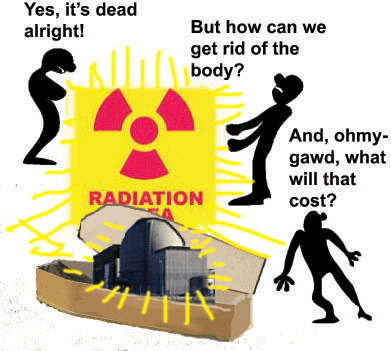 US nuclear power plant owners are currently pouring resources into efforts to circumvent the already virtually non-existent regulations for the dismantlement and decommissioning of permanently closed nuclear reactors.
And sad to say, many on the US Nuclear Regulatory Commission (NRC), the industry’s ever compliant lapdog, are trotting happily by their side.
There is an occasional lone critic. NRC Commissioner Jeff Baran, observed that the“NRC does not currently have regulations specifically tailored for this transition from operations to decommissioning. As a result, licensees with reactors transitioning to decommissioning routinely seek exemptions from many of the regulations applicable to operating reactors.”
The inevitable result is that reactor owners will successfully avoid spending money now on decommissioning as they seek to delay beginning the actual cleanup work for the next half century and maybe longer. Later, when it comes time to finish the job, the owners – and the money – could well be long gone.
US reactor owners rely on ‘decommissioning trust fund’ investments to pay for decommissioning activities. But these are failing to accrue adequate funds to do the job. Many of the trusts are incurring annual losses on their investments.
In fact, the US Government Accountability Office (GAO) has found the NRC’s financing formula for decommissioning trust funds to be fundamentally flawed, resulting in the utilities ability to accrue only 57% to 75% of the needed funds……..http://www.theecologist.org/News/news_analysis/2987679/us_nuclear_industrys_plan_thanks_to_nrc_let_taxpayers_carry_the_can_for_closed_power_plants.html
Degrading panel at Pilgrim Nuclear Power Station’s spent fuel pool
Report: Panel at Pilgrim degrading Problem in spent fuel pool described as ‘slow to develop’ Cape Cod Times, By Christine Legere May 14, 2016
PLYMOUTH — One of the panels designed to absorb neutrons and prevent a nuclear reaction called fission from occurring in the spent fuel rods stored in the Pilgrim Nuclear Power Station’s spent fuel pool has deteriorated, according to a report submitted by Entergy Corp. to federal regulators yesterday.
Fission would cause the rods to heat up the same way they do in a nuclear reactor. The heat would cause the water in the pool to boil and evaporate. If exposed, the rods could start a fire and release radiation.
Neil Sheehan, spokesman for the Nuclear Regulatory Commission said degradation of the panels has been a known problem for decades and one experienced by a number of nuclear plants……..It takes as little as four fuel assemblies to begin a nuclear chain reaction. Currently the racks in Pilgrim’s pool hold 3,300 spent fuel assemblies……..
The storage pools at nuclear plants, particularly older ones like the 43-year-old Pilgrim, were designed to hold spent fuel rods short term. Pilgrim’s pool was designed for about 800 assemblies. Assemblies were on large racks that relied on large spacing, about 20 inches between the spent fuel assemblies to maintain sub-critical conditions.
But as the solution to long-term storage continued to be elusive, the pools had to accommodate many more rods than “Because of the federal government’s problem to provide a disposal site for irradiated fuel, tens of thousands of tons of irradiated fuel remains where it was produced,” said David Lochbaum, director of nuclear safety for the Union of Concerned Scientists. “Spent fuel pools have been re-racked with storage racks holding irradiated fuel very close together, often closer than when it is in the reactor core. In the core, there are control rods to prevent criticality. In the spent fuel pools, other methods must be used to protect against criticality.
Solutions to the problem include the use of borated water or the insertion of sleeves containing boron over defective panels.
At this point, there is no time frame for a solution at Pilgrim. http://capecodtimes.com/article/20160513/NEWS/160519684
Convention on the Physical Protection of Nuclear Material strengthens nuclear security
 New amendment on safeguarding nuclear facilities comes into force, strengthening a weak link in nuclear security, UN News Centre, 12 May 2016 – After nearly two decades, the Amendment to the United Nations –backed Convention on the Physical Protection of Nuclear Material (CPPNM) entered into force on 8 May – strengthening nuclear security and reducing the threat of nuclear terrorism worldwide.
At an event marking the historic milestone, Yukiya Amano, Director General of the International Atomic Agency (IAEA), said: “The entry into force of the Amendment demonstrates the determination of the international community to act together to strengthen nuclear security globally.”
On 8 April, the ratification of Panama brought the number of CPPNM adherences to 102, the threshold necessary to kick the agreement into effect in 30 days. The bolstered Convention,described by Mr. Amano as “the single most important step which the world can take to strengthen nuclear security,” will, among other things, reduce the risk of a terrorist attack on a nuclear power plant and make it more difficult to smuggle nuclear material.
As the only international legally-binding undertaking on the physical protection of nuclear material, the 1979 Convention established measures to prevent, detect and punish offenses.
The Amendment broadens the CPPNM by protecting nuclear facilities and material in domestic use, storage and transport. It also expands on identified offences, such as nuclear material theft, as well as introduces new ones, including nuclear material smuggling and nuclear facility sabotage.
Now that the Amendment has entered into force, new international notification and cooperation requirements will become fully operational, including enhanced information sharing between States in locating and recovering stolen material……..http://www.un.org/apps/news/story.asp?NewsID=53920#.VzTqW9J97Gg
Britain failed to consult Europe over Hinkley nuclear safety dangers – UN
 Hinkley Point: UN says UK failed to consult over risks UN Economic and Social Council says Britain has not met its obligations to discuss the impact of nuclear accident with neighbouring countries Terry Macalister, Guardian, 9 May 16 The British government has run into a major new problem with the Hinkley Point C nuclear project, with a United Nations committee ruling that the UK failed to consult European countries properly over potential environmental risks.
Documents seen by the Guardian show Britain “is in non-compliance with its obligations” (page 21) to discuss the possible impact of any accident or other event that could affect those nations in proximity to Hinkley.
This is just the latest in a string of problems connected with the planned £18bn project to construct new reactors in Somerset, with the developer EDF of Francerecently delaying a final investment decision until September.
Paul Dorfman, a senior researcher at UCL’s energy institute, said the ruling from the UN Economic and Social Council throws great uncertainty over Hinkley.
“This is a huge blow to the government and introduces a whole new element of doubt over the scheme. It is hard to see how EDF can sign off any final investment decision whilst the government has yet to resolve this important issue.”…..http://www.theguardian.com/uk-news/2016/may/08/hinkley-point-united-nations-says-uk-failed-to-consult-over-risks
Nuclear safety problems, and high powered guns
 If the nuclear security people have high-powered guns, how long before the terrorists get the, and can then damage the nuclear facilities?
Bigger guns, bigger problems? How high-powered ammunition could affect nuclear power plants May 9, 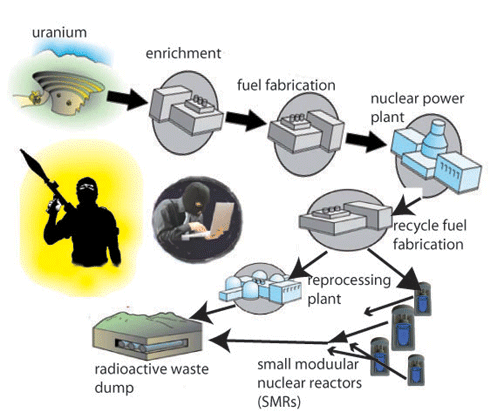 2016 By TERI SFORZA / STAFF WRITER, Orange County Register, Shortly after the horrors of 9/11, a curious package landed on Dave Lochbaum’s desk.
It was flat but heavy. Inside the bubble pack was a battered steel plate, blasted with dents and holes from semiautomatic weapons fire. Each pockmark and perforation was carefully labeled – by hand, in permanent ink – with the type of ammunition used to produce it.
Security forces at San Onofre Nuclear Generating Station and nuclear plants nationwide had increased their firepower to take on a more formidable terrorist threat. The steel plate, sent by a San Onofre security manager, graphically illustrated what Lochbaum, a nuclear engineer, considered a potentially devastating, increased risk:
More powerful ammunition meant to protect nuclear reactors was capable of piercing control panels and critical piping.
The concern doesn’t appear to have been publicly disclosed at the time, but it resurfaced recently after the Nuclear Regulatory Commission allowed nuclear security forces to override state and local gun control laws and possess high-powered weaponry that would otherwise be banned.
Government documents – provided by the Union of Concerned Scientists, a nonprofit watchdog that keeps a critical eye on the U.S. Nuclear Regulatory Commission in Washington, D.C. – offer a rare glimpse intoefforts to secure America’s nuclear power plants that occur out of the public eye and the controversies that can simmer behind the scenes.
Critics maintain that not enough is being done to protect plants and the public. Their issue is not whether those guarding nuclear plants should have high-powered weaponry, but about how much additional security training and hardening of facilities should be required to reduce the risk of collateral damage.
An accidental discharge, friendly fire or all-out firefight during a terrorist attack could potentially cripple a working reactor and release dangerous radiation, experts said.
Risks are different at shuttered plants like San Onofre Nuclear Generating Station because there’s no reactor core to melt down. But millions of pounds of nuclear waste remain on site, cooled and protected by intricate technologies that sit beyond the thick containment domes.
The NRC has allowed San Onofre to dial back its emergency plans because it no longer splits atoms, a move that many critics opposed. Operating nuclear plants must work up detailed responses to four levels of emergency, but San Onofre owner Southern California Edison no longer has to prepare for the worst two.
Nuclear power plant security is a nationwide concern. Nearly one-third of Americans – 96 million – live within 50 miles of such facilities, according to the U.S. Census Bureau………
Plant security must defend against attackers whose goal is to damage or disable safety-related equipment, the letter said. Because such attackers would likely be armed with automatic weapons with high-powered ammunition, the guards must have comparable equipment……..
Concerns remain, however.
“We have upgraded security at America’s nuclear plants and made it much harder for bad guys to cause mayhem, and that’s good,” Lochbaum said. “But there’s all kinds of equipment that could inadvertently be damaged, and not much training on what security officers should try not to hit. ”………http://www.ocregister.com/taxdollars/nuclear-715262-security-nrc.html
Unfolding nuclear disasters in America
Is there any nuclear site in the United States that is not currently collapsing, leaking or otherwise posing a major health or environmental risk? Certainly there are, but that number is becoming smaller and smaller.
In addition to three other nuclear disasters unfolding across the country, a fourth has now arisen. This new disaster is located in Washington state in a facility known as the Hanford site.
One week after 19 workers were sent for medical evaluation as the nuclear waste tank was being transferred because of a leak, 3 more workers are now being reported as injured at the site. According to RT, the workers inhaled radioactive fumes – the same issue facing the 19 previously hospitalized workers. This brings the injured number of workers up to 22…….
Although the facility was decommissioned at the end of the Cold War, the facility has been used to store nuclear waste. In fact, according to RT, two-thirds of America’s radioactive materials are stored at this location which makes it one of the largest facilities of its kind in the world.
The storage tanks which were built as early as 1940 and as late as 1970 contain 56 million gallons of radioactive chemicals.
According Gerry Pollet, a Washington State Representative, those tanks were never expected to last longer than 20 years.
Pollet says,
Twenty years was a dream in the first place. And, as you know, some of them didn’t last 20 years – and we had a small explosion on the 1950s. That hot waste boiled; created a steam explosion under the tank, and we were lucky that we didn’t have half of eastern Washington having to be permanently evacuated.
The company operating the facility acknowledged “higher-than-normal readings for contamination” for a certain tank, but claimed that the readings “well below the alarm level.” RT correspondent Alexey Yaroshevsky traveled to the Hanford site with a Geiger counter.
Yaroshevsky measured the radiation levels of a rock laying well outside of the containment facility and, while the readings were not considered an emergency even the reporter’s handheld device registered a higher-than-normal level of radiation.
Yaroshevsky wondered aloud whether or not the radiation levels closer to the center to the containment facility would be much higher. The reports of the Hanford site leakage now add a West Coast dimension to the nuclear crisis that has escalated in the last few weeks.
In addition to Hanford, reports West Lake Landfill in St. Louis, Missouri which houses sizable amounts of nuclear waste is facing an approaching fire from an adjacent landfill that threatens to turn West Lake into a cauldron of radioactive air pollution. In addition, a nuclear power plant in Turkey Point, Florida is reportedlyleaking polluted water into Biscayne Bay. New York’s Indian Point power plant is also threatening to become a major radioactive incident. Constant leaks, mishaps and other signs of an outright collapse have existed at Indian Point for quite some time but have increased in frequency over the last year . http://www.naturalblaze.com/2016/05/is-this-the-4th-recent-nuclear-disaster-to-strike-the-u-s.html

US lawmakers concerned about possible drone attacks on nuclear facilities
Defense Bill Has Nuclear Facilities Fighting Drones http://www.defensenews.com/story/defense/policy-budget/congress/2016/05/07/defense-bill-has-nuclear-facilities-fighting-drones/83931328/ Joe Gould, Defense News May 7, 2016 WASHINGTON — As US regulators grapple with the safety, privacy and national security concerns posed by a boom in the use of recreational drones, lawmakers worried about their use for malicious ends have advanced legislation aimed at letting Defense Department and Energy Department facilities defend themselves against them

That is a very aggressive approach, and one we have yet to see in federal regulations,” energy and infrastructure attorney Roland Backhaus, with the firm Pillsbury Winthrop Shaw Pittman, said of the bill.
While the US Federal Aviation Administration has yet to report any serious incident involving a drone at a nuclear facility, fears and speculation have been fueled by a commercial quadcopter’s crash landing on the White House lawn last year, and a Massachusetts man’s guilty plea in 2012 to plotting attacks on the Pentagon and US Capitol building with an explosive-laden model plane.
Drones reportedly buzzed nuclear facilities around France 32 times over two months in 2014, according to a report commissioned by Greenpeace, sparking concern the country’s nuclear reactors are unsafe from aerial assaults and jangling nerves in other nations about the potential threat.
Unmanned aerial systems (UAS) small enough to elude radar could be used “by criminals and terrorists” to attack or spy on “critical government and industrial facilities,” according to a Jan. 27 Congressional Research Service report. “Somewhat larger UAS could be used to carry out terrorist attacks by serving as platforms to deliver explosives or chemical, biological, radiological, or nuclear weapons,” said the report, by aviation policy specialist Bart Elias.
Taking no chances given the devastation that could be wrought at such a facility, House Armed Services Committee (HASC) strategic forces subcommittee chairman Mike Rogers, R-Ala., included the two counterdrone provisions in the 2017 NDAA, which the HASC approved April 28.
“The bottom line is the members are tracking the increased prevalence and sophistication of unmanned aerial systems around the country, and they understand the threat these can pose to certain defense facilities,” said a congressional staffer.
DoE has 10 active sites across the country that handle the US arsenal of nuclear weapons and material, while DoD controls nuclear missile fields, silos, underground storage and maintenance, as well as nuclear reactors for training and research.
The massive defense policy bill has several hurdles before it becomes law. The language would have to survive a vote on the House floor and reconciliation with the Senate bill due later this month. The reconciled bill will face a vote in both houses of Congress and must be signed by the president.
Under the bill’s mandate for DoD, the defense secretary would develop a means to disrupt, seize, confiscate, control, disable or destroy drones deemed a threat to facilities related to nuclear deterrence, missile defense or the national security space mission.
For DoE, personnel and contractors who think a drone presents “a threat to people, property, or classified information” at a facility that stores or uses special nuclear material would be allowed to “mitigate the threat from, disable, interdict, interfere with” its operation. It varies by DoE facility, but most are operated by private contractors, and physical security is generally provided by third-party companies.
Lawmakers don’t mean to encourage the shooting down of drones, and while the bill permits DoE to do it, its language discourages the use of force in favor of “appropriate escalation,” saying “non-kinetic responses should be utilized when feasible to mitigate a threat.”
An FAA spokesman declined to comment on the pending legislation, but had this to say:
“Generally, shooting at any aircraft — including unmanned aircraft — poses a significant safety hazard. An unmanned aircraft hit by gunfire could crash, causing damage to persons or property on the ground, or it could collide with other objects in the air.”
The legislation comes as federal agencies have been waiting for the FAA to carve out security-based rules for drones, a step mandated by law in 2013. In the meantime, an FAA notice strongly advises pilots of airplanes and drones to avoid — and not “circle or loiter” in — the airspace of critical infrastructure, such as power plants, military bases and prisons.
Washington nuclear waste site’s huge spike in radiation levels
TV: EPA data reveals “sharp spike in radiation level” around US nuclear site — “It’s been reportedly leaking huge amounts of radioactive materials for more than 2 weeks” — Evacuations enacted… Almost 50 workers have sought medical attention… Symptoms include bleeding ulcers, burned lungs (VIDEOS) http://enenews.com/tv-epa-data-reveals-sharp-spike-radiation-level-around-nuclear-site-leaking-huge-amounts-radioactive-materials-2-weeks-evacuations-enacted-almost-50-workers-sought-medical-attention-symtoms-incl?utm_source=feedburner&utm_medium=email&utm_campaign=
KING 5 News, May 5, 2016 (emphasis added): Record number of Hanford workers sickened by toxic vapors — An unprecedented number of workers at Hanford have been exposed to dangerous chemical vapors since Thursday, April 28. In one week’s time a total of 47 people either sought medical attention… Symptoms reported by workers include a headache, burning nose and throat, nausea, a metallic taste in the mouth, elevated blood pressure, and dizziness… [T]hose familiar with the nuclear site cannot remember so many people falling victim in such a short period… On May 4, two more evacuations were enacted at the site after workers smelled odors and experienced symptoms… “Forty-two employees have been evaluated as a precautionary measure due to reported odors or symptoms at the on-site medical facility since Thursday. Thirty-one employees reported health symptoms while 11 went for cautionary reasons. All have been released to return to work” said Rob Roxburgh of the Dept. of Energy, in a statement sent to KING 5 on Wednesday. Chemical vapor releases at Hanford come from underground nuclear waste storage tanks that vent the gasses without warning.
RT, May 7, 2016: Spike in radiation levels after toxic waste leak at Washington nuclear site — Radiation levels at the Hanford, Washington nuclear waste site have spiked to “elevated risk” after thousands of gallons of toxic waste leaked in April… The recent readings from the Environmental Protection Agency (EPA) obtained by RT have revealed that a sharp spike in the radiation level had been registered in Richland on the morning of May 5. The readings show the random jump when the toxic fume rates briefly reached around 410 CPM (counts per minute), nearly the highest possible level… As of Friday afternoon, there have been no media reports suggesting that an evacuation or other measures and guidance have been ordered for Richland… The most recent radiation spike comes less than a month after a massive leak was first detected…
RT transcript, May 5, 2016: On Thursday last week at least 19 workers at the Hanford nuclear site were hospitalized after inhaling poisonous fumes, from tasting metal in their mouth tobleeding ulcers and burned lungs.
RT transcript, May 3, 2016: At the Hanford nuclear site in Washington state… more workers sought medical attention after inhaling radioactive fumes. This adds to 19 workers hospitalized last week for the same reason — reinforcing burning concerns about the facility as it’s been reportedly leaking huge amounts of radioactive materials for more than 2 weeks… [Tom Carpenter, Executive Director of Hanford Challenge:] “It’s an environmental disaster, at some point the [Columbia] River becomes so contaminated that you can’t use the river.”… Ecologists say the situation can always get worse. They hate to think what would happen in case of even a minor earthquake in a geologically unstable area that it is. But even in the current state of thingswith tanks leaking nuclear poison into the environment, Hanford is already way past the ticking time bomb stage.
RT transcript, May 2, 2016: [Tom Carpenter, Executive Director of Hanford Challenge:] “A second double-shelled nuclear waste tank is showing signs of having failed, you find that out because there’s high radiation levels in between the two shells of the tank. There should be no radiation in that space… but instruments they have deployed there show high radiation levels,plutonium, cesium, strontium-90, etc. – well where did that come from? It probably came from the tank, meaning there’s a hole.”… So we’re looking at potentially a catastrophe, a disastrous catastrophe? [Carpenter:] “Every day we’re looking at that at Hanford – I’m totally serious.”
RT transcript, Apr 21, 2016: ‘Washington state nuke plant leaks thousands of gallons of toxic waste‘… Experts say it’s time for every American to be worried.
1 This Month
26 September – International Day for the Total Elimination of Nuclear Weapons





PLEASE OPPOSE HR 8255 AND S.3639 – bills would accelerate satellite deployment, with no environmental review or safeguards – https://ncstd5li.quorum.us/campaign/169331/
To see nuclear-related stories in greater depth and intensity – go to https://nuclearinformation.wordpress.com
-
Archives
- September 2026 (305)
- August 2026 (330)
- July 2026 (355)
- June 2026 (287)
- May 2026 (306)
- April 2026 (356)
- March 2026 (251)
- February 2026 (267)
- January 2026 (308)
- December 2025 (358)
- November 2025 (359)
- October 2025 (375)
-
Categories
- 1
- 1 NUCLEAR ISSUES
- business and costs
- climate change
- culture and arts
- ENERGY
- environment
- health
- history
- indigenous issues
- Legal
- marketing of nuclear
- media
- opposition to nuclear
- PERSONAL STORIES
- politics
- politics international
- Religion and ethics
- safety
- secrets,lies and civil liberties
- spinbuster
- technology
- Uranium
- wastes
- weapons and war
- Women
- 2 WORLD
- ACTION
- AFRICA
- Atrocities
- AUSTRALIA
- Christina's notes
- Christina's themes
- culture and arts
- Events
- Fuk 2022
- Fuk 2023
- Fukushima 2017
- Fukushima 2018
- fukushima 2019
- Fukushima 2020
- Fukushima 2021
- general
- global warming
- Humour (God we need it)
- Nuclear
- RARE EARTHS
- Reference
- resources – print
- Resources -audiovicual
- Weekly Newsletter
- World
- World Nuclear
- YouTube
-
RSS
Entries RSS
Comments RSS

