Rockland County Lawmakers Want Shutdown of Dangerous Indian Point Nuclear Station
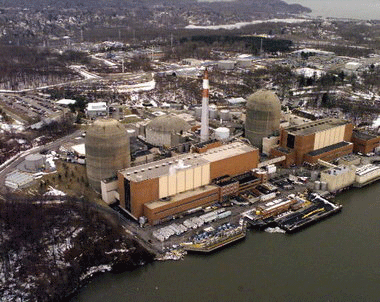 VOICE OF THE LEGISLATIVE MAJORITY: Shut Down Indian Point
http://www.rocklandtimes.com/2016/06/09/voice-of-the-legislative-majority-shut-down-indian-point/June 9th, 2016 By Legislator Alden H. Wolfe (D- Montebello) Chairman, Rockland County Legislature
From the moment the Indian Point nuclear power plants went on line, safety issues began to emerge. Malfunctions and faulty parts caused the plants to be closed, and later restarted. As the Hudson Valley population grew and the problems at Indian Point increased, the reality of the potential for a catastrophic disaster became clearer and clearer.
Sadly, the Indian Point facility continues to suffer more failures than ever before. In the last year alone, there have been seven plant shutdowns. At this point, there is undoubtedly only one solution: Indian Point must be shut down immediately.
This week, I stood with other governmental and environmental leaders in Westchester to call for the shutdown of the plant, and to raise awareness about continuing dangerous conditions that exists in the plant.
One of the critical components of a nuclear plant is its cooling capability. Carefully laid metal plates channel cooling water through the reactor at a rate of 250,000 gallons per minute. The water flows through the core of the plant, cooling it and preventing a nuclear meltdown. The plates need to be arranged in such a way to control the amount and speed of the water that flows in the plant. Any deviation from those parameters could create a devastating meltdown endangering hundreds of thousands of lives.
The plates are kept in place by bolts known as “baffle-former assembly bolts.” The Indian Point Unit 2 nuclear reactor has 832 of these bolts, and each one is essential to keeping the metal plates secure. Nationally, roughly 1 – 3 percent of bolts at the average nuclear power plant are broken or missing. At Indian Point, that number is an astounding 27 percent.
Two hundred and twenty seven of the 832 bolts that are the difference between life and death are broken or missing at Indian Point. According to the Nuclear Regulatory Commission, that is “the largest seen to date at a U.S. reactor.” Shockingly, these failures occurred under the watchful eye of the NRC, which now declares the reactor safe to restart once the bolts are replaced. What other critical safety component will be the next to fail at this aging plant?
As if the threat of loss of life weren’t enough, last month it was estimated that in the event of a nuclear meltdown, it would take 1.5 million workers and as much as $1 trillion – with a T – to decontaminate the affected areas.
Indian Point is a powder keg. Every minute it operates is another risk to all of us, and it is a risk we should no longer allow. The Legislature will continue to work with those committed to closing Indian Point to put an end to this unnecessary gamble with our lives.
Alarm sounded on Southern California Edison’s plan for nuclear waste burial near beach
Local Leaders, Scientists Sounding Alarm Over Possible Nuclear Disaster In Southland http://losangeles.cbslocal.com/2016/06/08/local-leaders-scientists-sounding-alarm-over-planned-nuclear-waste-dumping-in-san-onofre-state-beach/ June 8, 2016 LAGUNA BEACH (CBSLA.com) — A standing-room-only public forum was held Wednesday night to warn the community about Southern California Edison’s plans to bury radioactive waste near San Onofre State Beach.
If nothing is done, the utility will be allowed to bury 2,000 tons of high-level nuclear waste in canister less than an inch thick 100 feet from the beach, according to the newly formed Secure Nuclear Waste Coalition, made up of scientists, city leaders and people who live near the San Onofre nuclear plant.
“Each canister contains a Chernobyl’s worth of radiation, and there’s 50 of them. And they want to put 100 more without dealing with the fact that ocean air is going to cause them to crack and potentially and even explode,” Donna Gilmore said.
The California Coastal Commission approved the beachfront nuclear waste burial on October 6, 2015.
The group told those living within the 50-mile evacuation zone from San Diego to Long Beach that even though the San Onofre nuclear- generating station has been shut down, the real danger still lies in the still highly radioactive spent nuclear fuel that will remain on site for years.
“They have been called rightfully so – bombs in our backyard,” warned Rita Conn of the coalition.
Edison has maintained the shuttered nuclear power plant and the spent fuel rods stored there are safe. But some fear Southern California is one earthquake, one tsunami or one terrorist attack away from a nuclear disaster.
“Whether it’s mother nature, human error or terrorism, anything could close down the 7th largest economy of the United States for the next 10,000 years,” Laguna Beach resident Marni Magda said.
“If we don’t do anything about it, people are just going to have their heads in the sand and heaven forbid, something terrible happens,” Donna Tiab warned.
A call to Southern California Edison for comment Wednesday night was not returned.
Iran nuclear deal points to a better nuclear order
 The Iran Deal’s Building Blocks of a Better Nuclear Order, Carnegie Endowment For International Peace, GEORGE PERKOVICH June 9, 2016 The U.S. debate over the Iran nuclear deal focused primarily on whether the agreement’s terms were sufficient to prevent Iran from acquiring nuclear weapons, whether Iran would cheat, and whether Iran would use gains from sanctions relief to fund aggression against its neighbors and Israel. Practically no attention was paid in the media or in Congress to the possibility that the nuclear agreement, known as the Joint Comprehensive Plan of Action (JCPOA), could provide opportunities to strengthen the global nonproliferation regime. Of course, the potential to build on the agreement depends on its being successfully implemented; the deal’s collapse would create an international crisis that would subsume efforts to adopt its salutary provisions elsewhere.
It will take considerable time and patient give-and-take bargaining to persuade Russia and other influential players in nuclear diplomacy to build on the JCPOA, but there is no need to rush. Beyond the Republic of Korea, there are no other states on the near horizon that have the capability and intention to initiate a new fuel-cycle program.
The JCPOA innovatively fills in each of these lacunae in the NPT. While it does not settle or fully address these complex issues, it offers potentially important building blocks for doing so. For example, the JCPOA, in practice, establishes that the NPT does not a priori deny states the “right” to acquire and utilize capabilities to produce fissile materials for peaceful purposes. Critics have identified this as a major shortcoming. The agreement makes it easier for other states to insist that they, too, should be allowed to enrich uranium, which many observers fear could exacerbate proliferation risks. But the JCPOA also defines conditions, as well as monitoring and verification mechanisms, that would significantly bolster international confidence that a state’s fuel-cycle activities are exclusively peaceful.
Macau environmentalists warn on dangers for Taishan nuclear power plant
ENVIRONMENTALIST RAISES RED FLAGS ON NUCLEAR PLANT Macao Daily Times , MAY 31, 2016 – Sammie Lun, chairman of Green Environment Protection Association of Macau, is concerned about safety issues surrounding the upcoming Taishan nuclear power plant. The plant, located approximately 80 kilometers west of Macau, is currently under construction and has been surrounded by controversies….
Lun told the Times “I am personally totally against nuclear power plants.” Furthermore, he added that he maintains his opposition to the plant simply because of the pollution risks that are known to come with all nuclear power plants. “Even if the nuclear power plant is clean, if problems arise, they will be catastrophic, pollution will exist forever,” said Lun…..
NUCLEAR safety experts are calling for households in the UK to be supplied with anti-radiation pills
nuclear materials transported by road, rail, sea and air are also potential targets.
Fears of nuclear terror attack grow amid call for UK homes to be sent anti-
 radiation pills NUCLEAR safety experts are calling for households in the UK to be supplied with anti-radiation pills as fears grow of the potential for terrorists to strike highly-sensitive sites around the country. Express, By TOM BATCHELOR May 31 A new report warns British nuclear plants are at risk of mass drone strikes, sophisticated cyber attacks and terrorist infiltrators.
Analysis for the Nuclear-Free Local Authorities (NFLA) found nuclear facilities at Faslane – where the UK stations its Trident missile system – was vulnerable to attack. Sensitive nuclear sites at Hunterston, Torness and Dounreay are also at risk, the study claims. More worrying still, UK authorities were deemed to be underestimating the risk of devastating terrorist attacks.
The report demands urgent action from ministers as it warns governments and regulatory agencies are struggling to keep up with evolving threats. Such is the fear of an attack that the NFLA is demanding anti-radiation pills be distributed to households in Glasgow, Edinburgh and surrounding areas.
The medication is a preventative measure which would help protect people from a radiation leak – either accidental or a deliberate attack.
The report on nuclear security, compiled by Dr David Lowry, a senior research fellow with the US Institute for Resource and Security Studies, argues that nuclear materials transported by road, rail, sea and air are also potential targets. He said: “The main consequences would be, whatever the level of attack, mass public panic and sensationalist media reportage. “We would inevitably see total road gridlock, as everyone tries to flee by car en masse at once.”
 Drones could carry shaped charges, poison gas, booby traps or decoys, and could come individually or in large groups. The report said: “One heavily laden small drone could probably travel at least 20mph with a load of 5-10kg. “Just one 5kg shaped charge can penetrate 0.75 metres of reinforced concrete, or 0.25 meters of steel.”
The second report for NFLA, written by Dr Ian Fairlie, an independent radiation scientist, focuses on the stable iodine tablets that can prevent radiation poisoning after some nuclear accidents.
Several other European countries distribute the pills across a wide area, but in Scotland they are only given to residents who live within two or three kilometres of nuclear plants……..
EDF Energy, the French company that runs nuclear power stations in Scotland, and the Ministry of Defence, which runs the Faslane nuclear base, declined to comment. http://www.express.co.uk/news/uk/675515/Nuclear-terror-attack-fears-experts-call-government-hand-out-anti-radiation-pills
China’s plans for floating nuclear power plants- major risks, good terrorism targets
While floating power plants may seem to present exciting economic opportunities–both for sites lacking affordable power and for the entities selling the plants—they also come with major risks.
“naval bombardment” is a growing risk in the South China Sea. A floating nuclear power plant might make a tempting target.
 Floating nuclear power plants: China is far from first, Bulletin of the Atomic Scientists Dawn Stover , 2 June 16 On April 22, the state-owned Chinese newspaper Global Times reported that China plans to build as many as 20 floating nuclear power plants, the first of which could be producing power in just a few years. The story made a splash because the power from the floating reactors would most likely be used to accelerate construction of oil rigs and artificial islands in the South China Sea—already a source of border disputes and escalating tension between China and its neighbors.
Portable power stations may sound futuristic, but the idea is far from new. The United States launched the first floating nuclear power plant five decades ago, and Russia started its own construction project in 2000. Where the United States has seen a proprietary technology, though, China sees a marketing opportunity.
China floats an idea. Earlier this year, as part of its latest five-year plan, China’s National Development and Reform Commission approved the development of two nuclear reactors for marine platforms, one each from the country’s two big nuclear companies: The China General Nuclear Power Group will develop the ACPR50S, a small modular reactor with a generating capacity of 200 megawatts. Meanwhile, the China National Nuclear Corporation plans to work on the AC100S reactor, a marine version of its ACP100, which would generate 100 megawatts.
China General Nuclear has signed an agreement with China National Offshore Oil Corporation, which would presumably use floating nuclear power plants to provide power for offshore oil and gas exploration. China Shipbuilding Industry Corporation, the country’s largest shipbuilder, is building a barge-like platform for China General Nuclear’s pilot plant. An illustration of the platform looks very similar to Russian designs, which is not surprising. Only a few years ago, the Chinese were planning to build floating nuclear power plants in China using Russian technology; now the Chinese are floating their own designs………
Potential risks and rewards. Russia’s nuclear-powered icebreakers use highly enriched uranium, but the modified reactors for the Akademik Lomonosov will run on low-enriched uranium. That helps to alleviate concerns about proliferation, but environmental and safety concerns remain. A floating nuclear power plant would probably be safe from earthquakes, but storms could be a threat, and accident response would be slow in remote Arctic areas.
In the event of a nuclear accident, an offshore plant would have plenty of cooling water readily available. But a floating nuclear power plant might not have access to off-site backup power, and it would be more difficult to contain any radioactive releases than when an accident occurs at a land-based plant. A failed reactor might end up being abandoned at sea, as has happened to seven Soviet or Russian nuclear submarines.
Those risks aren’t preventing the Russians and Chinese from moving ahead with plans for floating nuclear power plants. Russia hopes to lease floating plants to other countries, and China sees an opportunity to capitalize on technologies originally developed by the United States and Russia…….
While floating power plants may seem to present exciting economic opportunities–both for sites lacking affordable power and for the entities selling the plants—they also come with major risks. As Bennett Ramberg, author of the book Nuclear Power Plants as Weapons for the Enemy: An Unrecognized Military Peril, noted in the Bulletin’s March 1986 issue: “[F]acilities can be placed on large lakes, inland seas, or oceans—on floating platforms surrounded by breakwaters, on floating vessels anchored to the marine floor, on artificial islands, or even undersea. However, there would be higher transmission costs for reactors, unique construction costs, and exposure to such dangers as ship collisions, accidental explosions, and naval bombardment.”
Thirty years later, “naval bombardment” is a growing risk in the South China Sea. A floating nuclear power plant might make a tempting target.
Editor’s note: The Bulletin’s archives from 1945 to 1998, complete with the original covers and artwork, can be found here. Anything after 1998 can be found via the search engine on the Bulletin’s home page. http://thebulletin.org/floating-nuclear-power-plants-china-far-first9522
Nuclear stations more at risk than Regulators say
 Undercovered: New Report Says Nuclear Power Plants More Vulnerable Than Regulators Said, Mediaite, by Sam Reisman May 31st, 2016
Welcome to Undercovered: our new daily feature bringing attention to excellent reporting and stories we feel deserve a larger audience.
Nuclear power plants in the United States are more vulnerable to the threats of natural disaster or terrorism than federal regulators have said, according to study released May 20 by the National Academies of Sciences, Engineering, and Medicine.
The Academies’ study is something of a rebuke to a 2014 study by the Nuclear Regulatory Commission, a government agency that oversees the nuclear power industry. According to the chair of Academies board, the NRC’s study neglected to adequately evaluate the risks posed by terrorism or sabotage to nuclear power plants, specifically to the aboveground pools that hold the spent nuclear fuel. There are 96 such pools in the U.S. spread out across 30 states………http://www.mediaite.com/online/undercovered-new-report-says-nuclear-power-plants-more-vulnerable-than-regulators-said/
Probability of a big nuclear accident within the next 10 years
The Chances of Another Chernobyl Before 2050? 50%, Say Safety Specialists
And there’s a 50:50 chance of a Three Mile Island-scale disaster in the next 10 years, according to the largest statistical analysis of nuclear accidents ever undertaken. MIT Technology Review April 17, 2015 Given that most countries with nuclear power intend to keep their reactors running and that many new reactors are planned, an important goal is to better understand the nature of risk in the nuclear industry. What, for example, is the likelihood of another Chernobyl in the next few years?
Today, we get an answer thanks to the work of Spencer Wheatley and Didier Sornette at ETH Zurich in Switzerland and Benjamin Sovacool at Aarhus University in Denmark. These guys have compiled the most comprehensive list of nuclear accidents ever created and used it to calculate the likelihood of other accidents in future.
Their worrying conclusion is that the chances are 50:50 that a major nuclear disaster will occur somewhere in the world before 2050. “There is a 50 per cent chance that a Chernobyl event (or larger) occurs in the next 27 years,” they conclude.

The nuclear industry has long been criticised for its over-confident attitude to risk. But truly independent analyses are few and far between, partly because much of the data on accidents is compiled by the nuclear industry itself, which is reluctant to share it.
The International Atomic Energy Agency rates accidents using a system called the International Nuclear Event Scale, which is related to the amount of radiation released. However, the Agency does not publish a historical database of these accidents, probably because it has a dual role of both regulating the nuclear industry and promoting it.
So it has fallen to others to compile lists of accidents, the most comprehensive of which contains details of 102 events. (By comparison there are 72 events that have a rating on the International Nuclear Event Scale.)
Wheatley and co have significantly increased this number. They refrain from using the data from the International Atomic Energy Agency and compile their own list instead……..
The resulting list ranks 174 accidents between 1946 and 2014 and includes their date, location, the monetary cost in U.S. dollars, and the rating where available on the International Nuclear Event Scale and on another well-known scale called the Nuclear Accident Magnitude Scale.
The top five accidents ranked by monetary cost are the Fukushima accident in March 2011, the Chernobyl explosion in April 1986, a fire at the Tsuruga nuclear plant in December 1995, a fire at Rocky Flats nuclear weapons plant in September 1957 and an incident in March 1955 at Sellafield, then known as Windscale, two years before the infamous fire at the facility. Indeed, Sellafield appears five times in the list of the top 15 of most expensive nuclear accidents.
The new database contains 75 percent more entries than the most comprehensive list up until now. And this extra data significantly improves the kind of statistical analysis that can be done.
Wheatley and co take full advantage of this. They say for a start that the new database reveals just how poor the International Nuclear Event Scale actually is. For that to be consistent, the Fukushima disaster would need to be rated at 10 or 11, rather than at the current maximum level of 7, they say…….
These kinds of large unexpected events are known as dragon king events and particularly difficult to analyse because they follow this different distribution, have unforeseen causes, and are few in number.
Nevertheless, Wheatley and co say their data suggests that the nuclear industry remains vulnerable dragon king events. “There is a 50% chance that a Fukushima event (or larger) occurs in the next 50 years,” they say……
The team calculate that a Chernobyl-scale event, the most severe in terms of radiation release, is as likely as not in the next 27 years. And they say a Three Mile Island event in the next 10 years has a probability of 50 percent……
Wheatley and co’s work suggests that a Chernobyl-scale accident is worryingly likely to occur within the working lifetime of the reactors now being built. And when that happens, a once obscure place will enter the lexicon as a synonym for catastrophe, just like Chernobyl, Windscale and Fukushima.
These risks will have to be carefully weighed against the advantages. The question for engineers, policy makers and the general public alike is whether that risk is worth taking, given what’s at stake.
Ref: arxiv.org/abs/1504.02380 : Of Disasters and Dragon Kings: A Statistical Analysis of Nuclear Power Incidents & Accidents https://www.technologyreview.com/s/536886/the-chances-of-another-chernobyl-before-2050-50-say-safety-specialists/
Growing anxiety over the safety of Indian Point Nuclear Power Plant
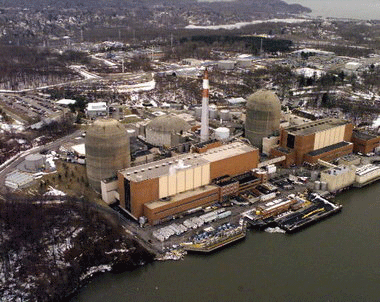 Concern Mounts For Indian Point Nuclear Power Plant http://www.ladailypost.com/content/concern-mounts-indian-point-nuclear-power-plant by Carol A. Clark on May 31, 2016 SECURITY News:
Located 26 miles from New York City, in the right weather conditions a radiation release at Indian Point nuclear power plant could reach Times Square in as little as 90 minutes, making evacuation of New York City impossible and rendering the area uninhabitable for a long time.
Critics of the agiing plant say that the disappearance and disintegration of more than 1 in 4 critical bolts holding the Indian Point nuclear reactor cooling system together is far more serious than owner, Entergy, admits.
Friends of the Earth (FOE) filed an emergency petition with the Nuclear Regulatory Commission (NRC) May 24, calling for immediate action by the agency. The filing demands keeping reactor 2 offline until theNRC certifies that the problem is fully diagnosed and fixed, and that the reactor is safe to operate. It also calls for an immediate shutdown to inspect reactor 3 to ensure that the reactor’s bolts have not also disintegrated. Reactor 3 is the twin of reactor 2, but Entergy has rejected inspecting it until 2017 despite it being the same design and almost as old. Friends of the Earth also released an expert report detailing the breadth and depth of the bolt problem.
Although critical to the core cooling system (essential to preventing a nuclear meltdown), bolts securing the plates that channel cooling water through the reactor core are broken, degraded or missing in reactor 2. FOE says that Entergy is pushing simply to replace the bolts and restart the reactor in June—in time for the profitable peak summer energy season. The company has said that it will conduct a root cause analysis of why the bolts broke or disappeared but are conducting the repairs without completing such a comprehensive review.
“This is a matter of common sense denied: if a machine breaks, you have to figure out what is wrong and then fix it,” said Damon Moglen of Friends of the Earth. “Instead, at Indian Point, Entergy has decided that the priority is to get the damaged reactor up and running by summer to protect their profits. They are making a theoretical fix to a serious but undiagnosed problem. This is a recipe for disaster.”
The technical report, also released by Friends of the Earth, concludes that the more than 25 percent failure rate of the bolts is extraordinarily high and appears to be unprecedented in the history of the global nuclear power industry. Without a full root cause analysis approved by the NRC, the report warns that there can be no assurance that the remaining old bolts will not fail or that simply replacing bolts will fix the problem.
“Only a utility that puts profits ahead of public safety would resume running this nuclear reactor without an “all clear” from the federal regulator,” said Dave Freeman, who was the head of NYPA in the mid-1990s, and operated the nuclear reactors at that time.
FOE says that just as the Space Shuttle Challenger was brought down by a seemingly minor faulty O-ring, Indian Point is in danger from the damaged and missing bolts. Located twenty-six miles from New York City,in the right weather conditions a radiation release at Indian Point could reach Times Square in as little as ninety minutes, making evacuation of New York City impossible and rendering the area uninhabitable for a long time.
The Indian Point reactors’ licenses expired in 2013 and 2015, respectively, and the plant is operating beyond its 40-year life span. The NRC must intervene and take immediate steps to protect the public.
Russia’s backyard a hotbed of nuclear danger – Armenia
 Dangerous Nuclear Security Failures in Russia’s Backyard Armenia is gambling with nuclear safety. National Interest Petra Posega May 30, 2016 Nuclear security is seemingly at the forefront of global attention, but the large framework of international safeguards is increasingly perceived as a toothless tiger. In the contemporary age, where asymmetric threats to security are among the most dangerous, the time is nigh to mitigate the risk of rogue actors having potential access to materials that are necessary to develop nuclear weapons.
Nowhere is this urgency more pivotal than in already turbulent areas, such as the South Caucasus. With many geopolitical instabilities, lasting for decades with no completely bulletproof conflict resolution process in place, adding the threat of potential nuclear weapons means creating a house of cards that can cause a complete collapse of regional peace and stability. That is precisely why Armenia’s recently uncovered recurring actions toward the goal of building its own nuclear capacity must be addressed more seriously. They should also attract a bolder response to ensure safety of the region is sustained.
According to a report by the Vienna-based nuclear watchdog the International Atomic Energy Agency (IAEA), Armenia has established a record of illegal trafficking in nuclear and other radioactive materials. There have been several serious incidents spanning from 1999 onward. A large number of reported incidents has occurred on the country’s border with Georgia, leading the IAEA to conclude there is high probability that a so-called Armenian route does in fact exist. There is a further evidence to support this assertion. An unusually high number of Armenians have been caught in nuclear trafficking activities. Additionally, some of the incidents that made their way into the official reports suggest that the main focus of trafficking activities is the smuggling of materials that could be used for nuclear weapons. There were also reports suggesting the trafficking of other radioactive materials that could be used for alternate purposes, such as building a so-called dirty bomb. Since the stakes are always high with nuclear weapons, this threat must not be underrated and dismissed too easily……..
It is worrying that some of the nuclear material that was trying to find its way into Armenia through South Ossetia has been, at least according to some reports, traced back to Russian nuclear facilities. This is of course no small wonder, since Russia is the official supplier of nuclear fuel for the only nuclear power plant in Armenia—the Metsamor nuclear plant, which supplies roughly 40 percent of the country’s electricity.
But the reactor itself demonstrates another facet of the nuclear threats that Armenia poses, namely, nuclear safety threats. The reactor is extremely outdated, and there are no proper safeguards and safety mechanisms installed to ensure adequate monitoring of its operations and recognition of potential faults in the system.
The world just marked the thirtieth anniversary of the devastating Chernobyl accident, and it is unsettling to know there is high risk of a similar disaster in an adjacent area. …. http://nationalinterest.org/feature/dangerous-nuclear-security-failures-russias-backyard-16392?page=2
Exposing the vulnerability of Scottish nuclear facilities to terrorist attack
 Nuclear-Free Local Authorities say Scottish nuclear facilities are vulnerable to terrorist attack Herald Scotland, Rob Edwards 29 May 16, UK authorities are underestimating the risks of devastating terrorist attacks on nuclear plants and shipments of radioactive material, according to an expert report seen by the Sunday Herald.
A new analysis for the 40-strong group of Nuclear-Free Local Authorities (NFLA) highlights the vulnerability of Scottish nuclear facilities at Faslane, Hunterston, Torness and Dounreay to mass drone strikes, sophisticated cyber attacks and terrorist infiltrators.
UK authorities are underestimating the risks of devastating terrorist attacks on nuclear plants and shipments of radioactive material, according to an expert report seen by the Sunday Herald.
A new analysis for the 40-strong group of Nuclear-Free Local Authorities (NFLA) highlights the vulnerability of Scottish nuclear facilities at Faslane, Hunterston, Torness and Dounreay to mass drone strikes, sophisticated cyber attacks and terrorist infiltrators.
“The main consequences would be, whatever the level of attack, mass public panic and sensationalist media reportage,” he says. “We would inevitably see total road gridlock, as everyone tries to flee by car en masse at once.”
His report argues that a series of unidentified drone flights over French nuclear power stations last summer “should be seen as a major wake-up call for the nuclear industry”. Drones could carry shaped charges, poison gas, booby traps or decoys, and could come individually or in large groups.
Special Report on Nuclear America
Nuclear America: RT special report on state of US nuclear facilities 27 May, 2016 Over the past 18 months, a number of nuclear facilities across the country have experienced problems. From the Hanford Site in Washington state to Indian Point in New York, RT America takes a close look at the disastrous conditions at US nuclear sites.
Nuclear America: Special Report
Taking a look at the past, present and future of nuclear facilities in the US, Friday’s special report seeks to fill in the gap about America’s crumbling radioactive infrastructure that the mainstream media has ignored….https://www.rt.com/usa/344636-nuclear-america-special-report/
America’s risks of catastrophic fire in spent nuclear fuel pools
 Spent fuel fire on U.S. soil could dwarf impact of Fukushima, Science, By Richard Stone May. 24, 2016 A fire from spent fuel stored at a U.S. nuclear power plant could have catastrophic consequences, according to new simulations of such an event.
A major fire “could dwarf the horrific consequences of the Fukushima accident,” says Edwin Lyman, a physicist at the Union of Concerned Scientists, a nonprofit in Washington, D.C. “We’re talking about trillion-dollar consequences,” says Frank von Hippel, a nuclear security expert at Princeton University, who teamed with Princeton’s Michael Schoeppner on the modeling exercise.
The revelations come on the heels of a report last week from the U.S. National Academies of Sciences, Engineering, and Medicine on the aftermath of the 11 March 2011 earthquake and tsunami in northern Japan. The report details how a spent fuel fire at the Fukushima Daiichi Nuclear Power Plant that was crippled by the twin disasters could have released far more radioactivity into the environment.
The nuclear fuel in three of the plant’s six reactors melted down and released radioactive plumes that contaminated land downwind. Japan declared 1100 square kilometers uninhabitable and relocated 88,000 people. (Almost as many left voluntarily.) After the meltdowns, officials feared that spent fuel stored in pools in the reactor halls would catch fire and send radioactive smoke across a much wider swath of eastern Japan, including Tokyo. By a stroke of luck, that did not happen.
But the national academies’s report warns that spent fuel accumulating at U.S. nuclear plants is also vulnerable. After fuel is removed from a reactor core, the radioactive fission products continue to decay, generating heat. All nuclear power plants store the fuel onsite at the bottom of deep pools for at least 4 years while it slowly cools. To keep it safe, the academies report recommends that the U.S. Nuclear Regulatory Commission (NRC) and nuclear plant operators beef up systems for monitoring the pools and topping up water levels in case a facility is damaged. The panel also says plants should be ready to tighten security after a disaster.
At most U.S. nuclear plants, spent fuel is densely packed in pools, heightening the fire risk. NRC has estimated that a major fire at the spent fuel pool at the Peach Bottom nuclear power plant in Pennsylvania would displace an estimated 3.46 million people from 31,000 square kilometers of contaminated land, an area larger than New Jersey. But Von Hippel and Schoeppner think that NRC has grossly underestimated the scale and societal costs of such a fire…….http://www.sciencemag.org/news/2016/05/spent-fuel-fire-us-soil-could-dwarf-impact-fukushima
Canada’s wildfires – surrounding a radioactive trash site

 The nuclear waste site at the heart of Canada’s wildfires http://www.euronews.com/2016/05/18/the-nuclear-waste-site-at-the-heart-of-canadas-wildfires/#.V0M0ugThEm0.twitterJust south of the Canadian city of Fort McMurray, in an area partly ravaged by flames, sits a nuclear waste site.
Situated at the extreme north of the Beacon Hill landfill tip, it contains some 42,500 m3 of radioactive minerals, including uranium and cesium.
But does it pose a threat to society today? According to information gained by euronews reporter Renaud Gardette, the site lies in the middle of the huge wildfires, blazing uncontrollably since May 1.
Why was the landfill created?
To understand the origins of the landfill site, we must first go back to 1982 when Canada launched an extensive exploration and containment of low-level radioactive land programme all over the territory. It was piloted by the Low-Level Radioactive Waste Management Office (LLRWMO).
In Fort McMurray, radioactive minerals were regularly discharged and used along the Northern Transportation Road. Built in the 1930s, the thoroughfare was initially used to transport uranium from the Port Radium mine (Northwest Territories) to Fort McMurray. From there, uranium was also transported by train to Port Hope, Ontario.
The Port Radium mine closed in 1960. Thefts and pillages occurred along the road and that is where the contamination is most visible.
The LLRWMO detected more radioactive sites around Fort McMurray. Work began in 1992 and, up to 2003, 42,500m3 of waste were sent to a specially-engineered landfill with a double layer of clay, several management systems, protection and monitoring, as well as a layer of earth and grass.
The site is monitored annually by the LLRWMO.
Does the site really exist?
The site’s existence is confirmed in several reports, including the Inventory of Radioactive Waste in Canada, published in 2012 by the LLRWMO.
What if?
Several questions have arisen. Was the site burnt in the wildfires? Have radioactive particles been emitted into the atmosphere? What is the risk to the environment?
For the moment, no specific warning has been triggered.
The response from the Canadian authorities
(Translated from French)
Canadian Nuclear Laboratories and our Low-Level Radioactive Waste Management Office are responsible for managing historic low-intensity radioactive waste located in the Beacon Hill dump at Fort McMurray. The site is at the north end of the Beacon Hill landfill site, which itself is south of the city of Fort McMurray and west of Highway 63. The approximate coordinates are: 56 degrees 39 ’10 “ N, 111 degrees 20 ’56 “W.
- CNL manages these sites on behalf of Atomic Energy of Canada Ltd, the federal corporation that is ultimately responsible for the safe management of historic low-intensity radioactive waste.
- The low-intensity waste at Beacon Hill consists of uranium ore residue, mixed with soil and placed in isolation (in a separate cell), which is covered with a thick layer of low-permeability soil, then another, dense layer of clean earth. In total, there are at least 45 centimetres of clean soil over the contaminated soil.
- According to the information available, it appears that the site was affected by the fires. That said, this does not pose any immediate risk to the health and safety of people and the environment. There are also no concerns about the physical integrity of the cell.
- Given the composition of the contaminated soil, that is to say, ore residue mixed with earth, there is no risk that it will catch fire. In a similar way to a field or garden, fire can ignite the grass, but the earth itself does not catch fire.
- We continue to monitor the situation closely.
Middle Eastern nuclear stations and radioactive materials – a cause for anxiety
The Middle East: Culprit for my nuclear security insomnia http://thebulletin.org/what-path-nuclear-security-beyond-2016-summit/middle-east-culprit-my-nuclear-security-insomnia Nilsu Goren, 24 May 16,
What keeps me up at night—US East Coast time—is reading Turkey’s morning news concerning Syria and Iraq. The insomnia is especially severe when my thoughts turn to nuclear security not just in Syria and Iraq but in countries throughout the Middle East.
All participants in this roundtable agree that, despite the achievements of the Nuclear Security Summits, the threat of nuclear terrorism is not necessarily diminishing. In the Middle East, nuclear terrorism seems a particularly immediate concern. True, the region lacks large quantities of highly enriched uranium and plutonium. But its political instability and its tendency toward violent extremism are conditions that can enable nuclear terrorism.
According to the 2016 Nuclear Security Index, published by the Nuclear Threat Initiative (NTI), Middle Eastern nations rank poorly when it comes to safeguarding their nuclear materials from theft. Of the 24 countries that possess at least 1 kilogram of weapons-usable nuclear materials, two are Middle Eastern: Israel and Iran. The Index ranks these countries near the bottom of the theft-protection list. Israel comes in at number 20 and Iran at 23.
Among the 152 countries with less than 1 kilogram of weapons-usable nuclear materials, about a dozen are Middle Eastern. They are all over the lot in their vulnerability to theft—from the United Arab Emirates at number 24 to Syria at 151 (just above Somalia). Clearly, the region’s efforts to prevent nuclear theft are not strong enough.
Where vulnerability to nuclear sabotage is concerned, the Middle East does even worse. Of the 45 countries in NTI’s sabotage index, five are Middle Eastern. Israel—the highest-ranking of the five—comes in at number 36. Iran is tied with North Korea for last place.
And as my roundtable colleague Hubert Foy has discussed, concern about nuclear materials is not limited to fissile materials. Radiological sources are also an issue of pressing concern. The Middle East’s generally lax security environment, along with its political instability, makes the misuse of radiological sources more likely in this region than in many other places.
Civilian radiological sources are ubiquitous, particularly in medicine. They would be relatively easy to access in children’s hospitals, for example. Luckily, most radioactive sources are not easily dispersible. Their half-lives are short. They could contaminate only limited areas. Moreover, anyone attempting to steal an unshielded source might die from acute radiation exposure. Still, using a radiological source in a “dirty bomb” could create panic and terror in local populations. A dirty bomb would turn affected areas into no-go zones for a number of years, which would have profound economic repercussions.
Another reason to be concerned about Middle Eastern nuclear security is the planned expansion of nuclear power in the region. Some nations, pointing toward Iran’s limited right to enrich uranium under the Joint Comprehensive Plan of Action, will also wish to enrich uranium domestically. To be sure, such nations have the right to pursue the peaceful uses of nuclear energy, including uranium enrichment. But in order to alleviate international concerns about their enrichment capacity, these nations must develop robust laws regarding nuclear security. They must establish procedures for secure interim storage of nuclear materials. And they must make final disposition plans for spent fuel and radioactive waste.
The International Atomic Energy Agency can help with all of those tasks. It has the authority, resources, and expertise for the job. But a lot of work will nonetheless fall to state regulatory authorities. A key challenge will be for regulators to establish independence from political authorities. A key component of success, meanwhile, will be identifying nuclear security approaches appropriate to the region—via close cooperation between regulators and the nuclear industry. Here the Nuclear Security Summits can extend their legacy. The Nuclear Industry Summits that ran parallel to the Nuclear Security Summits offer a valuable model for including industry in the dialogue toward establishing good nuclear security practices in the Middle East.
1 This Month
26 September – International Day for the Total Elimination of Nuclear Weapons





PLEASE OPPOSE HR 8255 AND S.3639 – bills would accelerate satellite deployment, with no environmental review or safeguards – https://ncstd5li.quorum.us/campaign/169331/
To see nuclear-related stories in greater depth and intensity – go to https://nuclearinformation.wordpress.com
-
Archives
- September 2026 (305)
- August 2026 (330)
- July 2026 (355)
- June 2026 (287)
- May 2026 (306)
- April 2026 (356)
- March 2026 (251)
- February 2026 (267)
- January 2026 (308)
- December 2025 (358)
- November 2025 (359)
- October 2025 (375)
-
Categories
- 1
- 1 NUCLEAR ISSUES
- business and costs
- climate change
- culture and arts
- ENERGY
- environment
- health
- history
- indigenous issues
- Legal
- marketing of nuclear
- media
- opposition to nuclear
- PERSONAL STORIES
- politics
- politics international
- Religion and ethics
- safety
- secrets,lies and civil liberties
- spinbuster
- technology
- Uranium
- wastes
- weapons and war
- Women
- 2 WORLD
- ACTION
- AFRICA
- Atrocities
- AUSTRALIA
- Christina's notes
- Christina's themes
- culture and arts
- Events
- Fuk 2022
- Fuk 2023
- Fukushima 2017
- Fukushima 2018
- fukushima 2019
- Fukushima 2020
- Fukushima 2021
- general
- global warming
- Humour (God we need it)
- Nuclear
- RARE EARTHS
- Reference
- resources – print
- Resources -audiovicual
- Weekly Newsletter
- World
- World Nuclear
- YouTube
-
RSS
Entries RSS
Comments RSS

