New York Governor Andrew Cuomo blasted security conditions at Indian Point Nuclear plant
 New York’s governor just slammed the state of a nuclear power plant 40 miles from Manhattan, Business Insider MICHELLE MARK 30 MAR 16 New York Governor Andrew Cuomo blasted the troubling conditions at the Indian Point Nuclear plant Tuesday evening, announcing in a statement that hundreds of faulty bolts were found within one of the plant’s reactors.
The plant poses no immediate danger to public health and safety, but the bolts are the latest incident in a series that “raise deep concerns” about the plant’s operations and further the state’s argument that the plant should not be re-licensed, Cuomo said.
The plant is located in Buchanan, New York, approximately 40 miles from New York City.
The two working reactors at the plant opened in the 1970s, and have worried many of the 2,100 residents who live around the facility for years. The licenses for both reactors have expired, but the Nuclear Regulatory Commission determined that the amount of complaints lodged against the plant warrant its continuing operations until all the grievances are addressed, according to the Guardian.
The Indian Point facility has a long history of issues. Just a few:……http://www.businessinsider.com.au/the-ny-governor-just-slammed-the-state-of-a-nuclear-power-plant-2016-3?r=US&IR=T
Spanner in the works of Japan’s planned nuclear power revival

 Japan’s Nuclear Energy Comeback Takes a Tumble IEEE Spectrum, By John Boyd, 29 Mar 16, Just when it seemed Japan was poised to get its nuclear plants up and running again after the 2011 accident at Fukushima Daiichi brought about the shutdown of all the country’s nuclear operations, a series of mishaps has raised doubts over the government’s ability to achieve its goal of supplying 20-22 percent of Japan’s energy needs with nuclear power by 2030.
Last month, TEPCO, the regional electric utility that operated the Fukushima plant, issued a press release admitting that according to the results of a recent investigation, staffers had not followed guidelines requiring them to quickly declare a meltdown following the Daiichi accident.
“In the course of our investigations, it was discovered that TEPCO’s internal manual at the time clearly stated that a core meltdown was to be determined if the percentage of core damage exceeded 5%,” states the release. It goes on to say that, “We have confirmed that there were events where it may have been possible to issue notifications and reports more promptly immediately after the tsunami hit on March 11, 2011.”
Two days before last month’s TEPCO announcement, Kansai Electric Power Co. (KEPCO, which serves the Osaka and Kyoto regions) revealed that it had found a leak on 20 February in the filtering system of the Unit 4 reactor at its Takahama Nuclear Plant in Fukui Prefecture, some 500 kilometers west of Tokyo. A contaminated pool of water was also discovered. The incident happened during preparations to restart the reactor after Japan’s Nuclear Regulatory Authority’s (NRA) had deemed it safe to go back on line.
“Subsequently, the puddle was wiped [up] and it was confirmed that there was no remaining contamination,” the KEPCO announcement explained.
Convinced that all was well, KEPCO started up the reactor on 26 February. It shut down automatically three days later due to a “main transformer/generator internal failure,” the company reported.
But the biggest blow came on 9 March, when the District Court in Otsu, Shiga Prefecture, located near the Takahama plant—though unprecedentedly not in the same prefecture—ordered the immediate shutdown of Units 3 and 4. The decision came after it agreed with a group of local plaintiffs that the plant did not satisfy all the NRA safety requirements. The Unit 3 reactor had gone back online in January………
, says the University of Tokyo’s Terai, “Should there be more legal actions of this kind inside and outside the prefectures where the plants are located, the power companies would face serious problems in starting up their nuclear power plants.”
Given that some 30 lawsuits and petitions for injunctions have been reported in the press, such an outcome seems likely. Currently, the NRA is reviewing 20 nuclear reactors in 16 power stations to see if they meet the new regulatory rules. Meanwhile, the Takahama closures leave just two reactors in operation—both at the Sendai plant run by Kyushu Electric Power Co., also in western Japan.
Clearly, the power companies’ missteps are not helping the NRA’s efforts to rebuild trust with citizens—a critical factor in winning the necessary approval of local governments……http://spectrum.ieee.org/energywise/energy/nuclear/japans-nuclear-energy-comeback-takes-a-tumble
Troubled history of New York’s Indian Point nuclear power station
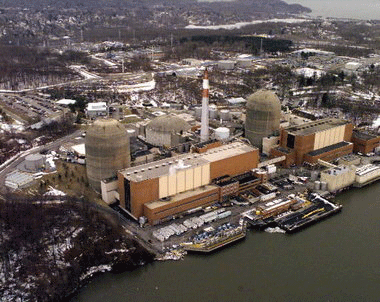 Indian Point nuclear plant reeks of troubled history As New York’s governor and other critics wage an ongoing campaign to shut the facility down citing leaks and old age, nearby residents explain complicated tale, Guardian, Sam Thielman, 29 Mar 16 Outside the Westchester Diner in Peekskill, New York, about 40 miles from New York’s Central Park, a reactor dome crests the trees behind an overpass like a giant’s bald head.
It’s one of two at Indian Point Energy Center, at the bank of the Hudson river in neighboring Buchanan, among the oldest nuclear power plants still in operation, and a monument to the energy industry’s resistance to years of work by concerned scientists, locals and state officials to close down a facility that only last month dumped a plume of radioactive waste into their groundwater.
Indian Point’s two working reactors opened in the early 1970s and have had a lot of people worried for a long time. Five years ago the New York Times wondered if it was “America’s Fukushima” – the Japanese site of the world’s worst radiation crisis since Chernobyl. In February the New York governor, Andrew Cuomo, called its operation “unacceptable” – he wants the plant closed.
It’s easy to see the source of his concern. The population density around Indian Point is of more than 2,100 people per square mile, by far the greatest for any of the US’s 61 nuclear power plants. Many of those people live and work in the plant’s shadow with growing unease.
In May 2015, an electrical transformer in the reactor called Unit 3 exploded, causing water to flood a room near the explosion where electrical distribution panels are housed and pouring 3,000 gallons of oil into the Hudson. The Union of Concerned Scientists classified the incident as a “near miss” in its annual review.Last year near misses occurred at eight nuclear facilities in the US. “Had the flooding not been discovered and stopped in time, the panels could have been submerged, plunging Unit 3 into a dangerous station blackout, in which all alternating current (AC) electricity is lost,” the report’s authors wrote. “A station blackout led to the meltdown of three nuclear reactor cores at Fukushima Dai-ichi in 2011.”
In February, radiation levels at three monitoring wells around the plant spiked, in one spot by 65,000%. Patricia Kakridas, a spokeswoman for Entergy, said the source was likely “water which exited a temporary filtration system that was set up and dismantled in late January 2016” in preparation for refueling; the company said radioactive material won’t leach into drinking water.
And in March, when the plant was being refueled, a breaker tripped and cut power in one of the reactors; when the diesel generators kicked in, they died while trying to restart the first electrical system. Fortunately a second backup worked.
Because the plant is cooled in large part by water from the Hudson – up to 2.5bn gallons a day – it kills about 1 billion fish and other aquatic organisms a year.
Incidents such as these are among the reasons Cuomo wants it closed, and Indian Point is now in a vulnerable position. The operating license for Indian Point 3 expired in December. The license for Indian Point 2 expired in 2013 (Indian Point 1 was decommissioned in 1974). Yet both remain active as the company pursues a license renewal and in the meantime Spectra, a pipeline company, is planning to add a gas pipeline that runs underneath the property to the two that have been there since the plant was built………
The fuel remains onsite at Indian Point, as it does at most nuclear power plants, and must be carefully maintained, for example it must be cooled for at least a decade before it can be sealed in concrete “dry casks”. Sheehan (and others) point out that moving it out of the state along Interstate 95 is impractical given the population density along the busy transport corridor. The plant has produced about 1,500 tons of waste and continues to produce more.
At this point, the license renewal process for Indian Point is scheduled through at least September of 2016 but the legacy of Indian Point, whether it closes or no, has a half-life of far, far longer.http://www.theguardian.com/us-news/2016/mar/28/indian-point-nuclear-plant-new-york-troubled-history
India needs to come on itys nuclear security issues

 Come clean on nuclear security http://www.thehindu.com/opinion/op-ed/come-clean-on-nuclear-security/article8406194.ece THE HINDU, NARAYAN LAKSHMAN 29 Mar 16,
If India is more open about discussing its nuclear weapons programme with a view to ultimately denuclearising the neighbourhood, it would be one of its most courageous contributions
This week, Prime Minister Narendra Modi will touch down in Washington, DC for the fourth and final Nuclear Security Summit, a biennial conference series initiated in 2010 by the Barack Obama administration. Mr. Modi will no doubt seek to showcase India’s nuclear regime as one that adheres to the highest standards of transparency and safety through rigorous regulation of nuclear products and institutions. Although that would be welcome, what Mr. Modi’s interlocutors in the U.S. may be hoping for is that he will break with India’s tradition of maintaining a masterful silence on two questions surrounding its nuclear policy. First, how can India address disquieting signals that have emerged in recent times, which point to growing concerns over the security of its nuclear materials? Second, at a time when India’s macro strategy of rapid economic development is premised on a climate of neighbourly peace and stability in the region, is it not appropriate that Mr. Modi call for an end to the nuclear arms race in Asia, and address environmental risks of India’s covert weapons plants?
Let us consider each of these questions in turn.
India’s nuclear security
First, the need for heightened nuclear security has now become urgent, especially with the emergence of global jihadi threats such as the Islamic State. In this context, three potential nuclear terrorist threats relate to extremists making or acquiring and exploding a nuclear bomb; the danger of radioactive material being fashioned into a “dirty bomb”; and the risk of nuclear reactor sabotage.
The first and second scenarios are vectors of imminent concern in Pakistan, with analysts citing as examples a series of terrorist attacks in 2007 on nuclear weapons facilities in that country, including a nuclear missile storage facility at Sargodha and a nuclear airbase at Kamra.
However, a paper published earlier this month by Harvard University’s Kennedy School of Government cautioned that U.S. officials ranked Indian nuclear security measures as “weaker than those of Pakistan and Russia”, and U.S. experts visiting the sensitive Bhabha Atomic Research Centre (BARC) in 2008 described the security arrangements there as “extraordinarily low key” Further, the Harvard report notes, there are concerns about threats within Indian nuclear facilities stemming in part from “significant insider corruption”, and what appears to be inconsistent strength of regulation. An example that the report cites relates to the 2014 case of Vijay Singh, head constable at the Madras Atomic Power Station at Kalpakkam, who shot and killed three people with his service rifle. According to the report, this event may have been avoided had the Central Industrial Security Force’s personnel reliability programme been able to detect Mr. Singh’s deteriorating mental health, which it failed to do “despite multiple red flags, including his telling colleagues that he was about to explode like a firecracker.” With a scarcity of data points on insider threats and the attendant concerns about sabotage and nuclear accidents, the unsurprising conclusion of the report was: “Given the limited information available about India’s nuclear security measures, it is difficult to judge whether India’s nuclear security is capable of protecting against the threats it faces.”
Weapons development programme
This brings us to the second question, which relates to India’s clandestine weapons development programme.
Set within the broader context of nuclear deterrence vis-à-vis Pakistan and China, it has quietly steamed forward since the 1998 Pokhran-II tests. Recent evidence that this shadowy realm of government activity has been proceeding apace beyond the scrutiny of the media and public surfaced in June 2014when IHS Jane’s, a U.S.-based military intelligence think tank, discovered satellite imagery showing efforts underway to extend a Mysore nuclear centrifuge plant constructed in 1992 at the Rare Metals Plant at that location. According to Jane’s, the purpose behind this extension may have been the covert production of uranium hexafluoride, which could be channelled towards the manufacture of hydrogen bombs or naval reactors to power India’s nuclear submarine fleet.
One month later, another U.S. think tank, the Institute for Science and International Security, revealed additional satellite imagery suggesting that India was building a Special Material Enrichment Facility, including constructing an industrial-scale centrifuge complex in Chitradurga district in Karnataka. Some time during 2009 and 2010, approximately 10,000 acres of land were allegedly diverted at that site for various defence purposes, including 290 acres in Khudapura allocated to the Defence Research and Development Organisation (DRDO) for developing and testing drones.
A few years later, in December 2015, a study by the Centre for Public Integrity (CPI), reported in Foreign Policy magazine, confirmed that India’s under-radar ambition to acquire thermonuclear weapons at the Chitradurga site had advanced much further than many had suspected.
There are likely to be a number of other such walled-off weapons development zones across the breadth of the country, and this begs two critical questions. First, what are the broader implications of India’s covert nuclear programme for the triangular standoff vis-à-vis Pakistan and China? Second, while the Nuclear Liability Law protects its citizenry from the potentially catastrophic fallout of a nuclear accident in the civilian nuclear sector, what guarantees do we have that India’s nuclear black sites do not endanger the health of the people and the environment?
On the first question, India’s search for thermonuclear weapons certainly exacerbates the nuclear arms race with its neighbours, specifically by sparking dangerous games of tit-for-tat weaponisation, loose talk about tactical superiority and theatre nukes, and growing doubts about deterrence stability. The region is already a potential hothouse of nuclear posturing — a fact corroborated by the independent Stockholm International Peace Research Institute’s estimates that India has something in the range 90-110 nuclear weapons, Pakistan has around 120, and China has close to 260.
Environmental impact
On the question of environmental impact, evidence suggests that the Chitradurga and Khudapura sites may be degrading the surrounding grassland ecosystems called kavals, which are habitats for critically endangered local species such as the Great Indian Bustard, the Lesser Florican and the Black Buck, not to mention the livelihoods source for thousands of pastoral communities.
In February 2014, NGOs in Karnataka including the Environment Support Group complained about government land acquisitions for DRDO and BARC in the Challakere in Chitradurga, and obtained a direction from the National Green Tribunal to halt construction activity that had commenced without securing permission from the Karnataka Forest Department and the Union Ministry of Environment and Forests.
Since then, it is unclear whether the government ever paused its weapons development activity to conduct proper environmental assessments, but the CPI study indicates otherwise, citing as evidence an October 2012 letter marked “Secret” from the Ministry to atomic energy officials which suggested approval of the Mysore site’s construction as “a project of strategic importance” that would cost nearly $100 million.
When he meets Mr. Obama at the end of this month, Mr. Modi may come laden with a “house gift” as a sign of India’s sustained commitment to nuclear security. If this could be an indication that India is willing be more open about discussing its nuclear weapons programme with a view to ultimately denuclearising the neighbourhood, it would by far be one of the most courageous contribution that India could make towards a lasting subcontinental security.
Unexpected shutdown of Washington nuclear power station
Nuclear Power Plant in Washington Unexpectedly Shut Down, abc news, By THE ASSOCIATED PRESS RICHLAND, Wash. — Mar 29, 2016 Washington state’s only nuclear power plant has been shut down after operators received an indication that a system used to cool equipment wasn’t working. Officials said there was no release of radiation and no danger to the public.
The Columbia Generating Station near Richland was shut down about 1:30 p.m. on Monday, Energy Northwest spokesman John Dobken said.
Officials hope to restart the plant sometime this week, Dobken told The Associated Press early Tuesday.
The Tri-City Herald reported that the plant was shut down after operators were alerted to problems with the system that uses water to cool heat exchangers and pumps, including those that control the power level of the reactor.
Energy Northwest says it seems that a water system valve may not have been in the right position, but adds that an investigation is ongoing…….http://abcnews.go.com/US/wireStory/nuclear-power-plant-richland-unexpectedly-shut-37995902
$47 billion and counting – the cost of nuclear safety upgrades, post Fukushima
 Nuclear safety upgrades post-Fukushima cost $47 billion, The Barrel, Platt’s, 20 Mar 16 Five years after the accident at Fukushima I in Japan resulted in three reactor meltdowns, the global nuclear industry is spending $47 billion on safety enhancements mandated after the accident revealed weaknesses in plant protection from earthquakes and flooding. This is according to a Platts review put together by Steven Dolley in DC, Benjamin Leveau in London, Yuzo Yamaguchi from Tokyo, as well as Platts correspondents in Sweden, South Korea and China.
Reactions to the March 11, 2011 accident ranged from pauses in new nuclear construction programs in China to Germany’s decision to gradually phase out nuclear generation.
But in the majority of countries with nuclear power, plans for new reactors have been scaled back, not just because of the Fukushima I accident but for economic reasons, as competing sources of power become less expensive, renewable energy grows in popularity and slow economic growth curbs demand.
Global nuclear regulators carried out reviews of the accident, and in most countries nuclear plant operators were required to install backup sources of electric power and cooling water along with additional protection from earthquakes and flooding. A record-setting earthquake triggered a tsunami that swamped backup emergency power generators and disabled on-site power distribution systems at Fukushima I, leading to a complete loss of cooling.
Those safety improvements have come at a high cost.
A Platts review found that in nine of the 13 countries with the largest nuclear fleets, costs to comply with post-Fukushima requirements will total more than $40 billion, mostly before 2020. Those countries accounted for 289, or two-thirds, of the power reactors in operation worldwide.
The median of the costs was $46.9 million/reactor.
If the remaining reactors not covered in the Platts survey spent the median amount to meet post-Fukushima regulatory requirements, the global cost to make post-Fukushima enhancements would be $47.2 billion. The greatest cost per country was in Japan, where operators may spend $640 million per reactor to enhance safety.
The OECD Nuclear Energy Agency released a five-year status report on the Fukushima I accident, concluding that actions implemented by member countries had improved the overall safety of the world’s nuclear fleet, but that enhancing safety remains “a long-term process.”……..
Anti-nuclear groups have said the regulatory and industry response following the Fukushima I accident has been insufficient. Regulators in the US have “capitulated” to industry by failing to order vent filters, the group Beyond Nuclear said in a March 10 statement.
Measures to protect nuclear plants from earthquakes and flooding have left unaddressed vulnerabilities in areas such as plant security, the group said.
The biggest problem facing US nuclear plant operators recently has been economic. Low natural gas prices and an abundance of cheap renewable electricity in some markets have created financial problems for nuclear plants in competitive electricity markets. Entergy in late 2015 said it would permanently shut two stations, the 849 MW FitzPatrick in New York state and 728 MW Pilgrim in Massachusetts.
Japan’s nuclear reactors were all shut following the Fukushima I accident, and only two have met regulatory requirements and restarted.
The country’s nuclear industry has budgeted about Yen 3.1 trillion ($27.5 billion) for earthquake and tsunami protection following the accident………http://blogs.platts.com/2016/03/29/nuclear-safety-upgrades-post-fukushima/
Terrorism threat to Britain’s nuclear facilities is increasing – warns Nuclear Regulator
 Nuclear watchdog warns of terrorist threat to UK reactors As Hinkley Point hangs in balance, strategic plan acknowledges security risks Independent, Mark Leftly Associate business editor @MLeftly 26 March 2016
Britain’s nuclear industry is under threat from cyber-attacks, terrorism and state-sponsored espionage, regulators have warned.
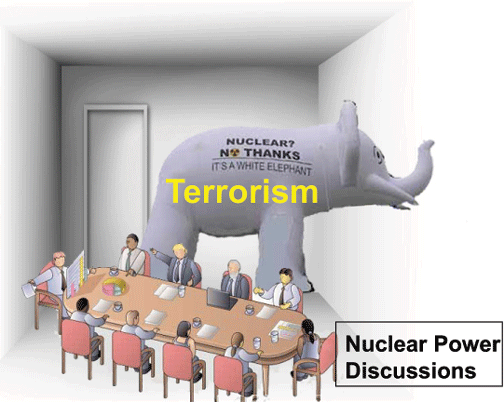
Buried in the Office for Nuclear Regulation’s 2016-20 strategic plan are bleak references to the growing threat of attack on Britain’s 15 operational reactors, which account for nearly a fifth of the country’s electricity. The Independent has established this is the first time that the ONR has explicitly acknowledged the growing terrorist threat to the nuclear industry.
The document states: “The threat of terrorism in the nuclear sector will continue to be managed proportionately and effectively through national and international capabilities. The capabilities of potential adversaries to operate in cyberspace will continue to grow.”
At the top of a list of the industry’s corporate risks, the ONR writes: “Failure to protect the confidentiality, integrity and availability of sensitive information and assets from both known and emerging security threats to the UK nuclear infrastructure (eg, cyber-attacks, terrorist activity, state-sponsored espionage).”
In another reference, it says: “We recognise the world is increasingly globalised and digitised, where both the terrorist threat and the risks from cyberspace are changing. The Government and duty-holders have well-developed security capabilities to deter and defend against organisations and individuals that might conspire to attack or exploit the nuclear estate. ONR will continue to work with the Government to ensure that security-focused regulations evolve to remain fit for purpose and align with safety regulation.”
The news comes at a sensitive time, with French giant EDF weighing up whether to risk its balance sheet on building a £24.5bn reactor at Hinkley Point on the Somerset coast. This is supposed to herald a new generation of nuclear power plants, which are needed to bridge the UK’s yawning energy gap, but EDF has delayed a final investment decision until May. There are also reports that the Isis terrorists who attacked Brussels might have planned to steal radioactive materials from a Belgian nuclear plant to build a bomb.
John Large, the nuclear expert who warned in a 2014 report for the French authorities that reactors are highly vulnerable to drone attacks, said the admission was “a step forward”, but warned: “It might be too late. The problem is that the plants were designed in the 1950s and 1960s and those designs ignored terrorism. That’s one of the problems they [the nuclear industry] face. ……..
Clive Lewis, a shadow Energy minister, pointed out that the ONR’s admission comes shortly after news that the Civil Nuclear Constabulary will be cut by about 200 officers by 2020, despite government promises to protect police funding. ….. http://www.independent.co.uk/news/uk/home-news/exclusive-nuclear-watchdog-warns-of-terrorist-threat-to-uk-reactors-a6953396.html
Shot dead – Belgian nuclear security guard, and his security badge stolen
 Guard at Belgian nuclear plant shot dead; his security badge was stolen. By Kellan Howell – The Washington Times – Saturday, March 26, 2016 Just two days after terrorists attacked the Brussels airport and subway system, a security guard for a Belgian nuclear facility was murdered and his security access badge was stolen, Belgian media reported Saturday.
The security guard’s badge was de-activated as soon as it was discovered it was stolen, according to French newspaper Derniere Heure.
He was shot dead in the Charleroi region of Belgium as he walked his dog, International Business Times reported. http://www.washingtontimes.com/news/2016/mar/26/belgian-nuclear-guard-shot-badge-stolen/
Nuclear Security Summit clouded by Belgium terrorism news
 Belgium Attacks Loom Over Final Nuclear Security Summit Aaron Mehta, Defense News March 27, 2016 WASHINGTON — When President Barack Obama kicks off the fourth and final Nuclear Security Summit (NSS) in Washington on Thursday, he will tell delegations from 51 nations, plus major groups such as the European Union and United Nations, about successes made in ensuring nuclear material does not fall into the hands of terrorists.
It’s a timely message in the wake last Tuesday’s attacks in Belgium, which have been claimed by the Islamic State group, commonly known as ISIS or ISIL. But some in the nonproliferation community are concerned that when the summit shuts down at the end of the week, the issue of securing fissile material will cease to be a prime focus for the nations.
Speaking hours after the attacks, Rose Gottemoeller, undersecretary of state for arms control and international security, laid out the stakes clearly: “Nothing I can say would highlight [the summit’s message], sadly, better than this tragic attack in Brussels this morning. Thank god those terrorists do not have their hands on nuclear materials.”…….http://www.defensenews.com/story/defense/policy-budget/2016/03/27/belgium-terrorism-attakcs-nuclear-security-summit-isis/82231000/
UN security chief warns on nuclear terrorism
A grapefruit-sized amount of plutonium can be fashioned into a nuclear weapon
a far likelier risk was a “dirty bomb”. This is a device using conventional explosives to disperse radioactive material other than uranium or plutonium.
Such material can be found in small quantities in universities, hospitals and other facilities the world over, often with little security.

UN atomic chief warns on ‘nuclear terrorism’ http://news.yahoo.com/un-atomic-chief-warns-nuclear-terrorism-134919666.html By Simon Sturdee 26 Mar, Vienna (AFP) – The world needs to do more to prevent “nuclear terrorism”, the head of the UN atomic watchdog has warned ahead of an important summit and in the wake of the Brussels terror attacks.
“Member states need to have sustained interest in strengthening nuclear security,” he said. “The countries which do not recognise the danger of nuclear terrorism is the biggest problem.”
Amano’s comments came before a summit of around 50 leaders in Washington on March 31-April 1 on ensuring that nuclear material in the world’s roughly 1,000 atomic facilities are secured.
Highlighting the risks, in December Belgian police investigating the November 13 Paris terror attacks found 10 hours of video of the comings and goings of a senior Belgian nuclear official. The material, filmed by a camera in bushes outside the official’s home, was reportedly found at the property of Mohamed Bakkali, incarcerated in Belgium for his links to the Paris attackers.
One Belgian newspaper reported that the device was collected by none other than brothers Ibrahim and Khalid El Bakraoui — two of the suicide bombers in this week’s Brussels attacks.
– Grapefruit-sized –
The Washington summit is part of a process begun by US President Barack Obama in a speech in Prague in 2009 and follows similar gatherings in Seoul in 2012 and The Hague in 2014.
Major progress has been made, with countries reducing stockpiles of nuclear material, experts say. Japan for example is this month returning to the US enough plutonium to make 50 nuclear bombs.
But according to the International Panel on Fissile Materials, enough plutonium and highly enriched uranium still exist to make 20,000 weapons of the magnitude that levelled Hiroshima in 1945.
A grapefruit-sized amount of plutonium can be fashioned into a nuclear weapon, and according to Amano it is “not impossible” that extremists could manage to make a “primitive” device — if they got hold of the material.
“It is now an old technology and nowadays terrorists have the means, the knowledge and the information,” he said.
But he said that a far likelier risk was a “dirty bomb”. This is a device using conventional explosives to disperse radioactive material other than uranium or plutonium.
Such material can be found in small quantities in universities, hospitals and other facilities the world over, often with little security.
“Dirty bombs will be enough to (drive) any big city in the world into panic,” Amano said. “And the psychological, economic and political implications would be enormous.”
This is thought to be well within the capabilities of extremists. The Islamic State group has already used chemical weapons, CIA director John Brennan told CBS News in February.
– Tip of the iceberg –
Since the mid-1990s, almost 2,800 incidents of illicit trafficking, “unauthorised possession” or loss of nuclear materials have been recorded in an IAEA database. One such incident occurred in Iraq last year.
Only a few involved substances that could be used to make a actual nuclear weapon, but some could be used to create a dirty bomb.
“It is very possible this is the tip of the iceberg,” Amano told AFP. A vital step, he said, would be the entry into force of the arcane-sounding but important 2005 Amendment to the Convention on the Physical Protection of Nuclear Material (CPPNM).
It is the only legally-binding international undertaking for the physical protection of nuclear material.
Amano said it will reduce the likelihood of a dirty bomb by making it legally binding for countries to protect nuclear facilities and to secure nuclear material in domestic use, storage and transport.
Pakistan this week became the latest country to ratify the CPPNM, bringing to just eight the number of adherences still required.
“The weakest link (in nuclear security) is that this amendment. .. has not entered into force. This is a top priority,” Amano said, expressing hope that this could happen “in the coming months”.
Wake up World! Belgium terrorist attack shows vulnerability of nuclear facilities
“Every country, no matter how safe it thinks it is, needs to protect nuclear weapons and the materials you could use to make them against the full spectrum of plausible threats,”
“And wherever there are potential nuclear bomb materials, they need to have armed guards.”
A Nuclear Wake-Up Call in Belgium, Huffpost, 25 Mar 16, By R. Jeffrey Smith “…….The risk of radiation bombs raised few concerns before it became clear that al Qaeda was seeking nuclear materials. And over the past 15 years, those worries have taken a back seat to an even larger anxiety: that materials usable in a Hiroshima- or Nagasaki-sized nuclear bomb might fall into the wrong hands.
As a result, the Obama administration has focused its attention until now on locking down or eliminating the big sparkplugs: plutonium and highly enriched uranium.
But the smaller “dirty bombs” and their lighter security have been a real source of worry among specialists, some of whom say that a detonation somewhere in the world is inevitable.

“I’m surprised it has not happened yet,” said Laura Holgate, the National Security Council’s senior director for weapons of mass destruction terrorism, at a Washington symposium three years ago. The mechanics of such a device are simple and widely known.
An internal Energy Department report in 2013 counted 70,000 medical, industrial and research devices with potentially dangerous radiological materials, and observed that they are “poorly secured at facilities in nearly every country.”……..
“Every country, no matter how safe it thinks it is, needs to protect nuclear weapons and the materials you could use to make them against the full spectrum of plausible threats,” said Matt Bunn, a nuclear security expert and former White House official who is now at Harvard University. “And wherever there are potential nuclear bomb materials, they need to have armed guards.”
Government studies have shown that attackers can reach sensitive areas at many nuclear sites quickly, and that “it’s really hard to design systems” against a concerted assault, Bunn said.
That’s why Britain, Canada, France, Germany and the United States have long posted armed guards at sensitive sites. But many other countries still don’t. The Netherlands, which supplies a large portion of the world’s radioisotopes, is one; Italy, Argentina, Brazil, Slovakia and Spain similarly lack regulations requiring armed guards at their nuclear sites, according to the nonprofit advocacy group Nuclear Threat Initiative.
Many other measures can be taken to limit the risks of radiological materials. These include expert training of security personnel, helping less-developed countries find and use non-threatening industrial or medical alternatives, and creating rigorous systems to track material locations.
A major problem, however, is that the U.S. budget for this work has declined steadily in recent years, largely to make room for increased spending on modernizing nuclear weapons. The administration in February proposed a $7.6 million cut for next year and $270 million less than previously planned over the next four years. A U.S. target for securing radiological materials in 4,400 facilities has slipped by more than a decade, according to the Arms Control Association……..http://www.huffingtonpost.com/the-center-for-public-integrity/a-nuclear-wake-up-call-in_b_9532550.html
“Deadly force” – a new rule for nuclear facility safety
 Tenn. House OKs deadly force by security officers at ‘nuclear power reactor’ facilities http://www.knoxnews.com/news/politics/house-oks-deadly-force-by-security-officers-at-nuclear-power-reactor-facilities-2e94b9d4-2e46-5bc3-e-373013301.html By News Sentinel Staff, 25 Mar 16, NASHVILLE — The House gave final legislative approval Monday night to a bill expanding the use of deadly force by security officers at nuclear power reactor facilities.
Tennessee law currently allows the use of deadly force by security personnel at “category I nuclear facilities” — facilities possessing “strategic special nuclear material” defined and licensed by the Nuclear Regulatory Commission, “when reasonably necessary to prevent or impede an act of radiological sabotage,” under specific circumstances.
The bill expands the law to include any “nuclear power reactor facility.”
The House voted 94-0 Monday on the bill, following the Senate’s 32-0 vote on Feb. 29. The bill now goes to the governor.
Belgium: staff refused access following news that terrorists had considered attack on nuclear plant
Nuclear Staff Lose Access After Brussels Attacks http://news.sky.com/story/1666949/nuclear-staff-lose-access-after-brussels-attacks 25 Mar 16
A number of workers at the Tihange plant have their passes withdrawn as reports say nuclear sites could have been targeted. The entry badges of some workers at Belgium’s nuclear sites have been withdrawn amid reports the suicide bombers who attacked Brussels may have originally planned to target a nuclear power plant.
Nuclear control agency spokeswoman Nele Scheerlinck confirmed that “in recent days, several people have been refused access to the nuclear sites”.
The El Bakraoui brothers, who blew themselves up at the airport and metro station on Tuesday, had secretly filmed the home of the head of Belgium’s nuclear research and development programme, it has been reported. :: Terror Suspect Linked To Paris Ringleader The footage recorded the nuclear chief’s routine and caused investigators to conclude the terrorists “could have put national security in danger like never before”, according to Belgian media.
However, the arrest of Paris attacker Salah Abdeslam forced them to switch to targets, said reports.
A police source is quoted as saying: “There is no doubt that they rushed their operations because they felt under pressure. “Even if one couldn’t prevent these (Brussels) attacks, one can say that their magnitude could have been much bigger if the terrorists had been able to implement their original plan and not opted for easier targets.”
In the immediate aftermath of Tuesday’s attacks at the airport and subway, security was boosted around Belgium’s nuclear sites and hundreds of staff were evacuated.
Belgian media reports said 11 staff had their badges withdrawn at the Tihange plant. Ms Scheerlinck said the move is “not necessarily linked with the terrorist attacks”. However, she added that the decision usually takes weeks and is based on information from the intelligence services and police, as well as a person’s criminal record.
The head of the UN’s nuclear watchdog warned of Friday that countries need to do more to prevent “nuclear terrorism”.Yukiya Amano, the head of the International Atomic Energy Agency, said that it was not impossible that militants could manufacture a “primitive” device. It is now an old technology and nowadays terrorists have the means, the knowledge and the information,” he said.
Mr Amano also warned about the dangers of a “dirty bomb”. “Dirty bombs will be enough to (drive) any big city in the world into panic,” he said. “And the psychological, economic and political implications would be enormous.”
Ten disturbing facts about Ukraine’s nuclear power station s
But this can be changed.
The European Commission, the European Parliament, and EU governments – particularly in neighouring countries that could be affected by the Ukrainian government’s reckless nuclear adventure – need to demand Ukraine complies with its international obligations, especially when EU public money is involved.
For more on this Bankwatch campaign see here.

Ten things the Ukrainian government doesn’t want you to know about its nuclear energy plans http://stories.bankwatch.org/10things March 2016, The Ukrainian government appears willing to go to great lengths to make sure that people don’t talk too much about the plans it has for its ageing nuclear stations.
On Wednesday, March 23, the Supreme Economic Court if Ukraine will hear an appeal case by activsts who were sued for defamation for warning about the risk of the country’s continued dependence on outdated nuclear reactors.
The lawsuit was brought by Ukraine’s state-run nuclear operator Energoatom and the governmental nuclear energy regulator (SNRIU) in what appears as an attempt to discourage public participation in the important debate on this issue.
But this move is indicative of the Ukrainian government’s approach. Kiev has also been ignoring the opinions of people in neighbouring countries who could be affected by its nuclear plans, despite a legal obligation to consult them under international treaties.
So, what is it that Ukraine is so keen to hide? Here’s the complete lowdown:
1. Ukraine has 15 nuclear energy reactors and 6 of them will reach their expiry date by May 2020. Four others are already operating beyond their design lifetime, and two more were shut down as soon as they exceeded their original lifespan, in December and in February. Yet, Kiev is determined to keep all eight units going for at least 10 more years beyond their original expiry date.
3. All of Ukraine’s nuclear power plants are completely dependent on Russia for their fuel. And that’s not all. Three of the four nuclear stations are also dependent on Russia for either the reprocessing of spent fuel or its storage.
4. Even though most of these nuclear units will reach their expiry date in the next four years, EU taxpayer money is used for their renovation.How much? EUR 600 million from Euratom and the European Bank for Reconstruction and Development. For proportions, this is a quarter of the total EU support to Ukraine’s energy sector between 2007-2014.
5. International conventions oblige Ukraine to launch public consultations with neighbouring countries that could be affected by the prolonged operations of these nuclear stations. But so far, Kiev has consistently refused to do so. The Aarhus Convention and the Espoo Convention also stipulate that transboundary environmental impact assessments need to be carried out in such cases. Complying with these requirements is also an explicit condition of the European loans. But the Ukrainian government remains defiant.
6. Ukraine has already been found in breach of the Espoo Convention.The ruling came after it had authorized lifetime extensions for two of the units at the Rivne nuclear power plant, located less than 200 kilometres from the border with Poland. Ukrainian authorities are, unsurprisingly, challenging this ruling.
7. The Ukrainian government cannot guarantee the safety of any nuclear power plant. Since January 2015 a governmental decree prevents the nuclear energy regulator from carrying out inspections in nuclear facilities on its own initiative.
8. At least one of the four nuclear reactors already working beyond their design lifetime is in a dangerous condition. An independent expert analysis released in March 2015 found that the pressure vessel of unit 1 at the South Ukraine nuclear power plant suffers critical vulnerabilities that could potentially lead to a dangerous nuclear emergency. The state nuclear regulator disputes these findings, of course. But no matter how much is invested into renovations, a nuclear unit’s pressure vessel is one of the elements that simply cannot be replaced.
9. The Zaporizhia nuclear power plant in southeast Ukraine is Europe’s largest. It is also just 250 kilometres from the frontlines of the ongoing armed conflict in eastern Ukraine. This has officials at the power plant obviously concerned: 10. And all of this is even more urgent than you think.
Two of the oldest units in the Zaporizhia nuclear power plant were taken off the grid once they reached their expiry dates. But in two months, on May 12 and May 28, Ukraine’s nuclear regulator will consider again a lifetime extension for both reactors. Worried? So are we.
But this can be changed.
The European Commission, the European Parliament, and EU governments – particularly in neighouring countries that could be affected by the Ukrainian government’s reckless nuclear adventure – need to demand Ukraine complies with its international obligations, especially when EU public money is involved.
For more on this Bankwatch campaign see here.
Military presence increased at Belgium’s nuclear power stations
Belgium steps up security at nuclear sites in wake of attacks Military presence increased at Tihange and Doel plants as officials continue previous investigation of a secret video shot by man linked to Paris attacks, Guardian, Angelique Chrisafis 25 Mar 16 Belgian authorities have stepped up security at nuclear sites but safety officials said there was no concrete element to suggest a specific threat against the country’s reactors or plants.
Secret video footage of a senior Belgian nuclear official was found in November at the home of a Belgian man, Mohamed Bakkali, suspected to be part of the logistics network for November’s Paris attacks that killed 130 people.
The 10-hour video, shot by a hidden camera in a bush, showed a senior nuclear official coming and going out of his home in the Flanders region. …….
Earlier this month, the government had deployed 140 soldiers to guard nuclear sites………
Increased safety procedures in Belgium include system controls, screening who has access to the site, and strengthening the security in and around the site.
Belgian police are continuing to investigate a mysterious case of sabotage at part of the Doel power station in 2014. No explanation for the sabotage has yet been put forward.
In 2014, Belgian media reported that Ilyas Boughalab, 26, who was tried in absentia for his part in a “jihadi” recruitment network in Antwerp, had worked for three years as a technician for a sub-contractor with access to some areas the Doel nuclear plant. He died in Syria after leaving in 2012. http://www.theguardian.com/world/2016/mar/25/belgium-steps-up-security-at-nuclear-sites-in-wake-of-attacks
1 This Month

of the week – THE ONENESS of HUMANITY
26 June – Radiation Trainwreck at the NRC / Join the Protect Better Campaign – https://us02web.zoom.us/meeting/register/4ZlZ5_qLSHGiLSCg8FF6Bg#/registration

1st July – Webinar Waste of Space: The Environmental Harm of Military and Civil Space Activity st July, 7 pm

Report Launch Online: We are seeing an increasing exploitation of space for military and commercial purposes. This must change.

Protect Sazan Island from the Trump family! https://secure.avaaz.org/campaign/en/protect_sazan_island_from_the_trump_family_loc/?bqFCVab&v=174511&cl=22707147157&_checksum=5e9dde668860e8231c33699735e16a1fbf22ab2cb01da50c999fe8732b9775ef&utm_source=email&utm_medium=blast_email&utm_campaign=174511


Cuba Is Not a Failed State – It Is a Besieged State
PETITION: “Global Appeal to Endorse Palestinian Right of Return of Refugees”
To see nuclear-related stories in greater depth and intensity – go to https://nuclearinformation.wordpress.com
-
Archives
- June 2026 (251)
- May 2026 (306)
- April 2026 (356)
- March 2026 (251)
- February 2026 (268)
- January 2026 (308)
- December 2025 (358)
- November 2025 (359)
- October 2025 (376)
- September 2025 (257)
- August 2025 (319)
- July 2025 (230)
-
Categories
- 1
- 1 NUCLEAR ISSUES
- business and costs
- climate change
- culture and arts
- ENERGY
- environment
- health
- history
- indigenous issues
- Legal
- marketing of nuclear
- media
- opposition to nuclear
- PERSONAL STORIES
- politics
- politics international
- Religion and ethics
- safety
- secrets,lies and civil liberties
- spinbuster
- technology
- Uranium
- wastes
- weapons and war
- Women
- 2 WORLD
- ACTION
- AFRICA
- Atrocities
- AUSTRALIA
- Christina's notes
- Christina's themes
- culture and arts
- Events
- Fuk 2022
- Fuk 2023
- Fukushima 2017
- Fukushima 2018
- fukushima 2019
- Fukushima 2020
- Fukushima 2021
- general
- global warming
- Humour (God we need it)
- Nuclear
- RARE EARTHS
- Reference
- resources – print
- Resources -audiovicual
- Weekly Newsletter
- World
- World Nuclear
- YouTube
-
RSS
Entries RSS
Comments RSS
 nuclear-news