Covering shattered Chernobyl nuclear reactor – a financial problem for Ukraine
 Nuclear comeback: Funding fears for hi-tech lid on Chernobyl, The Australian, NATHAN HODGE, THE WALL STREET JOURNAL APRIL 26, 2016″………
A workforce of about 2500 people is finishing a massive steel enclosure that will cover Chernobyl’s reactor 4, where the radioactive innards of the nuclear plant are encased in a concrete sarcophagus hastily built after the disaster. The zone is now aglow with the reflective safety vests of construction workers.
If all goes to plan, the new structure — an arch 260m wide, 165m long and 110m high — will be slid into place late next year over the damaged reactor and its nuclear fuel, creating a leak-tight barrier designed to contain radioactive substances for at least the next 100 years.
The project, known as the New Safe Confinement, is a feat of engineering. It will take two or three days to slide the 36,000- tonne structure into place. The arch, which looks something like a dirigible hangar, is large enough to cover a dozen football fields.
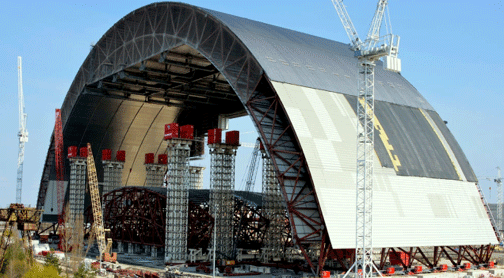
“You could put Wembley Stadium underneath here, with all the car parks,” said David Driscoll, the chief safety officer for the French consortium running the construction site.
- …….
Nicolas Caille, project director for Novarka, the consortium of Vinci and Bouygues, the French contractors running the project, said about 1000 people worked on a typical shift at the construction site, keeping to a schedule of 15 days in and 15 out.
The €2.15 billion ($3.1bn) shelter installation plan has been funded by international donors and the European Bank for Reconstruction and Development, a non-profit lending institution. But the Chernobyl clean-up faces a shortfall: €100 million is needed to finish a storage facility for highly radioactive spent nuclear fuel from the other three reactors, all now offline
The EBRD’s spent fuel facility contract is with a US-based energy technology firm. When the dollar-denominated contract was signed, the euro was stronger against the greenback; with the two currencies approaching parity, the bank faces a shortfall.
“This has dug a huge euro hole,” said Vince Novak, director of the nuclear safety department for the EBRD. “Our income is in euros.”
Mr Novak said donors would meet by the end of this month to discuss financing to finish the project, which is financed separately from the Chernobyl shelter fund.
Spent fuel rods are stored in an ageing facility.
Completion of the project, Mr Novak said, “has always been somehow in the shadow of the New Safe Confinement because it is not as attractive, not as sexy. But it is equally important in terms of nuclear safety.
Even if donors plug the gap, Chernobyl will continue to pose a financial challenge for Ukraine.
More than 40 countries and the EBRD have contributed to the Chernobyl containment work, and international donors say it will be years before the Kiev government can take on the larger share of the burden. http://www.theaustralian.com.au/business/wall-street-journal/nuclear-comeback-funding-fears-for-hitech-lid-on-chernobyl/news-story/1df7b13de774a981f1063ac3c62e9a36
Computer viruses have infected German nuclear power station
 German nuclear plant infected with computer viruses, operator says http://www.dailymail.co.uk/wires/reuters/article-3560358/German-nuclear-plant-infected-computer-viruses-operator-says.html , 27 April 2016 FRANKFURT, – A nuclear power plant in Germany has been found to be infected with computer viruses, but they appear not to have posed a threat to the facility’s operations because it is isolated from the Internet, the station’s operator said on Tuesday.
The Gundremmingen plant, located about 120 km (75 miles) northwest of Munich, is run by the German utility RWE.
The viruses, which include “W32.Ramnit” and “Conficker”, were discovered at Gundremmingen’s B unit in a computer system retrofitted in 2008 with data visualisation software associated with equipment for moving nuclear fuel rods, RWE said.
Malware was also found on 18 removable data drives, mainly USB sticks, in office computers maintained separately from the plant’s operating systems. RWE said it had increased cyber-security measures as a result.
W32.Ramnit is designed to steal files from infected computers and targets Microsoft Windows software, according to the security firm Symantec.
First discovered in 2010, it is distributed through data sticks, among other methods, and is intended to give an attacker remote control over a system when it is connected to the Internet.
Conficker has infected millions of Windows computers worldwide since it first came to light in 2008. It is able to spread through networks and by copying itself onto removable data drives, Symantec said.
RWE has informed Germany’s Federal Office for Information Security (BSI), which is working with IT specialists at the group to look into the incident.
The BSI was not immediately available for comment.
After Japan’s Fukushima nuclear disaster five years ago, concern in Germany over the safety of nuclear power triggered a decision by the government to speed up the shutdown of nuclear plants. Tuesday was the 30th anniversary of the Chernobyl nuclear disaster. (Reporting by Christoph Steitz, Eric Auchard and Joseph Nasr; Editing by Kevin Liffey)
European Union and other global donors pledge more money for Chernobyl nuclear safety effort
Global donors pledge more money for nuclear safety on Chernobyl anniversary, DW 26 Apr 16 Ukraine has commemorated the 30th anniversary of the Chernobyl nuclear disaster. Global donors have used the occasion to pledge additional funds to help keep the area safe for generations to come………A UN report in 2005 estimated that “up to 4,000” people could eventually perish from the invisible poison in Ukraine and neighboring Russia and Belarus.
The exact number of dead remains a subject of intense debate because the Soviet authorities kept most of the information about the disaster hidden.
Global donors
The EU was among the global donors that promised an additional 87.5 million euros ($99 million) to help secure the Chernobyl nuclear power plant, as the Ukrainian government began marking 30 years since the disaster.
The money will go toward the construction of a new spent nuclear waste storage facility, adding to the 2 billion euros already donated to helping clean up and secure the site. Ukraine still needs 15 million additional euros to be able to safely store hazardous materials underground.
“It’s an important project for the world as well as, of course, for Ukraine and Ukrainians,” said Suma Chakrabarti, chief of the European Bank for Reconstruction and Development (EBRD), the organization in charge of the project…….http://www.dw.com/en/global-donors-pledge-more-money-for-nuclear-safety-on-chernobyl-anniversary/a-19214334
Ukraine’s nuclear industry remains a time bomb
But the nuclear danger in Ukraine does not go away with the conflict in the east quieting down this year, the scale and intensity of the war reduced to a shadow of what it was during 2014 and the beginning of 2015. The country, already facing economic depression, a war and a PTSD epidemic, has to deal with the lifetime of its nuclear reactors going to an end.
Ukraine has 15 nuclear reactors divided between four nuclear power plants. Built during Soviet times, 12 of them have a designed lifetime that ends before 2020. As the government in Kiev together with the operating company Energoatom are determined to keep all reactors running for at least 10 years beyond their expiry date, four units have already received licenses for their expanded lifetime.

“The situation is that the reactors are in a bad shape and always have been,” says Patricia Lorenz, nuclear safety expert with Friends of the Earth, an organization that campaigns for solutions to environmental problems. “They lag 15 years in safety level and they are definitely not catching up. The general problem is aging, maintenance — that is always a big topic, especially with power plants here where they admit they don’t have enough money for keeping them.”
But Ukraine got a loan for bringing its reactors up to international standards. The European Bank for Reconstruction and Development is providing 300 million euro in a project that will cost 1.4 billion euro in total and is scheduled for completion by the end of 2017. The European Atomic Energy Community, or Euratom, iscontributing another 300 million euro.
According to Bankwatch, an NGO that monitors the activities of international financial institutions in order prevent them from financing environmentally and socially harmful investments, the lifetime of the four reactors was prolonged without completing necessary safety upgrades and without properly assessing all risks. This means disregarding the legal conditions attached to the EBRD loan.
The same NGO is concerned that this European financial support is nothing else but “cementing Ukraine’s dependence on an outdated and highly unsafe nuclear sector” — and with that, its dependence on Russia, as all of Ukraine’s nuclear reactors use Russian technology and are almost entirely dependent on nuclear fuel from Russia. Furthermore, Ukraine has yet to make long-term investments in infrastructure and safe disposal of radioactive waste, which is also sent back to Russia.
No peaceful atom
With the Chernobyl disaster still casting its long shadow, Ukraine’s decision to base its long-term energy policies on the lifetime extension of its Soviet-era nuclear reactors is at least worrisome. Between 2010 and 2015 alone, three different unitswere forced to shut down due to accidents, while severe safety issues wereidentified in two more units. The reality is that Ukraine’s nuclear power plants currently supply over half the country’s electricity. But some say that this comes more from a political choice of the government, rather than necessity or lack of options.
The problem with a nuclear disaster is that it doesn’t give a damn for borders. So this is not only Ukraine’s problem, it is a European one and the danger lurks on at least all of its neighboring countries. And there are questions that still need answering: Is the lifetime extension process performed so that it can ensure the safety of not only Ukrainians but all Europeans as well? Are all the measures being taken to avoid another Chernobyl? Because in the end, says Oleksandr Galuh, “there is no such thing as the peaceful atom.” http://www.huffingtonpost.com/ioana-moldovan-/chernobyl-nuclear-menace_b_9774040.html
Over 1,500 defects at aging Israeli nuclear plant
 Report finds more than 1,500 defects at aging Israeli nuclear plant April 26, 2016 by JNS.org.A recent examination of Israel’s nuclear reactor site in Dimona has revealed signs of 1,537 defects to the site’s aging aluminum core, according to a study released at a scientific forum held in Tel Aviv, Haaretz reported.
According to the report, the reactor core, which houses the fuel rods where nuclear fission takes place, has absorbed a great deal of heat and radiation over the years, raising questions over its ability to operation.
Israel’s nuclear reactor was supplied by France in the late 1950s and became active in 1963. According to manufacturer standards, the reactors were intended to be operational for only 40 years. …..http://www.jns.org/news-briefs/2016/4/26/report-finds-more-than-1500-defects-at-aging-israeli-nuclear-plant#.VyAwOdR97Gg=
Danger of Chernobyl nuclear reactor wreck will remain for thousands of years
Ruined Chernobyl nuclear plant will remain a threat for 3,000 years @mattschodcnews BY MATTHEW SCHOFIELD mschofield@mcclatchydc.com , Miami Herald, 24 Apr 16,
- 30 years since Chernobyl may seem like a long time, but it’s really just the start
- Below reactor’s ruins is a 2,000-ton radioactive mass that can’t be removed
- How do you protect a site for as long a time as Western civilization has existed?
….It will be 30 years ago on 26 April that Pripyat and the nearby Chernobyl nuclear plant became synonymous with nuclear disaster, that the word Chernobyl came to mean more than just a little village in rural Ukraine, and this place became more than just another spot in the shadowy Soviet Union.
Even 30 years later – 25 years after the country that built it ceased to exist – the full damage of that day is still argued.
Death toll estimates run from hundreds to millions. The area near the reactor is both a teeming wildlife refuge and an irradiated ghost-scape. Much of eastern and central Europe continues to deal with fallout aftermath. The infamous Reactor Number 4 remains a problem that is neither solved nor solvable………..
All told, about 4,000 people would eventually die from the accident, according to a report by the World Health Organization and the International Atomic Energy Agency.
Others say those numbers are wildly low. Alexey Yablokov, a former environment adviser to Russian President Boris Yeltsin, estimated the global death toll to be 1.44 million. Other reports placed the cancer death totals at 30,000 to 60,000. Belarusian physicist Georgiy Lepin, a vice president of the association of liquidators of Chernobyl, the men brought in to fight the fire and clean up, estimated that within a few years, 13,000 rescue workers had died and another 70,000 were left unfit for work. The official number of disabled Chernobyl rescue workers today in Ukraine is 106,000.
A United Nations study says that “5 million people currently live in areas of Belarus, Russia and Ukraine that are contaminated with radionuclides due to the accident; about 100,000 of them live in areas classified in the past by government authorities as areas of ‘strict control.’ ”……….
What they figured out was the worst nuclear-energy disaster in human history, far worse than the explosion at Kyshtym nuclear complex in 1957 in what was then the Soviet Union, which released 70 tons of radioactive material into the air, or the 1957 fire at the Windscale Nuclear Reactor in northwestern England, which forced a ban on milk sales for a month, or the Three Mile Island disaster in Pennsylvania on March 29, 1979, where a cooling malfunction led to a partial meltdown.
All of central and eastern Europe was at risk. Even today, in Bavaria in southern Germany, wildlife officials warn hunters not to eat the meat of wild boars, which continue to show high levels of radiation contamination……..http://www.miamiherald.com/news/nation-world/world/article73405857.html
The intractable thousands of years problem of Chernobyl’s radioactive debris
Ruined Chernobyl nuclear plant will remain a threat for 3,000 years @mattschodcnews BY MATTHEW SCHOFIELD mschofield@mcclatchydc.com , Miami Herald, 24 Apr 16, “…………When the steam burst through the roof of Reactor Number 4 in 1986, it took with it 5 percent of the enriched uranium. That means 10 tons vanished. It also means 95 percent, or 190 tons, remained. They’re still there.
After the blasted reactor partially collapsed into the nuclear material, it created a radioactive blob of uranium, concrete, steel and assorted junk weighing about 2,000 tons. Ideally, Ukraine would remove the material. Sergiy Parashyn grabs a pen and paper as he talks about the problems with that.
“We do not know how to do this,” he explains. “We do not have the technology to do this. It must be something new.”……
“One problem is that the material is decaying and is brittle, and when we cut it up to transport it to disposal bins, it will very likely fill the air with radioactive dust,” he explains. So the tractor has to be able to operate in a radioactive environment, it has to be able to control and eliminate any dust and it has to operate in an area that will not be at all safe for humans. “Maybe something like this would work, maybe it wouldn’t. We don’t know. That’s a problem.”
It’s a problem because while 5 percent of the radioactive material caused problems that continue 30 years later and will continue to cause problems for eons to come, the other 95 percent of the material could represent about 20 times the problems.
For instance, if mistakes are made and the brittle material is released into the atmosphere, they’re back to square one. If the material gets into the Pripyat River, it will flow into the Dnieper River. The Dnieper River is the water source for Kiev. The Dnieper is the primary water source for much of Ukraine.
This is why Ukrainian officials are counting on what they call a sarcophagus to contain the site, a massive structure that looks like a Quonset hut being assembled behind a wall that is intended to deflect radiation from the decaying plant from workers.
When finished, it will be rolled across the crumbling concrete of the surrounding ground to cover and further seal the dangerous reactor. The work is expected to be completed in 2018, though that is just a guess. It’s expected to last 100 years. It’s not nearly long enough.
Reactor Number 4 today is essentially an unplanned nuclear-waste dump. To serve in that role requires it to last for 3,000 years. That means the area surrounding Chernobyl will be safe to inhabit by people again in the year 4986.
How likely is that? To get an idea of what it means to contain and control a deadly and potentially devastating radioactive pile in Ukraine for 3,000 years, consider what the world looked like 3,000 years ago:……
Detlef Appel, a geologist who runs PanGeo, a Hamburg, Germany, company that consults on such nuclear storage issues, notes that 3,000 years probably isn’t long enough. He suggests that truly safe radioactive waste storage needs to extend a million years into the future. Think back to when man’s earliest relative began to walk the Earth.
“We can trust human endeavor, perhaps, for a few hundred years, though that is doubtful,” he said. “Storage implies a way to retrieve the materials. It requires trained personnel, maintenance, updating and security. Clearly, nothing man made is more than temporary, and therefore it isn’t adequate.”
Even the continents will have moved in a million years.
Tetiana Verbytska, an energy policy expert at the National Ecological Center of Ukraine, worries that people are far too easygoing about Chernobyl. Among government officials right now, mindful of the 30-year anniversary, there is a movement to shrink the radius of the highly contaminated no man’s land from 18 miles to 6.
“The move to reduce the highly contaminated zone has nothing to do with science and everything to do with public relations,” she says. “In Ukraine, each April we make wonderful speeches about our commitment to dealing with this problem, and the rest of each year we hope the problem will just go away.”
There are other reasons to worry. Ukraine is creaking under a civil war against insurgents backed by Russia and scraping by with an economy that in the decades since the collapse of the Soviet Union has been looted by a series of oligarchs. It doesn’t have the money to fund an educational system that can be expected to create legions of top scientists and engineers.
Officials speak very proudly of the new sarcophagus roof that is being put into place. But the finish date on that has been repeatedly backed up, and there’s no guarantee that its 2018 date won’t be moved again.
A variety of disasters could still strike. The site’s existing covering, built in haste after the accident, could collapse, shattering the brittle mix of radioactive materials below and sending nuclear dust into the atmosphere to mix with rain. There could be an earthquake. The entire site is fragile.
Olga Kosharna, the lead scientist at the Ukrainian Department of Energy and Nuclear Safety in Kiev who oversaw safety at Chernobyl in the 1990s, recalls walking the roof above the shattered reactor and being horrified to find holes that had been burned through the concrete.
The shoes she wore that day were highly contaminated and had to be destroyed.
Alexandre Polack, a spokesman for the European Union, notes in an email that the date to begin removing radioactive material from the site is still 20 to 30 years away. “The current shelter covering destroyed Reactor 4 was reinforced in recent years and seems stable,” he writes. “However it was built in haste after the accident and never intended as a long-term solution.”
Verbytska emphasizes that the mass of uranium debris inside Reactor Number 4 is now a mess that goes beyond human ability to clean up. Others dismiss the situation as a problem, but one that technology can fix.
“We don’t have the technology to fix the problem,” she says. “We don’t have the process to develop the technology to fix the problem, and we don’t have the money to support the process to develop the technology to fix the problem. The solutions for our Chernobyl problems are very much ‘seal it for now.’ We will have smart children and smart grandchildren who in 100 years or so will figure out what to do.”
After the disaster, radiation burned off the tops of the trees. Soviet officials ordered the trees cut down and buried deep. But they failed to properly encase the buried wood. As a new forest grew unchecked above the radioactive remains of the old forest, the new wood was also highly radioactive. The whole thing will have to be dug up and encased and buried again, properly. http://www.miamiherald.com/news/nation-world/world/article73405857.html
EDF wants to extend depreciation period for nuclear plants this year, but nuclear watchdog may not be willing
 EDF to extend depreciation period for nuclear plants this year – CEO https://au.news.yahoo.com/world/a/31423313/edf-to-extend-depreciation-period-for-nuclear-plants-this-year-ceo/ Reuters on April 23, 2016 PARIS – French utility EDF will extend the depreciation period for its nuclear plants this year, its CEO said in a newspaper interview, an accounting move that will free up cash for costly investment projects in France and Britain.
“By the closing of our first-half results, we will draw the accounting consequences of our intention to extend the lifespan of our existing nuclear plants beyond 40 years,” EDF CEO Jean-Bernard Levy said in Saturday’s Le Figaro newspaper.
EDF had said before it intended to extend the lifespan of its French nuclear plants to 50 or 60 years, beyond the 40 years they were initially built for. Energy Minister Segolene Royal said in February that the government was willing to give the go-ahead for such a move.
But French nuclear watchdog ASN is the only authority allowed to grant such an extension, and it has said a decision on the matter would not come before 2018-2019. To make the accounting change, which would automatically boost EDF’s profits, the company must convince its auditors that there is a good chance of the extension being granted.
In 2003, EDF extended the depreciation schedule for nuclear reactors in its accounts to 40 years from 30 years – six years before the ASN agreed to the move.
The utility, 85 percent-owned by the French government, said on Friday it would seek to raise 4 billion euros ($4.5 billion), amid concerns that a 23 billion euro nuclear plant project at Hinkley Point in Britain would put a strain on its finances.
(Reporting by Michel Rose; Editing by Toby Chopra and Hugh Lawson)
‘New Nuclear” lobby working to weaken powers of USA’s Nuclear Regulatory Commission (NRC)
Edwin Lyman, senior scientist for the Union of Concerned Scientists’ Global Security Program, said the timing of the legislation is “premature.” Lyman told Congress to consider that the legislation might pose an unfair burden on taxpayers and put Americans at increased risk.
The legislation would also eliminate language that requires NRC’s Atomic Safety and Licensing Board Panel to hold a hearing on new applications.
“That’s inherently dangerous technology that needs tough questions to be asked about it,” said Sen. Ed Markey (D-Mass.). “I don’t think the public is going to be happy if they’re told ‘no hearings’ on this dangerous technology.”

Advanced reactor bill raises ‘red flags‘ Hannah Hess, E&E reporter E&E Daily: Friday, April 22, 2016
The Nuclear Regulatory Commission’s head of operations yesterday tried to sell lawmakers on a strategy to license the latest nuclear technology.
But Victor McCree had to contend with lawmakers who have their own plan to lay the groundwork for advanced reactors, and it goes beyond the administration’s comfort zone……
Eight days ago, EPW Chairman Jim Inhofe (R-Okla.) teamed up with Whitehouse and Sens. Mike Crapo (R-Idaho) and Cory Booker (D-N.J.) to introduce legislation to reform the licensing process and restructure how NRC is funded.
But a hearing of the Clean Air and Nuclear Safety Subcommittee revealed concerns about safety and security, including NRC’s own fears that the legislation could handcuff regulators (E&E Daily, April 14).
The bill would change NRC to develop “technology-inclusive regulatory framework” — defined as using methods of evaluation that are flexible and predictable, such as risk-informed and performance-based techniques.
Critics warn that lawmakers didn’t properly explain those terms, which could lead to less rigorous standards for the approval of novel nuclear power technologies.
The legislation would also eliminate language that requires NRC’s Atomic Safety and Licensing Board Panel to hold a hearing on new applications.
“That’s inherently dangerous technology that needs tough questions to be asked about it,” said Sen. Ed Markey (D-Mass.). “I don’t think the public is going to be happy if they’re told ‘no hearings’ on this dangerous technology.”
NRC concerns
McCree, who assumed NRC’s top career post last fall, cautioned that the bipartisan legislation would require “significant time and resources” over several years in areas where the agency’s internal planning process was well underway.
Current performance metrics allow fluidity at NRC to “account for emerging safety or security issues, changes in licensee plans and the like,” McCree said. “As written, the proposed requirements would limit the NRC’s flexibility in this area.”
At the Obama administration’s request, NRC earmarked $5 million for work on advancing small modular reactor (SMR) licensing practices in its fiscal 2017 budget proposal. Both House and Senate proposed spending bills include language to address this issue.
McCree said NRC staff expect to complete the first draft of their own strategy for licensing non-light-water reactor technologies soon and will discuss it in a public meeting in June.
NRC is also in the process of a downsizing measure, popular on Capitol Hill, that aims to streamline the agency.
Testifying on behalf of the U.S. Nuclear Infrastructure Council, where he now is chairman of a task force on advanced reactors, Merrifield encouraged the committee to press for further staffing cuts below NRC’s Project Aim 2020. ….NRC’s budget for fiscal 2017 would cut an equivalent of 90 full-time employees, surpassing the Project Aim goal, for a total reduction of roughly 280 full-time workers since fiscal 2014 …….
One thing senators and the nuclear industry agree on is that the commission’s current licensing process, with a design and certification that can cost billions of dollars and stretch for up to a decade, is one of the biggest obstacles for SMRs and advanced reactor designs that use coolants other than water.
“You have a situation in which it is very hard to get early investment in these new technologies,” Crapo said.
Ashley Finan, policy director of the Nuclear Innovation Alliance, one of four industry witnesses who testified in support of the Senate legislation, presented charts showing the big money and time hurdles the private sector sees with the current NRC process.
“The investors and innovators have made it very clear that their most immediate and pressing concern is regulatory uncertainty,” Finan said……
Because advanced nuclear reactor companies rely primarily on investors, the bill seeks to change the model……
The Nuclear Infrastructure Council wants language added that would provide early stage engagement with no or limited cost to the developer, with an “appropriate cost share,” perhaps 50-50, for later stages of the licensing process.
“Fewer resources are not good for the agency in protecting against a terrorist attack,” said an animated Markey, demanding any of the witnesses to refute his claim.
Bill ‘premature’
Edwin Lyman, senior scientist for the Union of Concerned Scientists’ Global Security Program, said the timing of the legislation is “premature.”
Lyman told Congress to consider that the legislation might pose an unfair burden on taxpayers and put Americans at increased risk.
The history of the failed Next Generation Nuclear Plant project, a prototype of a modular high-temperature gas-cooled reactor, is an illustrative example, he said.
Mandated by the Energy Policy Act of 2005, the project was suspended after the Energy Department decided in 2011 not to proceed into the detailed design and license application phases. DOE’s decision cited the reluctance of vendors, owners and operators, and customers to commit to substantial upfront cost sharing.
“The main problem is the cost and difficulty of obtaining the necessary analyses and experimental data to satisfy regulatory requirements and ensure that new reactors can operate safely,” Lyman said. “This is a fundamental issue we think Congress needs to address through oversight of the budget for nuclear energy [research and development].”….. http://www.eenews.net/stories/1060036081
USA Nuclear regulator allows big drop in Vermont Yankee insurance ( tax-payer will cover any disaster)
FEDS ALLOW BIG DROP IN VERMONT YANKEE INSURANCE, VT Digger, APR. 21, 2016, BY MIKE FAHER VERNON — It’s not cheap to maintain an insurance policy on a nuclear power plant.
But as of this month, Entergy Vermont Yankee is getting a big break on its premiums: The Nuclear Regulatory Commission says the company can cut its on-site property damage insurance coverage from $1.06 billion to $50 million……..
Since stopping power production at Vermont Yankee in December 2014, Entergy has sought a number of regulatory changes for the Vernon plant.
One example is an NRC-approvedreduction in the Vermont Yankee emergency planning zone, which took effect Tuesday. In making a successful case for cutting emergency planning and funding, Entergy argued that the potential for accidents and radiation releases is much lower now that the plant is no longer operational.
The company’s request to reduce its insurance coverage uses the same logic……
The main risks remaining in Vernon, officials say, are associated with radioactive spent nuclear fuel. Currently, that fuel is stored both in a cooling pool in the plant’s reactor building and in sealed dry casks on a pad nearby; Entergy has pledged that all fuel will be in casks by the end of 2020……..There is a possibility — though the NRC labels it “highly unlikely” — that, if water were drained from the cooling pool, zirconium cladding on the spent fuel could catch fire…..
The NRC notes that it has granted similar insurance exemptions to other decommissioning plants including Maine Yankee and the Zion Nuclear Power Station in Illinois…..
the NRC’s exemption announcement has immediate financial benefits for Vermont Yankee: When factoring in reductions in both on-site and off-site insurance policies, the company’s annual premiums will decrease from about $1.9 million to less than $500,000, Cohn said……https://vtdigger.org/2016/04/21/feds-allow-big-drop-in-vermont-yankee-insurance/
Radioactive rain within Indian Point 2 reactor cavity falls on workers

 23 Years of Radioactive Rainfall at New York Nuclear Plant, Huffington Post, Roger Witherspoon, 18 Apr 16,
And after decades of ignoring the problem and having workers wear raincoats and rain hats to prevent radioactive contamination from the indoor precipitation, Entergy pledged in 2010 to try different methods in each of the next three refueling outages to see if they could stop the flow of water through the massive concrete and steel tub surrounding the reactor. That six-year plan was deemed acceptable by the NRC.
But Entergy’s efforts during the first two refueling outages failed. The plant is currently in the midst of the third refueling outage and NRC spokesman Neil Sheehan said in an email exchange that the company has been unable to find or halt the leaks.
“Entergy is still working on a solution to the problem of leakage from the Unit 2 refueling cavity,” Sheehan wrote. “Thus far, the leakage has not yet been halted. But it’s important to note that leakage is captured in the containment building sump and then processed in the plant’s radioactive water cleanup system.
“We had a metallurgical specialist at the site this week to observe Unit 2 refueling activities. As part of his inspection, he reviewed the work on the refueling cavity. The results of that review will be documented in an upcoming inspection report.”
- The steady drip of about 10 gallons per minute comes through the specially designed, concrete, waterproof cavity which surrounds the reactor and is filled with water in order for refueling to take place. Exposure to the reactor core would kill anyone in the area, so the cavity extends more than 30 feet above the reactor itself. When filled, the reactor head can be removed remotely and the 12-foot long fuel rods lifted out and transported on an underwater train through a flooded canal to the spent fuel pool in an adjacent building………
- At this decades-long leak rate, more than 4.6 million gallons of radioactive rain has fallen through the reactor cavity and transfer canal onto the work area below………
Entergy has been seeking 20 year extensions on the licenses of the twin reactors, which are now more than 40 years old, since 2007. The license for Indian Point 2 expired in 2013, and the license for Indian Point 3 expired last year. They are currently allowed to operate by the NRC until the licensing process is complete. The NRC is actively seeking to relicense all of the nation’s 100 reactors, and has so far granted extensions to about 75. The license review process for all other reactors has taken an average of two years.
- The extensions for both Indian Point plants, however, are being challenged by the environmental groups Riverkeeper and Clearwater, and the State of New York on several grounds, including contentions that the ageing management process for the plants’ critical components is flawed and unreliable……….
An Old, Unsolved Problem
The indoor leaks at Indian Point stem from a grave miscalculation made when the nation’s nuclear plants were designed in the 50s and 60s. It was assumed, explained Lochbaum, that pipes and concrete conduits wouldn’t break down over time and that concrete, though porous, was certainly unlikely to leak in the two weeks to a month needed for refueling and reactor maintenance. http://linkis.com/huffingtonpost.com/jBTm9
Growing concern over Sendai Nuclear Plant as earthquakes continue in the region
 Kyushu Earthquake Swarm Raises Concerns Over Nuclear Plant Safety IEEE Spectrum, By John Boyd 21 Apr 2016 The populous island of Kyushu in southwest Japan has been shaken by hundreds of earthquakes and aftershocks over the past eight days, and there is no immediate end in sight to Mother Nature’s upheavals.
The first major quake, 6.5 in magnitude, struck on April 14. A second more disastrous tremblor measuring 7.3 hit the area at 1:25 am on Thursday, April 16, injuring thousands of people, and killing dozens. Water, electricity and gas services have been disrupted. Buildings, roads, and bridges have been destroyed, complicating search, rescue and aid efforts for emergency workers and the Japan Self-Defense Force. The quakes are occurring inland, so there are no tsunami warnings.
As the quakes continue, fears are growing over the safety of two nuclear reactors in the Sendai Nuclear Plant operated by Kyushu Electric Power Co. (Kyuden). According to the Japan Times, citizens’ fears are rising, while mayors from more than 100 cities have called on the central government “to re-evaluate the way earthquake safety standards for nuclear power plants are calculated.”……http://spectrum.ieee.org/energywise/energy/nuclear/kyushu-earthquake-swarm-raises-concerns-over-nuclear-plant-safety
Belgian nuclear safety in question, after repeated reactor shutdowns
Renewed shutdowns cast doubt on Belgian nuclear safety, DW, 21.04.2016 Martin Kuebler, Brussels
Belgium’s nuclear authority has said its power plants are safe after calls by Germany to shut down two aging reactors. But critics say details are lacking – and point to a conflict of interest. Martin Kuebler reports.
With doubts about the safety of Belgium’s nuclear reactors rife among neighboring countries, and the threat of attacks on its nuclear sites still a valid concern, the news that one of the country’s disputed reactors had once again shut down unexpectedly on Thursday wasn’t encouraging.
Late in the afternoon, utilities operator Engie Electrabel announced that the 34-year-old Doel 3 reactor near the city of Antwerp, close to the border with the Netherlands, had automatically shut down following a standard test – “normal procedure if there is an anomaly,” according to a plant spokesperson. The Belga news agency said the outage was expected to last for 24 hours.
Earlier in the day, Engie also said the Doel 1 reactor – shut down since April 13 for maintenance work scheduled to last several days – would now remain offline until May 31 “for additional analyses” and “operational maintenance.” Doel 1 and 2, in operation since the mid-1970s, were set to be taken out of service in 2015 after 40 years, until parliament decided to extend their lifespans by another decade.
The shutdowns are just the latest for Belgium’s seven aging reactors, which in the last two years have gone offline around 10 times for various technical problems or minor emergencies like fires – four incidents this year alone.
On Wednesday, German Environment Minister Barbara Hendricks called on the Belgian government to shut down Doel 3 and Tihange 2, located near the eastern city of Liège, for an indefinite period to guarantee safety “until further research can be undertaken.”
Her request came after a meeting between representatives of the German Environment Ministry, an independent German Reactor Safety Commission (RSK) and Belgium’s Federal Agency for Nuclear Control (FANC) in early April, in which Germany expressed its concern over tiny cracks in the pressure vessels of the two reactors discovered in 2012.
Hendricks pointed out that RSK had failed to confirm that the reactors were safe, and called for further tests to show that Belgium “takes the concerns of its German neighbors seriously.” The Tihange nuclear power station is located about 60 kilometers (37 miles) from the German border, and the decision to restart Tihange 2 in December sparked great concern in the nearby city of Aachen.
Belgium’s Energy and Environment Minister Marie-Christine Marghem was unavailable for comment on Thursday………. http://www.dw.com/en/renewed-shutdowns-cast-doubt-on-belgian-nuclear-safety/a-19206484
Nuclear Regulatory Commission orders Exelon to quickly fix Peach Bottom waste storage pools
NRC: Peach Bottom must fix nuclear fuel pools, YDR.com Brett Sholtis, bsholtis@ydr.com April 21, 2016
Panels in the nuclear power plant’s waste storage pools have degraded below acceptable levels, the NRC says. The Nuclear Regulatory Commission flagged Peach Bottom Atomic Power Station, along with four other nuclear power plants, for a problem with its nuclear waste storage in an April 7 letter.
At issue are Peach Bottom’s “spent fuel pools,” two tanks of circulating water, about 40 feet deep, which are located in buildings near its two reactors. Used fuel rods, still lethally radioactive, are stored in the pools, where the water helps to cool the rods and keep radiation contained.
The walls of the above-ground tanks are lined with special panels that help to prevent unwanted nuclear reactions, said Neil Sheehan, NRC spokesman.
Peach Bottom’s panels have degraded, making the nuclear waste more likely to threaten plant safety, Sheehan said.
“The pool could heat up, and it would be an event they’d have to respond to,” Sheehan said. “The idea is to prevent this from ever occurring.”
Peach Bottom has 210 days to tell the NRC what it has done to address the issue, Sheehan said. Though not an immediate safety concern, “degradation” of the panels has been “a longstanding issue,” Sheehan said.
In March 2012 the NRC issued a violation against Exelon, the company that owns the plant, for failing to keep the panels from degrading below required levels, Sheehan said……..http://www.ydr.com/story/news/2016/04/21/nrc-peach-bottom-must-fix-nuclear-fuel-pool/83344280/
NATO concerned at danger of ISIS nuclear attack on Britain or Europe


 EU and Nato say there is ‘a justified concern’ of ISIS carrying out a chemical or nuclear attack in Britain or Europe
- ISIS ‘plans nuclear and chemical attacks on Britain and EU’, say NATO
- Terrorists are trying to obtain nuclear weapons, security chiefs warns
- ISIS is also ‘trying to implant bombs in humans and hack driver less cars’
- See more news on the ISIS threat at www.dailymail.co.uk/isis
By SARA MALM and ALLAN HALL FOR MAILONLINE, 20 April 2016 ISIS terrorists are planning nuclear and chemical attacks on Britain and Europe, international security chiefs have warned.
Both Nato and the EU say there are ‘justified concerns’ that ISIS jihadists are working on obtaining chemical, biological, radioactive and nuclear materials to carry out attacks on the EU.
Speaking at the Security and Counter Terror Expo in London this week, senior counter terrorism officials warned of ISIS’s plans to carry out chemical attacks. ‘With CBRN [chemical, biological, radioactive and nuclear materials], there is a justified concern.’ Jorge Berto Silva, deputy head of counter terrorism for the European Commission said according to The Telegraph.
Dr Jamie Shea, deputy assistant secretary general for emerging security threats at Nato, told the annual Security and Counter Terror Expo: ‘We know terrorists are trying to acquire these substances.’………http://www.dailymail.co.uk/news/article-3547840/EU-Nato-say-justified-concern-ISIS-carrying-chemical-nuclear-attack-Britain-Europe.html
1 This Month

of the week – THE ONENESS of HUMANITY
26 June – Radiation Trainwreck at the NRC / Join the Protect Better Campaign – https://us02web.zoom.us/meeting/register/4ZlZ5_qLSHGiLSCg8FF6Bg#/registration

1st July – Webinar Waste of Space: The Environmental Harm of Military and Civil Space Activity st July, 7 pm

Report Launch Online: We are seeing an increasing exploitation of space for military and commercial purposes. This must change.

Protect Sazan Island from the Trump family! https://secure.avaaz.org/campaign/en/protect_sazan_island_from_the_trump_family_loc/?bqFCVab&v=174511&cl=22707147157&_checksum=5e9dde668860e8231c33699735e16a1fbf22ab2cb01da50c999fe8732b9775ef&utm_source=email&utm_medium=blast_email&utm_campaign=174511


Cuba Is Not a Failed State – It Is a Besieged State
PETITION: “Global Appeal to Endorse Palestinian Right of Return of Refugees”
To see nuclear-related stories in greater depth and intensity – go to https://nuclearinformation.wordpress.com
-
Archives
- June 2026 (251)
- May 2026 (306)
- April 2026 (356)
- March 2026 (251)
- February 2026 (268)
- January 2026 (308)
- December 2025 (358)
- November 2025 (359)
- October 2025 (376)
- September 2025 (257)
- August 2025 (319)
- July 2025 (230)
-
Categories
- 1
- 1 NUCLEAR ISSUES
- business and costs
- climate change
- culture and arts
- ENERGY
- environment
- health
- history
- indigenous issues
- Legal
- marketing of nuclear
- media
- opposition to nuclear
- PERSONAL STORIES
- politics
- politics international
- Religion and ethics
- safety
- secrets,lies and civil liberties
- spinbuster
- technology
- Uranium
- wastes
- weapons and war
- Women
- 2 WORLD
- ACTION
- AFRICA
- Atrocities
- AUSTRALIA
- Christina's notes
- Christina's themes
- culture and arts
- Events
- Fuk 2022
- Fuk 2023
- Fukushima 2017
- Fukushima 2018
- fukushima 2019
- Fukushima 2020
- Fukushima 2021
- general
- global warming
- Humour (God we need it)
- Nuclear
- RARE EARTHS
- Reference
- resources – print
- Resources -audiovicual
- Weekly Newsletter
- World
- World Nuclear
- YouTube
-
RSS
Entries RSS
Comments RSS
 nuclear-news