Inspector of welds at nuclear station falsified results
U.S. Attorney: Sulphur man inspecting Lake Charles nuclear facility lied about certification BY Lanie Lee Cook | LCOOK@THEADVOCATE.COM JUL 29, 2016 A Sulphur man who lied about being certified to inspect welds on a Port of Lake Charles nuclear module will be sentenced in November after pleading guilty to a federal criminal charge for providing the false information, U.S. Attorney Stephanie Finley’s office announced Friday.
Joseph B. Burnworth, 35, admitted to one count of submission of false information as part of a plea agreement, the release states.
Burnworth’s plea agreement shows he conducted more than 150 visual inspections of welds on an under-construction nuclear module, a large metal structure designed to hold a nuclear reactor, from April 2013 to August …..2013. http://www.theadvocate.com/acadiana/news/courts/article_e58a3cb0-55b5-11e6-b2ff-8b7759ceb4a1.html
Japan Atomic Energy Agency again fails to do safety tests at Monju fast-breeder nuclear reactor
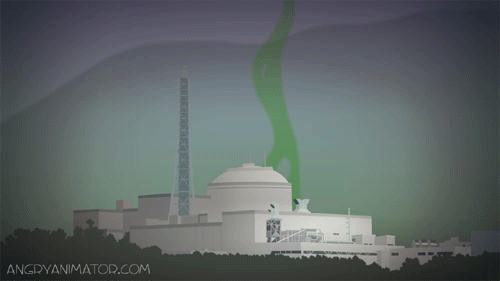 Japan Atomic again flubs maintenance checks at Monju reactor http://www.japantimes.co.jp/news/2016/07/22/national/japan-atomic-again-flubs-maintenance-checks-at-monju-reactor/?utm_source=feedburner&utm_medium=feed&utm_campaign=Feed%3A+japantimes+%28The+Japan+Times%3A+All+Stories%29#.V5gV29J97Gj JIJI The Japan Atomic Energy Agency again failed to conduct checks on a device at its experimental Monju fast-breeder reactor and overlooked a warning signal from a maintenance management system for about three months, it was learned Friday.
The state-affiliated agency, which recently came under fire for failing to inspect thousands of devices at Monju, is investigating the cause of the latest mishap and devising measures to prevent a recurrence.
According to sources familiar with the matter, the device in question controls the temperature of sodium coolant for the prototype reactor, which is situated in Tsuruga, Fukui Prefecture.
The JAEA was slated to complete the inspection by the end of March, after moving up the previous deadline, which was set at the end of May
Around the end of February, the maintenance management system installed at Monju started to display a warning signal. But it was not until May 27 that agency officials noticed it, the sources said.
JAEA reported the problems to the Nuclear Regulation Authority and completed the inspection of the temperature-controlling device on May 31, the sources said.
A massive sodium leak and coverup bid in December 1995 caused Monju’s operations to be suspended. It was eventually brought back online in May 2010, but halted again by a different problem in August the same year.
In November 2012, it was found that JAEA failed to carry out maintenance checks on more than 10,000 devices at Monju. After that, the NRA effectively banned the JAEA from operating the reactor.
In November last year, the NRA recommended to science and technology minister Hiroshi Hase that JAEA be replaced as Monju’s operator. The ministry is studying the matter.
EDF’s 900-MW Fessenheim-2 nuclear reactor may have to remain shut, until anomalies are corrected
EDF reactor may remain shut after regulator suspends certificate London (Platts)–19 Jul 2016 EDF’s 900-MW Fessenheim-2 nuclear reactor may have to remain shut beyond the end of scheduled maintenance after French nuclear safety authority ASN said Tuesday it had suspended a certificate for one of the reactor’s steam generators, in which several anomalies were discovered in June.
ASN issues test certificates for the most important nuclear equipment, and these certificates are required for the commissioning of the equipment. The suspension of the test certificate, ASN said, would result in the Fessenheim-2 reactor remaining shut until Areva NP — the reactor unit of Areva and owner of the Creusot Forge — demonstrates the steam generators can meet the regulatory standards.
Le Creusot Forge manufactures forgings and castings for the large components of nuclear reactors.
ASN said it had asked Areva NP to send the agency details on how it intends to rectify the steam generator’s problems……..http://www.platts.com/latest-news/electric-power/london/edf-reactor-may-remain-shut-after-regulator-suspends-21023392
B61 thermonuclear warheads in Turkey – a worry in the light of coup attempt
Coup attempt in Turkey raises a nuclear concern at US air base Incirlik Air Base was an operational centre of the attempted coup. It is also America’s largest foreign stockpile of nuclear weapons. South China Morning Post, 24 July, 2016 A little more than 100 miles from the territory held by Islamic State, there is a little piece of Americana. It has an eight-lane swimming pool, a baseball diamond and housing tracts built on carefully manicured cul-de-sacs.
The Incirlik Air Force Base in Turkey has some other American assets: several dozen B61 thermonuclear warheads. The base has been a linchpin in Nato’s southern flank for more than half a century, the staging ground for US anti-terrorism missions and the fight against Islamic State.
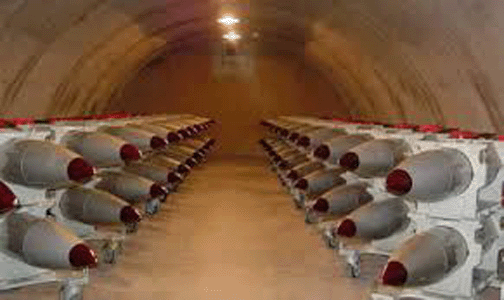
But the failed military coup against Turkish President Recep Tayyip Erdogan has increased long-standing concerns about the military usefulness and security of the Incirlik armoury, America’s largest foreign stockpile of nuclear weapons. Security remains at the highest level. Electrical power was restored Friday after a weeklong blackout that strained living conditions at the base. The 3,000 US service personnel stationed there have been ordered to remain inside the gates. Hundreds of dependents were sent home months ago because of fears of a terrorist attack.
The base was an operational centre of the attempted coup. Its commander and his subordinates were arrested on suspicion of trying to overthrow the Turkish government, leaving junior officers in control. The developments have shocked US military experts who say they demonstrate a worrying level of instability in Turkey’s military command close to the B61s.
Defence officials have never acknowledged the existence of these weapons on the base and refused at news briefings after the coup attempt to answer questions about them…….
The weapons are in underground vaults in a mile-long security zone at the base, protected by an Air Force guard unit with attack dogs. The nearly 12-foot-long weapons have devices that are supposed to prevent unauthorised detonation, but experts are divided on the effectiveness of those controls.
Unlike the strategic weapons that the US deploys in missile silos, submarines and intercontinental bombers, the B61s at Incirlik are tactical weapons that can be deployed at low altitude in the battlefield……..
“The weapons should be pulled back,” said Hans Kristensen, a nuclear weapons expert at the Federation of American Scientists. “They have been in excess of what is needed in Europe for the past two decades. And now we have this new situation. This is the US nuclear base closest to a war zone. The country has a deeply fractured political and military system.” http://www.scmp.com/news/world/europe/article/1994052/coup-attempt-turkey-raises-nuclear-concern-us-air-base
Anxieties grow over the security of America’s Nuclear Weapons in Europe
 How Secure are America’s Nuclear Weapons in Europe?, The National Interest, Lydia Dennett, 24 July 16, After the recent military coup attempt in Turkey, multiple organizations have raised appropriate concerns about the 50 U.S. nuclear bombs stored at a Turkish Air Base less than 70 miles away from the Syrian border. And while this new interest is warranted, the security vulnerabilities of the 131 American B61 nuclear bombs currently deployed at military bases in Belgium, Italy, Germany, and the Netherlands have been a growing concern for almost a decade.
These nuclear bombs are relics of Cold War perceptions of reassurance, and are now more of a liability than a legitimate international security strategy. Given how uncertain the security situation is in Europe, particularly in Belgium andTurkey, it’s time to consider just how useful, or not, these weapons actually are.
In 2012, and again in 2013, the Project On Government Oversight (POGO) wrote letters to the Secretary of Defense questioning the military efficacy of keeping these bombs in Europe when faced with mounting costs and troubling security concerns. Although these weapons are protected by U.S. military personnel, the overall security of the sites where they’re stored is the responsibility of the host nation. This can be dangerous if, in the case of Turkey, there is an abrupt change in national leadership. Dan Lamothe of The Washington Post reported that one of the Turkish officers detained after the coup was the commander of the base where the nukes are kept.
A 2008 U.S. Air Force Blue Ribbon review found that security at the European sites varied widely, and most did not meet U.S. nuclear weapons protection standards. Some security requirements—including armored vehicles and perimeter fencing—were underfunded, leading the review to conclude: “the [United States Air Force] must continue to emphasize to its host nation counterparts their requirement to honor security commitments.”
Just two years later, a group of peace activists jumped the fence around the Kleine Brogel Airbase in Belgium. They wandered around the base for an hour, near buildings containing nuclear weapons vaults, before they were finally stopped by a soldier carrying an unloaded rifle and without readily available ammo. They posted a video of their break-in on YouTube.
In the wake of the terrorist attacks in Belgium earlier this year, Belgian authorities discovered video surveillance footage of a nuclear power facility, indicating the Islamic State’s possible interest in nuclear materials. The New York Times reported, “This is especially worrying in a country with a history of security lapses at its nuclear facilities, a weak intelligence apparatus and a deeply rooted terrorist network.”
All of these incidents should have set off major alarm bells given how catastrophic the results would be if access to nuclear material ended up in the wrong hands. POGO has found that the U.S. considers three main potential terrorism scenarios when assessing security:
– The creation of an improvised nuclear device on site by suicidal terrorists.
– The use of conventional explosives on site to create a radiological dispersal device, also known as a dirty bomb.
– The theft of nuclear materials in order to create a crude nuclear weapon off-site………..
With a new Administration coming this January, there is an opportunity to re-evaluate how the U.S. deploys its assets. Is the presence of U.S nukes in Europe really a meaningful way to reassure our allies that we are committed to their security, or is it instead creating an expensive and unnecessary risk to the region? http://nationalinterest.org/blog/the-buzz/how-secure-are-americas-nuclear-weapons-europe-17098
REGIONAL RISKS in America’s Spent Nuclear Fuel Rods and Storage Pools
 Spent Nuclear Fuel Rods and Storage Pools: A Deadly and Unnecessary Risk in the United States. Based on an Institute for Policy Studies report by Robert Alvarez entitled “Spent Nuclear Fuel Pools in the U.S.: Reducing the Deadly Risks of Storage.”
“…….New York. If a spent fuel fire were to happen at one of the two Indian Point nuclear reactors located 25 miles from New York City, it could result in as many as 5,600 cancer deaths and $461 billion in damages. Indian Point spent fuel storage has about three times more radioactivity than the combined total in the spent fuel pools at the four troubled Fukushima reactors.
Los Angeles. The spent fuel at Diablo Canyon nuclear reactors have nearly 2.7 times more radioactivity than the combined total in the spent fuel pools at the four troubled Fukushima reactors.
Miami. Turkey Point reactors 65 miles from Miami have 2.5 times more radioactivity than the combined total in the spent fuel pools at the four troubled Fukushima reactors.
Dallas. The Comanche Peak nuclear station 60 miles southwest of Dallas has spent fuel that contains about 2.3 times more radioactivity than the combined total in the spent fuel pools at the four troubled Fukushima reactors.
Atlanta. The Vogtle nuclear reactors near Augusta are 147 miles northeast of Atlanta. These reactors have generated 2.5 times more radioactivity than the combined total in the spent fuel pools at the four troubled Fukushima reactors. https://ratical.org/radiation/NuclearExtinction/IPS-RA-ReportFactSheet.pdf
South Korean nuclear reactor shuts down
Nuclear reactor in S. Korea stops operations , Korea Times, 22 Jul 16,
The Wolseong-1 reactor at the plant, located in Gyeongju, about 400 km southeast of Seoul, came to a halt at around 11:24 a.m. according to the Korea Hydro and Nuclear Power Co. (KHNP).
No radiation leaks have been reported. The operator said that it is currently working on finding the exact cause of the shutdown….
The Wolseong-1 reactor had been shut down since 2012 when it reached its 30-year commercial operation period.
But it went back online in June last year after the state-run nuclear watchdog decided to restart operation of the facility for another 10 years.The decision has sparked public concerns over the reactor’s safety here after the 2011 Fukushima nuclear disaster in Japan….http://www.koreatimes.co.kr/www/news/nation/2016/07/116_210056.html
What if you were not informed when a nuclear emergency occurred?
What if there were a nuclear plant emergency and you didn’t know? Bill Gallo Jr. | For NJ.com 22 July 16 MANNINGTON TWP. — What if there’s an emergency at a nearby nuclear power plant that requires you to take action but you are never informed?
That was the fear expressed by speakers this week during the state’s annual review of the plan that would be put into action in case of a large-scale accident at one of New Jersey’s four nuclear reactors.
“The deteriorating telecommunications infrastructure throughout in South Jersey will have a disastrous impact in executing this plan,” said Barbara Stratton who lives in Stow Creek Township in Cumberland County within the 10-mile emergency planning zone around PSEG Nuclear’s Artificial Island generating complex.
Without reliable service how would a person in harm’s way receive a call alerting them of an emergency, she asked.
Stratton spoke at the Salem County Department of Emergency Management headquarters Wednesday night where officials from the New Jersey Department of Environmental Protection, New Jersey State Police and New Jersey Department of Health held the local hearing.
The New Jersey Radiological Emergency Response Plan deals with how emergency officials would respond if there was a major release of radiation from one of the four reactors in the state. It addresses what evacuations, if any, would be needed and testing of the environment after a radiation release. A key part of the plan is communicating with the public about what actions they would need to take.
“Many area within and surrounding the emergency response zone do not have anything other that deteriorating copper landline telephone service that does not work in wet or damp weather,” Stratton said. “The citizens in these areas have no alternatives …. Cell service is non-existent or spotty at best.”……..
A public hearing has been scheduled by the state Board of Public Utilities on the matter on Aug. 4 in Estell Manor.
Both Stratton and Facemyer urged officials involved with nuclear emergency planning to attend the BPU hearing. ……http://www.nj.com/salem/index.ssf/2016/07/what_if_there_were_a_nuclear_plant_emergency_and_y.html
UK submerged nuclear submarine collides with merchant vessel off Gibraltar

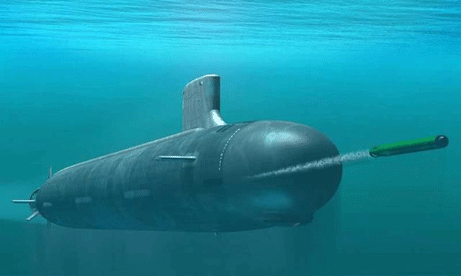 UK nuclear sub collides with merchant vessel off Gibraltar Rt.com 21 Jul, 2016 One of Britain’s newest Astute-class submarines has docked at Gibraltar after suffering a “glancing collision” with a merchant vessel, the UK Royal Navy announced, emphasizing that the HMS Ambush suffered “absolutely no damage” to her nuclear reactor
Natural Resources officials to meet Canadian Nuclear Safety Commission about allegations of nuclear unsafety

 CNSC head to meet with officials to tackle allegations in anonymous letter, GLORIA GALLOWAY, OTTAWA — The Globe and Mail, Jul. 19, 2016 Natural Resources officials will meet with the head of the Canadian Nuclear Safety Commission to discuss allegations that information was withheld from commissioners as they made critical decisions about the licensing of the country’s nuclear plants.
An anonymous letter, purportedly written by specialists at the nuclear regulator, was sent five weeks ago to CNSC president Michael Binder. It points to five separate cases in which the commission’s staff sat on relevant information about risk or non-compliance that might have called the safety of a nuclear plant into question…….
The anonymous letter writers say nuclear hazards have been underestimated, plant operators have been permitted to skip requirements of the licensing regime, and assessments outlining what could happen in the event of a major nuclear disaster – such as the one that occurred in Fukushima, Japan in 2011 – have been withheld from the commissioners and the public……
Among other allegations, the writers of the anonymous letter to Mr. Binder say an evaluation of the effects of a Fukushima-scale nuclear disaster in Canada has never been released to the commissioners or the public.
In a 2014 e-mail obtained by the environmental group Greenpeace under access to information laws, François Rinfret, a director at the regulator, said a scenario for a Fukushima-size disaster would “become the focal point of a licence renewal and, despite brilliant attempts to caution readers … would be used malevolently at a public hearing” by people concerned about nuclear energy. http://www.theglobeandmail.com/news/politics/anonymous-letter-accuses-cnsc-of-withholding-critical-information/article30998523/
.The 15 most costly nuclear events
A Rethink of Nuclear Risk Assessment, ETH Zurich, Department of Management, Technology and Economics 11.07.2016
“……..The 15 most costly nuclear events analysed by the team are:
1. Chernobyl, Ukraine (1986) – $259 billion
2. Fukushima, Japan (2011) – $166 billion
3. Tsuruga, Japan (1995) – $15.5 billion
4. TMI, Pennsylvania, USA (1979) – $11 billion
5. Beloyarsk, USSR (1977) – $3.5 billion
6. Sellafield, UK (1969) – $2.5 billion
7. Athens, Alabama, USA (1985) – $2.1 billion
8. Jaslovske Bohunice, Czechoslovakia (1977) – $2 billion
9. Sellafield, UK (1968) – $1.9 billion
10. Sellafield, UK (1971) – $1.3 billion
11. Plymouth, Massachusetts, USA (1986) – $1.2 billion
12. Chapelcross, UK (1967) – $1.1 billion
13. Chernobyl, Ukraine (1982) – $1.1 billion
14. Pickering, Canada (1983) – $1 billion
15. Sellafield, UK (1973) – $1 billion
An open-source database of all 216 analysed events is available athttps://innovwiki.ethz.ch/index.php/Nuclear_events_database, containing dates, locations, cost in US dollars, and official magnitude ratings. This is the largest public database of nuclear accidents ever compiled. https://www.mtec.ethz.ch/news/d-mtec-news/2016/07/a-rethink-of-nuclear-risk-assessment.html
Nuclear Risk Assessment – more dangerous than previously thought
 A Rethink of Nuclear Risk Assessment, ETH Zurich, Department of Management, Technology and Economics 11.07.2016 Prof. Didier Sornette and Dr Spencer Wheatley, D-MTEC and a researcher at the University of Sussex, England, have carried out the biggest-ever statistical analysis of historical nuclear accidents. It suggests that nuclear power is a currently underappreciated extreme risk and that major changes will be needed to prevent future disasters.
A team of risk experts at the University of Sussex, in England, and ETH Zurich, in Switzerland, have analysed more than 200 nuclear accidents, and – estimating and controlling for effects of industry responses to previous disasters – provide a grim assessment of the risk of nuclear power: The next disaster on the scale of Chernobyl or Fukushima may happen much sooner than the public realizes.
Their worrying conclusion is that, while nuclear accidents have substantially decreased in frequency, this has been accomplished by the suppression of moderate-to-large events. They estimate that Fukushima- and Chernobyl-scale disasters are still more likely than not once or twice per century, and that accidents on the scale of the 1979 meltdown at Three Mile Island in the USA (a damage cost of about 10 Billion USD) are more likely than not to occur every 10-20 years.
As Dr Spencer Wheatley, the lead author, explains: “We have found that the risk level for nuclear power is extremely high. Although we were able to detect the positive impact of the industry responses to accidents such as Three Mile Island and Chernobyl, these did not sufficiently remove the possibility of extreme disasters such as Fukushima. To remove such a possibility would likely require enormous changes to the current fleet of reactors, which is predominantly second-generation technology.”
The studies, published in two papers in the summer issues of the journalsEnergy Research & Social Science and Risk Analysis, put fresh pressure on the nuclear industry to be more transparent with data on incidents. The articles have also been picked up by popular media, e.g. very recently by the German “Spiegel Online” (in German).
“Flawed and woefully incomplete” public data from the nuclear industry is leading to an over-confident attitude to risk, the study warns. The research team points to the fact that their own independent analysis contains three times as much data as that provided publicly by the industry itself. This is probably because the International Atomic Energy Agency, which compiles the reports, has a dual role of regulating the sector and promoting it.
The research team for this new study gathered their data from reports, academic papers, press releases, public documents and newspaper articles. The result is a dataset that is unprecedented – being twice the size of the next largest independent analysis. Further, the authors emphasize that the dataset is an important resource that needs to be continually developed and shared with the public.
Professor Benjamin Sovacool of the Sussex Energy Group at the University of Sussex, who co-authored the studies, says: “Our results are sobering. They suggest that the standard methodology used by the International Atomic Energy Agency to predict accidents and incidents – particularly when focusing on consequences of extreme events – is problematic. The next nuclear accident may be much sooner or more severe than the public realizes.”
The team also calls for a fundamental rethink of how accidents are rated, arguing that the current method (the discrete seven-point INES scale) is highly imprecise, poorly defined, and often inconsistent.
In their new analysis, the research team provides a cost in US dollars for each incident, taking into account factors such as destruction of property, the cost of emergency response, environmental remediation, evacuation, fines, and insurance claims. And for each death, they added a cost of $6 million, which is the figure used by the US government to calculate the value of a human life.
That new analysis showed that the Fukushima accident in 2011 and the Chernobyl accident in 1986 cost a combined $425 billion – five times the sum of all the other events put together.
However, these two extremes are rated 7 – the maximum severity level – on the INES scale. Fukushima alone would need a score of between 10 and 11 to represent the true magnitude of consequences……..https://www.mtec.ethz.ch/news/d-mtec-news/2016/07/a-rethink-of-nuclear-risk-assessment.html
Allegations that nuclear risk information was withheld from Canadian Nuclear Safety Commission
 Letter claims info on nuclear risks withheld from safety commissioners GLORIA GALLOWAY OTTAWA — The Globe and Mail, Jul. 18, 2016 The Canadian Nuclear Safety Commission is investigating allegations contained in an anonymous letter claiming to be written by specialists at the nuclear regulator that says information has been withheld from commissioners while making critical decisions about the licensing of this country’s nuclear plants.
The letter, which was sent several weeks ago to CNSC president Michael Binder, points to five separate cases in which the commission’s staff sat on relevant material about risk or non-compliance that might have called the safety of a plant into question.
The letter says hazards have been underestimated, plant operators have been permitted to skip requirements of the licensing regime and assessments outlining what could happen in the event of a major-scale nuclear disaster – such as the one that occurred in Fukushima, Japan, in 2011 – have been withheld from the commissioners and the public…….
The letter was also sent to representatives of two environmental groups, as well as to a current and former CNSC commissioner.
Although it is impossible to verify that the letter was written by CNSC specialists, environmentalists who received copies of the document say the level of detail, the manner of speaking and the amount of complexity suggest it was written by someone with inside knowledge. And, they say, the problems are symptomatic of a culture at the commission in which employees are expected to act as boosters of the nuclear industry rather than watchdogs of nuclear safety.
The letter writers, who say they are remaining anonymous because they are not confident of whistle-blower protection, are asking Dr. Binder to assign an independent expert to review the accuracy of their claims. They make eight additional recommendations for improving the licensing regime, many of them relating to specific issues at the Darlington Nuclear Generating Station on Lake Ontario, just east of Toronto, and at the Bruce plant on Lake Huron.
“Our primary concern is that CNSC commissioners do not receive sufficient information to make balanced judgments,” the letter says. And “because insufficient information is made available, other branches of government cannot make informed decisions. For example, the government of Ontario cannot make a good decision about financing the refurbishment of Darlington without knowing all the facts.”
Dr. Binder was appointed by the former Conservative government of Stephen Harper after it fired then-CNSC president Linda Keen when she balked at skirting safety rules. Ms. Keen now serves as a corporate director for various organizations and does consulting work.
“We’ve seen the CNSC become a cheerleader for the nuclear industry since the Harper government fired former CNSC president Linda Keen,” said Shawn-Patrick Stensil, a senior energy analyst with Greenpeace Canada who was one of the two environmentalists to receive a copy of the letter. “The Trudeau government needs to restore the independence of Canada’s nuclear regulator,” he said.
The letter writers refer to a number of cases in which, they say, the commissioners have made decisions without knowing all of the facts…….
Theresa McClenaghan, executive director of the Canadian Environmental Law Association, who was the other environmentalist sent a copy of the letter, said actions of this sort – in which whistle-blowers make such specific allegations – are both rare and surprising. But, she said, she has no doubt it was written by someone inside the CNSC.
“We are often very concerned that commissioners are not getting the full story from the proponents or the regulatory staff,” Ms. McClenaghan said. “In the hearings, we really do see a frustrating amount of apologetics for the industry going on by staff.”
Mr. Stensil, of Greenpeace, said the most serious issue raised in the letter is the allegation suggesting that CNSC staff knows about additional risks being posed by reactors, but is ignoring them. That is what happened at Fukushima, he said.
“That’s not a nuts-and-bolts or an engineering issue,” Mr. Stensil said. “That’s a safety culture issue.” http://www.theglobeandmail.com/news/politics/anonymous-letter-claims-info-on-nuclear-risks-withheld-from-safety-commissioners/article30964195/
Japan’s “ludicrous” policy regarding nuclear safety and earthquakes – former nuclear regulator

 Former Japan nuclear regulator lashes out over earthquake standards, Reuters 15 July 16 A former senior official of Japan‘s atomic watchdog has lashed out publicly at the agency’s response to his concerns over the assessment of earthquake risks to nuclear plants, adding to a controversy over safety five years after the Fukushima disaster.
Former deputy chairman of the Nuclear Regulation Authority (NRA), Kunihiko Shimazaki, now a professor emeritus of seismology at the University of Tokyo, in June broke his silence after leaving the regulator in 2014 to voice his concerns that earthquake risks are not being sufficiently addressed.
Shimazaki then met with the NRA on June 16 and the regulator said it would make recalculations of its measurements but Shimazaki said the response falls short.
“I cannot be convinced by their conclusions. I think they are ludicrous,” he told reporters on Friday.
Shimazaki’s technical concerns relate to the Ohi nuclear plant operated by Kansai Electric Power, which is being assessed for a restart. But, he told Reuters after the June meeting with the NRA, “a sense of crisis” over safety prompted him to go public and urge more attention to earthquake risk in general……..
Kyushu Electric Power is the only utility that has been cleared to restart two reactors at its Sendai plant, while other utilities have been blocked so far by legal action from nearby residents. One more reactor may restart later this month.
(Reporting by Osamu Tsukimori; Writing by Aaron Sheldrick; Editing by Christian Schmollinger) http://uk.reuters.com/article/uk-japan-nuclear-regulation-idUKKCN0ZV11C
Canada’s aging nuclear plants – renewal of licenses due, but concrete decaying
Decaying concrete raising concerns at Canada’s aging nuclear plants, National Post Ian MacLeod, Postmedia News | July 8, 2012 Decaying concrete at nuclear power plants is the latest concern for nuclear safety authorities.
At Quebec’s sole atomic power station, Gentilly-2, eroding concrete has prompted federal licensing officials to suggest that any provincial attempt to refurbish and re-license the 30-year-old plant must satisfy federal concerns over the aging concrete’s ability to stand up to another two or three decades of service.
The move comes as economic pressures force nuclear utilities to consider refurbishing their nuclear plants and operating them well past their 25- to 30-year initial lives.
With Gentilly-2 at the end of its service life, the Quebec government is under pressure to decide soon whether to order a refit or shut down the plant permanently. Refurbishment estimates range from $2 billion to $3 billion. A shutdown is pegged at $1.6 billion.
Of particular concern for any “life extension” is the dome-shaped containment building that encloses the 675-megawatt CANDU 6 reactor. The metre-thick, steel-reinforced concrete structure serves as the final physical barrier against radioactive contamination escaping into the atmosphere around Becancour, on the south shore of the St. Lawrence River across from Trois-Rivieres and an hour’s drive northeast of Montreal.
“Special attention is needed for the containment structure in the longer term since it has been identified that containment concrete suffers from” a common type of concrete decay called alkali-silica reaction (ASR), says a 2010 report by the Canadian Nuclear Safety Commission (CNSC) in Ottawa.
Despite those long-term concerns, the CNSC last year renewed the plant’s operating licence until 2016.……..http://news.nationalpost.com/news/canada/decaying-concrete-raising-concerns-at-canadas-aging-nuclear-plants
1 This Month
26 September – International Day for the Total Elimination of Nuclear Weapons





PLEASE OPPOSE HR 8255 AND S.3639 – bills would accelerate satellite deployment, with no environmental review or safeguards – https://ncstd5li.quorum.us/campaign/169331/
To see nuclear-related stories in greater depth and intensity – go to https://nuclearinformation.wordpress.com
-
Archives
- September 2026 (305)
- August 2026 (330)
- July 2026 (355)
- June 2026 (287)
- May 2026 (306)
- April 2026 (356)
- March 2026 (251)
- February 2026 (267)
- January 2026 (308)
- December 2025 (358)
- November 2025 (359)
- October 2025 (375)
-
Categories
- 1
- 1 NUCLEAR ISSUES
- business and costs
- climate change
- culture and arts
- ENERGY
- environment
- health
- history
- indigenous issues
- Legal
- marketing of nuclear
- media
- opposition to nuclear
- PERSONAL STORIES
- politics
- politics international
- Religion and ethics
- safety
- secrets,lies and civil liberties
- spinbuster
- technology
- Uranium
- wastes
- weapons and war
- Women
- 2 WORLD
- ACTION
- AFRICA
- Atrocities
- AUSTRALIA
- Christina's notes
- Christina's themes
- culture and arts
- Events
- Fuk 2022
- Fuk 2023
- Fukushima 2017
- Fukushima 2018
- fukushima 2019
- Fukushima 2020
- Fukushima 2021
- general
- global warming
- Humour (God we need it)
- Nuclear
- RARE EARTHS
- Reference
- resources – print
- Resources -audiovicual
- Weekly Newsletter
- World
- World Nuclear
- YouTube
-
RSS
Entries RSS
Comments RSS

