No safe way to move nuclear waste
 There’s no safe way to move nuclear waste’: Scottish Politicians slam nuke flight that needed armed cop convoy Daily Record 18 SEP 2016 BY JIM LAWSON
Green MP John Finnie and Caithness MP Paul Monaghan among those to voice concerns about flying nuclear waste to the US. THE first flight believed to be carrying British nuclear waste to America took off from Wick Airport amid tight security yesterday.
Scots politicians and anti-nuclear campaigners have slammed the deal, brokered by David Cameron and Barack Obama, to move the waste.
The airport was closed from early morning as armed police patrolled the perimeter.
Twenty miles away in Thurso, more armed officers escorted a lorry from the Dounreay nuclear plant through the town. It was carrying two heavily reinforced containers……
Dr Richard Dixon, director of Friends of the Earth, said: “There is no truly safe way to move this waste.”
Caithness MP Paul Monaghan said the deal was “morally reprehensible” and Green MP John Finnie said people would be stunned that nuclear waste was being transported by plane.
Nuclear expert John Large said: “The risk in transport by air is the fuel being engulfed in fire, the packages breaking down and the fuel igniting.”
The runways at Wick have been extended at a cost of £18million to take the US planes, and Highland Council have published an order allowing local roads to be closed for five hours at a time until March 2018.
Police refused to comment on yesterday’s operation for security reasons.The first flight believed to
be carrying British nuclear waste to America took off from Wick Airport amid tight security yesterday. http://www.dailyrecord.co.uk/news/scottish-news/gun-cop-8859315
‘Substantial weaknesses’ in TVA safety culture at new nuclear plant
NRC inspection finds ‘substantial weaknesses’ in TVA safety culture at new nuclear plant, Times Free Press, November 1st, 2016
The U.S. Nuclear Regulatory Commission met with 136 workers in 17 focus groups at Watts Bar this summer after concluding in March that TVA had “a chilled work environment” at the Spring City, Tenn., plant that could discourage employees or contractors from raising safety concerns.
“Focus groups within and outside of the operations department indicated the existence of broader, previously unrecognized challenges to the maintenance of a positive safety culture, which continued to challenge the safety conscious work environment,” Alan Blamey, branch chief of reactor projects in the Atlanta office of the NRC, said in a letter to TVA last week. “The (NRC inspection) team identified substantial weaknesses in various attributes which were found to be pervasive across various work units.”
Blamey said nearly half of those interviewed by the NRC at Watts Bar “believed retaliation was a potential outcome for raising concerns.”
“In addition, most employees did not believe that concerns were promptly reviewed or appropriately resolved, either by their management or via the corrective action program,” Blamey told the TVA………. http://www.timesfreepress.com/news/business/aroundregion/story/2016/nov/01/nrc-inspectifinds-substantial-weaknesses-tvsa/395354/
Fears over core safety as cracks found in Scots nuclear reactor
Cracks found in Scots nuclear reactor spark fears over core safety , Daily Record, 31 OCT 2016 BY SALLY HIND
OFFICIAL documents revealed the nuclear regulator’s concerns over fractures in the core structure of Hunterston B power station in Ayrshire. CRACKS found in a nuclear reactor have sparked fears that it could not be shut down in an emergency.
Official documents revealed the nuclear regulator’s concerns over fractures in the core structure of Hunterston B power station in Ayrshire.
Operators EDF Energy say the cracks pose no threat to safety at the site.
But paperwork obtained through a freedom of information request shows the Office for Nuclear Regulation have raised concerns over fractures in the brick keyways that lock together the core in reactor three.
It’s feared the same problem could arise at EDF’s sister station – Hinkley B in Somerset. The ONR have agreed the stations can continue operating safely after making changes to the reactor shutdown process of the 70s structures.
But John Large, who helped design the advanced gas-cooled reactors, believes that if the cracks get worse, they could jeopardise a reactor’s stability in the event of a disaster and make it impossible to shut it down…..http://www.dailyrecord.co.uk/news/scottish-news/cracks-found-scots-nuclear-reactor-9167417
Grand Gulf Nuclear Station still shut down for special investigation
Grand Gulf Nuclear Station stays closed as feds inspect Grand Gulf Nuclear Station has been shut down since Sept. 8 as Entergy makes a “thorough review” of the power plant after several maintenance issues, and the Nuclear Regulatory Commission is conducting a special inspection after “several recent operational events.”……..
Global nuclear market affected by France’s safety problems: many French reactors offline
 France’s Nuclear Storm: Many Power Plants Down Due to Quality Concerns, Power, 11/01/2016 | Lee Buchsbaum The discovery of widespread carbon segregation problems in critical nuclear plant components has crippled the French power industry—20 of the country’s 58 reactors are currently offline and under heavy scrutiny. France’s nuclear safety chairman said more anomalies “will likely be found,” as the extent of the contagion is still being uncovered.With over half of France’s 58 reactors possibly affected by “carbon segregation,” the nation’s nuclear watchdog, the Autorité de Sûreté Nucléaire (ASN) has ordered that preventative measures be taken immediately to ensure public safety. As this story goes into production in late October, ASN has confirmed that 20 reactors are currently offline and potentially more will shut down in coming weeks.
The massive outages are draining power from all over Europe. Worse, new questions continue to swirl about both the safety and integrity of Électricité de France SA’s (EDF’s) nuclear fleet, as well as the quality of some French- and Japanese-made components that EDF is using in various high-profile nuclear projects around the world……….
Questionable Materials and Documentation
At the heart of France’s nuclear crisis are two problems. One concerns the carbon content of critical steel parts, steam heat exchangers, and other components manufactured or supplied by AREVA SA, the French state-owned nuclear engineering firm and global producer of nuclear reactors. The second problem concerns forged, falsified, or incomplete quality control reports about the critical components themselves. Continue reading
France’s nuclear reactor unsafety raises same problem for Japan
JAPANESE STEEL AT CENTRE OF FRENCH NUCLEAR CRISIS – MAJOR QUESTIONS AND IMPLICATIONS FOR JAPANESE REACTOR SAFETY http://www.greenpeace.org/japan/ja/news/press/2016/pr201610251/
プレスリリース – 2016-10-25 Tokyo – The safety and regulation of the Japanese nuclear fleet is called into serious question by the discovery of Japanese-manufactured flawed steel components installed in operating French nuclear reactors forced to shut down last week by the French nuclear safety regulator ASN, according to a new Greenpeace report. The threat to nuclear reactor safety in Japan is due to the supply of steel components to the nuclear industry from both Japan Casting and Forging Company (JCFC) and the Japan Steel Works (JSW), according to the technical report (http://bit.ly/2eMqJMm) released today by Greenpeace Japan, by the nuclear engineering consultancy, Large&Associates of London. Evidence of astonishingly high levels of excess carbon far outside regulatory limits with the associated loss of steel toughness and significant increase in the risk of catastrophic failure of primary containment components, have been discovered in JCFC-manufactured components installed in steam generators in 12 reactors owned by the French state-utility, EdF. The independent French nuclear agency, IRSN, recently warned that due to the excess carbon content, there was an increased risk of failure of the affected steam generator leading to a potential reactor core meltdown
During the period 1994-2006, JCFC supplied flawed components to France, which somehow managed to pass through the quality assurance controls of JCFC, the supplier Areva, and the French regulator to be installed in operating reactors. How the defects were not detected along the supply chain has not yet been disclosed. A commissioner from the NRA is visiting France this week to discuss the crisis.
From 1984-1993, JCFC also supplied steam generator components to the following Japanese reactors: Takahama 3&4, Sendai 2, Tomari 1&2 and Tsuruga 2; JCFC steam generator and reactor pressure vessel components are installed in a total of 14 Japanese reactors (not including two reactors at Fukushima Daiini).
“As a result of substandard manufacturing in Japan, citizens in France have been unknowingly exposed to the risk of catastrophic failure of critical reactor components which could result in a reactor core meltdown. Japanese-supplied steel is now at the center of France’s unprecedented nuclear crisis the scale of which has never been seen in any country. All 12 reactors supplied by JCFC are either in forced shutdown or about to be. It lacks all credibility that the Japanese nuclear industry would claim that there are no implications for the safety of their own nuclear reactors. The steel production records released in France did not reveal the scale of excess carbon, which was only found after physical testing. There are currently no plans for such tests in Japan. That is wholly unacceptable. There are many urgent questions that need to be answered by the industry and the NRA, and with full public disclosure and transparency,” said Shaun Burnie, senior nuclear specialist at Greenpeace Germany.
The French nuclear safety regulator has been investigating components supplied by both JCFC and the Japan Steel Works (JSW). Test results obtained by Greenpeace in June 2016 indicated that there was a possibility of excess carbon problem in JSW-manufactured components in the steam generator boiler pods – there are 3 or 4 steam generators in each pressurized water reactor PWR nuclear power plant, each weighs upwards of 300 to 400 tonnes and, typically, the cost of replacement is around US$130 to 150 million.
Since the French publication of the JCFC and JSW component test results, it has been claimed that JSW components are free of excess carbon. However, no tests results proving this have been disclosed and Large&Associates research raises questions over the credibility of this claim. The non destructive testing that has been conducted in France is incapable of identifying the scale of excess carbon. Large&Associatess recommends destructive testing .
The Japanese utilities are required to submit documentation to the NRA by 31 October 2016 detailing the quality of the steel components supplied by Japanese companies, JCFC, JSW and the other steel supplier, JFE. This is however only a paper exercise and not the result of actual physical testing of components installed in reactors.
Greenpeace has today sent a copy of the Large&Associates report to the NRA. A series of urgent questions will be submitted, via a member of the Japanese Diet, to the NRA in the coming days.
Priority reactors to be assessed and tested in Japan due to their status: operating, possibility of early operation or approval by the NRA for restart are: Ikata 3, Sendai 2, Takahama 2, Takahama 3&4 (under appeal by Kansai Electric); and next in line for approval by NRA – Genkai 3&4 and Kashiwazaki-kariwa 6&7.
Notes:
(1) The Japanese supplied components under investigation in France are designated Class 1, by which they are not permitted under any circumstances to fail during operation due to the potentially severe consequences. Specifically the components are Steam Generator tube support plates, elliptical domes, and bottom channel heads; as well as Reactor Pressure Vessel upper and lower heads, rings and pressurizers. The French governments Institute for Radiological and Nuclear Safety (IRSN) warned in August that there was a risk of reactor fuel melt down if steam generators with excess carbon operated. A maximum carbon limit is set by regulation to prevent a reduction in the toughness of the steel in the steam generators and Reactor Pressure Vessel, reduced toughness can lead to thermal shock induced fast fracture, where the steel shatters like glass. See, IRSN, 2016 2016-00275 Objet: EDF – REP – Paliers CP0, CPY et N4 – Ségrégations en carbone des fonds primaires de générateurs de vapeur – Analyse de sûreté et mesures compensatoires, 5th August 2016.
Download the report
For further information:
Shaun Burnie, senior nuclear specialist, Greenpeace Germany (Tokyo):shaun.burnie@greenpeace.org, +81 (0)80 3694 2843
Kendra Ulrich, senior global nuclear campaigner, Greenpeace Japan:kendra.ulrich@greenpeace.org, +81 (0) 90 6478 5408
Chisato Jono, communications officer, Greenpeace Japan: chisato.jono@greenpeace.org, +81 (0)80-6558-4446
Transport of nuclear waste – as big a problem as storage
Nuclear Waste Travels With One Heck Of An Entourage Truck Yeah, Andrew P Collins , 27 Oct 16 Do you compost? Rinse and separate your recycling? Yeah, getting rid of garbage is a pain. Unless your garbage is nuclear waste. Getting rid of that is apparently a production of epic proportions……..
How the USA’s NRC regulations work
On the Same (Nuclear) Pages, UCS, DAVE LOCHBAUM, DIRECTOR, NUCLEAR SAFETY PROJECT | OCTOBER 25, 2016, DISASTER BY DESIGN/SAFETY BY INTENT #55
Safety by Intent
Merriam-Webster defines regulation as “an official rule or law that says how something should be done” and as “the act of regulating something.” The Energy Reorganization Act of 1974 created the Nuclear Regulatory Commission (NRC) and tasked the agency with both saying how things should be done and regulating to ensure that those things get done right. How does the NRC discharge its statutory responsibilities?……
The NRC uses regulations backed by standard review plans, regulatory guides, and official endorsements of industry guides to clearly articulate its regulatory expectations. The NRC uses publicly available inspection procedures to clearly convey how it plans to gauge compliance with its regulatory expectations. Such efforts literally put the NRC and owners on the same pages when it comes to nuclear power plant safety requirements.
Regulations
The safety regulations developed by the NRC are readily available online in Title 10 of the Code of Federal Regulations. Title 10 contains dozens of parts tailored to specific aspects of nuclear safety. For example, Part 100 defines the criteria applied when locating a nuclear power reactor. Part 20establishes the requirements that protect workers and the public from radiation. Part 50 governs the licensing of nuclear power plants. Part 73 covers the security measures needed to protect nuclear plants from radiological sabotage. And so on.
For example, Section 100.10 in Part 100 defined “Factors to be considered when evaluating sites” for proposed nuclear power reactors. Applications for reactor operating licenses had to describe the site’s seismology, meteorology, hydrology, geology and the evaluations concluding these physical characteristics posed no undue hazard to the reactor.
Regulatory Guides
The applicants for licenses and certificates from the NRC and the holders of licenses and certificates issued by the NRC have the responsibility of complying with the agency’s regulations. The NRC supplemented its regulations with Regulatory Guides that helped applicants meet their obligation through increased understanding of the regulatory expectations……..
As reflected by the name, a regulatory guide is not born as a regulatory requirement. It can be adopted as a requirement when an owner commits to its provisions to comply with a regulation. But owners are entirely free to comply with the regulation through methods other than those described in regulatory guides. To do so, the owners need only convince the NRC that the alternate methods are comparable to, or better, than the methods in the regulatory guides…….
Standard Review Plan
The Standard Review Plan (NUREG-0800 for nuclear power reactors) was developed to help the NRC’s reviewers determine whether applications for operating licenses properly showed compliance with applicable regulations. This “answer key” also helps applicants conduct all the homework necessary to prepare high quality submittals.
The Standard Review Plan is a valuable complement to the regulations and regulatory guides. Regulatory guides identify the NRC’s expectations for factoring meteorology into reactor siting and design decisions. The Standard Review Plan identifies the spectrum of regulations that include meteorological considerations. The regulatory guides define the tornado wind speeds and the snowfall amounts the NRC expects to be considered; the Standard Review Plan describes how these parameters are to be applied in judging the integrity of plant structures and in the radiological protection of the public following an accident………
Inspection Procedures
The NRC conducts numerous inspections at each operating nuclear plant under its Reactor Oversight Process. The owners are notified in advance about upcoming inspections and the inspection procedures are available online………
Prior to joining UCS, I worked for awhile as a consultant in the engineering department for a company with two operating nuclear reactors. Engineering had issued a procedure for coatings applied to piping and equipment for protection against rusting and degradation. The procedure prohibited applying a certain epoxy to equipment inside containment. So, during a refueling outage workers unbolted a component, moved it outside containment, and applied the epoxy coating. They then moved the component back inside containment and reconnected it.
The letter of the procedure had been satisfied, but not its spirit. The reason the epoxy was banned was that following certain accidents, it could react chemically with fluid discharged into containment with harmful consequences. Fortunately, the mis-applied epoxy coating was detected and corrected before the reactor restarted from the outage.
This benign example illustrates the potentially more serious consequences that can occur when the NRC and plant owners are not on the same pages. The NRC can set the safety bar at an appropriate height to adequately manage a risk, but owners need to see the bar and understand all its associated fine print in order to facilitate compliance.
The NRC’s readily available regulations, regulatory guides, standard review plans, and inspection procedures guard against miscommunications and misinterpretations that can undermine safety.
—–
Disaster by Design UCS’s Disaster by Design/Safety by Intent series of blog posts is intended to help readers understand how a seemingly unrelated assortment of minor problems can coalesce to cause disaster and how effective defense-in-depth can lessen both the number of pre-existing problems and the chances they team up. http://allthingsnuclear.org/dlochbaum/on-the-same-nuclear-pages
Scottish power plant forced offline for a week by swarm of jellyfish
Power plants seek nuclear option to end jellyfish raids, Sunday Times, There are plenty of problems for those in charge of nuclear power stations to worry about when they look out to sea, from rising sea levels, erosion, storm surges, even in some cases tsunamis, but few are as ever present, or as irritating, as jellyfish.
Swarms of them have plagued coastal power plants worldwide by clogging their water intakes and cooling systems. In June 2011, Torness in the east of Scotland was forced offline for a week after moon jellyfish blocked its filters.
Yet they are fiendishly difficult to stop, track or predict because jellyfish have no hearts and thus… (registered readers only) http://www.thetimes.co.uk/edition/business/power-plants-seek-nuclear-option-to-end-jellyfish-raids-tqjzf7bst
Five more nuclear reactors need shutdown and safety inspection – says France’s nuclear regulator

 France’s nuclear watchdog wants to shut down 5 reactors over failure risk https://www.rt.com/news/363484-france-nuclear-shut-down/ 20 Oct, 2016 10: The French nuclear watchdog has called for the shutdown and inspection of five more nuclear reactors for safety checks. The reactors have a high level of carbon which could lead to various failures.
The Nuclear Safety Authority (ASN) has asked nuclear power utility EDF to carry out additional inspections at Fessenheim 1,Tricastin 2 and 4, Gravelines 4 and Civaux 1 reactors, according to a press release. All these reactors are located across the whole France, close to towns and communes.
“The performance of these inspections will require shutdown of the reactors concerned,” ASN added. The watchdog wants to check “certain channel heads of the steam generators on five of its reactors, in which the steel is affected by a high carbon concentration.”
According to ASN’s analysis, “certain channel heads of the steam generators … contain a significant carbon concentration zone which could lead to lower than expected mechanical properties.”
The watchdog said that it doesn’t want to wait “for the scheduled refueling outage of these reactors” and thus demands safety checks “within three months.”
According to the Local, this abnormality could lead to failures in mechanical properties and even to leaks or explosions.
The five reactors under scrutiny are among 18 at which ASN found abnormalities in June. Of the 18 reactors ASN says that six could be restarted after inspection. Seven others (Bugey 4, Civaux 2, Dampierre 3, Gravelines 2, Saint-Laurent-des-Eaux B1 and Tricastin 1 and 3) are being inspected and awaiting reboot.
CEO of ASN Olivier Gupta downplayed the concerns in comments to Le Monde newspaper, saying “the safety margins are very large and the carbon content does not undermine integrity or security, even in the case of an accident.”
France has 58 nuclear reactors with total capacity of 63.2 GWe. The country gets two thirds of its electricity from nuclear generation. READ MORE: Risk of nuclear theft, sabotage, cyberattacks by terrorists may be increasing – report
In April, President Francois Hollande promised to formally initiate the shutdown of the France’s oldest nuclear reactors on the grounds of environmental and safety concerns surrounding the Fessenheim power plant near the German and Swiss borders.
READ MORE: Hollande vows to shut down France’s oldest nuclear power plant Fessenheim houses two 920 megawatt reactors and has been running since 1978, making it France’s oldest operating plant. Due to its age, the German government and activists alike have long been calling for it to be permanently closed.
READ MORE: France shuts down Flamanville nuclear reactor over transformer failure
The German government has repeatedly called on France to terminate the Fessenheim plant as soon as possible, after an April 2014 accident when one of the reactors had to be shut down as water was found leaking from several places.
Japanese nuclear research facility hacked
 Nation-State Hackers Hit Japanese Nuclear Facility, Info Security Magazine, 19 Oct 16, A Japanese nuclear research facility has been hacked, resulting in the theft of 59,000 files.
The University of Toyama’s Hydrogen Isotope Research Center is one of the world leaders in tritium research. Tritium, also known as Hydrogen-3, is a radioactive isotope of hydrogen that is an important fuel for controlled nuclear fusion, and a key component of hydrogen bombs.
It is also one of the contaminants in the water building up at the Fukushima No. 1 nuclear plant.
The infiltrators stole the lab’s tritium research, according to Japanese media, along with the personal details of 1,493 researchers. Attackers stole data in three batches: December 2015, March 2016 and June 2016.
The malware that was used in the breach was delivered via a spear-phishing attack in November of 2015, when a hacker posed as a Tokyo university student working on a research assignment. Investigators said that the malware samples they analyzed were also pre-programmed to search the victim’s computer for the term IAEA, which is the acronym for the UN’s International Atomic Energy Agency.
“The breach at the University of Toyama’s Hydrogen Isotope Research Center is a textbook example of the sort of cyber-threats facing academia,” said Vishal Gupta, CEO of Seclore, via email. “Researchers are extremely lucrative targets for nation-states, as it’s cheaper to invest in the theft of existing data then to conduct the research outright…….. http://www.infosecurity-magazine.com/news/nationstate-hackers-hit-japanese/
Public distrust inside and outside Belarus about troubled nuclear power project
 Controversial new nuclear plant ignites Belarus Thirty years after Chernobyl catastrophe, construction of new nuclear station on border with Lithuania stirs debate. Aljazeera by Jonathan Brown Minsk, Belarus , 19 Oct 16, – Thirty years after an explosion at the Chernobyl nuclear power station devastated the countryside on the southern border of Belarus, leaving behind lasting consequences for millions of people, the construction of a new nuclear station is stirring discord between government officials, opposition politicians, the local populace and foreign diplomats.
On July 10 of this year, the 330-tonne reactor casing dropped from a height of between two and four metres in an incident that only came to the public’s attention two weeks later when a member of the Belarus United Civil Party, Mikalai Ulasevich, leaked the news to the local press.
The Ministry of Energy eventually released a statement acknowledging the incident, and Rosatom – the Russian state nuclear corporation and the primary contractor for the project, said that tests had revealed the dropped casing to be safe.
Concerns and opposition
However, with the memory of Chernobyl looming large, both the energy ministry and Rosatom, which agreed to replace the casing to “mitigate rumours and panic among the population” have so far failed to reassure all Belarusians of the station’s safety.
“They are building a crematorium,” Ulasevich says, driving through the rural village of Varniany where BelNPP’s stacks loom over the horizon.
“The only way to guarantee the safety of the plant is to cease its construction.”
Anti-BelNPP activists, including Ulasevich, are concerned by the government’s decision to build the plant in an ecologically pristine region of the country’s north, surrounded by agricultural land and lakes not affected by Chernobyl.
They have also accused the Belarusian government of violating both the Aarhus andEspoo environmental protection conventions in the planning and the construction of the station in Astravets……..
Threatened neighbour
News of the spate of accidents has been met with concern in neighbouring Lithuania. The country’s interior ministry recently indicated that plans were being drafted, in the event of an accident at Astravets, for the evacuation of the capital, Vilnius, which is only 50km from the BelNPP construction site.
Meanwhile, Lithuania has called for Belarus to carry out IAEA stress tests at the site, during which experts both from the EU and Lithuania may be present.
A Lithuanian delegation for the plant said that until the tests are carried out, Belarus should halt the construction work. In August, Lithuanian President Dalia Grybauskaite described the project as an “existential” threat to European security……..
Public mistrust
By June of this year, the Belarussian public was largely split on BelNPP. A poll conducted by the Independent Institute of Socio-Economic and Political Studies suggested that a slight majority – 35 percent or respondents – disapproved of the project.
Tatyana Korotkevich, who was an independent candidate in the country’s parliamentary elections in September, told Al Jazeera in her offices in central Minsk that Belarusians in her electorate feel their questions about the plant have not been sufficiently addressed by the government………
Who will profit?
Energy analysts and activists alike say that the government’s economic arguments for the station are outdated since the Belarusian economy entered into a decline that the World Bank forecasts will continue into 2017 [PDF].
They say there is little evidence to suggest that the country’s economy would benefit from or even require the energy surplus the $11bn BelNPP will produce.
Minsk, which in July owed Moscow almost $300m in energy debts, hopes its nuclear project will help to levy energy independence. But anti-nuclear activists and independent analysts note that Russia, the primary contractor, will be the sole supplier of fuel for the project once completed…..
Like thousands of Belarusians following Chernobyl, anti-nuclear activist Tanya Novikova was diagnosed with thyroid cancer. She, like other anti-nuclear activists in Belarus, including Ulasevich, report having been detained and harassed in their opposition to the plant. But Novikova won’t be deterred, she told Al Jazeera.
“I personally know that the consequences of Chernobyl may be more scary, more dramatic than being arrested,” she said. http://www.aljazeera.com/indepth/features/2016/09/controversial-nuclear-plant-ignites-belarus-160926094703537.html
Call to halt Pipeline Construction and Operation Next to Indian Point Nuclear Plant
 Medical and Disaster Experts Investigate Pipeline Construction Next to Indian
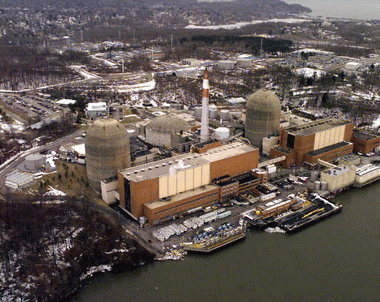 Point Nuclear Plant: Prompts Strong Call to Immediately Halt Pipeline Construction and Operation, Physicians For Social responsibility October 18, 2016 Buchanan, NY – With a sense of utmost urgency, health care professionals, nuclear and disaster experts, public officials and members of the public had a first hand look this morning at the dangerous siting of the 42 inch diameter, high pressure Spectra AIM gas pipeline only 105 feet from vital structures at the aging Indian Point nuclear power plant located near two major earthquake fault lines in the most densely populated region in the nation. The pipeline construction which is nearing completion is targeted for operation on November 1st further heightening experts’ warnings and deep concerns regarding the unacceptable risk the pipeline poses to more than 20 million people in the region and the imperative to immediately halt construction and operation of the pipeline project to avert a potential nuclear disaster. The tour and press conference, hosted by Physicians for Social Responsibility (PSR), a national organization comprised of medical professionals, that has been advocating for public health and safety for over 50 years, featured Dr. Irwin Redlener, Director of the National Center for Disaster Preparedness at Earth Institute at Columbia University and Paul Blanch, a nuclear power expert.
Leading nuclear and pipeline safety experts have repeatedly warned that a pipeline rupture at Indian Point could result in catastrophic nuclear releases worse than the Fukushima nuclear disaster endangering millions of people throughout the New York tri-state area who live within the 50-mile impact radius. Numerous documents in the record submitted by safety experts to the Federal Energy Regulatory Commission (FERC), the Nuclear Regulatory Commission (NRC), and other state and federal agencies reflect serious concerns regarding the lack of pipeline thermodynamics expertise and the complete absence of comprehensive independent risk, health and safety assessments of the co-location of these two major hazardous sites despite repeated urgent calls for such evaluations before any consideration of approval of the pipeline project. Serious concerns have also been raised about the considerable national security implications of the vulnerability of multiple, proximate sources of critical power infrastructure. However, FERC disregarded all of those concerns and requests and granted approval for the project in March 2015 allowing construction to begin in October 2015. The unacceptable risk to New York’s vast population compounded by the total lack of emergency protocols, safety training and preparedness, evacuation plans and public education in emergency scenarios have prompted public officials on local, state, and federal levels to join health and safety experts and the public in their demand for FERC to immediately halt construction and operation of the Spectra AIM pipeline.
Requests by safety experts and public officials for emergency protocols and safety preparedness indicate no evidence of planning for a pipeline rupture or explosion adjacent to the nuclear plant. The lack of emergency training and preparedness reflects the lack of recognition of the safety experts’ concerns regarding the perilous impact of a pipeline accident at that location and the imminent and permanent danger the AIM pipeline poses to the nuclear plant and the entire New York metropolitan area. Data from the U.S. Department of Transportation Pipeline Hazardous Material Safety Administration (PHMSA) confirms that pipeline accidents are commonplace and have been significantly increasing in frequency in recent years including in newly constructed pipelines. There were 143 gas transmission line accidents in 2015.
Major concerns regarding lack of health and safety assessments, emergency procedures, training and preparedness before pipeline project approvals are considered have been echoed by other health professionals, public officials and emergency first responders in other regions across the Spectra AIM pipeline route in New England and for other pipeline projects across the United States……..http://www.psr.org/news-events/press-releases/medical-and-disaster-experts-halt-pipeline-indian-point.html?referrer=https://t.co/PrdY14d7r1
Hans Blix warns on nuclear power stations as terrorist bait
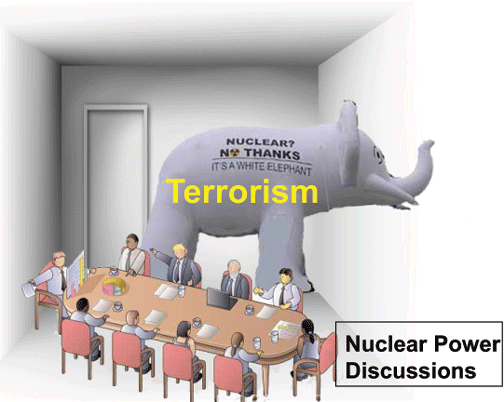 Nuclear power plants are terrorist bait, need extra protection – ex-IAEA chief to RT Rt.com. 11 Oct, 2016 Nuclear power plants are one of the best protected facilities in the world, but they still remain likely targets for terrorists and therefore require extra protection, Hans Blix, former IAEA chief, told RT.
“One has to be very careful, of course, about installations like nuclear power plants and enrichment plants,” said Blix, who headed the International Atomic Energy Agency between 1981 and 1997…..
Blix stressed that modern nuclear facilities “are getting more digitalized – earlier, they weren’t – and they now have to be given a special new protection” from potential cyber-attacks.
He recalled the hack at Iran’s uranium enrichment facility at Natanz back in 2010 “where a malware called ‘Stuxnet’ was smuggled in and managed to stop several hundred enrichment centrifuges.”…….
According to Blix, the risk of radicals creating a so-called ‘dirty bomb,’ which combines radioactive material with conventional explosives, shouldn’t be ignored either.
“Caesium [which is extracted from waste produced by nuclear reactors] is something that is used in hospitals in many places and if it’s stolen or goes astray it can also be used in a dirty bomb and exploded somewhere in the center of a city – whether Moscow, New York or Washington. We have to be careful everywhere,” he said……
Also on Tuesday, current IAEA head, Yukiya Amano, warned that risks of terrorist attacks against nuclear power plants or militants eventually making a “dirty bomb” are very real. He stressed that terrorist groups, such as Islamic State (IS, formerly ISIS/ISIL), pose a serious threat to nuclear power stations.
There was an attempt to smuggle enriched uranium as well a cyberattack, which disrupted a nuclear plant’s operations, in recent years, Amano said without elaborating. https://www.rt.com/news/362428-nuclear-plants-terrorists-iaea-blix/
The consequences of a nuclear plant meltdown – as they would apply to NewYork’s nuclear plants

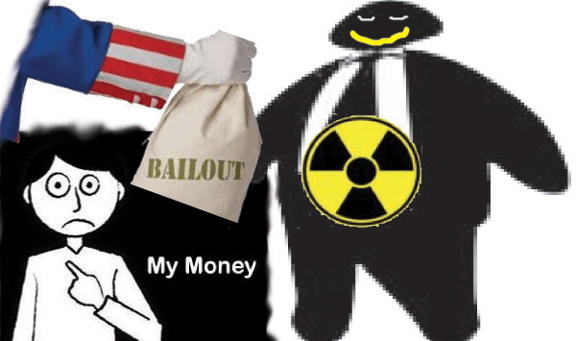 Bailing out aging nuclear power plants can impact development of renewable energy technologies, Enformable, 17 Oct 2016 “…………Beyond Dollars—It’s About Life
And this, most importantly, is beyond dollars—it’s about life.
The most comprehensive study of the consequences of a nuclear plant meltdown with loss of containment was done for the U.S. Nuclear Regulation Commission, which succeeded the Atomic Energy Commission, by Sandia National Laboratories in 1982. It’s title: Calculation of Reactor Accident Consequences or CRAC2.
The study projected “peak early fatalities,” “peak early injuries,” peak cancer deaths” and “scaled costs” in the billions of dollars for such a meltdown at every nuclear plant in the United States. In “scaled costs” the study itemizes “lost wages, relocation expenses, decontamination costs, lost property” but it is noted that “the cost of providing health care for the affected population” is not included. The nuclear industry and nuclear promoters in government were so upset with the release of this analysis that I doubt there will ever be anything like it again. I’ve distributed a breakdown of the CRAC2 numbers done by the House Subcommittee on Oversight & Investigations for your review.
The figures—and we’re speaking here of lives not mere numbers—for the four nuclear plants that would be bailed out under the Cuomo plan are:
Ginna — 2,000 fatalities, 28,000 injuries, 14,000 cancer deaths and $63 billion in costs—based on the value of the 1980 dollar. It would be three times that now.
FitzPatrick – 1,000 fatalities, 16,000 injuries, 17,000 cancer deaths and $103 billion in costs.
Nine Mile Point which consists of two nuclear power plants.
Unit 1 — 700 fatalities, 11,000 injuries, 14,000 cancer deaths, $66 billion in costs.
And Nine Mile Point 2 – 1,400 fatalities, 2,600 injuries, 20 000 cancer deaths, $134 billion in costs.
Also, as we have seen from Three Mile Island, Chernobyl and Fukishima, nuclear accidents are not rare events, like the BNL scientists told me, and not minor. With a little more than 400 nuclear power plants in the world, 100 in the U.S., disaster has occurred nearly every decade.
And if the next nuclear disaster is to strike anywhere, it could easily happen at these four old nuclear plants. Nuclear plants were only seen as operating for 40 years. After that, the metals would become embrittled from radioactivity creating unsafe conditions. So they were given 40-year operating licenses. But the Nuclear Regulatory Commission has gone ahead in recent times and given 20-year license extensions to now more than 80 of the nuclear plants in the U.S.—including the four upstate plants. This would allow them to run for 60 years. And the NRC is considering having an additional license extension program to allow nuclear plants to run for 80 years. It’s just asking for disaster. Considering taking a 60-year car on to the LIE or an Interstate and driving it at full speed—and that’s also part of the NRC program, allowing the nuclear plants given extensions to “uprate”—run hotter and harder to produce more electricity.
In terms of age, Nine Mile Point Unit 1 went online in 1969 and is one of the two oldest nuclear plants in the U.S., tied with Oyster Creek in New Jersey. Ginna started operating in 1970. FitzPatrick in 1975. These are from-the-past machines prone to mishap.
Excelon: 800 Pound Nuclear Gorilla
But there’s an 800 pound nuclear gorilla heavily involved in the bail-out plan—a company called Excelon. It’s the major owner of three of the plants—Ginna and the two Nine Mile Point plants—and Excelon has made a $110 million deal to buy FitzPatrick from Entergy with the bail-out deal in mind……….http://enformable.com/
1 This Month
26 September – International Day for the Total Elimination of Nuclear Weapons





PLEASE OPPOSE HR 8255 AND S.3639 – bills would accelerate satellite deployment, with no environmental review or safeguards – https://ncstd5li.quorum.us/campaign/169331/
To see nuclear-related stories in greater depth and intensity – go to https://nuclearinformation.wordpress.com
-
Archives
- September 2026 (305)
- August 2026 (330)
- July 2026 (355)
- June 2026 (287)
- May 2026 (306)
- April 2026 (356)
- March 2026 (251)
- February 2026 (267)
- January 2026 (308)
- December 2025 (358)
- November 2025 (359)
- October 2025 (375)
-
Categories
- 1
- 1 NUCLEAR ISSUES
- business and costs
- climate change
- culture and arts
- ENERGY
- environment
- health
- history
- indigenous issues
- Legal
- marketing of nuclear
- media
- opposition to nuclear
- PERSONAL STORIES
- politics
- politics international
- Religion and ethics
- safety
- secrets,lies and civil liberties
- spinbuster
- technology
- Uranium
- wastes
- weapons and war
- Women
- 2 WORLD
- ACTION
- AFRICA
- Atrocities
- AUSTRALIA
- Christina's notes
- Christina's themes
- culture and arts
- Events
- Fuk 2022
- Fuk 2023
- Fukushima 2017
- Fukushima 2018
- fukushima 2019
- Fukushima 2020
- Fukushima 2021
- general
- global warming
- Humour (God we need it)
- Nuclear
- RARE EARTHS
- Reference
- resources – print
- Resources -audiovicual
- Weekly Newsletter
- World
- World Nuclear
- YouTube
-
RSS
Entries RSS
Comments RSS

