Proposal to remove handguns from nuclear security guards
Duke Energy may take handguns from security at nuclear plants, wsoctv.com by: Paul Boyd Dec 18, 2016 CHARLOTTE, N.C. – Two Duke Energy insiders said they’re risking their jobs to speak out about a proposal aimed at taking handguns away from nuclear security officers.
Duke Energy operates six nuclear power plants in the Carolinas. They’re among the most highly secured and fortified facilities in the country.
Terrorist groups consider nuclear power plants high-value targets.
“We’re only there for one reason. To stop a breach into that plant,” one of the nuclear security officers said.We’ve hidden the faces and altered the voices of the security officers in our report.
They agreed to speak to Whistleblower 9 because of what they feel is an imminent safety threat — a Duke Energy proposal to take away their handguns.”If they take these weapons away, they’re not providing what we need to protect these plants,” one officer said.
“Taking away the handgun would provide us with zero backup. It’s a safety issue. It’s an officer safety issue,” the other officer said. Rifles are the nuclear security officer’s primary weapon but they say their handguns are a crucial backup weapon if a rifle jams or fails.”In this day and time with the terrorist activity escalating, taking away half of our weapons platform — that is ludicrous,” one officer said.
Channel 9 confirmed a proposal is in place to take away the security guard’s handguns. We obtained an internal document from Duke Energy that reads “efficiency bulletin” and “handgun elimination” for nuclear security officers.
The document says it is Duke Energy’s “intent” to move forward with the plan……..http://www.wsoctv.com/news/local/duke-energy-may-take-handguns-from-security-at-nuke-plants/476623922
Increasing threat of computer hacking on nuclear plants
 Threat rises of hacking on nuclear plants http://www.news.com.au/world/breaking-news/threat-rises-of-hacking-on-nuclear-plants/news-story/b339bce09319bb03647838d8eacaa9f4.16 Dec 16 The “nightmare scenario” is rising for a hacking attack on a nuclear power plant’s computer system that causes the uncontrolled release of radiation, the United Nations’ deputy chief has warned.
Deputy Secretary-General Jan Eliasson told a Security Council meeting on Thursday that extremists and “vicious non-state groups” are actively seeking weapons of mass destruction “and these weapons are increasingly accessible”.
Non-state actors can already create mass disruption using cyber technologies – and hacking a nuclear plant would be a “nightmare scenario,” he said.
The open council meeting focused on ways to stop the proliferation of nuclear, chemical and biological weapons by extremist groups and criminals.
Members unanimously approved a resolution to strengthen the work of the council committee monitoring what countries are doing to prevent “non-state actors” from acquiring or using weapons of mass destruction, known as WMDs.
Eliasson said there are legitimate concerns about the security of stockpiles of radioactive material suitable for making nuclear weapons but that are outside international regulation.
In addition, he said, “scientific advances have lowered barriers to the production of biological weapons.”
“And emerging technologies, such as 3D printing and unmanned aerial vehicles, are adding to threats of an attack using a WMD,” Eliasson said.
He said the international community needs robust defences to stay ahead of this technological curve.
B-52 nuclear bomber disasters
 In 1968, a B-52 Bomber Crashed (With 4 Super Lethal Nuclear Weapons Onboard That ‘Exploded’) The National Interest, Matthew Gault December 15, 2016 Throughout the 1950s and ’60s American bombers carrying nuclear weapons crisscrossed the globe, ready at a moment’s notice to fly into the heart of Russia and bomb it back to the stone age. Strategic Air Command — a now defunct branch of the U.S. Air Force — commanded this airborne alert force.
It was once the pride of the American military. For more than a decade, SAC bombers were no more than 15 minutes from nuking Russia. But the shifts on the bombers were long — sometimes more than 24 hours — and keeping such an alert force ready was taxing on pilots and crew.
There were many accidents.
In 1958, a B-47 carrying a nuke collided with an F-86 Sabre in the skies above Savannah, Georgia. The B-47 jettisoned its nuclear payload into the Atlantic Ocean. Authorities never recovered the bomb.
Months later, another B-47 dropped its nuke over South Carolina when a bomb technician aboard accidentally activated the emergency release. The bomb’s conventional explosives detonated and destroyed a nearby house.
Those were bad, but SAC and its airborne alert survived them. Then, in 1968, a B-52 crashed near Thule Monitoring Station in Greenland and spilled its payload all over the ice. It was one disaster too many, and it signaled the end of America’s airborne alert program … and Strategic Air Command’s prestige……..
The Arctic’s climate is harsh and the radar station was fragile. Outages were frequent, and SAC needed redundancy to ensure that it didn’t attack Moscow just because it lost contact with Thule.
So SAC did what it always did. It strapped some nukes on a bomber. The air command sent one of its airborne alert bombers — complete with live nukes — to fly above the Thule monitoring station 24 hours a day … forever.
It seemed silly to keep live nukes in the air above the world’s head all day, every day. It was a sword of Damocles and it dropped in 1968.
On Jan. 21, 1968, fire swept through the cabin of the airborne B-52 watching Thule station. Smoke and flames consumed the plane and the seven crew members ejected. Six survived. The bomber crashed into an ice cap in the bay near the base.
The conventional explosives in the plane’s four hydrogen bombs exploded and cracked their nuclear payloads. Radioactive elements slid out of the bombs and onto the ice.
SAC’s Operation Chrome Dome was already on its last legs. The Thule accident just confirmed what many politicians and military leader already thought — keeping a fleet of nuclear-armed bombers in the air at all times was dangerous and insane……….
Only one of the B-52’s crew died during the Thule disaster, but his death wasn’t the end of the tragedy. The hydrogen bombs spread jet fuel and radioactive materials across the ice cap. It busted up the flow of the sea, blackened the ice and spread plutonium, uranium, americium and tritium into the ice and water……..
the Danish workers who helped clean up the site are dying of cancer. Crested Ice was a rush job done under pressure from the international community, and its leadership cut corners. American and Danish workers didn’t have the protective gear they needed to work with the radioactive materials.
The Danes tried to sue the United States for compensation and 1987, but failed. In 1995, Copenhagen paid a settlement to 1,700 members of the crew. Crested Ice, the plight of its workers and the possibility that America left contaminated material behind is a recurring story in the Danish press to this day……..This first appeared in WarIsBoring here. http://nationalinterest.org/blog/the-buzz/1968-b-52-bomber-crashed-4-super-lethal-nuclear-weapons-18746
USA’s Nuclear Regulatory Commission gives 30 yr old Fermi 2 nuclear plant 20-year operating license renewal
 Fermi 2 nuclear plant gets 20-year operating license renewal http://www.wtol.com/story/34074155/fermi-2-nuclear-plant-gets-20-year-operating-license-renewal FRENCHTOWN TOWNSHIP, Mich. (AP) – The operating license for the Fermi 2 nuclear power plant in southeastern Michigan has been renewed.
The Nuclear Regulatory Commission says Friday that the renewal is through March 20, 2045.
Fermi 2 is in Frenchtown Township, southwest of Detroit. The power plant’s license was issued in 1985 and was valid through March 20, 2025.
DTE Energy submitted the renewal application in 2014.
The extension approval was put on hold late last month after an activist group encouraged the Nuclear Regulatory Commission to look more closely into how potassium iodide pills would be given to area residents if the plant ever has a major release of radioactive steam.
USA nuclear regulators investigating potential risks linked to falsified French nuclear documents
U.S. looks for potential issues linked to falsified French nuclear documents Reuters, 14 Dec 16 U.S. nuclear regulators are investigating whether the suspected falsification of documents at French nuclear power company Areva SA, which supplies components for reactors globally, poses any problems at U.S. nuclear plants……..
France’s Nuclear Safety Authority, or ASN, requested a probe of Le Creusot in early May after a flaw was discovered in the vessel of a reactor under construction in Flamanville in France.
Areva checked the records of Le Creusot and found anomalies associated with about 400 parts manufactured there since the plant opened in 1965. Areva purchased the forge in 2006.
One U.S. plant with parts from Le Creusot is Dominion Resource Inc’s Millstone station in Connecticut, which has had a pressurizer from the French forge in service in Unit 2 since 2006.
Dominion spokesman Ken Holt said that when Areva manufactured the pressurizer for Millstone they performed some additional heat treatment, but did not tell Dominion……
Another plant that may be affected is FirstEnergy Corp’s Beaver Valley station in Pennsylvania. Beaver Valley has steam generators and reactor vessel heads manufactured by Spain’s Equipos Nucleares SA, or ENSA, which FirstEnergy said may contain some subcomponents from Le Creusot.
“The audit is still underway but at this point in time there have not been any identified issues with quality or safety of any components at our plants,” FirstEnergy spokeswoman Jennifer Young said.
(Reporting by Scott DiSavino; Editing by Tom Brown) http://www.reuters.com/article/us-usa-france-nuclear-idUSKBN1432XY
Global review of nuclear reactors, following news of cover-up of AREVA’s manufacturing flaws

 Coverup at French Nuclear Supplier Sparks Global Review Inspectors say Areva unit’s files suggest manufacturing flaws in critical parts were covered up for decades, WSJ, By MATTHEW DALTON and INTI LANDAURO in Paris and REBECCA SMITH in San Francisco, Dec. 13, 2016
Inspectors from the U.S. and other countries are investigating a decadeslong coverup of manufacturing problems at a key supplier to the nuclear power industry, probing whether flaws introduced in a French factory represent a safety threat to reactors world-wide.
Inspectors from the U.S., China and four other nations visited ArevaSA’s Le Creusot Forge in central France earlier this month to examine the plant’s quality controls and comb through its internal records.
A string of discoveries triggered the newly expanded review: First, French investigators said they found steel components made at Le Creusot and used in nuclear-power plants across France had excess carbon levels, making them more vulnerable to rupture. Then, the investigators discovered files suggesting Le Creusot employees for decades had concealed manufacturing problems involving hundreds of components sold to customers around the world.
The disclosure of flaws covered up by Le Creusot led to two reactor shutdowns this summer in France, and in September authorities ordered Areva to check 6,000 manufacturing files by hand, covering every nuclear part made at Le Creusot since the 1960s.
“I’m concerned that there keep being more and more problems unveiled,” said Kerri Kavanagh, who leads the U.S. Nuclear Regulatory Commission’s unit inspecting Le Creusot. Regulators are considering returning to Le Creusot or inspecting Areva’s Lynchburg, Va., offices to deepen their probe of the plant, a U.S. official said.
On Wednesday, Paris prosecutors opened a preliminary investigation into whether Le Creusot’s activities were fraudulent and dangerous, according to a spokeswoman for prosecutors.
“What we see now at Le Creusot is clearly unacceptable,” said Julien Collet, assistant general manager at France’s Nuclear Safety Authority.
Areva executives have acknowledged the records falsifications and blamed them on a breakdown of manufacturing controls spanning many decades at Le Creusot. Areva has since tightened its controls and is cooperating with the regulators’ reviews, company officials said…….
Beyond France, regulators are trying to determine whether other nuclear facilities that relied on components from Le Creusot are safe. Finnish inspectors visiting the forge last week said they learned of potential flaws in a component slated for a reactor in the southwestern island of Olkiluoto. In the U.S., the NRC has identified at least nine nuclear plants that use large components from Le Creusot……..
Last week’s inspection has turned up a concern with one of Areva’s next-generation reactors, the European Pressurized Reactor under construction in Finland, versions of which are also planned for plants in China, France and the U.K…….http://www.wsj.com/articles/problems-at-nuclear-components-supplier-spark-global-reviews-1481625005
Switzerland concerned over possible abnormalities in AREVA-supplied nuclear reactor components
 Two Swiss nuclear plants to be checked for irregularities, SwissInfo, 13 Dec 16, The Swiss Federal Nuclear Safety Inspectorate (IFSN) has confirmed that steam generators at the Beznau and Gösgen nuclear plants must be checked for possible anomalies.
In a statement on Tuesday, IFSN said it had asked the operators of the Beznau and Gösgen nuclear plants to check the quality of steel components used in the steam generators.
Plant operators must scrutinize documents relating to the components and report to IFSN by April. They should then carry out any physical checks on materials.
The news follows reports that the French nuclear safety authority (ASN) discovered in June that certain steam generator channel heads made by two different manufacturers – Areva’s Creusot plant and Japan Casting & Forging Corp (JCFC) – could contain a zone comprising a high carbon concentration. That could weaken the mechanical resilience of the steel and its ability to resist the spreading of cracks.
“This pushed us to check the steam generators at the Beznau and Gösgen plants,” said IFSN interim director, Georg Schwarz……http://www.swissinfo.ch/eng/nuclear-power_two-swiss-nuclear-plants-to-be-checked-for-irregularities/42759794
Nuclear worker convicted of terrorism conspiracy – had worked for 3 years while under investigation!

 French Nuclear Plant Technician Continued Working While Under Investigation For Terrorism, BuzzFeed News, 14 Dec 16, Paris Rida E. was put under investigation for suspected ties to terrorist groups in Syria, but that didn’t prevent him from working for several months at a nuclear power plant.
A French radiation protection technician has been banned from working at nuclear power plants by a Paris court more than three years after he began posting in support of armed jihad on Facebook.
The 31-year-old technician, referred to in court proceedings as Rida E., was permitted to access nuclear plants for several months while he was being investigated by French authorities for suspected ties to terrorist groups in Syria. He was convicted on Dec. 7 of conspiring to commit acts of terrorism……https://www.buzzfeed.com/paulaveline/rida-e-employee-of-the-tricastin-and-devoted-def?utm_term=.xtWZDAWkLe#.fnNAdXYxOD
Roof collapse at USA’s Waste Isolation Pilot Plant – more nuclear safety worries
An Albuquerque watchdog group is calling for an additional federal review before WIPP can reopen.
The Waste Isolation Pilot Plant outside Carlsbad has been working for nearly three years to recover from a radiation accident in February 2014.

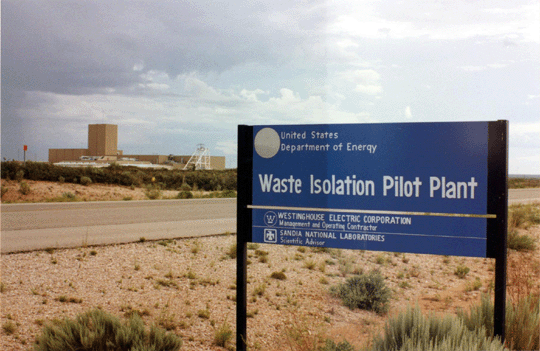 Roof collapses at WIPP raise new safety questions,Albuquerque Journal By Lauren Villagran / Journal Staff Writer Tuesday, December 6th, 2016 In a salt mine more than 2,000 feet underground where drums of nuclear waste are embedded in enormous rooms – some radiologically contaminated – workers heard a loud noise and saw a spray of salt dust.
Nuclear industry’s legacy – stranded wastes, safety fears, collapsing communities
 As nuclear plants age, risks rise, telegram.com Christine Legere, Dec 4, 2016
France launches investigation of Fessenheim nuclear power plant
The investigation was launched by the Paris Prosecutor’s office, AFP reported on Monday evening, citing judicial sources.
The Fessenheim power plant is in the Haut-Rhin department in Alsace, eastern France, near the German and Swiss borders.
The plant’s activity is endangering the lives of people and it has equipment which doesn’t fulfill the requirements of safety, according to the AFP report.
READ MORE: France’s nuclear watchdog wants to shut down 5 reactors over failure risk
All these concerns were previously voiced by Greenpeace, which accused AREVA, a group specializing in nuclear power and renewable energy, and Électricité de France (EDF) of inaction.
In October this year, Greenpeace called upon the Paris prosecutor to investigate the abnormalities of both reactors of the plant.
“EDF and AREVA were aware of serious irregularities on Reactor 2 at Fessenheim,” the statement said. “The defective part is a steam generator, an essential component of nuclear reactors.”
The group also called for the immediate shutdown of Reactor 1 of the plant.
Greenpeace also accuses EDF and AREVA of falsifying safety certificates of the plant so that the authorities won’t shut it down.
“EDF, as the operator, has in fact decided to give priority to economic interests instead of protecting people and the environment.”
Fessenheim has recently been the topic of heated discussion, which even took place in the Elysee Palace. In April, President Francois Hollande promised to formally initiate the shutdown of France’s oldest nuclear reactors on the grounds of environmental and safety concerns.
READ MORE: Hollande vows to shut down France’s oldest nuclear power plant
Also in October, the Nuclear Safety Authority (ASN) asked EDF to shut down and inspect the plant. Fessenheim houses two 920 megawatt reactors and has been running since 1978, making it France’s oldest operating nuclear power plant. The German government and activists alike have long been calling for it to be permanently closed.
The plant is situated on a seismic fault line, making it vulnerable to earthquakes and flooding. The German government has repeatedly called on France to terminate the Fessenheim plant as soon as possible, after an April 2014 accident when one of the reactors had to be shut down as water was found leaking from several places.
France has 58 nuclear reactors with a total capacity of 63.2 Gigawatts. The country gets two thirds of its electricity from nuclear energy.
EDF’s nuclear reactor troubles pose another hindrance to UK’s Hinkley project
New blow for Hinkley Point contractor EDF after French safety checks
Safety issues force many reactors offline with warnings of power cuts across France, higher energy prices and a rise in emissions, Guardian, Adam Vaughan and Kim Willsher, 4 Dec 16, The company building the UK’s first new nuclear power station for decades is facing questions over the health of its fleet of French nuclear plants after an investigation which has left the country with the lowest level of nuclear power for 10 years and the prospect of power cuts during a cold snap.
Thirteen of Électricité de France’s (EDF) 58 atomic plants are offline, some due to planned maintenance, but most for safety checks ordered by the regulator over anomalies discovered in reactor parts……..
The problems stem from a fault identified last year by the Nuclear Safety Authority (ASN) in the as-yet-unfinished reactor at north-western France’s Flamanville plant – the same design approved for Hinkley Point C in the UK…….
Nuclear critics believe the situation shows the need for France to diversify away from nuclear and invest more in renewable sources such as wind and solar power, which account for less than 4% of electricity generation, compared with 25% in the UK.
Charlotte Mijeon, of the anti-nuclear group Sortir du Nucléaire (Get Out of Nuclear), said there was a “chain of responsibility” for the crisis in France’s nuclear industry which ranged from the government at the top to subcontracted private suppliers.
“The system of nuclear safety in France has always been limited,” she said. “It starts from the premise that the industrials are honest and the moment there is a problem they will flag it up to the safety authorities and it will be sorted out.” https://www.theguardian.com/environment/2016/dec/02/hinkley-point-edf-new-crisis-safety-checks-french-nuclear-plants
Generals warn on the ‘unimaginable’ refugee crisis if global warming is not checked
 Climate change will stir ‘unimaginable’ refugee crisis, says military Unchecked global warming is greatest threat to 21st-century security where mass migration could be ‘new normal’, say senior military, Guardian, Damian Carrington, 1 Dec 16, Climate change is set to cause a refugee crisis of “unimaginable scale”, according to senior military figures, who warn that global warming is the greatest security threat of the 21st century and that mass migration will become the “new normal”.
The generals said the impacts of climate change were already factors in the conflicts driving a current crisis of migration into Europe, having been linked to the Arab Spring, the war in Syria and the Boko Haram terrorist insurgency.
Military leaders have long warned that global warming could multiply and accelerate security threats around the world by provoking conflicts and migration. They are now warning that immediate action is required.
“Climate change is the greatest security threat of the 21st century,” said Maj Gen Munir Muniruzzaman, chairman of the Global Military Advisory Council on climate change and a former military adviser to the president of Bangladesh. He said one metre of sea level rise will flood 20% of his nation. “We’re going to see refugee problems on an unimaginable scale, potentially above 30 million people.”
Previously, Bangladesh’s finance minister, Abul Maal Abdul Muhith, called on Britain and other wealthy countries to accept millions of displaced people.
Brig Gen Stephen Cheney, a member of the US Department of State’s foreign affairs policy board and CEO of the American Security Project, said: “Climate change could lead to a humanitarian crisis of epic proportions. We’re already seeing migration of large numbers of people around the world because of food scarcity, water insecurity and extreme weather, and this is set to become the new normal.
“Climate change impacts are also acting as an accelerant of instability in parts of the world on Europe’s doorstep, including the Middle East and Africa,” Cheney said. “There are direct links to climate change in the Arab Spring, the war in Syria, and the Boko Haram terrorist insurgency in sub-Saharan Africa.”……https://www.theguardian.com/environment/2016/dec/01/climate-change-trigger-unimaginable-refugee-crisis-senior-military
It could take just one offshore nuclear incident to bankrupt Ireland
Nuclear incident off our coast has potential to bankrupt Ireland, Irish Times, 2 Dec 16 Expert model shows best-case consequence of minor episode implies €4bn cost to State Dick Ahlstrom
NRC fines TVA for Browns Ferry violations
30 November 2016 The Tennessee Valley Authority (TVA) has been given 30 days to pay a $140,000 civil penalty proposed by the US Nuclear Regulatory Commission (NRC) for fire watch violations at the Browns Ferry nuclear power plant in Alabama. The violations relate to “numerous” occasions in May 2015 when five workers contracted to provide fire watch services failed to conduct roving fire watch patrols as required under NRC regulations. The patrols were required to compensate for fire protection equipment that was out of service at the time……..http://www.world-nuclear-news.org/RS-NRC-fines-TVA-for-Browns-Ferry-violations-301
1 This Month
26 April – Chernobyl: Inside the Meltdown airs on National Geographic on Sunday 26th April from 4pm

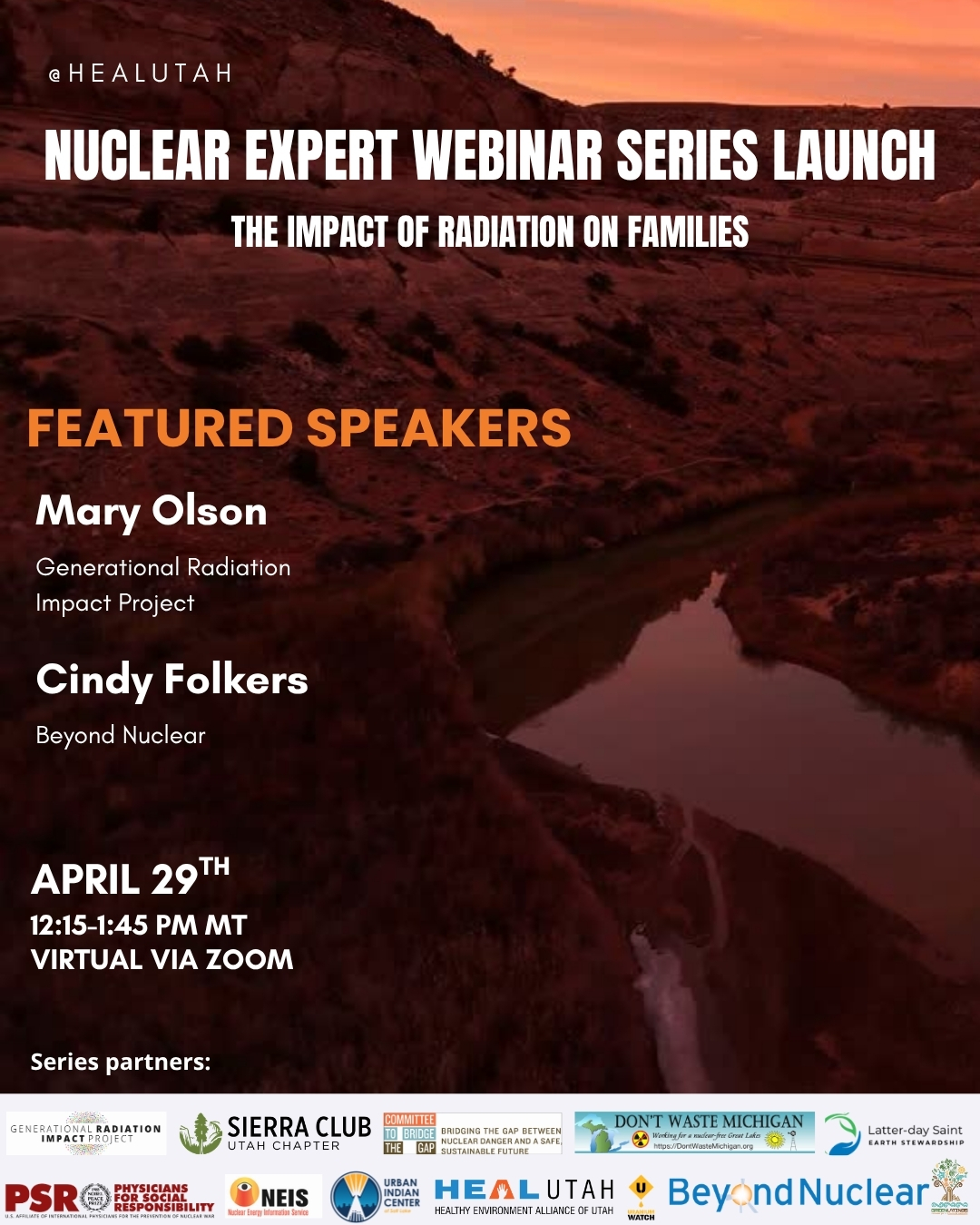
29 April – Nuclear Expert Webinar #1 – Radiation Impacts on Families with Mary Olson and Cindy Folkers
- 12:15 PM MT – 1:45 PM MT
- Location: Virtual – REGISTER TODAY

4 May -West Suburban Peace Coalition to discuss Iran war at May Educational Forum
Monday, May 4, 7:00 – 8:00 PM Central Standard Time
Title: : How Trump’s Narrative Tries to Shape the Reality of the War on Iran.
Contact Walt Zlotow, zlotow@hotmail.com 630 442 3045 for further information
14 May – online event From Bombs to Data Centres: the Face of Nuclear Colonialism

Pine Ridge Uranium is the real threat, not Tehran- Tell Burgum: Stop the Extraction.
Chernobyl: The Lost Tapes – A good documentary on Chernobyl on SBS available On Demand for the next 3 weeks– https://www.sbs.com.au/ondemand/tv-program/chernobyl-the-lost-tapes/2352741955560
To see nuclear-related stories in greater depth and intensity – go to https://nuclearinformation.wordpress.com
-
Archives
- May 2026 (12)
- April 2026 (356)
- March 2026 (251)
- February 2026 (268)
- January 2026 (308)
- December 2025 (358)
- November 2025 (359)
- October 2025 (376)
- September 2025 (257)
- August 2025 (319)
- July 2025 (230)
- June 2025 (348)
-
Categories
- 1
- 1 NUCLEAR ISSUES
- business and costs
- climate change
- culture and arts
- ENERGY
- environment
- health
- history
- indigenous issues
- Legal
- marketing of nuclear
- media
- opposition to nuclear
- PERSONAL STORIES
- politics
- politics international
- Religion and ethics
- safety
- secrets,lies and civil liberties
- spinbuster
- technology
- Uranium
- wastes
- weapons and war
- Women
- 2 WORLD
- ACTION
- AFRICA
- Atrocities
- AUSTRALIA
- Christina's notes
- Christina's themes
- culture and arts
- Events
- Fuk 2022
- Fuk 2023
- Fukushima 2017
- Fukushima 2018
- fukushima 2019
- Fukushima 2020
- Fukushima 2021
- general
- global warming
- Humour (God we need it)
- Nuclear
- RARE EARTHS
- Reference
- resources – print
- Resources -audiovicual
- Weekly Newsletter
- World
- World Nuclear
- YouTube
-
RSS
Entries RSS
Comments RSS
 nuclear-news