Hong Kong-based watchdog reports six minor incidents at Guangdong power suppliers last year, including accumulation of 3mm shrimps around water pipe at Ling Ao station, South China Morning Post, Ernest Kaoernest.kao@scmp.comhttp://twitter.com/ernestkaoWednesday, 19 April, 2017 Operators of a nuclear power plant in Shenzhen have surrounded water intake pipes with gill nets to prevent the accumulation of shrimp that caused a minor safety incident last year.
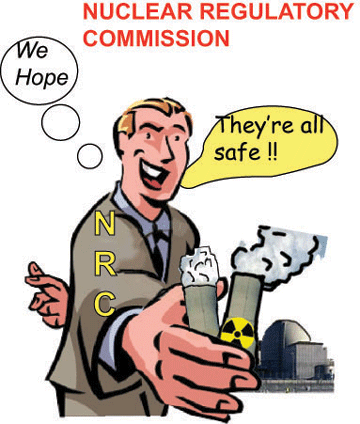
One example is the U.S. Nuclear Regulatory Commission, which oversees safety across a complex, privately owned network of nuclear power plants, used fuel storage facilities and other sites related to civilian uses of nuclear energy.
As a researcher studying communication in energy and environmental settings, I have followed the NRC’s work with particular interest since 2011. The agency and the system it regulates exemplify what some scholars call a “high reliability organization” – one that cannot be allowed to fail, because the consequences would be grave.
As studies have shown, failures of external oversight were key factors in the disasters at Chernobyl in 1986 and Fukushima in 2011. Those examples show that there is good reason to assess how today’s anti-regulatory climate could affect the NRC and nuclear safety in the United States.
An industry in flux
The NRC conducts risk-related research and develops and enforces rules for the design and operation of nuclear facilities nationwide. Today it is grappling with major challenges that will shape the future of nuclear power in the United States.
In response, the industry is relying on 20-year license renewals for existing reactors, which allow them to operate for up to 60 years. As of December 2016, the NRC had approved 87 renewal applications.
Now the agency is preparing to consider applications for “subsequent license renewals” that would extend reactor lifetimes to 80 years. This prospect poses new challenges. Notably, the NRC needs to analyze the safety implications of operating geriatric plants and develop regulatory rules to manage issues such as structural and operational risks.
At the same time, the industry is promoting new reactor designs, which advocates say will be safer and more cost-efficient than current plants. The NRC is building a framework for reviewing and licensing these untested new technologies – an enormous and safety-critical task.
Authorizing such facilities would require changes to the Nuclear Waste Policy Act, which currently allows only permanent disposal of used nuclear fuel. Nevertheless, the NRC is already engaged in new risk analysis and public communication issues related to these projects.
Used fuel now held at power plants would need to be packaged and moved long distances, secured safely for decades and ultimately moved again to its final disposal site. Communities are also concerned about whether current or interim sites could end up as long-term locations for “stranded” nuclear waste.
Meanwhile, the administration’s 2018 budget blueprint proposes reopening the licensing process for a permanent nuclear waste repository at Yucca Mountain in Nevada. President Obama ended work on licensing Yucca Mountain in 2010, so the NRC would need to reorganize its staffing and resources to resume work on the project.
Anti-regulatory challenges
The current anti-regulatory climate could affect the NRC in multiple ways. Broader executive and legislative developments, and a recent agency leadership change, provide early clues. For example, an executive order issued in January requires federal agencies to eliminate two rules for every new rule they create.
Because the NRC is formally designated as an independent regulatory agency, it might be exempt from this order. However, asked in March about that possibility, NRC Chair Kristine Svinicki responded ambiguously that although the agency is “in some ways beyond the reach” of such orders, she wants to “look to the spirit and intent” they express. It is hard to see how the NRC can develop new regulations for so many emerging activities and keep the U.S. nuclear industry operating safely while slashing existing rules.
When the House passed the latest version of the bill in January, New York Democratic Rep. Jerrold Nadler sought to exempt the NRC due to its safety-critical role, but his amendment was defeated.
The new chairman, who serves as the agency’s sole official spokesperson (working through staff), has espoused a commitment to public transparency but has not always acted accordingly. For example, although up-to-date archives of speeches and testimony by the other commissioners are provided with their NRC website biographies, a recent look at the link for Commissioner Svinicki showed none more recent than 2012.
Svinicki’s appointment will expire on June 30, and the NRC cannot normally operate without a three-member quorum, so action on her reappointment or replacement will soon be needed. Two additional seats on the five-member commission remain open. This will be an important time to look closely at the backgrounds and qualifications of nominees.
To regulate the industry effectively, commissioners must have a firm grasp of the technical and administrative complexities of nuclear safety. Watchdog groups have called on the NRC to enforce safety regulations more aggressively and to promote greater confidence that staff members can bring problematic issues to light.
As a specialized agency working in a highly technical area, the NRC does not usually receive much public or media attention – except when nuclear failures occur at home or abroad. Although there have been more close calls in the United States than is generally understood, NRC oversight has been crucial to the industry’s overall positive safety record.
A high reliability organization is not automatically a highly reliable organization. Reliability is an ongoing accomplishment involving continuous learning, sustained vigilance and a strong system of checks and balances. Moving forward in an anti-regulatory climate, with so many complex challenges facing the agency, it is essential to ensure independent leadership, public transparency and adequate resources to support the NRC’s mission.
Nuclear Plant Exempted From Regulations As Shutdown Nears http://www.chem.info/news/2017/04/nuclear-plant-exempted-regulations-shutdown-nearsPLYMOUTH, Mass. (AP) — The only nuclear power plant in Massachusetts won’t have to comply with certain safety requirements as it prepares to shut down, getting a pass on precautions put in place after the Fukushima disaster in Japan.
The U.S. Nuclear Regulatory Commission, or NRC, says that Pilgrim Nuclear Power Station won’t have to upgrade its vent system before it closes in 2019, despite not meeting all standards. It will also be exempted from seismic and flooding regulations established after the Fukushima meltdowns.
An NRC spokesman says the plant doesn’t have time to complete necessary upgrades and they wouldn’t meaningfully improve safety.
Earlier this month, federal regulators said the plant is safe to operate despite some “performance deficiencies.”
Democratic Senator Edward J. Markey says the decision undermines the safety of people living nearby.
While all incoming cargo into the port is scanned by radiation detecting equipment, the new system automates the process to expedite trade and provide a needed layer of nuclear protection. Approximately two million containers pass through the TraPac terminal every single year.
The new process begins as rail-bound cargo is placed on conveyers by automated carriers. The system then transports the cargo through a radiation portal monitor for detection. If all cargo passes the security check, the cargo is then transported to rail carriers for transportation to its final destination.
TraPac originally envisioned the system as part of a move to automate scanning processes. At the same time, U.S. Customs and Border Protection needed a new means to scan ship-to-rail containers for radioactive materials. DHS then worked with the Pacific Northwest National Laboratory to test, evaluate, and approve the new system for live rail operations.
DHS said the new system offers a more efficient approach to preventing illicit radioactive materials from entering the country.
Skagit Valley Herald, Apr 13, 2017 RICHLAND, Wash. (AP) — A shipment of nuclear waste from a commercial power plant located on the Hanford Nuclear Reservation in Washington state was improperly labeled when it was trucked to a commercial disposal site, the Nuclear Regulatory Commission said.
As a result, Energy Northwest, the consortium that operates the Columbia Generating Station nuclear plant, has been temporarily barred by state regulators from sending waste to the US Ecology disposal site located on leased Hanford land, the Tri-City Herald (http://bit.ly/2pyWwWi ) reported Thursday.
The Energy Northwest plant makes electricity and is located on the sprawling Hanford site, which is half the size of Rhode Island. Energy Northwest is separate from Hanford’s past mission of creating plutonium for the nation’s nuclear weapons, which ended in the 1980s. Plutonium production left Hanford with the nation’s largest collection of radioactive waste.
The sirens located within the 10-mile radius of the three reactors operated by PSEG Nuclear, are scheduled to sound at 7:20 p.m., according to company spokesman Joe Delmar.
The sirens — 34 in New Jersey and 37 in Delaware –will sound for three minutes. They are part of the alert system that would inform those living near the Artificial Island complex in case of an emergency at one of the nuclear plants.
Parts of Salem and Cumberland counties in New Jersey and in New Castle and Kent counties in Delaware all fall within the 10-mile radius of the plants.
During the siren tests residents are not required to do anything. n an emergency, such as the accidental release of a large amount of radiation, the sirens would alert those living near the generating complex to tune to radio stations WENJ-FM 97.3 or Marine Channel 16 in New Jersey for official information on what steps they should take.
The stations in Delaware include WKNZ-FM 88.7, WDEL-AM 1150, WDDE-FM 91.1, WSUX-AM 1280, WDSD-FM 94.7, WWTX-AM 1290, WSTW-FM 93.7, WDOV-AM 1410, WRDX-FM 92.9, WILM-AM 1450, WJBR-FM 99.5 and Marine Channel 16.
These radio stations are part of the Emergency Alert System.
Depending on the emergency, residents in the 10-mile zone could be directed to shelter in place or evacuate.
Information about what to do in an emergency is also available online. he three reactors operated by PSEG Nuclear at Artificial Island make up the second-largest commercial nuclear complex in the U.S. in terms of power output. Only the Palo Verde complex in Arizona produces more electricity.
nuClear News No.94 April 2017 The UK’s Office for Nuclear Regulation (ONR) has published its assessment of the Periodic Safety Review (PSR) for Hunterston B (HNB) and Hinkley Point B (HPB). ONR has also accepted EDF’s revised graphite core safety case for both sites, but has included a number of recommendations as part of this acceptance. Acceptance of the safety case is reliant on a revised inspection and monitoring strategy. (1)
To comply with a nuclear site licence, a periodic review – a comprehensive study of plant safety – is carried out every ten years to justify continued safe operations. This requirement means that the site licence company regularly reviews and reassesses safety at nuclear sites, making improvements where necessary. The four Hunterston B and Hinkley Point B advanced gascooled reactors (AGRs) started up in 1976 are scheduled to close in 2023.
Graphite The graphite core of each of the reactors is made up of around 6000 graphite bricks – 3000 of these are the graphite bricks containing fuel channels – which are all connected together. Graphite ageing is one area used to determine the lifespan of an AGR nuclear power station. EDF says greater understanding of the ageing process by sampling and modelling can lead to them operating safely for longer.
In November 2015, EDF Energy said it had found cracks in three of the graphite bricks in one of the Hunterston B reactors. Similar cracks were found in October 2014 in two of the graphite bricks of the other reactor. A recent BBC Radio Programme revealed that the
ONR was considering doubling the limit it had set on the percentage of cracked bricks it is willing to accept from 10% to 20%. This has been a particularly controversial part of this process with people living near theses reactors finding it difficult to understand why the definition of “safe” seems to be changing. ONR has now agreed to this increased limit. It says:
“Continued operation of HPB/HNB reactors is now supported by NGL’s [EDF’s] safety case NP/SC 7716 which sets an operational limit of 20% cracking in the core. The justified period of operation of each reactor at HPB/HNB is therefore dependent upon the findings from the inspections at each outage.”
The ONR is also concerned about a very specific form of cracking. The keyway is a slot that holds each brick to the adjacent brick, the bricks underneath and the bricks on top. These keyways, which are acknowledged to be the limiting factor in the life of these reactors, are beginning to fracture. John Large points out that this will make the graphite blocks a very loose set of bricks. Seven of the keyways have been discovered to have cracks at Hunterston B. John Large believes the presence of keyway cracks casts doubt on the safety of the reactor in the event of an emergency like an earthquake. If the core becomes misaligned, and the fuel modules get stuck in the core, the fuel temperature will get raised and could undergo a melt. If the radioactivity gets into the gas stream and the reactor is venting because it’s over pressurised then you have a release to the atmosphere and you have dispersion and a contamination problem.
John Large says that if the cracks get any worse it could jeopardise the reactor’s stability in the event of a significant disaster – such as a small earthquake – and make it impossible to lower control rods to shut the reactor down. He said: “These keyways are beginning to fracture… that means the locking together – the way that force can be transferred from one brick to another – is lost, so it becomes a very loose stack of bricks.” Allan Jeffrey of Stop Hinkley added: “This weakness in the graphite core could end up distorting the channels the fuel and the boron control rods use. In cases of emergency there are sudden changes in temperature and pressure which could all end up starting to deform these channels. If you can’t get the control rod down then you can’t control the temperature inside the reactor and you’re heading for accidents – possibly even meltdowns.” (2)
ONR said that EDF had attempted to predict the rate of KWRC. Originally the first cracks were not expected to occur until 2019, but the first KWRC was observed at Hunterston B in 2015.
Inspection will “play a crucial role in supporting the period of safe operation of the reactor in later life,” the regulator said, adding that certain improvements are necessary, such as the development of a capability to measure the condition of control rod channels. EDF Energy should develop improved inspection and monitoring technology; in particular equipment capable of performing visual inspection and dimensional measurements of control rod channels, it said. http://www.no2nuclearpower.org.uk/nuclearnews/NuClearNewsNo94.pdf
This summer, a giant Russian typhoon-class nuclear submarine, 172 metres in length, is expected to pass Denmark.
The submarine will depart from Russia, pass Norway and then sail into the North Sea and the Skagerrak, onwards into the Baltic, where it will finally dock in St Petersberg, the Barents Observer writes. The sub will pass underneath the Øresund Bridge as the water is not deep enough by the Great Belt Bridge or at Flintreden.
All the preparations are underway, and now all that is needed is the signature of Russian President Vladimir Putin.
No nukes, please!
The submarine was built in 1981 and has the capacity to carry up to 20 missiles and 200 nuclear warheads at a time. However, nowadays it is used as a test platform for ballistic missiles and is based in the town of Severodvinsk in western Russia.
The age of the vessel might be cause for concern, though, according to Norwegian atomic physicist Nils Bøhmer.
“I’m worried when a 40-year-old atomic submarine with a relatively large reactor aboard sails along the Norwegian coast and into the Baltic,” he told Barents Observer.
“The authorities have to know the exact time of its voyage in order to be prepared. It is also vital to ensure there are not atomic weapons on board.”
Workers incorrectly opened and shut certain valves, causing water to flood from a massive storage tank to an area of the reactor known as the torus. The torus plays a role in depressurizing and cooling down the reactor in case of a serious accident.
“This was a breakdown in the process that shows lack of adherence to procedure,” according to a spokesman for the Nuclear Regulatory Commission. He said there were no immediate safety concerns.
At noon on Friday, Pilgrim operators were flushing pipes in the reactor’s cooling system in preparation for an upcoming refueling. They opened a valve on the torus without first closing the valve on the water storage tank. Water being drained into the torus, setting off an alarm in the control room.
“This volume of water placed the torus level above the administrative limit for readiness should an unplanned event occur,” a spokesman for plant owner Entergy Corp. told the Cape Cod newspaper. “Station personnel appropriately responded to close the valves and processed and filtered the water from the torus back to the condensate storage tanks.”
Friday’s flood was the second recent serious incident involving operator error. On March 27, workers triggered the wrong switch, causing the temporary shutdown of a coolant injection system that is essential to cool the plant in a severe emergency.
Federal regulators in 2015 labeled Pilgrim as one of the three worst performers in the country and placed under increased oversight for safety violations and unplanned shutdowns.
Soon thereafter, Entergy announced it would close Pilgrim permanently in mid-2019 due to poor market conditions and increased operational costs. The closure will remove 680 megawatts of capacity from the New England power grid.
There have been a number of problems and violations at the aging nuclear power plant in recent years. Pilgrim has reportedly logged $40 million in annual losses.
Intelligence agencies fear ISIS and other terrorist groups could have developed ways to plant explosives in laptops and mobile phones which can bypass airport security screening methods, the Telegraph reports. Last month, Britain and the US banned travellers from a number of countries carrying laptops and large electronic devices on board.
They also fear terrorists, foreign spies and hackers could try to break into nuclear power station security systems.
Jesse Norman, the energy minister, said nuclear plants must ensure they ‘remain resilient to evolving cyber threats’.
Mr Norman told the paper: ‘The Government is fully committed to defending the UK against cyber threats, with a £1.9 billion investment designed to transform this country’s cyber security.’
Terrorists are feared to have developed the technology after getting hold of airport screening equipment allowing them to experiment.
FBI experts have tested how explosives can be hidden inside laptop battery compartments so that it can still be turned on.They are said to have concluded that the technique would be achievable using everyday equipment.
In a statement, the US Department of Homeland Security said: ‘Evaluated intelligence indicates that terrorist groups continue to target commercial aviation, to include smuggling explosive devices in electronics.
‘The US government continually reassesses existing intelligence and collects new intelligence. ‘This allows us to constantly evaluate our aviation security processes and policies and make enhancements when they are deemed necessary to keep passengers safe.’
Last year al-Shabaab, an al-Qaeda affiliate group in Somalia, detonated a bomb on a flight from Mogadishu to Djibouti by hiding it in a part of a laptop where bomb-makers had removed a DVD drive.
April 2, 2017 Britain: Britain raised its terrorism alert in the past 24 hours saying that the Islamic State (IS, formerly ISIS) group operating in Syria and Iraq may have developed ways of bypassing nuclear power station security measures.
According to Intelligence agencies, the terrorist groups have developed ways to plant explosives in laptops and mobile phones that can evade airport security screening methods.
Energy minister Jesse Norman said that the government was “fully committed to defending the UK against cyber threats, with a £1.9 billion investment designed to transform this country’s cyber security.”
The growing threat of attack on Britain’s 15 operational reactors, which account for nearly a fifth of the country’s electricity from terrorists, foreign spies and “hacktivists” remains high.
Norman said the civil nuclear strategy published in February sets out ways to ensure that the civil nuclear sector “can defend against, recover from, and remain resilient in evolving cyber threats.”
Deputy director-general Professor Malcolm Chalmers of the Royal United Services Institute, an independent think tank for defence and security, said that it was crucial for the Government to “respond rapidly”.
ISIS ‘can plant bombs in laptops and mobile phones that will get through airport screening undetected’ http://www.mirror.co.uk/news/world-news/isis-can-plant-bombs-laptops-10146339Experts fears terrorists made a breakthrough after obtaining airport screening equipment to experiment and there are fears they will use the techniques at US and European airports, BY TOM PARR, 2 APR 2017
Intelligence agencies believe ISIS has developed ways to plant explosives in laptops and mobile phones that can evade airport security screening methods.
The warning by security services has led to Britain’s airports and nuclear power stations being instructed to tighten their defences against terrorist attacks.
It is this new information which is thought to have led the US and Britain to ban travellers from a number of countries carrying laptops and large electronic devices on board.
Now there are concerns that terrorists will use the techniques to bypass screening devices at European and US airports.
Some experts fears terrorists made a breakthrough after obtaining airport screening equipment to allow them to experiment. FBI experts have tested how the explosives can be hidden inside laptop battery compartments in a way that allows a computer still to be turned on.
Manny Gomez, a former FBI special agent, said: “We had the shoe bomber, cartridge attempt, now this is the next level. We need to be several steps ahead of them.”
The explosives were hidden in a part of a laptop where bomb-makers had removed a DVD drive. The bomber was blown out of the window but the plane survived.
Now, the Nuclear Power Corporation of India (NPCIL) plans to deploy drones for the purpose at the Madras Atomic Power Station (MAPS) near Kalpakkam in Tamil Nadu.
While MAPS would be the first such facility in the country to use drones for general surveillance and intrusion detection, they were famously deployed by Japanese engineers at the Fukushima Daiichi nuclear power plant after the nuclear accident of 2011.
The Kalpakkam plant, located 70 km from Chennai, is also in the vicinity of other sensitive installations of the Department of Atomic Energy (DAE) such as the Indira Gandhi Centre for Atomic Research, the Fast Breeder Reactor Project, the BARC-run nuclear desalination demonstration plant and Kalpakkam fuel reprocessing plant.
Sources close to the development said tenders are likely to be floated by the NPCIL for procuring the drones and their control systems this fiscal. The use of drones will also require clearances from the Atomic Energy Regulatory Board (AERB), the regulator for all atomic energy institutions in the country.
Both aerial and ground level drones are capable of large-scale territorial surveillance. They are fitted with video cameras and other sensors that allow continuous surveillance of facilities.
Sources said the cameras mounted on the drones could be programmed to scan for certain topographical features on the ground and if there is a mismatch between the programmed image and the live feed from drones, alarms would go off.
Lt Gen DS Hooda (Retd), who served as Chief of Northern Army Command, told BusinessLine that the Army had been using drones on the India-Pakistan border and in Kashmir region. Drones allow the forces to get a bird’s eye view of the terrain and identify intruders hiding in tall structures. Drones would prove to useful in securing large installations, he said.
In 2016, the No. 1 tourist destination of Ukraine was the lifeless town of Pripyat, evacuated after the deadly reactor meltdown at Chernobyl in 1986. Today, Ukraine relies on nuclear power for 53 percent of its power generation, but is risking another nuclear accident on a scale greater than Europe — and the world — could imagine.
The problems facing Ukraine’s nuclear power industry are multi-faceted, but the main issue is the same one plaguing the whole of the former Soviet republic — corruption, which is breeding a lack of accountability and mismanagement of the sector’s critical infrastructure.
Ukraine’s nuclear power plants are supposed to be regulated by the State Nuclear Regulatory Inspectorate of Ukraine (SNRIU), which by law is an independent regulatory body. In recent years, however, it has become standard practice for the leaders of SNRIU to be appointed by the state nuclear power plant operator, Energoatom, instead of through a rigorous, independent selection process.
This, perversely, subjugates the regulator to the whims of the operator. If Energoatom cannot meet certain safety standards or deadlines, its bosses simply inform the regulator of such, and the deadlines are extended or eliminated, public safety be damned.
In addition, many positions at the regulatory body remain empty. For example, the position of the chief state inspector of nuclear and radiation safety has been vacant for three years. Other key posts of the Ukrainian nuclear regulator remain vacant.
GIL SCOTT HERON – WE ALMOST LOST DETROIT (LIVE AT 98.3 SUPERFLY)
This Day in History: America’s Worst Nuclear Fears Realized at Three Mile Island Plant, VOA, 28 Mar 17, Thirty-eight years ago today — March 28, 1979 — disaster struck at 4 a.m. at the Three Mile Island (TMI) nuclear power plant in central Pennsylvania after its cooling system failed.
It remains the worst nuclear accident in American history. A simple plumbing failure prevented the main feedwater pumps from sending water to generators that remove heat from the plant’s core reactor.
During those pre-dawn hours, the temperature of the reactor rose steadily even as staffers were unaware that a valve in the emergency cooling system had become stuck in place, allowing cool water to flow through the valve — not reaching the reactor.
Instruments in the control room misled operators, who thought the cooling system was working normally.
As coolant flowed from the primary system through the valve, other instruments available to reactor operators provided inadequate information. There was no instrument that showed how much water covered the core. As a result, plant staff assumed that as long as the pressurizer water level was high, the core was properly covered with water.
As alarms rang and warning lights flashed, the operators did not realize that the plant was experiencing a loss-of-coolant accident — or, rather, the beginnings of a nuclear meltdown. And just after 6:00 am, data indicated the core reactor had overheated so much that radiation was detected inside the control room.
In the months following the accident, questions were raised about possible adverse effects from radiation on human, animal and plant life around the nuclear power plant, although none could be directly correlated to the accident.
Thousands of environmental samples of air, water, milk, vegetation, soil and foodstuffs were collected by various government agencies monitoring the area.