Nuclear site given more time to fix safety breach
Jason Arunn Murugesu, BBC News, North East and Cumbria, 4 Apr 25,
https://www.bbc.co.uk/news/articles/cgkgxdddmlyo
A nuclear site which breached hazardous substance regulations has been given more time to figure out how best to protect workers.
Last year, the Office for Nuclear Regulation (ONR) served two improvement notices on Sellafield Ltd, near Whitehaven, Cumbria, after it “failed to manage the risks of working with nickel nitrate and to prevent or adequately control exposure of workers to this hazardous substance”.
The breaches did not compromise either nuclear or radiological safety, the ONR said.
Sellafield Ltd said it had completed one improvement notice and “significant progress” had been made on the other. It has until September to come up with a solution.
Used in the treatment of effluent, nickel nitrate is not radioactive but is a hazardous substance and could cause harm to the health of a worker exposed to it.
To mitigate these risks, operations involving the chemical should be conducted in a glovebox to protect workers from any harmful health effects.
However, contamination was found outside the glovebox area at a Sellafield facility, which resulted in workers potentially being exposed to the chemical, the ONR previously said.
A poorly designed and maintained glovebox appeared to have contributed to the situation, it added.
‘Technical challenges’
Sellafield Ltd was required to complete a nickel nitrate risk assessment by the end of October, and to “prevent or adequately control” the exposure of workers to nickel nitrate by March.
However, the ONR said “technical challenges” had come to light regarding the exposure of workers to the material and it would now give the nuclear plant until 30 September to come up with a solution.
Hygiene controls would remain in place in the facility, monitored by an occupational hygienist, until full compliance with both improvement notices was achieved, the ONR explained.
Pearl Harbor update brings nuclear risk
Star Advertiser March 30, 2025, Lynda Williams
Kevin Knodell’s recent article highlights the significance of Dry Dock 5 at Pearl Harbor, but omits a critical detail: this facility is set to host the U.S. Navy’s most lethal nuclear-powered and nuclear-armed submarines (“‘An emphasis on lethality,’” Star-Advertiser, March 23).
This will likely transform Hawaii’s role in the U.S. nuclear arsenal by accommodating Ohio-class and, eventually, Columbia-class ballistic missile submarines, each capable of carrying Trident missiles with multiple nuclear warheads.
The detonation of even a single modern warhead could result in millions of deaths and potentially trigger a nuclear winter, devastating the global biosphere.
An accident on such a submarine near Pearl Harbor would be catastrophic and could cause widespread contamination across Hawaii. Hawaii’s residents were not consulted about housing nuclear-armed submarines in Honolulu. Please do not whitewash or sugarcoat the dangers associated with housing these submarines in our community……………………………………….. https://lyndalovon.blogspot.com/2025/03/my-op-ed-in-honolulu-star-advertiser.html?m=1&fbclid=IwY2xjawJYOxdleHRuA2FlbQIxMQABHXmnePII2HU6StRh1n7LgFionyc9TcmHIMLXETxISQeaZWtElxJvUl_axg_aem_RhuD_LZZLNNZDjuYWl-yGg
Risks posed by hole in protective shell over Chernobyl
Lilia Rzheutska, DW, March 29, 2025,
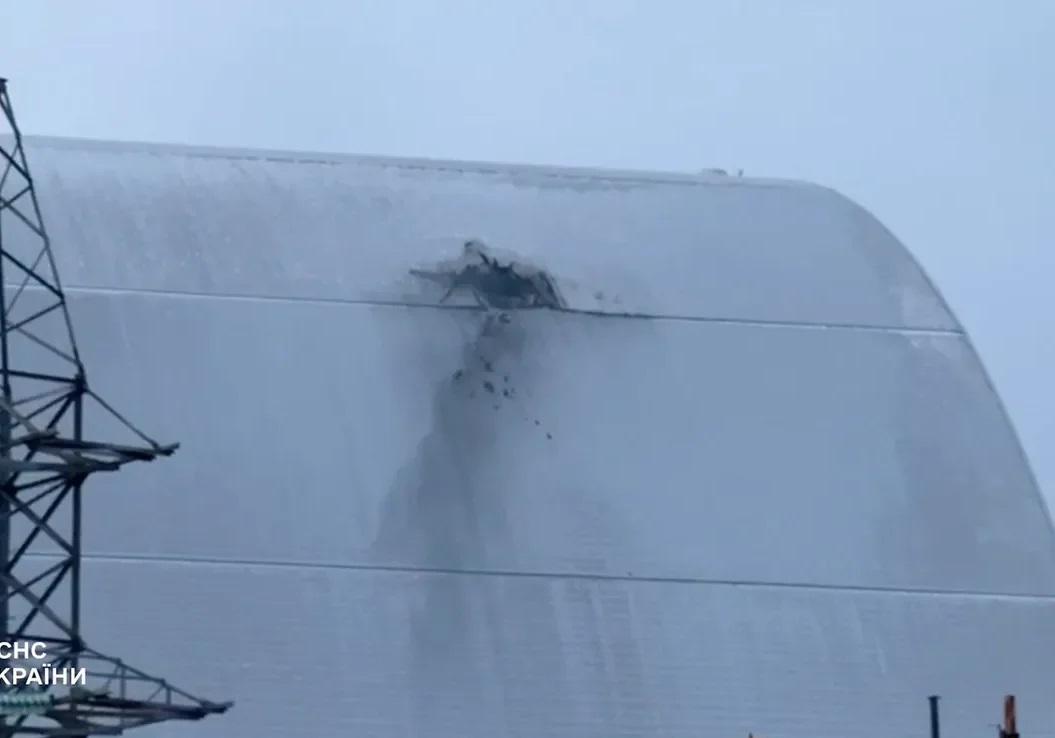
When it was erected in 2019, the giant shell over the damaged nuclear reactor in Chernobyl was one of the biggest structures ever moved by humans. In February a Russian drone put a hole in it.
For weeks, the Ukrainian authorities have been looking for ways to repair a large hole in the protective shell that covers the fourth reactor of the decommissioned Chernobyl nuclear plant. On February 14, a Russian drone hit the structure, which is called the New Safe Confinement, or NSC, because it is meant to “confine” the reactor’s radioactive remains. The drone started a fire that caused considerable damage and was only extinguished three weeks later on March 7.
“The main mission is to close the hole, which is about 15 square meters [around 162 square feet] in size, but also the more than 200 small holes that the State Emergency Service of Ukraine drilled into the shell during firefighting operations,” said Hryhoriy Ishchenko, the head of the State Agency of Ukraine on Exclusion Zone Management, which is responsible for the area around the Chernobyl power plant.
He told DW that experts would soon be arriving on site to examine the structure and that “preliminary recommendations on the repair work should be available within a month.”
A €1.5 billion megaproject
The NSC was erected over a pre-existing protective shell called the sarcophagus, which is there to prevent the release of radioactive contaminants from the reactor, which exploded in 1986. The NSC was built after 45 donor countries came together and gathered around €1.5 billion for the project. Eventually 10,000 people from 40 countries would play a part in the shell, which took 12 years, from the signing of contracts to the moment the NSC was ready in 2019. …………………………
Although experts say the drop in pressure in the NSC does not pose any immediate threat, there are other dangers. Dmytro Humeniuk, a safety analysis expert at Ukraine’s State Scientific and Technical Center for Nuclear and Radiation Safety said it was currently impossible to dismantle the old sarcophagus. The NSC was built in part to replace the old shell but inside the old shell, there are still 18 unstable beams. Three of the main beams could reportedly collapse at any time. If this were to happen under the new-but-now-damaged protective structure, radioactive dust could be stirred up and radioactivity released, Humeniuk said. “The protective shell is currently not fulfilling its function, which is to contain the nuclear fission products beneath it.”………………………….
For Jan Vande Putte, a nuclear expert at Greenpeace Ukraine, there are very few options. “Due to the high radiation levels above the sarcophagus, the entire Chernobyl protective shell will probably have to be moved back to the place where it was built on rails before the expensive repairs can be carried out,” he said adding that the costs of doing this were completely unknown.
Representatives of the European Bank for Reconstruction and Development visited Chernobyl on March 18 and spoke with the power plant’s directors, according to a report on the power plant’s website. They also inspected the technical units of the NSC and the area under the protective shell.
After the meeting, €400,000 from the International Chernobyl Cooperation Account, which the European Bank manages, was approved for a specialist-led damage assessment. https://www.dw.com/en/risks-posed-by-hole-in-protective-shell-over-chernobyl/a-72078360?fbclid=IwY2xjawJV0VZleHRuA2FlbQIxMQABHfhIgvFmxHhPebzUFjc8wxY4HEGBSRbgMxQdAOL2rCSoRY-S4A1j5U8wvw_aem_qeZu8AA
Russia rules out transferring control over Zaporizhzhia Nuclear Power Plant to Ukraine

the plant being jointly operated, including with the participation of international organizations,
“In this case, for example, it is impossible to properly ensure nuclear and physical nuclear safety, or regulate issues of civil liability for nuclear damage.
Transfer of the facility or control over it to Ukraine or any other country is ‘impossible,’ says Foreign Ministry
Burc Eruygur 26.03.2025, https://www.aa.com.tr/en/russia-ukraine-war/russia-rules-out-transferring-control-over-zaporizhzhia-nuclear-power-plant-to-ukraine/3520006#
Russia on Tuesday rejected transferring control over the Zaporizhzhia Nuclear Power Plant (ZNPP) to Ukraine or any other country, saying it is “impossible.”
US President Donald Trump and his Ukrainian counterpart Volodymyr Zelenskyy discussed the situation surrounding energy supplies to Ukraine and the country’s nuclear power plants during a phone call last Wednesday.
Trump told Zelenskyy that the US could be “very helpful in running the plants with its electricity and utility expertise” and that “American ownership of those plants could be the best protection for that infrastructure,” according to a White House statement.
Zelenskyy told journalists at a briefing later that he and Trump did talk about the restoration of the ZNPP and that Ukraine is ready to discuss the modernization of the plant but they did not discuss the issue of ownership of the plant.
A statement by the Russian Foreign Ministry stressed that the plant is a “Russian nuclear facility,” saying the transfer of the facility or control over it to Ukraine or any other country is “impossible.”
“All the station’s employees are citizens of the Russian Federation. Their lives cannot be played with, especially considering the atrocities that Ukrainians have committed and continue to commit on the territory of our country,” it said.
The statement also denied the possibility of the plant being jointly operated, including with the participation of international organizations, describing this as having “no such precedents in world practice.”
“In this case, for example, it is impossible to properly ensure nuclear and physical nuclear safety, or regulate issues of civil liability for nuclear damage.
The statement also denied the possibility of close cooperation between NATO intelligence services with Ukraine, which have impressive sabotage potential, makes it impossible, including with the participation of international organizations, describing this as having “no such precedents in world practice.”
“In this case, for example, it is impossible to properly ensure nuclear and physical nuclear safety, or regulate issues of civil liability for nuclear damage.
“An important aspect is that close cooperation between NATO intelligence services with Ukraine, which have impressive sabotage potential, makes it impossible to even temporarily admit representatives of these states to the ZNPP,” the statement added.
The situation around the Zaporizhzhia Nuclear Power Plant, Europe’s largest and one of the world’s 10 biggest, particularly remains tense as concerns persist over a possible nuclear disaster involving Moscow and Kyiv, both of which have frequently accused each other of attacks around the facility.
Since Sept. 1, 2022, International Atomic Energy Agency (IAEA) personnel have been present at the plant, which has been under Russian control since March 2022.
What is the fate of Russian-held Zaporizhzhia nuclear power plant after Trump talks?
The Zaporizhzhia Nuclear Power Plant is one of the world’s 10 largest and Europe’s biggest
Hanna Arhirova, Friday 21 March 2025, https://www.independent.co.uk/news/world/europe/ukraine-nuclear-power-plants-trump-putin-b2719353.html
President Donald Trump suggested a potential transfer of Ukrainian power plants to US ownership during a call with Ukrainian President Volodymyr Zelensky, according to a US statement.
The discussion, later clarified by Zelensky, centred on the Zaporizhzhia Nuclear Power Plant (ZNPP), currently under Russian occupation.
While the plant remains connected to Ukraine‘s grid, it is not producing electricity, raising questions about the feasibility and nature of any future US involvement.
The Zaporizhzhia Nuclear Power Plant is one of the world’s 10 largest and Europe’s biggest.
Who controls the Zaporizhzhia Nuclear Power Plant
Located in Ukraine’s southern Zaporizhzhia region, Russian forces occupied it shortly after Moscow’s February 2022 invasion.
While Russia declared the region annexed in Autumn 2022, its largest city, Zaporizhzhia, remains under Ukrainian control.
Ukraine has accused Russia of stationing troops and weapons at the plant and using it as a launchpad for attacks across the Dnipro River. Russia denies this, accusing Ukraine of shelling the facility.
How many nuclear power plants does Ukraine have?
Besides Zaporizhzhia, Ukraine operates three active nuclear power plants, which generate the majority of the country’s electricity following sustained Russian attacks on thermal and hydroelectric plants.
These facilities are located in southern, western and northwestern Ukraine, away from frontline areas.
What did Trump and Zelenskyy discuss and are there negotiations over Zaporizhzhia’s fate?
During their call on Wednesday, Trump suggested that Zelensky should consider giving the US ownership of Ukraine’s power plants to ensure their long-term security, according to a White House statement from US Secretary of State Marco Rubio and National Security Adviser Mike Waltz.
“American ownership of those plants could be the best protection for that infrastructure,” Trump suggested, according to the statement.
Zelensky later told journalists their conversation focused on the Zaporizhzhia nuclear power plant, and the following day, made it clear that “the issue of ownership” of the other three plants was never discussed.
“All nuclear power plants belong to the people of Ukraine,” he said.
Zelenskyy said that when they discussed Zaporizhzhia, the US leader had inquired about the facility’s future. “Trump asked my thoughts on the plant,” Zelensyy said. “I told him that if it is not Ukrainian, it will not operate. It is illegal.”
Even though ZNPP is a state-owned plant, Zelenskyy acknowledged that if the US were to claim it from Russian control, invest in it and modernise it, Ukraine might consider it. “That is a separate question, an open one,” he said.
What is the current state of Zaporizhzhia’s nuclear plant?
Since falling under Russian control, the plant’s conditions have deteriorated. While its six reactors have been shut down for years, they still require power and qualified staff to maintain cooling systems and safety features.
Energoatom, Ukraine’s state nuclear operator, said that after Russian forces took over, Ukrainian personnel were forced to sign contracts with Russian authorities and take Russian citizenship. Those who refused faced abduction or threats, forcing thousands to flee, leaving the facility understaffed and harder to manage.
The collapse of a dam in June 2023 further jeopardised the plant’s cooling systems, which relied on water from the reservoir. In response, plant administrators dug wells, according to the International Atomic Energy Agency (IAEA).
Zelensky said extensive repairs would be needed before the plant could operate again, estimating the process could take at least two years.
The IAEA has repeatedly warned the war could cause a radiation leak. While the plant no longer produces electricity, it still holds large amounts of nuclear fuel, requiring constant cooling.
Regular blackouts caused by the fighting have disrupted the facility, though power has been quickly restored each time.
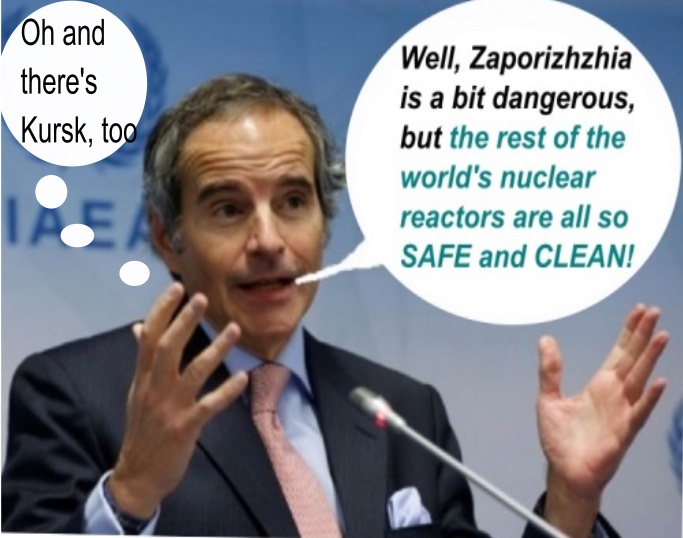
IAEA experts permanently stationed there still face restricted access, with Russian authorities blocking some inspection requests, according to IAEA head Rafael Grossi.
Is any kind of deal imminent?
Zelensky said the discussions with Trump on restoring Zaporizhzhia were a positive step, but cautioned that no one would work at the plant if Russian forces remained stationed nearby.
Control over the plant is likely to remain a legal and logistical challenge, intertwined with a highly divisive issue for both warring sides: control over the land itself.
Russian troops hold the area, while Ukrainian forces are separated from it by the Dnipro River and more than 100 kilometres (62 miles) of terrain.
Leak is Sellafield’s ‘biggest environmental issue’

BBC 21st March 2025,
The head of the Nuclear Decommissioning Authority (NDA) called the silo “Britain’s most hazardous building” He said it was the “single biggest environmental issue” facing the nuclear plant
A longstanding leak at “Britain’s most hazardous building” is a nuclear plant’s “single biggest environmental issue”, a select committee has heard.
The leak in the Magnox Swarf Storage Silo (MSSS) – built more than 50 years ago at Sellafield in Cumbria – started in 2019 after first occurring in the 1970s.
Labour MP Luke Charters told the Public Accounts Committee (PAC) on Thursday that every three years the silo leaked enough material to fill an “Olympic-sized swimming pool”.
Sellafield head Euan Hutton said the leak did not “pose a detriment to the public”.
The silo contains Magnox fuel cladding, mostly made up of magnesium, which was removed from nuclear fuel rods.
It was built in the 1960s, with three further extensions built in the 1970s and 1980s.
The leak is being caused by a crack in the underground portion of the silo, Mr Hutton told the committee.
He said the team had “excellent ground modelling and monitoring” which showed the activity was staying in the ground beneath the facility.
The head of the Nuclear Decommissioning Authority (NDA) called the silo “Britain’s most hazardous building” and said the best way to the stop the leak was “to empty the silo as efficiently and quickly as we can”.
He said it was the “single biggest environmental issue” facing the nuclear plant
Mr Hutton said the team hoped to empty the silo by about 2059……………………………… https://www.bbc.co.uk/news/articles/ckgy77y21djo
House Of Commons Public Accounts Committee: Decommissioning Sellafield – Seafield is the most dangerous place in the U.K
House Of Commons Public Accounts Committee: Decommissioning Sellafield.
Admissions that Seafield is the most dangerous place in the U.K. and an
accident involving the high activity waste storage tanks would be
catastrophic. Witness(es): Clive Maxwell, Second Permanent Secretary,
Department for Energy Security and Net Zero; Lee McDonough, Director
General, Net Zero, Nuclear and International, Department for Energy
Security and Net Zero; David Peattie, Group Chief Executive Officer,
Nuclear Decommissioning Authority; Kate Bowyer, Chief Financial Officer,
Nuclear Decommissioning Authority; Euan Hutton, Chief Executive, Sellafield
Ltd
Parliament TV 20th March 2025 https://parliamentlive.tv/Event/Index/7f124fa5-c2e2-4c68-bce8-557763429471
In the shadow of a nuclear bargaining chip, Ukrainians fear disaster.
Russia occupies Zaporizhzhia power plant and knows its importance to
Ukraine. While its fate is debated, engineers say the danger is rising.
Since Russia occupied the region’s nuclear power plant, Europe’s
largest, three years ago, millions of potassium iodide tablets have been
handed to locals. Officials in anti-radiation masks and suits have enacted
ominous drills where they treat and hose down volunteers in preparation for
the worst.
When President Trump announced that he would discuss the “big
question” of Ukraine’s “land” and “power plants” with President
Putin in a phone call on Tuesday, he did not name Zaporizhzhia directly.
But shortly afterwards, Oleksiy Honcharenko, a Ukrainian MP, claimed that
the Trump administration was “really talking about the return of the
Zaporizhzhia nuclear power plant”.
Steve Witkoff, Trump’s envoy, has
hinted that the plant could be a bargaining chip for Russia. “There is a
nuclear reactor that supplies quite a bit of electricity to the country of
Ukraine. That’s got to be dealt with,” he told CBS on Sunday,
ostensibly referring to Zaporizhzhia, which before the war produced 20 per
cent of the nation’s power. The war has created instability in the supply
of two key ingredients for running the plant and averting disaster: water
and electricity.
With all six of its nuclear reactors running in a “cold
state”, in an attempt to limit the fallout of a disaster, it still
requires regular maintenance and inspections by observers from the
International Atomic Energy Agency, the UN nuclear watchdog. The situation
remains precarious. “In these three years, there has been a degradation
in the quality of the equipment and personnel,” said Taras, a senior
engineer at the plant who escaped occupied Ukraine with his family in 2023.
Times 17th March 2025, https://www.thetimes.com/world/russia-ukraine-war/article/in-the-shadow-of-a-nuclear-bargaining-chip-ukrainians-fear-disaster-mpck2vzpz
State Police to Hold Major Radiological Incident Exercise with International, Federal, State and Local Partners

The Michigan State Police, Emergency Management and Homeland Security Division (MSP/EMHSD) is playing a lead role in the planning, hosting and execution of a historic full-scale radiological exercise. More than 70 local, state, provincial and federal agencies from the United States and Canada will participate in this major radiological incident exercise at various locations in Lansing, southeast Michigan, Indiana, Ohio and Ontario from March 14 – 21.
The Cobalt Magnet 2025 exercise is led by the U.S. Department of Energy’s National Nuclear Security Administration (NNSA), in partnership with the MSP/EMHSD. It will bring numerous agencies together to ensure preparedness against radiological threats.
“Michigan is home to two active nuclear power plants, with a third slated to return online within the next year,” said Col. James F. Grady II, director of the Michigan State Police and state director of emergency management and homeland security. “Given our location near Canada and other Great Lakes states, Michigan is uniquely positioned to play a critical role in this vital exercise, where the lessons learned will improve safety and response actions impacting the nation and beyond.”
Cobalt Magnet 2025 represents the culmination of 18 months of planning by local, state, provincial and federal responders. The exercise, with more than 3,000 participants, will simulate a nuclear power plant accident. It will enable response personnel to practice scanning for radiological materials, protecting public health and safety, providing emergency relief to affected populations and restoring essential services.
“During the exercise, members of the public may see field teams in protective clothing using radiological monitoring and detection equipment, low-flying aircraft conducting data-gathering overflights and groups of first responders and others staged at various locations,” explained Capt. Kevin Sweeney, deputy state director of Emergency Management and commander of the MSP/EMHSD. “The MSP/EMHSD will host a large portion of the Cobalt Magnet 25 exercise at the State Emergency Operations Center at MSP Headquarters in Dimondale. Multiple State of Michigan agencies will join the MSP in this full-scale exercise.”
Cobalt Magnet 2025 is part of a regular program of training, exercises and planning that help first responders prepare in case of a public health and safety emergency.
For more information on how to prepare before, during and after an emergency or disaster, visit www.michigan.gov/miready or follow MSP/EMHSD on X at @MichEMHS.
‘Nervous and rushed’: Massive Fukushima plant cleanup work involves high radiation and stress
Experts say the hard work and huge challenges of decommissioning the plant are just beginning. There are estimations that the work could take more than a century. The government and TEPCO have an initial completion target of 2051, but the retrieval of melted fuel debris is already three years behind, and many big issues remain undecided.
By ASSOCIATED PRESS, 12 March 2025
OKUMA, Japan (AP) – The Fukushima Daiichi nuclear power plant’s radiation levels have significantly dropped since the cataclysmic meltdown in Japan 14 years ago. Workers walk around in many areas wearing only surgical masks and regular clothes.
It’s a different story for those who enter the reactor buildings, including the three damaged in the 2011 earthquake and tsunami. They must use maximum protection – full facemasks with filters, multi-layered gloves and socks, shoe covers, hooded hazmat coveralls and a waterproof jacket, and a helmet.
As workers remove melted fuel debris from the reactors in a monumental nuclear cleanup effort that could take more than a century, they are facing both huge amounts of psychological stress and dangerous levels of radiation.
The Associated Press, which recently visited the plant for a tour and interviews, takes a closer look.
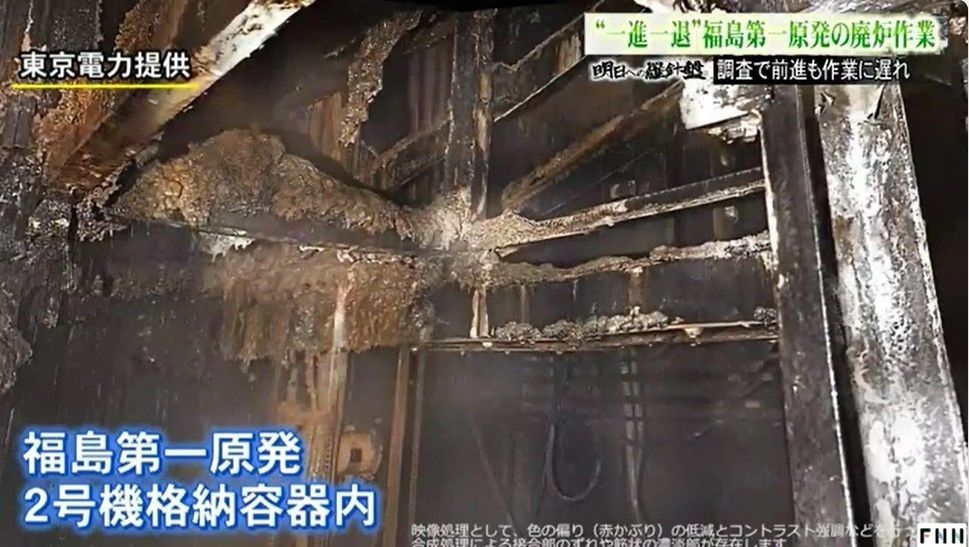
A remote-controlled extendable robot with a tong had several mishaps including equipment failures before returning in November with a tiny piece of melted fuel from inside the damaged No. 2 reactor.
That first successful test run is a crucial step in what will be a daunting, decades-long decommissioning that must deal with at least 880 tons of melted nuclear fuel that has mixed with broken parts of internal structures and other debris inside the three ruined reactors…………………………………………………
Radiation levels are still dangerously high inside the No. 2 reactor building, where the melted fuel debris is behind a thick concrete containment wall. Earlier decontamination work reduced those radiation levels to a fraction of what they used to be.
In late August, small groups took turns doing their work helping the robot in 15- to 30-minute shifts to minimize radiation exposure. They have a remotely controlled robot, but it has to be manually pushed in and out.
“Working under high levels of radiation (during a short) time limit made us feel nervous and rushed,” said Yasunobu Yokokawa, a team leader for the mission. “It was a difficult assignment.”
Full-face masks reduced visibility and made breathing difficult, an extra waterproof jacket made it sweaty and hard to move, and triple-layered gloves made their fingers clumsy, Yokokawa said.
To eliminate unnecessary exposure, they taped around gloves and socks and carried a personal dosimeter to measure radiation. Workers also rehearsed the tasks they’d perform to minimize exposure…………………………………………………..
a growing number of workers are concerned about safety and radiation at the plant, said Ono, the decommissioning chief, citing an annual survey of about 5,5,00 workers……
Yokokawa and a plant colleague, Hiroshi Ide, helped in the 2011 emergency and are team leaders today. They say they want to make the job safer as workers face high radiation in parts of the plant.
On the top floor of the No. 2 reactor, workers are setting up equipment to remove spent fuel units from the cooling pool. That’s set to begin within two to three years.
At the No. 1 reactor, workers are putting up a giant roof to contain radioactive dust from decontamination work on the top floor ahead of the removal of spent fuel.
To minimize exposure and increase efficiency, workers use a remote-controlled crane to attach pre-assembled parts, according to TEPCO. The No. 1 reactor and its surroundings are among the most contaminated parts of the plant.
Workers are also removing treated radioactive wastewater. They recently started dismantling the emptied water tanks to make room to build facilities needed for the research and storage of melted fuel debris.
After a series of small missions by robots to gather samples, experts will determine a larger-scale method for removing melted fuel, first at the No. 3 reactor.
Experts say the hard work and huge challenges of decommissioning the plant are just beginning. There are estimations that the work could take more than a century. The government and TEPCO have an initial completion target of 2051, but the retrieval of melted fuel debris is already three years behind, and many big issues remain undecided.
Ide, whose home in Namie town, northwest of the plant, is in a no-go zone because of nuclear contamination, still has to put on a hazmat suit, even for brief visits home…….
https://www.dailymail.co.uk/wires/ap/article-14484347/Nervous-rushed-Massive-Fukushima-plant-cleanup-exposes-workers-high-radiation-stress.html
Human error leads to water spill at Finnish EPR
About 100 cubic metres of slightly radioactive water flowed into rooms
within the containment of Olkiluoto unit 3 after a hatch in the reactor
pool was not properly closed before the filling of the pool began.
World Nuclear News 10th March 2025, https://www.world-nuclear-news.org/articles/human-error-leads-to-water-spill-at-finnish-epr
US report discusses possibility of nuclear submarine accident, if subs supplied to Australia

A report to the US Congress discusses the possibility of an accident with a nuclear-powered submarine if it supplies one to Australia.
This comes amid renewed questions over whether an AUKUS submarine deal would leave the US vulnerable, and an accident off the English coast where a tanker carrying jet fuel for the US military has hit a cargo ship.
The risk of a marine accident is one of three risks looked at around the submarines deal that is central to the the AUKUS Pillar One pact.
The congressional research report said an accident “might call into question for third-party observers the safety of all US Navy nuclear-powered ships”.
That could erode US public support and the ability of US nuclear-powered ships to make port calls around the world.
The 111-page report by the Congressional Research Service discussed the US not handing over the subs at all – although Canberra just made a $870m downpayment on them.
Keeping them might make up for the US sub fleet hitting “a valley or trough” around now till the 2030s, and shipbuilding being at a low point, it said.
Donald Trump’s pick for the top defence policy role at the Pentagon, Elbridge Colby, has said AUKUS could leave the US short and “it would be crazy to have fewer SSN Virginia-class [attack submarines] in the right place and time”.
The new research report to Congress said Pillar One was launched in 2021 without a study of the alternatives.
One alternative “would keep all US-made SSNs under the control of the US Navy, which has a proven record extending back to 1954 of safely operating its nuclear-powered ships”.
The original Pillar One pact is for the US to sell between three and five subs to Australia, then Australia to use US and UK nuclear propulsion technology to build another three-to-eight nuclear powered, conventionally armed submarines itself, for a total fleet of eight.
Australia’s Defence Minister Richard Marles said on Monday that Elbridge Colby was broadly supportive of AUKUS, if enough subs were available.
Canberra was aware of the challenge in the US around producing submarines, “and that’s why we’re contributing to the US industrial base”.
“And it’s a significant contribution and it’s going to increase the availability of Virginia class submarines for the United States.
“That’s a point which has been accepted and understood by the US Defence Secretary, Pete Hegseth, in the meeting that I had with him.”
Australia was last year included as a “domestic source” of US military production for the first time, and is aiming to ramp up making ammunition and missiles, as well as test hypersonic weapons with the US and UK.
“That’s going well in the sense that we are making the contributions, we are seeing an increase in production rates, and over the time frame in which we are looking to have our Virginia class submarines transferred to us, we are confident that this challenge can be met,” Marles told the ABC.
In the US, Trump appears most focused on building an ‘Iron Dome’ missile defence system, as he mentioned in his speech to Congress. This would be another huge pressure on military spending.
The report to Congress covered three big risks – accidents and whether Pillar One was the best option for deterrence and “warfighting cost-effectiveness”, and how the tech – the “crown jewels of US military technology” – could be kept secret, especially from China.
It debated a different “military division of labour”.
“Australia, instead of using funds to purchase, build, operate, and maintain its own SSNs, would instead invest those funds in other military capabilities – such as … long-range anti-ship missiles, drones, loitering munitions, B-21 long-range bombers, or other long-range strike aircraft” to conduct “missions for both Australia and the United States”.
The general rule was programmes should not go ahead without a sound business case, it noted.
“There is little indication that, prior to announcing the AUKUS Pillar 1 project in September 2021, an analysis of alternatives … or equivalent rigorous comparative analysis was conducted to examine whether Pillar 1 would be a more cost-effective way to spend defence resources for generating deterrence and warfighting capability”.
The report made no mention of how New Zealand, Japan, Korea and others might join AUKUS Pillar Two, an agreement for sharing advanced military tech.
What if a Fukushima-sized nuclear accident happened in Australia?
Today is the 14th anniversary of the Fukushima disaster, and this morning the good folks at Don’t Nuke the Climate released a huge research project that shows what a Fukushima-style nuclear disaster would look like if it happened at one of Dutton’s seven proposed reactor sites.
About these maps, https://nuclearplume.au/ 11 Mar 25
The seven sites on this map have been selected by the federal Coalition to house multiple nuclear power reactors.
You can select the reactor site and wind direction to see how a Fukushima-scale nuclear disaster would contaminate different areas surrounding the seven sites in Australia.
The interactive map uses a radiation plume map, originally peer reviewed and published by the European Geosciences Union. It shows the deposition of radioactive caesium-137 from the Fukushima disaster as of July 2011. The darker the shading, the higher the level of radioactive contamination and the higher the radiation exposures for people in those areas. At distances far from the Fukushima plant, radiation exposures were low but even low radiation doses can cause negative health impacts including fatal cancers and cardiovascular disease.
Caesium-137 has been one of the most significant radioactive contaminants since the March 2011 Fukushima disaster but many other types of radioactive particles contaminated wide areas (iodine-131, xenon-133, etc.).
Other radiation fallout maps from the Fukushima disaster can be seen here and here.
Ripping up the rules on nuclear power heightens the risk to us all

CND, Labour Outlook 7th March 2025 https://labouroutlook.org/2025/03/07/ripping-up-the-rules-on-nuclear-power-heightens-the-risk-to-us-al
“Ripping up the rules for nuclear greatly exacerbates the risk of accidents, will contaminate more of our environment with radioactive waste, and above all, raise the spectre of nuclear conflict.”
Sam Mason, convenor of CND’s Trade Union Advisory Group explains why the government’s new rules for expanding nuclear power production must be opposed.
The government’s announcement that it is going to ‘rip up the rules to fire-up nuclear power’ may be music to the ears of nuclear proponents but for CND, it is something we must vehemently oppose.
Part of wider planning law reforms to put ‘builders not blockers’ first and ‘build baby, build’, the proposal is to extend beyond the eight sites identified for nuclear power plants in 2009, and to include small or advanced modular reactors. This means nuclear sites could be constructed anywhere across England and Wales, and anyone opposing them on legitimate grounds of safety or the environment for example dismissed as NIMBYs.
According to the government, nuclear is needed for energy security and to satisfy high demand from ‘local users such as data centres, gigafactories, hydrogen and synthetic fuel production and/or industrial clusters’. It also includes using nuclear for district heat networks, being placed closer to centres of population, and in proximity to military activities.
A further driver for the government’s plans is the creation of good jobs, to drive growth and support climate action. With the impacts of climate change accelerating across the globe there is an urgent need to decarbonise our energy system, but nuclear power is not the answer on any of these levels.
The government’s laudable aim to decarbonise electric power by 2030 includes 4.5 gigawatts of nuclear power. For reference, the long over budget and delivery of Hinckley Point C in Somerset is due to generate 3.2gw of power.
Assurances about maintaining high standards of regulation do little to assuage fears of this nuclear proliferation. The addition of a new Nuclear Regulatory Taskforce to speed up delivery will cover both civilian and defence nuclear. Reporting directly to the Prime Minister, it serves to further emphasise we cannot decouple civilian nuclear from the weapons system.
Much is made about the low level of risk from nuclear, including new technologies such as SMRs. However, as we mark the 14th anniversary of the Fukushima Daiichi nuclear power plant disaster on 11 March, it should serve as a stark reminder of the impact of nuclear, and its legacy to current and future generations.
Ripping up the rules for nuclear greatly exacerbates the risk of accidents, will contaminate more of our environment with radioactive waste, and above all, raise the spectre of nuclear conflict. We must do all we can to oppose these plans.
Cybersecurity in the Nuclear Industry: US and UK Regulation and the Sellafield Case
Key Points:
With both the U.S. and U.K. strengthening their regulatory frameworks and increasing enforcement powers, nuclear facilities should take steps now to review and upgrade cybersecurity measures. This includes not just updating technical controls, but also ensuring compliance with security plans, auditing systems, and maintaining proper documentation.
Real-world examples from both the U.S. and U.K. demonstrate that nuclear facilities are being targeted by sophisticated cyber attackers, including state actors. This isn’t just a theoretical risk—it’s happening now, and facilities must take it seriously.
The successful prosecution of Sellafield with significant fines (£332,500) shows that regulators are now willing to take strong enforcement action, even when no actual breach has occurred. Nuclear facilities cannot afford wait for an incident before improving their cybersecurity—they must be proactive……………………………………………..
JD Supra 6th March 2025,
https://www.jdsupra.com/legalnews/cybersecurity-in-the-nuclear-industry-2447724/
1 This Month

of the week – Shut Down Drone Warfare!


Tell the Ukrainian Government to Drop Prosecution of Peace Activist Yurii Sheliazhenko

Petition to revoke the licensing of the Near Surface Nuclear Disposal Facility (NSDF) at Chalk River. https://www.ourcommons.ca/petitions/en/Petition/Details?Petition=e-7247
To see nuclear-related stories in greater depth and intensity – go to https://nuclearinformation.wordpress.com
-
Archives
- April 2026 (68)
- March 2026 (251)
- February 2026 (268)
- January 2026 (308)
- December 2025 (358)
- November 2025 (359)
- October 2025 (376)
- September 2025 (257)
- August 2025 (319)
- July 2025 (230)
- June 2025 (348)
- May 2025 (261)
-
Categories
- 1
- 1 NUCLEAR ISSUES
- business and costs
- climate change
- culture and arts
- ENERGY
- environment
- health
- history
- indigenous issues
- Legal
- marketing of nuclear
- media
- opposition to nuclear
- PERSONAL STORIES
- politics
- politics international
- Religion and ethics
- safety
- secrets,lies and civil liberties
- spinbuster
- technology
- Uranium
- wastes
- weapons and war
- Women
- 2 WORLD
- ACTION
- AFRICA
- Atrocities
- AUSTRALIA
- Christina's notes
- Christina's themes
- culture and arts
- Events
- Fuk 2022
- Fuk 2023
- Fukushima 2017
- Fukushima 2018
- fukushima 2019
- Fukushima 2020
- Fukushima 2021
- general
- global warming
- Humour (God we need it)
- Nuclear
- RARE EARTHS
- Reference
- resources – print
- Resources -audiovicual
- Weekly Newsletter
- World
- World Nuclear
- YouTube
-
RSS
Entries RSS
Comments RSS
 nuclear-news