Donald Trump was rude to Zelensky, but he did tell him the hard truths.

Much of what President Trump told Ukraine President Zelensky in their contentious public meeting Friday was valid…and needed to be said to achieve peace. A sampling of the truths Trump told Zelensky:
1. Ukraine must seek immediate ceasefire not more war
2. Why? The war is lost with Zelensky having “no more cards to play” to achieve his unrealistic, indeed delusional war objectives.
3. Only the US can achieve war’s end thru a negotiated peace with Russia. What Trump omitted is that this has always been America’s war simply using Ukraine proxies to fight it.
4. Ukraine is running out of soldiers, relying on old men and conscripts snatched off the street to fight a lost cause.
5. Zelensky could start WWIII with his efforts to keep war going by attacking deep into Russia.
Trump’s comments signaled a near complete break with predecessor Biden’s embrace of the weak, compliant Zelensky to fight the war to weaken Russia and keep it out of the European political economy.
Trump knows the war has nothing to do with Europe or America’s national security interests and must be ended.
If the Oval Office dustup offends people who want this war to continue indefinitely, possibly going nuclear, then by all means be outraged. But if you want to end this lost war utterly destroying Ukraine so US can weaken Russia, then join the peace community in supporting Trump’s peace initiative.
This war has put peoplekind at risk of nuclear annihilation for all 1,100 days since it began. That must end.
As Freed Palestinians Describe Torture, Trump OKs $3 Billion Arms Package for Israel
Like the Biden administration, Trump is claiming an “emergency” in order to bypass Congress.
Common Dreams, Brett Wilkins, 28 Feb 25
As Palestinians released from Israeli imprisonment recount torture and other abuse suffered at the hands of their former captors, the Trump administration on Friday approved a new $3 billion weapons package for Israel.
The new package, reported by Zeteo‘s Prem Thakker, includes nearly $2.716 billion worth of bombs and weapons guidance kits, as well as $295 million in bulldozers. The Trump administration said that “an emergency exists that requires the immediate sale,” allowing it to bypass Congress, as the Biden administration did on multiple occasions. However, the weapons won’t be delivered until 2026 or 2027.
From October 2023 to October 2024, Israel received a record $17.9 billion worth of U.S. arms as it waged a war of annihilation against the Gaza Strip that left more than 170,000 Palestinians dead, maimed, or missing and millions more displaced, starved, or sickened. Israel is facing genocide allegations in an International Court of Justice case brought by South Africa. The International Criminal Court has also issued arrest warrants for Israeli Prime Minister Benjamin Netanyahu and former Israeli Defense Minister Yoav Gallant.
Reporting on the new package came after U.S. Sen. Bernie Sanders (I-Vt.) on Monday announced an effort to block four other arms sales totaling $8.56 billion in offensive American weaponry to Israel.
Meanwhile, some of the approximately 1,000 Palestinians released by Israel as part of a prisoner swap described grim stories of abuse by Israeli forces. The former detainees, who were arrested but never charged with any crimes, “have returned visibly malnourished and scarred by the physical and psychological torture they say they faced in Israeli prisons,” according toThe Washington Post. Some returned to what were once their homes to find them destroyed and their relatives killed or wounded by Israeli forces.
Eyas al-Bursh, a doctor volunteering at al-Shifa Hospital in Gaza City when he was captured by Israeli troops, was held in Sde Teiman and the Ofer military prison in the illegally occupied West Bank for 11 months.
“The places where we were held were harsh, sleep was impossible, and we remained handcuffed and blindfolded,” al-Bursh told the Post……………………………………………………………………
Rahdi also said that Mohammed al-Akka, a 44-year-old detainee held with him, died last December. Al-Akka is one of dozens of Palestinian prisoners who have died in Israeli custody, some from suspected torture and, in at least one case, rape with an electric baton. A number of Israeli reservists are being investigated for the alleged gang-rape of a Sde Teiman prisoner. https://www.commondreams.org/news/trump-arms-to-israel
Small modular reactor plans edge closer, amid claims that the technology makes no economic sense
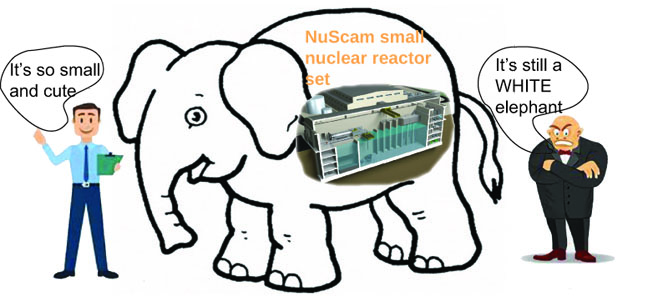
By Simon Hacker, Punchline Gloucester 28th Feb 2025
…………………………………….Dale Vince, the owner of Stroud-based green energy group Ecotricity, has
roundly condemned the technology for “defying the economic laws of
gravity”.
Speaking on his weekly Zerocarbonista podcast, Mr Vince said:
“When you come to small nukes, the government and the nuclear industry have
consistently said that we will get lower bills, but they don’t put a number
on it. They are ecomonists without numbers!
Energy minister Ed Miliband: keen to move ahead on SMR plans. Big nuclear is the most expensive electricity we have ever made, it’s off the charts compared to renewable
energy and one of the fundamental laws of physics is that the economies of
scale come by making something bigger, not by making something smaller –
it always costs money to miniaturise.
So here they are, saying we can
miniatarise nuclear reactors that famously went decades late and billions
over budget… and they’ll be cheap. I don’t believe that for a second and
what we are of course doing is proliferating the risk.”
He added: “It’s always worth imagining what it would be like if the Romans had nuclear
power. If they did, Bath would be a toxic no-go zone. It’s only 2,000 years
ago and sounds like a long time, but not in the context of toxic nuclear
waste.” Whether Berkeley and neighbouring site Oldbury-on-Severn progress
with Rolls Royce’s SMR bid, the technology’s pathway to viable commercial
models for energy production remains challenging: as of today, only China
and Russia have operational SMRs, with China’s HTR-PM pebble-bed reactor
connected to the grid and Russia’s floating Akademik Lomonosov plant
utilizing two 35MW SMRs. https://www.punchline-gloucester.com/articles/aanews/smr-plans-edge-closer-amid-claims-the-technology-makes-no-economic-sense
Rachel Reeves eyes cuts to nuclear in spending review

Energy industry insiders fear the Chancellor could target Britain’s mini-nuke programme
Matt Oliver, Industry Editor, Telegraph 28th Feb 2025
Rachel Reeves is eyeing cuts to Britain’s £20bn mini-nuclear reactor programme amid a scramble to slash government expenditure, insiders fear.
Sources believe the Chancellor is considering approving a smaller number of reactors than previously expected in an attempt to reduce the costs of the programme, which is part of wider efforts to transform Britain’s power grid.
The competition to design and build the first small modular reactors (SMRs) entered its last phase on Friday, with four finalists – Rolls-Royce, GE-Hitachi, Westinghouse and Holtec – told to submit final bids by mid-April.
It was previously suggested that up to three winners would be chosen by Great British Nuclear (GBN), the quango in charge of running the contest.
But sources said there was concern this has quietly been scaled back to a “maximum” of two – raising the possibility that only one winner will be chosen. Fewer reactors would be built overall as a result………………………………………
The Chancellor is struggling to balance the books as weak economic growth makes it harder to meet her self-imposed “fiscal rules” for borrowing.
Everything is on the table’
Industry sources said there had as yet been no suggestion that ministers had decided to scale back the SMR programme.
But the final outcome has been linked to the spending review and there remains uncertainty about how many vendors will be chosen.
One person briefed on the discussions warned: “It all comes down to the spending review. Everything is on the table.”……………………..
the nascent technology remains commercially unproven, with a string of European countries and the US all currently pursuing their own individual competitions to fund the first examples of the technology.
Scaling back Britain’s SMR programme would represent a significant retreat for Sir Keir Starmer, the Prime Minister, who this month announced plans to speed up the development of the mini reactors and vowed to “build, baby, build”.
………there are fears that Mr Miliband, the Energy Secretary, is under pressure to choose which energy schemes he will prioritise as he scrambles to deliver Labour’s promise…
………….The competition has suffered repeated delays, with ministers in the previous Conservative government originally suggesting it would be concluded last spring.
This week it emerged there had been yet another delay, with the deadline for final bid submissions moved back from the end of March to mid-April.
……………………….The Treasury was contacted for comment.
https://www.telegraph.co.uk/business/2025/02/28/reeves-eyes-cuts-to-nuclear-in-spending-review/
Nuclear powers down as global reactor numbers shrink.
By Jennifer Dudley-Nicholson, March 3 2025 – https://www.canberratimes.com.au/story/8906917/nuclear-powers-down-as-global-reactor-numbers-shrink/
The number of nuclear reactors operating around the world is shrinking, a report has found, and renewable energy generation is outpacing the technology.
The EnergyScience Coalition released the findings on Monday in a report analysing progress on renewable and nuclear energy generation, as well as investments in each.
It found nuclear power generation was “stagnating rather than growing” despite claims to the contrary, and that only three countries were planning to add nuclear reactors to their energy mix, while another three were planning to phase it out.
The report comes after the coalition pledged to establish nuclear power plants in seven Australian locations if it won the upcoming federal election, and after warnings that Australia could miss its climate targets by years under a nuclear plan.
The EnergyScience Coalition study, authored by academics from the University of Melbourne and the Nuclear Consulting Group, found the number of nuclear power plants worldwide had shrunk from 438 in 2002 to 411 last year.
Nuclear reactors also generated just 9.15 per cent of the world’s energy in 2024, it noted, compared to 17.5 per cent in 1996, and gained 4.3 gigawatts during the year.
By comparison, renewable energy sources added 666 gigawatts, according to the International Energy Agency, and were expected to overtake coal-fired power generation this year.
Claims about the number of countries investing in nuclear reactors had also been overstated in Australia, co-author and Nuclear Consulting Group member Jim Green said.
Nuclear reactors were being built in 13 countries, the study found, but only three were new to nuclear energy: Egypt, Bangladesh and Turkey.
“This report provides a factual rebuttal to the pro-nuclear disinformation campaign currently underway in Australia,” Dr Green said.
“There has been zero growth in nuclear power over the past 20 years and the number of countries operating reactors is the same as it was in the late 1990s.”
Four countries had already phased out nuclear power generation, including Italy and Germany, the report said, and another three were planning to phase out the technology, including Switzerland and Spain.
Recent nuclear power projects in countries where the technology was well established had also suffered significant cost and time blow-outs including a project the US state of South Carolina that was abandoned and the Hinkley Point reactor in the UK that was expected to cost 11.5 times more than its original estimate.
The examples proved Australia would face a significant challenge to build nuclear reactors within deadlines and budgets, co-author and University of Melbourne Professor Jim Falk said.
“Reactor construction projects in countries with vast expertise and experience, such as France, the US and the UK, have run literally tens of billions of dollars over budget and construction schedules have slipped by many years,” he said.
“Since those countries have failed to build reactors on time and on budget, it would be naive to believe that a nuclear newcomer country such as Australia could do it.”
The coalition’s nuclear plan would establish five large nuclear reactors and two small modular reactors across five states, with the first forecast to be operational by 2035.
But a recent report from the Climate Change Authority found switching from a renewable energy pathway to nuclear would delay Australia’s progress to its 2030 climate goal by 12 years.
Beyond Nuclear files two relicensing legal actions

February 27, 2025, https://beyondnuclear.org/beyond-nuclear-files-two-legal-relicensing-actions/
In February 2025, Beyond Nuclear and the Sierra Club (“petitioners”) filed two legal actions challenging extreme relicensing decisions by the Nuclear Regulatory Commission (NRC) to qualify and extend US reactor operating licenses beyond 60 years to 80 years. The petitioners have argued that these license renewals are based on faulty analyses of the environmental impacts for extreme reactor operations that are irrational, unreasonable, incomplete, unsupported, arbitrary and capricious. Beyond Nuclear contends that the NRC has failed to satisfy requirements under the National Environmental Policy Act (NEPA) for both its generic and site-specific relicensing applications.
On February 20, 2025, Beyond Nuclear and Sierra Club (“petitioners”) filed a 76-page legal brief in the US Court of Appeals for the District of Columbia in response to the NRC issuance of its new rule and Final Generic Environmental Impact Statement for License Renewal (GEIS). The lawsuit draws attention to the federal agency ignoring the petitioners’ comments submitted earlier in 2024 on the Draft GEIS compiled. The petitioners’ substantial comments are supported by expert witness testimony of a retired NRC senior risk analyst and nuclear engineer focused on the materials facts that the new rule and rewrite of the GEIS, effective September 15, 2024, does not meet the legal standard for “adequate protection” of the public health and safety during the extended reactor operations from the destructive impacts of age-related degradation of critical reactor safety systems, structures and components (SSC). These SSCs include the large and irreplaceable steel reactor pressure vessels, reactor internal components, the massive concrete containment buildings and foundations. Other critical safety systems also include the miles and miles of the by and large inaccessible, uninspected buried control, instrumentation and power electrical cables and similarly extensive and inaccessible safety-related buried pipe systems.
The petitioners further challenge that the new rule and final GEIS do not meet the legal standard of “adequate protection” from the projected impacts of climate change on the increase of severe reactor accident risk and frequency as well as radiological accident consequences during the projected license renewal period.
In both the cases of age-related degradation of safety-related SSC operations and climate change impacts of severe accident risk and consequences, the NRC GEIS further fails to acknowledge an extensive list of identified “knowledge gaps” and even broader uncertainties that erode the reliability of projecting operational risk, accident frequency and consequences into the license renewal period.
The petitioners are specifically challenging the NRC GEIS finding that the environmental impacts of a nuclear reactor accident “during the initial (40 to 60 years) and subsequent (60 to 80 years) license renewal term” would be insignificant or “SMALL” and, as a result, the NRC does not need to evaluate less impactful alternatives to extended reactor operations.
The petitioners are asking the federal court to vacate the NRC rule and Final GEIS. They further request that the Court order the NRC to more thoroughly investigate the adverse impacts, gaps and uncertainties of operational aging degradation of reactor safety margins. Furthermore, given that the NRC GEIS further claims that the adverse impact of climate change on reactor operations is “out of scope” of the agency’s environmental reviews for license extension, the petitioners assert that the court should require the NRC to take a “hard look” at the impact of climate change (sea level rise, increasingly severe storms, hurricanes, flooding, wild fires, etc) on severe nuclear accident risk and environmental consequences.
On February 24, 2025, petitioners Beyond Nuclear and Sierra Club additionally filed an appeal to the NRC Office of the Commissioners regarding an Atomic Safety Licensing Board order on a 60 to 80 year license renewal application of Duke Energy’s Oconee Units 1, 2 & 3 nuclear power station in Seneca, South Carolina for operations out to 2053 and 2054. The licensing board order now under appeal to the NRC Commissioners denies their request for a hearing, dismisses all of the petitioners’ contentions and terminates the relicensing proceeding.
Oconee nuclear station operates beneath and downstream of two large hydroelectric dams; the Jocassee Dam, a 385 feet high earthen rock-filled dam, ten miles upstream of the Oconee reactors roughly 300 feet below the top of the Lake Jocassee water level of more than 1 million acre feet of water and; the Keowee Dam, a 175 feet earthen dam that immediately abuts the nuclear power station that is sited roughly five feet below the top level of Lake Keowee and an additional 990,000 acre feet of water.
The three reactors were originally designed, constructed as a “dry site” where dam failure was considered an “incredible” event. Only precipitation directly onto the reactor site was analyzed for its flooding impact risk and dismissed. The only dam failure evaluated was for a “sunny day failure” or a structural failure unrelated to severe flooding. The “initial” 40 to 60 years license renewal application was approved without any challenge or consideration of a flood induced dam failure resulting in severe nuclear accident consequences that were analyzed in an environmental review or the NRC Environmental Impact Statement.
The NRC site-specific Environmental Impact Statement for Oconee has concluded that determining the projected impact of climate change on the reliable operation of Oconee safety systems including climate change induced extreme flooding events is “out of scope” of an environmental review.
Both of the petitioners’ legal actions as filed February 20 and 25, 2025 stem from previous Commission Orders issued three years ago on February 24, 2022. These NRC orders were won on appeal in the first round of Subsequent License Renewal Applications filed by the intervenors that resulted in the NRC rescinding the original subsequent license renewals for the Turkey Point Units 3 & 4 and Peach Bottom 2 & 3 nuclear power plants, as well as suspend other active subsequent license renewal proceedings pending a rewrite of the GEIS as reported by the Associated Press . These same NRC Orders required the NRC staff to rewrite a new rule and Generic Environmental Impact Statement because the previous 2013 GEIS as written only applied to the license renewal period for the “initial” 20 year license extension of 40 to 60 years, not the “subsequent” license renewal of 60 to 80 years.
IAEA mission arrives at nuclear plant in Ukraine through Russia

By Reuters, March 2, 2025, https://www.reuters.com/world/europe/new-iaea-mission-arrives-russian-held-zaporizhzhia-nuclear-plant-russia-says-2025-03-01/
March 1 (Reuters) – A new monitoring mission from the U.N. nuclear watchdog arrived on Saturday at the Russian-held Zaporizhzhia nuclear power plant in Ukraine for the first time through Russian territory, a Russia-installed head of the plant said.
The IAEA rotation came after weeks of delay caused by military activity around the site with each side blaming the other for violating rules to ensure the team’s safe passage to the plant.
“It is fundamentally important that the route passed through the territory of the Russian Federation for the first time,” Yuri Chernichuk, the Russia-installed head of the Zaporizhzhia plant in southeastern Ukraine, said in a video on Telegram.
The arrival of three inspectors, he added, was ensured by Russia’s defence ministry and national guard and followed “intense” consultations between the heads of Russia’s state nuclear power company Rosatom and IAEA.
Reuters could not independently verify the report. The IAEA could not be reached outside business hours to comment on the Russian statement. There was no immediate comment from Ukraine.
UK Energy Secretary Signals China Pivot
By Irina Slav – Feb 28, 2025,
https://oilprice.com/Latest-Energy-News/World-News/UK-Energy-Secretary-Signals-China-Pivot.html
UK’s energy secretary is reportedly scheduled to travel to China next month in a bid to forge a closer relationship with the country, despite it being seen by previous governments in London as a threat to national security.
The report comes from Reuters, which spoke to unnamed sources close to Ed Miliband, who said the top energy member of the UK cabinet will discuss alternative energy sources in China. What he will not discuss, per the sources, is nuclear energy.
The UK’s Labour government is looking to mend fences with China after the last series of Conservative cabinets all demonstrated mistrust and suspicion to Beijing, in sync with the EU and the United States. However, the Starmer government has signaled it was willing to change this, diverging from the EU/U.S. course of import tariffs and accusations of national security attacks on the part of the Chinese.
In the energy sector, Chinese equipment and components are crucial for the Starmer government’s transition efforts as the country is the largest producer of things such as solar panels, wind turbines, and inverters. It is also the lowest-cost producer, ironically thanks to the amount of coal-powered generation Chinese manufacturers use to make the transition components.
The UK has some of the most ambitious transition goals in the world, aiming to generate as much as 95% of its electricity from non-hydrocarbon sources. As part of efforts to achieve this, the government has committed to doubling onshore wind energy by 2030, quadrupling offshore wind, and trebling solar power by the end of the decade.
To do this, the Starmer government would need to speed up the pace of growth in wind and solar capacity considerably. In offshore wind alone, the government would need to approve more offshore capacity in the next two annual renewable energy auctions, than it has approved in the last six auctions, the country’s grid operator warned last year.
Stop government handouts to EDF for Hinkley Point C

Roy Pumfrey, 27th February, https://www.bridgwatermercury.co.uk/your_say/postbag/24966410.letter-stop-government-handouts-edf-hinkley-point-c/
It’s been reported that EDF, under pressure from French national auditors, is still desperately looking for investors in Hinkley Point C (HPC) to replace lost top-up funding from its Chinese partner, CGN.
Despite having talks with lots of potential investors, EDF has been unable to proceed with any of them.
HPC was initially expected to cost £18 billion and to be completed in 2025, but the estimated cost has increased to roughly £46 billion in 2024 terms and the start date has been pushed back to 2029 at the earliest, possibly as late as 2031, because of construction delays.
The UK government is also trying to drum up investors for the Sizewell C (SZC) project in Suffolk.
EDF only wants to invest up to 20 per cent of the estimated cost in the project.
The government is hoping to make a final investment decision on SZC in June.
In January, France’s state auditor said EDF should not proceed with SZC until it had cut its exposure to HPC.
It seems quite likely that EDF is threatening to withdraw from SZC unless the government bails them out on HPC.
EDF has already been given an overly generous index-linked contract to supply electricity from HPC to British consumers at around £130/MWh (at today’s prices) compared to today’s cost of electricity from wind at £44MWh.
There should be no more government handouts to French government-owned EDF.
If they can’t afford to build it on such generous terms, they should stop now.
SZC would be funded in a different way to HPC, which could cost British consumers as much as £100 billion – official cost estimates do not include the cost of the finance needed to build Sizewell.
The obvious thing to do is to cancel SZC now before any more taxpayers’ money is wasted and resist pressure from EDF for us to bail them out on HPC.
1 This Month
23-25 October – on Zoom – World BEYOND War’s annual global conferenc


Shut down the radiation-damaged Heysham nuclear reactors now
To see nuclear-related stories in greater depth and intensity – go to https://nuclearinformation.wordpress.com

Say No to NASA’s Reckless Nuclear Reactor on the Moon
Say No to NASA’s Reckless Nuclear Reactor on the Moon

-
Archives
- October 2026 (247)
- September 2026 (339)
- August 2026 (330)
- July 2026 (355)
- June 2026 (287)
- May 2026 (306)
- April 2026 (356)
- March 2026 (251)
- February 2026 (267)
- January 2026 (308)
- December 2025 (358)
- November 2025 (359)
-
Categories
- 1
- 1 NUCLEAR ISSUES
- business and costs
- climate change
- culture and arts
- ENERGY
- environment
- health
- history
- indigenous issues
- Legal
- marketing of nuclear
- media
- opposition to nuclear
- PERSONAL STORIES
- politics
- politics international
- Religion and ethics
- safety
- secrets,lies and civil liberties
- spinbuster
- technology
- Uranium
- wastes
- weapons and war
- Women
- 2 WORLD
- ACTION
- AFRICA
- Atrocities
- AUSTRALIA
- Christina's notes
- Christina's themes
- culture and arts
- Events
- Fuk 2022
- Fuk 2023
- Fukushima 2017
- Fukushima 2018
- fukushima 2019
- Fukushima 2020
- Fukushima 2021
- general
- global warming
- Humour (God we need it)
- Nuclear
- RARE EARTHS
- Reference
- resources – print
- Resources -audiovicual
- Weekly Newsletter
- World
- World Nuclear
- YouTube
-
RSS
Entries RSS
Comments RSS

