Time to Step Up – Campaigner calls on MP to challenge decision to give fusion indemnity over accident liabilities

Renowned nuclear campaigner, and friend to the Nuclear Free Local
Authorities, Dr David Lowry has just written to his local Member of
Parliament calling on her to challenge ministers over their pledge to
provide an absolute indemnity over costs incurred by a nuclear fusion pilot
plant being built in the Midlands should there be ‘incidents involving
nuclear matter or emissions of ionising radiation arising from fusion
activities relating to the STEP programme.’
In a written statement issued
to Parliament just prior to MPs leaving for the summer recess, Minister for
Climate – and seemingly defacto Nuclear Minister – Kerry McCarthy –
announced that this latest financial ‘get out of jail free’ card for the
nuclear industry would be ‘remote and uncapped’. The assumption by the
Treasury – and therefore by taxpayers – of any liability is Ms McCarthy
insists necessary to ‘address the gap in the insurance market’ which
rather suggests that no-one in the commercial insurance market is prepared
to take on the risks associated with this nascent technology.
NFLA 22nd July 2025, https://www.nuclearpolicy.info/news/time-to-step-up-campaigner-calls-on-mp-to-challenge-decision-to-give-fusion-indemnity-over-accident-liabilities/
Trump axes nuclear waste oversight panel
By Francisco “A.J.” Camacho | 07/21/2025, https://www.eenews.net/articles/trump-axes-nuclear-waste-oversight-panel/
The move comes at a time when Republicans and Democrats alike are pursuing a nuclear expansion, with Presiden Donald Trump aiming to quadruple nuclear power capacity by 2050.
President Donald Trump dismissed all but one of the members of the U.S. Nuclear Waste Technical Review Board, diminishing oversight over the country’s long-term spent nuclear fuel storage program.
“On Wednesday, the White House sent emails to seven Board members — Drs. Richelle Allen-King, Miles Greiner, Silvia Jurisson, Nathan Siu, Seth Tuler, Scott Tyler, Brian Woods — dismissing them from the Board, effective July 16, 2025,” Christopher Burk, the board’s director of external affairs, said in an email. “As a result, Dr. Peter Swift, Board Chair, is the sole member of the Board. The NWTRB staff and funding have remained in place.”
The move came at a time when Republicans and Democrats alike are pursuing a nuclear expansion, with Trump aiming to quadruple nuclear power capacity by 2050. It also comes amid a major shakeup at the Nuclear Regulatory Commission, with administration officials directing the agency to apply minimal scrutiny in reviewing reactors backed by the departments of Energy or Defense and the firing of Christopher Hanson, a Democratic commissioner and former NRC chair under former President Joe Biden.
US Nuclear Industry Revival on the Horizon
In late May, President Trump issued four separate Executive Orders (EOs)
with respect to growing the nuclear power industry in the US. As the
implementation of these orders begins, several Washington focused
publications have written about one emerging consequence of these EOs—the
likely termination of NRC oversight with respect to approval of new nuclear
reactor designs.
This major responsibility is being moved to the Pentagon
and the Department of Energy. One administration official referred to the
NRC’s prospective role in reactor approval as akin to a rubber stamp. The
implied criticism here being that the NRC was much too slow in approving
new reactor designs and are an obstacle to the President’s goal of
dramatically increasing nuclear power in the US. So, in effect, they got
FEMA’d. This raises the question whether we are effectively deregulating
commercial nuclear energy technologies, assuming, of course, that the
prospective review processes of the Pentagon and DoE are less rigorous than
the NRC’s.
Oil Price 21st July 2025, https://oilprice.com/Alternative-Energy/Nuclear-Power/US-Nuclear-Industry-Revival-on-the-Horizon.html
Trump axes nuclear waste oversight panel
The move comes at a time when Republicans and Democrats alike are pursuing a nuclear expansion, with Presiden Donald Trump aiming to quadruple nuclear power capacity by 2050.
By: Francisco “A.J.” Camacho | 07/21/2025
ENERGYWIRE | President Donald Trump dismissed all but one of the members of the U.S. Nuclear Waste Technical Review Board, diminishing oversight over the country’s long-term spent nuclear fuel storage program.
“On Wednesday, the White House sent emails to seven Board members — Drs. Richelle Allen-King, Miles Greiner, Silvia Jurisson, Nathan Siu, Seth Tuler, Scott Tyler, Brian Woods — dismissing them from the Board, effective July 16, 2025,” Christopher Burk, the board’s director of external affairs, said in an email. “As a result, Dr. Peter Swift, Board Chair, is the sole member of the Board. The NWTRB staff and funding have remained in place.”
The move came at a time when Republicans and Democrats alike are pursuing a nuclear expansion, with Trump aiming to quadruple nuclear power capacity by 2050. It also comes amid a major shakeup at the Nuclear Regulatory Commission, with administration officials directing the agency to apply minimal scrutiny in reviewing reactors backed by the departments of Energy or Defense and the firing of Christopher Hanson, a Democratic commissioner and former NRC chair under former President Joe Biden………………..
Energy Wire 21st July 2025, https://subscriber.politicopro.com/article/eenews/2025/07/21/nuclear-waste-oversight-panel-finally-gets-the-ax-under-trump-00463505
…
Pay danger money to communities impacted by nuclear projects, say NFLAs

The Nuclear Free Local Authorities have called on government ministers to
make the operators of nuclear plants pay their neighbouring communities
‘danger money’ to properly compensate them for living with the risk.
The Department of Energy Security and Net Zero has just concluded a
consultation on plans to introduce a mandatory scheme obliging energy
generators to pay community benefits. The amount of money payable annually
would be based on one of two models, the potential generating capacity of
the plant or the actual amount of electricity generated.
Ministers would make the scheme applicable to nuclear plants, as well as larger renewable
energy projects, but the NFLAs want them to factor in a premium on payments
made by nuclear operators to reflect the potential for accidents, the
environmental contamination caused during their operations, and their
legacy of deadly radioactive waste. We also want nuclear plants to make
payments through their lifecycle, including during the period of
decommissioning and waste management after closure.
NFLA 18th July 2025, https://www.nuclearpolicy.info/news/pay-danger-money-to-communities-impacted-by-nuclear-projects-say-nflas/
Office for Nuclear Regulation says its ‘insufficient organisational capability’ is increasing strategic risk.
18 Jul, 2025 By Tom Pashby
The Office for Nuclear Regulation (ONR) has identified its “insufficient
organisational capability” as an increasing strategic risk in its latest
annual report. The risks are: Insufficient organisational capability, the
ONR being ineffective at discharging its duties as a regulator, failure to
deliver objectives due to an inability to respond to incidents, poor
knowledge management, inflexible funding, the impact of changes to deliver
leadership and insufficient security controls.
Each of these risks has been
analysed on whether it is static, increasing or decreasing. Notably, it
said the risk of “insufficient organisational capability” was found to
be increasing. This has “matured out of the former Insufficient
Organisational Capability and Capacity risk to allow for an enhanced focus
on the capability of the organisation. “We have implemented a review of
regulatory competence and capacity to meet future regulatory
requirements.” An ONR spokesperson told NCE: “The government has
announced its biggest expansion of nuclear power in several decades and so
maintaining a resilient regulatory capability and capacity to deliver our
mission remains a key priority.
New Civil Engineer 18th July 2025, https://www.newcivilengineer.com/latest/office-for-nuclear-regulation-says-its-insufficient-organisational-capability-is-increasing-strategic-risk-18-07-2025/
Trump’s nuclear power push weakens regulator and poses safety risks, former officials warn
Spencer Kimball, Jul 17 2025
Key Points
Former NRC commissioners say the order threatens the regulator’s independence, raising safety concerns that could undermine public confidence.
President Donald Trump has ordered an overhaul of the Nuclear Regulatory Commission, part of his push to quadruple nuclear power in the U.S. by 2050.
The order requires the NRC to make decisions on nuclear plants within 18 months, completely revise its regulations and reduce its staff.
Former NRC commissioners say the order threatens the
regulator’s independence, raising safety concerns that could undermine
public confidence. President Donald Trump’s push to approve nuclear
plants as quickly as possible threatens to weaken the independent regulator
tasked with protecting public health and safety, former federal officials
warn.
Trump issued four sweeping executive orders in May that aim to
quadruple nuclear power by 2050 in the U.S. The White House and the
technology industry view nuclear as powerful source of reliable electricity
that can help meet the growing energy needs of artificial intelligence.
The most consequential of Trump’s orders aims to slash regulations and speed
up power plant approvals through an overhaul of the Nuclear Regulatory
Commission. The NRC is an independent agency established by Congress in
1975 to make sure that nuclear reactors are deployed and operated safely.
Trump accuses the NRC of “risk aversion” in his order, blaming the
regulator for how few nuclear plants have been built in the U.S. over the
past three decades. The president says that the NRC is focused on
protecting the public from “the most remote risks,” arguing that such a
cautious approach to approving plants restricts access to reliable
electricity.
CNBC 17th July 2025, https://www.cnbc.com/2025/07/17/trumps-nuclear-power-push-weakens-regulator-and-poses-safety-risks-former-officials-warn.html
Improvements required at Sellafield after lead oxide release
The Office for Nuclear Regulation (ONR) has served an improvement notice
on Sellafield Ltd following an incident at the Cumbria site. In April, an
unintentional release of lead oxide was detected at the First Generation
Magnox Storage Pond (FGMSP) facility when workers noticed the degraded
condition of some flexible lead shielding.
Lead shielding sheets are used
across the site to protect workers from potential exposure to radiation.
The coating on the sheets used on the FGMSP skip handling machine had
degraded over time, resulting in lead oxide being released which posed a
potential risk to workers. Further enquiries have identified a number of
other locations across the Sellafield site where degraded flexible lead
shielding sheets caused a risk of lead exposure. Lead oxide is not a
radioactive substance, but can be harmful if ingested, inhaled or absorbed.
ONR 9th July 2025, https://www.onr.org.uk/news/all-news/2025/07/improvements-required-at-sellafield-after-lead-oxide-release/
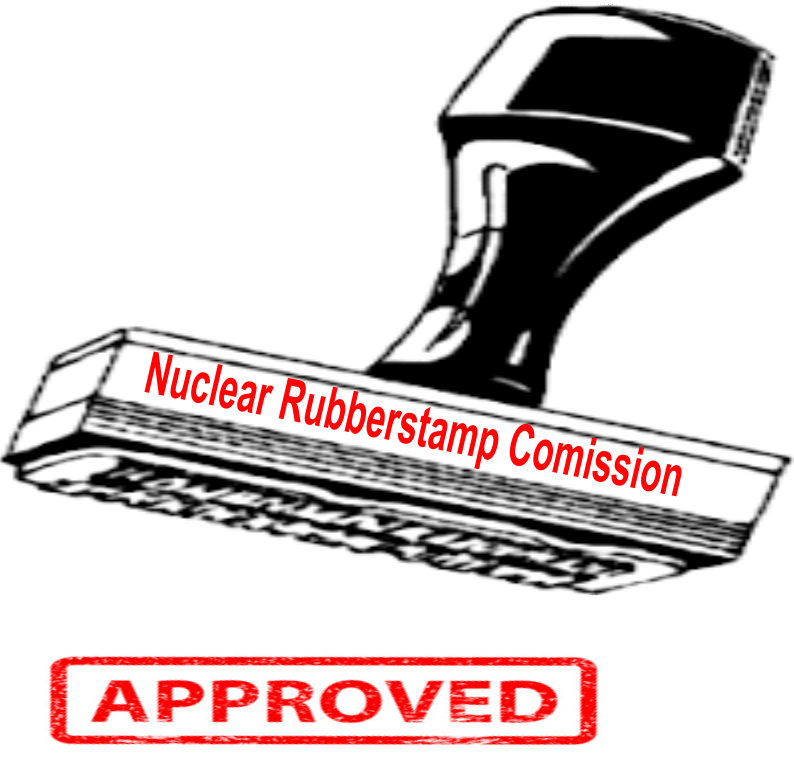
US DOGE (Department of Government Efficiency) told regulator to ‘rubber stamp’ nuclear.
The Nuclear Regulatory Commission’s historic role of assuring safety is changing as the White House shifts some responsibility to the Department of Energy.
Politico, By Francisco “A.J.” Camacho and Peter Behr, 07/14/2025
A DOGE representative told the chair and top staff of the Nuclear Regulatory Commission that the agency will be expected to give “rubber stamp” approval to new reactors tested by the departments of Energy or Defense, according to three people with knowledge of a May meeting where the message was delivered.
The three people said Adam Blake, detailed to the NRC by the Department of Government Efficiency, described a new regulatory approach by NRC that would expedite nuclear safety assessments.
“DOE, DOD would approve stuff, and then NRC would be expected to just kind of rubber-stamp it,” said one of the three people, who were all granted anonymity because of the sensitivity of the issue.
The meeting was held after President Donald Trump signed a May 23 executive order that would supplant the NRC’s historical role as the sole agency responsible for ensuring commercial nuclear projects are safe and won’t threaten public health.
Two of the three people said Blake used the term “rubber stamp” at the meeting that included NRC Chair David Wright, senior agency staff and DOE officials. Under Trump’s executive order, the NRC could not revisit issues assessed by DOE or the Pentagon, but the people with knowledge of the meeting said Blake and DOE officials went a step further to suggest the NRC’s secondary assessment should be a foregone conclusion.
Trump’s executive order and staff departures have added to concern at the independent agency and among nuclear experts that the White House is exerting more control over the NRC’s mandate under the Atomic Energy Act of 1954 than any previous administration.
“The NRC is working quickly to implement the executive orders reforming the agency and modernizing our regulatory and licensing processes,” said NRC spokesperson Maureen Conley. “We look forward to continuing to work with the administration, DOE and DOD on future nuclear programs.”
The NRC’s Wright was not made available for an interview. POLITICO’s E&E News also reached out for comment from Blake about the “rubber stamp” remark and his role at the agency. Blake and the White House did not respond to requests for comment.
When asked about the May meeting, a DOE spokesperson referenced Trump’s executive order.
Trump has said he wants to quadruple the U.S. supply of nuclear power by 2050. Tech industry allies, Republicans in Congress and Secretary of Energy Chris Wright have been sharply critical of the NRC for what they say is an unreasonably slow approval process that has held back the nuclear industry.
Defenders of the NRC and former agency officials agree that today’s smaller reactor designs require a new approach to licensing nuclear technology. They’re also adamant that a political push to build more nuclear reactors, and fast, doesn’t change NRC requirements under the law to ensure new reactor designs are safe.
Nuclear is now in political vogue again, with bipartisan support lately driven by Silicon Valley and Trump administration plans to use nuclear power to fuel huge artificial intelligence data centers. Some clean energy supporters see new, smaller nuclear reactors as crucial sources of carbon-free power in the 2030s.
Ongoing shake-up
In the weeks following the “rubber stamp” comment, the NRC experienced significant upheaval, including the abrupt June 13 firing of Christopher Hanson, a Democratic commissioner originally appointed during Trump’s first term and the former chair under President Joe Biden.
Hanson took to social media to protest the termination, saying it was done “without cause, contrary to existing law and longstanding precedent regarding removal of independent agency appointees.”
Anna Kelly, a White House spokesperson, told POLITICO at the time that “all organizations are more effective when leaders are rowing in the same direction,” adding that Trump “reserves the right to remove employees within his own Executive Branch who exert his executive authority.”
Wright’s term on the commission expired at the end of June as his reappointment from Trump waited in a Senate committee. Wright’s appointment squeaked through the Environment and Public Works Committee on Wednesday on a party-line vote after Democrats decried what they characterized as the administration’s “hostile takeover” of the NRC.
The decision by Trump and top aides to insert DOE into the NRC’s statutory licensing process was spelled out in four executive orders Trump signed May 23 — prompting nuclear experts to warn of “serious consequences” if the NRC’s loss of independence erodes safety.
Trump ordered a “wholesale review” of the NRC’s reactor design and safety regulations, with a nine-month deadline for proposed changes and final action in another nine months. The order said commission reviews of new designs must be completed within 18 months, with shorter deadlines set as appropriate.
A committee of at least 20 people would perform the review, including representatives of DOGE and the Office of Management and Budget, headed by Russ Vought, the architect of Project 2025’s conservative blueprint for shrinking the federal government.
Leadership at Idaho National Laboratory, which has been one of the centers of DOE’s research on nuclear reactors, has said DOE can perform safety evaluations of new reactors, and in doing so move more quickly and efficiently than the NRC………………………………………………….
………………………………………….
Big tech companies such as Microsoft, Google, Amazon and Meta are also signing long-term agreements with utilities that own nuclear reactors and SMR startups for future purchases of electricity to power their AI data centers.
The NRC is assessing a plan to reopen a closed unit at the Three Mile Island nuclear plant in Pennsylvania. And last month, the agency received a combined license application from Fermi America, a Texas-based company led by former Energy Secretary Rick Perry that plans to build the nation’s largest nuclear power complex. The “HyperGrid” site is in Amarillo, Texas, near the largest U.S. assembly plant for nuclear weapons known as Pantex.
“The Chinese are building 22 nuclear reactors today to power the future of AI,” said Perry, the former Texas governor. “America has none. We’re behind, and it’s all hands on deck.”
One of the three people with knowledge of the May meeting and Blake’s “rubber stamp” remark said the influx of nuclear license applications — and from politically connected people — is adding pressure and scrutiny to the process. “This is where the rubber hits the road,” the person said.
All of this comes amid a shake-up of senior leadership at the NRC. That includes the commission’s Executive Director of Operations Mirela Gavrilas, who had worked at the agency for more than 20 years and who was effectively forced out, according to the three people.
As the Senate Environment and Public Works Committee sent Wright’s renomination to the full Senate on Wednesday, its top Democrat, Sheldon Whitehouse of Rhode Island, withdrew his support……………………………..https://www.politico.com/news/2025/07/14/doge-to-regulator-rubber-stamp-nuclear-00450658
IAEA Director General Statement on Situation in Ukraine
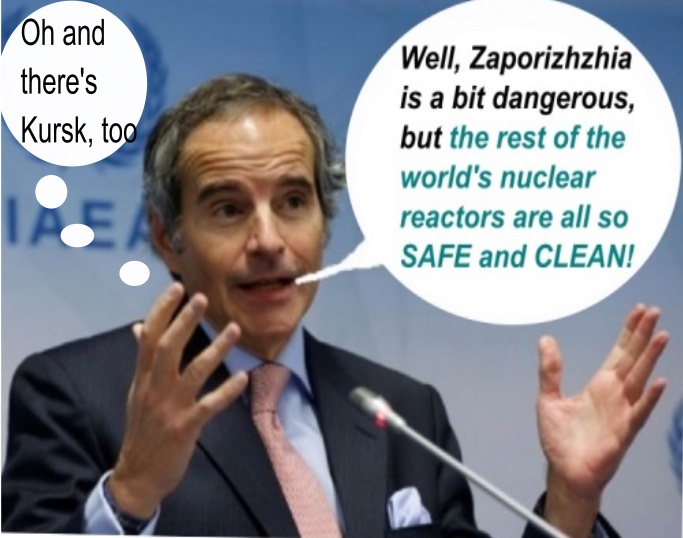
The IAEA team at Ukraine’s Zaporizhzhya Nuclear Power Plant (ZNPP) reported hearing hundreds of rounds of small arms fire last night, the latest sign of military activity potentially threatening nuclear safety and security, Director General Rafael Mariano Grossi said today.
The large number of shots – repeatedly fired for about an hour from 10pm local time – was unusual, the team members reported.
Conducting a site walkdown this morning, they saw numerous small calibre casings lying scattered on the ground near reactor units 5 and 6. There was no sign of broken windows or other physical damage.
The IAEA team at the ZNPP is seeking further information about the incident.
“Such military activity at or near a major nuclear power plant is clearly unacceptable,” Director General Grossi said.
Saturday evening’s shooting came after a series of purported attacks and other incidents involving drones near the ZNPP and other nuclear facilities in Ukraine in recent months, including a report of a strike a few days ago in the city of Enerhodar, where most ZNPP staff live.
Director General Grossi reiterated his deep concern about the apparent increased use of drones near nuclear power plants since early this year, saying such weaponry posed a clear risk to nuclear safety and security.
Any drone strike on a nuclear facility would violate the Seven Indispensable Pillars for nuclear safety and security during an armed conflict as well as the Five Principles to help ensure nuclear safety and security at the ZNPP, outlined by the Director General in March 2022 and May 2023, respectively.
“We are seeing a clear escalation in drone strikes during this war, also affecting Ukraine’s nuclear power plants and potentially putting them in further danger. As I have repeatedly stated, any military attack on a nuclear site – with or without drones – jeopardizes nuclear safety and must stop immediately,” Director General Grossi said.
Zaporizhzhia loses off-site power for first time in 19 months
7 July 2025, https://www.world-nuclear-news.org/articles/zaporizhzhia-loses-off-site-power-for-first-time-in-19-months
The Zaporizhzhia nuclear power plant lost its off-site power supply for more than three hours on Friday, having to rely on its emergency back-up diesel generators for the first time since December 2023.
IAEA Director General Rafael Mariano Grossi said: “What was once virtually unimaginable – that a major nuclear power plant would repeatedly lose all of its external power connections – has unfortunately become a common occurrence at the Zaporizhzhia Nuclear Power Plant. Almost three and a half years into this devastating war, nuclear safety in Ukraine remains very much in danger.”
The 18 emergency diesel generators started operating when the external power supply was lost. The power is needed to cool the cores of the reactors – which are all currently shut down – and the used fuel pools. Ten days worth of fuel for the back-up generators is stored at the plant, and the generators were turned off after the power supply returned.
Why the US must protect the independence of its nuclear regulator
By Stephen Burns, Allison Macfarlane, Richard Meserve | July 7, 2025, https://thebulletin.org/2025/07/why-the-us-must-protect-the-independence-of-its-nuclear-regulator/https://thebulletin.org/2025/07/why-the-us-must-protect-the-independence-of-its-nuclear-regulator/
The White House has introduced radical changes that threaten to disrupt the effectiveness of the US Nuclear Regulatory Commission (NRC). The agency was formed in 1975 to be an independent regulator, separating it from the promotional role pursued by its predecessor, the Atomic Energy Commission. The NRC has set safety requirements that have become the global gold standard for nuclear regulation. The White House actions threaten to undermine this record.
Conversations with fellow former NRC chairs and retired NRC experts reveal a shared concern that the changes will have unintended, dangerous consequences. In February, the White House issued an executive order that intruded on the traditional autonomy of independent agencies, thereby giving the White House the capacity to control NRC regulatory actions and allow politics to infect regulatory decision-making. A series of executive orders on nuclear matters issued in late May compounded the challenge. One of the executive orders focuses on the reform of the NRC. It would establish arbitrary deadlines for decisions on construction permits and operating licenses, regardless of whether the design offers new and previously unevaluated safety challenges. Other provisions demand the review of all the extensive NRC regulations within 18 months. The other executive orders allow the construction of nuclear power reactors on federal lands—sites belonging to the Energy Department and the Defense Department—without any review by the NRC.
Then, on June 13, the Trump administration fired Christopher Hanson, an NRC commissioner and former chair, without any stated justification. These actions all serve to weaken protections for those who work in or live near reactors. Given the anticipated expansion of reliance on nuclear power, the drastic staff reductions contemplated by the White House come at the wrong time.
There is always room to assess the efficiency and effectiveness of the regulatory process and adapt it to the evolution of nuclear technologies and their implementation. Recognizing that, past and current NRC commissioners and technical staff have set in motion changes to reduce the regulatory burden and speed the deployment of reactors at a lower cost. The changes are prudent and reasonable and support the promise of expanded reliance on nuclear energy. Congress has also encouraged those efforts and further instructed the NRC to make more improvements to the process through the bipartisan ADVANCE Act signed into law in 2024. All of this was underway before the White House interference.
The NRC has protected the health and safety of Americans for 50 years without a single civilian reactor radiation-related death. The lessons of the 1979 Three Mile Island accident have long been woven into the safety regime, and every commercial reactor in the United States is safer today because of major safety steps taken after the destruction of reactors in Japan’s Fukushima Daiichi plant by a massive earthquake and tsunami in 2011.
Since Three Mile Island, the agency has licensed approximately 50 power reactors to operate. It has recently issued construction permits for advanced reactors ahead of schedule. And the NRC has cleared utilities to boost the power of many existing reactors and has licensed them to run longer than originally planned.
We are concerned about the unintended safety consequences that a reduced NRC independence and a schedule-driven regulatory paradigm threaten to bring.
We fear the loss of public confidence that can befall a safety agency when expediency is seen to be given priority. Reducing the NRC’s independence while mixing promotion of nuclear energy and responsibility for safeguarding the public and environment is a recipe for corner-cutting at best and catastrophe at worst.
We are also concerned that such steps could damage the reputation of US reactor vendors worldwide. A design licensed in the United States now carries a stamp of approval that can facilitate licensing elsewhere, including the many countries that plan to embark on a nuclear power program. If it becomes clear that the NRC has been forced to cut corners on safety and operate less transparently, US reactor vendors will be hurt.
The US nuclear industry is helped by the fact that it has a strong independent regulator behind it. The White House’s executive orders may produce the opposite effect from their stated purpose.
Editor’s note: The authors are former chairs of the US Nuclear Regulatory Commission.
America’s largest airport reveals ‘plan’ to build NUCLEAR REACTOR on its land.
America’s largest airport by size is reportedly considering plans to build
a nuclear reactor on its sprawling 33,500-acre property. Denver
International Airport CEO Phil Washington, 67, made the shocking revelation
during a recent Future of Aerotropolis event hosted by local business
publication, Business Den. Washington, a former pick to lead Joe Biden’s
FAA before he withdrew under heavy Republican criticism over the airport’s
safety record, told the panel discussion the he was seriously considering a
‘small modular reactor’ to meet growing energy demands.
Daily Mail 9th July 2025, https://www.dailymail.co.uk/news/article-14890859/Americas-largest-airport-reveals-plan-build-NUCLEAR-REACTOR-land.html
Corrosion-hit Civaux most modulated 1.5 GW French unit – study
French utility EDF’s Civaux 2 unit, where EDF recently detected fresh
stress corrosion, was the most modulated of France’s four 1.5 GW nuclear
reactors last year, according to a study by analytics firm Kpler requested
by Montel.
Montel News 3rd July 2025, https://montelnews.com/news/b24ca2fd-a322-4b72-9fc1-de737f3e9fe0/corrosion-hit-civaux-2-most-modulated-1-5-gw-french-unit-study
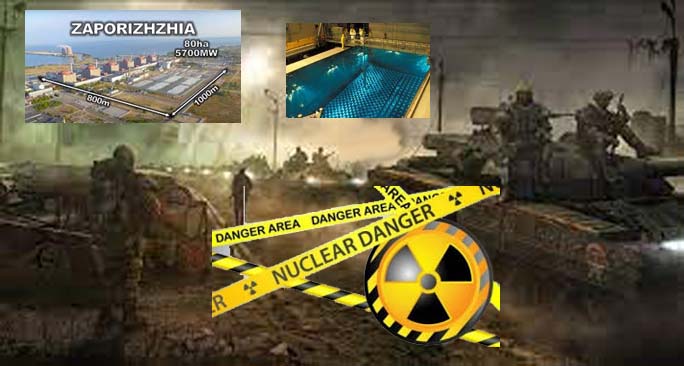
Seizing Zaporizhzhia: A Meltdown in Nuclear Governance
By Robert Schuett – 30 June 2025, https://www.globalpolicyjournal.com/blog/30/06/2025/seizing-zaporizhzhia-meltdown-nuclear-governance
This is not just about Ukraine. Robert Schuett argues that Russia’s occupation of the Zaporizhzhia Nuclear Power Plant signals a broader unravelling of global nuclear governance—one that must urgently be addressed.
“There cannot be a crisis next week,” Henry Kissinger once quipped. “My schedule is already full.”
Decades later, the line reads less like a joke about the work ethic and demands of high office, and more like a grim diagnosis of the current global condition. From the ongoing war in Europe—where Russian armed forces continue their relentless aggression, with recent escalations in Kyiv and Odesa—to the deepening geopolitical fracture in the Middle East, international society is not short on crises, violence, and human suffering.
The real strategic risk for global policy is that when pre-emptive force becomes the de facto tool for upholding non-proliferation principles, the entire framework of nuclear governance begins to fracture.
Yet among them, one threat quietly festers in a war zone on the east bank of the Dnipro River: the occupation of the Zaporizhzhia Nuclear Power Plant (ZNPP)—after all, the largest in Europe—located in the city of Enerhodar, in Ukraine’s Zaporizhzhia Oblast. Overshadowed by battlefield developments and Russia’s broader diplomatic brinkmanship, this overlooked flashpoint risks unravelling the foundational norms of nuclear safety, civilian infrastructure protection, and international law itself.
Captured by Russian forces in March 2022, the facility has become a symbol of everything that should not happen in modern warfare. Russia has consistently ruled out transferring control of the ZNPP—either back to Ukraine, the US, or any international authority. The Kremlin maintains a posture of legal reinterpretation, insisting on its operational authority despite international condemnation.
Although all six reactors remain in cold shutdown, the risk is far from neutralized. The plant now depends on a single functioning high-voltage line to power critical cooling and safety systems, which is a stark contrast to the ten off-site lines it had before the illegal Russian war of aggression. The destruction of the Kakhovka Dam in 2023 eliminated its primary cooling reservoir, forcing the plant to rely on makeshift groundwater wells.
Russian forces have reportedly deployed military assets within the facility, further compromising its integrity. While the International Atomic Energy Agency (IAEA) maintains a presence onsite, its ability to enforce safety protocols is severely limited under conditions of foreign military occupation.
As IAEA Director General Rafael Mariano Grossi recently warned, the power supply to Zaporizhzhia remains “extremely fragile,” placing the site, and the entire region, at persistent risk.
This is not merely a technical or regional issue, however. Russia’s nuclear blackmail is a serious threat to global nuclear order.
Russia’s occupation of ZNPP constitutes a rupture in the international legal and regulatory architecture that safeguards civilian nuclear infrastructure. For decades, global norms and laws—rooted in instruments like the Geneva Conventions, the Convention on the Physical Protection of Nuclear Material, and IAEA guidance—have treated nuclear power plants as protected, non-military assets. Seizing or attacking them was once unthinkable. Russia’s actions have shattered this principle, undermining legal norms from which it has historically benefited.
The twist is as alarming as it is cynical. Russian state entities like Rosatom, which in peacetime present themselves as responsible global stewards of nuclear safety, are now party to an act of strategic subversion and tool of ruthless state power. Rosatom and its subsidiaries regularly construct and operate nuclear plants abroad, complying with international standards and cultivating an image of professionalism. But at Zaporizhzhia, the same actor has helped transfer control of the facility to a newly created Russian-operated entity. The contradiction is jarring: the self-proclaimed guarantor of global nuclear norms is now violating them in pursuit of pseudo-geopolitical gain. Rosatom has recently confirmed its long-term intention to restart ZNPP, despite the unresolved security, political, regulatory, and moral challenges on the ground.
At a strategic level, this selective application of international rules and norms sets a dangerous precedent. If civilian nuclear infrastructure can be seized and operated by military force—while cloaked in the language of regulation—it opens the door to the normalization of impunity. The rulebook governing civilian nuclear conduct risks becoming a tool of expedience rather than a binding constraint. Such erosion undermines not only nuclear safety but also the predictability and trust that underpin broader technical agreements, from arms control to climate-related energy cooperation.
The longer Zaporizhzhia remains a “nuclear hostage,” the more the world risks sleepwalking into disaster. The plant is not operational, but that is no guarantee of safety. The worst-case scenarios, ranging from damage to spent fuel pools, sabotage of safety systems, or collapse of staff morale, are not theoretical. The ongoing uncertainty erodes public trust in nuclear energy, destabilizes non-proliferation efforts, and sends dangerous signals to other regimes watching how the world responds.
Moreover, the moral implications cannot be ignored. Civilian nuclear facilities were never meant to be pawns in geopolitical contests. They exist to serve public needs, not strategic or revanchist ambitions. Allowing one state to weaponize this infrastructure risks eroding the civilian character of nuclear energy itself.
What’s at stake is far more than a single nuclear plant—or even the authority of one international watchdog. This is a stress test for the entire system of rules that keeps the world from tipping into chaos. If the norms protecting nuclear safety can be so casually violated, what’s to stop similar breaches in artificial intelligence, biotechnology, climate regulation, or space?
The responsibility now lies with the international community not only to condemn, but to act. Diplomatic actors—especially those in Europe and within multilateral institutions—must ensure that the Zaporizhzhia crisis remains at the forefront of international attention. It cannot be allowed to drift into the background of conflict fatigue or be buried beneath newer headlines.
Sustained diplomatic pressure, public engagement, and policy innovation are essential to prevent normalization of the unacceptable. The defense of global norms must not be reactive or selective. Rather, it must be proactive, persistent, and principled.
If international society won’t defend longstanding rules at Zaporizhzhia, it may find itself unprepared when those rules collapse everywhere else.
Robert Schuett is co-founder and managing partner at STK Powerhouse, a global risk advisory firm. A former Defence civil servant, he also serves as Chairman of the Austrian Political Science Association and is a long-standing Honorary Fellow at Durham University.
1 This Month

To see nuclear-related stories in greater depth and intensity – go to https://nuclearinformation.wordpress.com
-
Archives
- September 2026 (184)
- August 2026 (330)
- July 2026 (355)
- June 2026 (287)
- May 2026 (306)
- April 2026 (356)
- March 2026 (251)
- February 2026 (267)
- January 2026 (308)
- December 2025 (358)
- November 2025 (359)
- October 2025 (375)
-
Categories
- 1
- 1 NUCLEAR ISSUES
- business and costs
- climate change
- culture and arts
- ENERGY
- environment
- health
- history
- indigenous issues
- Legal
- marketing of nuclear
- media
- opposition to nuclear
- PERSONAL STORIES
- politics
- politics international
- Religion and ethics
- safety
- secrets,lies and civil liberties
- spinbuster
- technology
- Uranium
- wastes
- weapons and war
- Women
- 2 WORLD
- ACTION
- AFRICA
- Atrocities
- AUSTRALIA
- Christina's notes
- Christina's themes
- culture and arts
- Events
- Fuk 2022
- Fuk 2023
- Fukushima 2017
- Fukushima 2018
- fukushima 2019
- Fukushima 2020
- Fukushima 2021
- general
- global warming
- Humour (God we need it)
- Nuclear
- RARE EARTHS
- Reference
- resources – print
- Resources -audiovicual
- Weekly Newsletter
- World
- World Nuclear
- YouTube
-
RSS
Entries RSS
Comments RSS
 nuclear-news