Japan taps tech to foil nuclear terrorism ahead of Tokyo Olympics, Japan Times, KYODO
JUL 19, 2017 With the 2020 Olympics and Paralympics in Tokyo just three years away, the government is stepping up efforts to prevent terrorist attacks using nuclear and other radioactive materials……
At a meeting of the Education, Culture, Sports, Science and Technology Ministry in December, Mitsuru Uesaka, president of the Atomic Energy Society of Japan and a professor at the University of Tokyo, said it was important to “enhance nuclear security” ahead of the games.
There have been numerous incidents overseas involving attempts to smuggle nuclear materials……
There are also fears that the radical militant group Islamic State might have made a “dirty bomb” capable of scattering radioactive materials. Unlike nuclear weapons, such devices can be made relatively cheaply without advanced skills.
To stop nuclear materials from entering Japan through airports, the agency developed a device to detect very small amounts of uranium concealed in luggage by irradiating luggage with a beam of neutrons. The result is available in less than a second.
Baggage screening at domestic airports usually uses X-rays, but an expert at the agency said conventional screening is not effective in detecting nuclear materials…..
As of the end of 2015, there were 454 confirmed incidents around the world involving unauthorized possession of nuclear materials and related criminal activities, 762 incidents involving reported theft or loss of such materials, and 1,622 incidents involving other unauthorized activities and events related to such materials, according to an International Atomic Energy Agency report. http://www.japantimes.co.jp/news/2017/07/19/national/japan-taps-tech-foil-nuclear-terrorism-ahead-tokyo-olympics/#.WW8OgBWGPGg
HM Gov 13th June 2017, This paper outlines the United Kingdom’s (UK) position on the ownership and
responsibility for special fissile material and related safeguards
equipment.
The Treaty establishing the European Atomic Energy Community
(Euratom) provides the basis for the UK’s cooperation with the Euratom
Community on civil nuclear issues. It includes the provision of safeguards
arrangements for non-proliferation of nuclear materials, cooperation in
nuclear research and development, mobility of workers and trade in the
nuclear sector and wider nuclear regulatory cooperation.
The UK invoked Article 106(a) of the Treaty establishing Euratom at the same time as
Article 50 of the Treaty on European Union (TEU).
As the European Commission has stated in its recommendation for a European Council decision
authorising the Commission to open negotiations with the UK on an agreement
on its withdrawal from the European Union (EU): “It is recalled that in
accordance with Article 106(a) of the Treaty establishing the European
Atomic Energy Community, Article 50 of the Treaty on European Union applies
also to the European Atomic Energy Community”.
Holyrood 12th July 2017,The Scottish Government has raised concerns over the future transfer of
radioactive materials in Scotland, after a Westminster debate saw Theresa
May’s government maintain its commitment to withdrawing from an
international nuclear treaty.
With May facing growing opposition from herown party over plans to withdraw the UK’s membership of the European
Atomic Energy Community (Euratom), which fosters cooperation on the safe
handling of nuclear materials, Environment Secretary Roseanna Cunningham
expressed irritation over a lack of consultation from UK ministers.
Turkey Point: Fire and Explosion at the Nuclear Plant, UCS , DAVE LOCHBAUM, DIRECTOR, NUCLEAR SAFETY PROJECT | JULY 11, 2017, The Florida Power & Light Company’s Turkey Point Nuclear Generating Station about 20 miles south of Miami has two Westinghouse pressurized water reactors that began operating in the early 1970s. Built next to two fossil-fired generating units, Units 3 and 4 each add about 875 megawatts of nuclear-generated electricity to the power grid.
Both reactors hummed along at full power on the morning of Saturday, March 18, 2017, when problems arose.
The Event
At 11:07 am, a high energy arc flash (HEAF) in Cubicle 3AA06 of safety-related Bus 3A ignited a fire and caused an explosion. The explosion inside the small concrete-wall room (called Switchgear Room 3A) injured a worker and blew open Fire Door D070-3 into the adjacent room housing the safety-related Bus 3B (called Switchgear Room 3B.)
A second later, the Unit 3 reactor automatically tripped when Reactor Coolant Pump 3A stopped running. This motor-driven pump received its electrical power from Bus 3A. The HEAF event damaged Bus 3A, causing the reactor coolant pump to trip on under-voltage (i.e., less than the desired voltage of 4,160 volts.) The pump’s trip triggered the insertion of all control rods into the reactor core, terminating the nuclear chain reaction.
Another second later and Reactor Coolant Pumps 3B and 3C also stopped running. These motor-driven pumps received electricity from Bus 3B. The HEAF event should have been isolated to the Switchgear Room 3A, but the force of the explosion blew open the connecting fire door, allowing Bus 3B to also be affected. Reactor Coolant Pumps 3B and 3C tripped on under-frequency (i.e., alternating current electricity at too much less than the desired 60 cycles per second). Each Turkey Point unit has three Reactor Coolant Pumps that force the flow of water through the reactor core, out the reactor vessel to the steam generators where heat gets transferred to a secondary loop of water, and then back to the reactor vessel. With all three pumps turned off, the reactor core would be cooled by natural circulation. Natural circulation can remove small amounts of heat, but not larger amounts; hence, the reactor automatically shuts down when even one of its three Reactor Coolant Pumps is not running.
At shortly before 11:09 am, the operators in the control room received word about a fire in Switchgear Room 3A and the injured worker. The operators dispatched the plant’s fire brigade to the area. At 11:19 am, the operators declared an emergency due to a “Fire or Explosion Affecting the Operability of Plant Systems Required to Establish or Maintain Safe Shutdown.”
At 11:30 am, the fire brigade reported to the control room operators that there was no fire in either Switchgear Room 3A or 3B.
…….The NRC needs to understand HEAF factors as fully as practical before it can determine if additional measures are needed to manage the risk. The NRC is also collecting information about potential HEAF vulnerabilities. Collectively, these efforts should enable the NRC to identify any nuclear safety problems posed by HEAF events and to implement a triaged plan that resolves the biggest vulnerabilities sooner rather than later. http://allthingsnuclear.org/dlochbaum/turkey-point-fire-and-explosion-at-the-nuclear-plant
Reuters 11th July 2017 The U.N. global nuclear watchdog is about to open a uranium bank in the Central Asian state of Kazakhstan, but it may never have any customers.
The raw material used to make nuclear fuel and atomic bombs will be stored in aSoviet-era industrial plant where security was once considered so lax that all the highly enriched uranium kept there was removed in a covert U.S. operation in 1994.
The International Atomic Energy Agency’s goal now is the same as Washington’s 23 years ago as it prepares for next month’s launch of its Low Enriched Uranium Bank in the city of Oskemen — to prevent nuclear proliferation. http://uk.reuters.com/article/uk-nuclear-kazakhstan-bank-idUKKBN19W0UV
The steel anomalies in the reactor vessel of the EPR in Flamanville and
many steam generators have led to one of the most serious crises faced by
the French nuclear industry.
The report of the High Committee on Transparency and Information on Nuclear Safety (HCTISN) highlights the
absence of precise information from Areva and EdF on the serious problems
affecting the reactor vessel of the Flamanville EPR .
The finding would be the same for steam generators. ACRO, therefore calls for more transparency.
The association made an inventory of the available documentation and
reconstructed a chronology of the events on a dedicated website: http://transparence-nucleaire.eu.org.
Construction of the floating plant, which is to be deployed in Russia’s Far East, has caused concern among environmentalists. Rashid Alimov of Greenpeace’s Russian branch said Tuesday’s fire showed that plans for loading nuclear fuel into the plant’s reactors are “irresponsible.”
The shipyard is about two kilometers (1.25 miles) downriver from some of St. Petersburg’s most renowned tourist sites, including the State Hermitage Museum.
The ministry statement says the fire was caused by a short circuit in a storage battery.
CORE 2nd July 2017, The Pacific Heron and sister shipPacific Egret, armed with naval canon and
carrying security ‘swat- squads’ sailed unladen from their home port of Barrow-in-Furness early this morning en-route to Cherbourg where MOX (mixed oxide) plutonium fuel assemblies will be loaded for onward delivery to Japan.
The 16 fuel assemblies, fabricated in French company Areva’s MeloxPlant and containing some 500kg of nuclear weapons useable plutonium aredestined for Kansai Electric’s Takahama 4 reactor in the south west of Japan. Preparation for the two-month voyage have been evident over the last few days at Barrow’s Ramsden Dock nuclear terminal with the loading of stores, the arrival of the security swat-squads provided by the Civil Nuclear Constabulary’s Strategic Escort Group (aka Sea-Plods), the
loading of ammunition and the sweeping of the ships’ hulls by divers.
Commenting on the preparations, CORE’s spokesman Martin Forwood said today that the need for this level of armed security brings home the reality of the very real and significant dangers of transporting plutonium – in this case enough for around one hundred nuclear weapons – and demolishes the industry’s complacent and short-sighted claim that such shipments pose no risks.
“At a time of heightened and increasingly sophisticated action by terrorists we re-iterate our condemnation of the trans-world shipment of such dangerous material by sea. This voyage not
only foists needless risks on the marine environment and communities along the route, but also raises additional and significant concerns in Japan on the use of MOX fuel in the Takahama reactor (as also used in the fated Fukushima reactors) which has only just re-started after the overturning of a court injunction by local activists which kept the reactor off-line for inadequate safety standards” http://corecumbria.co.uk/news/nuclear-gunships-sail-from-barrow-on-plutonium-voyage-to-japan/
Rotten resin gas ‘most likely’ cause of Ibaraki nuclear accident http://www.asahi.com/ajw/articles/AJ201707040020.html July 4, 2017 The Japan Atomic Energy Agency (JAEA) now considers the most likely cause of last month’s nuclear contamination accident at its Oarai research center to be gas produced by decomposing resin containing plutonium and other radioactive substances.
The June 6 incident at the facility in Ibaraki Prefecture, northeast of Tokyo, exposed five workers to plutonium when they handled 26-year-old radioactive waste stored there.
Resin was used to stick the radioactive waste on an aluminum sheet and stored in a tightly sealed polyethylene container, which was wrapped in plastic bags and placed in a stainless steel container.
The accident occurred when the workers opened the steel container and were exposed to radioactive particles that seeped out of the polyethylene container in gas that ruptured the plastic coverings and escaped into the room they were in.
“Decomposition of resin by a radioactive substance is considered as the most likely cause of the gas’s formation,” said Toshio Kodama, JAEA president, at a July 3 meeting with the science and technology ministry’s special investigation team that was set up to determine the cause of the accident.
JAEA found that the polyethylene container inside the plastic bags contained powdered plutonium set in pieces of epoxy resin.
The agency is looking at other possibilities, but now considers decomposition of the resin as the most likely cause.
On the same day, the National Institute of Radiological Sciences in Chiba announced that three of the five workers have been admitted to its facility for the third time to receive medication via an intravenous drip that speeds the excretion of radioactive substances from their bodies as urine.
The health of the five workers has not changed, according to NIRS.
Atomic Bellyflop: America’s 1st ’21st Century Nuclear Reactor’ Fails, Shuts Down After 5 Months bureauEnviroNews DC News Bureau ,byJulia Travers July 3, 2017
2nd Hanford tunnel storing radioactive waste at risk of failing, federal study says Seattle Times, July 1, 2017 “This makes it clear that the second tunnel may also pose a risk to human health and the environment,” said Alex Smith, nuclear-waste program manager for the state Department of Ecology. Hal BerntonSeattle Times staff reporter. A second tunnel storing radioactive waste at the Hanford nuclear reservation has structural problems and is at risk of failing, according to a U.S. Energy Department investigation released Friday.
This tunnel is more than four times longer than the smaller Hanford tunnel that suffered a partial roof collapse May 9, triggering an order for more than 4,800 employees to stay indoors.
Officials say the May 9 event did not trigger any radioactive releases. But it did escalate safety concerns about the storage of high-hazard materials left from the legacy of Hanford’s plutonium production.
State Department of Ecology officials ordered an engineering evaluation as part of a series of corrective actions. The findings were jointly released Friday in Richland by state and federal officials……..
It is not clear what caused the collapse of the wood-and-concrete tunnel that contains eight flatbed railcars holding radioactive waste. Possible factors included heavy rainfall in early May and deteriorating wood, according to the Energy Department.
The stabilization plan for the smaller tunnel involves filling it with grout, with work scheduled to be done by year’s end.
The Energy Department has until Aug. 1 to submit a plan to state officials for shoring up the second tunnel, which stretches for some 1,700 feet.
Made of metal and concrete, it was built in the 1960s and, like the other tunnel, holds railcars containing radioactive waste.
Investigators found it does not meet codes for structural integrity, and may not be able to bear the weight of soil above it……..
the Energy Department is examining options to shore up the larger tunnel. The task is complicated by the fact that, because of radiation, no one can enter the tunnel to assess its conditions…… About 8,000 people are working on a complex cleanup expected to cost more than $100 billion and last for decades.
Air Force to “Cyber-Secure” Nuclear Arsenal, SCOUT WARRIOR, 2 Jul 17, Modernizing computer networks for the nuclear arsenal is part of the current Air Force plan to build as many as 400 new Inter-Continental Ballistic Missiles, or ICBMs, to serve through the 2070s.
The Air Force is seeking more interactions with private sector firms to build better networks for securing nuclear weapons computer systems, service officials said.
Air Force engineers say protection of computer networks is well established in many ways, but that the service needs to widen its scope with greater focus on IT dimensions to its nuclear arsenal’s command and control apparatus.
“Information technology that touches weapons systems needs to be cyber secure, updated and patched. Worldwide nuclear systems are one example of where we need to get an overhaul,” Peter Kim, Air Force Chief Information Security Officer, told Scout Warrior in an interview.
Ukrainian Firefighters Battle Forest Fire Near Chernobyl Nuclear Plant, https://www.rferl.org/a/firefighters-battle-forest-fire-near-chernobyl/28588006.html June 30, 2017 RFE/RL’s Ukrainian Service, Ukrainian firefighters are battling to contain a forest fire inside the irradiated exclusion zone around the Chernobyl nuclear plant, officials say.
The fire erupted around midday on June 29 during tree cutting works at the Lubyanskoye Forestry and spread to an area of some 25 hectares by early June 30, the emergency services said.
More than 100 firefighters and scores of trucks and aircraft were dispatched to the area, a statement said.
It is not the first wildfire to break out near the site of the 1986 reactor explosion and fire, the world’s worst civilian nuclear disaster. In 2015 alone, fires engulfed some 400 hectares of forests in the exclusion zone.
A separate Defense Nuclear Facilities Safety Board report in February detailed the magnitude of the shortfall:
Los Alamos’ dangerous work, it said, demands 27 fully qualified criticality safety engineers.
The lab has 10
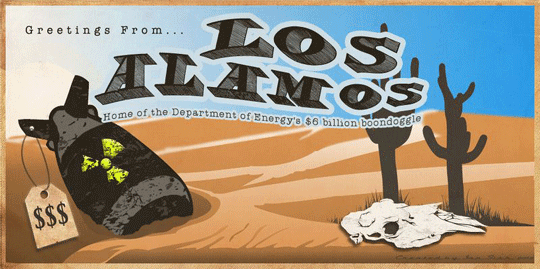
Safety problems at a Los Alamos laboratory delay U.S. nuclear warhead testing and production A facility that handles the cores of U.S. nuclear weapons has been mostly closed since 2013 over its inability to control worker safety risks, Science, By The Center for Public Integrity, R. Jeffrey Smith, Patrick MalonJun. 30, 2017
In mid-2013, four federal nuclear safety experts brought an alarming message to the top official in charge of America’s warhead production: Los Alamos National Laboratory, the nation’s sole site for making and testing a key nuclear bomb part, wasn’t taking needed safety precautions. The lab, they said, was ill-prepared to prevent an accident that could kill lab workers, and potentially others nearby.
Some safety infractions had already occurred at the lab that year. But Neile Miller, who was then the acting head of the National Nuclear Security Administration in Washington, says those experts specifically told her that Los Alamos didn’t have enough personnel who knew how to handle plutonium so it didn’t accidentally go “critical” and start an uncontrolled chain reaction.
Such chain reactions generate intense bursts of deadly radiation, and over the last half-century have claimed nearly two dozen lives. The precise consequences, Miller said in a recent interview, “did not need an explanation. You don’t want an accident involving criticality and plutonium.” Indeed, Miller said, criticality “is one of those trigger words” that immediately gets the attention of those responsible for preventing a nuclear weapons disaster.
With two of the four experts remaining in her Washington office overlooking the national mall, Miller picked up the phone and called the lab’s director, Charles McMillan, at his own office on the idyllic Los Alamos campus in the New Mexico mountains, where nuclear weapons work is financed by a federal payment exceeding $2 billion a year. She recommended that a sensitive facility conducting plutonium operations — inside a building known as PF-4 — be shut down, immediately, while the safety deficiencies were fixed.
McMillan, a nuclear physicist and weapons designer with government-funded compensation exceeding a million dollars a year, responded that he had believed the problems could be solved while that lab kept operating. He was “reluctant” to shut it down, Miller recalled. But as the call proceeded, he became open to her view that the risks were too high, she added. So on McMillan’s order, the facility was shut within a day, with little public notice.
In the secrecy-shrouded world of America’s nuclear weapons work, that decision had far-reaching consequences. Continue reading →





 nuclear-news