Komo news, by NICHOLAS K. GERANIOS, Associated Press SPOKANE, Wash. (AP) 5 Oct 17, – Workers at the Hanford Nuclear Reservation have started injecting grout into a partially collapsed tunnel that contains radioactive wastes left over from the production of nuclear weapons, the U.S. Department of Energy said Wednesday.
The grout is intended to improve the stability of the 360-foot-long (110 meters) tube, which dates to 1956, and help prevent any radioactivity from escaping into the environment.
It will take an estimated 650 truckloads of grout to fill the tunnel adjacent to the closed Plutonium Uranium Extraction Plant, which produced most of the plutonium for the nation’s nuclear arsenal, the agency said. The complicated work should be completed by the end of the year……..
The roof of the tunnel, which was sealed in 1965, partially collapsed on May 9, forcing about 3,000 workers to shelter in place for several hours……
The site now contains the nation’s greatest volume of radioactive defense wastes. Cleanup of the site is expected to last until 2060 and cost $100 billion.
The grout will be injected into the tunnel at night. It is engineered to flow easily and will cover the contents, including eight contaminated railroad cars that carry waste.
The tunnel being filled with grout is one of two near the PUREX plant that contain contaminated rail cars and other radioactive waste.
The department concluded earlier this year that there is a high risk that the second, much larger, tunnel could also collapse.
The Energy Department has said that the two sealed tunnels “do not meet current structural codes and standards.”
The larger tunnel was built of metal and concrete in 1964. It is approximately 1,700 feet (510 meters) long and is covered with eight feet (2.5 meters) of soil to prevent radiation from escaping. Inside are 28 flat-bed rail cars containing nuclear waste, including giant storage vessels and other large equipment from plutonium production. That tunnel was sealed in 1996 and has not been entered since. http://komonews.com/news/local/650-truckloads-of-grout-to-fill-collapsed-radioactive-tunnel-at-hanford
Quoting unnamed sources news portal The Print reported that the damage could be the result of either a collision at sea or accidental scraping while entering the harbour. Officials in the the Navy refused to comment on the incident.
“Repair work on the submarine is likely to be complicated given that the sonar dome is made of titanium, a difficult metal that requires both specialised machinery and manpower to work on. However, the indigenous Arihant nuclear armed submarines are also being made in Visakhapatnam and that could help,” said the report.
INS Chakra, inducted in April 2012, is on ten year lease. The vessel is belongs to Akula-II class of Russian submarine.
The submarine, having displacement of 12,000 tonnes, is powered by a 190 MW reactor with top speed of over 30 knots.
Nuclear Shutdown News chronicles the decline and fall of the nuclear power industry in the US and abroad and highlights the efforts of those who are working for a nuclear free world. Here is our September 217 report.
As Hurricanes Batter the Caribbean and Southeast US, Nuke Plants in Texas And Florida Refuse To Shut Down, Heightening Risk To Already Devastated Communities.
On September 19 the Austin (TX) American-Statesman ran this story “South Texas Project stayed open during Hurricane Harvey.” South Texas Project is a nuclear plant with two reactors near Bay City, TX on the Gulf Coast, 90 miles from Houston.It has been operating since the late 1980s. Austin Energy is one of three utilities that owns it.
The newspaper article’s subtitle was “Some question decision to keep Texas nuclear plant open during Harvey.”
The American Statesman reported, “An evacuation of surrounding areas and flooding fears kept the plant’s storm crew in the plant for nine days.” But management had planned for a stay of only three days and the A-E also reported “the Colorado River is only two miles away” and “it was forecast to crest a week after the storm hit.”
Fortunately the floodwaters didn’t reach the plant, so the nuke kept operating at 100%.
But Kathy Hedden, director of Sustainable Energy and Economic Development (SEED) told the American-Statesman “the risk wasn’t worth keeping the plant running.” And although winds “topped off at 40 mph–well below the 73 mph that would have triggered mandatory shutdown for the nuke, the paper reported. “tornadoes touched down just miles from the site.”
Kathy Hedden asserted “The South Texas Plant nuclear reactors, 90 miles south of Houston, could have shut down to ensure our health and safety, but instead played radioactive roulette. They prioritized profit and continued operating. Picture a nuclear disaster on top of that.”
The situation was much the same in Florida as Hurricane Flora roared in. Florida Power & Light, owner of the Turkey Point and St. Lucie nuke plants, each with two reactors, was preparing to shut them down during the storm. But when winds fell to less than hurricane force, and the utility wasn’t required by law to take them offline, FPL kept them running full force, except when a faulty valve at one Turkey Point reactor closed it down.
By the way, both reactors at Turkey Point are over 40 years old, as is one of St. Lucie’s.
On September 11 Newsweek reported that FPL had been “operating during Irma although the plant had not met federal safety requirements implemented after Fukushima.”
The Fukushima catastrophe in March 2011 followed a severe earthquake and tsunami, resulting in the meltdown of three of its reactors and a disaster that continues today.
Although nuclear plants produce electricity, they are also dependent on outside sources for electrical power as well. If the grid is down, the risk of serious accidents can increase.Newsweek consulted two nuclear experts on this matter.
David Lochbaum is director of the Nuclear Safety Project at the Union of Concerned Scientists. “The pump room is the Achilles Heel at Turkey Point,” he commented. “Without Cooling Water during an accident, workers must deploy backup to the backup system. At Fukushima workers were unable to accomplish this task in time to prevent the reactor core from overheating.”
And Maggie Gundersen, co-founder of Fairewind Energy and Education, like Lochbaum a former high level nuclear employee, added “”When there’s a possibility to lose power, why would you take the risk of that? That’s just hubris and a hug risk to the population.”
Predicted collapse reignites worker safety concerns at WIPP, Adrian C Hedden, Carlsbad Current-Argus Sept. 29, 2017 Worker safety could yet again become a concern at the Waste Isolation Pilot Plant.
A rock collapse in a portion of the plant’s underground mine where nuclear waste is permanently emplaced is expected in four to six weeks.
The collapse is expected in Room 6 of Panel 7 in the underground, which was off limits to workers for at almost a year before a Thursday announcement by the U.S. Department of Energy of a potential collapse.
Since it was sealed, no ground control measures took place in Room 6………
Rick Fuentes, president of the United Steelworkers Union Local 12-9477, which represents WIPP waste handlers, said the mine is safe for now.
But Fuentes worried that the underground can be unpredictable, and a collapse could occur sooner than expected.
“We’re not going to take any chances,” Fuentes said. “The underground is unpredictable. It could move faster.”……..
“When you deal with mother nature, it’s hard to know what will happen,” Fuentes said. “Day in and day out we have to stay on our A-game to ensure workers are safe.”
When measurements show the ground is unstable or if stability deteriorates at a dangerous rate, Fuentes said all underground activity will cease until conditions become safe.
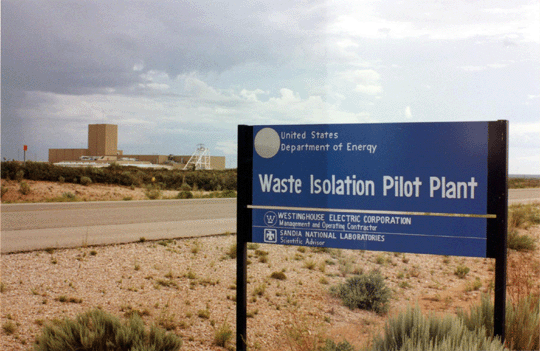
In the coming weeks, deep inside the Waste Isolation Pilot Plant in Carlsbad, large blocks of salt rock are expected to collapse inside a room containing six irradiated vehicles, each holding gasoline. The room is packed with radioactive waste, and the entrance has been sealed to prevent workers from entering.
It is expected to be the fifth rock fall event in the last year in an area of the underground storage facility, Panel 7, where maintenance has been neglected since a waste drum breached on Valentine’s Day 2014. The accident released radiation into parts of the waste facility and closed the site for nearly three years.
Officials from the U.S. Department of Energy said Thursday they are closely monitoring increasing movement in the walls and ceiling and keeping employees who work in the area informed about developments.
The collapse is predicted in four to six weeks.
The salt mine is expected to “creep” over time and slowly encase radioactive waste inside. Rock falls are not uncommon. But unlike previous anticipated collapses — one of which was measured at half the length of a football field and 8 feet wide — this one threatens to occur as waste shipments have resumed in the area, increasing the number of workers present and the amount of waste being handled.
“Right now we are evaluating our work processes to get a better understanding of when the roof potentially could fall and take appropriate action for our workforce,” said Todd Shrader, manager of the Department of Energy’s Carlsbad Field Office, during a WIPP town hall meeting Thursday evening.
“It is not an exact science,” he said.
All workers in Panel 7 are wearing protective clothing and respirators because of existing contamination.
But Don Hancock, with the Southwest Research and Information Center in Albuquerque, said WIPP should be taking more measures to protect workers.
“They can’t prevent the ceiling from collapsing,” he said. “That is going to happen. But they should be keeping workers out around the time they expect it to happen, and until after it happens.”
WIPP is composed of a maze of carved salt tunnels, each with an offshoot of rooms used to permanently place transuranic waste. This includes materials like soil, gloves, tools and other equipment that have been contaminated by radioactive materials heavier than uranium at the Department of Energy’s nuclear weapons sites.
Since WIPP opened in 1999, Panel 7 has been one of the most problematic regions of the facility. It was there, inside Room 7 of Panel 7, that an improperly packed drum of transuranic waste from Los Alamos National Laboratory burst in 2014.
The radiation compromised the facility’s ventilation system, hampering workers’ maintenance efforts. As a result, regular repairs to the large bolts and steel mesh cage used to hold the salt mine in place have not been completed, making collapses more likely and frequent.
Hancock said there is a risk of further radiation exposure when Room 6 collapses, as well as the potential for fuel inside the vehicles to cause a small fire.
There are six vehicles in Room 6 that were irradiated when the drum burst next door, and they hold a collective 527 gallons of fuel.
WIPP officials initially planned to drain the fuel, Shrader told the New Mexico Environment Department, but the plan was abandoned when officials decided the risk of collapse was too great to re-enter the room.
Bruce Covert, president of Nuclear Waste Partnership, which manages WIPP, said during Thursday’s town hall that cloth and metal in the room should contain most of the radiation after the collapse, but officials anticipate some contamination to spread.
Meanwhile, officials said they planned to move forward with waste storage work in the area and hoped to begin mining a new panel by late October, with the assistance of a temporary ventilation system.
Since waste acceptance restarted in April, WIPP has received 68 shipments, and it anticipated taking 258 more shipments between August 2017 and August 2018.
WIPP has reached about 52 percent of its capacity and is expected to be full by 2026, according to a September report by the U.S. Government Accountability Office. But the Department of Energy is considering a plan to expand the type of waste WIPP can take, as well as a physical expansion of the plant.
Given past events, Hancock said, “I expect more problems. You have a dangerous situation and you have a contractor who has demonstrated that are not capable of operating this facility safely.”
The effects of a single terrorist nuclear bomb, Bulletin of the Atomic Scientists
Matthew Bunn Nickolas Roth28 SEPTEMBER 2017, The escalating threats between North Korea and the United States make it easy to forget the “nuclear nightmare,” as former US Secretary of Defense William J. Perry put it, that could result even from the use of just a single terrorist nuclear bomb in the heart of a major city.
At the risk of repeating the vast literature on the tragedies of Hiroshima and Nagasaki—and the substantial literature surrounding nuclear tests and simulations since then—we attempt to spell out here the likely consequences of the explosion of a single terrorist nuclear bomb on a major city, and its subsequent ripple effects on the rest of the planet. Depending on where and when it was detonated, the blast, fire, initial radiation, and long-term radioactive fallout from such a bomb could leave the heart of a major city a smoldering radioactive ruin, killing tens or hundreds of thousands of people and wounding hundreds of thousands more. Vast areas would have to be evacuated and might be uninhabitable for years. Economic, political, and social aftershocks would ripple throughout the world. A single terrorist nuclear bomb would change history. The country attacked—and the world—would never be the same.
The idea of terrorists accomplishing such a thing is, unfortunately, not out of the question; it is far easier to make a crude, unsafe, unreliable nuclear explosive that might fit in the back of a truck than it is to make a safe, reliable weapon of known yield that can be delivered by missile or combat aircraft. Numerous government studies have concluded that it is plausible that a sophisticated terrorist group could make a crude bomb if they got the needed nuclear material. And in the last quarter century, there have been some 20 seizures of stolen, weapons-usable nuclear material, and at least two terrorist groups have made significant efforts to acquire nuclear bombs.
Terrorist use of an actual nuclear bomb is a low-probability event—but the immensity of the consequences means that even a small chance is enough to justify an intensive effort to reduce the risk. Fortunately, since the early 1990s, countries around the world have significantly reduced the danger—but it remains very real, and there is more to do to ensure this nightmare never becomes reality.
Brighter than a thousand suns. Imagine a crude terrorist nuclear bomb—containing a chunk of highly enriched uranium just under the size of a regulation bowling ball, or a much smaller chunk of plutonium—suddenly detonating inside a delivery van parked in the heart of a major city……….
The silent killer. The bomb’s immediate effects would be followed by a slow, lingering killer: radioactive fallout. A bomb detonated at ground level would dig a huge crater, hurling tons of earth and debris thousands of feet into the sky. Sucked into the rising fireball, these particles would mix with the radioactive remainders of the bomb, and over the next few hours or days, the debris would rain down for miles downwind. Depending on weather and wind patterns, the fallout could actually be deadlier and make a far larger area unusable than the blast itself. Acute radiation sickness from the initial radiation pulse and the fallout would likely affect tens of thousands of people. Depending on the dose, they might suffer from vomiting, watery diarrhea, fever, sores, loss of hair, and bone marrow depletion. Some would survive; some would die within days; some would take months to die. Cancer rates among the survivors would rise. Women would be more vulnerable than men—children and infants especially so.
Much of the radiation from a nuclear blast is short-lived; radiation levels even a few days after the blast would be far below those in the first hours. For those not killed or terribly wounded by the initial explosion, the best advice would be to take shelter in a basement for at least several days. But many would be too terrified to stay. Thousands of panic-stricken people might receive deadly doses of radiation as they fled from their homes. Some of the radiation will be longer-lived; areas most severely affected would have to be abandoned for many years after the attack. The combination of radioactive fallout and the devastation of nearly all life-sustaining infrastructure over a vast area would mean that hundreds of thousands of people would have to evacuate.
Ambulances to nowhere. The explosion would also destroy much of the city’s ability to respond. Hospitals would be leveled, doctors and nurses killed and wounded, ambulances destroyed. (In Hiroshima, 42 of 45 hospitals were destroyed or severely damaged, and 270 of 300 doctors were killed.) Resources that survived outside the zone of destruction would be utterly overwhelmed. Hospitals have no ability to cope with tens or hundreds of thousands of terribly burned and injured people all at once; the United States, for example, has 1,760 burn beds in hospitals nationwide, of which a third are available on any given day.
And the problem would not be limited to hospitals; firefighters, for example, would have little ability to cope with thousands of fires raging out of control at once. Fire stations and equipment would be destroyed in the affected area, and firemen killed, along with police and other emergency responders. Some of the first responders may become casualties themselves, from radioactive fallout, fire, and collapsing buildings. Over much of the affected area, communications would be destroyed, by both the physical effects and the electromagnetic pulse from the explosion.
Better preparation for such a disaster could save thousands of lives—but ultimately, there is no way any city can genuinely be prepared for a catastrophe on such a historic scale, occurring in a flash, with zero warning. Rescue and recovery attempts would be impeded by the destruction of most of the needed personnel and equipment, and by fire, debris, radiation, fear, lack of communications, and the immense scale of the disaster. The US military and the national guard could provide critically important capabilities—but federal plans assume that “no significant federal response” would be available for 24-to-72 hours. Many of those burned and injured would wait in vain for help, food, or water, perhaps for days.
The scale of death and suffering. How many would die in such an event, and how many would be terribly wounded, would depend on where and when the bomb was detonated, what the weather conditions were at the time, how successful the response was in helping the wounded survivors, and more. Many estimates of casualties are based on census data, which reflect where people sleep at night; if the attack occurred in the middle of a workday, the numbers of people crowded into the office towers at the heart of many modern cities would be far higher. The daytime population of Manhattan, for example, is roughly twice its nighttime population; in Midtown on a typical workday, there are an estimated 980,000 people per square mile. A 10-kiloton weapon detonated there might well kill half a million people—not counting those who might die of radiation sickness from the fallout. (These effects were analyzed in great detail in the Rand Corporation’s Considering the Effects of a Catastrophic Terrorist Attack and the British Medical Journal’s “Nuclear terrorism.”)………http://thebulletin.org/effects-single-terrorist-nuclear-bomb11150
L’Usine Nouvelle 25th Sept 2017, [Machine Translation]The nuclear watchdog announced Monday that it has
filed an application for interim measures to prohibit the French Nuclear
Safety Authority (ASN) from validating the EPR reactor vessel under
construction in Flamanville.
A hearing is scheduled for Tuesday 10 October
at the Paris tribunal de grande instance, the anti-nuclear association said
in a statement.
“This is probably the last chance to avoid an irresponsible
commissioning of the EPR with its defective tank and the prospect of a
catastrophe affecting the whole of Europe,” according to the Observatory
which calls for the appointment of an independent expert.
But it’s not the fear of a deliberate nuclear attack that has scholars and experts in East Asia most worried, but something totally accidental.
Recent sanctions against North Korea have been designed not only to cripple the country’s economy, but to stop them gaining the equipment needed to make more nuclear weapons.
But those same sanctions could prevent North Korea getting the supplies they need to maintain their existing nuclear facilities.
“There could be a nuclear accident, and that could be a nuclear weapon exploding and releasing radiation, or it could be the nuclear facilities breaking down and causing a Fukushima-style radiation leak,” Stephen Nagy of Tokyo’s International Christian University told nine.com.au.
“If you think about where North Korea is, that radiation would spread into northeast China, probably go to South Korea, and it would affect parts of Japan as well.”
Most experts agree that North Korea simply wants a nuclear bomb as a deterrent to prevent other nations bombing or invading them. And the purpose of their various weapons tests is a demonstration not of what they will do, but of what they can do.
Dr Nagy said most people in Tokyo are “not so concerned about an actual attack”. “They worry about a launch over Japan, and what happens if it falls into Japan accidentally?” he said. “What happens if that weapon does carry a nuclear weapon and there’s an accident?”
It’s not an unreasonable concern, though North Korea is unlikely to do something so provocative as firing a nuclear weapon over another country.
But Pyongyang has fired two intercontinental ballistic missiles over Japan’s northern island of Hokkaido, a literal shot across the bow as a sabre-rattling method.”If a launch falls down on Japan, does that mean that the United States goes to war?” Dr Nagy said. “Does that mean the nuclear fallout falls on Japan?”
Nuclear fallout can be far-reaching and devastating. The Chernobyl meltdown of 1986 spread a cloud of radiation stretching from Iran to Ireland.
North Korea is not as geographically isolated as many people think. The sprawling metropolis of Seoul has a population of 25 million and is walking distance from the border. And a serious nuclear accident in North Korea could spread radiation across the most heavily populated part of the world, with Beijing, Shanghai, Tokyo and Vladivostok certainly within range.
As with all nuclear meltdowns, the extent of the radioactive damage is based on the strength and direction of the wind.
There are already radiation fears stemming from North Korea’s detonation site, the mountain of Punggye-ri. Chinese scientist Wang Naiyan flagged the possibility the mountain could collapse, leaking radioactive material into the atmosphere.
Perhaps even more concerning is the prospect of an accidental detonation of a nuclear bomb on North Korean soil.
A 250-kiloton detonation would be so broad and destructive that it would be difficult to determine the cause.
So it is entirely possible an accidental explosion would be indistinguishable from a nuclear attack from the United States, triggering a nuclear war.
The area where the earthquake struck is not known to experience natural earthquakes. As earth-shaking booms are a natural feature of underground nuclear weapons testing, the quake led to suspicions North Korea had detonated yet another model of nuke — as it did earlier this month, sparking fears it had successfully developed a hydrogen bomb.
“This event occurred in the area of the previous North Korean Nuclear tests,” the United States Geological Survey wrote on its website. “We cannot conclusively confirm at this time the nature (natural or human-made) of the event. The depth is poorly constrained and has been held to 5km by the seismologist.”
According to the Washington Post, China’s state earthquake-monitoring agency initially believed the test to have been an explosion, although South Korean officials told the Associated Press “the analysis of seismic waves and the lack of sound waves clearly showed that the quake wasn’t caused by an artificial explosion.”
Per the AP, the 3.4-magnitude quake would be much smaller than previous nuclear tests, the weakest of which generated a magnitude 4.3 quake and the strongest of which, the test this month, resulted in a magnitude 6.3 quake. One possible explanation is the region is undergoing aftershocks in the wake of the previous nuclear tests.
“It could be a natural earthquake that really was man-made as the nuclear test would have transferred a lot of stress,” Yonsei University in Seoul earth system sciences professor Hong Tae-kyung told CBC. “The quake is small enough to suspect that it could have been caused by a tunnel collapse, and satellite data shows there have been many landslides in the area since the nuclear test.”
Other than the disquieting pace of North Korean nuclear weapons development, one immediate concern from the ongoing tests is seismological data suggesting the test site might be about to cave in.
Researchers at the University of Science and Technology of China in Hefei, Anhui province concluded earlier this month another test at Punggye-ri could cause the overhead mountain to cave in, potentially releasing large amounts of radioactive material which could drift far beyond the region into neighbouring countries including China.
According to South Korean paper Chosun Ilbo, sources said after the September 3rd test, residents in the area were prohibited from travelling to the capital, Pyongyang, due to possible radioactive contamination.
Oversight panel: Nuclear lab workers violated safety rules
Putting plutonium or other materials too close together could cause a nuclear reaction. Daily Herald, , September 23, 2017 SANTA FE, N.M. — A national laboratory’s workers producing a shell for a triggering device for nuclear weapons violated safety rules in August by storing too much material at one location in a facility for plutonium, a highly radioactive material, a federal oversight panel reported.
The Defense Nuclear Facilities Safety Board memorandum called the Aug. 18 incident at the Los Alamos National Laboratory a “criticality safety event” and said workers there discovered the placement error made by a casting crew three days later when they moved the grapefruit-sized shell again.
The workers at that point failed to follow proper procedures for reporting the Aug. 21 action, the safety board said in a one-page memorandum dated Sept. 1. The report doesn’t specify whether the shell itself contained plutonium.
The Albuquerque Journal and Santa Fe New Mexican reported Saturday on the safety board’s memorandum.
Michael Golay, a professor of nuclear science and engineering at the Massachusetts Institute of Technology who has served on the U.S. Nuclear Regulatory Commission’s research review committee, told the New Mexican there are strict controls on the use of nuclear materials because putting plutonium or other materials too close together could cause a nuclear reaction.
Golay said he could not comment on the specific conditions at Los Alamos……..
Los Alamos — the birthplace of the atomic bomb and still a premier nuclear research facility — is resuming production of the plutonium triggering devices, which are called cores and which haven’t been made since 2011. The Energy Department wants to ramp up production.
Greenpeace France 20th Sept 2017, Theoretically, in France, the overflight of nuclear power plants is subject
to very strict regulations. For certain sites, it is prohibited within a
five-kilometer and 1000-meter-high perimeter around the sites, and is
punishable by one year’s imprisonment and a fine of 75,000 euros.
This regulation has not however prevented dozens of overflights since 2013. And
this without ever the officials are found: the state and EDF seem unable to
cope.
Between September and November 2014 alone, more than 30 overflights
were recorded over 14 nuclear power plants operated by EDF. Some events are
more worrying than others: on 19 October 2014, four sites (Bugey,
Gravelines, Chooz, Nogent-sur-Seine) were flown simultaneously, suggesting
that this was a coordinated operation. In January 2015, two drones flew
over the Nogent-sur-Seine power plant, located less than 100 kilometers
from Paris. https://www.greenpeace.fr/survols-de-centrales-nucleaires-saga-continue/
Japan earthquake: A strong quake has hit the Asian island not far from the Fukushima nuclear power station,news.com.au 21 Sept 17
JAPAN has recorded a strong earthquake off its east coast and just 300km away from the Fukushima nuclear power plant. AN earthquake has struck off the east coast of Japan — just 320 kilometres east of Fukushima nuclear plant.
The tremor is said to have had a magnitude of 6.1, according to the US Geological Society (USGS).
The American scientific agency, which tracks natural disasters around the world, said the quake happened 281 kilometres from Fukushima nuclear power plant.
Bridgwater Mercury 16th Sept 2017, A FOURTH unexploded bomb thought to date back to the Second World War hasbeen found in the Bristol Channel not far from Hinkley C. Watchet
Coastguard say the 250lb device is partially detonated and is advising
vessels in the area to proceed with caution and stay at least 500m away
from the site. It is likely the device will be dealt with via a controlled
detonation later today (Saturday, September 16).
Energy Voice 18th Sept 2017, A plane carrying weapons-grade nuclear waste to the US left the Highlands
the day after the UK’s terror threat level was raised to “critical”.
Armed police and anti-terrorism specialists stood guard at Wick John
O’Groats Airport as the enriched uranium was loaded onto a US Air Force
C-17 Globemaster transporter jet.
But last night opponents slammed the decision to go ahead with the flight on Saturday, just a day after the
London tube bomb attack. Highlands and Islands MSP (Green) John Finnie
said: “Every avenue should have been considered, including the current
threat level, and it would have been appropriate to set that flight aside.
It is the third such flight under a deal agreed between the UK and US
governments to transfer nuclear material in exchange for a medical grade
uranium from the US used to diagnose cancer. The plane firstly travelled to
RAF Lossiemouth on Saturday – before heading for a nuclear facility in
Tennessee – as the runway at Wick is 1,712ft too short for a fully
fuelled Globemaster to get airborne. Wick’s runway was strengthened, but
not lengthened in preparation for the flights in an £8million upgrade. Up
to 10 more flights are expected in the future as the decommissioning at
Dounreay continues.
Mr Finnie added that terrorists would be seeking
“prestigious targets” such as these flights and that the consequences
of a disaster would be “unthinkable”. Tor Justad, chairman of Highlands
Against Nuclear Transport (HANT), said: “I think everyone is aware of the
heightened security and it does not seem to be an appropriate time to be
adding to the risks when these risks are avoidable. There is no reason why
this flight had to happen on Saturday, just after the third terrorist
incident in London in a few months.” https://www.energyvoice.com/otherenergy/nuclear/150794/nuclear-waste-flight-takes-off-despite-attack
Soldiers on the streets and extra armed police on patrol as Theresa May raises terror level to CRITICAL after ISIS claim Tube bucket-bomb attack was carried out by a cell of several jihadis –IED had timer attached meaning terrorist probably exited at an earlier station but bomb failed to detonateCLG News, 15 Sept 2017 | Soldiers are being deployed on London’s streets as the terror threat level is raised to critical amid fears the Parsons Green bomber could strike again, Theresa May announced tonight.
Operation Temperer will see military personnel replacing police at key sites such as nuclear power plants to free up extra armed police for regular patrols. Scotland Yard said it is making ‘excellent’ progress in hunting the suspected terrorist who set off an improvised bucket bomb on a packed commuter train by Parsons Green tube station in west London at 8.20am. Mrs May said in a statement from Number 10: ‘The Joint Terrorism Analysis Centre has now decided to raise the national threat level from severe to critical – this means their assessment is that a further attack may be imminent.’ Minutes later Assistant Commissioner Mark Rowley suggested there may have been more than one person involved stating that police were ‘chasing down suspects’.