Locals call for transparency after nuclear drill
Vikki Irwin, BBC political reporter, Suffolk, Matt Precey, Suffolk,
BBC 22nd April 2025
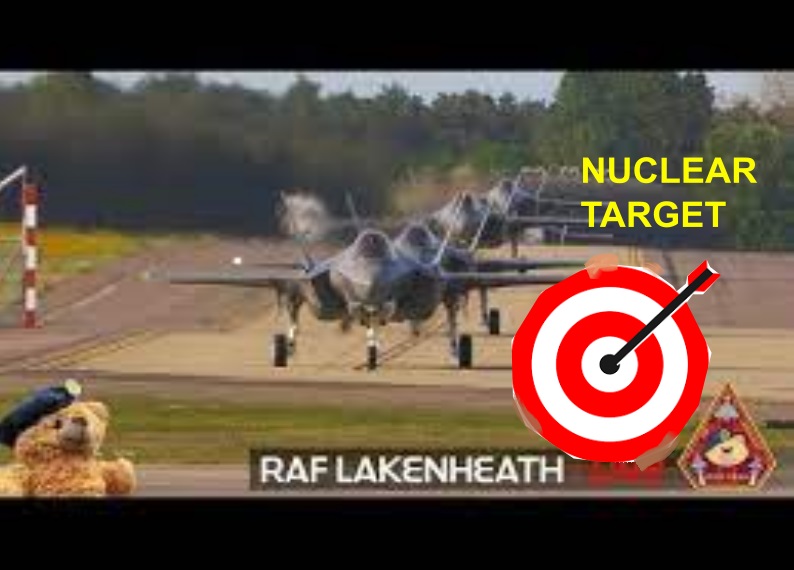
People living near a US airbase earmarked to house nuclear weapons say they are being left in the dark about what would happen in the event of a radiation alert.
It comes after a drill simulating an accident involving such material was held, with personnel from RAF Lakenheath in Suffolk taking part.
Nick Timothy, Conservative MP for West Suffolk, said while the US military was “welcome”, there needed to be “transparency as far as possible on issues like this exercise”.
A Ministry of Defence (MoD) spokesman said: “Exercise Diamond Dragon demonstrated our preparedness to respond to any incident, no matter how unlikely”……………………………………….
The Suffolk Resilience Forum, which leads on emergency planning in the county, confirmed the scenario in both instances was a simulated crash in the UK of a US aircraft carrying “defence nuclear materials”.
Lakenheath Parish Council chairman Gerald Kelly said he had been told informally about the latest drill.
He said the area had an emergency plan, but added: “There is nothing in there about this sort of incident.”
The MoD should inform residents “what it wants us to do” if the event of an incident, he said.
Mr Kelly called for a siren system to be installed and for the local community to be involved in any future exercises.
https://www.bbc.co.uk/news/articles/cde2dyk5rjpo
Security fears over mini nuclear plant network with ‘1,000s more police needed’.

Keir Starmer’s plans for a ‘proliferation’ of small reactors – potentially nearer UK towns – would require an urgent rethink of how armed officers protect them, experts warn.
Government plans to build a network of
“mini” nuclear power stations across the country have failed to
adequately assess major security threats to the public, top policing
experts have warned.
Sir Keir Starmer has pledged to “rip up the rules”
governing the nuclear industry to fast-track so-called Small Modular
Reactors (SMRs) to generate affordable low-carbon electricity, boosting the
economy and powering energy-intensive technology such as AI data centres.
However, security analysts caution that arrangements for guarding SMRs from
terrorists, enemy states and criminal groups need radical rethinking to
protect the public. They told The i Paper that thousands more armed
officers could be required to defend these facilities – which may be
located nearer towns and cities – plus the vehicles carrying their
radioactive fuel.
They believe these policing operations would be so much
larger, more complex and more costly than existing arrangements that a new
force may be required – yet fear ministers are overlooking or
underestimating the challenges ahead.
The Government hopes the first SMRs
will open in less than 10 years, probably at some of the country’s eight
existing nuclear sites, but the network may later expand to other locations
in England and Wales. Professor Fraser Sampson, a national security expert
at Sheffield Hallam University, said these will necessitate “a very
different policing and security model,” especially if they are located
“much nearer or even within areas of significant population, and you have
many more of them.”
Sampson, a former solicitor and police officer who
recently served as the UK’s biometrics and surveillance camera
commissioner, worries the Government is not focusing enough on security.
Anticipating a “proliferation of smaller sites,” he said: “The thing
that I think is missing, and Two researchers at King’s College London, Dr
Zenobia Homan and Dr Ross Peel, have warned that SMRs increase the
possibility of “insider threat.”
iNews 20th April 2025
https://inews.co.uk/news/crime/security-fears-mini-nuclear-plant-network-police-3648464
INSIDER THREAT SECURITY CONSIDERATIONSFOR ADVANCED AND SMALL MODULAR REACTORS.
The wide range of nuclear power plant technologies currently in design
globally have an assortment of unique characteristics that create novel
security considerations compared to large conventional nuclear power
plants.
Some of these characteristics create “insider threat”
considerations for nuclear security, where insiders are defined as
individuals with legitimate access to nuclear facilities and materials who
use this access to carry out sabotage or theft of nuclear material.
These include a lack of mature security culture in developer organisations,
serial plant manufacturing in a production line environment, plant siting
in remote and isolated areas, minimised staff numbers, teleoperation of
plants by offsite staff, the increased reliance on digital instrumentation
and control systems, and the potential for greater involvement of foreign
experts and third-party suppliers, especially on short-term bases for, e.g,
refuelling and maintenance.
The paper takes a technology agnostic approach
to examine what these factors may mean for insider threat risks and
suggests that plant designers should be identifying and minimising the
opportunities of insiders to act throughout the engineering design process.
Doing so is anticipated to strengthen effective insider threat mitigation
in deployed small and advanced reactors.
Kings College 21st April 2025 – https://kclpure.kcl.ac.uk/ws/portalfiles/portal/311074601/Paper_381_Insider_Threat_for_SMR.pdf
The core of the Flamanville EPR reactor will be completely rebuilt
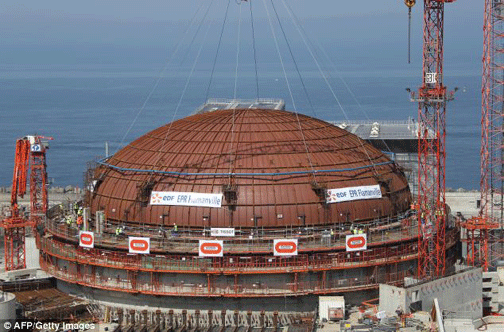
To prevent potential fuel rod leakage problems, EDF has decided to completely
rebuild the core of the Flamanville EPR reactor (Manche). This decision is
based on feedback from the Taishan reactor in China, which experienced
similar problems during the second production cycle.
As the Flamanville EPR
prepares to be reconnected to the electricity grid on Monday, April 21,
2025 , after more than two months of shutdown, EDF has also announced the
future change of part of the fuel. As a precaution, the Flamanville EPR
reactor core will be recomposed with reinforced fuel after its first unit
outage, in late 2026 or early 2027. “This is a precautionary measure,” EDF
emphasizes. ” To date, there have been no leak-tightness issues. We are
simply taking into account international feedback.”
Ouest France 18th April 2025 https://www.ouest-france.fr/environnement/nucleaire/le-cur-du-reacteur-de-lepr-de-flamanville-sera-entierement-recompose-5262993e-1b70-11f0-a759-74724e64dd56
Ukraine is seeking solutions to the Chernobyl nuclear reactor’s damaged confinement vessel .
Ukraine is seeking solutions to repair the damage caused by a Russian
drone attack to the confinement vessel at the stricken Chornobyl nuclear
power plant, a government minister said on Saturday. Minister of
Environmental Protection and Natural Resources Svitlana Hrynchuk was
speaking outside the decommissioned station during the inauguration of a
0.8-megawatt solar power facility ahead of two conferences due to discuss
Chornobyl and other issues related to nuclear power operations.
Reuters 12th April 2025, https://www.reuters.com/world/europe/ukraine-seeking-solutions-damaged-chernobyl-confinement-vessel-minister-says-2025-04-12/
Ukraine works to repair Chornobyl containment structure damaged in Russian drone strike
by Olena Goncharova, Kyiv Independent 13th April 2025 https://kyivindependent.com/ukraine-works-to-repair-chornobyl-containment-structure-damaged-in-russian-drone-strike/
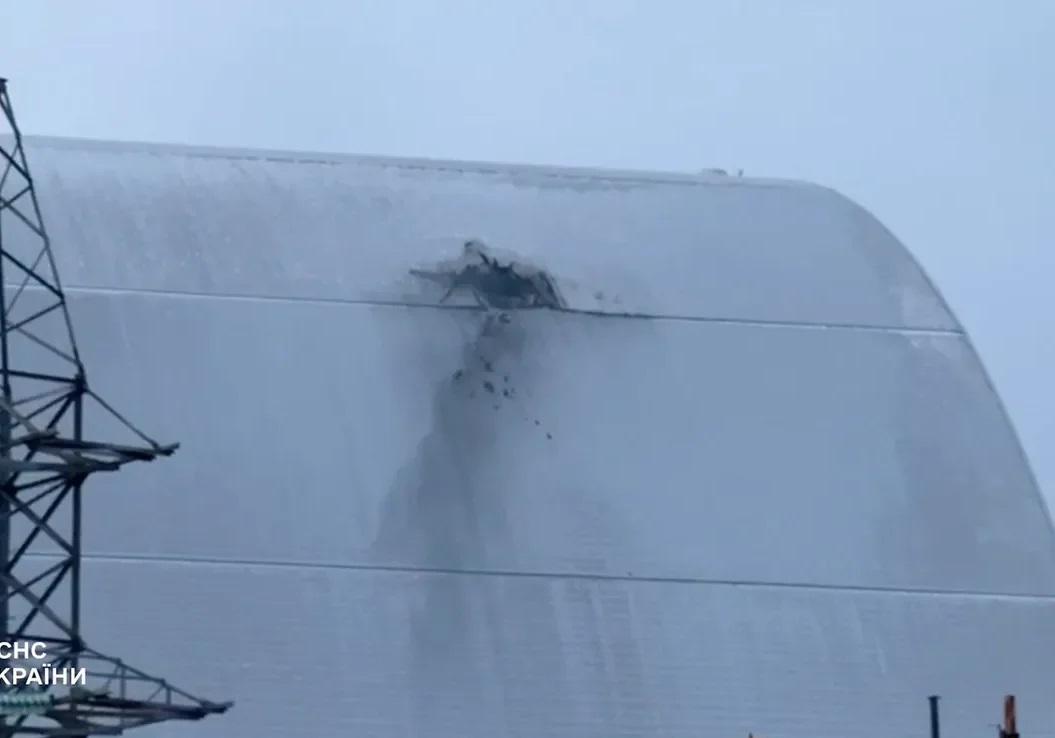
Ukraine is working to repair damage to the containment structure at the Chornobyl nuclear power plant following a Russian drone strike in February, Environment Minister Svitlana Hrynchuk said on April 12.
Speaking at the site of the decommissioned plant, Hrynchuk noted that the strike had compromised the functionality of the massive protective arch installed in 2019 to prevent radioactive leaks.
The minister commented during the launch of a new 0.8-megawatt solar power station near Chornobyl ahead of two upcoming nuclear safety and energy conferences. She said that Ukraine is cooperating with international experts to assess the extent of the damage and determine the necessary steps to restore the arch’s integrity.
“Unfortunately, after the attack, the arch partially lost its functionality. And now, I think, already in May, we will have the results of the analysis that we are currently conducting …,” Hrynchuk said. “We are actively working on this … We, of course, need to restore the “arch” so that there are no leaks under any circumstances because ensuring nuclear and radiation safety is the main task.”
She added that the European Bank for Reconstruction and Development, as well as scientific institutions and companies involved in the arch’s original installation, are contributing to the analysis.
According to plant officials, the February 14 drone attack created a hole in the containment vessel’s outer layer and exploded inside. The Russian Foreign Ministry dismissed the incident as “a provocation.”
The structure was designed to enclose the unstable sarcophagus hastily built after the 1986 reactor explosion—the worst nuclear accident in history.
Hrynchuk also emphasized the importance of renewable energy in the Chornobyl exclusion zone, saying the new solar facility would support the site’s power needs.
“We have been saying for many years that the exclusion zone needs to be transformed into a zone of renewal,” she said. “And this territory, like no other in Ukraine, is suitable for developing renewable energy projects.”
Assessment result on the condition of the shelter at the Chornobyl Nuclear Power Plant (ChNPP) is due in May
The first results of an assessment on the condition of the shelter at the
Chornobyl Nuclear Power Plant (ChNPP), following a Russian drone attack,
will be available in May. In June, Ukraine plans to present proposals for
restoring the New Safe Confinement (NSC or the Arch) at the donor assembly
in London.
As reported by Ukrinform, this was announced by Ukraine’s
Minister of Environmental Protection and Natural Resources, Svitlana
Hrynchuk. “It’s currently hard to say how much the project timeline has
been delayed, because certain works at the site cannot be performed right
now. However, I want to assure everyone that the radiation background has
not changed in any way — even after the attack,” said Hrynchuk.
Ukrinform 13th April 2025, https://www.ukrinform.net/rubric-society/3981370-ministry-of-environment-results-of-chornobyl-shelter-assessment-following-russian-drone-attack-expected-in-may.html
Newest French reactor faces further delays due to new issues.
By Reuters, April 11, 2025
EDF’s Flamanville 3 reactor outage was extended for an additional week to
carry out maintenance on three more components in the nuclear part of the
reactor, an EDF spokesperson told Reuters on Friday. The extension comes
after a two-month delay for maintenance on the cooling circuit and rotors
of the turbo alternator group.
The reactor is currently in the ramp-up
phase and has only produced a minimal amount of power since starting last
December. EDF said it could not provide specific details on the components
that require maintenance or the cost, but said that the summer date to
reach full power has not changed.
The maintenance to the turbo alternator
will only be measurable when the reactor is next connected to the grid, the
EDF spokesperson said, meaning that there could be an additional shutdown
if additional problems are found during the ramp up. EDF said that the
shutdown is a normal part of the ramp-up process where the equipment is
stress-tested before operating at full power and will be repeated several
times in the coming weeks and months. https://www.reuters.com/business/energy/newest-french-reactor-faces-further-delays-due-new-issues-2025-04-11/
Starmer appoints ex-Office of Fair Trading chief to lead nuclear regulatory taskforce
The prime minister has appointed ex-Office of Fair Trading boss John Fingleton to head up the country’s nuclear taskforce
Energy Voice, By Jessica Mills Davies, 10/04/2025
The UK government’s nuclear taskforce will be led by John Fingleton, formerly the boss of the Office of Fair Trading, following his appointment to spearhead the unit.
The Nuclear Regulatory Taskforce, which was set up to accelerate the development of new nuclear power stations across the country, is poised to embark on an overhaul of UK planning regulation.
In February, Keir Starmer moved to slash “red tape” in the industry to enable more nuclear power plants to be approved across England and Wales.
Those reforms are designed to enable small modular reactors to be built for the first time. That is the intended result of the government abolishing a set list of approved sites for nuclear development so that nuclear power stations can be built anywhere in the country.
The energy department said that contract negotiations to progress a competition for these small reactors, held by Great British Nuclear, are “currently underway”, and that a panel of nuclear experts will be appointed to the taskforce in due course.
In a controversial move, the government is also getting rid of expiry dates on nuclear planning rules, in an effort to avoid projects timing out.
These changes to nuclear planning rules were proposed after the pre-development stage Sizewell C nuclear plant in Suffolk was taken to court by local activists.
The Department for Net Zero and Energy Security said that the government committed a further £2.7 billion in public funding to Sizewell C last month………………………..
The independent taskforce will seek to identify how nuclear power regulation can incentivise investment in new projects more quickly and cost efficiently, it said………….
Fingleton said he will “work closely with business, regulators and other interested individuals and groups to identify how regulation can better enable and incentivise investment in this area”…………………. https://www.energyvoice.com/renewables-energy-transition/570966/starmer-selects-fingleton-to-head-up-nuclear-taskforce/
Declassified MoD document reveals US Visiting Forces across Britain are exempt from nuclear safety rules

CND 7th April 2025
At a time of heightened nuclear dangers, the Campaign for Nuclear Disarmament has uncovered shocking evidence that US military bases across Britain are exempt from UK emergency radiation regulations.
This means that bases like RAF Lakenheath, which is being prepared to host deadly new US nuclear weapons, is under no legal obligation to have emergency radiation plans in case of nuclear accidents.
A declassified exemption order shows that the government is putting so-called ‘national security’ before people’s safety.
CND is calling on Prime Minister Keir Starmer to announce in Parliament that no US nuclear weapons will be welcomed in Britain and that the exemption on adhering to legally required safety standards is revoked.
A letter from CND’s lawyers Leigh Day has forced the Ministry of Defence to declassify a significant nationwide exemption certificate, issued in March 2021 by former Defence Secretary, Ben Wallace, on the grounds of ‘national security’.
The certificate exempts Visiting Forces – primarily US military personnel – engaged in work with ionising radiations, from any legal enforcement of safety standards, using powers under Regulation 40 of the Ionising Radiations Regulations 2017 and Regulation 25 of the Radiation (Emergency Preparedness and Public Information) Regulation 2019. This means they are not legally bound to have in place plans and measures for emergency situations involving radioactive materials and nuclear weapons.
This is particularly dangerous given US preparations at RAF Lakenheath in Suffolk for a new nuclear weapons mission. However, the exemption not only covers RAF Lakenheath but all US military bases across Britain.
There are at least 10,000 US Department of Defence personnel stationed at 13 RAF bases. Nuclear material for Britain’s own nuclear weapons programme is regularly transported through RAF Brize Norton and RAF Fairford regularly hosts the US B2 nuclear-capable stealth bomber.
The government’s exemption means that local councils will never be told about the presence of nuclear weapons at these bases – and are therefore not obliged to produce their own emergency plans for a radiological accident. This puts the British population at even greater risk.
CND is calling on Prime Minister Keir Starmer to announce in Parliament that no US nuclear weapons will be welcomed in Britain and that the exemption on adhering to legally required safety standards is revoked. The majority of the British public don’t want US nuclear weapons in this country.
CND is upping pressure on the government, supporting two weeks of protest actions from Monday 14 April, culminating in a blockade of the base on Saturday 26 April. The peace camp and actions are organised by the Lakenheath Alliance for Peace, of which CND is a member………………………………………………………………………………………………. https://cnduk.org/declassified-mod-document-reveals-us-visiting-forces-across-britain-are-exempt-from-nuclear-safety-rules/
Hartlepool Nuclear site moved into enhanced regulatory attention
The Office for Nuclear Regulation (ONR) has moved Hartlepool Nuclear Power Station operated by EDF into enhanced regulatory attention for safety.
ONR has made the decision based on evidence gained from ongoing targeted engagements at the site which have identified areas where improvements are required.
The change in regulatory attention level does not relate to EDF’s recent decision to extend the operating lifetime of the station in County Durham, which is subject to ongoing safety standards being demonstrated.
The enhanced regulatory attention level reflects the effort ONR is using to influence improvements in areas including conventional health and safety, the number of site incidents and the production of nuclear safety cases.
ONR 7th April 2025, https://www.onr.org.uk/news/all-news/2025/04/nuclear-site-moved-into-enhanced-regulatory-attention/
Disconnection of nuclear plants during severe space weather highlighted as risk to grid stability
08 Apr, 2025 By Tom Pashby
Nuclear power station operators’ reactions to severe space weather could negatively impact the stability of the electricity transmission grid, a space weather expert has told NCE……………….
New Civil Engineer 8th April 2025 https://www.newcivilengineer.com/latest/disconnection-of-nuclear-plants-during-severe-space-weather-highlighted-as-risk-to-grid-stability-08-04-2025/
Unsafe for Russia to restart Zaporizhzhia nuclear plant, says Ukraine energy chief
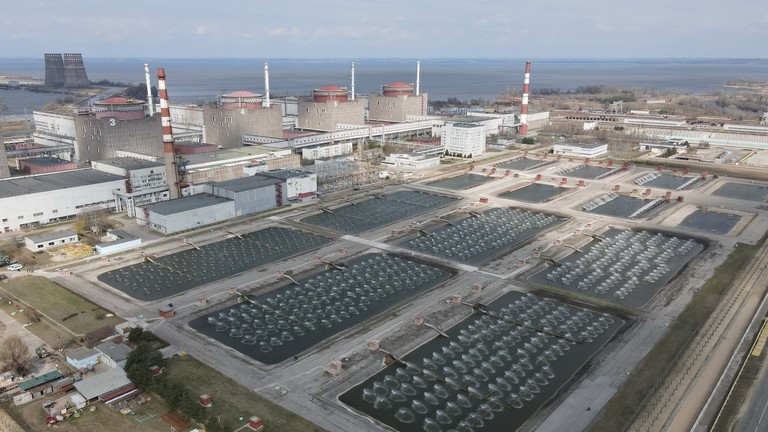
Energoatom CEO, Petro Kotin, says ‘major problems’ need to be overcome before it can safely generate power
Guardian, Dan Sabbagh in Kyiv, 7 Apr 25
It would be unsafe for Russia to restart the occupied Zaporizhzhia nuclear plant and would take Ukraine up to two years in peacetime if it regained control, the chief executive of the company that runs the vast six-reactor site has said.
Petro Kotin, chief executive of Energoatom, said in an interview there were “major problems” to overcome – including insufficient cooling water, personnel and incoming electricity supply – before it could start generating power again safely.
The future of the Zaporizhzhia plant, Europe’s largest nuclear reactor, is a significant aspect of any negotiations to end the war in Ukraine. Seized by Russia in spring 2022 and shut down for safety reasons a few months later, it remains on the frontline of the conflict, close to the Dnipro River.
Russia has said it intends to retain the site and switch it back on, without being specific as to when. Alexey Likhachev, head of Russian nuclear operator Rosatom, said in February it would be restarted when “military and political conditions allow”.
Meanwhile, Donald Trump has expressed an interest in taking control of it, though this possibility is considered very remote.
Kotin said Energoatom was prepared to restart the plant but it would require Russian forces to be removed and the site to be de-mined and demilitarised.
He said such a restart by Ukraine would take anywhere “from two months to two years” in an environment “without any threats from militaries”, while a Russian restart during wartime “would be impossible, even for one unit [reactor]”.
Kotin said the six reactors could only be brought online after the completion of 27 safety programmes agreed with Ukraine’s nuclear regulator, including testing the nuclear fuel in the reactor cores because it had exceeded a six-year “design term”.
That raises questions about whether Russia could restart the plant after a ceasefire without incurring significant risk. The plant was already unsafe, Kotin said, given that it was being used as “a military base with military vehicles present” and there were “probably some weapons and blasting materials” present as well.
Russia has acknowledged that it has placed mines between the inner and outer perimeters of the plant “to deter potential Ukrainian saboteurs” while inspectors from the IAEA nuclear watchdog have reported that armed troops and military personnel are present at the site.
Last month, the US Department of Energy said the Zaporizhzhia plant was being operated by an “inadequate and insufficently trained cadre of workers”, with staffing levels at less than a third of prewar levels.
The US briefing said Ukrainian reactors, though originally of the Soviet VVER design, had “evolved differently” from their Russian counterparts and “particularly the safety systems”. Russian-trained specialists acting as replacements for Ukrainian staff were “inexperienced” in operating the Ukrainian variants, it said.
Kotin said an attempt to restart the plant by Russia would almost certainly not be accepted or supported by Ukraine. It would require the reconnection of three additional 750kV high-voltage lines to come into the plant, he said.
A nuclear reactor requires a significant amount of power for day-to-day operation, and three of the four high-voltage lines came from territories now under Russian occupation. “They themselves destroyed the lines,” Kotin said, only for Russia to discover engineers could not rebuild them as the war continued, he added.
Only two lines remain to maintain the site in cold shutdown, a 750kV line coming from Ukraine, and a further 330kV line – though on eight separate occasions shelling disrupted their supply of energy, forcing the plant to rely on backup generators.
Experts say a pumping station has to be constructed at the site, because there is insufficient cooling water available. The June 2023 destruction by Russian soldiers of the Nova Kakhova dam downstream eliminated the easy supply of necessary water from the Dnipro river………………………………………………….. https://www.theguardian.com/world/2025/apr/06/unsafe-for-russia-to-restart-zaporizhzhia-nuclear-plant-energoatom-says
‘We thought it was the end of the world’: How the US dropped four nuclear bombs on Spain in 1966
Myles Burke https://www.bbc.com/culture/article/20250404-how-the-us-dropped-nuclear-bombs-on-spain-in-1966 7 Apr 25
In 1966, the remote Spanish village of Palomares found that the “nuclear age had fallen on them from a clear blue sky”. Two years after the terrifying accident, BBC reporter Chris Brasher went to find what happened when the US lost a hydrogen bomb.
On 7 April 1966, almost 60 years ago this week, a missing nuclear weapon for which the US military had been desperately searching for 80 days was finally found. The warhead, with an explosive power 100 times that of the bomb dropped on Hiroshima, was carefully winched from a depth of 2,850ft (869m) out of the Mediterranean Sea and delicately lowered onto the USS Petrel. Once it was on board, officers painstakingly cut into the thermonuclear device’s casing to disarm it. It was only then that everyone could breathe a sigh of relief – the last of the four hydrogen bombs that the US had accidentally dropped on Spain had been recovered.
“This was not the first accident involving nuclear weapons,” said BBC reporter Chris Brasher when he reported from the scene in 1968. “The Pentagon lists at least nine previous accidents to aircraft carrying hydrogen bombs. But this was the first accident on foreign soil, the first to involve civilians and the first to excite the attention of the world.”
This terrifying situation had come about because of a US operation code-named Chrome Dome. At the beginning of the 1960s, the US had developed a project to deter its Cold War rival, the Soviet Union, from launching a pre-emptive strike. A patrol of nuclear-armed B-52 bombers would continuously criss-cross the skies, primed to attack Moscow at a moment’s notice. But to stay airborne on these long looping routes, the planes needed to refuel while in flight.
On 17 January 1966, one such bomber was flying at a height of 31,000ft (9.5km) over the Almería region of southern Spain, and attempted a routine air-to-air refuelling with a KC-135 tanker plane. “I believe what happened was the bomber was closing at a too-high rate of closure speed and he didn’t stabilise his position,” US Maj Gen Delmar Wilson, the man in charge of dealing with the catastrophic accident, told Brasher, “with the result that they got too close and collided.”
The B-52 bomber’s impact with the refuelling plane tore it open, igniting the jet fuel the KC-135 was carrying and killing all four of the crew onboard. The ensuing explosion also killed two men in the B-52’s tail section. A third managed to eject, but died when his parachute did not open. The other four members of the bomber’s crew successfully bailed out of their burning plane before it broke apart and fell to earth, raining down both flaming aircraft fragments and its lethal thermonuclear cargo onto the remote Spanish village of Palomares.
Everyone kept talking about a ‘broken arrow’. I learnt then that ‘broken arrow’ was the code word for a nuclear accident – Capt Joe Ramirez
The huge fireball was seen a mile away. Thankfully, it did not trigger a nuclear explosion. The bomber’s warheads were not armed and had built-in safeguards to prevent an unintended atomic chain reaction. But the thermonuclear devices did have explosives surrounding their plutonium cores as part of the triggering mechanism. In the event of an accident, the bombs had parachutes attached to them designed to cushion the impact on landing and prevent radioactive contamination. And indeed, one undetonated bomb did land safely in a riverbed and was recovered intact the following day. Unfortunately, two of the plummeting nuclear bombs’ parachutes failed to open.
That morning, Spanish farmer Pedro Alarcón was walking to his house with his grandchildren when one of the nuclear bombs landed in his tomato field and blew apart on impact. “We were blown flat. The children started to cry. I was paralysed with fear. A stone hit me in the stomach, I thought I’d been killed. I lay there feeling like death with the children crying,” he told the BBC in 1968.
Devastation and chaos
The other hydrogen bomb also exploded when it hit the ground near a cemetery. These dual blasts created vast craters and scattered highly toxic, radioactive plutonium dust across several hundred acres. Burning aircraft debris also showered the Spanish village. “I was crying and running about,” a villager called Señora Flores told the BBC in 1968. “My little girl was crying, ‘Mama, Mama, look at our house, it is burning.’ Because of all the smoke I thought what she said must be true. There were a lot of stones and debris falling around us. I thought it would hit us. It was this terrific explosion. We thought it was the end of the world.”
Once the news that the bomber had come down with nuclear weapons aboard reached US military command, a huge operation was launched. At the time of the disaster, Capt Joe Ramirez was an US Air Force lawyer stationed in Madrid. “There were a lot of people talking, there was a lot of excitement in the conference room. Everyone kept talking about a ‘broken arrow’. I learnt then that ‘broken arrow’ was the code word for a nuclear accident,” he told BBC’s Witness History in 2011.
US military personnel were scrambled to the area by helicopter. When Capt Ramirez arrived in Palomares, he immediately saw the devastation and chaos wrought by the accident. Huge pieces of smoking wreckage were strewn all over the area – a large part of the burning B-52 bomber had landed in the school’s yard. “It’s a small village but there were people scrambling in different directions. I could see smouldering debris, I could see some fires.”
Despite the carnage, miraculously no one in the village was killed. “Nearly 100 tonnes of flaming debris had fallen on the village but not even a chicken had died,” said Brasher. A local school teacher and doctor climbed up to the fire-scarred hillside to retrieve the remains of the US airmen who had been killed. “Later still, they sorted the pieces and the limbs into five coffins, an act that was to cause a certain amount of bureaucratic difficulty when the Americans came to claim only four bodies from that hillside,” said Brasher.
Three of the B-52 crew who managed to eject landed in the Mediterranean several miles off the coast and were rescued by local fishing boats within an hour of the accident. The fourth, the B-52 radar-navigator, ejected through the plane’s explosion, which left him badly burned, and was unable to separate himself from his ejection seat. Despite this, he managed to open his parachute and was found alive near the village and taken to hospital.
However, this still left the problem of locating the plane’s deadly nuclear payload. “My main concern was to recover those bombs, that was number-one priority,” Gen Wilson told the BBC in 1968.
One of our nuclear bombs is missing
“The first night, the Guardia Civil [the Spanish national police force] had come to the little bar in Palomares, and that was about the only place that had electricity. And they had reported what they considered to be a bomb, so we immediately despatched some of our people to this riverbed which is not far from the centre of town, and, in fact, it was a bomb, so we placed a guard on that. And then the next morning, at first daylight, we started conducting our search, and I believe it was something in the order of 10am or 11am the following morning, we located two other bombs.”
This accounted for three of the nuclear bombs, but there was still one missing. By the next day, trucks filled with US troops had been sent from nearby bases, with the beach in Palomares becoming a base for some 700 US airmen and scientists urgently trying to contain any radioactive contamination and locate the fourth warhead.
“The first thing that you could see as the search really got underway in earnest was Air Force personnel linking up hand-by-hand and 40 or 50 people in a line. They would have designated search areas. There were some people with Geiger counters who started arriving, and so they started marking off the areas which were contaminated,” said Capt Ramirez in 2011. When US personnel registered an area contaminated with radiation, they would scrape up the first three inches of topsoil and seal it in barrels to be shipped back to the US. Some 1,400 tonnes of irradiated soil ended up being sent to a storage facility in South Carolina.
Both the US and Spain, which at the time was under the brutal rule of Francisco Franco’s military dictatorship, were keen to downplay the devastating accident. Franco was especially worried that radiation fears would hurt Spain’s tourism industry, a major source of revenue for his regime. In an effort to reassure the local population and the wider world that there was no danger, the US Ambassador to Spain, Angier Biddle Duke, would end up taking a swim in the sea off Palomares coast in front of the international press just weeks after the accident.
But despite hundreds of US personnel conducting an intensive and meticulous search of the surrounding area for a week, they still couldn’t find the fourth bomb. Then Capt Ramirez spoke to a local fisherman who had helped rescue some of the surviving airmen who had splashed down in the sea. The fisherman kept apologising to Capt Ramirez for not being able to save one of the US flyers, whom he thought he had witnessed drifting down into the depths.
Capt Ramirez realised that the fisherman could have actually seen the missing nuclear bomb. “All the bodies had been accounted for, I knew that,” he said. The search then quickly shifted to the Mediterranean Sea, with the US Navy mobilising a flotilla of more than 30 ships, including mine-sweepers and submersibles, to scour the seabed. The exploration of miles of ocean floor was both technically complicated and a very slow process, but after weeks of exhaustive searching, a newly developed deep-diving vessel, Alvin, finally located the missing bomb in an underwater trench.
Nearly four months after it was first lost, the warhead was finally made safe and back in US hands. The next day, despite the secrecy with which the US military had surrounding its nuclear arsenal, it took the unusual step of showing the bomb to the world’s press. Ambassador Duke reasoned that unless people saw the bomb for themselves, they would never feel certain that it had actually been recovered.
How Many Nuclear Bombs Has The US Air Force Lost?

https://simpleflying.com/nuclear-bombs-us-air-force-lost/ 3 Aug 24 [excellent tables on original]
Summary
- 3 US nuclear bombs lost, never found
- Possible unknown lost nuclear bombs worldwide
- The Soviets lost nuclear torpedoes and missiles
According to a 2022 BBC article, the United States has lost at least three nuclear bombs that have never been found – they are out there somewhere, and the military has given up looking for them. In total, there have been at least 32 so-called US Force ‘broken arrow’ accidents since 1950. The United States is not just one of the foremost nuclear powers; it operates the unique Boeing E-4B Nightwatch (aka Doomsday) planes to serve as emergency flying command centers for the President and Joint Chiefs in case Washington comes under nuclear attack.
32 Broken Arrow accidents
These broken arrow incidents occur when an aircraft has jettisoned a nuclear bomb in an emergency or by mistake, or the aircraft carrying them crashes. A bad time for nukes was at the height of the Cold War between 1960 and 1968 when Operation Chrome Dome kept nuclear-armed airplanes in the air at all times.
“But three US bombs have gone missing altogether – they’re still out there to this day, lurking in swamps, fields and oceans across the planet.” – BBC
In January 1966, a B-52G bomber carrying four B28 thermonuclear bombs collided midair with a KC-135 tanker over Palomares, Spain. The three bombs that fell on the land were swiftly recovered, but one fell into the Mediterranean Sea. However, this 1.1-megaton warhead bomb was eventually retrieved by a robotic submersible. However, the Air Force was not always so fortunate, and bombs were not always found.
Sometimes, it is only by sheer luck that nuclear bombs haven’t exploded in accidents. In 1961, a B-52 broke up over Goldsboro, North Carolina, and dropped two nuclear bombs. While one was largely undamaged, investigations found that three of the four safeguards on the other bomb had failed.
Incidentally, the B-52H bomber remains one of the three strategic nuclear bombers of the US Air Force, and Congress wants to restore more of them to carry nukes again
The three American nuclear bombs lost
Tybee Island mid-air collision
On February 5, 1958, an F-86 fighter plane collided with a B-47 bomber carrying a 7,600-pound Mark 15 nuclear bomb. The bomb was then jettisoned to help prevent the B-47 from crashing and the bomb exploding. The bomb fell around Tybee Island near Savannah, Georgia. After a number of unsuccessful searches, the bomb was eventually declared lost in Wassaw Sound, and to everyone’s understanding, it remains there to this day.
Philippine Sea A-4 crash
In 1965, a US Navy Douglas A-4E Skyhawk attack aircraft was armed with a nuclear weapon when it fell off the Essex-class aircraft carrier, the USS Ticonderoga. This occurred around 68 miles from Japan’s Kikai Island near Okinawa. The aircraft, pilot, and the B43 thermonuclear bomb were never recovered (despite 10 weeks of searching) and remain in the ocean depths today. The pilot was Lieutenant Douglas M. Webster and the ocean depth is around 16,000 feet.
Thule Air Base crash
The third known nuclear loss came in January 1968 when a US B-52 bomber carrying four B28FI thermonuclear bombs crashed. A cabin fire forced the aircraft’s crew to abandon it before they could make an emergency landing at the Thule Air Base. Six of the seven crew ejected safely, while the seventh perished while attempting to bail out.
Pilotless, the zombie bomber crashed into sea ice in North Star Bar, Greenland; the crash triggered a conventional explosion that caused the nuclear payload to rupture and disperse (the area was left radioactively contaminated). After extensive Danish-American clean-up efforts, one secondary stage of one of the warheads was never found.
Unknown nukes lost from other powers
If it is unsettling to know there are three known American nuclear bombs out there, take a pause to think the ones known to the public are all American. The British, French, Pakistanis, Indian, Chinese, and likely the North Koreans and Israelis all have nuclear weapons – these countries could have lost nuclear bombs and never disclosed them.
But most terrifying were the Soviets and, later, the Russians. The Soviets and Russians have had many nuclear accidents, from the Chornobyl nuclear power plant disaster to the early K-9 number submarine meltdown to the later Kursk explosion. All that’s known of lost Soviet/Russian nukes are the ones lost on at least three submarines (the K-8. K-129, and K-278).
No one knows how many nukes were lost on Soviet aircraft (but it’s more likely a question of how many and not if they lost any). The Soviet Union amassed the world’s largest stockpile of nuclear weapons, reaching a mind-boggling 45,000 in 1986

1 This Month

of the week – Shut Down Drone Warfare!


Tell the Ukrainian Government to Drop Prosecution of Peace Activist Yurii Sheliazhenko

Petition to revoke the licensing of the Near Surface Nuclear Disposal Facility (NSDF) at Chalk River. https://www.ourcommons.ca/petitions/en/Petition/Details?Petition=e-7247
To see nuclear-related stories in greater depth and intensity – go to https://nuclearinformation.wordpress.com
-
Archives
- April 2026 (68)
- March 2026 (251)
- February 2026 (268)
- January 2026 (308)
- December 2025 (358)
- November 2025 (359)
- October 2025 (376)
- September 2025 (257)
- August 2025 (319)
- July 2025 (230)
- June 2025 (348)
- May 2025 (261)
-
Categories
- 1
- 1 NUCLEAR ISSUES
- business and costs
- climate change
- culture and arts
- ENERGY
- environment
- health
- history
- indigenous issues
- Legal
- marketing of nuclear
- media
- opposition to nuclear
- PERSONAL STORIES
- politics
- politics international
- Religion and ethics
- safety
- secrets,lies and civil liberties
- spinbuster
- technology
- Uranium
- wastes
- weapons and war
- Women
- 2 WORLD
- ACTION
- AFRICA
- Atrocities
- AUSTRALIA
- Christina's notes
- Christina's themes
- culture and arts
- Events
- Fuk 2022
- Fuk 2023
- Fukushima 2017
- Fukushima 2018
- fukushima 2019
- Fukushima 2020
- Fukushima 2021
- general
- global warming
- Humour (God we need it)
- Nuclear
- RARE EARTHS
- Reference
- resources – print
- Resources -audiovicual
- Weekly Newsletter
- World
- World Nuclear
- YouTube
-
RSS
Entries RSS
Comments RSS
 nuclear-news