Sellafield failing to address ‘intolerable risks’, damning parliamentary report warns

Sam Baker, Staff reporter, The Chemical Engineer, 6 June 25
MANAGEMENT of the Sellafield nuclear facility in Cumbria, UK is not responding quickly enough to “intolerable risks” at the site posed by ageing assets, a damning new report has warned.
In the report published yesterday, the UK Public Accounts Committee (PAC), a group of MPs tasked with evaluating the cost-effectiveness of public spending projects, said that deteriorating assets are making the site “increasingly unsafe”.
Sellafield, the UK’s oldest nuclear site, has been in the long process of decommissioning since it stopped generating power in 2003, overseen by wholly state-owned Sellafield Ltd, and now works primarily in processing spent nuclear fuel.
The PAC’s report found that sluggish progress in decommissioning Sellafield has meant Sellafield Ltd has missed most of its annual targets in retrieving waste. This includes radioactive waste currently stored in Sellafield’s Magnox Swarf Storage Silo (MSSS), the UK’s most hazardous building.
After setting a target to have emptied the MSSS of waste by 2046, Sellafield Ltd now does not expect to achieve this until between 2054 and 2059. Problems at the MSSS are also behind the plant’s “single biggest environmental issue” – radioactive water has been leaking into the ground since 2018. Sellafield Ltd has confirmed that radioactive particles are “contained” in the soil and that there is no risk to the public…………………………………………………………………………………………………………………………..
Money not well spent
The current estimate for the total cost to the public of decommissioning Sellafield is £136bn (US$184bn), with completion expected no earlier than 2125, although problems identified by the PAC are likely to see the cost rise and the completion delayed.
One example of overspend highlighted in the report was the water sample lab refurbishment, which the PAC said was “very poorly managed” leading to a “waste” of £127m.
The report also resurfaced past issues of bullying and harassment at Sellafield, which the NDA settled in 2023-24 for £377,200. The PAC pointed out that Sellafield Ltd has signed 16 non-disclosure agreements in the last three years. These are separate from the Official Secrets Act which most staff routinely sign when joining Sellafield.
Clifton-Brown acknowledged the “early indications of some improvement” at Sellafield but said that the “government must do far more to hold all involved immediately accountable to ensure these do not represent a false dawn, and to better safeguard both the public purse and the public itself”………………………………………………………………………………………………………………………………………………………………
Not going underground
Sellafield’s troubles this week do not end with the PAC report. On Tuesday, Lincolnshire County Council withdrew its candidacy to host a geological disposal facility (GDF) that could store radioactive plutonium for thousands of years once retrieved from stockpiles at Sellafield.
As recently as July 2024, a site in Theddlethorpe in Lincolnshire was a leading candidate to build the GDF. However, the newly elected council, led since May 2025 by Reform UK, this week revoked its membership of the nuclear waste community partnership, which council leader Sean Matthews described as a “nuclear nightmare”.
Announcing the results of the vote to withdraw membership, Matthews, a former London police officer, said: “Now, Lincolnshire people can get back to living their lives, assured that this nuclear nonsense is over.” https://www.thechemicalengineer.com/news/sellafield-failing-to-address-intolerable-risks-damning-parliamentary-report-warns/
Zaporizhzhia ‘extremely fragile’ relying on single off-site power line, IAEA warns

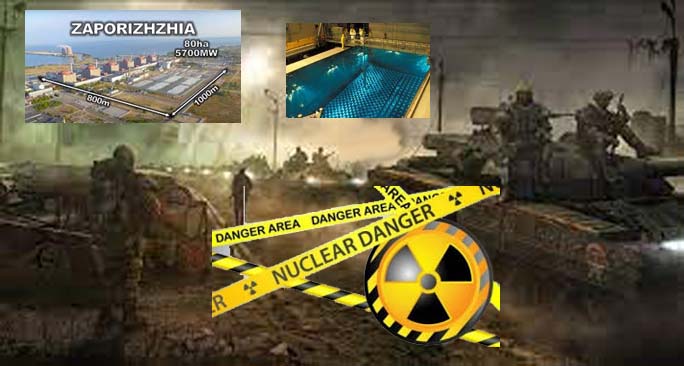
Europe’s largest nuclear power plant has just one remaining power line for essential nuclear safety and security functions, compared with its original 10 functional lines before the military conflict with Russia, warned Rafael Mariano Grossi, director general of the International Atomic Energy Agency.
The off-site power situation at the six-reactor Zaporizhzhia nuclear power plant in Ukraine is “extremely fragile,” Grossi said, since its last 330-kilovolt backup line has remained disconnected since the plant lost access to it on May 7. It is unclear when it will be restored.
As a result, Zaporizhzhia is entirely dependent on the last remaining 750-kV line for the external electricity required to operate the plant’s nuclear safety systems and cool its nuclear fuel.
After Russia took control of Zaporizhzhia in early 2022, the plant has lost all access to off-site power eight times, but it was usually restored within a day, according to the IAEA.
Quotable: “We are actively engaged. I have been discussing with the [energy] minister, with the Ukrainian regulator, and also, of course, with the Russian side, because they are in control of the plant. The idea is to be talking to everybody when it comes to safety,” Grossi said during a press conference Tuesday during his visit to Kyiv, Ukraine.
Grossi warned that even though Zaporizhzhia has not been operating for some three years now, its reactor cores and spent nuclear fuel still require continuous cooling, for which electricity is needed to run the water pumps.
“There are only two [power lines] in operation—one 750-kV and another 330-kV—which are intermittently down because of a number of situations… attacks or interruptions, we do not know,” Grossi added in his remarks. “The repair works have been performed but what we expect is this quite unpredictable situation will continue.”
“We have to move to a more stable situation, and this, of course, depends on overall political negotiation, which will lead to less—or, ideally, no—military activity around the plant.” Grossi said. “Absent that, what we are doing [and] what everyone is doing is (trying) to avoid the worst (and) repair it as soon as possible. Try to ensure outside power supply whenever it falls down.” Grossi plans to visit Russia as part of his regular contacts with both sides to ensure nuclear safety and security during the conflict.
A closer look: In addition to the lack of off-site power backup, on May 22 the IAEA reported a drone strike at Zaporizhzhia’s training center—the third such incident so far this year. There were no casualties or major damage; however, one person died in April 2024 when a drone struck the plant’s main containment building.
Ukraine blames Russia for the strikes, but Russia has denied responsibility.
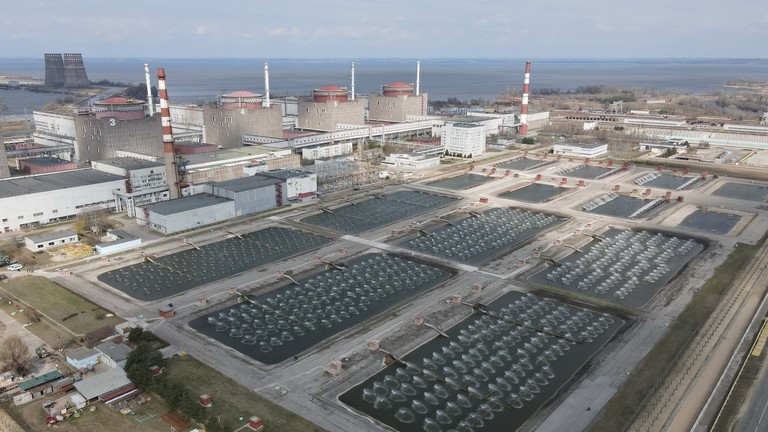
The Zaporizhzhia-based IAEA team continues to monitor and assess other aspects of nuclear safety and security at the plant. They conducted a walkdown last week to measure and confirm stable levels of cooling water in the site’s 12 sprinkler ponds and visiting its two fresh fuel storage facilities, where no nuclear safety or security issues were observed.
The IAEA team has reported hearing military activities on most days over the past week, at different distances away from the power plant, Grossi said.
At Ukraine’s three operating nuclear plants—Khmelnytskyi, Rivne and South Ukraine—three of the nine total reactors are in planned outage for refueling and maintenance.
IAEA team members at these sites also continue to hear military activities nearby. At South Ukraine, the IAEA team saw a drone being shot at by antiaircraft fire on May 23, and plant workers reported that 10 drones were observed 2.5 kilometers (about 1.55 miles) south of the site the same evening. Also on May 23, Chernobyl workers saw two drones flying just a few miles from the site. And the IAEA team at the Khmelnytskyi plant was required to shelter on-site last Monday.
A superhighway to nuclear hell

by beyondnuclearinternational, https://beyondnuclearinternational.org/2025/06/02/a-superhighway-to-nuclear-hell/
Trump’s reckless and accelerated nuclear orders would destroy safety oversight and endanger the public, writes Linda Pentz Gunter
On May 23rd, with several strokes of his pen, President Trump issued orders that would roll back US energy policy about 50 years.
On that day, Trump signed five Executive Orders (EOs): Restoring Gold Standard Science; Ordering the Reform of the Nuclear Regulatory Commission; Reinvigorating the Nuclear Industrial Base; Reforming Nuclear Reactor Testing at the Department of Energy; and Deploying Advanced Nuclear Reactor Technologies for National Security. (This page keeps a running tally of all the White House executive orders.
All of this madness was announced in a press release headlined “President Trump Signs Executive Orders to Usher in a Nuclear Renaissance, Restore Gold Standard Science.” Just in case there was any confusion about what this meant, the press release included an explanation that read: “Gold Standard Science is just that—science that meets the Gold Standard.”
Collectively, the four orders that focused on the nuclear sector would: reduce and undermine the already inadequate safety oversight authority of the US Nuclear Regulatory Commission (NRC); fast-track unproven new reactor projects without regard for safety, health or environmental impacts; curtail or possibly even end public intervention; weaken already insufficient radiation exposure standards; and reopen the pathway between the civil and military sectors, all while “unleashing” (Trump’s favorite verb) nuclear power expansion on a dangerous and utterly unrealistic accelerated timeline.
The precursive warning shot to all this had been fired on February 5th with Energy Secretary Chris Wright’s own Executive Order: Unleashing the Golden Era of American Energy Dominance, ‘dominance’ being another of Trump’s favorite big beautiful words, along with ‘big’ and ‘beautiful’ (—see his One Big Beautiful Bill Act.) “It’s time for nuclear, and we’re going to do it very big,” Trump told industry executives when he signed the orders.
Perhaps it’s no surprise to find that ‘dominance’ appears 35 times in the Heritage Foundation’s 2023 handbook, Authoritarianism for Dummies, officially known as Project 2025. Variations on the word ‘unleash’ appear 19 times. ‘Tremendous’ shows up 11 times. So does ‘gold standard’.
Which brings us to the fifth executive order of May 23, Restoring Gold Standard Science. While it does not specifically reference nuclear power, the order determines a hierarchy that will put political appointees in charge of specialized federal agencies, including the NRC. The order also itemizes a set of requirements on how scientific research and activities must be conducted, including “without conflicts of interest.”
But guess whose stocks soared after the release of Trump’s nuclear Executive Orders? Answer: Oklo, the company attempting to deliver the first US micro-reactors. Guess who was on the board of Oklo before his appointment as Trump’s Energy Secretary? Yes, Chris Wright.
Uranium mining company Centrus Energy and the U.S. Navy’s main nuclear reactor supplier, BWX Technologies, also saw their stock prices soar after Trump’s executive orders were released.
An Oklo executive, Jacob DeWitte, who was present at the signing, brought along a golf ball to help Trump understand just how little uranium is needed for the lifetime needs of a single human being (an entirely irrelevant statistic given the lethality contained in that glowing little golf ball.) Trump called the golf ball show-and-tell “very exciting” before teeing up another order that will not only muzzle but actually persecute scientists for any findings with which the Trump hive don’t agree.
The definition of ‘sound science’, under Trump’s ‘gold standard’, is simply anything happening now or under the previous Trump administration. Anything that happened under the Biden administration is “politicized science”.
Among the enforcers who will police and punish the NRC, along with other federal agencies who stray from Trump’s “science” script, is the Director of the Office of Science and Technology Policy, one Michael Kratsios.
Kratsios is the former chief of staff to AI entrepreneur, venture capitalist and nuclear promoter, Peter Thiel. Thiel’s venture capital firm, Founders Fund, supported nuclear fuel start-up General Matter, in contention to produce high-assay low-enriched uranium (HALEU) for advanced nuclear reactors. One of the executive orders will “seek voluntary agreements pursuant to section 708 of the DPA with domestic nuclear energy companies that could deliver HALEU fuel.”
Kratsios is already sharpening his knives to go after the NRC, viewed as an obstacle to fast-tracking the new nuclear projects that Kratisios’s former boss, among others, will be pushing.
“Today’s executive orders are the most significant nuclear regulatory reform actions taken in decades,” said Kratsios on May 23. “We are restoring a strong American nuclear industrial base, rebuilding a secure and sovereign domestic nuclear fuel supply chain, and leading the world towards a future fueled by American nuclear energy. These actions are critical to American energy independence and continued dominance in AI and other emerging technologies.”
There has already been some pushback against allowing a political appointee to be the arbiter of scientific integrity. “Putting that power in the hands of a political appointee who doesn’t need to consult with scientific experts before making a decision is very troubling,” Kris West of COGR, an association of research universities, affiliated medical centers, and independent research institutes, told Science.
A group of scientists has written an open letter, retitling the order “Fool’s Gold Standard Science,” declaring that it “would not strengthen science, but instead would introduce stifling limits on intellectual freedom in our Nation’s laboratories and federal funding agencies”.
Part of the “regulatory reform” outlined as “gold standard science” and that Kratsios will oversee, is gutting the NRC, which, complains the White House, “charges applicants by the hour to process license applications with prolonged timelines that maximize fees while throttling nuclear power development.”
Somehow, “throttling nuclear power development” is not what springs to mind when reviewing the record of an agency that consistently favors the financial needs of the nuclear industry over the interests of public safety and the environment.
Furthermore, charges the White House, the NRC “has failed to license new reactors even as technological advances promise to make nuclear power safer, cheaper, more adaptable, and more abundant than ever.”
Trump, who seems to treat executive orders like a Nike slogan (“just do it”), has commanded that the US quadruple its nuclear energy capacity by 2050. This will be achieved not only by stripping the NRC of its power to scrutinize the safety assurances for new, primarily small modular reactors, but by expediting their licensing while keeping current reactors running longer and hotter and even reopening permanently closed ones.
Licensing timeframes will be slashed to “a deadline of no more than 18 months” for final decisions on construction and operating license applications for new reactors, and to just one year “for final decision in an application to continue operating an existing reactor of any type.”
The Trump order will also require “the reactivation of prematurely shuttered to partially completed nuclear facilities.” The former refers to Palisades, Three Mile Island and Duane Arnold so far. The latter is about the abandoned two-reactor Westinghouse AP 1000 project at V.C. Summer in South Carolina.
Currently operating reactors will be expected to add “5 gigawatts of power uprates”, which comes with its own set of safety concerns given the age of the US nuclear reactor fleet.
Everything has been put on a superhighway to nuclear hell, unhinged from the very real obstacles to fast-tracking nuclear expansion, most notably the cost and risks.
“A pilot program for reactor construction and operation outside the National Laboratories,” will require the Energy Secretary to “approve at least three reactors pursuant to this pilot program with the goal of achieving criticality in each of the three reactors by July 4, 2026,” one order said.
An astonishing “10 new large reactors with complete designs under construction by 2030,” is another aspirational command.
The Secretary of Energy must also designate at least one site for advanced reactor technologies within three months of the order, and ensure that it will host a fully operational reactor there “no later than 30 months from the date of this order.”
None of these timelines share any precedent with the track record of nuclear power plant construction, and bullying or handcuffing the NRC won’t change that.
That’s because, as Toby Dalton and Ariel Levite of the Carnegie Endowment for International Peace point out in their recent column in The Hill: “The Nuclear Regulatory Commission has not presented the key obstacle to nuclear development in the U.S.” The orders, they said “underestimate the addition of time to market due to limitations on workforce availability, supply chain, financing, specialty fuels and community buy-in.”
The Carnegie authors also criticized the way the orders treat nuclear power as if it is similar to any other form of energy. “The orders downplay or ignore the special magnitude of nuclear risks, the series of traumatic accidents suffered by leading nuclear power nations and the unique environmental and multi-generational footprint of nuclear waste and spent fuel,” they wrote.
What reining in the NRC will achieve is an even greater reduction in confidence over the safe operation of current and future nuclear reactors.
“This push by the Trump administration to usurp much of the agency’s autonomy as they seek to fast-track the construction of nuclear plants will weaken critical, independent oversight of the U.S. nuclear industry and poses significant safety and security risks to the public,” said Ed Lyman, a physicist and Director of Nuclear Power Safety at the Union of Concerned Scientists.
To set all this right, the DOGE kids will soon be paying a visit to the NRC to fire people. DOGE, says the Reform the NRC order, will “reorganize the NRC to promote the expeditious processing of licensing applications and the adoption of innovative technology. The NRC shall undertake reductions in force in conjunction with this reorganization, though certain functions may increase in size consistent with the policies in this order, including those devoted to new reactor licensing.”
But “reorganizing” the NRC will have the reverse effect, argues Senator Ed Markey (D-MA) a longtime nuclear watchdog on Capitol Hill, including during his earlier years in the US House of Representatives. “It will be impossible for NRC to maintain a commitment to safety and oversight with staffing levels slashed and expertise gone,”Markey said.
“Allowing DOGE to blindly fire staff at the NRC does nothing to make it easier to permit or regulate nuclear power plants, but it will increase the risk of an accident,” said ranking member of the House Energy and Commerce Committee, Frank Pallone (D-NJ), who called the orders “dangerous.”
But then the Trump administration doesn’t actually consider nuclear power itself to be dangerous, and instead accuses the NRC of being overly cautious, saying: “Instead of efficiently promoting safe, abundant nuclear energy, the NRC has instead tried to insulate Americans from the most remote risks without appropriate regard for the severe domestic and geopolitical costs of such risk aversion.”
Consequently, it’s no surprise to find a clause in the order that reads: “The personnel and functions of the Advisory Committee on Reactor Safeguards (ACRS) shall be reduced to the minimum necessary”. The ACRS panel is composed of cream-of-the-crop scientists from the national laboratories, universities and other areas of academia. Its mandate, ironically and in place for decades, has been precisely to uphold “Gold Standard Science” in the nuclear power sector.
Like everything else Trump does, all of this constitutes another accident waiting to happen. “If you aren’t independent of political and industry influence, then you are at risk of an accident,” confirmed former NRC chair Allison Macfarlane of efforts to undermine her former agency.
The orders are a “guillotine to the nation’s nuclear safety system”, another former NRC chair Greg Jaczko told the Los Angeles Times.
Also guillotined is any pretense about protecting the public from the harm caused by exposure to the ionizing radiation released by the nuclear power sector.
No longer must we adhere to the standard, endorsed by the National Academy of Sciences, that exposure to any amount of radiation, no matter how small, could be harmful to human health. (This is especially true if it involves consistent and chronic longterm exposure even to what might be considered “low” doses.)
Instead, say Trump’s orders, “the NRC shall reconsider reliance on the linear-no-threshold (LNT) model for radiation exposure and the ‘as low as reasonably achievable’ standard, which is predicated on LNT.” Those models, says the White House, are “flawed.”
This will of course open the door to the hormesis advocates who, without any firm basis in actual science, insist that a little radiation is good for all of us.
It’s time to set the record straight on radiation and the damage it causes, particularly to pregnancy, children and women,” responded Cindy Folkers, radiation and health hazard specialist at Beyond Nuclear. “Contrary to what Trump’s recent EO claims, abundant and largely officially ignored scientific evidence demonstrates that childhood cancers increase around normally operating nuclear facilities, with indications that these cancers begin during pregnancy. The uranium mining needed to produce fuel for reactors, is associated with a number of health impacts. Even already existing background radiation is associated with childhood cancers.”
The already flimsy separation between the civil and military nuclear sectors is all but erased in the new EOs, most notably in the emphasis on a return to the reprocessing of irradiated reactor fuel. This operation separates out the uranium and plutonium while producing a vast amount of so-called low- and intermediate-level liquid and gaseous wastes that are routinely released into the air and sea.
Reprocessing was rejected in the US by the Ford and Carter administrations as too proliferation risky, given that plutonium is the trigger component of a nuclear weapon. It is still carried out in France — and until recently in the UK — where radioactive isotopes released by these operations have been found as far away as the Arctic Circle. The UK reprocessing activities at Sellafield rendered the Irish Sea the most radioactively contaminated sea in the world.
But, wrote the White House in the Deploying Advanced Nuclear Reactor Technologies EO: “Within 90 days of the date of this order, the Secretary of Energy shall identify all useful uranium and plutonium material within the Department of Energy’s inventories that may be recycled or processed into nuclear fuel for reactors in the United States.” That sounds like a return to mixed oxide fuel, or MOX, another program that was abandoned, but not until after a protracted opposition campaign launched by our movement — Nix MOX — finally prevailed.
Another order directs “The Secretary of Defense, through the Secretary of the Army” to “commence the operation of a nuclear reactor, regulated by the United States Army, at a domestic military base or installation no later than September 30, 2028.”
Some of those closed civil nuclear power plants could find themselves repurposed by the Department of Defense, serving as “energy hubs for military microgrid support.” Advanced nuclear reactor technologies will also be expected to power AI datacenters “within the 48 contiguous States and the District of Columbia, in whole or in part, that are located at or operated in coordination with Department of Energy facilities, including as support for national security missions, as critical defense facilities, where appropriate.”
Pronounced Kratsios in the May 23 press release: “We are recommitting ourselves to scientific best practices and empowering America’s researchers to achieve groundbreaking discoveries.”
Until they come and arrest you for telling the truth.
Linda Pentz Gunter is the international specialist at Beyond Nuclear and writes for and edits Beyond Nuclear International.
The NRC’s new Mission Impossible: Making Atoms Great Again

If the NRC complies with them and reduces itself to a rubber-stamp, the public will be increasingly at risk.
Perhaps recognizing that this NRC “reform” will likely render the agency non-functional for the foreseeable future, the administration hedged its bets by issuing two other orders that would bypass NRC licensing altogether.
The NRC has been given a new mission to facilitate nuclear power at the expense of public health and environmental protection.
By Edwin S. Lyman | May 29, 2025
In early May, drafts of presidential executive orders surfaced that would “reform” (e.g., dismantle) the long-established independent safety and security framework under which the United States regulates commercial nuclear power. For those who held out hope that the leaked orders were trial balloons and would be shot down by stakeholders who value regulatory stability and clarity—such as nuclear power plant operators—disappointment loomed. On May 23, President Donald Trump signed the orders, which in some respects had gotten even more extreme than originally advertised.
One order mandates that the Nuclear Regulatory Commission (NRC) fundamentally change its mission to support the absurd and reckless goal of quadrupling of US nuclear energy capacity to 400 gigawatts by 2050—which would, if achieved, add the equivalent of 300 large nuclear plants to the US fleet—by prioritizing speedy licensing over protecting public health and safety from radiation exposure. This would effectively make the NRC a promotional agency not unlike its predecessor, the Atomic Energy Commission, thereby undoing the NRC’s 51-year history as the independent safety regulator established by the 1974 Energy Reorganization Act. Congress considered but ultimately watered down a legislative provision to do just that last year. Now President Trump wants to finish the job by requiring the NRC to “facilitate nuclear power” in addition to “ensuring nuclear safety.”
The order requires that the agency undertake “a wholesale revision of its regulations and guidance documents” and produce draft and final versions of the new rules within nine and 18 months, respectively. Anyone who has even a passing familiarity with this massive body of regulatory detail—refined over decades of increasing technical knowledge, facility operating experience (including the 1979 Three Mile Island and 2011 Fukushima Daiichi accidents), and often impassioned debate about “how safe is safe”—surely knows this is a nigh impossible task. The challenge is compounded by the vague criteria provided to guide the revision, which invoke subjective terms that are the bane of regulators, such as “reduce unnecessary burdens” and “focus on credible, realistic risks.”
This exercise in busywork on a massive scale will only serve as a disruptive distraction from the NRC’s important work overseeing the operating fleet of US nuclear reactors, likely leading to regulatory paralysis and delays.
Specifically, even though the NRC has already been working to shorten approval timelines under pressure from Congress, the order directs the commission to establish fixed, 18-month deadlines for approving applications for new reactors of any type, providing no leeway except for “instances of applicant failure.” Imposing such a rigid schedule may appease arrogant vendors of new nuclear designs who resent the scrutiny of regulators, but such a dictat is terrible for nuclear safety. New nuclear reactors in the licensing pipeline are mostly experimental in design; they have had little to no operating experience and introduce novel safety concerns that require painstaking and time-consuming experiments and analyses to resolve. Forcing technical reviewers to paper over such gaps in knowledge to meet arbitrary deadlines may lead to faster approvals, but it is sure to create implementation headaches and serious safety problems for anyone who tries to build and operate these first-of-a-kind reactors. And dedicated safety professionals at the NRC are not likely to remain in an environment where they are compelled to compromise their integrity, depleting the workforce needed to process a growing number of applications.
NRC reviews often uncover safety issues that reactor applicants miss. A case in point is the NuScale small modular reactor. During the review of the original NuScale design, NRC staff identified a mechanism that could cause the reactor to become critical and melt down following an emergency shutdown, leading the company to make last-minute design changes.
In the anti-science push that we have come to expect from the Trump administration, the order also deems well-established models of the risks of low-level radiation exposure to “lack sound scientific basis.” It directs the agency to “specifically consider adopting determinate radiation limits”—that is, to accept the view of a small minority that there is a “safe” level of radiation and incorporate it into its regulations—despite an actual lack of sound scientific basis supporting such a claim. The NRC recently affirmed in a unanimous vote that the “linear no-threshold model” (the principle that any level of radiation is harmful, but the cancer risk is proportional to the dose), which is the foundation of international radiation protection standards, remains an effective basis for the NRC’s regulatory framework. Compelling the NRC to rewrite its regulations based not on the current state of scientific knowledge but on pseudoscience will only create chaos and ultimately put the public at unnecessary risk.
Perhaps recognizing that this NRC “reform” will likely render the agency non-functional for the foreseeable future, the administration hedged its bets by issuing two other orders that would bypass NRC licensing altogether. Those orders encourage approval of reactors within the purview of the Defense Department and the Energy Department. This would have a detrimental impact on nuclear safety in both cases: Defense lacks the expertise to conduct such reviews (as it hasn’t approved its own nuclear reactors in decades); and Energy’s self-regulation of nuclear plants would be tainted by conflicts of interest, as the agency would directly benefit from approval of these projects. One order calls for deploying reactors to power artificial intelligence data centers at Energy Department sites, even if they are privately owned and operated. Whether this order actually expands Energy Department authority to approve reactors for commercial purposes is a complicated question best left for the lawyers. But there is clear intent to sideline the Nuclear Regulatory Commission and the relatively high level of public engagement and transparency that the agency offers compared to the Defense and Energy departments.
Another goal of the orders is to “promote American nuclear exports.” But what the administration doesn’t realize is that the NRC’s image (deserved or not) as the world’s “gold standard” nuclear safety regulator is a critical selling point for the US brand and US nuclear vendors. This is especially true for countries new to nuclear power that lack their own regulatory expertise and put their faith in NRC licensing. Yet nearly every action in the orders will undermine global confidence that the NRC is continuing to make independent safety judgments about new reactor designs and isn’t merely doling out seals of approval to Trump’s preferred cronies of the moment. Also, adopting radiation protection standards that violate international norms is not likely to bolster confidence in US designs around the world.
The NRC has been given a new mission to facilitate nuclear power at the expense of public health and environmental protection. But it doesn’t have to choose to accept it. It’s no surprise that an administration that embraces conflicts of interest would not care about preserving NRC’s non-promotional status. But unless the Supreme Court says otherwise, it is far from clear that independent agencies are obligated to follow executive orders—and as an independent agency, the NRC would be well justified in rejecting any attempt to negate Congress’ chief rationale for creating it in 1974. Chairman David Wright often says that safety is the NRC’s “North Star.” Now he can show that he means what he says by rebuffing President Trump’s crude and possibly illegal attempt to effectively destroy the Nuclear Regulatory Commission and undermine its authority to protect the public from potentially disastrous corner-cutting by the nuclear industry.
For decades, the nuclear industry has blamed overregulation for the cost overruns and delays that have plagued new projects and caused it to lose the confidence of investors. Now, these dangerous executive orders call the bluff. If the NRC complies with them and reduces itself to a rubber-stamp, the public will be increasingly at risk. Only time will tell if the industry, even without needed oversight and reasonable regulation, can build nuclear plants on schedule and on budget, or if it will finally have to grapple with the real root causes of its failure to thrive.
The Nuclear Gambit: Trump just handed the atom to the highest bidder

NJ Today News, 2 June 25, https://njtoday.news/2025/05/31/the-nuclear-gambit-trump-just-handed-the-atom-to-the-highest-bidder/
The air in America reeks of uranium and unchecked ambition as the Trump administration, in a move that can be described as arson, signed a series of executive orders designed to gut the Nuclear Regulatory Commission—the last line of defense between corporate nuclear profiteers and the American public.
This was no mere policy shift.
This was a full-scale sabotage of oversight, a calculated demolition of the very safeguards that have kept Three Mile Island from becoming a recurring nightmare. With the stroke of a pen, Trump has effectively turned the NRC into a rubber-stamp factory, slashing staff, silencing public input, and fast-tracking reactor approvals with all the caution of a drunk gambler doubling down on a losing hand.
The Death of Independent Regulation
The NRC was created for one reason: to keep nuclear power from killing people. But in Trump’s America, profit margins matter more than containment walls. His executive order, dripping with disdain for “overregulation,” directs the NRC to stop worrying about “trivial risks”—as if radiation exposure were a mere nuisance, like a parking ticket.
Meanwhile, the newly christened Department of Government Efficiency (DOGE)—a bureaucratic black hole designed to strangle federal agencies—will “streamline” the NRC by cutting staff and kneecapping its ability to conduct rigorous safety reviews.
Senator Ed Markey, one of the few voices in Washington still screaming into the void, put it bluntly: “Trump wants to turn this critical regulatory agency into the Johnny Appleseed of nuclear energy without safeguards and despite the law that states the NRC has no role in promoting the expansion of nuclear activity. This executive order is a giveaway to the nuclear industry, which has a track record that includes mismanaging for 15 years and at a $35 billion price tag, building just one nuclear power plant in Georgia. That is the very definition of waste.”
The Corporate Handshake
Of course, none of this happens in a vacuum. Standing beside Trump at the signing ceremony was Joe Dominguez, CEO of Constellation Energy, the largest nuclear operator in the U.S. Constellation has big plans—like restarting Three Mile Island’s Unit 1 reactor, the same site where a partial meltdown in 1979 nearly turned Pennsylvania into a no-go zone.
Dominguez, ever the corporate evangelist, whined about “silly questions” slowing down permits—as if nuclear safety were some bureaucratic prank rather than a matter of life and death.
And why the rush? Because AI needs power.
That’s right—the same tech bros who brought us algorithmic chaos now demand 24/7 nuclear juice to fuel their data centers.
Never mind that the last two reactors built in the U.S. were seven years late and $18 billion over budget. Never mind that small modular reactors (SMRs), the industry’s latest pipe dream, are financial black holes propped up by taxpayer subsidies. The grift must go on.
The Ghosts of Uranium Past
But the darkest specter looming over this radioactive power grab is uranium mining—an industry with a legacy of death and environmental ruin.
The Navajo Nation still bears the scars of decades of exploitation, with poisoned water, cancer clusters, and abandoned mines littering their land. Now, with Trump’s orders expanding domestic uranium production, those horrors may return under the banner of “energy dominance.”
Amber Reimondo of the Grand Canyon Trust put it best: “They’re repeating history, pretending the lessons were never learned.”
The Fallout
What does this all mean? It means fewer safety checks. It means rushed reactor designs. It means communities silenced in the name of “efficiency.” And, most of all, it means a windfall for nuclear executives while taxpayers foot the bill for their inevitable disasters.
Edwin Lyman of the Union of Concerned Scientists put it bluntly: “This is a recipe for catastrophe.”
But in Trump’s America, catastrophe is just another business opportunity.
Welcome to the atomic age, version 2.0—where the only thing more unstable than the reactors is the maniac in charge of them.
ENSURING A MELTDOWN – Trump’s reckless nuclear orders.
On March 23, President Trump signed five executive orders that threaten to roll back US nuclear energy policy at least 50 years. The orders are: Restoring Gold Standard Science; Ordering the Reform of the Nuclear Regulatory Commission; Reinvigorating the Nuclear Industrial Base; Reforming Nuclear Reactor Testing at the Department of Energy; and Deploying Advanced Nuclear Reactor Technologies for National Security.
Collectively, they would reduce and undermine the safety oversight authority of the US Nuclear Regulatory Commission; fast-track unproven new reactor projects without regard for safety, health or environment; restart closed reactors and complete unfinished projects; impede public intervention; and reopen the pathway between the civil and military sectors, all while putting nuclear power expansion on a dangerous and unrealistic accelerated timeline. https://www.whitehouse.gov/presidential-actions/executive-orders/
Experts warn Trump’s nuclear blitz could trigger ‘Next Three Mile Island’
Brett Wilkins, Common Dreams, May 24, 2025 https://www.rawstory.com/trump-nuclear-2672196220/?fbclid=IwY2xjawKjnDZleHRuA2FlbQIxMQBicmlkETEzMGNjOWI3bFRMSEJiaUlwAR4t6X-H7T5I-o-kJ91nrJSopEuECY5lTfTvuemKX7ecn0rbBfTP2vKInLv2Wg_aem_YNxd4-jClVC7LuYhQWfF_A
U.S. President Donald Trump on Friday signed a series of executive orders that will overhaul the independent federal agency that regulates the nation’s nuclear power plants in order to speed the construction of new fissile reactors—a move that experts warned will increase safety risks.
According to a White House statement, Trump’s directives “will usher in a nuclear energy renaissance,” in part by allowing Department of Energy laboratories to conduct nuclear reactor design testing, green-lighting reactor construction on federal lands, and lifting regulatory barriers “by requiring the Nuclear Regulatory Commission (NRC) to issue timely licensing decisions.”
The Trump administration is seeking to shorten the yearslong NRC process of approving new licenses for nuclear power plants and reactors to within 18 months.
White House Office of Science and Technology Director Michael Kratsios said Friday that “over the last 30 years, we stopped building nuclear reactors in America—that ends now.”
“We are restoring a strong American nuclear industrial base, rebuilding a secure and sovereign domestic nuclear fuel supply chain, and leading the world towards a future fueled by American nuclear energy,” he added.
However, the Union of Concerned Scientists (UCS) warned that the executive orders will result in “all but nullifying” the NRC’s regulatory process, “undermining the independent federal agency’s ability to develop and enforce safety and security requirements for commercial nuclear facilities.”
“This push by the Trump administration to usurp much of the agency’s autonomy as they seek to fast-track the construction of nuclear plants will weaken critical, independent oversight of the U.S. nuclear industry and poses significant safety and security risks to the public,” UCS added.
Edwin Lyman, director of nuclear power safety at the UCS, said, “Simply put, the U.S. nuclear industry will fail if safety is not made a priority.”
“By fatally compromising the independence and integrity of the NRC, and by encouraging pathways for nuclear deployment that bypass the regulator entirely, the Trump administration is virtually guaranteeing that this country will see a serious accident or other radiological release that will affect the health, safety, and livelihoods of millions,” Lyman added. “Such a disaster will destroy public trust in nuclear power and cause other nations to reject U.S. nuclear technology for decades to come.”
Friday’s executive orders follow reporting earlier this month by NPR that revealed the Trump administration has tightened control over the NRC, in part by compelling the agency to send proposed reactor safety rules to the White House for review and possible editing.
Allison Macfarlane, who was nominated to head the NRC during the Obama administration, called the move “the end of independence of the agency.”
“If you aren’t independent of political and industry influence, then you are at risk of an accident,” Macfarlane warned.
On the first day of his second term, Trump also signed executive orders declaring a dubious “national energy emergency” and directing federal agencies to find ways to reduce regulatory roadblocks to “unleashing American energy,” including by boosting fossil fuels and nuclear power.
Rise in nuclear-related incidents deeply worrying

Scottish Greens 26th May 2025, https://greens.scot/news/rise-in-nuclear-related-incidents-deeply-worrying
Scottish Green MSP Ross Greer raises alarm on radioactive leaks at Faslane.
A concerning rise in nuclear-related incidents at the Faslane naval base should “sound the alarm” across Scotland, warns the area’s Scottish Green MSP, Ross Greer.
In an article in The Ferret, it was revealed that since 2023, 12 incidents occurred that could have led to radioactive materials leaking into the Gare Loch, Loch Long and the Firth of Clyde. However, the Ministry of Defence refused to give details of any specific incidents or leaks.
In the first four months of 2025, there were three incidents which had “actual or high potential for radioactive release to the environment”, the highest for the time period in 17 years.
In 2020 Ross Greer highlighted the issue of nuclear leaks at Faslane, with over 6,000 Scots signing a campaign to stop the Ministry of Defence from increasing the volume of radioactive materials such as cobalt-60 and radioactive tritium that it discharged into the waters around the base.
Scottish Greens MSP Ross Greer said:
“Another report on radioactive leaks at Faslane is deeply worrying but not surprising news for people living around the Gare Loch and Loch Long. For too long, the threat of a serious radioactive incident at the base has loomed over communities across the West of Scotland.
“The increasing number of incidents is just one of the many examples of the huge danger posed by Britain’s ageing nuclear arsenal. We have the right to sound the alarm and demand answers, but of course the Ministry of Defence regularly refuses to answer.
“For decades the Scottish Greens have raised concerns about Faslane. The weapons of mass slaughter houses there would be quite literally world-ending if they were ever used, but even their storage and the transportation of nuclear and explosive materials by road from England is a totally unacceptable risk.
“Of course, the only way to rid Scotland of these evil weapons and use the base for more conventional purposes instead is for Scotland to become an independent nation. Westminster will never give up an arsenal which allows it to continue pretending that Britain is a global superpower, even if it costs hundreds of billions of pounds which could otherwise be spent on our crumbling public services
“As an independent nation, we can remove these mass murder devices from Scotland and work toward a world without nuclear weapons.”
Rise in nuclear incidents at Faslane naval base, that could leak radioactivity

Rob Edwards, The Ferret, May 25, 2025
There have been 12 nuclear incidents that could have leaked radioactivity at the Faslane naval base since 2023, The Ferret can reveal.
According to the Ministry of Defence (MoD), the incidents at the Clyde nuclear submarine base had “actual or high potential for radioactive release to the environment”.
But the MoD has refused to say what actually happened in any of the incidents, or exactly when they occurred. There were five in 2023, four in 2024 and three in the first four months of 2025 – the highest for 17 years.
Campaigners warned that a “catastrophic” accident at Faslane could put lives at risk. The Trident submarines based there were a “chronic national security threat to Scotland” because they were “decrepit” and over-worked, they claimed.
New figures also revealed that the total number of nuclear incidents categorised by the MoD at Faslane, and the neighbouring nuclear bomb store at Coulport, more than doubled from 57 in 2019 to 136 in 2024. That includes incidents deemed less serious by the MoD.
The Scottish National Party (SNP) described the rising number of incidents as “deeply concerning”. It branded the secrecy surrounding the incidents as “unacceptable”.
The MoD, however, insisted that it took safety incidents “very seriously”. The incidents could include “equipment failures, human error, procedural failings, documentation shortcomings or near-misses”, it said.
The latest figures on “nuclear site event reports” at Faslane and Coulport were disclosed in a parliamentary answer to the SNP’s defence spokesperson, Dave Doogan MP. They show that a rising trend of more serious events – first reported by The Ferret in April 2024 – is continuing.
There was one incident at Faslane between 1 January and 22 April 2025 given the MoD’s worst risk rating of “category A”. There was another category A incident at Faslane in 2023.
The MoD has defined category A incidents as having an “actual or high potential for radioactive release to the environment” in breach of safety limits.
The last category A incident reported by the MoD was in 2008, when radioactive waste leaked from a barge at Faslane into the Clyde. There were spillages from nuclear submarines at the base in 2007 and 2006.
There were also four “category B” incidents at Faslane in 2023, another four in 2024 and two in the first four months of 2025. The last time that many category B incidents were reported in a year was 2006, when there were five.
According to the MoD, category B meant “actual or high potential for a contained release within building or submarine”, or “actual or high potential for radioactive release to the environment” below safety limits.
The MoD also categorised nuclear site events as “C” and “D”. C meant there was “moderate potential for future release to the environment”, or an “actual radioactive release to the environment” too low to detect. D meant there was “low potential for release but may contribute towards an adverse trend”.
The number of reported C incidents at Faslane and Coulport increased from six in 2019 to 38 in 2024, while the number of D incidents rose from 50 to 94.
At the same time the number of incidents described by the MoD as “below scale” and “of safety interest or concern” dropped from 101 to 39.
The SNP’s Dave Doogan MP, criticised the MoD in the House of Commons for the “veil of secrecy” which covered nuclear incidents. Previous governments had outlined what happened where there were “severe safety breaches”, he told The Ferret.
“The increased number of safety incidents at Coulport and Faslane is deeply concerning, especially so in an era of increased secrecy around nuclear weapons and skyrocketing costs,” Doogan added.
“As a bare minimum the Labour Government should be transparent about the nature of safety incidents at nuclear weapons facilities in Scotland, and the status of their nuclear weapons projects. That the Scottish Government, and the Scottish people, are kept in the dark about these events is unacceptable.”
Doogan highlighted that the government’s Infrastructure and Projects Authority had judged many of the MoD’s nuclear projects to have “significant issues”, as reported in February by The Ferret. The MoD nuclear programmes would cost an “eye-watering” £117.8bn over the next ten years, he claimed.
He said: “If the UK cannot afford to store nuclear weapons safely, then it cannot afford nuclear weapons.”
Anti-nuclear campaigners argued that the four Trident-armed Vanguard submarines based at Faslane were ageing and increasingly unreliable. They required more maintenance and their patrols were getting longer to ensure that there was always one at sea.
“The Vanguard-class submarines are already years past their shelf-life and undergoing record-length assignments in the Atlantic due to increased problems with the maintenance of replacement vessels,” said Samuel Rafanell-Williams, from the Scottish Campaign for Nuclear Disarmament.
“There is a crisis-level urgency to decommission the nuclear-capable submarines lurking in the Clyde. They constitute a chronic national security threat to Scotland, especially now given their worsening state of disrepair.”
He added: “The UK government is placing the people of Scotland at risk by continuing to operate these decrepit nuclear vessels until their replacements are built, which will likely take a decade or more.
“The Vanguards must be scrapped and the Trident replacement programme abandoned in favour of a proper industrial policy that could genuinely revitalise the Scottish economy and underpin our future security and prosperity.”
Nuclear accident could ‘kill our own’
Dr David Lowry, a veteran nuclear consultant and adviser, said: “Ministers tell us the purpose of Britain’s nuclear weapons is to keep us safe.
“But with this series of accidents involving nuclear weapons-carrying submarines, we are in danger of actually killing our own, if one of these accidents proves to be catastrophic.”
According to Janet Fenton from the campaign group, Secure Scotland, successive governments had hidden information about behaviour that “puts us in harm’s way” while preventing spending on health and welfare.
She said: “Doubling the number of incidents while not telling us the nature of them is making us all hostages to warmongers and the arms trade, while we pay for it.”…………………………………
In 2024 The Ferret revealed earlier MoD figures showing that the number of safety incidents that could have leaked radiation at Faslane had risen to the highest in 15 years. We have also reported on the risks of Trident-armed submarines being on patrol at sea for increasingly long periods.https://theferret.scot/nuclear-incidents-radioactivity-faslane/
Wyoming nuclear developer Terra Power wants legal protections for private, armed security force

Cap City News, by Wyofile, May 24, 2025, By Dustin Bleizeffer
Don’t mess around at a nuclear power plant facility. If you have no business there but insert yourself anyway, you will be met with armed guards who are directed to “detect, assess, interdict and neutralize” all threats — including with lethal force.
Use of force in securing such facilities, including TerraPower’s Natrium nuclear plant underway near Kemmerer, is required by the U.S. Nuclear Regulatory Commission, according to agency officials. So are a litany of other security measures to ensure the sensitive operations don’t fall prey to “radiological sabotage” — among the highest threats to U.S. national security, they say.
Trained security guards must assume that “adversaries would be dedicated and willing to exhibit lethal force and, quite frankly, receive lethal force in return,” NRC Regional State Liaison Officer Ryan Alexander told members of the Joint Minerals, Business and Economic Development Committee on Thursday in Casper.
TerraPower officials, who will use a highly enriched uranium fuel to power an “advanced” nuclear reactor, presented a draft bill, “Wyoming Security,” to the committee. They’re asking lawmakers to extend protections against civil lawsuits to a private security force, which the company will be required to install when it begins handling nuclear materials. In addition to describing potential statutory changes to accommodate lawful “use of force” by private security guards and related civil protections, the measure refers to standard NRC security requirements and what would be considered criminal trespass.
“Wyoming law currently lacks clear legal authority for trained security personnel performing these duties without such [legal] protection,” TerraPower Nuclear Security Manager Melissa Darlington testified. Without expressed legal protection, TerraPower would still be held to federal NRC standards of security enforcement, she added, which “may result in hesitancy [upon private security personnel] in implementing their duties.”
The committee directed the Legislative Service Office to work up draft legislation based on TerraPower’s proposed language, and agreed to continue discussion at its next hearing in July…………………………………………………..
Several committee members expressed anxiety over providing civil liability protections to a private, corporate security force. Rothfuss suggested the committee should consider forming a special task force to explore the issue.
“When we’re writing statute, we don’t want to provide somebody who’s an armed-nuclear-security guard the authority to use deadly force on the other side of town,” he said. https://capcity.news/wyoming/2025/05/24/wyoming-nuclear-developer-wants-legal-protections-for-private-armed-security-force/
Experts Warn Trump Attack on Nuclear Regulator Raises Disaster Risk

“Simply put,” said one critic, “the U.S. nuclear industry will fail if safety is not made a priority.”
Brett Wilkins, 24 May 25, https://www.commondreams.org/news/nuclear-regulatory-commission-trump
U.S. President Donald Trump on Friday signed a series of executive orders that will overhaul the independent federal agency that regulates the nation’s nuclear power plants in order to speed the construction of new fissile reactors—a move that experts warned will increase safety risks.
According to a White House statement, Trump’s directives “will usher in a nuclear energy renaissance,” in part by allowing Department of Energy laboratories to conduct nuclear reactor design testing, green-lighting reactor construction on federal lands, and lifting regulatory barriers “by requiring the Nuclear Regulatory Commission (NRC) to issue timely licensing decisions.”
The Trump administration is seeking to shorten the yearslong NRC process of approving new licenses for nuclear power plants and reactors to withinf 18 months.
“If you aren’t independent of political and industry influence, then you are at risk of an accident.”
White House Office of Science and Technology Director Michael Kratsios said Friday that “over the last 30 years, we stopped building nuclear reactors in America—that ends now.”
“We are restoring a strong American nuclear industrial base, rebuilding a secure and sovereign domestic nuclear fuel supply chain, and leading the world towards a future fueled by American nuclear energy,” he added.
However, the Union of Concerned Scientists (UCS) warned that the executive orders will result in “all but nullifying” the NRC’s regulatory process, “undermining the independent federal agency’s ability to develop and enforce safety and security requirements for commercial nuclear facilities.”
“This push by the Trump administration to usurp much of the agency’s autonomy as they seek to fast-ttrack the construction of nuclear plants will weaken critical, independent oversight of the U.S. nuclear industry and poses significant safety and security risks to the public,” UCS added.
Edwin Lyman, director of nuclear power safety at the UCS, said, “Simply put, the U.S. nuclear industry will fail if safety is not made a priority.”
“By fatally compromising the independence and integrity of the NRC, and by encouraging pathways for nuclear deployment that bypass the regulator entirely, the Trump administration is virtually guaranteeing that this country will see a serious accident or other radiological release that will affect the health, safety, and livelihoods of millions,” Lyman added. “Such a disaster will destroy public trust in nuclear power and cause other nations to reject U.S. nuclear technology for decades to come.”
Friday’s executive orders follow reporting earlier this month by NPR that revealed the Trump administration has tightened control over the NRC, in part by compelling the agency to send proposed reactor safety rules to the White House for review and possible editing.
Allison Macfarlane, who was nominated to head the NRC during the Obama administration, called the move “the end of independence of the agency.”
“If you aren’t independent of political and industry influence, then you are at risk of an accident,” Macfarlane warned.
On the first day of his second term, Trump also signed executive orders declaring a dubious “national energy emergency” and directing federal agencies to find ways to reduce regulatory roadblocks to “unleashing American energy,” including by boosting fossil fuels and nuclear power.
The rapid advancement and adoption of artificial intelligence systems is creating a tremendous need for energy that proponents say can be met by nuclear power. The Three Mile Island nuclear plant—the site of the worst nuclear accident in U.S. history—is being revived with funding from Microsoft, while Google parent company Alphabet, online retail giant Amazon, and Facebook owner Meta are among the competitors also investing in nuclear energy.
“Do we really want to create more radioactive waste to power the often dubious and questionable uses of AI?” Johanna Neumann, Environment America Research & Policy Center’s senior director of the Campaign for 100% Renewable Energy, asked in December.
“Big Tech should recommit to solutions that not only work but pose less risk to our environment and health,” Neumann added.
Drone attacks Zaporizhia NPP training centre third time this year – IAEA
Zaporizhia Nuclear Power Plant (ZNPP) told the team of the International
Atomic Energy Agency (IAEA) based at the Plant that the drone hit the roof
of the training centre located just outside the ZNPP site perimeter on May
21, according to an update on the situation in Ukraine on the IAEA website
late on Wednesday.
The drone hit the roof, without causing any casualties
or major damage. It was not immediately known whether the drone had
directly struck the building or whether it crashed on the structure after
being shot down. The IAEA said that it was the third time this year that
the training centre was reportedly targeted by such an unmanned aerial
vehicle.
Interfax Ukraine 22nd May 2025, https://en.interfax.com.ua/news/general/1073812.html
White House weighs overhaul of Nuclear Regulatory Commission

E and E News, By Francisco “A.J.” Camacho | 05/14/2025
Draft White House executive orders would overhaul nuclear regulation and hand the Department of Energy secretary new powers to approve advanced reactor designs and projects — placing a nuclear safety gatekeeper directly under President Donald Trump.
A review by POLITICO’s E&E News of the language in four separate draft orders shows that nuclear advocates in the Trump administration are looking for ways to bypass the independent Nuclear Regulatory Commission and challenge its central claim over nuclear safety standards.
“This is the detailed, agency-specific effort to override the historic independent agency construct,” Stephen Burns, former chair of the NRC during the Obama administration, said in an interview.
Burns emphasized that many of the reforms outlined in the draft orders are already being implemented under the ADVANCE Act that Congress passed last year. He questioned the necessity and merits of White House micromanagement.
“Everybody should be worried about that, especially because we depend on nuclear power plants for about 20 percent of our electricity across this country,” said Emily Hammond, a former DOE deputy general counsel and current George Washington University law professor. “That’s an important segment of low-carbon electricity, and if it’s not safe, that’s a huge gap to fill.”
It isn’t clear when or if any of the draft orders will land on Trump’s desk. But as written now, the drafts return to a theme laid out in many of Trump’s energy orders: Radical policy overhauls are needed to power the rapidly growing U.S. tech industry.
Efforts to restart large nuclear plants along with private-sector investment and Department of Energy support for small modular reactor technology are pushing the industry forward after decades of little or no growth. The government and big technology firms say they hope to plug AI data centers into nuclear power plants that can provide around-the-clock generation.
But in asserting more direct control over the NRC, some nuclear boosters fear more harm than good. Trump’s February executive order subjects “significant regulatory actions” to review by the White House’s Office of Information and Regulatory Affairs, or OIRA.
Judi Greenwald, executive director of the Nuclear Innovation Alliance, said adding the OIRA review of either technical nuclear safety issues or minor activities would make NRC less efficient and introduce uncertainty into licensing timelines.
“NRC’s reputation as a trusted regulator is important to the public, to industry, and to potential customers of U.S. nuclear technology both here and abroad,” Greenwald said. “We don’t want changing political winds in either direction to undermine NRC’s credibility.”
Sources with direct knowledge of how NRC and the White House are handling the February order have told E&E News that OIRA has instructed the agency to submit all draft rules. OIRA will decide on a case-by-case basis if a given regulation is “significant.” If it is, the White House will conduct a second review that may entail comments or edits. The draft rules will then be returned to the commission.
People familiar with policy discussions say OIRA has already deemed reactor safety rules to be “significant” enough for a deeper White House review. The proposed “Part 53” advanced reactor rule and updates to environmental standards are also considered likely to trigger a second review.
The new process also obscures the public record of internal commission deliberations.
“It would potentially run afoul of the Sunshine Act,” said Adam Stein, nuclear energy innovation director at the pro-nuclear think tank Breakthrough Institute. “The Atomic Energy Act does not say the commission will send regulations to OIRA for approval. It says that the commission will decide.”
The prospect of stripping away much of the NRC’s independence has rattled Republicans and Democrats on the House Energy and Commerce Committee.
Rep. Jay Obernolte (R-Calif.) said in February that he’s willing to give the administration “the benefit of the doubt” as it tries to bring more political control over independent agencies. “Everyone should be able to agree that regulatory authorities like the NRC should not be involved in the day-to-day political struggles that occur here in Washington, D.C.,” he said.
Rep. Lori Trahan (D-Mass.) characterized any White House effort to exert more control over the NRC as a “dangerous attempt to serve the interests of Donald Trump and his donors.”
“Undermining the NRC’s independence invites safety risks, regulatory dysfunction, and corruption that threaten the future of nuclear energy in America,” she said.
Adding to the instability is growing speculation about leadership changes at the NRC. The term of Trump-appointed Chair David Wright expires in June, and no renomination has been announced.
“At this point, it would be difficult to get him through the process without a lapse,” Stein said.
Here is what we know about the four draft orders:
Draft Order 1: Overhauling NRC
The White House is circulating draft executive orders that could radically alter nuclear policy. They touch on several fronts, from restructuring the NRC to reorienting federal nuclear research and development priorities to setting a goal to quadruple U.S. nuclear power capacity by 2040.
The first draft viewed by E&E News would order NRC, OIRA, the Department of Government Efficiency and “other agencies” to finalize NRC rules that would establish deadlines for reviewing license applications; reconsider the NRC radiation safety threshold; revise the environmental review process; expedite approvals for reactors that have been tested at DOE and Defense Department sites; and shrink the Advisory Committee on Reactor Safeguards, which independently reviews all nuclear licensing actions.
And the agencies, the draft says, would have 18 months to finish this “wholesale regulatory revision” of the NRC with mandatory “reductions in force.”………………………………………………………………….
Draft Order 2: Nuclear R&D
Another draft order would authorize DOE to more directly spearhead pilot and demonstration reactor projects at national laboratories and on other federal lands.
“The Department shall approve at least three reactors pursuant to this pilot program with the goal of completing construction of each of the three reactors by July 4, 2026,” the draft reads.
Experts say that the timeline is nearly impossible at this point.
Draft Order 3: Nuclear for “national security”
A third draft order seeks to boost American nuclear power by leveraging DOE and the Defense and State departments.
The draft would give the secretaries of Defense and Energy 60 days to “identify 9 military facilities at which advanced nuclear technologies can be immediately installed and deployed,” prioritizing bases in the Arctic and Indo-Pacific. Then, the military would move toward installation.
Another section would have the secretary of Energy “site, approve, and authorize the design, construction, and operation of privately-funded advanced nuclear technologies at Department of Energy-owned sites for the purpose of powering AI infrastructure.” It would classify such nuclear power as “defense critical infrastructure” and allow them to connect to the commercial grid……………
Other sections of the draft order would release DOE-held high-assay, low-enriched uranium to private advanced reactor developers and create a new State Department envoy to promote American nuclear exports.
Draft Order 4: Nuclear supply chain
The final draft order primarily focuses on bolstering the nuclear energy supply chain. It would have DOE bolster R&D and deployment of uranium enrichment and nuclear fuel recycling, fund the restart of closed nuclear plants and improve the “nuclear engineering talent pipeline” with other Cabinet departments.
It is unclear how likely Trump is to sign any of these draft executive orders. “Each executive order is almost written from a certain agency’s perspective,” Stein said. “They overlap and conflict in some places probably because they weren’t written together.”……………….. https://www.eenews.net/articles/white-house-weighs-nrc-overhaul/
Nuclear weapons woes: Understaffed nuke agency hit by DOGE and safety worries
The consequences of DOGE’s disruptions at the National Nuclear Security Administration could be far-reaching, experts say.
Davis Winkie and Cybele Mayes-Osterman, USA TODAY, 18 May 25
- For decades, the NNSA has struggled with federal staffing shortages that have contributed to safety issues as well as delays and cost overruns on major projects.
- Experts fear that the Trump administration’s moves to reduce the federal workforce may have destabilized the highly specialized federal workforce at the National Nuclear Security Administration.
- USA TODAY reviewed decades of government watchdog reports, safety documents, and congressional testimony on U.S. nuclear weapons.
In 2021, after a pair of plutonium-handling gloves had broken for the third time at the Los Alamos National Laboratory, contaminating three workers, and after the second accidental flood, investigators from the National Nuclear Security Administration found a common thread in a plague of safety incidents: the contractor running the New Mexico lab lacked “sufficient staff.”
So did the NNSA.
The agency, whose fewer than 1,900 federal employees oversee the more than 60,000 contractors who build and maintain the U.S. nuclear arsenal, has struggled to fill crucial safety roles. Only 21% of the agency’s facility representative positions – the government’s eyes and ears in contractor-run buildings – at Los Alamos were filled with qualified personnel as of May 2022.
Now, President Donald Trump’s administration has thrown the NNSA into chaos, threatening hard-won staffing progress amid a trillion-dollar nuclear weapons upgrade. Desperately needed nuclear experts are wary of joining thanks to chaotic job cuts by Elon Musk’s Department of Government Efficiency, experts say.
The disruption of NNSA’s chronically understaffed safety workforce is “a recipe for disaster,” said Joyce Connery, former head of the Defense Nuclear Facilities Safety Board.
Los Alamos is not the only facility with staffing shortages in crucial safety roles.
As of May 2022, less than one-third of facility representative roles at NNSA’s Y-12 facility in Oak Ridge, Tennessee, and the Pantex plant near Amarillo, Texas were held by fully qualified employees, according to a USA TODAY review of nuclear safety records.
At Pantex, where technicians assemble and disassemble nuclear weapons, only a quarter of safety system oversight positions had fully qualified hires, and only 57% of those safety positions had qualified employees at Y-12.
Nuclear weapons workers don’t grow on trees, nor do the federal experts who oversee them. Many of the jobs require advanced degrees, and new hires often need years of on-the-job training. Security clearance requirements limit the most sensitive jobs to U.S. citizens.
America’s nuclear talent crisis isn’t new, but its consequences have grown as tens of billions of dollars pour into the NNSA annually in a broader $1.7 trillion plan to modernize U.S. nuclear weapons.
Congress ordered the cramped, aging plutonium facility at Los Alamos – called PF-4 – to begin mass production of plutonium pits, a critical component at the heart of nuclear warheads, for the first time in more than a decade.
Enter Elon Musk and DOGE…………………………………………………………………………………………………………..
What’s at stake
The struggle for staff has been NNSA’s Achilles heel for decades – and the stakes have only grown.
But despite efforts to develop talent, watchdogs said in February of this year the NNSA was “understaffed” and struggling to execute key oversight requirements.
Then came DOGE…………………………………………………………………………………….
Connery fears the strain and staffing problems could combine to disastrous effect.
“When you take an inexperienced or an understaffed workforce and you combine it with old facilities and a push to get things done – that is a recipe for disaster,” Connery said. https://eu.usatoday.com/story/news/politics/2025/05/18/nuclear-weapons-woes-nuke-agency-hit-by-doge-and-safety-worries/83621978007/
Don’t vent tritium gas


Lab should explore credible alternatives say Nuclear Watch New Mexico and Tewa Women United
The Los Alamos National Laboratory plans to begin large releases of radioactive tritium gas any time after June 2, 2025. The only roadblock to the Lab’s plans is that it needs a “Temporary Authorization” from the New Mexico Environment Department to do so.
Reasons why the New Mexico Environment Department should deny LANL’s request are:
1. The state Environment Department has a duty to protect the New Mexican public. As it states, “Our mission is to protect and restore the environment and to foster a healthy and prosperous New Mexico for present and future generations.”
2. Why the rush? LANL explicitly admits there is no urgency. According to the Lab’s publicly-released “Questions and Answers” in response to “What is the urgency for this project?” “There is no urgency for this project beyond the broader mission goals to reduce onsite waste liabilities.”
3. In addition, the National Nuclear Security Administration (NNSA) admits that the end time frame for action is 2028, not 2025. Therefore, there is time for deliberate consideration.
4. Contrary to NMED’s Resource Conservation and Recovery Act permit for LANL, the Lab has not fulfilled its duty to inform the public via NMED of possible alternatives to its planned tritium releases. According to Tewa Women United, “LANL has told EPA there are 53 alternatives; that list of alternatives, initially requested in 2022, has not yet been disclosed. Tewa Women United has repeatedly asked LANL to provide the public with that list.”
5. Despite extensive prompting by the Environmental Protection Agency on possible better alternatives, the NNSA categorically rejected any modifications.
6. NNSA’s January 2025 draft LANL Site-Wide Environmental Impact Statement had no substantive discussion of the planned tritium releases, much less the required “hard look” at credible alternatives. Further, LANL and NNSA included these planned releases in the “No Action Alternative,” with the specious justification that “The Laboratory and NNSA have been integrating with the EPA and NMED to obtain approval to move forward with the plan to vent the Flanged Tritium Waste Containers currently located in TA-54.” Seeking approval makes them No Action? NNSA and LANL are legally required to consider public comments submitted for the LANL SWEIS. These planned tritium releases should not proceed until NNSA issues a Record of Decision on the final LANL Site-Wide Environmental Impact Statement.
7. NNSA’s publicized maximum release of 30,000 curies is merely an administrative decision point at which LANL will stop the venting process to avoid exceeding the Clean Air Act’s 10 millirem public exposure limit for radioactive air emissions. It is not the potential total quantity of tritium that will have been released. LANL’s radioactive air emissions management plan sets an annual administrative limit of 8 millirem for the tritium releases, meaning venting will cease once this limit is reached but may resume in subsequent periods.
8. In addition, these planned releases are not necessarily a one-time event, as indicated above, contrary to what the LANL Site-Wide Environmental Impact Statement falsely states.
9. Nor are these planned releases strictly confined to just Area G, as claimed.
10. LANL declares “There are no cumulative impacts from this operation. All limits are conservative, and well within regulatory limits that are protective of the public.” However, one independent report calculates that the effective dose to infants could be three times higher than to adults (therefore likely violating the 10 millirem Clean Air Act standard for “any member of the public”) and all of LANL’s calculated doses would be higher in the event of low wind speeds and low humidity.” Another independent report noted how tritiated water can pervade every cell in the body while the planned LANL tritium releases are three times the amount of tritium that the crippled Fukushima nuclear power plant would release to the ocean over 30 years.
11. LANL claims “This critical milestone [the planned tritium releases] furthers \ the cleanup of Area G.” But what so-called cleanup means to LANL is “cap and cover” of ~200,000 cubic yards of existing toxic and radioactive wastes at Area G, leaving them permanently buried in unlined pits and shafts as a permanent threat to groundwater. NMED knows this all too well given the draft order it issued to the Lab to excavate and treat all wastes at the smaller Area C waste dump, which LANL categorically opposes. NMED should carefully consider the extent to which approving these planned tritium releases is consistent with its desire for full comprehensive cleanup at the Lab, including Area G.
Recommendation: Given the self-admitted lack of urgency and remaining uncertainties in potential doses, times, locations and ultimate purpose of these planned tritium releases,NMED should deny LANL’s request for a “Temporary Authorization” to proceed until there has been an open and transparent analysis of alternatives and all possible public health impacts.
This fact sheet is available here. For more contact Nuclear Watch New Mexico and Tewa Women United.
And please sign the petition — Petition to Deny LANL’s Request to Release Radioactive Tritium into the Air.
-
Archives
- May 2026 (163)
- April 2026 (356)
- March 2026 (251)
- February 2026 (268)
- January 2026 (308)
- December 2025 (358)
- November 2025 (359)
- October 2025 (376)
- September 2025 (257)
- August 2025 (319)
- July 2025 (230)
- June 2025 (348)
-
Categories
- 1
- 1 NUCLEAR ISSUES
- business and costs
- climate change
- culture and arts
- ENERGY
- environment
- health
- history
- indigenous issues
- Legal
- marketing of nuclear
- media
- opposition to nuclear
- PERSONAL STORIES
- politics
- politics international
- Religion and ethics
- safety
- secrets,lies and civil liberties
- spinbuster
- technology
- Uranium
- wastes
- weapons and war
- Women
- 2 WORLD
- ACTION
- AFRICA
- Atrocities
- AUSTRALIA
- Christina's notes
- Christina's themes
- culture and arts
- Events
- Fuk 2022
- Fuk 2023
- Fukushima 2017
- Fukushima 2018
- fukushima 2019
- Fukushima 2020
- Fukushima 2021
- general
- global warming
- Humour (God we need it)
- Nuclear
- RARE EARTHS
- Reference
- resources – print
- Resources -audiovicual
- Weekly Newsletter
- World
- World Nuclear
- YouTube
-
RSS
Entries RSS
Comments RSS