The global risks of North Korea’s questionable nuclear safety standards
 The other North Korea nuclear threat we should be worried about CNBC, 20 Dec17
- North Korea’s questionable nuclear safety standards and its isolation from the global scientific community increase the risk of a nuclear accident, according to 38North
- The country’s leader Kim Jong Un was caught on tape smoking a cigarette next to an intercontinental ballistic missile earlier this year
- If a nuclear disaster does occur, it would likely cause regional panic
Longstanding doubts over the hermit kingdom’s nuclear safety resurfaced in July, when a video emerged of leader Kim Jong Unsmoking a cigarette next to a Hwasong-14 intercontinental ballistic missile.
“Kim’s recklessness is certainly notable, and it hints at an under-emphasized and potentially devastating possibility: the threat of a nuclear accident in North Korea,” said the 38North note, released late last week.
The Yongbyon Nuclear Scientific Research Center, the North’s major nuclear facility, is so densely concentrated that one fire could lead to a disaster potentially worse than Chernobyl, former South KoreanPresident Park Geun-hye claimed in 2014……..https://www.cnbc.com/2017/12/19/kim-jong-un-north-korea-nuclear-accident-risks-rising.html
The danger of the unsafety of North Korea’s nuclear facilities
 North Korean Nuclear Reactor Safety: The Threat No One is Talking About, 38 North, BY: MATT KORDA, DECEMBER 14, 2017 The ability of North Korea to safely operate its nuclear reactors, according to many experts, is increasingly being called into question given the North’s isolation and lack of safety culture. Pyongyang’s ability to respond to a nuclear accident in a timely fashion will make the difference between a small-scale event and a catastrophic disaster. And while the actual contamination would be localized, the lack of transparency from North Korea in dealing with the situation is likely to cause political panic in the region in excess of the actual radiological exposure and environmental impact. The opening of nuclear safety talks with the North to help prevent such an accident from occurring would provide a rare opportunity for regional dialogue and could pry open the door for realistic and productive discussions of North Korea’s nuclear program.
A Disaster Waiting to Happen?
A video of Kim Jong Un smoking next to an untested liquid-fueled missile tells you everything you need to know about North Korea’s nuclear safety culture. The remarkable 14-second clip shows the Supreme Leader taking a puff while a Hwasong-14 intercontinental ballistic missile is erected on the launch pad mere feet away—prompting a torrent of snarky Twitter commentary expressing regret that Kim’s lit cigarette had not “solved the problem for us.” Kim’s recklessness is certainly notable, and it hints at an underemphasized and potentially devastating possibility: the threat of a nuclear accident in North Korea.
At the March 2014 Nuclear Security Summit in The Hague, then-South Korean President Park Geun-hye claimed that Yongbyon, North Korea’s primary nuclear research center, “is home to such a dense concentration of nuclear facilities that a fire in a single building could lead to a disaster potentially worse than Chernobyl.” While her damage assessment is likely an exaggeration—researchers from 38 North assess Chernobyl’s power output to have been 3,000 percent greater than Yongbyon—the potential for a nuclear accident is not.
Niko Milonopoulos and Edward D. Blandford noted previously that a sudden fault in North Korea’s outdated power grid could prevent the Yongbyon reactors from being adequately cooled and could potentially trigger a meltdown. Such an event could also be prompted by a natural disaster or abnormal weather patterns. Complementary analysis by Nick Hansen indicates that North Korea’s 5 MWe plutonium production reactor had to be briefly shut down following a flood in July 2013 which destroyed parts of the cooling systems. He noted with concern that “if a major flood cuts off the cooling water supply to the reactors before they can be shut down, a major safety problem could occur.” This is exactly what prompted the series of nuclear meltdowns at Fukushima……….http://www.38north.org/2017/12/mkorda121417/
New defects detected in AREVA’s European Pressurised Nuclear Reactor (EPR)
Times 14th Dec 2017, A French-designed nuclear reactor ordered by Britain is facing further
scrutiny after the disclosure that defects were detected in one of the same models under construction in China. The revelation adds to the string of setbacks that have hit the European Pressurised Reactor (EPR) designed by Areva, the French nuclear group.
Britain has ordered two of those reactors for Hinkley Point C. They are being built by EDF, the French state energy
giant, and China General Nuclear Power Corporation at a cost of £19.5 billion.
China General Nuclear Power Corporation, which is building two reactors in a joint venture with EDF near Macau in southern China, said it had found “local defects” in the Taishan 1 reactor. It said that welding in the deaerator, which is used to remove oxygen from water circuits, was defective. The parts had been replaced, it said.
Taishan 1 is due to come on stream this month to become the world’s first functioning example of the
European reactor. The second Chinese reactor, Taishan 2, is due to come online next year. The $8.7 billion project was initially due to be completed last year, but was delayed by safety concerns.
The problems in China pale by comparison with those affecting other projects. Work on a similar reactor at Olkiluoto in Finland began in 2005 and was supposed to finish in 2009. It is now expected to be in action from 2019. EDF is also
building a reactor at Flamanville in Normandy which was due to begin operating in 2012, but won’t be working until the end of next year. The reactors at Hinkley Point were originally due to be operational in 2025 but EDF said this summer that they were likely to be 15 months late.
https://www.thetimes.co.uk/edition/business/new-defects-in-hinkley-type-reactor-tjj0cprhz
Cyber security at nuclear facilities: US-Russian joint support needed
 https://thebulletin.org/cyber-security-nuclear-facilities-us-russian-joint-support-needed11354 15 DECEMBER 2017, Anna Wagner. In April 2016, operators at the Gundremmingen nuclear power plant in Germany discovered two computer viruses, W32.Ramnit and Conficker. The viruses had attacked office computers, removable drives, and visualization software used to move nuclear fuel rods. Fortunately, all critical systems at the plant were isolated from the Internet, and the viruses only caused “some disruption,” according to International Atomic Energy Agency (IAEA) Director Yukiya Amano. He said, however, that the issue of cyber attacks on nuclear facilities “should be taken very seriously.”
The 2016 incident is not an isolated case. The nuclear industry encounters cyber threats on a daily basis, and it is only a matter of time until control systems are compromised.
Cyber security is obviously a controversial topic in US-Russian relations. The political climate, including Edward Snowden’s revelations in 2013 and Russian interference in the 2016 US presidential election, has made the cyber domain a no-go zone for discussion. Cooperative efforts and confidence-building measures that were discussed in 2013 are long forgotten. Nevertheless, both states face an ongoing need to address this emerging threat and to work against third parties—such as terrorist groups—before a large-scale incident occurs. A scientific partnership focused on the civilian nuclear industry is a potential way to restart a cyber security dialogue in the future.
The United States and Russia have worked extensively, both bilaterally and multilaterally, on the enhancement of nuclear security domestically and globally. It has always been one of a few topics on which both states could find common ground. Assisting other countries, especially nuclear newcomers, by building capacity in the nuclear cyber security field can be the first step toward bilateral talks on this issue.
Cyber security at nuclear facilities. Cyber attacks are never entirely virtual, because they can have direct impacts on physical and human infrastructure. A malicious intrusion into control systems at a nuclear power plant, for instance, could cause a radiological accident or an intentional release of radioactive material. In a worst-case scenario, interference with the command and control of nuclear weapons could lead to unprecedented consequences, such as an unauthorized missile launch.
Civilian nuclear facilities require thousands of digital systems to support their operation. Software patches and updates are even more challenging than routine maintenance, and tech support usually comes from a single vendor. Contrary to popular belief, a computer system that is isolated from unsecured networks (or “air-gapped”) is not immune to cyber attacks, which can come from a compromised supply chain or from insiders. The Stuxnet computer worm, for example, destroyed about 1,000 Iranian centrifuges between 2009 and 2010, despite the fact that critical systems were air-gapped. The worm spread to these systems from infected USB thumb drives.
A number of states lack stringent requirements or national policies to protect nuclear facilities from cyber attacks. This is a dangerous situation, considering the growing number of incidents: for instance, the SQL Slammer worm that infected the Davis-Besse nuclear power plant in Ohio in 2003, the 2014 attack at the Korea Hydro and Nuclear Power plant that resulted in the leak of 10,000 workers’ personal details, and the 2015 intrusion into Supervisory Control And Data Acquisition (SCADA) systems of the Ukrainian power grid that caused outages for several hours. These cases not only show that security practices are in need of further improvements, but also reinforce a negative image of the nuclear industry.
Building a cyber framework by supporting other states. As leading powers in the nuclear domain, the United States and Russia play a special role in preventing an act of nuclear terrorism. Their long history of relations in this field has contributed to protecting and securing nuclear material around the world. Examples include a number of agreements on nuclear weapons control, lab-to-lab cooperation, the Megatons to Megawatts program, the Warhead Safety and Security Exchange agreement, and the Plutonium Production Reactor Agreement. The nuclear partnership continued to evolve until the recent deadlock over issues ranging from Ukraine to Syria.
Because of the renewed tensions, many agreements are collapsing or being revoked. Abandoning bilateral relations in the nuclear field sends worrying signals to other states. Fortunately, the United States and Russia still agree on curtailing Kim Jong-un’s nuclear ambitions, and there is still a glimpse of hope that the Iran nuclear deal will not be dismantled.
Building on previous nuclear cooperation, the US and Russia can enhance cyber nuclear security in other states where possible. By doing so, they can improve international security and facilitate the use of clean energy. Examples of potential activities and projects include:
- Establishing a set of minimum standards or recommendations to help assess cyber personnel qualifications at newly built plants. Russia, for example, provides a national educational program for nuclear cyber security, while the United States has various training and certification programs for cyber security specialists working in the critical infrastructure sector. Protecting computer systems at a nuclear facility is a complicated task, and a country with no experience in the field can lack trained human capital.
- Joint research on new developments in the field of computer security. For example, blockchain technology, originally developed to secure transactions made with the Bitcoin currency, is being introduced into the energy sector. Guardtime, a cyber security firm, is currently providing blockchain solutions to protect nuclear power plants in Great Britain and recently became one of the contractors chosento protect the energy sector in the United States.
- Creating a communication link between Russian and US Computer Emergency Response Teams. This can provide coordination during large-scale incidents.
- Technical exercises during scientific workshops. Such activities, led by the United States and Russia, can complement IAEA training and enhance the agency’s manuals. For instance, workshops can target topics such as patch management, detection of supply chain vulnerabilities, and the development of “human firewalls” to reduce the risk of human error. Working together on educational and training projects can help address pressing nuclear security challenges around the world and facilitate collaboration between Russian and US scientists.
A small step forward. The current political environment that surrounds cyber issues leaves slim prospects for a US-Russian dialogue. New developments in offensive cyber capabilities exacerbate the situation. Cyber weapons are perfect tools for an aggressor: They can damage critical infrastructure remotely and untraceably, with no casualties for the aggressor, at any given time. Bearing in mind the potential for a nuclear disaster triggered by a cyber attack, it would be beneficial for the United States and Russia to establish some sort of connection through support of other countries.
It is easy to overlook small cases, such as the malicious software discovered at the Gundremmingen plant last year, but they are evidence of the greater dangers that cyber attacks pose to nuclear facilities. A future incident could turn out to be a large-scale event, perhaps even one with irreversible consequences.
The United States and Russia have the best techniques for addressing these unique challenges. A cooperative exchange of expertise with other nations would be a small step toward stronger international security and a better-trained workforce in nuclear energy. Cyber defense is evolving, but so is the offense. The risks of nuclear terrorism are real. That is why the international community needs stronger policies to prevent terrorist groups from using cyber weapons.
In Middle East – a heightened risk of attacks on nuclear facilities
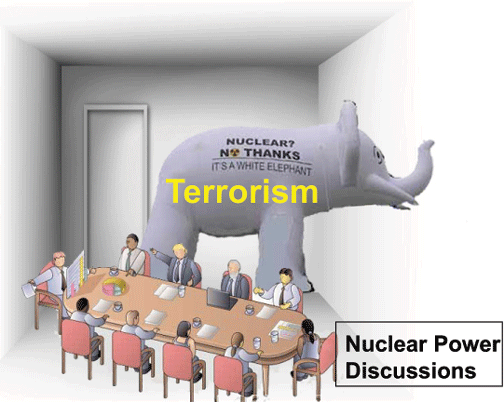
Bulletin of Atomic Scientists 8th Dec 2017, Earlier this week, Yemen’s Houthi rebel group claimed it had launched a
missile at the Barakah nuclear power plant in the western region of Abu
Dhabi, in retaliation for the Saudi-led blockade imposed on Yemen.
Abu Dhabi is part of the United Arab Emirates (UAE), a member of the coalition
that has been targeting the Houthis. UAE officials immediately denied that
the attack had taken place, and the Houthis have not provided any evidence
to support their claim.
However, regardless of the claim’s validity, and despite the lack of evidence, the incident is emblematic of the dangers of
nuclear power in the Middle East.
The UAE should take it very seriously. Even if this “attack” was merely a propaganda ploy, nuclear power
facilities will always be potential targets for enemy states and non-state
actors, including terrorist groups. In the Middle East, in particular,
there is a history of attacks on nuclear sites during regional conflicts.
https://thebulletin.org/yemeni-rebel-claim-highlights-risk-nuclear-power-middle-east11335
Israel’s 54-year-old nuclear reactor a safety risk
 Aljazeera, by Harry Fawcett
The Dimona reactor, which began its life in 1963, is one of Israel’s most closely guarded secret installations.
A study made public last year found more than 1500 fissures within the reactor core.
Israel is estimated to have more than 100 nuclear warheads, the plutonium for which comes from its Dimona reactor…….http://www.aljazeera.com/news/2017/12/israels-54-year-nuclear-reactor-safety-risk-171209153124924.html
Ontario frighteningly unprepared for nuclear emergencies
IFPress 7th Dec 2017,Ontario’s lack of readiness for nuclear emergencies is a frightening
situation that should alarm every resident, especially those in
Southwestern Ontario, says Sarnia Mayor Mike Bradley. “The province
preaches to municipalities about emergency plans. It turns out the preacher
isn’t following his own gospel,” Bradley said Thursday. Bradley joined
a chorus of critics slamming the Liberal government a day after Ontario’s
auditor general revealed shortcomings in provincial emergency and nuclear
response plans, concluding it’s not ready for a large-scale emergency.
Southwestern Ontario is home to the world’s largest operating nuclear
plant, the Bruce nuclear complex near Kincardine.
http://www.lfpress.com/2017/12/07/sarnia-mayor-weighs-in-after-auditors-less-than–glowing-review-of-provincial-preparedness
The unsolved hazard of damaged spent nuclear fuel rods – Andreeva Bay
In 2023, the risky part of Andreeva Bay nuclear cleanup starts https://thebarentsobserver.com/en/ecology/2017/12/2023-risky-part-andreeva-bay-nuclear-cleanup-starts
Donor countries agree to fund an additional study on how to extract the damaged spent nuclear fuel from Tank 3A. By Thomas Nilsen, December 08, 2017

USA’s Nuclear Waste Isolation Pilot Project struggling to deal with wastes and contaminated areas
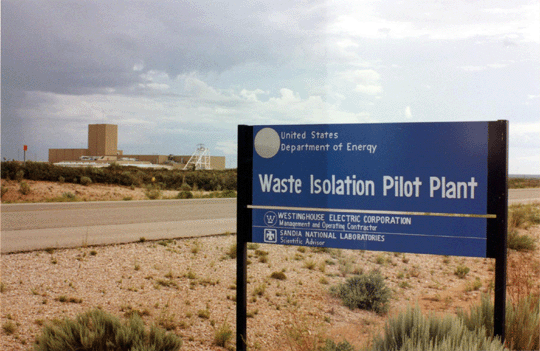 Official: WIPP deficiencies stem from lack of funds, By Rebecca Moss | The New Mexican, 7 Dec 17
Drones still buzz around France’s nuclear power plants!
 Liberation 5th Dec 2017, [Machine Translation] Drones still buzz around nuclear power plants. After
the autumn 2014 overflights, the authorities took technical and legislative
measures to put an end to them. These efforts only partially address this
new threat.
http://www.liberation.fr/france/2017/12/05/les-drones-bourdonnent-encore-autour-des-centrales-nucleaires_1614412
Nuclear industry would like to assess itself for safety, efficiency etc; (wouldn’t we all?)
 Nuclear industry wants power to self-assess plants, Cape Cod Times Christine Legere Dec 4, 2017 The federal agency in charge of overseeing the nation’s 99 commercial nuclear reactors is looking at ways to make its engineering inspection program more efficient, and one suggestion being entertained would allow plant operators to inspect, or “self-assess,” their own operations.
Nuclear watchdogs are speaking out against the proposal, arguing that inspection of plant systems should remain in the hands of an independent organization like the Nuclear Regulatory Commission to protect safety and ensure public confidence…….
charge of overseeing the nation’s 99 commercial nuclear reactors is looking at ways to make its engineering inspection program more efficient, and one suggestion being entertained would allow plant operators to inspect, or “self-assess,” their own operations.
Nuclear watchdogs are speaking out against the proposal, arguing that inspection of plant systems should remain in the hands of an independent organization like the Nuclear Regulatory Commission to protect safety and ensure public confidence.
A Duxbury citizens group called Pilgrim Watch also pushed for keeping the plant inspections in the hands of the NRC.
“Pilgrim provides the perfect example why NRC nuclear safety inspections are necessary and why industry self assessments would be dangerous,” stated Pilgrim Watch in its letter to the working group.
Pilgrim is one of three plants in the country classified in Column 4, a category established by the NRC for the worst performers. The plant is expected to be permanently shut down by May 31, 2019.
Referencing Pilgrim’s current classification, Yarmouth Port resident James Garb wrote that the plant’s decline is the result of lack of attention to safety matters and failure to perform safety procedures properly.
“How could you possibly expect a nuclear plant to conduct honest, effective safety inspections?” Garb wrote. “We certainly couldn’t.”……
Congressman William Keating, D-Mass., will oppose efforts toward self-assessment.
“We are currently reaching out to the NRC for any information on a potential self-policing proposal, which I would vehemently oppose,” said Keating in a statement provided by his office.
David Lochbaum, director of the Nuclear Safety Program for the Union of Concerned Scientists, said his organization expects that self-assessments will be one of the options the work group presents to the Nuclear Regulatory Commission once their study is complete.
His organization does not support that option…….. http://www.capecodtimes.com/news/20171203/nuclear-industry-wants-power-to-self-assess-plants
Fundamental problems with the Russian nuclear industry
Nuclear Russia Scares The World (Again), Lobe Log, DECEMBER 5, 2017, by Tatyana IvanovaAn international scandal involving ruthenium-106 (Ru-106) contamination of the atmosphere in most European countries has revealed fundamental problems with the Russian nuclear industry. The Russian State Corporation (Rosatom) has denied the massive leak at its Ural reprocessing facility. Instead, it has withheld data and spread propaganda in the best Soviet tradition.

During the last two months, Western European countries have been trying to identify the source of the Ru-106 cloud, which according to the French IRSN drifted over a majority of European countries. Several European networks involved in the monitoring of atmospheric radioactive contamination detected Ru-106 in late September. Then, German and French nuclear regulators found traces in the atmosphere at low but not dangerous levels. Later, 36 countries reported their measurements of Ru-106 to the International Atomic Energy Agency (IAEA).
The countries were puzzled by the source of contamination. Such a large-scale spread of a man-made radionuclide—not routinely detected in the atmosphere—could indicate a serious accident at a nuclear facility. The IAEA’s Incident and Emergency Centre (IEC) therefore asked European member states to share information about “any recent events associated with an atmospheric release of Ru-106.” Member states reported their own measurements of Ru-106, but none of the countries (including Russia) reported an incident. The agency said that the contamination did not pose a danger, because of the low concentrations of Ru-106.
The agency nevertheless detailed the kinds of situations that do not cause such a leak. The lack of other fission products accompanying the Ru-106 precludes the possibility of an accident at a nuclear reactor or spent nuclear fuel storage. The IEC also said that relatively small amounts of Ru-106 used in cancer treatment are unlikely to cause the reported air concentration. Also, Ru-106 can be used in a satellite as a source for a radioisotope thermoelectric generator (RTG). However such usage is not common, and no satellite containing Ru-106 has fallen back to earth during this period.
There are not many options left. Experts say that one of two kinds of events could cause such contamination. IRSN concluded that the origin of the mysterious Ru-106 is to be found either in nuclear fuel cycle facilities or in radioactive source production. There are very few such facilities in the world.
Since the IAEA didn’t find the source of contamination, the French IRSN and later the Ukrainian nuclear regulator carried out their own investigations.
Russian Traces
The results of independent modeling carried out by the IRSN and the Ukrainian regulator—based on the aggregated Ru-106 pollution data and meteorological conditions—indicate that the release zone lies “between the Volga and the Urals.” IRSN also calculated its total activity, which was considerable – between 100 and 300 TBq.
The Russian meteorological agency (Roshydromet), which monitors radioactive environmental pollution, then corroborated these findings. It also revealed measurements of “extremely high levels” of Ru-106 air contamination at two Russian villages in the Urals: Argayash and Novogorny. The levels were about 400 and 900 times higher then usual.
In this region of the Southern Urals, about 30 kilometers from these two polluted sites, there is only one potential large-scale polluter: the “Mayak” nuclear waste reprocessing plant. Accordingly, suspicion has fallen on it. Mayak is part of the Russian Rosatom State Corporation and is located at the closed secret town of Ozersk, in the Chelyabinsk district.
The source of the Ru-106 release could be facility number 235, which vitrifies highly radioactive waste. The same accident, according to the IAEA, occurred in 2001 in a similar nuclear fuel reprocessing plant at La Hague in northern France. A new vitrification furnace—the SverdNIIkhimmash EP-500/5—was put into operation in plant number 235 at Mayak at the end of December 2016.
According to Edwin Lyman of the Union of Concerned Scientists, the vitrification process oxidizes high-level waste solutions before they’re added to the glass melter. This tends to convert ruthenium into the tetroxide state, which is volatile. Reducing agents are added to prevent tetroxide formation. Lyman hypothesizes that an insufficient quantity of reducing agent added to a particular batch could result in the accidental production of ruthenium tetroxide, which would exceed the capacity of the off-gas filters. “Gaseous ruthenium tetroxide would then condense into small aerosol particles that could be transported large distances,” he concludes.
Rashid Alimov, from Greenpeace Russia, points out that the Russian furnace EP-500/5 has a special ruthenium tetroxide filter, which could fail. He notes that, according Rosatom’s 2015 annual report, Mayak routinely emits ruthenium tetroxide, but the recent release was significantly larger and exceeded the annual limit.
If such a large scale release had happened in France, IRSN reports, inhabitants within a radius of several kilometers would have been evacuated and local food produced within tens of kilometers would have been declared unsafe for human consumption.
Greenpeace Russia has already appealed to the Russian prosecutor’s office to investigate this accident. But “to date, everything points to Mayak,” says Alimov. Nadezhda Kutepova, a Russian human rights defender from Ozersk who is now a political refugee in France, added that an accident with the vitrification furnace is probable because of a number of problems that occurred during its installation and testing…………https://lobelog.com/nuclear-russia-scares-the-world-again/
Incident at Russia’s Mayak nuclear reprocessing plant may have caused radiation cloud over Europe
 Environmentalists point the finger of blame at Mayak, the plant to process Kola’s Cold War legacy, ByThomas Nilsen, – Barents Observer 30th Nov 2017
A mysterious cloud of radioactive ruthenium-106 blowing over Europe earlier
this autumn triggered many speculations about Russia trying to
‘cover-up’ a leak from the country’s largest nuclear waste treatment
facility.
Nadezhda Kutepova a local environmentalists from the closed city
of Ozyorsk near Mayak who was forced to flee Russia in 2015, now reveals
more inside information. Kutepova says Mayak was testing new equipment on
September 25 and 26 at the reprocessing plant and that something abnormal
may have happened.«Emission of ruthenium may come from the reprocessing
plant 235 or RT-1 in Mayak where the vitrification plant for very
high-level nuclear waste is located,» Kutepova tells.
She points to the new vitrification furnace which started operation last December and
experienced problems during construction and testing. «My idea is that the
furnace was built with a lot of problems that emerge in the operation and I
think this is the cause of the ruthenium-106 leak we saw in September,»
she explains.
Mayak has loads of high-level liquid radioactive waste that
needs to be stabilized and made safer and starting the new plant was,
according to Kutepova, rather urgent. She calls the equipment bought for
the electric furnace «low-quality» https://thebarentsobserver.com/en/node/3260
Appeal filed against commissioning of the tank of the Flamanville nuclear plant.

 Le Monde 30th Nov 2017, [Machine translation] Nuclear: appeal filed against the agreement given to
the commissioning of the tank of the Flamanville plant. Several NGOs
believe that the Nuclear Safety Authority should have vetoed the use of the
tank of the future EPR, which has anomalies.
The state of the tank of the European pressurized reactor (EPR) Flamanville (Channel) continues to
generate strong reservations and concerns. On Thursday, November 30th,
several NGOs, including Réseau sortie du nucléaire and Greenpeace, who
denounce anomalies in the construction of this tank, said they filed an
appeal before the State Council asking for the cancellation of the
agreement recently given by the Nuclear Safety Authority (ASN).
“This tankwas not manufactured according to the rules of the art, there were bad
workmanship (…). ASN should have vetoed the possible use of this tank,
“said Charlotte Mijeon, Spokeswoman of the Network out of the nuclear.
http://www.lemonde.fr/energies/article/2017/11/30/nucleaire-recours-depose-contre-le-feu-vert-donne-a-la-mise-en-service-de-la-cuve-de-la-centrale-de-flamanville_5222877_1653054.html
Disturbing faults, safety dysfunction in France’s Paluel nuclear power plant in Normandy.
Bastamag 1st Dec 2017 [Machine translation] A new accident reveals serious dysfunctions in terms
of nuclear safety in France. In March 2016, during a replacement operation,
a 465-ton steam generator fell in the heart of the Paluel nuclear power
plant in Normandy. A serious and unprecedented accident, which miraculously
does not cause serious injury or radioactive contamination. Since then,
experts have investigated the causes of the accident.
Consulted by Bastamag, their report, the conclusions of which will be summarized to
employees this 1st of December, reveals major dysfunctions in the
preparation and supervision of the site, largely related to the massive use
of subcontracting. Disturbing faults, while the renovation projects of the
power stations will multiply. https://www.bastamag.net/Un-accident-inedit-revele-de-graves-dysfonctionnements-en-matiere-de-surete
1 This Month
26 April – Chernobyl: Inside the Meltdown airs on National Geographic on Sunday 26th April from 4pm
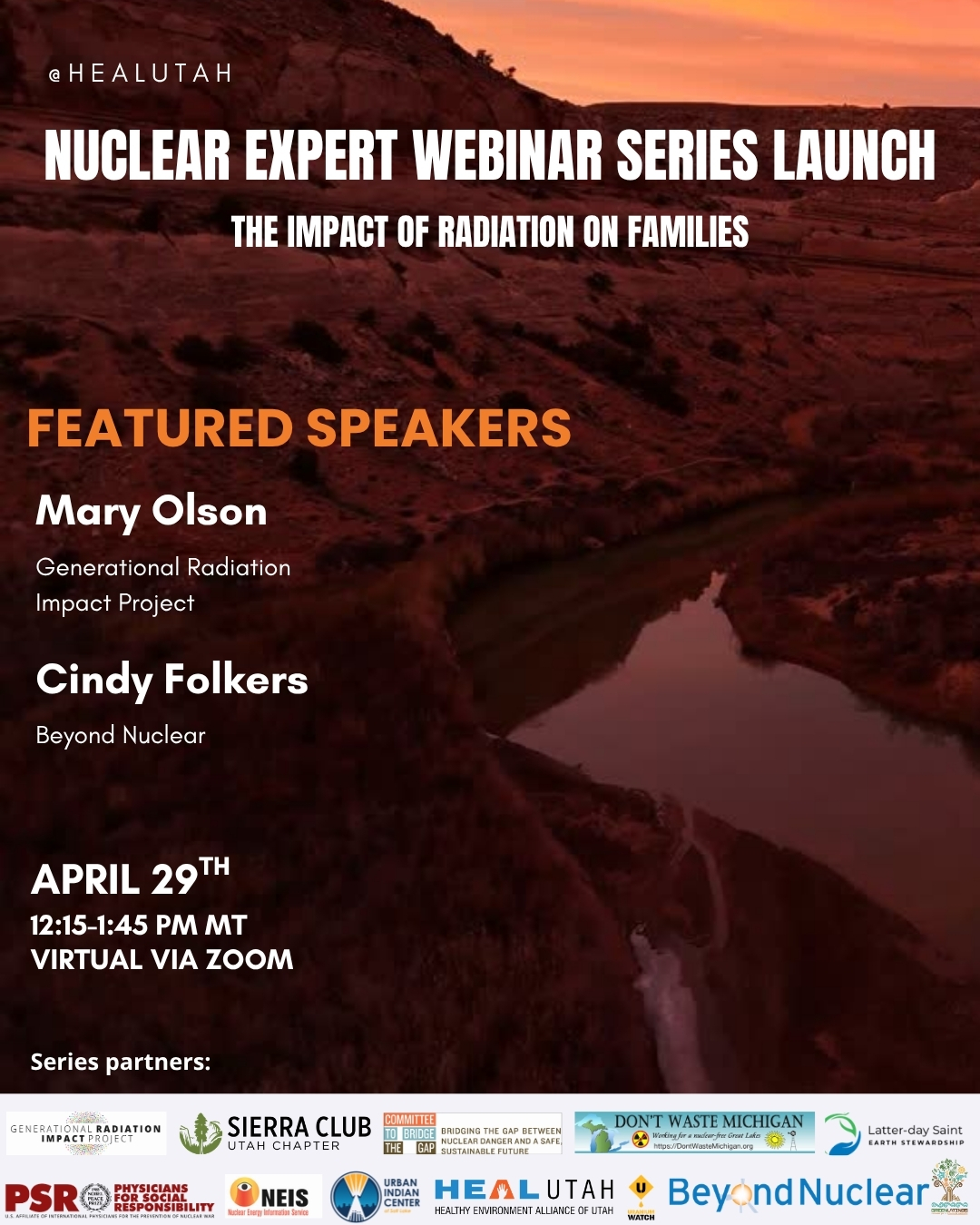
29 April – Nuclear Expert Webinar #1 – Radiation Impacts on Families with Mary Olson and Cindy Folkers
- 12:15 PM MT – 1:45 PM MT
- Location: Virtual – REGISTER TODAY

4 May -West Suburban Peace Coalition to discuss Iran war at May Educational Forum
Monday, May 4, 7:00 – 8:00 PM Central Standard Time
Title: : How Trump’s Narrative Tries to Shape the Reality of the War on Iran.
Contact Walt Zlotow, zlotow@hotmail.com 630 442 3045 for further information
14 May – online event From Bombs to Data Centres: the Face of Nuclear Colonialism

Pine Ridge Uranium is the real threat, not Tehran- Tell Burgum: Stop the Extraction.
Chernobyl: The Lost Tapes – A good documentary on Chernobyl on SBS available On Demand for the next 3 weeks– https://www.sbs.com.au/ondemand/tv-program/chernobyl-the-lost-tapes/2352741955560
To see nuclear-related stories in greater depth and intensity – go to https://nuclearinformation.wordpress.com
-
Archives
- April 2026 (356)
- March 2026 (251)
- February 2026 (268)
- January 2026 (308)
- December 2025 (358)
- November 2025 (359)
- October 2025 (376)
- September 2025 (257)
- August 2025 (319)
- July 2025 (230)
- June 2025 (348)
- May 2025 (261)
-
Categories
- 1
- 1 NUCLEAR ISSUES
- business and costs
- climate change
- culture and arts
- ENERGY
- environment
- health
- history
- indigenous issues
- Legal
- marketing of nuclear
- media
- opposition to nuclear
- PERSONAL STORIES
- politics
- politics international
- Religion and ethics
- safety
- secrets,lies and civil liberties
- spinbuster
- technology
- Uranium
- wastes
- weapons and war
- Women
- 2 WORLD
- ACTION
- AFRICA
- Atrocities
- AUSTRALIA
- Christina's notes
- Christina's themes
- culture and arts
- Events
- Fuk 2022
- Fuk 2023
- Fukushima 2017
- Fukushima 2018
- fukushima 2019
- Fukushima 2020
- Fukushima 2021
- general
- global warming
- Humour (God we need it)
- Nuclear
- RARE EARTHS
- Reference
- resources – print
- Resources -audiovicual
- Weekly Newsletter
- World
- World Nuclear
- YouTube
-
RSS
Entries RSS
Comments RSS
 nuclear-news