
Ken Raskin , 22 July 18 Trump has whole heartedly opened up the radioactive nightmare in America again. Uranium Mining in the Grand canyon. Into water that supplies much of the western United States.
This excerpt is from Majias Blog
“””In 2017 UR Energy’s Lost Creek mine in Wyoming had a terrible accident, described in the headline below as one of the worst recorded uranium mine spills, although trivialized in impact as not posing a threat:
Heather Richards (2017, September 8). Wyoming uranium mine spill one of the largest recorded in U.S.; officials say it does not pose a threat. Star Tribune:https://trib.com/business/energy/wyoming-uranium-mine-spill-one-of-the-largest-recorded-in/article_563faf2a-4093-5749-aaea-38f1f6b8efb0.html
The Lost Creek uranium mine north of Rawlins shut down operations Wednesday just weeks after reporting one of the largest spills of uranium injection fluid ever recorded in the U.S.
The spill was contained on site and is not a human health hazard, according to federal regulators. The spilled fluid had not yet been pumped into the uranium ore beneath the surface. Radioactive metal contained in the fluid was naturally occurring.
The mine, owned by Littleton, Colorado-based Ur-Energy, reported an Aug. 19 spill of 188,000 gallons of pre-injection fluid at Lost Creek. Another spill of 10,000 gallons of pre-injection fluid at Lost Creek on Tuesday was reported to federal regulators.
See how the article trivializes impact by stating that the radioactive metal contained in the spilled fluid was “naturally occurring.”
Uranium mining rapes the earth and processing and utilization poison the population as well as the eco-systems upon which we depend.
We don’t need nuclear power – its inefficient, costly, dangerous, and no solution exists for waste – and we don’t need nuclear weapons.
We don’t need any more uranium. Its antithetical to security when thought in relation to the preservation of life.””””
Start from Ship Rock NM, where a 90 million gallons of highly radioactive sludge, was released illegally into the environment and, san Juan River. The san Juan River Drains into the Colorado River.
Shiprock is also close to where underground nukes were detonated in New Mexico for project gasbuggy
Shiprock is on the navajo nation.
From there, moving West on the Navajo Nation.
Moving west to the grand canyon and the Uranium Mines there! Also downwind from Nevada nuke testing in the 50s and 60s.
GO NORTH TO Halchita IN DEEP SOUTH UTAH, BY the sacred Monument Valley.
Halchita, is where there was a uranium Mill and where there were mines, on the navajo Nation. Halchita is also downwind, from where the American Military nuke bombed its own citizens with a thousand bombs.
HALCHITA IS NAVAJO land, where half the residents in the area died from cancer.
Move norteast to Blanding, Utah, where energy Fuels is now located. By Bears ears, where Trump just opened unlimited uranium mining, even open pit uranium mining.
BLANDING IS Also downwinder. So many young people dead in mine accidents, prematurely from lung cancer, pacreatic cancer, ovarian cancer, lymphomas, leukemias. MANY PEOPLE THERE HATE URANIUM AND NUCLEAR.
A leader of the sagebrush rebellion, Cal Black, WAS a county commissioner of that county, San Juan County in the 60s and 70s.
Cal Black died with painful tumors, all over his body, at a young age. He regretted his involvement with Uranium, in the end.
The principal of Monticello High School, had a young son, who died of the same leukemia, that cursed so many kids in southern utah. All of those kids were downwinders and uranium babies. Monticello is just 20 miles north of the Energy Fuels genocide factory.
There was a Uranium Mill, right in the middle of monticello. It has not cleaned up all the way, to this day.
The mill and tailings of energy fuels in blanding blows radioactive shit all over s utah to colorado and arizona.
Blanding and energy fuels, are 20 miles s of Monticello Utah.
The heavily contaminated dust from that abomination, blows radioactive shit, to the Ute reservation in colorado 50 miles away, to Bluff Utah by Monument valley and has heavily contaminated the Bears Ears.
There were the numerous nuclear bombs, detonated at the headwaters of and under the Colorado River in the 60s and 70s. There are the towns north of energy fuels along the Colorado river in Utah and colarado, that had to sue the government and corporate polluters for 20 years, to get something done about the radioactive shit in their towns.
And now Trump is back to start it up all over again and make it worse.
July 22, 2018
Posted by Christina Macpherson |
incidents, Uranium, USA |
Leave a comment

 The Pickering nuclear plant’s explosive secret https://www.durhamregion.com/opinion-story/8738033-the-pickering-nuclear-plant-s-explosive-secret/?s=n1
Angela Bischoff says OPG has no plans to make its nuclear waste as safe as possible Jul 19, 2018 by Angela Bischoff Pickering News Advertiser
The Pickering Nuclear Station has a deadly secret: 740,000 radioactive fuel bundles sitting on site — the legacy of close to 50 years of nuclear operations.
These bundles contain radioactive materials that can penetrate the human body, leading to serious illness or death. They also contain an enormous amount of plutonium, the key ingredient in nuclear warheads or dirty bombs. There is enough plutonium on-site at Pickering today to construct more than 11,000 nuclear warheads.
We recently asked internationally recognized risk expert Dr. Gordon Thompson to review the advisability of storing this enormous pile of toxic waste in the midst of Canada’s largest urban area and next to the source of our drinking water.
His conclusion was stark: The Pickering site, he found, is “suboptimal as a spent nuclear fuel-storage site from perspectives including defensibility, proximity of populations, and potential to contaminate Lake Ontario.” He added that the current waste storage facilities have no protection from rocket, bomb or aircraft attacks from the air or water and that, overall, the site is “lightly defended” at best.
Half-a-century after the start of nuclear power operations in Canada, the Nuclear Waste Management Organization is still on the hunt for a “willing host” community to accept thousands of tonnes of spent fuel that will remain highly radioactive for thousands of years.
This means there is little chance the waste currently being stored at Pickering is going anywhere in the next 60 to 100 years. To add insult to injury, while Ontario Power Generation is planning to expand its conventional storage facilities so that Pickering can continue to produce and store more toxic nuclear wastes, it has no plans to make its new storage facilities as safe as possible. Specifically, it has no plans to build above-ground, attack-resistant, reinforced-concrete vaults to protect Pickering’s wastes from a terrorist attack.
Continuing to operate this patched-up nuclear plant surrounded by millions of people, while piling up more and more toxic nuclear wastes in conventional commercial storage buildings, is the very definition of an extremely bad idea that can only get worse.
Those who support keeping Pickering running until 2024 or beyond, such as Premier Doug Ford, need to explain how they plan to safeguard the thousands of tonnes of deadly waste already stored at the site and why it is a good idea to continue adding more.
— Angela Bischoff is the director of the Ontario Clean Air Alliance. We’re behind Ontario’s coal phase-out and are now working to move Ontario to a 100-per cent renewable electricity system.
July 21, 2018
Posted by Christina Macpherson |
Canada, safety |
Leave a comment
 Romandie 18th July 2018 Framatome (formerly Areva NP) has completed the analysis of the anomalies
detected on the manufacturing files of components manufactured on its site
of Le Creusot (Saône-et-Loire) for the French reactors of EDF, and the
factory is now “fully operational,” said Wednesday a company executive. The
audit launched in 2015 after detecting the existence of anomalies involved
three phases: an inspection step, or a review of “nearly 4,000 files”, then
a technical analysis phase of any discrepancies raised. which is “totally
finished for all the parts of the French park”, said David Emond, director
of the division Components of Framatome, during a press point in Le
Creusot. “We still have to finish a number of foreign customers, and it
will be done at the end of the year,” he added. The Nuclear Safety
Authority (ASN) must now complete the study, reactor by reactor as
scheduled maintenance stops by EDF, the results transmitted by Framatome.
https://www.romandie.com/news/937602.rom
July 20, 2018
Posted by Christina Macpherson |
France, safety |
Leave a comment
Herald 16th July 2018 , AN INVESTIGATION has been launched after a freight train carrying nuclear
material ran a stop signal near to Kingussie on Friday night. The service
was carrying spent fuel from the Dounreay Power Station to the
decommissioning site at Sellafield, Cumbria. It came to a stop after
travelling past a red light before being moved to a “position of safety” by
concerned officials. Direct Rail Services (DRS), the company which handles
shipments between the two sites on behalf of the Nuclear Decommissioning
Authority (NDA), said they understand there was no risk of collision due to
the error.
However, concerns have been raised as to why a train loaded with
radioactive material was allowed to sit there for almost two hours. An
investigation has since been launched into the circumstances of the
“highly-disturbing” incident. DRS has been transporting spent fuel between
the two sites for a number of years. The material is taken from Dounreay to
Georgemas Junction and loaded on to the train to Carlisle and then onto
Sellafield.
Tor Justad, chairperson of the Highlands Against Nuclear
Transport group, said: “We’ve been campaigning for these shipments to be
stopped and for the material to be kept on site. Storing nuclear material
is hazardous enough but it’s when you go to transport it that accidents can
happen. And obviously an incident like this is highly-disturbing. We know
that low-level radiation is emitted from these canisters so to hear that
the train was sitting at Kingussie for hours is concerning.”
http://www.heraldscotland.com/news/16356092.investigation-launched-after-train-carrying-nuclear-material-ran-stop-signal-at-kingussie/
July 18, 2018
Posted by Christina Macpherson |
safety, UK |
Leave a comment
Feds say it can’t wait. High-risk radioactive Hanford tunnel needs filling now ,BY ANNETTE CARY
The Department of Energy wants to start stabilizing a Hanford tunnel filled with highly radioactive waste that is at risk of collapse without waiting for more public comments.
Work needs to start in a few weeks to finish before winter, the department said.
DOE has asked the Washington Department of Ecology, a Hanford nuclear reservation regulator, if it can proceed with filling the nearly 1,700-foot-long storage tunnel with concrete-like grout in August.
DOE held a public comment period on the plan, but the state planned its own 45-day comment period and public meetings starting next month.
Ecology officials will review DOE’s request made Thursday, but still plans to go on with its own public process, said spokesman Randy Bradbury.
The older of the two waste storage tunnels at the PUREX processing plant partially collapsed in May 2017, causing thousands of workers across the Hanford site to take cover.
The concern was that radioactive contamination could have spread from the open tunnel roof. No radioactive material is believed to have escaped but DOE is trying to prevent further collapses of the aging tunnels.
DOE wants to start filling the longer tunnel in August to get some, if not all, of the tunnel stabilized with grout before ice and snow make roads slippery this winter.
Dozens of daily truckloads will be needed to bring supplies to a batch plant near the tunnel to mix the grout. Trucks then will deliver the grout to spots along the length of the tunnel, where it will be inserted.
In addition, video shot of the inside of the tunnel in April raised concerns about the condition of the tunnel. The videos found corrosion of bolts and weld plates.
“While not an indication of imminent collapse, the fact that some components are stressed above design capacity and are also corroding is a concern,” DOE said……….https://www.tri-cityherald.com/news/local/hanford/article214973345.html
July 18, 2018
Posted by Christina Macpherson |
safety, USA |
Leave a comment
Trident nuclear safety ratings kept secret by MoD, Herald Scotland, Rob Edwards , 14 July 18
THE Ministry of Defence has refused to reveal official safety ratings for the Trident nuclear weapons system and nuclear-powered submarines on the Clyde, citing “national security”.
The annual ratings, and the reports that justified them, were published for ten years by the MoD, uncovering a series of concerns about spending cutbacks, staff shortages and accidents. But now ministers have clamped down and decided that they can’t release any findings at all on security grounds.
Experts have accused the MoD of trying to evade public scrutiny, hide “cock-up and incompetence” and endanger public safety. But the MoD has insisted that the secrecy had not prevented independent assessment of the nuclear programme, which met “all the required standards”.
Safety during the refurbishment, transportation and storage of Trident nuclear warheads, along with the operation of the UK reactor-powered submarine fleet based at Faslane near Helensburgh, is regulated by the Defence Nuclear Safety Regulator (DNSR). Unlike the civil nuclear power industry, which is overseen by the independent Office for Nuclear Regulation, DNSR is part of the MoD.
After a prolonged freedom of information battle, the MoD started publishing DNSR annual reports from 2005. They were released over ten years until 2014-2015, highlighting issues as “regulatory risks” 86 times, including 13 rated as high priority, 50 as medium priority and 23 as low priority.
…… In November 2018 the Sunday Herald revealed that the MoD had abruptly decided to stop publishing the annual DNSR reports to protect national security. Last week the defence minister, Guto Bebb, went further, refusing to give any indication of even the headline summaries of the reports covering the last three years…….The Scottish National Party attacked the MoD’s secrecy. “This is simply not good enough and the MoD have a bad track record on transparency,” said the party’s defence spokesperson, Stewart McDonald MP.
“Safety and security are paramount when it comes to anything nuclear – and we need to be confident that is always the case.”
The independent nuclear engineer, John Large, described national security as a “flimsy excuse” for hiding nuclear safety issues. He suggested that the four Vanguard submarines that carry Trident warheads will all have to be brought into dock for unplanned overhauls because of problems with the ageing reactors that drive them.
“There is good reason to believe that both human resource and technical issues are continuing to impact on the reliability and full strength deployment of both the hunter-killer and Vanguard nuclear-powered submarines,” he said.
“The suppression of if and how the Royal Navy is reaching its nuclear safety targets is of great concern because within the MoD’s hierarchal review structure there is no opportunity for independent assessment. In effect, the buck stops short of a faceless admiral, whose primary duty of providing the nuclear deterrent overrides the safety of the public at large.”…..
Professor Andy Stirling, a nuclear expert from the University of Sussex, warned that secrecy could hide public dangers. “The British military nuclear establishment is increasingly seeking to escape public scrutiny and democratic accountability,” he said.
“The MoD is using the trump card of security to quash reasonable questions. History shows how dangerous this state of affairs can be, and how essential it is to achieve healthy transparency.”
……… Nuclear safety risks identified in reports by the Defence Nuclear Safety Regulator2014-15: five risks – shortage of engineers “the principal threat to the delivery of nuclear safety”
2013-14: eight risks – sustainability of the necessary nuclear skill set “remains fragile”
2012-13: eight risks – ageing nuclear submarines require attention “to ensure maintenance of adequate safety performance”
2011: eight risks – “lack of adequate resource to deliver the defence nuclear programmes safely”
2010: eight risks – danger of accidents “progressively worse” because of “painful” spending cutbacks
2009: nine risks – spending cuts meant that it was no longer possible to ensure that nuclear activities “remain safe”
2008: nine risks – some areas “barely resourced” to deliver nuclear safety
2007: 11 risks – “potentially significant risks” at nuclear sites across the UK
2006: 11 risks – “crew fatigue” could cause hazards during the road transport of nuclear weapons
2005: nine risks – “slow progress in implementing the regulation framework for the nuclear weapons programme” http://www.heraldscotland.com/news/16355206.trident-nuclear-safety-ratings-kept-secret-by-mod/
July 16, 2018
Posted by Christina Macpherson |
safety, UK, weapons and war |
Leave a comment
Pilgrim seeks exemption from post-closure emergency plans, http://www.capecodtimes.com/news/20180714/pilgrim-seeks-exemption-from-post-closure-emergency-plans By Christine Leger, 14 July 18
PLYMOUTH — The owner of Pilgrim Nuclear Power Station is looking to eliminate the 10-mile emergency planning zone around the reactor less than a year after it powers down for the final time, shrinking the radius under its protection to its property line.
Entergy Corp. plans to permanently shut down the Plymouth plant by June 1, 2019, after 46 years of operation.
The company submitted its request to the Nuclear Regulatory Commission for an exemption from the federal requirements to maintain an emergency planning zone beginning April 1, 2020, saying the requirements are expensive and unnecessary.
“Entergy currently provides in excess of $2.25 million to fund Emergency Management programs in the state and local communities,” said Joseph Lynch, senior government affairs manager for Entergy. “At least for the EPZ (emergency planning zone) communities, they will get the same level of funding for approximately one year after the plant is shut down.”
Plymouth, Kingston, Marshfield, Duxbury and Carver have sections falling within Pilgrim’s 10-mile radius.
July 16, 2018
Posted by Christina Macpherson |
safety, USA |
Leave a comment
https://www.thelocal.fr/20180706/french-mps-warn-of-nuclear-power-safety-failings news.france@thelocal.com
@thelocalfrance
A French parliamentary inquiry has flagged up “failings” in the defences of the country’s nuclear power plants, days after activists crashed a drone into a facility to underscore safety concerns.
“When you look for failings you find them, and some are more concerning than others,” said Barbara Pompili, a lawmaker from the governing Republic on the Move party.
France is the world’s most nuclear-dependent country, with 58 reactors providing 75 percent of its electricity.
Environmentalist group Greenpeace has carried out a string of break-ins at nuclear facilities in recent years to prove its claim that they are vulnerable to accidents and terror attacks.
In the latest stunt Tuesday, it flew a drone mocked up as Superman into an ageing plant in Bugey, about 25 kilometres (16 miles) outside the southeastern city of Lyon.
The drone crashed into a building housing a storage pool for spent nuclear fuel, one of the most radioactive areas at the site.
The cross-party commission tasked with looking into nuclear safety spent five months interviewing experts and visiting facilities, including in Japan where they reviewed measures taken after the 2011 meltdown at the Fukushima nuclear plant.
The lawmakers said the number of safety incidents in France “has risen steadily”.
They cited in particular last year’s temporary shutdown of the four reactors at a plant in Tricastin in the southeast, seen as prone to flooding in the event of an earthquake, and a blast at a facility at Flamanville in the north.
The report recommended 33 steps to improve nuclear safety, including boosting police numbers at atomic plants and reducing the number of subcontractors in the industry.
We cannot verify’
President Emmanuel Macron has been noncommittal about a pledge by his Socialist predecessor Francois Hollande to drastically reduce the share of nuclear power in France’s energy mix.
Environment Minister Nicolas Hulot said in November that meeting Hollande’s targets would be “difficult” and that a rushed move to bolster the share of renewables could jeopardise power supplies.
Anti-nuclear campaigners argue that older plants, like the 39-year-old Bugey facility, were not built to withstand an attack from the likes of the Islamic State group or Al-Qaeda.
Greenpeace has said the pools for storing spent fuel are particularly vulnerable.
The parliamentary report demanded that the government provide a timetable for dismantling older plants.
It also questioned the safety of a plan to store nuclear waste deep underground in the northeastern village of Bure and called for the number of subcontractors in the nuclear industry to be kept to a minimum, “to improve control over the operation of the sites”.
State energy utility EDF said the report contained “a number of errors” and said it would respond by mid-July.
The MPs for their part complained that many of the questions they put to the state and EDF went unanswered, with both invoking national security concerns.
“We have the feeling that a lot of work is being done to protect the plants but we cannot verify it,” Pompili said.
July 7, 2018
Posted by Christina Macpherson |
France, safety |
Leave a comment
FT 6th July 2018 , A French government commission has called for improvements in the safety of
the country’s nuclear power plants, including their ability to withstand
terrorist attack, putting further pressure on state-backed power utility
EDF.
The parliamentary commission set up to look at the safety and security
of nuclear installations in France said, in a report published on Thursday,
that the fleet remain vulnerable to accident and attack. The report comes
at a time of heightened political pressure for heavily indebted EDF, which
operates France’s nuclear fleet and faces a multi-billion euro bill to
extend the life of ageing plants.
Although an EPR is now coming online in
China, EDF is waiting for its Flamanville plant in France, which is seven
years late and €7bn over budget, to start up. A recently discovered
problem with weldings has increased uncertainty. EDF’s EPR projects in
Finland and at Hinkley Point, south-west England, are also running late and
over budget.
According to the parliamentary report, the NGO Greenpeace has,
over the last 30 years, “conducted 14 intrusion attempts in order to
demonstrate the vulnerability” of the French nuclear sites. The commission
put forward 33 suggestions to improve the situation – including reducing
reliance on subcontractors, putting more police on the ground at nuclear
sites, reconsidering waste disposal methods, being clearer on the timeline
for shutting down plants and strengthening the powers of the French nuclear
regulator, the ASN.
https://www.ft.com/content/347980d2-8067-11e8-bc55-50daf11b720d
July 7, 2018
Posted by Christina Macpherson |
France, safety |
Leave a comment
 CORE 4th July 2018 ,As a site, the full appreciation of chemical legislation, including The
Dangerous Substances and Explosive Atmospheres Regulations DSEAR, has been
inadequate’. [Sellafield Ltd Board of Investigation report on 2017
‘chemical event’ and made available to CORE in April 2018]
Many of the findings of the more recently published (20th June 2018) National Audit
Office (NAO) report will come as little surprise, once again apportioning
blame for a litany of missed milestones, mismanagement of contracts and
delays and overspend on major projects by site owner the Nuclear
Decommissioning Authority (NDA).
The report also criticises the Government’s failure to challenge and assess the NDA’s performance. Of
Sellafield’s 1400 buildings (operational and legacy), some are considered
by NAO to fall short of modern standards and, through deterioration,
‘pose a significant risk to people and the environment’.
Identified as amongst Sellafield’s top 10 highest hazards is the site’s plutonium
stock and associated management facilities, the NAO report warns
specifically of decaying plutonium canisters – a leak from which would
add to the growing list of ’intolerable risks’ posed by Sellafield as
identified by the Office for Nuclear Regulation (ONR) and the acknowledged
risks posed by the volumes of hazardous wastes and materials stored in
run-down buildings.
Yet curiously absent from the references to run down
buildings and intolerable risks – and despite making the national
headlines when the Army’s bomb squad was rushed to Sellafield late one
October weekend last year to deal with unstable chemicals – is the
site’s Analytical Services Laboratory (ASL) facility and the cocktail of
chemicals and radioactive materials it holds.
One of the oldest facilities on site (built in 1951) and located in the tight and highly controlled
confines of Sellafield’s Separation Area alongside old reprocessing plant
and the high hazard legacy ponds and silos, around 50 of ASL’s original
150 laboratories are currently operational. Described by the Office for
Nuclear Regulation (ONR) in June 2017 as a ‘relatively high risk’
facility whose laboratories hold a ‘considerable radiological
inventory’ that ‘has potentially high off-site consequences in the
event of a major accident’, it is little wonder that the Bomb Squad’s
arrival in late October 2017 to deal with ‘unstable chemicals’ and
their potential to ignite or explode; the evacuation of workers and a
100-metre cordon thrown up around ASL should have triggered major alarm
bells locally and further afield.
http://corecumbria.co.uk/briefings/chemical-chaos-and-confusion-at-sellafield-yet-another-intolerable-risk/
July 6, 2018
Posted by Christina Macpherson |
safety, UK |
Leave a comment
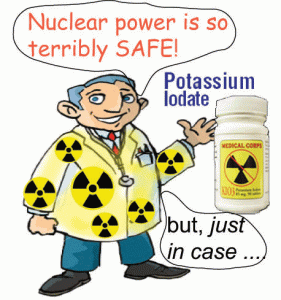 https://sputniknews.com/europe/201803061062271532-biligum-iodine-pills-nuclear-emergency/ BRUSSELS (Sputnik) 4 July 18 – Free distribution of iodine tablets has started in Belgium as a precautionary measure in the event of a nuclear catastrophe, the Belgian Pharmaceutical Association told Sputnik on Tuesday.
Starting from Tuesday, every Belgian citizen can come to a pharmacy and get free iodine pills, the association said. This move is part of the government’s nuclear safety policy.
Before March 6, only those living within 20 kilometers (12 miles) from nuclear sites were entitled to receive the medication free of charge, while now the area of distribution has been increased to 100 kilometers (62 miles).
Belgium has two nuclear plants, Tihange and Doel, with a total number of seven reactors. Only in 2017, there were seven incidents at the facilities.
Belgium’s neighbors, Germany and the Netherlands, are concerned over the safety of the kingdom’s ageing nuclear reactors.
In 2016, Germany requested Belgium to shut down its two reactors because of defects found in their pressure vessels, but the kingdom refused. In September 2017, citizens of Aachen, a western German city located 70 kilometers (43 miles) away from the Belgian Tihange, started getting free iodine tablets.
In 2016, the Netherlands started distributing the pills to people who lived within a 100-kilometre (62-mile) radius of the neighboring Dutch Borsselle and Belgian Doel plants.
July 6, 2018
Posted by Christina Macpherson |
EUROPE, safety |
Leave a comment
https://sputniknews.com/europe/201807051066069197-belgium-reactor-shutdown/ People who live near the Tihange nuclear power plant in Belgium’s Wallonia region have serious concerns about the safety of the station which has experienced several shutdowns in recent years.
The station’s operator, Engie-Electrabe, found “instability” in the reinforced concrete ceiling of the reactor’s armored bunker during a planned check that started on March 30, the newspaper Soir reported on Thursday.
According to the newspaper, company specialists also determined that the “anomalies” in the reinforced concrete had been there since the time the bunker was built.
They fear that the defect may potentially weaken the structural strength of the unit.
Soir said that the reactors of the Doel nuclear power plant in Flanders have not been affected as they have different architecture.
Belgium’s nuclear safety agency (AFCN) said that the Tihange reactor will not be restarted before the bunker has been pronounced safe.
According to a preliminary estimate, this may not happen before September, the newspaper wrote.
The Tihange plant is located just 60 kilometers (37 miles) from the country’s border with Germany and the Netherlands, while the Doel plant is located near the Belgian port city of Antwerp, next to the Dutch border.
About half of Belgium’s power is supplied by nuclear energy from the country’s seven operating reactors, three at Tihange and four at Doel.
July 6, 2018
Posted by Christina Macpherson |
EUROPE, safety |
Leave a comment
Durham Region.com NEWS Jul 04, 2018 by Kristen Calis Pickering News Advertiser
PICKERING — Questions from concerned advocacy groups regarding the Pickering Nuclear Generating Station remain, while Ontario Power Generation continues to defend its position to justify the plant’s continued operation.This was the scene at the second round of Canadian Nuclear Safety Commission hearings regarding OPG’s request for a licence extension to operate the Pickering power plant to 2024, followed by safe storage activities until 2028. The plant is currently scheduled to close on Aug. 31.
Shawn-Patrick Stensil, senior energy analyst for Greenpeace, spoke Thursday at the Pickering Recreation Complex during the hearings. The CNSC will make the decision on the extension request.
In his submission on behalf of Greenpeace, Stensil said there is no justification for Pickering’s operation and the commission should reject OPG’s “request to expose millions of people within the (Greater Toronto Area) to the possibility of a nuclear accident.”
The week of hearings wrapped up on Friday. The first round took place in Ottawa in April.
……….The advocacy group was granted funding from the CNSC to poll the public on specific issues for the purpose of the hearing and presented its results.
The poll found 93 per cent of those surveyed want detailed nuclear emergency plans in place to protect residents from a possible large-scale accident at Pickering (or Darlington).
“Population density around the Pickering station is already too high yet intensification is being stepped up,” McNeill said.
The poll also found 87 per cent believe the radius for predistribution of KI pills should be extended. Currently its delivered within 10 kilometres. Only 17 per cent are aware they can order the KI pills free from preparetobesafe.ca…………..https://www.durhamregion.com/news-story/8704832-pickering-nuclear-critics-call-for-more-emergency-preparedness/?s=n1
July 6, 2018
Posted by Christina Macpherson |
Canada, safety |
Leave a comment
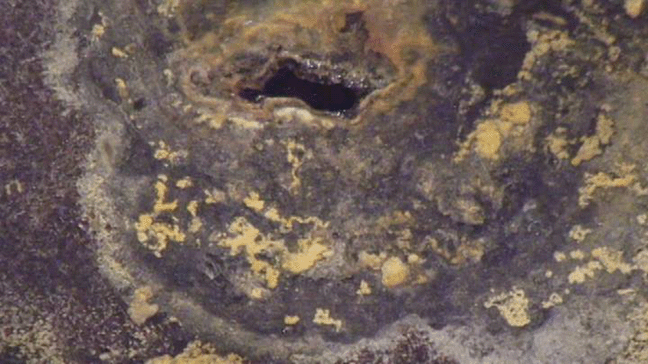
an inspection in 2017, after most of the waste was retrieved from the tank, found widespread pitting on the bottom of the inner shell, allowing waste to seep through. The finding pointed to a corrosion problem.
Experts don’t know enough about the issue yet to tell if the thinning is recent or definitely say what caused it.
More Hanford nuclear waste tanks at risk of leaking https://www.tri-cityherald.com/news/local/hanford/article214069424.html, BY ANNETTE CARY, 1 July 18 acary@tricityherald.com RICHLAND, WA
More of Hanford’s newest waste storage tanks could be at risk of developing leaks, according to a new evaluation.
Tank farm contractor Washington River Protection Solutions compared the chemistry of the waste in the nuclear reservation’s oldest double-shell tank, which was discovered to be leaking, to the waste in the nuclear reservation’s other double-shell tanks.
The evaluation’s conclusion and other findings about the condition of the Hanford Site’s double-shell tanks suggest a need to build more waste storage tanks for 56 million gallons of waste, according to the Washington Department of Ecology.
“We need to start doing something, the sooner the better,” said Steve Lowe, Ecology’s double-shell tank lead engineer. “Cleanup depends on it.”
He characterized three of the double-shell tanks that still hold waste as having “very high risk factors” for corrosion, based on information in the new study.
But the finding doesn’t mean the three tanks are leaking or will leak, said Jeremy Johnson, deputy DOE project director for the Hanford tank farms, at a recent Hanford Advisory Board committee meeting.
The Department of Energy is emptying the radioactive and hazardous chemical waste from 149 leak-prone single-shell tanks into 28 newer double-shell tanks for storage until the waste can be treated for disposal. The waste is left from the past production of plutonium for the nation’s nuclear weapons program.
But the first of the double-shell tanks — Tank AY-102, which dates to 1971 — has been taken out of service and emptied after developing a slow leak from its inner shell into the space between its shells.
Corrosion risks identified
Initially, officials suspected the leak was caused by construction problems, including welds that had to be reworked as many as four times.
But an inspection in 2017, after most of the waste was retrieved from the tank, found widespread pitting on the bottom of the inner shell, allowing waste to seep through. The finding pointed to a corrosion problem.
Now the new study finds three other of the double-shell tanks — AY-101, AZ-101 and AZ-102 — have held waste with similar chemistry to what’s suspected of corroding the bottom of the inner shell of Tank AY-102.
Among the issues with the three tanks, as well as the tank that leaked and has been emptied, is a history of holding waste that generates high heat, which could accelerate corrosion.
The waste chemistry is one of three potential problems in the 27 remaining double-shell tanks that Johnson discussed with advisory board committee members.
Two of the tanks with possible waste chemistry issues also have spots with thinning in a ring around the wall of the inner shell. The ring is where condensate, or water from ventilation systems in the tank farms, was added and interacted with the air before it mixed into the rest of the waste.
In addition, ultrasonic testing has found thinning of the steel in the bottom of the outer shell of nine of 11 of the double-shell tanks checked.
In one spot of Tank AP-102, the steel bottom of the shell had thinned up to 70 percent, according to DOE.
Experts don’t know enough about the issue yet to tell if the thinning is recent or definitely say what caused it.
However, DOE suspects that moisture may be infiltrating and corroding the outside of the tank where it sits underground on a concrete foundation. The foundation has drains to a sump system.
DOE has relied on an independent Tank Integrity Expert Panel, which met last week, to provide recommendations on the Hanford tanks.
The panel has “found areas of interest in time to take action before they become a problem,” Johnson said.
Ecology raises concerns
But the state is concerned that double-shell tank space already is in short supply, with several of the tanks at risk.
Every double-shell tank that fails will take two out of use — the one that failed and the one that is filled with waste from the failed tank, Lowe said. Double-shell tanks have a capacity of at least 1 million gallons.
DOE has said that once the vitrification plant starts turning low-activity radioactive waste into a stable glass form, as soon as 2021, about 12 million gallons of space will be freed up during the following decade in the double-shell tanks to empty more single-shell tanks.
But by the time the vitrification plant starts treating waste, the oldest of the double shell tanks will already be 50 years old. And some of the tanks will remain in service as the plant operates for another 40 years, Ecology officials pointed out.
One of the tanks identified as at high risk for corrosion, Tank AZ-101, holds waste that is expected to be treated as high-level radioactive waste, according to Ecology officials. The waste is expected to remain in the tank until 2036, when the vit plant is expected to be fully operational.
The Tank Integrity Expert Panel discussed the new study on tanks at risk of corrosion this week, and members said they were concerned that it underestimated risk, according to the Department of Ecology’s account of the meeting.
The study did not consider that multiple risks, such as waste that generates high temperatures and waste with certain chemistry, could be synergistic, creating faster corrosion than predicted, according to Ecology.
DOE taking action
DOE and its tank farm contractor are taking steps both to prevent further deterioration and to learn more.
A chemistry-control program for the double shell tanks will be revised, DOE said. Core samples will be collected to analyze the waste at the bottom of the three most at-risk tanks.
To prevent pitting in a ring around tanks from ventilation system condensate, the liquid now will be treated elsewhere at the nuclear reservation, rather than going into the tanks.
DOE also is evaluating ways to prevent moisture from collecting under outer shells and is considering whether corrosion inhibitor could be added.
New robots small enough to be used in the ventilation spaces between the bottoms of the two shells are being developed and could be used later this year to learn more about the condition of the tanks.
There also is a possibility that some repairs could be made on the outer shell.
Annette Cary; 509-582-1533; @HanfordNews
July 2, 2018
Posted by Christina Macpherson |
safety, USA, wastes |
Leave a comment





 nuclear-news