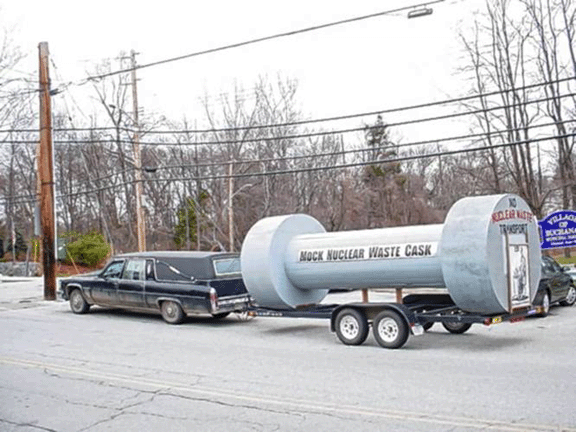
Earthquake Studies Reveal the True Cost of North Korea’s Nuclear Tests Inverse, By Emma Betuel September 26, 2018
On September 3, 2017, North Korea tested a nuclear bomb 17 times larger than the one that leveled Hiroshima, sending ripples of alarm across the world. More than just raise the eyebrows of policy makers, the blast also piqued the interest of experts at Columbia University’s Lamont Doherty Earth Observatory, who show in a pair of recent papers that last September’s nuclear test may be responsible for many of the aftershocks that occurred in the past year.
While some existing research argues it’s unlikely that a nuclear test could cause a massive earthquake, the two papers identify 13 high-frequency tremors that traveled through North Korea in the months following the September test. More importantly, they confirm which of them were triggered by the explosion, which were unrelated earthquakes, and which — as some have feared — were caused by additional nuclear tests.
“North Korea has conducted six nuclear tests, but the latest one was huge. That’s what we’ve analyzed the signals from,” Woon Young Kim, Ph.D., the lead author of the Seismological Research Letters paper and a professor of seismology geology and tectonophysics, tells Inverse. “The question was: Were they explosions or were they earthquakes?”
The earliest rumblings occurred just eight minutes after the initial nuclear test but were not included in the paper’s aftershock count. But two occurred later that month and another on October 12. In December there were five more. The tremors continued into 2018, with four in February and the final one on April 22.
The issue, explains Kim, is that scientists were aware of these tremors as they occurred but nobody knew why they were happening. At the time, some expertsidentified these tremors as evidence that North Korea was testing more nukes on a smaller scale, but Kim’s new paper, published in conjunction with another studyauthored by his colleague David Schaff, Ph.D., suggests not only that some of those tremors were actually just earthquakes but also that they were tightly grouped along a fault line, where similar events will likely occur in the future.
Bomb or Earthquake?
To find out whether these shakes were organic or the result of nuclear testing, Kim analyzed two major wave types measured after the tests. Whenever the earth shakes (whether it’s due to an explosion or not), the first rumble to roll by is called an “P-wave” or primary wave. It’s typically the first wave to get picked up by monitoring stations and travels around six kilometers per second.
…….. After more analysis, the researchers concluded that “event 8” was actually an earthquake, together with two other suspected explosions.
“There have been about three events at the North Korea test site that we feel were misclassified,” Schaff tells Inverse. “No method is 100 percent certain, but combining the two methods, I was able to say with a very high probably of certainty that these were earthquakes.”
The Real Consequences of September 3, 2017
The good news is that these results suggest that North Korea isn’t testing bombs as frequently as some might fear They do, however, suggest that there could be something going on underneath the surface as a result of the September 3 explosion.
Using the data provided by Kim, Schaff showed that the tremors following the explosion were clustered along a unified path. As it turns out, what had originally looked like a random spattering of explosions and earthquakes over an area spanning five kilometers was actually a cluster of tremors that occurred within about 700 meters of one another near North Korea’s Chinese border.
The activity around this fault line can actually be traced back to that initial explosion in September of last year, explains Kim. “It’s not 100 percent sure, but I think somehow that the nuclear test was so large that it triggered these small seismic events to the north of the area,” he says.
As some have feared, it appears that North Korea’s testing hasaltered the landscape, at least near the surface of the Earth. In April, Kim Jong-Un announced that North Korea would stop testing nukes in its mountainous hideaway beneath Mt. Mantap, a move that Chinese scientists have suggested is due to the fact that a number of underground tunnels have collapsed beneath the mountain. Other studies have also suggested that continued testing has blown bits of Mt. Mantap to smithereens, making it a non-useful test site.
Should North Korea start testing again, says Schaff, he will be eager to continue the project. “It’s nice to be working on something that affects the state of the world we’re living in,” he says. “This is more than just knowledge for knowledge’s sake. https://www.inverse.com/article/49304-north-korea-nuclear-test-caused-earthquakes
September 28, 2018
Posted by Christina Macpherson |
environment, North Korea, safety, weapons and war |
Leave a comment

Activists rally against nuclear waste transport, By JOSHUA SOLOMON
Staff Writer,Greenfield Recorder September 21, 2018 GREENFIELD — In a lot of ways it was like a party, celebrating the accomplishments of the past few years: The closures of the Vermont and Rowe nuclear plants. ……..The theme of the night? The high-level nuclear power plant waste being stored in Rowe and Vernon, Vt., must go — but only once the right and final safe place for it is decided.
“I haven’t bothered you for three or four years at this point,” leader of CAN and Rowe resident Deb Katz said. “But we’ve come back to our community to say: We need to be involved again. And I wish it wasn’t so.”
Katz and CAN just begun a tour of New England, and after spending their first two nights in Vermont, they came to Greenfield Thursday. On Friday, they will take the tour to the Statehouse on Beacon Hill.
Currently, the anti-nuclear activists are rallying against a bill that could allow for the high-level nuclear waste in Rowe and Vernon, Vt., to be shipped in canisters across the country to Texas or New Mexico. It would place the waste in what CAN is calling “parking lots” that are seen as more temporary holdings than anything else, but could be pitched as helping tthe economy in these regions in the Southwest of the country.
“Why shouldn’t we just say ‘yes, wow. Thank you so much’? The trouble is this is a really bad idea,” Katz said. “We all want the waste off the site, but we want it done right. And we want it done once.” ………
At the moment there isn’t a distinct solution on where to move the high-level nuclear waste, but Katz and fellow lead organizer Chris Williams of Vermont advovated for more science to figure out the best solution to storing waste that remains toxic for thousands of years.
“It took a lot of hard science to create this mess,” Williams said. “To get rid of this stuff properly, we’re going to have to apply real science and not just political expediency.”
The goal is to look to scientists to find the place for “deep geological storage,” Williams said.
Preaching to find a better, scientific solution was organizer and activist Kerstin Rudek from the Peoples Initiative, based out of Germany, where her neighbors have faced similar issues.
“It’s an international thing,” Rudek said, pointing to the lack of answers of what to do with the nuclear waste and the need for answers. “It’s not just a local thing.”
The meeting, which Williams described as a “little more lively than your usual nuclear waste meeting,” also included the speaker Leona Morgan, from the Navajo Nation and an Albuquerque, N.M. resident.
“It’s great news when we hear a nuclear power plant has been shut down, but it makes me nervous because it makes the push for these false solutions even harder,” Morgan said.
She described the political climate in New Mexico as pitching to residents that moving the nuclear waste there would be good for their economy, creating jobs, but ignoring the will of the residents who might be affected by it most.
“I’m here tonight to tell you we don’t want it,” Morgan said. “We don’t want this waste.”………
You can reach Joshua Solomon at: jsolomon@recorder.com 413-772-0261, ext. 264 https://www.recorder.com/Anti-nuclear-group-CAN-advocated-for-one-final-location-for-waste-at-tour-event-at-Hawks—Reed-20333471
September 21, 2018
Posted by Christina Macpherson |
opposition to nuclear, safety, USA, wastes |
2 Comments
‘Ticking time bomb!’ UK warning as nuclear bases ‘NOT FIT for purpose’https://www.express.co.uk/news/uk/1020963/uk-nuclear-submarines-ministry-of-defence-MoD
THE INFRASTRUCTURE for supporting the Royal Navy’s fleet of nuclear submarines is no longer “fit for purpose”, MPs have warned. Sep 21, 2018 The Commons Public Accounts Committee said past decisions to delay maintenance at the Ministry of Defence’s (MoD) 13 nuclear sites around the UK had created a “ticking time bomb”.
The warning came after the National Audit Office disclosed earlier this year that the MoD’s “Nuclear Enterprise” programme was facing a £2.9 billion “affordability gap”.
The committee chair Meg Hillier said that with the MoD already facing “challenges” over the delivery of its new aircraft carriers and a potential £20 billion shortfall in its equipment programme, there were “serious questions” over its ability to meet its national security commitments.
Over the next 10 years, the MoD is expected to spend £51 billion on the Nuclear Enterprise – maintaining and replacing the submarine fleet, including the Vanguard submarines which carry the UK’s Trident nuclear deterrent…..
he MoD had deferred work on dismantling old submarines which had been taken out of service on “affordability grounds” and there was now a backlog of 20 vessels waiting to be disposed of, including nine which still contained nuclear fuel.
To date, the UK has never completely disposed of an old nuclear submarine and while work has begun on the first, it is not due to be finished until the mid-2020s.
The committee said work on de-fuelling the next submarine was due to begin around the same time, and that the disposals programme was expected to last “at least a couple of decades”.
Ms Hillier said: “I am particularly concerned that the infrastructure available to support the Nuclear Enterprise is not fit for purpose.
“The MoD admits that while it has previously put off dismantling submarines on grounds of cost, this is no longer acceptable on grounds of safety and reputation. The MoD needs to get on top of this quickly.”
September 21, 2018
Posted by Christina Macpherson |
safety, UK, weapons and war |
Leave a comment
|
Duke Energy lifts emergency at Brunswick nuclear plant; relief workers start to arrive https://www.heraldsun.com/news/state/north-carolina/article218633480.html
Duke Energy began ferrying workers by boat out of the Brunswick nuclear plant Tuesday as the 1,200-acre complex, about 4 miles inland, remains largely inaccessible by land.
The Charlotte-based electric utility also notified the Nuclear Regulatory Commission on Tuesday to lift an emergency notification that Duke had filed Saturday when the Brunswick plant, 30 miles south of Wilmington, was cut off by rising water and workers could not get to the site in their cars.
Nearly 300 Duke employees, and two NRC “storm riders,” had spent days at the facility, sleeping on cots, using portable toilets and drinking bottled water because county water service is not available. Duke’s aviation service used a helicopter to bring in extra food on Monday.
Duke spokeswoman Rita Sipe said the company is bringing in fresh crews to relieve the workers on site; some hadn’t left the complex since the middle of last week. Sipe said the company would not disclose details about transporting workers by boat or discuss its plans to restart Brunswick’s twin nuclear reactors, which were untouched by flood waters.
Duke’s emergency notice alerted NRC of an “unusual event,” the lowest level of emergency at a U.S. nuclear facility, and did not indicate a threat to public safety.
The reactors were never at risk of flooding inside the facility, according to Duke and the NRC, but Duke shut them down as a precaution when Florence, then a Category 4 hurricane, approached the state.
|
|
September 21, 2018
Posted by Christina Macpherson |
safety, USA |
Leave a comment
https://sputniknews.com/europe/201809201068199461-belgium-nuclear-reactors/BRUSSELS (Sputnik) – Five out of seven reactors of the two Belgian nuclear power stations have been stopped, the press service of the Federal Agency for Nuclear Control (AFCN) confirmed to Sputnik Thursday.
“Five out of seven reactors have been stopped, the necessary technical work is being carried out,” the press service said.
Rectors 1 and 2 at Doel have been stopped over cooling system leak.
READ MORE: Belgian Nuclear Plant Test Reveals ‘Abnormal’ Findings, Raises Safety Concerns
The AFCN said on Wednesday that the analysis of the concrete was being carried out at Doel 4 and Tihange 2, after the initial checks found that it was getting old.In July, specialists discovered the degradation of the concrete quality at Tihange 3, while previously similar problems were found at Doel 3. The latter has since been repaired and restarted.
The AFCN specialist declined to comment on the potential rise of electricity prices in the upcoming winter due to power deficit. The AFCN representative stressed that the regulator’s specialization was the security. Belgian Minister of Energy Marie-Christine Marghem said earlier in September that there would be no strategic reserve of electricity for the upcoming winter as the interior production and import possibilities would be enough.
The two nuclear power stations have a total capacity close to 6,000 megawatts and cover about 50 percent of the electricity used in Belgium, according to the plants’ operator Engie Electrabel.
The Belgian government is planning to shut down all of the reactors by 2025.
September 21, 2018
Posted by Christina Macpherson |
EUROPE, safety |
Leave a comment
Washington Attorney General Bob Ferguson told reporters that the agreement represents a major win for hundreds of workers who have been getting sick for years while cleaning up the nation’s nuclear waste at the Hanford Nuclear Reservation in eastern Washington.
“Those workers deserve to be protected,” Ferguson said.
He added that the U.S. Department of Energy did not take the issue seriously and resisted putting protections in place.
“There’s no way to sugar coat this,” Ferguson said.
The Energy Department will for the first time test a new technology that Ferguson called “game-changing” that would protect workers from the vapor exposures.
Under the agreement, the agency will pay $925,000 in fees and costs to the state and Hanford Challenge, a watchdog group that has for decades been warning about worker safety. The agency will also install a new vapor monitoring and alarm system and maintain safety measures that are currently in place, including supplying air and respirators.
The Department of Energy said in an emailed statement that the agreement “acknowledges the extensive actions” that the agency, and its contractor, Washington River Protection Solutions LLC, have taken to protect workers from potential exposure to chemical vapors.
The agency said they continue to “take a very conservative approach to protecting workers from potential exposures to chemical vapors” and that agreement reinforces the ongoing effort.
The state, Hanford Challenge and the pipefitters union Local 598 sued the Energy Department in 2015 and its contractor for tank farms containing nuclear waste, seeking better protection for workers at risk of inhaling vapors or gases that leaked from underground storage tanks.
The agreement puts that federal lawsuit on hold while the Energy Department tests and implements a new system to capture and destroy vapors escaping waste tanks. Ferguson said if the federal agency doesn’t meet its obligations, legal action could resume.
“Hearing and documenting dozens of stories of sick workers was heartbreaking,” said Meredith Crafton, a lawyer representing Hanford Challenge, whose voice broke as she spoke to reporters.
The agreement protects workers in the interim but also creates incentives to find better technology to protect workers in the future, she said.
The 586-square-mile (943-square-kilometer) Hanford nuclear site located along the Columbia River in Eastern Washington state produced up to 70 percent of the plutonium for the U.S. nuclear arsenal since it was established in World War II.
Hanford has 177 underground tanks made of steel that contain more that 54 million gallons (204 million liters) of radioactive and chemical wastes.
Ferguson said studies over the last 20 years, including by the Energy Department and other government agencies, have shown workers falling ill after being exposed to the vapors. They’ve experienced dizziness, nausea and other issues.
September 21, 2018
Posted by Christina Macpherson |
employment, safety, USA |
Leave a comment
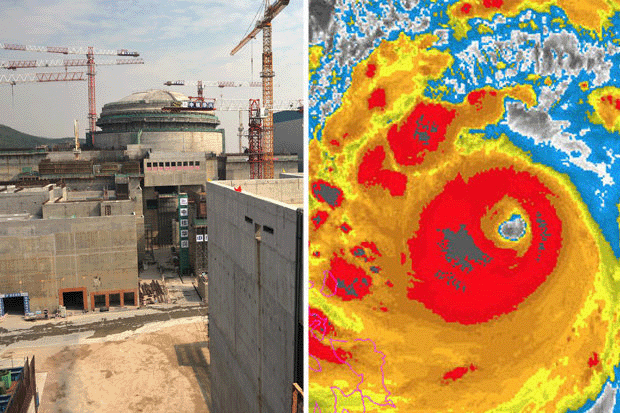
RED ALERT: Typhoon Mangkhut to SMASH into TWO nuclear plants as MILLIONS evacuate in panic https://www.express.co.uk/news/world/1018412/Typhoon-Mangkhut-Hong-Kong-China-nuclear-plants-red-alert-worst-storm
TYPHOON MANGKHUT – the most powerful storm of the year – is expected to directly hit two nuclear power plants later today with shocking 120mph winds, as officials issue a red alert warning.
By OLI SMITH Sep 16, 2018 Typhoon Mangkhut has battered Hong Kong and southern China today, prompting 2.45 million to evacuate.
The typhoon is the world’s most powerful storm of the year, with winds as high as 170 miles per hour – twice as powerful as Hurricane Florence which has struck the US east coast. At least 64 people have died in the wake of the typhoon in the Phillipines while so far two are reportedly dead in Hong Kong.
Officials have issued a red alert warning amid mounting fears over two nuclear power stations in the direct path of the typhoon.There are concerns the typhoon will damage the nuclear reactors and efforts are underway to avoid a repeat of the Japanese Fukushima catastrophe, when an earthquake and tsunami sent three nuclear reactors into meltdown.
The Taishan Nuclear Power Plant and Yangjiang Nuclear Power Station, both in Guangdong, mainland China, confirmed they were “combat ready” and in emergency lockdown as the superstorm nears.
Emergency safety investigations have been carried out at both plants for last-minute preparations behind the typhoon strikes this evening with 120mph winds.
A spokesman for the Taishan facility said: “All emergency personnel are at their posts and have conducted their preparatory work.The plant is fully prepared for the typhoon, and everything is in its place.”
Workers at the Yangjiang plant also secured the facility’s five generating units but fears remain for the sixth, which remains under construction.
Plant manager Chen Weizhong added that all doors and windows were tightly closed.
Mangkhut has already caused mass devastation in the Philippines, where around 40 gold miners are feared trapped following a landslide.The Hong Kong Observatory (HKO) raised the storm signal to T10 – the highest level possible, as the city shut down.
Footage from Hong Kong shows the scale of devastation, including a high-rise construction crane collapsing and windows in skyscrapers breaking under pressure.
One video shows a father and son swept off their feet and thrown into a wall due to the sheer power of the winds
After the typhoon passes over Hong Kong, the powerful storm is expected to wreak havoc across several Chinese megacities.
September 19, 2018
Posted by Christina Macpherson |
China, climate change, safety |
Leave a comment
 Le Monde 16th Sept 2018 [Machine Translation]
 Nuclear: In Flamanville, the welds of the discord.
The manufacturing difficulties of the French EPR have cruelly recalled the pitfalls that threaten the tricolor nuclear industry: an extremely ambitious initial vision and implementation difficulties with heavy consequences.
At the beginning of the year, problems with essential welds at the Flamanville reactor will lead EDF to re-evaluate the costs and delays of the project. While the group’s management hoped to start in early 2019, it will be necessary to wait until 2020 to see the EPR be connected to the network.
The welding business illustrates bitterly the difficulties of the French nuclear industry, faced with its loss of skills and know-how. EDF has defined this new quality standard for the construction of the EPR and has not been able to enforce it to its own subcontractors In February, EDF discovered problems on thirty-eight welds, on sixty-six of the secondary circuit. This water circuit is the one used to evacuate steam to the turbine. It consists of four loops, associated with four steam
generators.
As a first step, the group explains that these pipes comply with the regulations but that they should have corresponded to the “high quality” standard, which is more demanding than the regulations in force. Specifically, EDF had defined this new quality standard for the construction of the EPR and was unable to enforce it to its own subcontractors. “Why did we need to create this new standard?”
September 18, 2018
Posted by Christina Macpherson |
business and costs, France, safety |
Leave a comment
The Tip of the Radiation Disaster Iceberghttps://www.counterpunch.org/2018/08/31/the-tip-of-the-radiation-disaster-iceberg/ by JOHN LAFORGE The World Nuclear Association says its goal is “to increase global support for nuclear energy” and it repeatedly claims on its website: “There have only been three major accidents across 16,000 cumulative reactor-years of operation in 32 countries.” The WNA and other nuclear power supporters acknowledge Three Mile Island in 1979 (US), Chernobyl in 1986 (USSR), and Fukushima in 2011 (Japan) as “major” disasters. ¶ But claiming that these radiation gushers were the worst ignores the frightening series of large-scale disasters that have been caused by uranium mining, reactors, nuclear weapons, and radioactive waste. Some of the world’s other major accidental radiation releases indicate that the Big Three are just the tip of the iceberg.
CHALK RIVER (Ontario), Dec. 2, 1952: The first major commercial reactor disaster occurred at this Canadian reactor on the Ottawa River when it caused a loss-of-coolant, a hydrogen explosion and a meltdown, releasing 100,000 curies of radioactivity to the air. In comparison, the official government position is that Three Mile Island released about 15 curies, although radiation monitors failed or went off-scale.
ROCKY FLATS (Colorado), Sept. 11, 1957: This Cold War factory produced plutonium triggers for nuclear weapons 16 miles from Denver. It caused 30 to 44 pounds of breathable plutonium-239 and plutonium-240 to catch fire in what would come to be known as the second largest industrial fire in US history. Filters used to trap the plutonium were destroyed and it escaped through chimneys, contaminating parts of Denver. Nothing was done to warn or protect downwind residents.
WINDSCALE/SELLAFIELD (Britain), Oct. 7, 1957: The worst of many fires burned through one reactor igniting three tons of uranium and dispersed radionuclides over parts of England and northern Europe. The site was hastily renamed Sellafield. Another large radiation leak occurs in 1981and leukemia rates soared to triple the national average.
KYSHTYM/CHELYABINSK-65 (Russia), Sept. 29, 1957: A tank holding 70 to 80 metric tons of highly radioactive liquid waste exploded, contaminating an estimated 250,000 people, and permanently depopulating 30 towns which were leveled and removed from Russian maps. Covered up by Moscow (and the CIA) until 1989, Russia finally revealed that 20 million curies of long-lived isotopes like cesium were released, and the release was later declared a Level 6 disaster on the International Nuclear Event Scale. The long covered-up explosion contaminated up to 10,000 square miles making it the third- or 4th-most serious radiation accident ever recorded.
SANTA SUSANA (Simi Valley, Calif.), July 12, 1959: The meltdown of the Sodium Reactor Experiment just outside Los Angeles caused “the third largest release of iodine-131 in the history of nuclear power,” according to Arjun Makhajani, President of the Institute for Energy & Environmental Research. Released radioactive materials were never authoritatively measured because “the monitors went clear off the scale,” according to an employee. The accident was kept secret for 20 years.
CHURCH ROCK (New Mexico), July 16, 1979: Ninety-three million gallons of liquid uranium mine wastes and 1,000 tons of solid wastes spilled onto the Navajo Nation and into Little Puerco River, and nuclear officials called it “the worst incident of radiation contamination in the history of the United States.” The Little Puerco feeds the Little Colorado River, which drains to the Colorado River, which feeds Lake Mead—a source of drinking water for Los Angeles.
TOMSK-7 (Russia), April 7, 1993: In “the worst radiation disaster since Chernobyl,” Russian and foreign experts said a tank of radioactive waste exploded at the Tomsk nuclear weapons complex and that wind blew its plume of radiation toward the Yenisei River and 11 Siberian villages, none of which were evacuated.
MONJU (Japan), Dec. 8, 1995: This sodium-cooled “breeder reactor” caused a fire and a large leak of sodium coolant into the Pacific. Liquid sodium coolant catches fire on contact with air and explodes on contact with water. Costly efforts to engineer commercial models have failed. Japan’s Monju experiment was halted in 2018 after over 24 years of false starts, accidents and cover-ups.
TOKAI-MURA (Japan), Sept. 30, 1999: A uranium “criticality” which is an uncontrolled nuclear chain reaction caused a “neutron burst” that killed three workers and dispersed neutron radiation throughout the densely populated urban area surrounding the factory.
Not to be slighted, deliberate contamination has also been enormous: Five metric tons of plutonium was dispersed over the earth by nuclear bomb testing, and other nuclear weapons processes; Over 210 billion gallons of radioactive liquids were poured into the ground at the Hanford reactor complex in Washington State; and 16 billion gallons of liquid waste holding 70,000 curies of radioactivity were injected directly into Idaho’s Snake River Aquifer at the Idaho National Lab.
September 18, 2018
Posted by Christina Macpherson |
2 WORLD, incidents |
Leave a comment
Mediapart 14th Sept 2018 , Mediapart publishes a document that has never been made public: the list of all events increasing the risk of reactor core meltdown in French nuclear
power plants. Between 2003 and 2014, thirty-seven production units experienced more than ten. Cruas, Fessenheim, Gravelines and Tricastin are the most affected. It’s a list that has never been made public.
It was forwarded by the Nuclear Safety Authority (ASN) to German MP Sylvia Kotting-Uhl, who herself sent it to Mediapart. It brings together the so-called “precursor” events, that is to say that increase the risk of reactor core meltdown occurring in French nuclear power plants between 2003 and 2014.
https://www.mediapart.fr/journal/france/140918/nucleaire-nouvelles-questions-sur-la-surete-des-centrales
September 17, 2018
Posted by Christina Macpherson |
France, safety |
Leave a comment
 Global Chance 12th Sept 2018 [Machine translation]
 , Comment on the draft decision of the Nuclear Safety Authority authorizing the commissioning and use of the EPR reactor vessel of the Flamanville NPP (BNI No. 167) The Nuclear Safety Authority (ASN) has put into public consultation a draft decision authorizing the commissioning of the EPR reactor vessel under construction at Flamanville.
Ten years of technical faults and concealment by operators Areva and EDF led to the finding by the ASN, made public in April 2015 that the requirement of
technical qualification was not respected for the substance and EPR tank lid and that the operators had not made the choice of the best technique for the realization of these two parts, considered in “rupture exclusion and therefore subject to strict requirements. Such a judgment should have led to the rejection of these documents and the decision to replace them.
September 17, 2018
Posted by Christina Macpherson |
France, safety |
Leave a comment
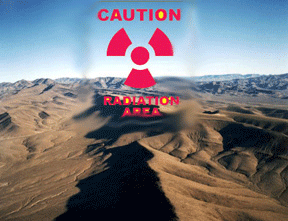 Yucca nuclear dump a threat to Nevada military bases, Rosen says By Ray Hagar, Nevada Newsmakers, Las Vegas Sun, Sept. 16, 2018
Nevada 3rd Congressional District Rep. Jacky Rosen looks at the controversy over a proposed nuclear waste repository at Yucca Mountain through the eyes of a member of the U.S. House Armed Services Committee. The transportation and storage of nuclear waste at the site — less than 100 miles from Las Vegas — would pose a threat to national security because of the U.S. military bases that surround the area, Rosen said Thursday on Nevada Newsmakers.
“We have Nellis Air Force Base, the premier pilot-training (facility) throughout the world. We have the Nevada Test and Training Range where we do all that training — 70 percent of the Air Force’s live munitions lives there,” Rosen said.
“We have Creech Air Force Base, where we have our unmanned aerial system,” she said. “We train those Topgun naval aviators in Fallon. We have a Hawthorne Army Depot, a Nevada Test Site and Area 51.”
“Yucca Mountain sits right in the center of all that,” Rosen said. “Nevada is critical to our national security, our homeland security and safety. And anything that could compromise that, moving nuclear waste through the Nevada Test and Training Range or any of those other routes, could put us at risk.”
Storage of nuclear waste near U.S. military installations is only one problem with Yucca, Rosen said. Another is moving it there through wide swaths of the United States.
“There are 75,000 metric tons of nuclear waste. At three loads a week via trains or trucks on our freeways, going through over 44 states and 300 counties, it will take 50 years to transport it,” Rosen said. “So don’t tell me that within that 50 years, there is not going to be some kind of accident.”………https://lasvegassun.com/news/2018/sep/16/yucca-nuclear-dump-a-threat-to-nevada-military-bas/
September 17, 2018
Posted by Christina Macpherson |
safety, USA, wastes |
Leave a comment
 Nuclear theft and sabotage threats remain high, report warns
Social unrest contributes to the US’s lack of improvement in the biennial ranking of how well countries protect against theft of weapons-usable materials. Physics Today, David Kramer, 14 Sept 18, Nations must drastically improve cybersecurity protection to guard against thefts of nuclear materials or acts of nuclear sabotage, according to an exhaustive global analysis released 5 September by the nonprofit Nuclear Threat Initiative (NTI). One-third of the 44 countries and Taiwan that possess weapons-usable nuclear materials or have reactors, reprocessing plants, and other nuclear facilities lack even the most basic cyberprotections, the NTI reports in its Nuclear Security Index. And although the US received a high grade for its cyberdefenses, it still needs to improve its overall level of protection.
The pace of cyberattacks on nuclear facilities has accelerated in recent years, according to the report. The authors cite multiple incidents that were publicly reported in 2016, including viruses discovered in computer systems at the Gundremmingen Nuclear Power Plant in Germany and the theft of tritium research from the University of Toyama’s Hydrogen Isotope Research Center in Japan. In addition, a former US Department of Energy and Nuclear Regulatory Commission employee pleaded guilty to charges stemming from an attempt via spear-phishing emails to fraudulently gain confidential information from dozens of DOE employee accounts.
Taiwan and 12 countries, including the US, received the highest grade from the NTI for their defenses against cyberthreats. But many other countries have not upgraded their cyberdefenses since 2016, the last time the NTI conducted its review. The report notes that nations with the largest number of sites are more likely to have cyber-nuclear regulations in place. The NTI recommends that those nations share their expertise and information on threats and vulnerabilities with less advanced countries. It also calls for countries to impose cybersecurity requirements at their nuclear facilities and to increase the number and quality of cyber-nuclear experts at sites.
Among the 22 nations that possess at least 1 kilogram of separated plutonium or highly enriched uranium, the US and Russia came in 12th and 17th, respectively, for their overall level of protections from thefts. The two nations hold the vast majority of weapons-usable materials. Factors considered in the report card besides cyberdefenses include quantities of materials and the number of sites where they are located, security and control measures, and adherence to international norms and agreements.
The US is down one place on the list from 2016 due to “heightened social unrest, resignations and vacancies from key government departments, and the increasingly deep polarization of political party politics.” Changes in regulatory policies require effective governance and bipartisan support, explains Hilary Steiner, a report coauthor from the consulting firm Economist Intelligence Unit. She cites large-scale demonstrations over the past two years, including the violent 2017 rally in Charlottesville, Virginia, as examples of social unrest that could adversely affect US nuclear regulatory policy……..
Besides the US and Russia, the declared nuclear weapons states ranked 11th (France), 12th (the UK, tied with the US), and 14th (China). Undeclared weapons states Israel, India, and Pakistan were near the bottom of the list, at 18th, 19th, and 20th, respectively. The states judged to be most vulnerable to nuclear theft were Iran and North Korea.
Of the 44 nations and Taiwan with nuclear facilities, Finland topped the rankings in protections from sabotage, followed by Australia, Canada, Japan, and the UK. The US tied for 11th place. https://physicstoday.scitation.org/do/10.1063/PT.6.2.20180914a/full/
September 14, 2018
Posted by Christina Macpherson |
2 WORLD, safety |
Leave a comment
 U.S. needs a safer way to store nuclear waste, As Hurricane Florence bears down on the Carolinas, the country is confronting a reality it normally
  ignores. Newsday, The Editorial Board, September 13, 2018
As Hurricane Florence bears down on the Carolinas, the United States is confronting a reality it normally ignores. This nation has no permanent, safe disposal site for the 90,000 metric tons of nuclear waste it has created in power and weapons plants. This waste is largely stored where it was generated, often in vulnerable above-ground tanks — at 80 sites in 35 states, including New York.
Nine of those sites, from northern Georgia to North Carolina, are in the potential path of Florence. Several were built with the same technology as the Fukushima power plant in Japan, whose reactors and waste storage were tragically compromised by a tsunami in 2011……..
September 14, 2018
Posted by Christina Macpherson |
safety, USA, wastes |
Leave a comment