The U.S. Energy Department says the fall happened Wednesday evening. Workers heard a loud thud while doing inspections underground so they left the area and all work was stopped.
UK nuclear regulator completes 2nd stage of assessing Chinese nuclear reactor for Bradwell, in Essex
 Reuters 15th Nov 2018 , The first Chinese-designed atomic reactor for use in Britain moved a step
closer to fruition on Thursday as the UK nuclear regulator said it had
completed the second stage of its assessment of the technology. General
Nuclear Services, an industrial partnership between China General Nuclear
Power Corp (CGN) IPO-CGNP.HK and French utility EDF, hopes to use the
design at a nuclear plant planned to be built at Bradwell in Essex, eastern
England.
https://uk.reuters.com/article/nuclearpower-britain-china/update-2-china-designed-uk-nuclear-reactor-plan-clears-second-assessment-stage-idUKL8N1XQ4A1
UK: Reactor 3 at Hunterston B remains offline, due to cracks in the graphite core
ONR 13th Nov 2018 , Reactor 3 at Hunterston B remains offline, after being shut down since a
routine inspection into cracks in its graphite core, in March. Cracking of
the graphite bricks in Advanced Gas-cooled Reactors such as Hunterston B is
expected as the reactors age.
routine inspection into cracks in its graphite core, in March. Cracking of
the graphite bricks in Advanced Gas-cooled Reactors such as Hunterston B is
expected as the reactors age.
However, the number of cracks found during
the inspection of Reactor 3 has led to the licensee, EDF Nuclear Generation
Limited, carrying out further inspections of the core. Reactor 4 at
Hunterston B was taken offline in October for an inspection of its graphite
core.
the inspection of Reactor 3 has led to the licensee, EDF Nuclear Generation
Limited, carrying out further inspections of the core. Reactor 4 at
Hunterston B was taken offline in October for an inspection of its graphite
core.
EDF Energy has submitted a safety case for Reactor 4 and is preparing
one for Reactor 3. The safety cases will be assessed by us to determine
whether the reactors are safe to return to service. Neither reactor may
restart without our consent, which will be given only if it is safe to do
so. http://news.onr.org.uk/2018/11/hunterston-b-outages/
one for Reactor 3. The safety cases will be assessed by us to determine
whether the reactors are safe to return to service. Neither reactor may
restart without our consent, which will be given only if it is safe to do
so. http://news.onr.org.uk/2018/11/hunterston-b-outages/
Rock Fall in underground nuclear waste facility in southern New Mexico
Managers Report Rock Fall at Underground Nuclear Waste Dump https://www.usnews.com/news/best-states/new-mexico/articles/2018-11-15/managers-report-rock-fall-at-underground-nuclear-waste-dump
Managers at the federal government’s nuclear waste repository in southern New Mexico have reported a rock fall in an area of the underground facility that is off-limits to employees. CARLSBAD, N.M. (AP) — Managers at the federal government’s nuclear waste repository in southern New Mexico have reported a rock fall in an area of the underground facility that is off-limits to employees.
Court order. USA Veterans Affairs must reveal numbers of troops exposed to radiation after 1966 Spanish nuclear disaster
Court forces VA to reveal extent of veterans’ contamination in Spanish nuclear disaster https://www.militarytimes.com/news/pentagon-congress/2018/11/14/court-forces-va-to-reveal-extent-of-veterans-contamination-in-spanish-nuclear-
Woolsey Fire Burns Nuclear Meltdown Site that State Toxics Agency Failed to Clean Up
 THE SANTA SUSANA FIELD LABORATORY (ROCKETDYNE) BURNED IN THE WOOLSEY FIRE, THREATENING TOXIC EXPOSURES FROM CONTAMINATED DUST, SMOKE, ASH AND SOIL. https://www.psr-la.org/woolsey-fire-burns-nuclear-meltdown-site-that-state-toxics-agency-failed-to-clean-up/

THE DEPARTMENT OF TOXIC SUBSTANCES CONTROL DENIES RISK THAT IT CREATED BY DELAYING THE LONG PROMISED CLEANUP. November 9, 2018, Denise Duffield, 310-339-9676 or dduffield@psr-la.org, Melissa Bumstead 818-298-3182 or melissabumstead@sbcglobal.net, Nov 9, 2018Last night, the Woolsey fire burned the contaminated Santa Susana Field Laboratory (SSFL), a former nuclear and rocket engine testing site. Footage from local television showed flames surrounding rocket test stands, and the fire’s progress through to Oak Park indicates that much of the toxic site burned.
A statement released by the California Dept. of Toxic Substances Control (DTSC) said that its staff, “do not believe the fire has caused any releases of hazardous materials that would pose a risk to people exposed to the smoke.” The statement failed to assuage community concerns given DTSC’s longtime pattern of misinformation about SSFL’s contamination and its repeated broken promises to clean it up.
“We can’t trust anything that DTSC says,” said West Hills resident Melissa Bumstead, whose young daughter has twice survived leukemia that she blames on SSFL and who has mapped 50 other cases of rare pediatric cancers near the site. Bumstead organized a group called “Parents vs. SSFL” and launched a Change.org petition demanding full cleanup of SSFL that has been signed by over 410,000 people. “DTSC repeatedly minimizes risk from SSFL and has broken every promise it ever made about the SSFL cleanup. Communities throughout the state have also been failed by DTSC. The public has no confidence in this troubled agency,” said Bumstead.
Nuclear reactor accidents, including a famous partial meltdown, tens of thousands of rocket engine tests, and sloppy environmental practices have left SSFL polluted with widespread radioactive and chemical contamination. Government-funded studies indicate increased cancers for offsite populations associated with proximity to the site, and that contamination migrates offsite over EPA levels of concern. In 2010, DTSC signed agreements with the Department of Energy and NASA that committed them to clean up all detectable contamination in their operational areas by 2017. DTSC also in 2010 committed to require Boeing, which owns most of the site, to cleanup to comparable standards. But the cleanup has not yet begun, and DTSC is currently considering proposals that will leave much, if not all, of SSFL’s contamination on site permanently.
Dr. Robert Dodge, President of Physicians for Social Responsibility-Los Angeles, shares the community’s concerns. “We know what substances are on the site and how hazardous they are. We’re talking about incredibly dangerous radionuclides and toxic chemicals such a trichloroethylene, perchlorate, dioxins and heavy metals. These toxic materials are in SSFL’s soil and vegetation, and when it burns and becomes airborne in smoke and ash, there is real possibility of heightened exposure for area residents.”
Dodge said protective measures recommended during any fire, such as staying indoors and wearing protective face masks, are even more important given the risks associated with SSFL’s contamination. Community members are organizing a campaign on social media to demand that DTSC release a public statement revealing the potential risks of exposure to SSFL contamination related to the fire.
But for residents such as Bumstead, worries will remain until SSFL is fully cleaned up. “When I look at that fire, all I see is other parents’ future heartache,” said Bumstead, “And what I feel is anger that if the DTSC had kept its word, we wouldn’t have these concerns, because the site would be cleaned up by now.”
Physicians for Social Responsibility-Los Angeles (PSR-LA) is the largest chapter of the national organization Physicians for Social Responsibility and has worked for the full cleanup of SSFL for over 30 years.. PSR-LA advocates for policies and practices that protect public health from nuclear and environmental threats and eliminate health disparities.
Parents vs. SSFL is a grassroots group of concerned parents and residents who demand compliance with cleanup agreements signed in 2010 that require a full cleanup of all radioactive and chemical contamination at the Santa Susana Field Laboratory.
Nuclear meltdown at Santa Susana Lab and the government cover-up
L.A.’s Secret Meltdown; Simi Valley, CA(1959)Largest Nuclear Incident in U.S. history.
LA’s Nuclear Secret: Part 1 link https://www.nbclosangeles.com/investigations/LA-Nuclear-Secret-327896591.html– Sep 22, 2015 Tucked away in the hills above the San Fernando and Simi valleys was a 2,800-acre laboratory with a mission that was a mystery to the thousands of people who lived in its shadow, By Joel Grover and Matthew Glasser The U.S. government secretly allowed radiation from a damaged reactor to be released into air over the San Fernando and Simi valleys in the wake of a major nuclear meltdown in Southern California more than 50 years ago — fallout that nearby residents contend continues to cause serious health consequences and, in some cases, death. LA’s Nuclear Secret: Timelines, Documents, FAQ
Those are the findings of a yearlong NBC4 I-Team investigation into “Area Four,” which is part of the once-secret Santa Susana Field Lab. Founded in 1947 to test experimental nuclear reactors and rocket systems, the research facility was built in the hills above the two valleys. In 1959, Area Four was the site of one of the worst nuclear accidents in U.S. history. But the federal government still hasn’t told the public that radiation was released into the atmosphere as a result of the partial nuclear meltdown.
Now, whistleblowers interviewed on camera by NBC4 have recounted how during and after that accident they were ordered to release dangerous radioactive gases into the air above Los Angeles and Ventura counties, often under cover of night, and how their bosses swore them to secrecy.
In addition, the I-Team reviewed over 15,000 pages of studies and government documents, and interviewed other insiders, uncovering that for years starting in 1959, workers at Area Four were routinely instructed to release radioactive materials into the air above neighboring communities, through the exhaust stacks of nuclear reactors, open doors, and by burning radioactive waste.
How It Began
On July 13, 1959, the day of the meltdown, John Pace was working as a reactor operator for Atomics International at Area Four’s largest reactor, under the watch of the U.S. government’s Atomic Energy Commission.
“Nobody knows the truth of what actually happened,” Pace told the I-Team.
In fact, Pace said, the meltdown was verging on a major radioactive explosion.
“The radiation in that building got so high, it went clear off the scale,” he said.
To prevent a potentially devastating explosion, one that in hindsight the 76-year-old Pace believes would have been “just like Chernobyl,” he and other workers were instructed to open the exhaust stacks and release massive amounts of radiation into the sky.
“This was very dangerous radioactive material,” he said. “It went straight out into the atmosphere and went straight to Simi Valley, to Chatsworth, to Canoga Park.”
Pace and his co-workers frantically tried to repair the damaged reactor. Instead, he said they realized, their efforts were only generating more radioactive gas. So for weeks, often in the dark of night, Pace and other workers were ordered to open the large door in the reactor building and vent the radiation into the air.
“It was getting out towards the public,” he said. “The public would be bombarded by it.”
Pace said he and his co-workers knew they were venting dangerous radiation over populated areas, but they were following orders.
“They felt terrible that it had to be done,” he said. “They had to let it out over their own families.”
Area Four workers “were sworn to secrecy that they would not tell anyone what they had done,” Pace explained.
He remembered his boss getting right in his face and saying, “You will not say a word. Not one word.”
That was more than five decades ago, but radioactive contamination didn’t just vanish. It remains in the soil and water of Area Four and in some areas off-site, according to state and federal records obtained by the I-Team. And, evidence suggests that the fallout could be linked to illnesses, including cancer, among residents living nearby.
Arline Mathews lived with her family in Chatsworth, downwind of Area Four during some of the radiation releases. Her middle son, Bobby, was a champion runner on the Chatsworth High School track team for three years, running to the Santa Susana Field Lab and back to school every day. Bobby died of glioblastoma, a rare brain cancer often linked to radiation exposure. Mathews said there is no known family history of cancer and she blames the radiation from Area Four for her son’s illness.
“He was exposed to the chemical hazardous waste and radioactivity up there,” Mathews said. “There’s no getting over the loss of son.”
The Government Cover-up
Six weeks after the meltdown, the Atomic Energy Commission issued a press release saying that there had been a minor “fuel element failure” at Area Four’s largest reactor in July. But they said there had been “no release of radioactive materials” to the environment.
“What they had written in that report is not even close to what actually happened,” Pace said. “To see our government talk that way and lie about those things that happened, it was very disappointing.”
In 1979, NBC4 first broke the story that there was a partial meltdown at Area Four’s largest reactor, called the Sodium Reactor Experiment. But at the time, the U.S. government was still saying no radiation was released into the air over LA.
But during its current yearlong investigation, the I-Team found a NASA report that confirmed “the 1959 meltdown… led to a release of radioactive contaminants.”
For years, NASA used part of the site for rocket testing and research.
More Radioactive Releases
After filing a Freedom of Information request, the I-Team obtained more than 200 pages of government interviews with former Santa Susana workers. One of those workers, Dan Parks, was a health physicist at Area Four in the 1960s.
In the early 60s, Parks said, he often witnessed workers releasing radiation into the sky through the exhaust stacks of at least three of Area Four’s ten nuclear reactors.
“They would vent it to the atmosphere,” he said. “The release was done with the flick of a switch.”
Radioactive Waste Up in Smoke
Parks said he often witnessed workers releasing radioactive smoke into the air when they disposed of barrels of radioactive waste from Area Four’s 10 nuclear reactors.
“We were all workers,” he said. “Just taking orders.”
Workers would often take those barrels of waste to a pond called “the burn pits” and proceed to shoot the barrels with a high-powered rifle causing an explosion. The radioactive smoke would drift into the air over nearby suburbs and toward a summer camp for children.
“It was a volatile explosion, beyond belief,” Parks said.
Whatever direction the wind was blowing, the radioactive smoke would travel that way.
“If the wind was blowing to the Valley, it would blow it in the Valley,” he said.
Ralph Powell, who worked as a security officer at Area Four in the mid-60s, recalled being blanketed by that radioactive smoke.
“I saw clouds of smoke that was engulfing my friends, that are dying now,” Powell said.
Powell believes it wasn’t just his friends who suffered the consequences. He fears he may have exposed his own family to radiation, tracking it home on his clothes and car.
While Powell was working at Area Four, his son Michael was diagnosed with leukemia — a cancer linked to radiation exposure — and died at age 11.
“I suspect it caused the death of my son,” he said. “I’ve never gotten that out of my mind.”
Toxic Chemical Contamination
In addition to the radiation, dozens of toxic chemicals, including TCE and Perchlorate, were also released into the air and dumped on the soil and into ground and surface water from thousands of rocket tests conducted at the Santa Susana Field lab from the 1950s to 80s. The tests were conducted by NASA, and by Rocketdyne, a government aerospace contractor.
According to a federally funded study obtained by the I-Team, “emissions associated with rocket engine testing” could have been inhaled by residents of “West Hills, Bell Canyon, Dayton Canyon, Simi Valley, Canoga Park, Chatsworth, Woodland Hills, and Hidden Hills.”
Contamination Moves into Neighborhoods
Radiation released at Area Four continues to contaminate the soil and water of the Santa Susana Field Lab.
In 2012, the U.S. Environmental Protection Agency completed a $40 million soil test of the site and found 423 hot spots — places contaminated with high levels of man-made radiation.
Other studies and government documents obtained by the I-Team show that radiation has moved off-site, and has been found in the ground and water in suburbs to the south, northeast and northwest of the Field Lab.
“Radiation doesn’t know any boundaries,” said Dr. Robert Dodge, a national board member of the Nobel Prize-winning nonprofit Physicians For Social Responsibility, which studies the health effects of radiation.
Dodge, who has reviewed numerous government and academic studies about the contamination at Santa Susana, said he believes the contamination has spread far beyond the facility’s borders.
“If the wind is blowing and carrying radiation from Santa Susana, it doesn’t stop because there’s a fence,” he said.
One of the places radiation has been found, in a 1995 study overseen by the U.S. EPA, was the Brandeis-Bardin Institute in Simi Valley. The Institute is a nationally-known center of Jewish learning, and the home to Camp Alonim, a beloved summer sleepaway camp that has hosted some 30,000 children.
In December 1995, The Brandeis-Bardin Institute filed a federal lawsuit against the present and past owners of the Santa Susana Field Lab, alleging that toxic chemicals and radiation from the field lab “have subsequently seeped into and come to be located in the soil and groundwater” of Brandeis “is injurious to the environment” and “will cause great and irreparable injury.”
Brandeis settled the lawsuit in a confidential agreement in 1997.
A spokesman for the Brandeis-Bardin Institute, Rabbi Jay Strear, told NBC4 that the groundwater and soil is “tested routinely,” and the results have shown the “the site is safe.”
The I-Team asked Brandeis-Bardin to provide NBC4 with those test results showing the site is safe and free of hazardous substances. The Institute refused, and in an email said “we are not in a position to devote the required staff time to respond to your more detailed inquiries, nor do we see the necessity for doing so.”
A government scientist who has studied the contamination at Santa Susana told the I-Team he thinks there’s a continued threat of radiation and toxic chemicals flowing from the field lab to places like Brandeis-Bardin, via groundwater and airborne dust.
Clusters of Cancer
Researchers inside and out of government have contended that the radiation and toxic chemicals from Santa Susana might have caused many cancer cases.
“The radiation that was released in 1959 and thereafter from Santa Susana is still a danger today,” Dr.Dodge said. “There is absolutely a link between radiation and cancer.”
The I-Team tracked down dozens of people diagnosed with cancer and other illnesses who grew up in the shadow of Santa Susana — in Canoga Park, West Hills, Chatsworth, Thousand Oaks, Simi Valley. Many of them believe their cancers were caused by radiation and chemicals from the field lab.
Kathryn Seltzer Carlson, 56, and her sisters, Judy and Jennifer, all grew up in Canoga Park around the time of the nuclear meltdown and for years after, and all have battled cancer.
“I played in the water, I swam in the water, I drank the water” that ran off the Santa Susana Field Lab, said Carlson, who finished treatment for ovarian cancer earlier this year and is now undergoing chemotherapy for lymphoma. “I’ve had, I don’t know how many cancers.”
Bonnie Klea, a former Santa Susana employee who has lived in West Hills since the 60s, also battled bladder cancer, which is frequently linked to radiation exposure.
“Every single house on my street had cancer,” Klea said.
A 2007 Centers for Disease Control study found that people living within two miles of the Santa Susana site had a 60 percent higher rate of some cancers.
“There’s some provocative evidence,” said Dr. Hal Morgenstern, an epidemiologist who oversaw the study. “It’s like circumstantial evidence, suggesting there’s a link” between the contamination from Santa Susana and the higher cancer rates.
Silence From the Government
For more than two months, the I-Team asked to speak with someone from the U.S. Department of Energy (DOE), the federal agency that’s responsible for all nuclear testing, to ask why workers were ordered to release dangerous radiation over Los Angeles, why the DOE has never publicly admitted this happened, and what it plans to do to help get the site cleaned up.
The DOE emailed the I-Team, “We will not have anyone available for this segment.”
So the I-Team showed up at a public meeting this month about Santa Susana and asked the DOE’s project manager for the site, Jon Jones, to speak with us. He walked away and wouldn’t speak.
Will the Contamination Ever Be Cleaned Up?
Community residents, many stricken with cancer and other radiation-related illnesses, have been fighting for years to get the government and the private owners of the Santa Susana Field Lab to clean up the contamination that remains on the site.
But efforts in the state legislature and state agencies that oversee toxic sites have, so far, stalled.
But residents, with the support of some lawmakers, continue to fight for a full cleanup.
“People are continuing to breathe that (radiation) in and to die,” Chatsworth resident Arline Mathews said.
“See that this is done immediately, before more lives are lost.”
In 1966 USA lost a hydrogen nuclear bomb over Spain – environmental and health repercussions continue
When America lost a nuclear bomb, Fosters.com, By D. Allan Kerr news@seacoastonline.com 11 Nov 18, In January 1966, an American B-52 bomber collided mid-air with a refueling tanker off the coast of Spain. The resulting fiery crash claimed the lives of seven crew members.
While the loss of life was devastating, there was potential for even greater catastrophe – the B-52 was carrying four fully-loaded hydrogen bombs.
Three of the bombs were located within 24 hours, in the vicinity of a Spanish fishing village called Palomares. The fourth was nowhere to be found.
With the Cold War mired in a deep chill, the United States dispatched an entire Navy armada to try to locate the missing bomb, which was believed to have gone into the Atlantic Ocean. Among those involved in the search was a 23-year-old Navy officer named Donald Craig.
Craig was an ensign at the time, having graduated the previous year from Officer Candidate School at Newport, Rhode Island. He was serving aboard his first vessel, the minesweeper USS Sagacity (MSO 469).
As it happened, Sagacity was near Barcelona, Spain, on a Mediterranean cruise when the tragedy occurred. The minesweeper was dispatched to the scene and over the next several weeks took part in the massive search for the missing nuke.
Craig is now 76 years old, retired, and a longtime resident of Kittery Point, Maine. He still recalls the hunt for the missing nuclear bomb, and the race to get to it before the Soviet Union.
He also remains frustrated on behalf of fellow veterans who say they are dealing with adverse health effects from radiation exposure during the incident – with no assistance from the government that sent them there.
“We knew nothing,” Craig said recently of the possible aftereffects. “We were just out there doing our job.”
A disaster begins
It should have been a routine operation…………
At one point the Navy lost the bomb again in the process of bringing it to the surface, and it sank even deeper into the ravine. Eventually, the bomb and an unmanned vehicle, which had become entangled in its parachute lines, were hauled onto the deck of the submarine rescue ship USS Petrel nearly three months after the initial tragedy.
But then the United States government had to deal with a whole separate controversy – the environmental repercussions of an unleashed hydrogen bomb.
Plutonium blowing in the wind
Members of the U.S. Air Force and residents of Palomares were all exposed to radioactivity from the two bombs that had broken apart on land. Craig recalls winds of about 30 knots at the time.
“Plutonium was blowing in the wind, it was all over the place there,” he said. “They (Air Force personnel) were sitting on the edge of the crater eating their lunches.”
An area of about one square mile was contaminated, including the village’s tomato crop. American servicemen removed this soil and brought it back to South Carolina for disposal.
But in a rather bizarre attempt to show there was no danger, the U.S. government fed the contaminated tomatoes to our troops for “breakfast, lunch and dinner,” according to a June 2016 New York Times article. The U.S. ambassador to Spain and the Spanish minister of tourism swam at a nearby beach in front of a crowd of reporters to prove the waters were safe.
“If this is radioactivity, I love it!” Ambassador Angier Biddle Duke told the media.
Somehow, no civilians on the ground were seriously harmed by falling debris from the aircraft collision. America pledged to the Spanish government the site would be cleared of contamination.
“The main objective here is to leave Spain as we found it,” Duke told LIFE magazine back in 1966.
But as recently as 2015, then-Secretary of State John Kerry and Spain’s foreign minister agreed to negotiate a binding agreement to resume cleanup efforts and further removal of contaminated soil from the site. While no substantive findings have verified serious health issues among the villagers, studies of wildlife such as snails have turned up high radioactive levels.
Craig, however, is particularly outraged by the treatment of Air Force veterans who took part in cleanup efforts at Palomares and now say they are suffering ill health effects as a result. The 2016 Times article featured several former servicemen now suffering from cancer and other ailments.
The Air Force has long insisted there were no serious adverse effects from the incident, so these conditions are not covered under Veterans Administration benefits. An estimated 1,600 veterans took part in the cleanup.
“That shouldn’t happen. They should absolutely be taken care of,” Craig said. ”(The government) did not look after their safety, and there are a lot of people suffering for it now.”
Last year, a number of veterans filed a lawsuit in Connecticut over disability benefits they were denied because the Pentagon refused to release records and reports related to the incident………….
D. Allan Kerr is the author of “Silent Strength,” a book about the 1963 loss of the nuclear Navy submarine USS Thresher. http://www.fosters.com/news/20181111/when-america-lost-nuclear-bomb
High fire warning continues including area of Santa Susana (Rocketdyne) nuclear irradiated area
 Red Flag Warning Extended Through Tuesday As Fires Roar In LA, Ventura Counties https://losangeles.cbslocal.com/2018/11/09/red-flag-warning-woolsey-fire/
November 9, 2018 LOS ANGELES (CBSLA) — A red flag warning denoting a high risk of wildfire has been extended until Tuesday, as two fires continued to roar across Los Angeles and Ventura counties today.Gusty, strong off-shore winds fueled the flames of the Woolsey and Hill fires, burning from West Hills to Camarillo and south to PCH late into the evening.
The Hill Fire erupted at 2:04 p.m. Thursday in the area of Hill Canyon in Santa Rosa Valley; less than a half-hour later, the Woolsey Fire ignited in the area of Rocketdyne, south of the City of Simi Valley. The flames were kicked up by heavy wind gusts, reaching speeds up to 60 mph.
Friday, winds were back in the teens and single-digits across the area, helping firefighters as they tried to get a better handle on the flames.
The National Weather Service said Friday dry conditions and gusty winds would continue through Saturday evening before Santa Ana winds redevelop, however, bringing continued Red Flag conditions to both counties Sunday through Tuesday, with wind gusts expected between 40-55 mph.
Officials warn residents to use caution with ignition sources.
Woolsey And Hill Fires: Evacuations, Road Closures And School Closures November 9, 2018 https://losangeles.cbslocal.com/2018/11/09/woosley-and-hill-fires-evacuations-road-closures-school-closures-and-evacuation-centers/
California’s wildfire threatens site of closed California’s closed Santa Susana nuclear site
California’s Woolsey Fire Now Threatening Malibu Went Through The Site Of A Nuclear Accident First, Forbes, Eric Mack 9 Nov 18 out of control and heading into populated areas of Malibu. All residents must evacuate immediately. ”
A mandatory evacuation is now in effect for the entire city of Malibu in southern California as a fast-moving fire dubbed the Woolsey Fire burns through the suburban hills and canyons between Simi Valley and the Pacific coast.
“MANDATORY evacuation now in effect for all of City of Malibu, and all areas south of 101 Fwy from Ventura County line to Las Virgenes / Malibu Cyn, southward to the ocean due to Woolsey Fire. Use PCH to evacuate, avoid canyons,” reads a 10 a.m. PT update from the city.
UPDATE: According to the latest alert from the city of Malibu at 12:27 p.m. PT, the Woolsey Fire “is now burning out of control and heading into populated areas of Malibu. All residents must evacuate immediately. “
A mandatory evacuation is now in effect for the entire city of Malibu in southern California as a fast-moving fire dubbed the Woolsey Fire burns through the suburban hills and canyons between Simi Valley and the Pacific coast.
“MANDATORY evacuation now in effect for all of City of Malibu, and all areas south of 101 Fwy from Ventura County line to Las Virgenes / Malibu Cyn, southward to the ocean due to Woolsey Fire. Use PCH to evacuate, avoid canyons,” reads a 10 a.m. PT update from the city. ……….
The blaze began with a brush fire ignited near the closed Santa Susana Field Laboratory (also referred to as the Rocketdyne facility) south of Simi Valley Thursday afternoon and has since grown to over 10,000 acres and claimed an undetermined number of structures.
The Rocketdyne facility was the site of a partial nuclear meltdown nearly sixty years ago and the subject of controversial and stalled cleanup efforts for decades…….. https://www.forbes.com/sites/ericmack/2018/11/09/californias-woolsey-fire-burned-through-the-site-of-a-nuclear-accident-on-its-way-toward-malibu/#4983a84b2142
The digital danger to nuclear weapons
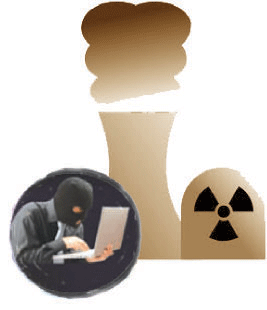 The argument from cyberspace for eliminating nuclear weapons NOVEMBER 9, 2018 At the height of the Cold War in 1982, American psychiatrist Robert Jay Lifton argued that the “central existential fact of the nuclear age is vulnerability.” That warning predated the proliferation of computers into almost every aspect of modern life, including nuclear weapons.
Today, the destructiveness of nuclear weapons has been coupled with the vulnerability of computers to create new pathways to disaster.
Specifically, there is now the possibility that hackers could compromise the computers that control nuclear weapons or provide information to officials about impending nuclear attacks.
Weapons security critically flawed
An October 2018 report reinforced this sense of vulnerability. In it, the United States Government Accountability Office (GAO) described a number of problems commonly found in the modern weapons systems developed by the U.S. Department of Defense (DOD). Although the report itself doesn’t say so, officials confirmed that nuclear weapons programs were included in the study.
PIC
The findings of the GAO report echoed earlier warnings of the cyberthreat to nuclear weapons. These included a 2013 DOD report and one by the Nuclear Threat Initiative, a non-governmental nuclear weapon threat reduction organization based in Washington, D.C.
Our research examines the risks associated with nuclear weapons systems, including those of accidental or inadvertent nuclear war. The most pressing concern from the GAO report is the possibility that some of these vulnerabilities might affect “nuclear command and control,” the term used to describe the computer networks that continuously monitor and direct the vast U.S. nuclear arsenal (or Russia).
The recent GAO report broadly criticized all DOD weapons systems. Over the past five years (2012 to 2017), the GAO reported, “DOD testers routinely found mission-critical cyber-vulnerabilities in nearly all weapon systems that were under development. Using relatively simple tools and techniques, testers were able to take control of these systems and largely operate undetected.”
In other words, just about every weapon system being developed by the U.S. military is vulnerable to cyberattack. What stands out are both the scale of the problem and that these problems exist in systems that should be highly protected.
The computerized military
Computers play an outsized role in the U.S. military — from providing information through various sensors to forming the backbone of communications networks. Faster communications and increased access to information are both valuable assets and these goals can be achieved with computers. Computers have become ubiquitous in the military environment as countries demand quick access to information and communications.
But computers also introduce vulnerabilities. As their role grows to include connecting the weapons systems of most advanced countries, so does our vulnerability. The vulnerability of these weapons systems should be seen as an anticipated and, arguably unavoidable, consequence of the computer-filled world we live in.
The GAO report went farther than just identifying vulnerabilities — it identified a culture within the DOD that fails to recognize and adequately address cybersecurity problems. Officials routinely assumed their systems were safe and ignored warnings until very recently.
We have observed a similar overconfidence in the military officials responsible for nuclear command and control.
This is a problem because the command-and-control system relies on complex networks of interconnected computers. These computers connect early warning satellites and radars to the president and will be used to pass on presidential orders to launch nuclear weapons should that fateful decision ever be made.
Computers must also constantly monitor and coordinate the daily operation of U.S. nuclear arsenal. Timelines for decisions in this system are extremely compressed, allowing less than 10 minutes for critical launch decisions to be made. The combination of interactive complexity and the tight timeline is typical of many other technological systems that are susceptible to unpredictable, large-scale accidents……. weapons https://stuff.co.za/the-argument-from-cyberspace-for-eliminating-nuclear-weapons/
Radioactive groundwater found at Westingouse SC nuclear fuel factory
 ‘You guys have gotten me afraid.’ Radioactive groundwater found at SC fuel factory, The News and Observer, BY SAMMY FRETWELL, sfretwell@thestate.com November 09, 2018 , COLUMBIA, SC
Groundwater at Westinghouse’s nuclear fuel factory on Bluff Road is contaminated with unsafe levels of radioactive material from years-old leaks that state and federal regulators only learned about in the past year.
Recent tests found levels of radioactive uranium that exceed safe drinking-water standards at two test wells adjacent to the nuclear fuel-rod plant southeast of Columbia, the U.S. Nuclear Regulatory Commission said during a community meeting.
Thursday night’s meeting was held as part of Westinghouse’s application for a new 40-year license from the Nuclear Regulatory Commission to operate the Bluff Road plant.
………. Thursday night’s revelation of high uranium levels in two test wells follows news this year about other leaks and spills at the Westinghouse plant, a major employer in the Columbia area since opening in 1969.
The NRC did not learn about the 2011 leak until last year and, only recently, found out about the 2008 leak from the fuel rod plant. Westinghouse did not tell the agency at the time the leaks occurred because that was not required, the company and federal officials have said. The leaks occurred in the same area of the factory, three years apart.
The 2008 and 20111 leaks are not the only concern.
In July, Westinghouse told state and federal regulators it had discovered that a uranium solution leaked through a hole in the floor in another part of the plant this summer and contaminated the ground.
Unlike the 2008 and 2011 leaks, regulators say they haven’t found that the uranium that leaked this summer got through the ground and into the water table below. The company is cleaning up that leak by excavating nine feet of tainted soil, Westinghouse spokeswoman Courtney Boone said.
Residents living near the plant expressed concerns Thursday about the safety of the facility. About 70 residents attended Thursday’s meeting at a Garners Ferry Road conference center.
Residents are concerned groundwater pollution could affect the private wells from which they draw drinking water. They also worry about the possibility of a nuclear accident.
……….. Critics of the plant say Westinghouse should not get a 40-year operating license because of problems at the site. …. https://www.newsobserver.com/news/state/south-carolina/article221376635.html
Computer errors that almost started nuclear wars
 The argument from cyberspace for eliminating nuclear weapons NOVEMBER 9, 2018 “…….Computer errors that almost started nuclear wars
Unclassified reports reveal that problems within the computers of nuclear command and control date back to at least the 1970s, when a deficient computer chip signalled that 200 Soviet missiles were headed towards the U.S. Computer problems have persisted: In 2010, a loose circuit card caused a U.S. launch control centre to lose contact with 50 nuclear missiles. In both cases, the accident might have been mistaken for a deliberate attack. Failing to recognize the mistake could have resulted in the U.S. launching nuclear weapons.
These cases were presumably the result of unintentional errors, not deliberate actions. But hacking and other forms of targeted cyberattacks greatly increase the risk of accidental nuclear launch or other devastating actions. Overconfidence on the part of the officials overseeing the nuclear arsenal is therefore negligent and dangerous.
A more recent compounding factor is the ongoing, roughly trillion-dollar upgrade of the U.S. nuclear arsenal started by the Obama administration. This so-called modernization effort included upgrades to the nuclear command and control system. The Trump administration continues to make this a priority.
Modernization increases the possibility that changes to the nuclear command and control system will introduce new or reveal hitherto unknown vulnerabilities into the system. The evidence from the GAO report and other publicly available documents indicates that the officials in charge will be emphasizing speed, convenience, or cost over cybersecurity.
In its conclusion, the GAO report explained that the DOD “has taken several major steps to improve weapon systems cybersecurity.” But the DOD “faces barriers that may limit its ability to achieve desired improvements,” such as constraints on information sharing and workforce shortages. That is not reassuring.
There is a more basic problem that we have emphasized above: the risks associated with cyberattacks can be ameliorated but not fully eliminated. When this intrinsic risk is integrated with the sheer destructiveness of nuclear weapons, the only way to avoid a catastrophic accident at some point in time is to embrace efforts to abolish the weapons themselves.
- — Postdoctoral research fellow, University of British Columbia
- — Simons Chair in Disarmament, Global and Human Security at the Liu Institute for Global Issues, University of British Columbia
- This article first appeared on The Conversation– https://stuff.co.za/the-argument-from-cyberspace-for-eliminating-nuclear-weapons/
? Canada’s nuclear regulator wants Small Nuclear Reactors exempted from full Environmental Assessment

Federal nuclear regulator urges government to exempt smaller nuclear
reactors from full Environmental Assessment panel review, Globe and Mail 6th Nov 2018 -(subscribers only)
https://www.theglobeandmail.com/business/article-federal-nuclear-regulator-urges-liberals-to-exempt-smaller-reactors/
Local opposition to restart of Tokai nuclear station, but it is cleared to start by Japan’s nuclear watchdog
|
Aging Tokai nuclear plant outside Tokyo cleared to restart, THE ASAHI SHIMBUN, November 7, 2018 The nation’s nuclear watchdog on Nov. 7 formally approved a 20-year extension of the only nuclear reactor in the Tokyo metropolitan area, although local communities will have the final say on the restart.Operator Japan Atomic Power Co. will need the consent of the Ibaraki prefectural government, as well as six local municipalities, including the village of Tokai, where its aging Tokai No. 2 nuclear plant is located.
The company faced having to prepare to decommission the plant’s 40-year-old reactor if it failed to meet a Nov. 27 deadline on revised and more stringent safety standards implemented by the Nuclear Regulation Authority in the aftermath of the 2011 nuclear disaster in Fukushima Prefecture. After the triple meltdown at the Fukushima No. 1 nuclear plant, the operational life of nuclear reactors was set at up to 40 years in principle. But power companies can continue to operate their facilities for an additional 20 years if their reactors pass the NRA screening. So far, all requests to the NRA to extend the operating life of old reactors have been approved. The reactor at the Tokai No. 2 plant is the fourth to clear the NRA for extended operations since the Fukushima disaster. It is located about 120 kilometers from the heart of Tokyo. The 1.1-gigawatt boiling water reactor is the only unit at the Tokai No. 2 plant and is of the same design as the crippled reactors at the Fukushima No. 1 nuclear plant. The Tokai No. 2 plant was also affected by the tsunami generated by the magnitude-9.0 Great East Japan Earthquake on March 11, 2011. It is the first time for a reactor affected by the tsunami to be approved for an operational extension. It is also the first boiling water reactor to gain such approval. The NRA examined the reactor’s pressure vessel and other equipment, and concluded that the unit could operate safely until November 2038. But it remains unclear if Japan Atomic Power can restart the plant under its earliest time frame of 2021, due to local opposition. In October, Mayor Toru Umino of Naka, one of the six municipalities around the plant, announced his opposition to the extension. The city assembly of Mito, another municipality, adopted a resolution against the extension in June. About 960,000 people live within a 30-km radius of the plant, making it the most densely populated site among the nation’s nuclear facilities. After the Fukushima disaster, municipalities in close proximity to a nuclear plant were required to craft an evacuation plan to respond to a nuclear emergency. But only three of the 14 municipalities around the Tokai No. 2 nuclear plant within that range have done so due to the difficulty of arranging transportation for such a large number of people. Bringing the reactor back online is expected to cost Japan Atomic Power at least 174 billion yen ($1.54 billion), a sum that includes construction of a seawall and other safeguard measures. The company hopes to have those measures in place by the end of March 2021. It may well also have to spend tens of billions of yen in the future to meet a new requirement that nuclear facilities are able to contain damage from a terrorist attack. TIMELINE OF KEY EVENTS …….http://www.asahi.com/ajw/articles/AJ201811070061.html |
|
U.S. sailors in nuclear reactor part of USS Ronald Reagan allegedly used drug LSD
|
US Navy investigates sailors working in nuclear department of USS Ronald Reagan for taking LSD, Telegraph 7 NOVEMBER 2018 The US Navy has confirmed it is investigating 15 sailors working mainly in the nuclear reactor department of the aircraft carrier Ronald Reagan for allegations of LSD abuse.Lt. Joe Keiley, spokesman for the Seventh Fleet, based in Japan, said that two sailors are already heading to court-martial accused of using, possessing and distributing the hallucinogenic drug, while three are waiting to see whether they will be charged as well.
Another 10 sailors were administratively disciplined. Of the 15, 14 worked in the nuclear department. News of the LSD ring was first reported by The Wall Street Journal in February, but Lt Keiley confirmed that the initial investigation had resulted in charges. When the allegations were first reported, the Seventh Fleet – beset by a series of problems – issued a statement saying that “the Navy has zero tolerance for drug abuse and takes all allegations involving misconduct of our sailors, Navy civilians and family members very seriously.”…….. The Seventh Fleet has been plagued by problems over the past year. In 2017, two ships – the USS John S. McCain and the USS Fitzgerald – were involved in separate collisions with commercial vessels, killing 17 sailors. In August 2017 Vice Admiral Joseph Aucoin, commander of all US naval forces in the eastern Pacific, was fired as the result of a “loss of confidence in his ability to command,” the Navy said.https://www.telegraph.co.uk/news/2018/11/07/us-navy-investigates-sailors-working-nuclear-department-uss/ |
|
|
1 This Month
26 September – International Day for the Total Elimination of Nuclear Weapons





PLEASE OPPOSE HR 8255 AND S.3639 – bills would accelerate satellite deployment, with no environmental review or safeguards – https://ncstd5li.quorum.us/campaign/169331/
To see nuclear-related stories in greater depth and intensity – go to https://nuclearinformation.wordpress.com
-
Archives
- September 2026 (281)
- August 2026 (330)
- July 2026 (355)
- June 2026 (287)
- May 2026 (306)
- April 2026 (356)
- March 2026 (251)
- February 2026 (267)
- January 2026 (308)
- December 2025 (358)
- November 2025 (359)
- October 2025 (375)
-
Categories
- 1
- 1 NUCLEAR ISSUES
- business and costs
- climate change
- culture and arts
- ENERGY
- environment
- health
- history
- indigenous issues
- Legal
- marketing of nuclear
- media
- opposition to nuclear
- PERSONAL STORIES
- politics
- politics international
- Religion and ethics
- safety
- secrets,lies and civil liberties
- spinbuster
- technology
- Uranium
- wastes
- weapons and war
- Women
- 2 WORLD
- ACTION
- AFRICA
- Atrocities
- AUSTRALIA
- Christina's notes
- Christina's themes
- culture and arts
- Events
- Fuk 2022
- Fuk 2023
- Fukushima 2017
- Fukushima 2018
- fukushima 2019
- Fukushima 2020
- Fukushima 2021
- general
- global warming
- Humour (God we need it)
- Nuclear
- RARE EARTHS
- Reference
- resources – print
- Resources -audiovicual
- Weekly Newsletter
- World
- World Nuclear
- YouTube
-
RSS
Entries RSS
Comments RSS

