MKG 4th April 2019 [Machine Translation] SKB speaks to the government on copper corrosion:
“Still no problem” The power industry’s nuclear waste company On April 4,
SKB expressed its opinion to the government with a supplement to, in the
first place, certain that the copper canister will function as intended in
the planned final repository for spent nuclear fuel in Forsmark.
Not surprisingly, the company will claim that there are no problems. This is
the same claim that the court rejected in its opinion to the government on
January 23, 2018. In a first analysis, the environmental organizations’
nuclear waste review has concluded that the compilation is very weak and
does not show that the court’s concerns are unfounded. It is now important
that the Swedish Radiation Safety Authority performs a renewed thorough and
unconditional review of both the old and the new data.
It’s Not Just Pork: Trump Is Also Letting Nuclear Plants Regulate Their Own Safety
The administration’s deregulation obsession is endangering Americans’ health and safety. New Republic, By EMILY ATKIN, April 5, 2019 “………
Trump’s desire to let industries regulate their own safety doesn’t begin and end with the pork industry. Salmonella and E. coli are one thing. Nuclear explosions, plane crashes, and offshore oil spills are another entirely.
…….in many cases, Republicans don’t see why the government itself has to be the regulator. Why should taxpayers pay for federal inspectors to badger businesses when the businesses themselves have an economic incentive not to threaten public health and safety?
But the record is clear: Industry self-regulation often fails, and a lot of people wind up getting hurt.
………..The day before the Post’s story on pork inspections broke, the Senate Environment and Public Works committee held an oversight hearing for the Nuclear Regulatory Commission (NRC). The hearing was called, in part, to discuss a new safety regulation designed to protect American nuclear reactors from earthquake and flooding events, like the one that caused the 2011 disaster at the Fukushima Daiichi power plant in Japan. Though the health impact of that disaster so far appears to be minimal, the plant is still not secured—large swaths of land and water remain contaminated, and surrounding villages are still uninhabited.
The draft version of the rule, released by the NRC in 2016, required all nuclear plant owners to do two things: reassess all flood and earthquake risks, then implement new safety measures taking the reassessment into account. But in January 2019, with Trump appointees making up a majority of the commission, it approved a final version of the rule making the safety measures voluntary. Nuclear power plants, in other words, will still have to do new risk assessments—but now they can choose whether they want to prepare for those risks or not.
The nuclear industry is also pushing the NRC to cut down on safety inspections and rely instead on plants to police themselves. The NRC “is listening” to this advice, the Associated Press reported last month. “Annie Caputo, a former nuclear-energy lobbyist now serving as one of four board members appointed or reappointed by President Donald Trump, told an industry meeting this week that she was ‘open to self-assessments’ by nuclear plant operators, who are proposing that self-reporting by operators take the place of some NRC inspections.”……….
But time and again, industries have proven that they will skimp on safety and cheat the rules if the government has made clear that it’s not watching. Sometimes that causes millions of Americans to lose their jobs and homes. Sometimes it causes thousands of people to get sick. And sometimes it causes hundreds to die. Trump is doing everything in his power to increase the chance of all of the above. https://newrepublic.com/article/153465/its-not-just-pork-trump-also-letting-nuclear-plants-regulate-safety
U.S. nuclear regulators do not recognize real danger of dirty bombs, watchdog says
Besides killing people with radiation, a dirty bomb would spread panic, prompt evacuations, require cleanup and undermine the economy, says a new report. NBC News, By Dan De Luce,5 Apr19
WASHINGTON — The Nuclear Regulatory Commission is failing to recognize the full range of dangers posed by a potential dirty bomb attack and needs to take more action to secure high-risk radioactive material, according to a government watchdog report released Thursday.
In assessing the possible effect of a radioactive dirty bomb detonated in an American city, the U.S. nuclear regulator has only focused on the possible health effects caused by the spread of radiation, the Government Accountability Office report said. But the NRC has not taken into account the potential consequences of a panic-driven evacuation and costly decontamination effort, according to the report.
“NRC’s regulatory approach in many ways is based on the idea that a dirty bomb would not be a high consequence event,” said David Trimble, director of the National Resources and Environment office at the GAO.
“Their view of what the risk is is very circumscribed, it’s very narrow.”
Rather than deaths or harm caused by radiation, the most significant impact of a radioactive dirty bomb would be its disruptive effect, by spreading panic, prompting evacuations, requiring cleanup work and undermining economic activity, said the report, citing experts convened by the National Academy of Sciences as well as other studies.
A chaotic evacuation could cause more deaths than any radiation released in an attack, and the results of the disruption and contamination could cause billions of dollars in damage, the report said………
The NRC’s staff operates under guidelines that require it to only evaluate the risk of a dirty bomb based on immediate deaths and other health effects of the radiation released.
“If you’re using that as a criteria to regulate, you’re kind of missing the boat,” Trimble said.
IAEA asks Saudis for safeguards on first nuclear reactor France 24, Washington (AFP), 5 Apr 19, The head UN nuclear inspector said Friday that his agency is asking Saudi Arabia to agree to safeguards on nuclear material for its first atomic reactor that could arrive by the end of the year.Satellite imagery recently emerged of the project on the outskirts of Riyadh, which comes amid controversy in Washington over what Democrats say is President Donald Trump’s rush to approve nuclear projects with the oil-rich kingdom.
But Yukiya Amano, director general of the International Atomic Energy Agency, said there was nothing secret about the reactor and that Saudi Arabia informed the Vienna-based UN body about its plans in 2014.
Nuclear Device Assembly Facility In Nevada Desert May Be A Ticking Time Bomb (Updated)
The fortress-like facility that holds nuclear material and high explosives wasn’t designed to take the quakes the land it sits on can dole out. The Drive , BY TYLER ROGOWAY, APRIL 4, 2019 One of the most important and high-security facilities in the Department Of Energy’s sprawling nuclear infrastructure portfolio could be a radiation hazard just waiting to occur according to the Chairman of the Defense Nuclear Facilities Safety Board.
The fortress-like Device Assembly Facility (DAF) sits about 60 miles northwest of Las Vegas within the highly-security Nevada National Security Site (NNSS)—previously called the Nevada Test Site—near Yucca Dry Lake.
It turns out that the area is at a much higher risk to powerful seismic activity than the DAF’s designers realized decades ago. Considering that the potentially seismically vulnerable installation houses nuclear material and high explosives, and these compounds are manipulated inside the facility, a large quake could have terrible consequences. The issue was first reported on by Gary Martin of the always great Las Vegas Review Journal.
In an official letter to DOE secretary Rick Perry, Chairman Bruce Hamilton states the following:
“The Defense Nuclear Facilities Safety Board is concerned that the Department of Energy has not adequately addressed the seismic hazards for the Device Assembly Facility at the Nevada Nationatinal Security Site. The DAF probabilistic seismic hazard analysis update in 2007 identified a significant seismic hazard increase… A seismically induced high explosive violent reaction could result in unmitigated dose consequences to the offsite public… The facility continues to operate without accounting for the increase in seismic hazard and without evaluating whether the credited structures, systems, and components can perform their safety function during and after a seismic event.”………..
The Device Assembly Building is a low-slung, partially buried, extremely high-security, bunker-like structure that is ringed by rows of security fencing and flanked by turrets. Internally it is comprised of various compartments including nuclear storage and device assembly areas, labs, and administrative offices…………
A Defense Nuclear Facilities Safety Board staff report dated November 27th, 2018 discusses the fact that the facility sits on ground that is more unstable than architects realized during its design and construction. It states:
“The Board’s staff review team is concerned that DAF continues to operate without incorporating the increased seismic hazard and without analyzing its credited safety-related SSCs to ensure that they can perform their safety function during and after a seismic event. In the DAF documented safety analysis, a high explosive violent reaction (HEVR), or a detonation of high explosives that are co-located with special nuclear material, has the highest public dose consequences that challenge the evaluation guideline and require safety class controls.”
The report goes on to talk about all the systems in place to help mitigate risk to the public during an accident and notes that these systems may not meet the current risk requirements. The same goes for the overhead crane systems, ducts, conduits, and other infrastructure contained in the facility.
The report includes a somewhat ominous conclusion:
“The Board’s staff review team is concerned that DAF continues to operate with the increase in seismic hazard and MSTS has not adequately evaluated credited safety-related SSCs to ensure that they can perform their safety function during and after a seismic event. Seismic accident scenarios at DAF could result in significant consequences to the offsite public. Since the impact of seismic events on DAF SSCs has not been adequately characterized, DAF continues to operate with unknown risk.”
All of this is quite timely as America’s aging nuclear infrastructure is taking center stage once again as the Pentagon pivots towards focusing on what it calls “great power competition.” This includes not just modernizing America’s existing nuclear arsenal, but also adding new nuclear capabilities like low-yield tactical nuclear warheads that can be mounted on cruise and ballistic missiles. With new nuclear weapons come the need for billions of dollars worth of testing and development and they have to be assembled and maintained somewhere over the course of their service lives.
With these developments in mind, it is quite possible, if not probable, that the DAF will see a substantial uptick in operations in the coming years, not the other way around. ……….
The potential vulnerability of the DAF to earthquakes is just another reminder of America’s rickety nuclear infrastructure that supports the strategic deterrent. Some have said it is not a matter of if but when a major nuclear issue occurs at one of these sites due to lack of maintenance, upgrades, and a robust long-term plan for storing nuclear waste. Even concerns about security in and around America’s nuclear stockpile have been raised. Scares of multiple types have occurred recently, some of which seem to underline these concerns.
The fact is that the dawn of nuclear age and the Cold War that followed has left the U.S. speckled with bizarre nuclear sites, most of which the average person would never know existed. But that could rapidly change if a major accident that could have been avoided occurs at one of them…
IAEA Director General Yukiya Amano, Washington, DC, USA Center for Strategic and International Studies, 5 Apr 19 “………Despite positive developments such as the introduction of the additional protocol, we face some challenges in our nuclear verification work.
The world in which the IAEA implements safeguards today is very different from that envisaged by our founding fathers in 1957. Nuclear proliferation is now easier than it has ever been. Globalization, new technology and modern communications have made it possible to access knowledge, materials and expertise that were previously not widely available.
Many countries, both developed and developing, have made great technological progress. Technology that could be used for the development of nuclear weapons is no longer out of reach.
The steady increase in the amount of nuclear material and the number of nuclear facilities under IAEA safeguards, and continuing pressure on our regular budget, are among the key challenges facing the Agency today.
The amount of nuclear material in the world is growing every year as countries make more use of nuclear power and other peaceful applications of nuclear technology. Nuclear material no longer in use, and nuclear facilities that have been shut down, also remain under safeguards……….
for some years, the IAEA has had to undertake verification activities against a background of close to zero budget increases. This year, our budget has actually been cut.
Pressure on the regular budget is a particularly serious problem for the IAEA. ………
Our safeguards budget last year was around 142 million euros. Since 2010, it has increased by only 6.3 percent in real terms.
However, in the same period, the number of nuclear facilities under safeguards rose by 12 percent to just over 1,300, while the number of so-called significant quantities of nuclear material under safeguards – that means enough material to make a nuclear explosive device – grew by 24% to 213,000. The number of nuclear material accounting reports from Member States which we process has gone up by more than a third since 2010 to 880,000……… https://www.iaea.org/newscenter/statements/challenges-in-nuclear-verification
John O Groat Journal 3rd April 2019 A CAITHNESS community councillor is trying to find out about an explosion
which occurred at the Vulcan nuclear submarine site at Dounreay. Alexander
Glasgow believes the incident could have caused serious injuries and is
critical of the lack of information provided by the Ministry of Defence
(MoD) which operates the facility. He raised the issue at the latest
meeting of the Thurso community council and said he is “still chasing it
up” but colleagues wondered why he was asking questions when Vulcan is not
within the community council boundary. Mr Glasgow said: ” I find it
extraordinary that this isn’t considered within our bailiwick. As well as
the local economy, a great many employees live in Thurso. We could have had
multiple serious injuries here.”
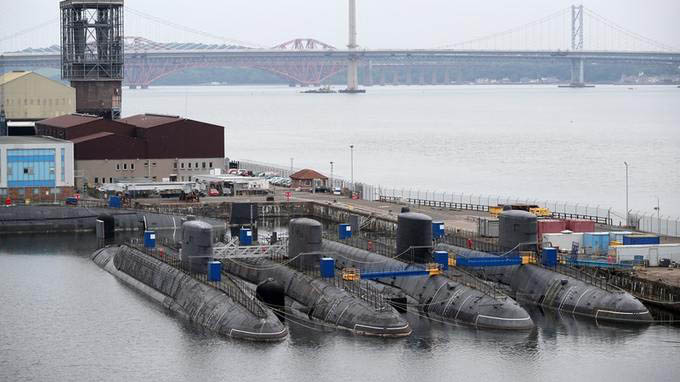
Scotsman 3rd April 2019 The SNP has today demanded a public inquiry into the decommissioning of
nuclear-powered submarines, following the publication of a damning report
on how the Ministry of Defence (MoD) has handled the process. The National
Audit Office (NAO) found the MoD still does not know how it will finally
dispose of 20 decommissioned vessels, several of which remain laid up
afloat at Rosyth Dockyard in Fife. The UK now has twice as many submarines
in storage as it does in service, and has not disposed of any of the boats
decommissioned since 1980. The estimated cost of disposing of a submarine
is £96 million, the NAO found, while the MoD has put its total future
liability for maintaining and disposing of the 20 stored and 10 in-service
nuclear-powered boats at £7.5 billion over the next 120 years. SNP defence
spokesman Stewart McDonald has now called on UK Government ministers to be
held to account and “face up to the consequences of their actions”.
REVELATIONS that the Ministry of Defence has failed to dispose of any of the 20 nuclear submarines it has decommissioned in nearly 40 years underlines the unique risks associated with nuclear weapons.
What passes for debate in Parliament on our nuclear arsenal is deeply frustrating.
Ministers airily dismiss concerns about the staggering cost of Trident renewal (over £200 billion), ignore advice from top brass that these “useless” weapons swallow up money that would be better spent on conventional equivalents, sidestep questions about whether the ability to incinerate whole cities at the push of a button is a relevant deterrent to modern threats from terrorism to climate change.
Even Tony Blair has said the utility of a nuclear arsenal was “non-existent in terms of military use,” admitting in his memoirs that he only supported renewal when PM because he felt foreigners would see it as “too big a downgrading of our status as a nation” if we voluntarily abandoned it.
Yet his successors portray any attempt to discuss these questions rationally as evidence of being soft on Britain’s security.
They could not be more wrong, as the National Audit Office’s investigation into how we dispose of decommissioned submarines attests.
We have not disposed of a single one since 1980. The MoD has not been in a position to remove radioactive fuel from retired submarines since 2004, when the Office for Nuclear Regulation ordered it to stop as its facilities for doing so — at the Devonport naval base in Plymouth — were not safe enough.
An original plan to have a new disposal process operational by 2011 has now been postponed to 2026; the MoD stores twice as many mothballed nuclear subs as it operates and some have been cooling off in retirement for longer than they ever roamed the seas.
This is not simply a matter of bad organisation or rising costs.
Dr Philip Webber of Scientists for Global Responsibility (SGR) warned in 2017 that of the 12 retired submarines docked at Devonport, eight still contained fuelled nuclear reactors.
These “have to be continually cooled using external power and water to avoid overheating, which could lead to a fire, meltdown or a release of radioactive particles and gases.”
The risks involved in defuelling nuclear reactors are considerable – that’s why the MoD has felt unable to do so safely for 15 years — and older reactors (as we would expect to find on vessels that haven’t been operational for up to 40 years) tend to pose a greater risk of igniting, exploding or releasing radiation if anything goes wrong in the process than newer ones.
In an excellent article published in the SGR newsletter of winter 2017, Dr Webber points out that the MoD is actually aware of how dangerous keeping decommissioned subs knocking around is: following freedom of information requests, minutes of a Defence Board Meeting of 2011 were released.
The MoD’s senior nuclear safety regulator Commodore Andrew McFarlane notes that “all pressurised water reactors are potentially vulnerable to … structural failure,” which could lead to “release of highly radioactive fission products outside the reactor core.”
This would be a public safety hazard “out to 1.5 kilometres” (almost a mile) from the submarine.
Dr Webber estimates that 32,000 residents of Plymouth would fall within that range.
Safely defuelling and disposing of these radioactive hulks should be a priority for any government that takes public
safety seriously.
The enormous difficulties of doing so are a warning of exactly what risks we take on by blithely opting to renew our nuclear weapons programme.
It’s tragic that for most of our politicians “national security” rests on our ability to harm the peoples of other nations, rather than keep people on these shores safe.
A panel of doctors in Japan’s Nuclear Regulation Authority says iodine tablets should be distributed in advance to residents under 40 to mitigate the effects of radiation exposure due to a nuclear accident.
The panel compiled the proposal on Friday.
Iodine tablets are used to prevent the thyroid gland storing radiation.
World Health Organization guidelines say iodine tablets should be distributed to children and pregnant women first because they may face high risks of thyroid cancer after radiation exposure in a nuclear accident.
Iodine tablets are distributed mainly to residents within five kilometers of nuclear plants. But actual distribution is very slow, making it urgent to put children first.
The panel proposes that in principle iodine tablets should be distributed in advance to people under 40 as well as pregnant women and lactating mothers.
It also says people aged 40 or over can ask for the tablets if there are sufficient supplies, even though it has not been proved that cases of thyroid cancer due to radiation exposure will increase among this age group.
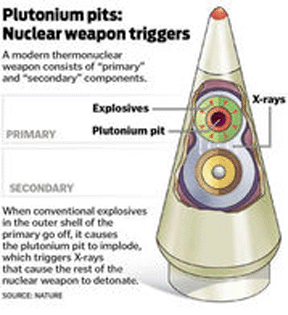
Recent comments on the proposed pit production at Savannah River Site warrant a cautionary comment. All is not wonderful news where pit production is concerned. It has a very dirty past. Awareness of that past is paramount to the protection of CSRA public health and safety.
The primary U.S. plant to smelt plutonium, purify it and shape it into “triggers” (pits) for nuclear bombs was Rocky Flats Nuclear Weapons Site. From 1952 to 1989, Rocky Flats manufactured more than 70,000 pits at a cost of nearly $4 million apiece. Each one contained enough breathable plutonium particles to kill every person on earth. Virtually all of the waste produced there remains on-site. As we have learned through the SRS waste storage struggles, there is no place for it to go and no government plan to develop a repository. What’s made at a nuclear processing plant, stays at the nuclear processing plant.
Much went wrong at Rocky Flats due to mismanagement, criminal government indifference and public complacency. It took more than 30 years for the public to become so concerned with the pollution hazards issuing from the plant before the Department of Energy (DOE) was forced to hold a public meeting in 1988 to address the problems. One example: The plant produced one boxcar a week packed with 140 drums of radioactive waste. They were parked on site. Moisture penetration of a drum could have triggered an explosion. Ground water, soil and air pollution were also major hazards. A subsequent DOE study indicated that Rocky Flats was the most dangerous site in the country.
On June 6, 1989 more than 70 FBI and EPA agents raided the plant to begin an official investigation of the contractor and DOE for environmental crimes. The plant manager acknowledged that problems were solved “when DOE wanted to pay for them.” The final FBI/EPA allegations included concealment of environmental contamination, false certification of federal environmental reports, improper storage and disposal of hazardous and radioactive waste, and illegal discharge of pollutants into creeks flowing to drinking water supplies. Another independent study found there was enough lost plutonium in the plant exhaust ducts to create the possibility of an accidental nuclear reaction. According to a later DOE report, about 62 pounds of plutonium was lost in the plant air ducts; enough for seven nuclear bombs.
A grand jury was convened to hear the case on Aug. 1, 1989. The contractor argued in court that it could not fulfill its DOE contract without also violating environmental laws. In order to remediate the damage, on Sept. 28, 1989, EPA added Rocky Flats to its Superfund cleanup list. The grand jury worked until May 1991, then voted to indict the plant contractor, five employees and three individuals working for DOE.
The Department of Justice refused to sign the indictments despite more than 400 environmental violations that occurred during the decades of pit production at the plant. All charges were dropped. A settlement guaranteed the contractor and all indicted individuals immunity. Although the contractor pleaded guilty to criminal violations of the federal hazardous waste law and the Clean Water Act, the fine was only $18.5 million, less than the corporation had collected in bonuses for meeting production quotas that year. The contractor’s annual fee to run the site was estimated at $10 million, with an additional $8.7 million paid from DOE for management and safety excellence.
The contractor was also allowed to sue for reimbursement of $7.9 million from taxpayers for fees and costs related to its case. In addition, the contractor’s plea agreement indemnified it from further claims and all future prosecution, criminal or civil. The trial records are permanently sealed. Further, the contractor argued that everything it did at Rocky Flats was at the behest of DOE and maintained the right to receive future government contracts.
Grand jury members asked to write their own report but the judge refused to read it or release it to the public. Not surprisingly, the report was leaked to the press and printed in a Denver newspaper and Harper’s magazine. In January 1993, a Congressional committee finally issued a report revealing evidence of high-level intervention by Justice Department officials for the purpose of reducing the contractor’s fines.
DOE has estimated that it will take until 2065 to clean up Rocky Flats, at a cost to American taxpayers of more than $40 billion. One DOE official testified to the Senate Armed Services Committee that some weapons plants, like Rocky Flats, may never be cleaned up because we lack the technology to do so at a reasonable cost. Another investigator, testifying before the U.S. Senate’s Governmental Affairs Committee, stated he did not believe it possible to reverse the harm done at Rocky Flats.
Could this history repeat itself at SRS? Without a comprehensive cradle to grave plan with built-in irrevocable government funding and independent oversight, including citizen stakeholder input, SRS could become the next Rocky Flats. How likely is the government to attach such planning and funding to an SRS pit processing campaign? Past experience at SRS includes years of having to do best guess planning under continuing resolution funding and government failures to pass a budget, decades of “temporarily” storing deadly radioactive waste due to the government’s failure to meet off-site disposition commitments, budget reductions, program cancellations (most recently, the MOX project), and more.
Plutonium pit production waste is not just radioactive. It is nuclear waste on steroids. If produced here, it will likely remain in our backyard, along with all the decades old waste at SRS. There is no place for it to go. Looming large as examples of the dangers and difficulties SRS will face in having pit production waste moved off-site are the explosion and prolonged closure at the New Mexico Waste Isolation Pilot Plant (the government’s only operating repository) and the abandonment of the Yucca Mountain project.
Is it the CSRA’s responsibility to take on this mission? Pit production, while bringing jobs to the Aiken/Augusts area, will add to the decades old SRS hazards waiting for DOE remediation. SRS is already part of the DOE nuclear complex cleanup program. That mission, 30 some years old, drags on under the burden of DOE mismanagement and variable federal funding. Estimates are it will take another 70 years to clean up the DOE nuclear complex and cost about $500 billion more. Celebration of plans to add U.S. pit production to SRS is a rush to judgement. Only the usual corporations, living large off gigantic federal awards, stand to benefit.
Dr. Rose O. Hayes is a medical anthropologist who spent her career in public health. She holds a B.S., M.S., M.A., and Ph.D. from SUNY and completed post-doctoral work in skeletal biology at The George Washington University. From 2009 to 2015, she served on the U.S. Department of Energy Site-Specific Advisory Board for the Savannah River plant, chairing its Nuclear Materials Committee.
The even madder plan to build a new nuclear plant on the beachMarch 31, 2019 by beyondnuclearinternationalThe case against Sizewell C,By Linda Pentz GunterIn December 2018 we ran an article — The mad plan to store nuclear waste on the beach— which has become one of our most read stories. Now, as the climate crisis worsens, here comes a possibly even madder plan — a new nuclear power plant on a beach with a shifting coastline famous for erosion…….
The Sizewell reactors sit on a windswept beach just yards from a sea that has already consumed ancient villages as the coastline changed and eroded over the centuries. Now the sea level rise that will come with climate change promises in time to drown a few more, most likely including the Sizewell nuclear site. Undeterred, the French government nuclear company, EDF, insists it will build a new reactor at Sizewell — one of its ill-fated EPR design that is already struggling at Flamanville, Olkiluoto and Hinkley. Just from a climate change point of view, it is an exercise in insanity. But there is so much more at stake.
The local activist group, Together Against Sizewell C (TASC) has been challenging the EDF plan for years, even as Sizewell sits permanently second in the queue behind the ever more delayed and ever more exorbitant sister site at Hinkley C in Somerset, where EDF is attempting to build two EPRs. Despite the technical problems, cost over-runs and the obscene strike price EDF scored off the UK government — which would almost triple current electricity rates — the company insists in can build Sizewell C more cheaply than Hinkley C and that construction could start within the next three years. It’s a pretty tall order and, arguably, total French farce.
What would actually happen to the Suffolk coastline and the surrounding villages, towns and countryside, is so alarming that TASC has ramped up its urgency in appealing to a likely somewhat otherwise distracted UK government — that is busy self-destructing over Brexit — to cancel Sizewell C.
In an eloquent petition, (which UK residents can sign at this link), TASC has laid out the case for halting the Sizewell C planning process immediately, arguing that in “report after report” nuclear power has shown “to be superfluous to UK climate change, cost and electricity generating targets. Nuclear is too expensive, a security risk and leaves a legacy of radioactive waste.” The petition will be delivered in person to the UK Secretary of State for Business Energy and Industrial Strategy.
On March 12, the group delivered an earlier petition, signed by 1,500 local people, to the Suffolk County Council’s Conservative leader Matthew Hicks, ahead of a cabinet meeting to discuss Sizewell C.
Researchers under gag order couldn’t investigate true health impacts after Three Mile Island nuclear disaster
Residents around Three Mile Island were exposed to much more radiation from the nuclear disaster than was claimed by officials, a fact that was kept from researchers and the public for years.
After the Three Mile Island reactor core melted and radioactivity was released to the surrounding population, researchers were not allowed to investigate health impacts of higher doses because the TMI Public Health Fund, established to pay for public health research related to the disaster, was under a research gag order issued by a court. If a researcher wanted to conduct a study using money from this Fund, they had to obey two main parameters set forth by Federal Judge Sylvia Rambo, who was in charge of the Fund.*
Those studying the health impact of Three Mile Island radiation emissions were prohibited from assessing “worst case estimates” of radiation releases unless such estimates would lead to a conclusion of insignificant amount of harm — that being “less than 0.01 health effects”.
If a researcher wanted to claim more harm or investigate a worst-case scenario, an expert selected by nuclear industry insurers would have to “concur on the nature and scope of the [dosimetry] projects.”
We don’t know how much radiation was released because monitors were non-functional
Data from radiation monitors from the time were unreliable. The Kemeny Commission concluded “An exceptional percentage (well over half) of health physics and monitoring instruments were not functional at the time of the accident . . .” (from Beyea) Without properly functioning monitoring equipment, dose reconstruction — the method used to figure out how much radiation people were exposed to — is at best unreliable, at worst, deceptive.
Luckily, biology doesn’t lie
Biological data show some residents’ exposures were much higher — 60–90 rads — than officials or industry admitted at the time. To arrive at these doses, researchers (see the Wing study, below) used meteorological data to establish where the radiation plumes traveled that were released from TMI. Researchers then drew blood from people in these plume pathways who complained of symptoms associated with higher radiation exposure: vomiting, diarrhea, skin reddening (erythema). Using a chromosome test initially established in the 1960s and honed during examination of Chernobyl liquidators, researchers determined that the public in these plumes received 600-900 milligrays of radiation exposure — thousands of times higher than annual natural background doses; and very much higher than research paid for by the Fund could ever have assessed. Where mechanical dosimeters failed, residents’ blood did not.
Increases of disease with no cause
Studies conducted by three universities (Columbia, Pittsburgh, North Carolina Chapel Hill) on the impacts of the Three Mile Island disaster show breast, lung, leukemia and general cancer increases, some associated with proximity to the reactors, some in the pathways of the radioactive plumes. However, because of the proscriptive court order governing the TMI Public Health Fund, the two studies that were funded by it (Hatch, et al. from Columbia and Talbott, et al. from Pittsburgh) were unable to associate the disease increases in their studies to radiation exposure. These two investigators were forced to conclude “Radiation emissions, as modeled mathematically, did not account for the observed increase.” (emphasis added) Their compromised study conclusions help to prop up the continuing mirage that TMI did not damage health.
Independent research pointed to radiation as culprit
Only the research paper by Wing, et al., University of North Carolina Chapel Hill, was able to associate the cancer increases of lung and leukemia to radiation from Three Mile Island. These researchers had obtained independent funding, allowing them to not only investigate health outcomes, but to correlate them with radiation exposure, rather than rely on court-ordered restraints and industry-collected data. Lending further credibility to their research, Wing et al., examined bioindicators in the blood of residents. (See above).
Health studies need to focus on health outcomes, not dose
As demonstrated by the TMI Health Fund debacle, the starting point for any health study should NOT have been an assumption of dose, but an examination of disease increases in the surrounding community after TMI’s radiation releases. Assumptions, codified in the Fund, that doses were too low to cause health impacts were proved wrong by blood examinations. Yet, Judge Rambo decided, against this blood evidence, that higher doses from TMI were not worthy of study because they didn’t happen. This placed the researchers taking Fund money in a position of compromising their scientific integrity, and allowed the TMI Public Health Fund to serve as an instrument of obfuscation, rather than information.
Recent research points to continued concern
Current research has found that thyroid cancers in members of the TMI community carry a biological mark specific to radiation exposure, are more aggressive and appear earlier, than thyroid cancers outside of the TMI community. Although research is ongoing, these studies reveal that radiation from TMI may be implicated in thyroid disease – a correlation never admitted to by officials or industry.
Compromised science still with us
Despite the evidence in human blood, lived experience of the exposed, recognition of faulty monitors, and increases of cancers, the constant false narrative that TMI caused no harm remains. The faulty science that plagues the residents around TMI also pervades other radiation studies assessing health impact, including those following explosions at Chernobyl and Fukushima. We are still all impacted by this scientific and legal failing surrounding TMI, which makes it much harder to assess radiation’s impact on human health.
*“Radiation doses were calculated under an order from the court governing the TMI Public Health Fund. This order prohibited ‘upper limit or worst case estimates of releases of radioactivity or population doses . . . [unless] such estimates would lead to a mathematical projection of less than 0.01 health effects’. The order also specified that ‘a technical analyst . . . designated by counsel for the Pools [nuclear industry insurers] concur on the nature and scope of the [dosimetry] projects’” from Wing, 1997.
Cindy Folkers is the radiation and health specialist at Beyond Nuclear.
Las Vegas Review Journal 29th March 2019 A defense safety board is concerned the Department of Energy has failed to
address a vulnerability to earthquake hazards at a Nevada National Security
Site facility where nuclear materials are stored — including a recent
shipment of weapons-grade plutonium. The Defense Nuclear Facilities Safety
Board outlined its concerns to Energy Secretary Rick Perry and issued a
report that pointed out the safety risks to workers and the “offsite
public” due to seismic hazards to structures at the Device Assembly
Facility at the Nevada security site, located about 90 miles north of Las
Vegas.
Public will never know truth behind Three Mile Island, anti-nuclear energy advocates say https://www.witf.org/news/2019/03/public-will-never-know-truth-behind-three-mile-island-anti-nuclear-energy-advocates-say.phpby Ivey DeJesus/PennLive | Mar 26, 2019 The public will never know the truth behind some of the most basic facts about the nation’s worst nuclear disaster nor the actual amount of radiation that was released.Those were some of the messages underscored on Monday by the head of Three Mile Island Alert, an anti-nuclear advocacy group, and other advocates at a press conference in the Main Rotunda of the state Capitol.
Just days shy of the 40th anniversary of the partial meltdown at the Three Mile Island nuclear plant in Londonderry Township, TMI Alert’s Eric Epstein excoriated the nuclear industry for misrepresenting the facts of the accident, and in the process misleading and misinforming the public.
“Three Mile Island is an accident without an ending,” Epstein said. “There’s no bookends to it. If you look at the holy trinity of nuclear accidents, Three Mile Island, Chernobyl and Fukushima, we can probably pretty much tell you when they started. The reality is there is no ending. This is a funeral where the pallbearers need to stand in place for 500 years. That’s tough for a society that has the memory of a fruitfly.”
Epstein was joined by Tim Judson, executive director of Nuclear Information and Resource Service, and Arnie Gundersen, a nuclear engineer, who over the years converted from a proponent to an ardent critic.
Judson and Gundersen outlined the chain of events that took place on March 28, 1979, the start of the partial meltdown, as well as the levels of radiation released and subsequent impact on the health of the region.
Judson said the Three Mile Island story amounted to a “mistelling of history” of what could have been a preventable accident. He said that as a result of inconsistencies provided by the nuclear industry, the public was not given – nor will never have – a clear picture of the facts and the risks surrounding the meltdown.
Gundersen explained that because inadequate radiation monitors were in place at the time, officials were never able to get an accurate reading of radiation levels.
All analysis of radiation releases were based on mathematical corrections to estimates derived from off-site dose readings, he said.
“How much radiation was released? Nobody knows,” said Gundersen, who began a change of heart on nuclear energy in the 1990s when he served as an expert witness for plaintiffs in a lawsuit against Three Mile Island.
He is today chief engineer of Fairewinds Associates, an advocacy group for clean, renewable energy.
The Nuclear Regulatory Commission has long stood by its 40-year-old estimate that 10 million Curies of radiation were released. The NRC has also long held that the radiation released during the accident was well within levels deemed safe. The industry has reiterated that no one died or was harmed as a result of the accident.
Gundersen said that according to his own analysis of raw data, he calculated that 10 times that amount was released.
Epstein further excoriated legislative efforts to “bail out” Pennsylvania’s nuclear power plants, including Exelon Corp., current owner of TMI-1.
He said proposals to bail out the nuclear industry in Pennsylvania – to the tune of nearly $3 billion – were “fundamentally and manifestly unfair,” adding that Three Mile Island Alert categorically opposed any bailout.Proposed legislation would lead to the reclassification of Pennsylvania’s nuclear plants as “zero emission energy” and create new requirements on how electric companies purchase power.
Among the members of the audience, were several visitors from Fukushima, Japan, site of the 2011 post-tsunami nuclear disaster that led to the evacuation of a quarter of million people.
“The same (tactics) used to minimize the damage and risk of health is the same between Fukushima and TMI,” said Hiroko Aihara, a journalist from Fukushima.
She said citizen engagement has been pivotal in the case of Three Mile Island and continues to be so in the Fukushima aftermath.
“It’s very important to work together. To know we are not alone,” she said.
Aihara said the Japanese people – like residents of central Pennsylvania 40 years ago – were not provided with the truth.
“Many people are still suffering… about evacuation, radiation, contamination and economic situation,” she said. “We are still suffering or fighting the situation.”