Two killed and four injured after blast, defence ministry say, A short-term spike in radiation levels has been recorded after a rocket engine exploded during a test in Russia, regional authorities said.Moscow’s defence ministry said two were killed and four others wounded after the blast at a military shooting range in the northwestern region of Arkhangelsk.
The ministry said there was no release of radioactivity or any toxic substances.
However, Ksenia Yudina, a spokeswoman for the city of Severodvinsk, which has a population of around 185,000, said: “A short-term rise in background radiation was recorded at 12 o’clock in Severodvinsk.”
The defence ministry confirmed six servicemen and civilian engineers were injured, and two died of their injuries. It said the explosion took place during the test of a liquid-propellant rocket engine.
City officials said background radiation levels had fully “normalised”.
An Arkhangelsk port official said the Dvina Bay area of the White Sea would be closed off to shipping for a month following the explosion, the Interfax news agency reported.
The rocket engine explosion occurred at a weapons testing area near the village of Nyonoksa in the Arkhangelsk region, 800 miles north of Moscow, said the Interfax news agency.
Russian media said an area near Nyonoksa is used for tests on weapons including ballistic and cruise missiles used by the navy.
KYODO NEWS An earthquake with a magnitude of 6.4 hit Japan’s northeastern prefecture of Fukushima and its surrounding areas on Sunday, but there is no danger of a tsunami, the weather agency said.
The epicenter of the quake, which occurred at around 7:23 p.m. at a depth of about 45 kilometers, was out at sea off the prefecture, the agency said.
There were no immediate reports of major damage or casualties, according to authorities.
No abnormalities were found at nuclear power plants in the region, including both Fukushima Daiichi and Daini, according to their operators.
The quake registered lower 5 on the Japanese seismic intensity scale of 7 in Futaba in Fukushima Prefecture, and Ishinomaki and Watari, both in Miyagi Prefecture, according to the Japan Meteorological Agency.
An official at the agency, speaking at a press conference, cautioned that quakes of similar intensity could hit the region over the following week or so.
The agency first announced the magnitude was 6.2 and the depth of the epicenter was 50 km, but later revised them to 6.4 and 45 km.
5 Unknown Nuclear Disasters: Chernobyl Is Far from the Only One, Chernobyl is not the world’s only nuclear disaster, there are plenty of others to keep you up at night., Interesting Engineering, By Marcia Wendorf, 2 Aug 19
The Kyshtym Disaster
In September 1957, Ozyorsk, Russia was a closed city, built around the Mayak plant which produced plutonium for both nuclear weapons and fuel.
After scrambling to build the Mayak plant between 1945 and 1948, all six of its reactors initially dumped high-level radioactive waste directly into Lake Kyzyltash. When it became contaminated, they moved on to dumping into Lake Karachay, which also became contaminated.
In 1968, the Soviet government disguised the EURT area by creating East Ural Nature Reserve, with access allowed to only authorized personnel. Documents describing the disaster were only declassified in 1989.
In 1953, workers built a storage facility for liquid nuclear waste, but that waste was being heated by residual decay heat from the nuclear reaction. The coolers around one of the tanks failed, and on September 29, 1957, that tank exploded with the force of between 70 to 100 tons of TNT.
While there were no immediate casualties, the explosion released an estimated 20 MCi (800 PBq) of radioactivity into the air. A plume containing 2 MCi (80 PBq) of radionuclides, primarily caesium-137 and strontium-90, moved toward the northeast and contaminated an area of more than 52,000 square kilometers (20,000 sq miles).
At least 270,000 people lived in that area, which is referred to as the East-Ural Radioactive Trace (EURT).
In an attempt to maintain secrecy, no evacuation was ordered, but a week later, on October 6, 1957, 10,000 people were removed from their homes.
Estimates of the death toll caused by the accident go from 200 to more than 8,000, depending on the study. A 2001 work stated that the accident caused 66 diagnosed cases of chronic radiation syndrome.
Amazingly, it wasn’t until 18 years later, in 1976, that the full scope of the disaster was disclosed by Zhores Medvedev in the publication the New Scientist.
In 1968, the Soviet government disguised the EURT area by creating East Ural Nature Reserve, with access allowed to only authorized personnel. Documents describing the disaster were only declassified in 1989.
Windscale: Britain’s Biggest Nuclear Disaster – Part 01
5 Unknown Nuclear Disasters: Chernobyl Is Far from the Only One, Chernobyl is not the world’s only nuclear disaster, there are plenty of others to keep you up at night., Interesting Engineering, By Marcia Wendorf, 2 Aug 19
The Windscale Fire
Less than two weeks after Kyshtym, a fire broke out in Unit 1 of the two reactors at the Windscale facility located in what is now known as Sellafield, Cumbria UK.
The two reactors were created because of Britain’s need for an atomic weapon following World War II. Determining that a uranium enrichment plant would cost ten times as much to produce the same number of atomic bombs as a nuclear reactor, the decision was made to build a nuclear reactor that would produce plutonium.
The cores of the reactors were comprised of a large block of graphite, with horizontal channels drilled through it for the fuel cartridges. Each cartridge consisted of a 12-inch-long (30 centimeters) uranium rod encased in aluminum.
The reactor was cooled by convection through a 400-foot (120 m) tall chimney. When Winston Churchill committed the UK to create a hydrogen bomb, the fuel loads at Windscale were modified to produce tritium, but this also meant that the core became hotter.
On the morning of October 10, 1957, the core began to uncontrollably heat, eventually reaching 400 degrees C. Cooling fans were brought in to increase the airflow, but just worsened the problem. It was then that operators realized that the core was on fire.
Workers tried dousing the core first in carbon dioxide, then in water, but both proved ineffective. What finally worked was cutting off air to the reactor building, which starved the fire.
The fire caused the release of radioactive radionuclides across the UK and Europe, including an estimated 740 terabecquerels (20,000 curies) of iodine-131, 22 TBq (594 curies) of caesium-137 and 12,000 TBq (324,000 curies) of xenon-133.
By comparison, the 1986 Chernobyl explosion released far more, and the Three Mile Island accident in 1979 in the U.S. released 25 times more xenon-135 than Windscale, but less iodine, caesium, and strontium. The atmospheric release of xenon-133 by the Fukushima Daiichi nuclear disaster was similar to that released at Chernobyl, and thus, high above what the Windscale fire released.
There were no evacuations of the surrounding area, but it has been estimated that the incident caused 240 additional cancer cases. For a month after the accident, milk coming from 500 square kilometers (190 sq mi) of the nearby countryside was destroyed.
The reactor tank has remained sealed since the accident and still contains about 15 tons of uranium fuel. The reactor core is still slightly warm due to continuing nuclear reactions. It is not scheduled for final decommissioning until 2037. On the International Nuclear Event Scale, Windscale ranks at level 5………. https://interestingengineering.com/5-unknown-nuclear-disasters-chernobyl-is-far-from-the-only-one
5 Unknown Nuclear Disasters: Chernobyl Is Far from the Only One, Chernobyl is not the world’s only nuclear disaster, there are plenty of others to keep you up at night., Interesting Engineering, By Marcia Wendorf, 2 Aug 19
Soviet Submarine K-19
K-19 was one of what the Soviets called their Project 658-class submarines, while NATO called them Hotel-class. They were the first generation of nuclear submarines equipped with nuclear ballistic missiles.
Commissioned on April 30, 1961, K-19 was snake bit from the start. On its initial voyage, on July 4, 1961, it was conducting exercises off the coast of Greenland when suddenly, pressure in the reactor’s cooling system dropped to zero due to a leak.
The emergency SCRAM system immediately inserted the control rods, but due to decay heat, the reactor’s temperature rose to 800 degrees C (1,470 degrees F). The accident released steam containing fission products throughout the ship through the ventilation system.
The captain ordered the ship’s engineering crew to fabricate a new cooling system, but this required them to work within the radioactive area. The jury-rigged cooling water system prevented a complete meltdown of the reactor core.
American warships nearby had picked up K-19’s distress call and offered to help, but K-19’s captain, fearful of giving away Soviet military secrets, refused. Instead, K-19 sailed to meet up with a diesel-powered Soviet submarine. The accident had irradiated K-19’s entire crew, as well as the ship and some of her ballistic missiles.
Within a month, all eight members of the ship’s engineering crew died of radiation exposure. They are Boris Korchilov, Boris Ryzhikov, Yuriy Ordochkin, Evgeny Kashenkov, Semyon Penkov, Nicolai Savkin, Valery Charitonov, and Yuriy Povstyev.
Within the next two years, 15 other sailors died of radiation-related illnesses.
Towed into port, K-19 contaminated a 700 meter (2,300 feet) wide area, and the repair crews who worked on her. Eventually, the Soviet Navy dumped the damaged reactor into the Kara Sea.
5 Unknown Nuclear Disasters: Chernobyl Is Far from the Only One, Chernobyl is not the world’s only nuclear disaster, there are plenty of others to keep you up at night., Interesting Engineering, By Marcia Wendorf, 2 Aug 19
The Goiânia Accident
In the 1980s, the Instituto Goiano de Radioterapia (IGR) was a private radiotherapy hospital in Goiânia, Brazil. When it moved to a new facility in 1985, a caesium-137-based therapy unit was left behind. The caesium-137 was encased in a shielding canister made of lead and steel.
Legal wrangling prevented the canister from being removed from the facility, and the court posted a security guard to protect the equipment. Unfortunately, that guard was nowhere to be found on September 13, 1987, when two men, Roberto dos Santos Alves and Wagner Mota Pereira, entered the facility and made off with the equipment, placing it in a wheelbarrow and taking it to Alves’s house.
There, they began dismantling the equipment, and both immediately began to vomit. The next day, Pereira noticed a burn on his hand that required the amputation of several fingers.
Alves soldiered on, piercing the canister with a screwdriver. He noticed the blue light of Cherenkov radiation. Alves’s arm ulcerated and had to be amputated, but before that, he sold the items to a scrapyard owned by Devair Alves Ferreira.
Fascinated by the blue glow being emitted, Ferreira carried the items into his house, and over the next three days, he invited his friends and family in to observe the blue glow.
Ferreira’s brother brought some of the caesium to his house where he sprinkled it onto a floor. There, his six-year-old daughter, Leide das Neves Ferreira, sat down and ate a sandwich.
Eventually, Ferreira’s wife took the caesium to a hospital, and news of the radioactive leak was broadcast on local media. 250 people were found to be contaminated by radiation, with 129 people having internal contamination.
Four people would die of radiation sickness including six-year-old Leide, Ferreira’s wife Gabriela, 37, and two employees of Ferreira, Israel Baptista dos Santos, 22, and Admilson Alves de Souza, 18.
The Goiânia accident spread significant radioactive contamination throughout the Aeroporto, Central, and Ferroviários districts of Goiânia. Contaminated areas included Alves’s house, Devair Ferreira’s scrapyard which had extremely high levels of radiation, and his brother Ivo’s house.
The “NATO Science for Peace and Security Series” bizarrely found radioactive contamination on: * Three buses * 42 houses * Fourteen cars * Five pigs * 50,000 rolls of toilet paper.
5 Unknown Nuclear Disasters: Chernobyl Is Far from the Only One, Chernobyl is not the world’s only nuclear disaster, there are plenty of others to keep you up at night., Interesting Engineering, By Marcia Wendorf, 2 Aug 19
Chalk River Ontario, Canada Incident
On December 12, 1952, there was a power excursion and partial loss of coolant in the NRX reactor at the Chalk River nuclear laboratories. Because of mechanical problems, the control rods couldn’t be lowered into the core, and the fuel rods overheated, resulting in a meltdown of the core.
Just like at Chernobyl, hydrogen gas caused an explosion that blew off the multi-ton reactor vessel seal. Also like at Chernobyl, 4,500 tons of radioactive water was found in the basement of the Chalk River reactor building. During the accident, 10,000 curies or 370 TBq of radioactive material was released into the atmosphere.
Future U.S. president Jimmy Carter, then a U.S. Navy officer, led a team of 13 U.S. Navy volunteers who helped in the cleanup of this disaster.
The experts say the cloud of radiation detected over Europe in late September 2017 could only have been caused by a nuclear fuel-reprocessing accident at the Mayak Production Association, a nuclear facility in the Chelyabinsk region of the Ural Mountains in Russia, sometime between noon on Sept. 26 and noon on Sept. 27.
The lead author of the new research, nuclear chemist Georg Steinhauser of Leibniz University in Hanover, Germany, said that more than 1,300 atmospheric measurements from around the world showed that between 250 and 400 terabecquerels of radioactive ruthenium-106 had been released during that time.
Ruthenium-106 is a radioactive isotope of ruthenium, meaning that it has a different number of neutrons in its nucleus than the naturally occurring element has. The isotope can be produced as a byproduct during nuclear fission of uranium-235 atoms.
Although the resulting cloud of nuclear radiation was diluted enough that it caused no harm to people beneath it, the total radioactivity was between 30 and 100 times the level of radiation released after the Fukushima accident in Japan in 2011, Steinhauser told Live Science.
The cloud of radiation in September 2017 was detected in central and eastern Europe, Asia, the Arabian Peninsula and even the Caribbean.
Only radioactive ruthenium-106 — a byproduct of nuclear fission, with a half-life of 374 days — was detected in the cloud — Steinhauser said.
During the reprocessing of nuclear fuel — when radioactive plutonium and uranium are separated from spent nuclear fuel from nuclear power reactors — ruthenium-106 is typically separated out and placed into long-term storage with other radioactive waste byproducts, he said.
That meant that any massive release of ruthenium could only come from an accident during nuclear fuel reprocessing; and the Mayak facility was one of only a few places in the world that carries out that sort of reprocessing, he said.
Advanced meteorological studies made as part of this new research showed that the radiation cloud could only have come from the Mayak facility in Russia. “They have done a very thorough analysis and they have pinned down Mayak — there is no doubt about it,” he said.
In the 1957 accident, known as the Kyshtym disaster after a nearby town, a tank of liquid nuclear waste at the Mayak facility exploded, spreading radioactive particles over the site and causing a radioactive plume of smoke that stretched for hundreds of miles.
Nuclear accident
The study showed that the 2017 accident at Mayak was unlikely to have been caused by a relatively simple release of radioactive gas, Steinhauser said. Rather, a fire, or even an explosion, might have exposed workers at the plant to harmful levels of radiation, he added.
Russia has not acknowledged that any accident occurred at the Mayak facility, maybe because plutonium is made there for thermonuclear weapons. However, Russia had established a commission to investigate the radioactive cloud, Steinhauser said.
The Russian commission ruled that there was not enough evidence to determine if a nuclear accident was responsible for the cloud. But Steinhauser and his team hope it may look again at this decision in the light of the new research.
“They came to the conclusion that they need more data,” he said. “And so we feel like, okay, now you can have all of our data — but we would like to see yours as well.”
Any information from Russia about an accident at the Mayak facility would help scientists refine their research, instead of having to rely only on measurements of radioactivity from around the world, Steinhauser said.
The international team of scientists involved are keenly interested in learning more about its causes. “When everybody else is concerned, we are almost cheering for joy, because we have something to measure,” he said. “But it is our responsibility to learn from this accident. This is not about blaming Russia, but it is about learning our lessons,” he said.
River of radiation: Life in the area of the world’s 3rd-worst nuclear disaster Rt.com 28 Jul, 2019 Before Fukushima and Chernobyl, the worst-ever nuclear disaster was a massive leak from a plant in the eastern Urals. RT went to see how people live in areas affected by the fallout from the USSR’s risky rush to the nuclear bomb.
Chernobyl and Fukushima are the two names that are most likely to come to mind when one thinks about nuclear disaster, and rightfully so. People in the US will likely recall the Three Mile Island accident, while Britons may say the “Windscale fire.”
The name “Kyshtym” will probably mean nothing to the wider public, despite it belonging to the third-worst nuclear accident in history. An RT Russian correspondent traveled to the area to speak with locals, some of whom personally witnessed the 1957 disaster, to find out what living in such a place feels like.
Bomb at any cost
Kyshtym is the name of a small town in what is now Chelyabinsk Region in Russia, located in an area dotted by dozens of small lakes. A 15-minute car ride east will bring you to another town called Ozyorsk. Six decades ago, you wouldn’t find it on any publicly available map because it hosted a crucial element of the Soviet Union’s nascent nuclear weapons program, the Mayak plant.
The Soviet leadership considered building up a stockpile of weapons-grade plutonium to be a high priority, while environmental and safety concerns came as an afterthought. Some of the less-dangerous radioactive waste from Mayak was simply dumped into the Techa River, while the more-dangerous materials were stored in massive underground tanks.
The sealed steel containers, reinforced with meter-thick concrete outer walls, were considered strong enough to withstand pretty much anything. In September 1957 this assumption was proven wrong, when one of the tanks exploded with an estimated power of 70-100 tons of TNT. This happened due to an unrepaired cooling system, which allowed radioactive waste to build heat and partially dry up, forming a layer of explosives, an investigation later found. An accidental spark was then enough to blow off the 160-ton lid of the tank, damage nearby waste storages, and shatter every window pane within a 3km radius.
A plume of radioactive waste was ejected high into the air. Some 90 percent of the material fell right back, contaminating the area and adding to the pollution in the Techa River, but some was atomized and traveled northeast with the wind. A 300km long, 10km wide stretch of land running through three Russian regions is what’s left by the fallout. The worst-affected part of it was designated a natural reserve a few years after the disaster.
Cover up
The disaster was covered up in the Soviet media, which reported that the strange lights in the night sky – actually a glow caused by ionization from radioactive waste – was a rare event related to the aurora. The locals knew something was wrong, of course, due to the evacuation of two dozen nearby villages and the large-scale decontamination work that was to be carried out over the next several years.
Later, the military came to get radiation readings in it. Afterwards, soldiers demolished the banya and took away not only the house but even the layer of soil on which it was built.
Officially, the scale of the disaster remained a state secret until the late 1980s.
Poisoned river
The Techa River remains contaminated now, long after Mayak stopped dumping waste in it. The radiation is relatively low, however: standing next to it is no worse than traveling on an airplane. Thousands of people cross it every day via a bridge road that connects Chelyabinsk and Ekaterinburg – the two nearest provincial capitals.
The only inhabited village down the river is called Brodokalmak and is about 85km downstream from Ozyorsk, and 50km away from the bridge crossing …….
Ghost village
Halfway between the bridge and Brodokalmak is another village, Muslyumovo. It was inhabited until about a decade ago, when Rostatom, the Russian nuclear monopoly, offered to relocate its 2,500 residents. Now it’s a ghost village………
Triple exposure
Another place that had a close brush with Mayak’s waste is Metlino, a town about 25 minutes east from Ozyorsk. Some residents were unfortunate enough to have been exposed to radiation three times in their lives, according to Lyudmila Krestinina, who heads a lab at a local radiation research medical center.
First, they lived on the Techa River when it was used to dump waste. Then the disaster happened, and the cloud went past, close enough for some fallout but not close enough for it to become a major risk. The third time happened in 1967.
“There was drought and the Karachay bog, where waste was dumped from the Mayak, caught fire. The wind brought radioactive smoke over Metlino,” she said. “Now the contamination level has decreased several times, but it’s still higher than background radiation.”
The bog used to be a lake in the early days of Mayak, which started to dry up in the 1960s. The 1967 incident prompted major landscaping work to cover its shallow parts with earth and provide greater water supply. This solution was ultimately deemed unfeasible, so the rest of the lake was covered as well. The work ended just four years ago. ……. https://www.rt.com/russia/465243-kyshtym-nuclear-disaster-mayak/
Editorial: Self-regulation of nuclear power plants? What could go wrong? St Louis Post Dispatch. 28 July 19, The idea of self-policing and minimizing government regulatory oversight worked so well for Boeing and its still-grounded 737 Max 8 jetliner fleet, the Trump administration now wants to expand those same powers to the nation’s aging nuclear power plants. What could possibly go wrong?
The industry insists that self-policing can work and that operators of the 90-plus nuclear plants across the country don’t need the kind of rigorous federal inspections that have been required annually or once every two years under previous administrations. Under plans now being contemplated, inspections would be reduced to as little as once every three years.
A Nuclear Regulatory Commission staff report, recently made public, recommends cutting back on nuclear reactor inspections to improve efficiency and save money. Competition in the energy-generating industry has grown much stiffer with the increased use of cheaper natural gas and renewable sources…….
Rare is the industry that welcomes heavy regulation and rigorous federal inspections. But history is rife with examples of how badly things can go wrong when the government steps back and allows companies in high-risk industries to police themselves.
Boeing faces billions of dollars in losses after two of its 737 Max 8 jetliners crashed. The Federal Aviation Administration’s acting administrator, Daniel Elwell, acknowledged before Congress in May that the agency had cut back on staff inspections and relied on manufacturers like Boeing to conduct their own inspections.
After the 2010 Deepwater Horizon disaster in the Gulf of Mexico, Congress imposed heavy regulations on the offshore oil industry to prevent any repeat of the explosion that killed 11 and sent millions of barrels of oil spewing into the Gulf of Mexico. The Trump administration is working to cut those regulations back so the industry can return to policing itself.
Likewise, the administration worked with Republicans in Congress to reverse banking-industry regulations imposed after the 2007-2008 financial-industry meltdown that prompted the Great Recession — again on the premise that the industry is better off self-regulating.
Nuclear industry has been pushing for less oversight, and it’s working. L A Times ELLEN KNICKMEYER, ASSOCIATED PRESS , JULY 17, 2019
Fewer mock commando raids to test nuclear power plants’ defenses against terrorist attacks. Fewer, smaller government inspections for plant safety issues. Less notice to the public and to state governors when problems arise.
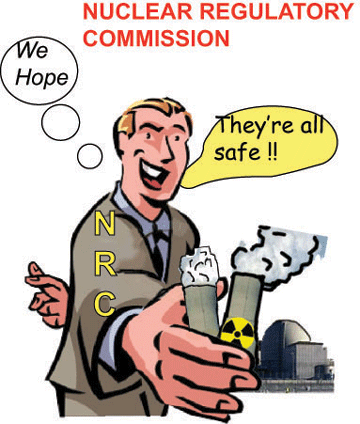
They’re part of the money-saving rollbacks sought by the country’s nuclear industry under President Trump and already approved or pending approval by the Nuclear Regulatory Commission, largely with little input from the general public.
The nuclear power industry says the safety culture in the U.S. nuclear industry — 40 years after a partial meltdown of a nuclear reactor at the Three Mile Island plant in Pennsylvania — is “exceptional” and merits the easing of government inspections.
Maria Korsnick, president of the industry’s Nuclear Energy Institute trade group, said she welcomed changes in NRC plant oversight “to ensure that it reflects a more robust understanding of the current performance of the U.S. nuclear fleet.”
Opponents say the changes are bringing the administration’s business-friendly, rule-cutting mission to an industry — nuclear reactors — in which the stakes are too high to cut corners.
While many of the regulatory rollbacks happening at other agencies under the current administration may be concerning, “there aren’t many that come with the existential risks of a nuclear reactor having a malfunction,” said Geoff Fettus, an attorney for the Natural Resources Defense Council on nuclear issues.
This week, the Nuclear Regulatory Commission released staff recommendations for rollbacks in safety inspections for the 90-plus U.S. nuclear power plants and for less flagging of plant problems for the public. Democratic lawmakers and one commissioner expressed concern about the safety risks and urged the commission to seek broader public comment before proceeding.
The country’s nuclear regulators were looking at “far-reaching changes to the NRC’s regulatory regime without first actively conducting robust public outreach and engagement,” Rep. Frank Pallone Jr. (D-N.J.), chairman of the House Energy and Commerce Committee, said in a letter to Nuclear Regulatory Commission Chairwoman Kristine Svinicki.
Svinicki and two other commissioners did not respond Wednesday to requests for comment made through the agency’s public affairs staff. Public affairs director David Castelveter said the commission would respond directly to lawmakers on Pallone’s letter.
A fourth commissioner, Jeff Baran, spoke out Tuesday, saying he opposed cutting inspections and reducing oversight. Baran called for more public input on proposed rollbacks.
Nuclear regulators post notices of meetings on proposed rollbacks of oversight of nuclear power plants on the Nuclear Regulatory Commission website. Lawmakers complained that there has been scant notice to the public at large about the meetings or proposals.
In general, according to attendance logs, the rollbacks are being hashed out at meetings attended almost solely by commission staffers and nuclear industry representatives. ……
Edwin Lyman, a nuclear safety expert with the Union of Concerned Scientists said the security changes “are jeopardizing public health and safety by restricting the NRC’s ability to ensure that nuclear plants are sufficiently protected against radiological sabotage attacks.”
In January, in one of the comparatively few widely reported changes, commissioners rejected staff recommendations for making nuclear plants harden themselves against natural disasters on the scale of the 2011 earthquake and tsunami that caused meltdowns at three nuclear reactors at the Fukushima nuclear plant in Japan……
Some rollbacks pushed by the industry have been rejected by the commission’s staff. Others are still under consideration, including one that would further cut inspections by regulators and allow more self-inspections overseen by plant operators.
Turkey’s Akkuyu nuclear plant facing numerous safety concerns – Birgün, https://ahvalnews.com/akkuyu/turkeys-akkuyu-nuclear-plant-facing-numerous-safety-concerns-birgun21 July 19,Top-level officials working at Turkey’s Akkuyu Nuclear Power Plant construction project say a series of problems, including lack of design adaptation and a shortage of competent engineers on site, are posing serious safety concerns, left-wing Birgün newspaper reported.Located in Turkey’s Mediterranean coastal town of Mersin, Turkey’s first nuclear power plant Akkuyu is a joint Russian-Turkish project with Russian energy company Rosatom as the majority stakeholder. President Recep Tayyip Erdoğan and his Russian counterpart Vladimir Putin kicked off the construction of the plant on Apr. 3 amid concerns about the potentially destructive ecological consequences of the plant.
The project hit a snag in May when fissures discovered in the foundations, according to pro-government outlet HaberTürk. New concrete was laid only for more cracks to be discovered.
The problem of the cracks, discovered by Turkey’s Atomic Energy Authority (TAEK), have since been fixed, however the foundation of the plant remains a problem.
The design of the plant was created with Russian landscape and weather in mind and is in need of revision to be adapted to Turkey’s warm climate, officials told Birgün.
“For example, sloping in the mountains should be conducted in a more horizontal fashion, but it has been done vertically to minimise costs and this is resulting the boulders continually rolling down the hills,’’ one official said.
The ground the plant is being built on, which according to a geology engineer, who spoke on condition of anonymity, is filled with gaps and cannot support the plant.
“Technically speaking, you can construct a structure over any kind of surface. However, the structure at hand is not a copy-paste matter, it must be revised according to the present surface. None of this is happening because the engineers of the project are not competent,’’ the engineer said, pointing to gaps that may lead to condensation, among other problems.
The project is run entirely on the ‘’past experiences’’ contractors, one official said. ‘’They are acting as though a building is being constructed instead of a nuclear reactor. And even during the process of constructing a building, a much more serious plan of action is followed.’’
The cooling of the plant is to take place through the waters of the Mediterranean Sea.
The warm water to be released into the sea after the cooling process, a chemical engineer who spoke to left-wing Birgün daily said, will lead to increased temperatures in the water, which in turn affects marine life.
’Chlorine is placed in the water to avoid mussels etc. from sticking to the pipes used to draw the water. And then this water, which now naturally has chlorine in it, is released into the sea,’’ the official said. ‘’Imagine the damage this can create in the sea, which is filled with living organisms.’’
experts are still studying the cancerous, continent-spanning impact of the 1986 meltdown, which took place just outside the small town of Prypyat, some 150 kilometers north of Kyiv, and belched billions of radioactive particles into the wind.
In Ukraine alone, nearly two million people are estimated to have been victims in some way of the disaster, caused by cost-cutting and negligence. The Ukrainian government pays the price today: in compensation to the families of at least 35,000 people who died of Chornobyl related cancers. Across Ukraine, Belarus and Russia, fatality estimates reach into the hundreds of thousands
A major complaint is that Energoatom’s environmental impact assessments are unconvincing. Safety and security are insufficiently addressed, waste disposal is barely mentioned and plans to mitigate risks are severely lacking in detail..
Ukraine’s nuclear power disasters may not be over, experts warn, Kyiv Post, By Jack Laurenson. July 19 2019
Ukrainian nuclear power plants (NPPs) score poorly on security and are failing to meet some important International Atomic Energy Agency safety requirements. At the Khmelnytsky NPP, the planned addition of two extra reactors (supplied by a controversial, Kremlin-linked company) will go ahead, despite the strong concerns.
After more than three decades in the shadow of the Chornobyl catastrophe — the world’s worst nuclear energy-related disaster — Ukrainians continue to live with nuclear power plants as part of their country’s landscape. A whopping 15 reactors power their towns and cities, while Ukraine’s total installed capacity makes it the seventh-largest nuclear nation in the world today.
At the same time, experts are still studying the cancerous, continent-spanning impact of the 1986 meltdown, which took place just outside the small town of Prypyat, some 150 kilometers north of Kyiv, and belched billions of radioactive particles into the wind.
In Ukraine alone, nearly two million people are estimated to have been victims in some way of the disaster, caused by cost-cutting and negligence. The Ukrainian government pays the price today: in compensation to the families of at least 35,000 people who died of Chornobyl related cancers. Across Ukraine, Belarus and Russia, fatality estimates reach into the hundreds of thousands.
Only two nuclear energy-related disasters have been rated at the maximum severity available on the International Nuclear Event Scale: the Chornobyl explosion, and the meltdowns that shook Japan and the world during the 2011 Fukushima disaster. There, some 170,000 evacuees still cannot return to their irradiated homes in the exclusion zone.
Today in Ukraine, difficult questions linger. Have the painful lessons of Chornobyl and Fukushima been learned, and can a country struggling with war, corruption and political turmoil guarantee the safety of its nuclear infrastructure?
Safety, security lacking
These days, at least 55 percent of all Ukrainian electricity comes from its 15 fission reactors, operating at four different nuclear power plants, or NPPs, around the country. They are all operated by the state-owned National Nuclear Energy Generating Company of Ukraine, widely known as Energoatom.
These nuclear reactors in Ukraine are still not as safe and secure as they could be. They are vulnerable to external shocks, internal sabotage, cybersecurity threats and terrorism, according to shortcomings identified in expert assessments.
Ukraine scored poorly in a 2018 security index published by the Nuclear Threat Initiative organization, scoring 70 out of 100 points, ranking it 30th out of the 45 countries indexed.
The most recent overall safety assessment of all Ukrainian NPPs, completed in 2010 by the International Atomic Energy Agency, or IAEA, and the European Commission, found that Ukrainian plants were non-compliant with 22 out of 194 vital safety requirements. Weak areas included the “consideration of severe accidents, NPP seismic resistance, completeness of deterministic safety analysis, and post-accident monitoring.”
The National Ecological Center of Ukraine, or NECU, and other nongovernmental organizations here warn that nine Ukrainian nuclear reactors are currently operating beyond their safe lifespan, on the basis of 10-year lifetime extension permits granted following an assessment they have labelled as “deeply flawed.”
And now, in Khmelnytsky Oblast, scientists, experts and campaigners are starting to raise their voices in protest at the latest and perhaps most serious concern.
Experts say that two new reactors which are planned to go into operation there have serious, known safety flaws and do not meet modern safety standards, widely adopted following lessons learned from the Fukushima disaster in Japan eight years ago………..
Khmelnytsky expansion
On May 16, a senior official with an Austrian government ministry taking part in talks on the Khmelnytsky project, contacted the Kyiv Post to express concern over its feasibility and safety. The official asked not to be named for fear of jeopardizing talks with Ukrainian counterparts, but shared an official report with the Kyiv Post that makes for alarming reading.
The 87-page report from Austria’s environment agency was commissioned by the country’s Federal Ministry of Sustainability and Tourism. Its lead authors are two Austrian scientists — Oda Becker, a physicist specializing in nuclear safety, and Gabriele Mraz, an expert on nuclear policy.
A major complaint is that Energoatom’s environmental impact assessments are unconvincing. Safety and security are insufficiently addressed, waste disposal is barely mentioned and plans to mitigate risks are severely lacking in detail.
And Energoatom’s plan to simply “continue” construction of facilities that would house KhNPP 3&4 is unthinkable, because the partially-finished constructions have been largely abandoned for nearly three decades and are no longer suitable, the report’s authors said.
“I was surprised that (KhNPP 3&4) was restarted…the site is in ruins… nothing has been done to protect the construction and the conditions there,” the official said.
The official asked how anyone can “think of using this ruin to build a nuclear power plant,” considering that the site and components had been exposed to ice, snow and rain over the years.
The experts also voiced concerns over the shady choice of supplier for the two new reactors.
Energoatom has selected a type of Russian-built reactor from the Czech-based (but ultimately Russian-owned) company Škoda JS. The reactor is cheap and fits within the existing, partially abandoned buildings, but features a number of known safety deficiencies, according to experts.
“They wanted a cheaper reactor — but this reactor is not considered good enough and it lacks safety features that have become required after what we learned since Fukushima,” the official said.
The Kyiv Post repeatedly tried to speak with Energoatom about its plans for the Khmelnytsky NPP, but the agency was uncooperative. Ultimately, Energoatom did not provide information or answer questions by deadline.Unanswered questions
In the report from Vienna seen by the Kyiv Post, the Austrian environment agency poses at least 89 separate questions to Energoatom which it said had so far gone unanswered. Some questions are highly technical, while others address issues of basic safety and security. The authors state that the Ukrainian side has not responded to many questions, or have provided materials that are insufficient and do not address their concerns.
Earthquakes repeatedly striking proposed US nuclear waste site
Officials fear deadly radioactivity could seep into earth if another high-magnitude quake strikes Nevada desert, Independent, Emma Snaith, 19 July 19
Repeated earthquakes could risk releasing deadly radioactivity into the earth if plans for a nuclear waste site in go ahead in Nevada’s desert, the state’s governor has warned.
Tens of thousands of tons of highly radioactive used nuclear reactor fuel are due to be transferred from 35 US states to a new facility in the Mojave Desert.
The Yuka Mountain nuclear waste repository is set to store this material deep within the earth.
But a series of recent earthquakes in the Mojave Desert has raised concerns about the safety of storing radioactive waste at the facility.
On 4 July, a 7.1 magnitude earthquake ruptured the earth in the desert, which stretches across the California-Nevada border.
The force of the quake cracked buildings, sparked fires, damaged roads and caused several injuries in southern California. It was followed by a 6.4-magnitude temblor two days later.
In the wake of the earthquakes, the governor of Nevada Steve Sisolak said he was committed to “fighting any continued federal effort to use Nevada as the nation’s nuclear dumping ground”.
“These significant recent earthquakes so near to Yucca Mountain show one of the many geologic problems with the site as a nuclear waste repository,” he said.
Mr Sisolak sent a letter to the energy secretary, Rick Perry, urging him to reconsider the location of the facility.
………. In governor of Nevada’s letter to Mr Perry, he included the opinions of James Faulds at the Nevada Bureau of Mines and Geology and Graham Kent at the seismological laboratory at the University of Nevada.
They urged for more research to be conducted into the seismic activity at the Yuka Mountain site. “The Ridgecrest earthquake sequence, which began July 4 and has yet to subside, clearly highlights the importance of such studies,” Mr Faulds and Mr Kent said.
A recent ranking compiled by the US Geological Survey found Nevada was the US state with the fourth highest level of seismic activity after Alaska, Wyoming and Oklahoma.
Russia operates 10 nuclear power plants, including the four-reactor Kalinin plant 350 kilometers northwest of Moscow, according to the London-based World Nuclear Association.
Second Russian Nuclear Plant Taken Down After Malfunction
Kalinin’s first, second and fourth reactors were taken offline, Russia’s state-run TASS news agency reported, citing emergency services in the town of Udomlya on Thursday.
The Tver region branch of Russia’s Emergency Situations Ministry told the agency the three reactors were taken down due to a short-circuit.
“The radiation level at the station and surrounding territory remains without change and is in line with normal background levels,” said Rosenergoatom, a subsidiary of state nuclear corporation Rosatom, in a statement.
Last Friday, a nuclear power plant reactor in Beloyarsk was knocked out, triggered by a safety mechanism. It resumed operations on Tuesday.
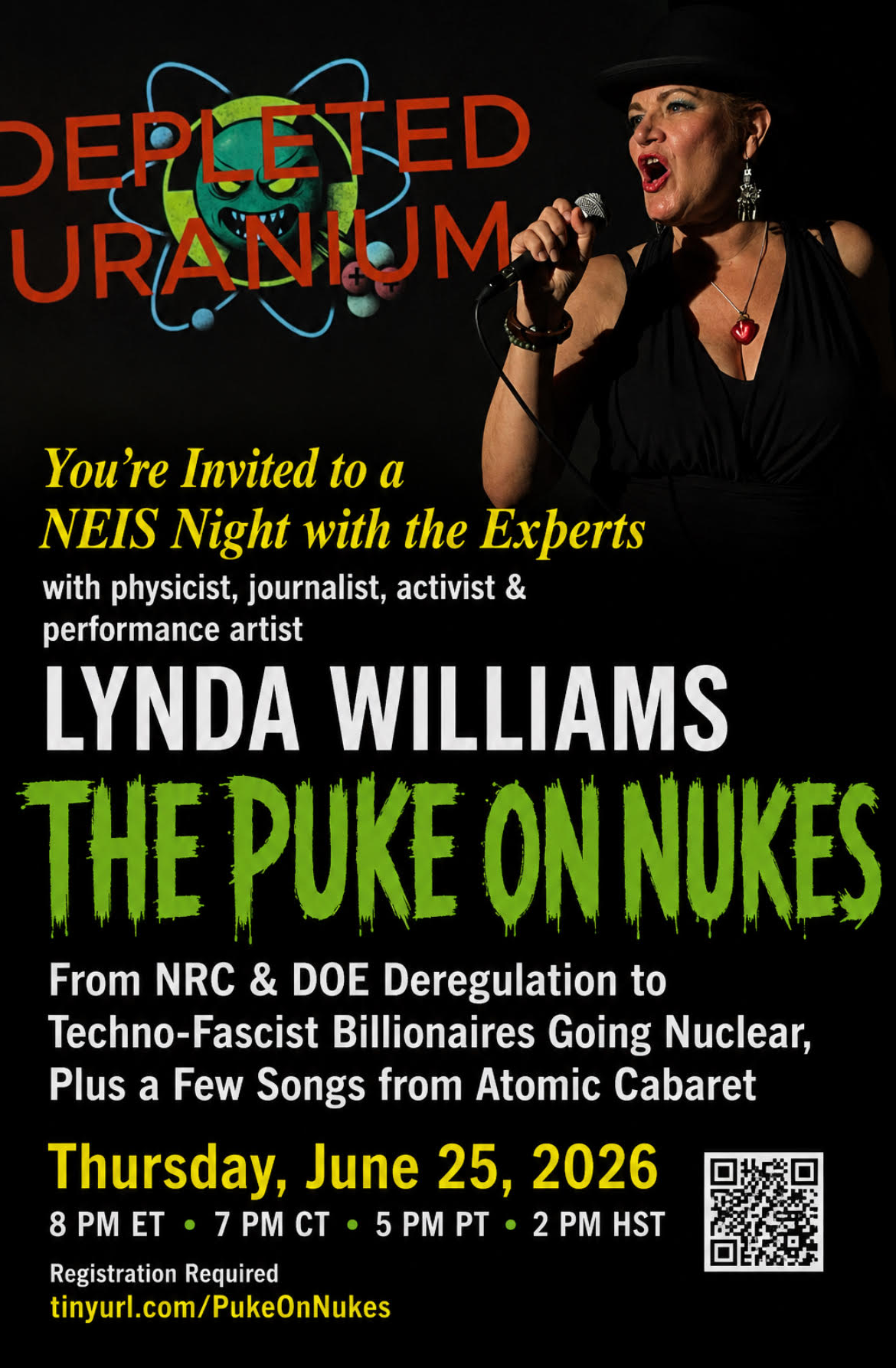
7pm Central Time (8pm ET, 6pm MT, 5pm PT) UTC – 5 From NRC & DOE Deregulation to Techno-Fascist Billionaires Going Nuclear, Plus a Few Songs from Atomic Cabaret REGISTER










 nuclear-news