 by WCYB, Wednesday, April 15th 2020 ERWIN, Tenn. — Multiple COVID-19 cases have been confirmed among Nuclear Fuel Services employees in Erwin.
The exact number of employees was not given.
April 16, 2020
Posted by Christina Macpherson |
safety, USA |
1 Comment
 Wildfires near Chernobyl under control, Ukrainian authorities say, By Jack Guy and Mary Ilyushina, CNN, April 14, 2020 The fires reportedly came within two kilometers of the Chernobyl nuclear power plant.
April 14, 2020
Posted by Christina Macpherson |
incidents, Ukraine |
Leave a comment

Blaze rages near Chernobyl, endangering abandoned nuclear plant https://www.mercurynews.com/2020/04/13/blaze-rages-near-chernobyl-endangering-abandoned-nuclear-plant/
“A fire approaching a nuclear or hazardous radiation facility is always a risk” By Margaryta Chornokondratenko and Alexander Marrow | Reuters
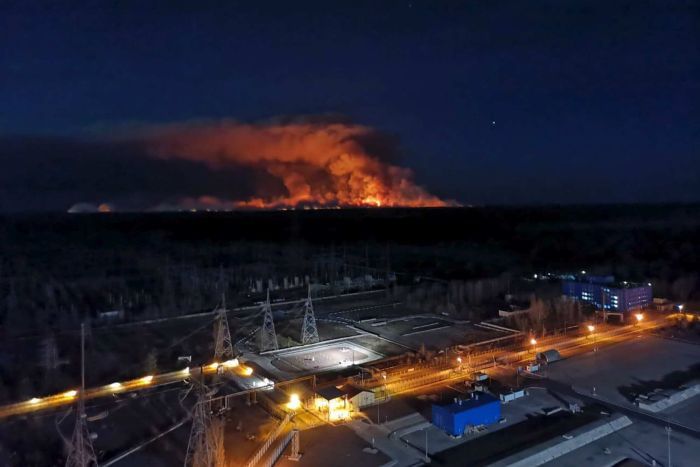
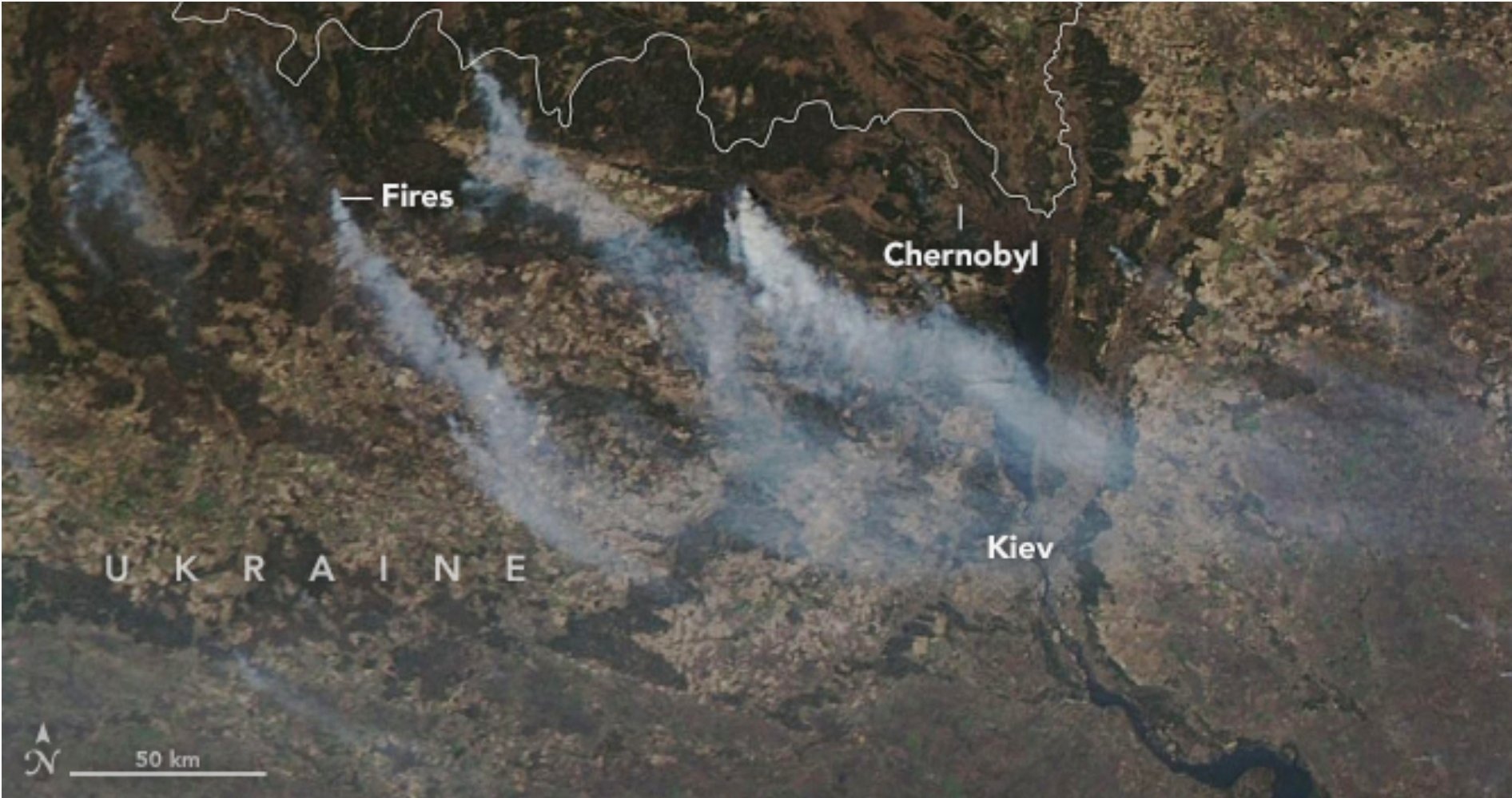
KIEV – A huge forest fire in Ukraine that has been raging for more than a week is now just one kilometer from the defunct Chernobyl nuclear power plant and poses a radiation risk, Greenpeace Russia warned on Monday, citing satellite images.
Ukraine’s Emergency Situations Service said it was still fighting the fires, but that the situation was under control.
Video footage shot by Reuters on Sunday showed plumes of black smoke billowing into the sky and trees still
ablaze, with firefighters in helicopters trying to put out the fires.
Aerial images of the 19 mile exclusion zone around the plant, site of the world’s worst nuclear accident in 1986, showed scorched, blackened earth and the charred stumps of still smoldering trees.
The Emergency Situations Service said radiation levels in the exclusion zone had not changed and those in nearby Kiev, the Ukrainian capital, “did not exceed natural background levels.”
Greenpeace Russia said the situation is much worse than Ukrainian authorities believe, and that the fires cover an area one thousand times bigger than they claim.
On April 4 Ukrainian authorities said the blaze covered an area of 20 hectares, but Greenpeace cited satellite images showing it was around 12,000 hectares in size at that time.
“According to satellite images taken on Monday, the area of the largest fire has reached 34,400 hectares,” it said, adding that a second fire, stretching across 12,600 hectares, was just one kilometer away from the defunct plant.
Ukrainian officials did not immediately respond to a request for comment on those claims.
Rashid Alimov, head of energy projects at Greenpeace Russia, said the fires, fanned by the wind, could disperse radionuclides, atoms that emit radiation.
“A fire approaching a nuclear or hazardous radiation facility is always a risk,” Alimov said. “In this case we’re hoping for rain tomorrow.”
Chernobyl tour operator Yaroslav Yemelianenko, writing on Facebook, described the situation as critical.
He said the fire was rapidly expanding and had reached the abandoned city of Pripyat, two kilometers from where “the most highly active radiation waste of the whole Chernobyl zone is located.” He called on officials to warn people of the danger.
Satellite images taken by NASA Worldview and seen by Reuters showed the two fires had extended far into the exclusion zone.
The fires, which follow unusually dry weather, began on April 3 in the western part of the exclusion zone and spread to nearby forests. Police say they have identified a 27-year old local resident who they accuse of deliberately starting the blaze.
It remains unclear if the person, who has reportedly confessed to starting a number of fires “for fun,” is partly or fully responsible.
April 14, 2020
Posted by Christina Macpherson |
incidents |
Leave a comment
 Radioactive Waste Regulations – Scotland

The Ferret 12th April 2020, More than 5,000 business sites across Scotland are going to escape
judgement on their environmental breaches in 2020 because of the coronavirus pandemic. Environmental rules governing radioactive waste, fish farming, recycling and other sectors are also being relaxed by the Scottish
Environment Protection Agency (Sepa) to help companies cope with Covid-19.
The Faslane nuclear base and nuclear power plants have been given the green light to break safety limits on radioactive waste. Sepa has relaxed environmental rules for specific sectors, notably the military and civil
nuclear industry. A “temporary regulatory position statement” posted on its website offered radioactive waste exemptions to the Faslane navel base on the Clyde, as well as nuclear plants at Hunterston in North Ayrshire,
Torness in East Lothian and Dounreay in Caithness.
“During a significant outbreak of Covid-19 the ability of operators to run their operations may be compromised by a lack of available staff,” the statement said. “We expect operators to be ensuring that the impacts of Covid-19 on the environment are minimised. We recognise, however, that in some cases operators may be unable to comply for reasons beyond their control.” It added: “Any failure by the operator to comply with the conditions of their authorisation will not be treated as a non-compliance”. This only applied “where non-compliance with authorisation conditions is unavoidable and a direct result of emergency resulting from Covid-19 outbreak and will not lead to significant environmental harm,” Sepa said.
The Scottish Campaign for Nuclear Disarmament warned that more dangerous radioactivity could be discharged into the environment. “It is outrageous to suggest that the pandemic is a reason for relaxation of the regulatory
requirements,” said campaign chair, Lynn Jamieson. “Willingness to tolerate possible breaches of regulations by civil or military nuclear facilities demonstrates shocking inadequacy on the part of the Scottish Environment Protection Agency. Whose environment are they in place to protect?”
The nuclear-free group of local authorities also expressed concern. “These new rules from Sepa seem to allow further leeway on nuclear sites over the handling of radioactive waste,” said the group’s vice convenor in Scotland, Renfrewshire SNP councillor Audrey Doig. “Sepa should be very wary of relaxing rules and find ways of continuing to
regulate the industry in the robust, safe and secure way the public expects.”
https://theferret.scot/pollution-checks-coronavirus-crisis-sepa/
The National 12th April 2020
https://www.thenational.scot/news/18374483.polluters-given-free-pass-coronavirus-crisis/
April 14, 2020
Posted by Christina Macpherson |
safety, UK |
Leave a comment
|
 Nuclear Power Industry Must Not Use Covid-19 Pandemic to Neglect Safety, https://www.commondreams.org/newswire/2020/04/09/nuclear-power-industry-must-not-use-covid-19-pandemic-neglect-safety, Reactor refueling should halt during outbreak while safety measures are maintained Nuclear Power Industry Must Not Use Covid-19 Pandemic to Neglect Safety, https://www.commondreams.org/newswire/2020/04/09/nuclear-power-industry-must-not-use-covid-19-pandemic-neglect-safety, Reactor refueling should halt during outbreak while safety measures are maintained
TACOMA PARK, Maryland – The nuclear power industry should not be allowed to significantly increase nuclear safety risks while jeopardizing the health and wellbeing of power plant workers and entire communities within emergency planning zones already sheltering in place under a viral threat, says a safety expert at Beyond Nuclear, a national anti-nuclear watchdog organization.
As the incidences of the novel coronavirus (Covid-19) among nuclear power plant workers spread across the U.S. nuclear power fleet, the U.S. Nuclear Regulatory Commission (NRC) is poised to relax nuclear power plant safety inspections and maintenance required by reactor operating licenses.
The NRC will also allow nuclear utilities to require their control room operators, onsite security forces, fire brigades and other critical site personnel to work substantially longer fatiguing shifts.
The deferral of the safety-related tasks and relaxation of work hour controls are needed, they say, to comply with “social distancing” recommendations from the Centers for Disease Control (CDC) and to respond to the anticipated attrition of a workforce stricken by the highly contagious and debilitating pandemic.
Yet at the same time, the industry and the NRC are crowding nuclear power plants with as many as 1,600 workers, brought in from across the country, to conduct reactor refueling operations. Fourteen reactors are presently shut down, primarily for refueling, and more reactors are scheduled to halt for refueling through the end of May.
“The nuclear industry and its regulator, the NRC, are maximizing the industry’s power production by pressing onward with scheduled reactor refueling outages,” said Paul Gunter, Director of Reactor Oversight at Beyond Nuclear.
“Yet at the same time, they are using CDC Covid-19 guidelines to defer scheduled and required inspections and maintenance of critical safety components until the next refueling cycle eighteen months away,” he said.
“The regulator and the industry know full well that they are rolling in a Covid-19 Trojan Horse with these refueling crews travelling from one reactor site and community to the next,” said Gunter.
Workers at plants that are refueling, such as Limerick in Pennsylvania, have publicly expressed alarm at the overcrowded conditions, describing workers sitting “elbow to elbow” in canteens and computer labs, and saying they are “terrified” that this will lead to widespread infections of the novel coronavirus.
Despite this, the industry is also requesting that the NRC defer inspections and delay maintenance required under reactor operating licenses of critical safety components and systems, including steam generators and reactor emergency core cooling systems, until the next refueling cycle eighteen months away. It says this is in order to observe the CDC guidelines for slowing the growth of the pandemic, while maintaining a minimum onsite workforce still fit for duty at operating reactors.
In anticipation of more and more workers falling ill to the debilitating virus, the NRC and industry are collaborating to relax “fitness for duty” licensing requirements meant to prevent the over-fatigue of operators and other critical plant workers including security.
“Nuclear plant operators on extended 12-hour shifts, who can now be assigned to work two consecutive 84-hour weeks, will suffer excessive fatigue,” Gunter said. “This not only compromises their immune systems, but makes catastrophic mistakes more likely.” The infamous nuclear accident at the Three Mile Island Unit 2 nuclear power station near Harrisburg, PA in the early morning hours of March 28, 1979, was attributed to mechanical failure worsened by operator fatigue and error.
In response to the public health emergency brought on by Covid-19, which mandates social distancing, the operators at Braidwood 2 in Illinois, Comanche Peak 2 in Texas, and Turkey Point 3 in Florida have all requested an 18-month delay on inspections and maintenance of the thousands of steam generator tubes that are required to be examined during the current refueling outage in April and May 2020.
Steam generators are critical to both power operations and reactor safety, as the tubes represent 50% of the reactor pressure boundary and recirculate vital cooling water through the reactor core. The reactors’ harsh operational environment places extreme stresses on the heat transfer component, causing tube degradation from vibration, heat, radiation, corrosion and cracking that must be guarded against through routine inspection and maintenance.
The price for ignoring the condition of steam generator tubes can be high, as was demonstrated in February 2000 when a similarly deferred inspection was attributed to a steam generator tube rupture at the Indian Point Unit 2 nuclear reactor just 30 miles from New York City. The single steam tube rupture released radioactivity into the environment and could have been severe had the high pressure rupture caused a cascading guillotine effect on neighboring tubes and a loss of coolant accident.
“It is a reckless contradiction that the nuclear industry is using social distancing restrictions to defer inspections of steam generator tubes while threatening the spread of the virus through thousands of workers moving around the country to refuel reactors,” Gunter said. “Once again, the nuclear industry and a captured regulator are putting financial interests ahead of the wellbeing and safety of workers and the surrounding communities,” he said.
“The NRC should suspend these refueling outages and delay the restart of reactors currently down for refueling until a Disaster Initiated Review of the pandemic’s impact on emergency preparedness can be completed, something that the Federal Emergency Management Agency should already be doing with the NRC,” Gunter added.
“It is not hard to imagine the level of chaos that would ensue should a nuclear accident occur during the current coronavirus crisis,” Gunter continued. “Emergency preparedness plans are already inadequate, but the prospect of a mandatory mass evacuation at a time like this is an impossible choice,” he said. “It is the duty of the NRC and FEMA to ensure workable emergency preparedness plans and procedures are in place before restarting any of the reactors currently refueling,” Gunter concluded.
Beyond Nuclear also recommends strategically powering down some reactors in areas where there is reduced demand induced by the pandemic and pre-pandemic excess regional generating capacity. The workforces at shuttered reactors could then supplement those over-stretched at reactors still operating.“It is not hard to imagine the level of chaos that would ensue should a nuclear accident occur during the current coronavirus crisis,” Gunter continued. “Emergency preparedness plans are already inadequate, but the prospect of a mandatory mass evacuation at a time like this is an impossible choice,” he said. “It is the duty of the NRC and FEMA to ensure workable emergency preparedness plans and procedures are in place before restarting any of the reactors currently refueling,” Gunter concluded.
Beyond Nuclear also recommends strategically powering down some reactors in areas where there is reduced demand induced by the pandemic and pre-pandemic excess regional generating capacity. The workforces at shuttered reactors could then supplement those over-stretched at reactors still operating.“It is not hard to imagine the level of chaos that would ensue should a nuclear accident occur during the current coronavirus crisis,” Gunter continued. “Emergency preparedness plans are already inadequate, but the prospect of a mandatory mass evacuation at a time like this is an impossible choice,” he said. “It is the duty of the NRC and FEMA to ensure workable emergency preparedness plans and procedures are in place before restarting any of the reactors currently refueling,” Gunter concluded.
Beyond Nuclear also recommends strategically powering down some reactors in areas where there is reduced demand induced by the pandemic and pre-pandemic excess regional generating capacity. The workforces at shuttered reactors could then supplement those over-stretched at reactors still operating.
|
|
April 13, 2020
Posted by Christina Macpherson |
safety, USA |
Leave a comment

Raging forest infernos in Chernobyl Exclusion Zone burning for eight days are now ‘close’ to exploded nuclear reactor amid new fears of radiation contamination
- Wildfires burning through Chernobyl forests are nearing the nuclear reactor
- There are fears that flames could reach radioactive trucks and vehicles abandoned after the notorious 1986 power station explosion
- Kiev has deployed more than 300 people and 85 pieces of equipment By JACK WRIGHT FOR MAILONLINE, 13 April 2020
|
- Wildfires burning through radioactive forests in the Chernobyl Exclusion Zone are getting ever closer to the exploded nuclear reactor.Firefighters are rushing to build firebreaks around the sarcophagus covering the ruined plant in Ukraine amid swirling winds.
There are fears that flames could reach abandoned trucks and other vehicles contaminated from the disastrous 1986 explosion.
An extraordinary video from firefighter Andrei Kukib shows an emergency vehicle driving through the raging fire and smoke laying waste to the polluted ‘dead zone’.
Fires have been blazing for nine days in the almost uninhabited 1,000-square-mile exclusion zone surrounding the disused plant. On Tuesday, the fire covered some 87 acres, having tripled in size due to strong winds, the emergencies service said in a statement.
- There are fears of radiation in the ground unleashed by the infernos can reach nearest city Kyiv, the Ukrainian capital, and other populated areas.This could be worse if the flames reach the Chernobyl reactors.
Kateryna Pavlova, a senior official involved in the firefighting, said: ‘We have been working all night digging firebreaks around the plant to protect it from fire.’
She told The New York Times: ‘At the moment, we cannot say the fire is contained.’
More than 300 people and 85 pieces of equipment have been deployed daily in the fight to extinguish the flames which comes as Ukraine – one of Europe’s poorest countries – is also battling against coronavirus.
- The State Agency for Management of the Exclusion Zone – which Pavlova heads – has ordered in three Antonov planes (AN-32P) and two MI-8 helicopters which have air dropped more than 250 tonnes of water in the wildfires.Police said the blaze broke out after a man set fire to dry grass near the exclusion zone. The man was detained by Ukrainian police. Ukrainian authorities rejected the warnings of the acting head of the country’s state ecological inspection service, Yehor Firsov, who withdrew remarks made this week that ‘radioactivity is higher than normal at the heart of the blaze’.
Initially covered up by the USSR, the 1986 explosion sent radioactive fallout across Europe exposing millions to dangerous levels of radiation. People are not allowed to live within 18 miles of the power station, which is some 62 miles north of Ukraine’s capital city Kiev.
The three other reactors at Chernobyl continued to generate electricity until the power station finally closed in 2000.
A giant protective dome was put in place over the fourth reactor in 2016.
Fires occur regularly in the forests near the Chernobyl power plant.
|
|
April 13, 2020
Posted by Christina Macpherson |
climate change, incidents, Ukraine |
Leave a comment
|
A perverse invitation to nuclear disasters https://www.record-eagle.com/opinion/opinion-a-perverse-invitation-to-nuclear-disasters/article_f4d38e32-6534-11ea-8db3-0732b08237c0.html, BY M.V. RAMANA and CASSANDRA JEFFERY Mar 15, 2020
The anniversary of the Fukushima nuclear reactor accident in Japan was March 11, a disaster that led to widespread radioactive contamination and health impacts to hundreds of thousands. Emerging evidence suggests radiation from contamination is associated with increased incidence of thyroid cancers. The health impacts would’ve been worse if not for the evacuation of nearly 150,000 people from Fukushima. The accident must remind us what could happen with nuclear power plants in America, something worth attention in a time when states subsidize aging nuclear power plants through expensive bailouts to private utility companies.
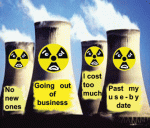 Most U.S. nuclear plants are aged. The average plant is nearly 40 years old, the same age Fukushima Daiichi was during its meltdown. Old nuclear plants are more susceptible to accidents, because equipment failures become more frequent as aging-related wear increases. Most U.S. nuclear plants are aged. The average plant is nearly 40 years old, the same age Fukushima Daiichi was during its meltdown. Old nuclear plants are more susceptible to accidents, because equipment failures become more frequent as aging-related wear increases.
The U.S. suffered severe accidents and close encounters with disaster, most notably the Three Mile Island reactor meltdown in March 1979. In March 2002, the Davis-Besse nuclear power plant in Ohio, owned by the electricity company FirstEnergy, almost experienced a meltdown. A routine but delayed reactor inspection found a “football sized” hole in the carbon-steel pressure vessel, which contains all the highly- radioactive fuel in the reactor. Boric acid leaked and corroded part of the structure, leaving all but a 3/8-inch-thick lining of stainless steel, which was never designed to contain the high-pressure water that cooled the reactor.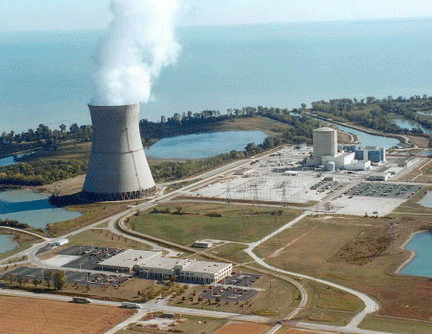
If the damage wasn’t discovered, the reactor could have experienced a serious accident, according to the Government Accountability Office. FirstEnergy also ignored numerous warnings from the Nuclear Regulatory Commission.
The parallels with Japan are unnerving. In February 2011, Japan’s Nuclear and Industrial Safety Agency extended Fukushima Daiichi’s operating license by 10 years. The regulatory agency kept the reactor operating despite knowledge of problems and warning signs, resulting in the March 2011 accident and subsequent health, environment, and economic consequences. Clean-up costs were estimated at $200 billion to over $600 billion (USD).
Fast forward to 2019, the Ohio governor signed House Bill 6, allowing FirstEnergy to extract $150 million annually from ratepayers. The massive subsidy aims to finance operations of the aging Davis-Besse nuclear plant, the Perry nuclear plant and two coal-based power plants. (There is no pretense of justifying the subsidy by claiming climate benefits.) Ohio electricity customers will pay a monthly surcharge to fund FirstEnergy’s profits
New York, New Jersey, Illinois and Connecticut have also introduced legislation to bail out aging nuclear power plants. Subsidies from consumers go toward profits of the electric utilities owning nuclear plants that were built decades ago. All of these are at risk of a severe accident.
Despite assurances about safety, nuclear reactors can undergo major accidents, albeit infrequently. No reactor design is immune to such accidents. There is always a residual risk that could lead to vast tracts of land being contaminated with radioactive substances that affect human health for long periods of time.
No matter which way you spin it, continuing to operate old reactors is inviting disaster.
About the authors: M. V. Ramana is the Simons chair in Disarmament, Global and Human Security and director of the Liu Institute for Global Issues at the University of British Columbia School of Public Policy and Global Affairs. Cassandra Jeffery is a graduate student of public policy and global affairs at the University of British Columbia. She is the recipient of a Simons Award in Nuclear Disarmament and Global Security and conducts research on energy policies in Asia and North America.
|
|
April 13, 2020
Posted by Christina Macpherson |
safety, USA |
Leave a comment
Energy Transitions 9th April 2020, David Lowry: Covid-19 spread shows up vulnerability at heart of nuclear
programmes, with resilience of UK critical national infrastructures undermined. The coronavirus’ effects act as threat multiplier, as David Lowry explains.
First indications that the dreaded coronavirus had penetrated the very heart of the UK nuclear sector came in on 15 March when Sellafield Ltd confirmed that a worker at the vast nuclear waste management complex – employing 13,000 workers – had tested positive for Covid19.
I asked the UK nuclear regulator what proportion of Office for Nuclear Regulation (ONR) staff being forced into simultaneous self-isolation would trigger a crisis that would not allow nuclear safety and security
regulatory oversight to continue effectively across the UK? And, if this situation arose, what executive regulatory decision would be required if all operating nuclear facilities could no longer be simultaneously regulated to a legal standard?
ONR responded, including the following thus: “All civil nuclear sites have minimum staffing levels, and contingency
plans should they fall below these levels, to enable them to remain in control of activities that could impact on nuclear safety under all foreseeable circumstances throughout the life cycle of the facility. In addition, licensees need minimum staffing levels to comply with their on-site and off-site emergency plans.
https://energytransition.org/2020/04/corona-crisis-hits-nuclear-sector/
April 12, 2020
Posted by Christina Macpherson |
safety, UK |
Leave a comment
Terrified Atomic Workers Warn That the COVID-19 Pandemic May Threaten Nuclear Reactor Disaster https://www.commondreams.org/views/2020/04/10/terrified-atomic-workers-warn-covid-19-pandemic-may-threaten-nuclear-reactor
Nuclear safety cannot be shortchanged—especially in the midst of an outbreak like what the nation is now experiencing, by Harvey Wasserman 10 Apr 20,
The COVID Pandemic has thrown America’s atomic reactor industry into lethal chaos, making a major disaster even more likely. Reports from “
terrified” workers at a Pennsylvania reactor indicate vital precautions needed to protect them may not even be possible.
Nationwide, with falling demand and soaring prices for nuke-generated electricity, the pandemic casts a dark shadow over reactor operations and whether frightened neighbors will allow them to be refueled and repaired.
America’s 96 remaining atomic reactors are run by a coveted pool of skilled technicians who manage the control rooms, conduct repairs, load/unload nuclear fuel. Because few young students have been entering the field, the corps of about 100,000 licensed technicians has been—like the reactors themselves—rapidly aging while declining in numbers. Work has stopped at the last two US reactors under construction (at Vogtle, Georgia) due to the pandemic’s impact, which includes a shrinking supply of healthy workers.
Every reactor control room requires five operators at all times. But the physical space is limited there and in plant hot spots that need frequent, often demanding repairs. Social distancing is virtually impossible. Long shifts in confined spaces undermine operator safety and performance.
Of critical importance: every 18-24 months each reactor must shut for refueling and repairs. Itinerant crews of 1000 to 1500 technicians travel to 58 sites in 29 states, usually staying 30-60 days. They often board with local families, or in RVs, hotels, or Air B&Bs.
Some 54 reactors have been scheduled for refuel/repairs in 2020. But there is no official, organized program to test the workers for the Coronavirus as they move around the country.
As the pandemic thins the workforce, older operators are being called out of retirement. The Trump-run Nuclear Regulatory Commission recently certified 16-hour work days, 86-hour work weeks, and up to 14 consecutive days with 12-hour shifts.
Long-time nuclear engineer Arnie Gundersen warns of fatigued operators falling asleep on the job. He recalls at least one exhausted worker falling into the highly radioactive pool surrounding the high-level fuel rods. Operator fatigue also helped cause the 1979 melt-down that destroyed Pennsylvania’s Three Mile Island Unit Two.
The industry is now using the coronavirus pandemic to rush through a wide range of deregulation demands. Among them is a move to allow radioactive waste to be dumped into municipal landfills.
The NRC may also certify skipping vital repairs, escalating the likelihood of major breakdowns and melt-downs. Nearly all US reactors were designed and built in the pre-digital age, more than 30 years ago. Most are in advanced decay. Atomic expert David Lochbaum, formerly with the NRC, warns that failure risks from longer work hours and deferred repairs could be extremely significant, and could vary from reactor to reactor depending on their age and condition.
The industry has also been required to maintain credible public health response plans should those reactors blow. But pandemic-stricken U.S. hospitals now have zero spare capacity, multiplying the possible human fallout from an increasingly likely disaster.
Industry-wide the pandemic has brought working conditions to the brink of collapse. At Pennsylvania’s Limerick Generating Station, workers say they are “terrified” that the plant has become a “breeding ground…a complete cesspool” for the coronavirus. “I’m in a constant state of paranoia,” one technician told Carl Hessler, Jr., of MontcoCourtNews.
Others say social distancing is non-existent, with “no less than 100 people in the training room” and “people literally sitting on top of each other…sitting at every computer elbow to elbow.” Shift change rooms, Hessler was told, can be “standing room only.” At least two Limerick workers are confirmed to have carried the virus. COVID rates in the county are soaring.
Gundersen, a nuclear engineer, warns that limited control room floorspace and cramped conditions for maintenance can make social distancing impossible. “Some component repairs can involve five workers working right next to each other,” he says.
Because reactor-driven electricity is not vital amidst this pandemic downturn, the demand for atomic workers to “stay home” is certain to escalate. “I am concerned with Exelon & Limerick Nuclear Generating Station’s handling of the scheduled refueling—which has required bringing in workers from across the country during this pandemic,” says US Rep. Madeleine Dean in a statement likely to be repeated at reactor sites around the country.
“The potential increase of COVID-19 cases from 1,400 new workers not observing social distancing is staggering,” says epidemiologist Joseph Mangano of the Radiation and Health Project. “The Limerick plant should be shut until the COVID-19 pandemic is over.”
Indian Point Unit One, north of New York City, will shut permanently on April 28. Iowa’s Duane Arnold will close in December.
But Ground Zero may be Pacific Gas & Electric’s two 35-year-old reactors at Diablo Canyon. PG&E is bankrupt for the second time in two decades, and recently pleaded guilty to 85 felonies from the fires its faulty wires sent raging through northern California, killing 84 people. In 2010 a faulty PG&E gas line exploded in San Bruno, killing eight people.
Surrounded by earthquake faults, Diablo’s construction prompted more than 10,000 civil disobedience arrests, the most at any US reactor. PG&E now admits its two Diablo nukes will lose more than $1.2 billion this year, more than $3.4 million per day.
Amidst its bitterly contested bankruptcy, PG&E may be taken over by the state. But more than a thousand workers are slated in early October to refuel and repair Unit One, which the NRC says is dangerously embrittled.
Whether local residents concerned about both a nuclear accident and the spread of the coronavirus will let them into the county remains to be seen. So is whether they’ll be still operating by then.
With the future of the nuclear industry at stake—along with the possibility of more reactor mishaps—the whole world will be watching.
April 11, 2020
Posted by Christina Macpherson |
safety, USA |
Leave a comment
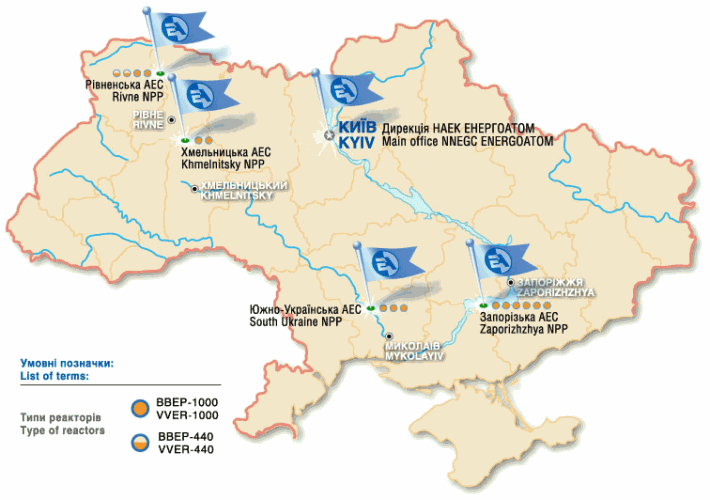
Ukrainian Nuclear Industry Workers Sound Alarm About Threat of ‘Another Chernobyl’ https://sputniknews.com/europe/202004101078906091-ukrainian-nuclear-industry-workers-sound-alarm-about-threat-of-another-chernobyl/ RIA Novosti . Alexei Furman 10.04.2020
Ukrainian firefighters reported that radiation levels at the Chernobyl Exclusion Zone spiked to over 16 times their normal level this week as wildfires continue to ravage the desolate, forested area. The fires are said to have unleashed radioactive elements previously trapped in soil and plants into the atmosphere, carrying them into the wind.
The Ukrainian Association of Veterans of Atomic Energy and Industry, a collective of retired officials including several former heads of nuclear power plants, have declared that the country’s nuclear energy sector is in a critical state and that there is a danger of “another Chernobyl.”
“A dire situation is taking shape in the country’s nuclear energy sector,” association members warn in a letter addressed to President Volodymyr Zelensky, the prime minister and speaker of parliament, and published by local media.
The letter alleges that Energoatom, operator of Ukraine’s nuclear power plants, has not had permanent managers working based on the relevant safety permits from nuclear regulators over a space of several months now. This, they say, means that “legally, no one is responsible for the safety of nuclear power plants.”
“Is it really the case that Chernobyl was not enough for us, and we are trying to repeat it again?” the appeal urges.
The letter also warns that Energoatom faces a critical shortage of financial resources necessary to ensuring the safe operation of plants and the procurement of fuel, and asks authorities if they understand what a forced shutdown of the country’s nuclear power plants could lead to (Ukraine depends on its nuclear power plants for about half of all the electricity generated in the country).
Complaining about what they say are ongoing efforts to have individuals with no knowledge of nuclear energy placed in senior positions at Energoatom, the retired nuclear industry workers ask whether authorities “realize that all of this is a gross violation of the international nuclear safety regime.”
Ultimately, the association says they are “not asking” nor urging, “but insisting” that authorities “stop the practice of [running Energoatom by] acting heads, stop the financial discrimination of Energoatom, and prevent the country from sliding toward another Chernobyl!”
The appeal was written by senior former industry officials, including Vladimir Bronnikov, former director of the Zaporizhzhia nuclear power plant, Vladimir Korovkin, former director of the Rivne nuclear plant, and Nikolai Shteynberg, former chief engineer of the Chernobyl nuclear power plant.
Ukraine’s Nuclear Power Plants
The Ukrainian nuclear power industry operates four power plants and 15 reactors, and has the seventh-largest nuclear power-generating capacity in the world. Starting in the mid-2010s, Ukraine began turning away from Russia’s Rosatom to US nuclear power company Westinghouse for its nuclear fuel rods. However, observers have expressed concerns over the safety of the US equipment, including amid reports that its nuclear fuel rods literally didn’t initially fit into Ukraine’s Soviet-era reactors.
In popular consciousness, Ukraine’s nuclear power sector is probably most commonly associated with the Chernobyl nuclear catastrophe, which took place on the night of April 26, 1986. The disaster was the result of an experiment simulating a power outage carried out by deputy chief-engineer Anatoly Dyatlov. The test saw the blatant violation of numerous safety regulations, with Dyatlov ordering the shutdown of multiple computerized and manual safety systems to proceed with the test. Ultimately, the ‘experiment’ led to an uncontrolled reaction and steam explosion, followed by a graphite fire. 54 people died in the disaster’s immediate aftermath and cleanup operation, with 4,000 more perishing from cancers and other illnesses in the two decades that followed, according to World Health Organization figures. The disaster also contaminated some 50,000 square kilometers of land across northern Ukraine, and up to 20 percent of the total land area of neighbouring Belarus.
Over three decades on, the fallout from Chernobyl continues to cause problems for Ukraine and its neighbours. This week, Ukraine’s emergency services reported that out of control fires in the forests of the Chernobyl Exclusion Zone had spread to cover at least 35 hectares of territory, leading to a massive spike in local radiation levels.
April 11, 2020
Posted by Christina Macpherson |
safety, Ukraine |
Leave a comment
Nuclear Free Local Authorities,( NFLA) 9th April 2020, A group of anti-nuclear Non-Governmental Organisations (NGO) and the UK & Ireland Nuclear Free Local Authorities (NFLA) remain highly alarmed that construction at the Hinkley Point C proposed new nuclear power station site is continuing, despite the extensive public lockdown and social distancing rules brought in across the UK.
These groups call for construction at Hinkley Point C to be reduced to control and maintenance operations only
until the Covid-19 public health emergency is under full control. This repeated call comes from the NGOs and NFLA following intensive lobbying of the UK Government, the Office for Nuclear Regulation (ONR) and the Somerset local authorities responsible for the Hinkley Point C site by many of these groups, including the local Stop Hinkley group.
It follows early photos from the site showing a crowded staff canteen and a lack of social distancing at bus queues and at entry and exit points.
NGO representatives and the NFLA have actively raised their concerns in meetings with senior officials of the UK Government and the Office for Nuclear Regulation, as well as with the UK Government Office for Nuclear Development. The StopHinkley group have also been in liaison with the local authority. A detailed letter was sent by the NGO Co-Chairs of the BEIS NGO Forum, the ONR NGO Forum and the NFLA on the 31st March when the photographs were first made public.
April 11, 2020
Posted by Christina Macpherson |
health, safety, UK |
Leave a comment
|
I n Cumbria 9th April 2020 n Cumbria 9th April 2020, Sellafield has announced it is extending the pause of construction work
across its nuclear site. Initially the firm has announced it would halt
construction work until April 8. But now it has been extended to April 27.
A company spokesman said: “Our pause on construction work has been extended
while we continue to identify the key work that needs to continue and which
of our key workers and supply chain are needed on site. “The pause includes
all construction work currently being undertaken by the Projects Delivery
Directorate and most other project work on-site, with some key exceptions
where stopping work could impact on nuclear safety.
https://www.in-cumbria.com/news/18369742.sellafield-extends-pause-work/
|
|
April 11, 2020
Posted by Christina Macpherson |
safety, UK |
Leave a comment
|
Chernobyl fires: Radiation fears as firefighters struggle to contain blazes in radioactive zone, 9 News, By AAP, Apr 10, 2020 Ukrainian firefighters are in their sixth day of battling fires within the Chernobyl exclusion zone amid concerns over radiation that has remained in the area since the nuclear disaster more than three decades ago.
More than 300 firefighters aided by several firefighting aircraft were working to contain the blazes, which in recent days have been exacerbated by high winds.
Authorities have more than doubled the number of firefighters in the area since Monday. The extent of the blazes has not been disclosed for the past two days.
Ukrainian firefighters are in their sixth day of battling fires within the Chernobyl exclusion zone amid concerns over radiation that has remained in the area since the nuclear disaster more than three decades ago.
More than 300 firefighters aided by several firefighting aircraft were working to contain the blazes, which in recent days have been exacerbated by high winds.
|
|
April 11, 2020
Posted by Christina Macpherson |
incidents, Ukraine |
Leave a comment
|
Ardrossan Herald 8th April 2020, Six safety incidents have been reported at Hunterston including concerns
about the nuclear plant’s cooling systems, fuelling machine and cracks in the reactors’ graphite core. The UK government’s safety watchdog, the Office for Nuclear Regulation, said that Hunterston had “failed to adequately account for” radioactive materials last October.
The Scottish Environment Protection Agency (SEPA) also disclosed that unauthorised radioactive “debris” was found in a supposedly empty fuel flask that had been returned to Hunterston from the Sellafield site. The Nuclear Free Local Authorities (NFLA) are calling for North Ayrshire Council to take more stringent measures regarding the plant and for EDF to close down old reactors. NFLA Scotland Convenor, Councillor Feargal Dalton said: “These
incidents confirm in our view that these aging reactors would be better being closed and the workers transferred into the long-term process of decommissioning Hunterston B.”
https://www.ardrossanherald.com/news/18353314.fresh-health-safety-concerns-hunterston-incidents-reported/
|
|
April 11, 2020
Posted by Christina Macpherson |
safety, UK |
Leave a comment











 nuclear-news