Ukraine Continues Fighting Fires Near Defunct Chernobyl Nuclear Plant
 Ukraine Continues Fighting Fires Near Defunct Chernobyl Nuclear Plant, Radio Free Europe, 27 Apr 20 KYIV — Firefighters in Ukraine continue to battle a series of fires near the defunct Chernobyl nuclear power plant nearly a month after they broke out.
The State Service for Emergency Situations said on April 27 that brigades were still working to extinguish fires in the Lubyanskiy, Paryshivskiy, Dytyatkivskiy, and Denysovytskiy forest districts in the Chernobyl exclusion zone.
“The main efforts are focused on the localization of two fire sites, smoldering stumps, wood segments, and peat-boggy soil,” the service said, adding that radiation in the area does not exceed permissible levels.
The fires began on April 3 in the western part of the uninhabited exclusion zone before spreading to nearby forests.
Ukrainian officials have said they have extinguished the fires several times, but new fires continue appearing in the area…… https://www.rferl.org/a/ukraine-continues-fighting-fires-near-defunct-chernobyl-nuclear-plant/30579563.html
Buildings around Fukushima Daiichi nuclear plant in poor condition, unsafe
The company says the condition of around 10 buildings, including the one that houses the No.4 reactor, have deteriorated due to the tsunami that triggered the accident and subsequent hydrogen explosions.
The NRA argues that the walls or other structures of these buildings could collapse in the event of an earthquake and injure people engaged in decommissioning work.
TEPCO says it will announce by the end of May how and when it will address the problem.
The utility also says it has inspected 340,000 pieces of equipment at the plant, and found that 36,000 of them lack devices that prevent leaks of radioactive materials as well as leak detectors.
Seven USA nuclear power stations allowed exemptions from working hour regulations
 Seven Nuclear Plants Get COVID-19–Related NRC Work-Hour Exemptions, Power Mag, Apr 23, 2020, by Sonal Patel To help nuclear generators manage worker fatigue amid the intensifying COVID-19 pandemic, the Nuclear Regulatory Commission (NRC) has so far granted individually requested exemptions from work-hour controls to seven U.S. nuclear power plants.As described by NRC Director of Nuclear Reactor Regulation Ho Nieh in March 28 letters sent to at least three industry leaders, the exemption from Part 26 of Title 10 of the Code of Federal Regulations (10 CFR 26.205(d)(1)-(7) is an emergency measure the federal regulatory body will consider on a case-by-case basis to help provide more flexibility as the sector grapples with COVID-19–related workforce issues…… Seven Nuclear Plants Get COVID-19–Related NRC Work-Hour Exemptions, Power Mag, Apr 23, 2020, by Sonal Patel To help nuclear generators manage worker fatigue amid the intensifying COVID-19 pandemic, the Nuclear Regulatory Commission (NRC) has so far granted individually requested exemptions from work-hour controls to seven U.S. nuclear power plants.As described by NRC Director of Nuclear Reactor Regulation Ho Nieh in March 28 letters sent to at least three industry leaders, the exemption from Part 26 of Title 10 of the Code of Federal Regulations (10 CFR 26.205(d)(1)-(7) is an emergency measure the federal regulatory body will consider on a case-by-case basis to help provide more flexibility as the sector grapples with COVID-19–related workforce issues……
The seven U.S. nuclear plants that have so far sought exemptions and expedited review received them from the NRC within less than 24 hours to 3 days. All plants described alternative controls for similar positions—including operators, health physics and chemistry, fire brigade, maintenance, and security. All requests also noted that near the end of the 60-day exemption period, if COVID-19 conditions persist, generators would consider submitting a request to extend the exemption period. Limerick (Exelon). Granted on April 3, the exemption for this two-unit plant near Philadelphia, Pennsylvania, is effective until June 2….. Ginna (Exelon). Granted on April 7, the exemption for the 576-MW plant in Ontario, New York, is effective until June 5. …. Quad Cities (Exelon). Granted on April 8, the exemption for this two-unit, 1,900–MW plant in Illinois, will be effective until June 9. Braidwood (Exelon). Granted on April 13 (and effective on April 20), the exemption for the 2,389-MW plant in Illinois will be effective until June 19. …… Seabrook (NextEra). Granted on April 13, the exemption for the 1,246-MW plant in New Hampshire will be effective until June 12. Seabrook 1 began an expected 27-day outage on April 1. On April 20, however, members of Congress sought details from the NRC about the process by which it is deciding to extend regulatory exemptions, and how the NRC will ensure the extended work-hour order does not compromise worker health and safety. The NRC’s general notification to nuclear licensees fails “to identify the regulations subject to exemptions or describe the criteria for their approval,” the lawmakers wrote. “The notification thus appears to offer the prospect of broad relief from regulatory requirements—including critical health and safety regulations—engendering confusion about how and why plants such as Seabrook could qualify.” In a statement to POWER on April 22, the NRC said it would respond to the lawmakers through its “existing correspondence process.” … Palo Verde (Arizona Public Service Co.). Granted on April 13, the exemption for the three-unit 3,937-MW Arizona plant will be effective until June 15…… Beaver Valley (Energy Harbor Nuclear Corp.). Granted on April 18, the exemption for the two-unit 1,872-MW plant in Shippingport, Pennsylvania, is effective until June 18….. The NRC is likely to grant more work-hour exemption requests as the pandemic intensifies in densely populated areas. ….. https://www.powermag.com/seven-nuclear-plants-get-covid-19-related-nrc-work-hour-exemptions/ |
|
|
Tsunami could overtake Fukushima Daiichi’s seawall
Tsunami could overtake Fukushima Daiichi’s seawall, https://www3.nhk.or.jp/nhkworld/en/news/20200422_03/
An estimate by a Japanese government panel suggests that tsunami could overwhelm a new seawall at the Fukushima Daiichi nuclear power plant, if a mega-quake occurs in a deep-sea trench off northeastern Japan.
The panel of experts on Tuesday released its projection of the scale of tsunami that could be triggered by a massive quake along the Japan Trench.
The panel expects that waves as high as 13.7 meters could hit Futaba Town, Fukushima Prefecture, where the plant is located.
That is higher than the 11-meter-high seawall being built on the ocean side of the compound. The wall is one of the anti-tsunami measures taken by Tokyo Electric Power Company as it decommissions the plant.
Other measures include blocking the openings of the reactor buildings and deploying power supply vehicles on higher ground to continue cooling spent nuclear fuel.
TEPCO says it will examine the estimate and consider what measures to take.
- Nearly 1,000 tanks of radioactive wastewater are stored in the compound. The operator says the projected tsunami won’t reach the higher ground where they are located
Nuclear Plants Allowed to Extend Workers’ Hours, Delay Inspections
|
Nuclear Plants Allowed to Extend Workers’ Hours, Delay Inspections, Insurance Journal,
By Will Wade | April 21, 2020 Nuclear power plants can now implement longer shifts for workers and delay some inspections, raising concerns that as the coronavirus pandemic upends basic operations the industry may be bending the rules too far.
The Nuclear Regulatory Commission is already allowing six U.S. power plants to extend workers’ shifts, to as long as 12 hours a day for two weeks, and more may be coming. That’s up significantly from current standards that require people to get two-to-three days off a week when pulling shifts that long. Employees can also work as many as 86 hours in a week now, up from 72 hours. To curb transmission of the virus, utilities also say they want to delay inspections that require people to work in close proximity. Environmental groups, though, warn the changes could have disastrous results, and worry they could lead to further deviations from safety rules. “This is a step backward,” said Eric Epstein, chairman of Three Mile Island Alert, a Pennsylvania non-profit group. “It’s not a good idea to stretch workers and marginalize safety standards.” The new rules come as at least 42 construction workers have tested positive for the coronavirus at a nuclear plant in Georgia where Southern Co. is building two new reactors. Last week, the utility and its partners announced they would reduce the 9,000-person workforce by 20% to slow the spread of the virus. The government considers nuclear power plants to be essential, and reactors will supply almost 21% of the country’s electricity this year……. watchdog groups are concerned that employees may be overworked, leading to fatigue and potentially errors. “You want an alert workforce,” said Paul Gunter, a director at Beyond Nuclear. “You don’t do this with bus drivers, but they’re saying it’s OK for nuclear power plant workers.” …… Nuclear watchdogs are paying close attention to four sites that have requested permission to delay tests on steam generator piping, including Exelon’s Braidwood. The agency already approved NextEra’s request for its Turkey Point plant in Florida. The pipes carry water at high pressure, allowing it to stay liquid even as temperatures reach 600 degrees Fahrenheit (316 degrees Celsius). They are supposed to be inspected every three years, with the job requiring people working in close proximity. Because of the virus, the operators are seeking to delay this until the next refueling cycle in 18 months……. https://www.insurancejournal.com/news/national/2020/04/21/565661.htm |
|
Japanese government panel warns on risk that tsunami could overwhelm Fukushima nuclear plant in future Japan earthquake
“A massive earthquake of this class (shown in the simulation) would be difficult to deal with by developing hard infrastructure (such as coast levees),” seismologist Kenji Satake, a University of Tokyo professor and head of the panel said Tuesday. “To save people’s lives, the basic policy would be evacuation.”A future mega-quake in the Japan Trench, which extends off Hokkaido, the northernmost of Japan’s main islands, to Boso Peninsula east of Tokyo, or in the Kuril Trench, which goes from Hokkaido to Russia’s Kuri Island, could yield disastrous results.
TEPCO currently stores about 1.2 million tons of radioactive water and only has space to hold up to 1.37 million tons, or until the summer of 2022. The water — leakage of contaminated cooling water from damaged reactors mixed with groundwater — has accumulated since the accident. It is constantly pumped up, treated and stored in tanks, while part of it is recycled as coolant.
The company said Wednesday it’s assessing the new government report…….. https://www.foxnews.com/world/tsunami-fukushina-nuclear-plant-japan-wrecked-future-earthquake-government-report-disaster
Formal petition to close Fermi 2 nuclear reactor in Michigan, from coalition of watchdog groups
Groups that include Beyond Nuclear and Don’t Waste Michigan have asked the Nuclear Regulatory Commission (NRC) to halt reopening within the next week or so of Fermi 2 — currently shut down for routine scheduled maintenance.
The petition was filed Thursday and requires an NRC review board to make an emergency decision on the application over the next week on whether the groups have valid concerns or that Fermi 2 be allowed to resume operations when its current outage for “refuelling” is completed.
“It is a very high-risk situation,” said Michael Keegan of Don’t Waste Michigan. “It is dangerous since the plant, should it reopen, will be operating in a compromised position. They have got a problem that could be a major nuclear accident.”
A spokesman for DTE, which owns and operates the nuclear generating station, said Sunday that proper maintenance and repairs are being conducted and that the facility is safe.
Thousands of residents in Amherstburg and Boblo Island are among those at greatest risk of a nuclear accident at Fermi — which sits across Lake Erie — but there are also potential health risks for thousands more stretching through LaSalle and into Windsor, as well as Michigan, should a Fermi 2 incident occur.
The petition calls on NRC to take enforcement action to inspect Fermi 2 and make full repairs to what’s known as the “torus,” a donut-type structure at the base of the reactor. ……. https://windsorstar.com/news/local-news/watchdog-groups-file-safety-concerns-on-fermi-2-nuclear-reactor/
With dry and windy conditions, new areas of ‘smoldering’ reported near Chernobyl nuclear plant
New areas of ‘smoldering’ reported near Chernobyl nuclear plant, Accu Weather, By Courtney Spamer, AccuWeather meteorologist, Apr. 18, 2020 A massive fire that broke out in northern Ukraine at the beginning of April is no longer said to be threatening the infamous Chernobyl nuclear power plant in the region. However, officials are monitoring hot spots as winds whip through the region.
The fire began to burn in the region back on April 3, near the town of Pripyat, located over two hours north of the country’s capital of Kiev and near the border with Belarus.
Police say they arrested a 27-year-old man who is being accused of starting the fire last week. On Monday, police said that another local resident burned waste and accidentally set dry grass ablaze.
The location of the fire was reportedly only one kilometer (less than one mile) away from the Chernobyl nuclear power plant, the site of the world’s largest nuclear catastrophe back in April 1986.
However, Greenpeace Russia, on Monday, warned that the fire being in close proximity of the power plant posed a radiation risk.
“Higher-than-usual” radiation levels were first reported by the AP on April 5, and are being carefully monitored as the fire continues.
According to Reuters, Chernobyl tour operator, Yaroslav Yemelianenko, shared on Facebook that the fire was only two kilometers away from where “the most highly active radiation waste of the whole Chernobyl zone is located.” He called on officials to warn people of the danger.
Emergency services said on Tuesday morning that there were still some acreage “smoldering” in the Chernobyl Exclusion Zone, but that the zone contained no open fire.
Acting Chairman of the State Environmental Inspectorate, Yegor Firsov, later said that the fire in the Chernobyl exclusion zone was extinguished, and cited some rain that moved through the region as one helpful factor.
Hundreds of firefighters, as well as several planes and helicopters, battled the blaze for 10 days.
………Strong winds increased the difficulty in containing what’s left of the blaze and new areas of “smoldering” were reported in the Exclusion Zone, but did not pose a threat to any critical facilities, reported officials……..
Dry weather across much of eastern Europe has allowed for a more volatile environment for fire to thrive.
Through April 13, only two percent of the month’s normal rainfall has fallen in Kiev. Since the beginning of 2020, the city has been much drier than normal, only recording 81 mm of rain instead of the average 150 mm.
The dry weather has also caused crop losses already this year across Ukraine, with further damage possible should the dry stretch continue.
Keep checking back on AccuWeather.com and stay tuned to the AccuWeather Network on DirecTV, Frontier and Verizon Fios.
Pennsylvania Department of Environmental Protection wants delay to license for moving radioactive Nuclear reactor 2 at Three Mile Island
Pennsylvania raises alarms on transfer of radioactive Three Mile Island reactor, State Impact, Pennsylvania, Susan Phillips , 17 Apr 20,
Citing financial concerns and the COVID-19 emergency, the Pennsylvania Department of Environmental Protection has asked the federal Nuclear Regulatory Commission to delay a decision over a license transfer of the radioactive Unit 2 reactor at the Three Mile Island nuclear power plant in Dauphin County.
The reactor, which sits on an island in the middle of the Susquehanna River, experienced a partial meltdown in 1979, the worst nuclear accident in United States history.
In an April 6 letter to NRC chair Kristine Svinicki, DEP Secretary Patrick McDonnell detailed a number of issues, including a lack of funds to properly clean up the site, unknown levels of radiation that remain on site, how and where the remaining radioactive materials will be disposed of, and how the process could affect the health of the Susquehanna River.
“The TMI Unit 2 nuclear accident resulted in damage to the majority of the reactor core, released millions of curies of radioactive noble gases into the environs, and grossly contaminated the interiors of the containment and auxiliary buildings,” McDonnell wrote in the letter. “… Despite the limited entries into the containment building to remove damaged nuclear fuel in the 1980s, there are vast areas in the plant with unknown radiological conditions related to the TMI Unit 2 accident. I firmly believe TMI Unit 2 is the most radiologically contaminated facility in our nation outside of the Department of Energy’s weapons complex.”
GPU Nuclear (now a subsidiary of FirstEnergy), the company that operated the plant during the meltdown, plans to transfer its license to Salt Lake City-based EnergySolutions, one of a few companies that purchase shuttered nuclear facilities to take over the decommissioning of the sites, with the goal of dismantling and disposing of radioactive materials cheaper and faster.
Each nuclear facility has a mandated trust fund — known as the Nuclear Decommissioning Trust Fund, or NDT, and financed with ratepayer dollars — to cover the costs of the decommissioning. Companies such as EnergySolutions and Holtec International, which bought the license of the shuttered Oyster Creek facility in New Jersey, hope to turn a profit by spending less than the dollars remaining in the trust fund to dispose of the radioactive waste.
Eric Epstein, chair of the anti-nuclear watchdog group TMI Alert, opposes the transfer and has petitioned the NRC for a hearing. Epstein argues that the transfer is an illegal taking of public funds.
“TMI-2 Solutions, an investment vehicle based in Delaware, wants to come in and clean the plant up, something that nobody’s been able to do in 41 years, and do it cheaper and faster than anybody else,” Epstein said. “… there’s over $1 billion in public money sitting in the decommissioning fund. And that’s what this is about, them coming in, taking the money, and then getting whatever is left over.”
Epstein said it’s an easy way for FirstEnergy to get the cleanup of the plant off its books. EnergySolutions has decommissioned a number of shuttered nuclear plants, including the Zion nuclear power plant in Illinois, the La Crosse plant in Wisconsin, the Fort Calhoun plant in Nebraska and the San Onofre plant in California.
Work done in the 1980s removed all the spent fuel at TMI Unit 2 and transferred it to a Department of Energy site in Idaho. The Three Mile Island site was decontaminated to the extent possible and sealed off. But some damaged fuel from the reactor vessel remains, as well as an unknown amount of radioactive material.
AmerGen, now Exelon, bought the neighboring TMI Unit 1 reactor in 1999, operating it until September, when Exelon shut it down. That plant will be put into what is called “SAFSTOR” status, in which the facility’s radiation is left to decay naturally over time, before the plant is dismantled.
GPU Nuclear continues to hold the license of TMI’s Unit 2. In October, EnergySolutions signed an agreement between FirstEnergy and its subsidiary GPU Nuclear. At the time, GPU Nuclear president Greg Halnon said the transfer to EnergySolutions freed FirstEnergy from its “decommissioning obligations.”
EnergySolutions created a joint venture with New Jersey-based construction company Jingoli to do the decommissioning of TMI-2, which they have named ES/Jingoli Decommissioning LLC. EnergySolutions also created a subsidiary known as TMI-2 Solutions.
The Nuclear Regulatory Commission published a notice in the Federal Register of review of the transfer on March 26, setting a 30-day period for public comment.
In his letter to the NRC, McDonnell, the Pennsylvania DEP secretary, said the recent shuttering and planned decommissioning of TMI-1 was never meant to jump-start the decommissioning of the contaminated remains of TMI-2.
“With the announcement of GPU Nuclear Corporation planning to shed its responsibility for TMI Unit 2 to TMI-2 Solutions, we now understand that TMI-2 Solutions plans to immediately begin the decommissioning of TMI Unit 2 with the accrued $800 million in the financial assurance fund that GPU Nuclear Corporation and the NRC currently control,” McDonnell wrote.
DEP pointed out in the letter that cost estimates for the clean-up for TMI-2 are $1.2 billion, but said it could be more given the unknown status of the unit, which has remained inaccessible for 27 years.
In a report issued to the NRC by GPU Nuclear dated March 18, 2020, the trust fund is listed at approximately $899 million, while the estimated clean-up costs are $1,353,638,075.
Epstein, who directs TMI Alert, said costs could run significantly higher.
“This company doesn’t have the experience or wherewithal to clean the place up,” Epstein said. “Their plan is to speed up the decommissioning. It’s on an island in the middle of a river. The building itself is radioactive.”
It’s unclear how the company will close the gap in funding and still make a profit, or who would be responsible for the clean-up should the current trust fund not cover the full costs…..
They’re operating off old data from the ’80s and ’90s in terms of the technical side of the equation,” he said. “And they’re operating off old data from last year in terms of the financial situation. We don’t think the money’s there.”
In a brief filed with the NRC, DEP attorneys asked for more time to review the company’s plan to make sure Pennsylvania taxpayers aren’t left holding the bag if the funds do run out.
DEP Secretary McDonnell also raised questions in his letter about where the radioactive material would end up, including whether any of the low-level waste would be disposed of in Pennsylvania landfills.
“Equally important, we require firm legal assurances that financial resources are available to complete decommissioning once started, including bonding between the Commonwealth and licensee,” he wrote. “I also expect no radioactive waste from TMI Unit 2 will be left on Three Mile Island.”…..
A spokesperson for the Nuclear Regulatory Commission said that “staff reviewing the application will carefully consider any comments submitted.”
Comments are due April 27. https://stateimpact.npr.org/pennsylvania/2020/04/17/pennsylvania-raises-alarms-on-transfer-of-radioactive-three-mile-island-reactor/
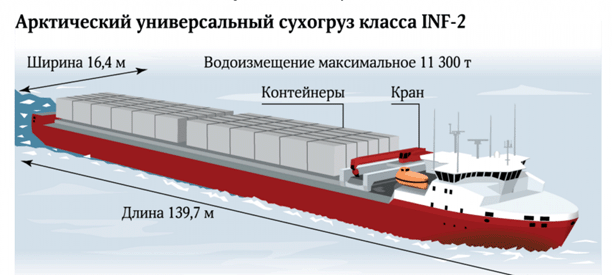
No easy fix for Russia’s troubled Arktica ice-breaker – delivery delayed for at least a year
|
Russia’s new Arktika nuclear icebreaker delayed for at least a year https://bellona.org/news/arctic/2020-04-russias-new-arktika-nuclear-icebreaker-delayed-for-at-least-a-yearA defective electric engine aboard Russia’s newest nuclear icebreaker has set off a cascade of difficulties that will postpone its scheduled May delivery date by at least several months, frustrating Moscow’s drive to tame Arctic sea routes as part of a broad economic plan. April 17, 2020 by Anna Kireeva, Charles Digges
A defective electric engine aboard Russia’s newest nuclear icebreaker has set off a cascade of difficulties that will postpone its scheduled May delivery date by at least several months, frustrating Moscow’s drive to tame Arctic sea routes as part of a broad economic plan. The problems aboard the Arktika icebreaker, slated to be the largest in the world, came to light in February, when a 300-ton electric propulsion motor on the vessel’s starboard side – which has nothing to do with the nuclear propulsion system – failed during sea trials. By this month, it has become clear to officials that there are no easy fixes are in sight, and that the delayed delivery of the enormous vessel from a St Petersburg shipyard to its stationing in Murmansk means a number of older nuclear powered will be forced to continue operations. “I don’t think we know all the details of this incident,” Andrei Zolotkov, a former nuclear icebreaker technician and the held of Bellona’s Murmansk offices, said. “The constant failure to meet the deadline to put new nuclear icebreakers into operation is already damaging to the builders’ reputations. The failure of the [electric motor] is another big minus.” The Artkika is the lead vessel of Russia’s LK60Ya nuclear icebreaker line, which Moscow sees as a central tool for developing the frozen Northern Sea Route, the Arctic shipping artery on which President Vladimir Putin has staked much of Russia’s economic future. Like its sister vessels – the Ural and the Sibir – the Arktika weighs in at a displacement of 33,500 tons, and measures 173 meters from bow to stern. The price tag of each new ship is about $550 billion. The Arktika’s twin RITM-200 reactors will deliver a combined 175 megawatts of power, making it the most powerful civilian vessel in the world. And like its sister vessels, the Arktika is named for an earlier nuclear icebreaker, in a nod to Soviet heyday of polar exploration. These newer vessels will be facing newer tasks. Putin has demanded that cargo tonnage flowing through the Arctic reach 80 million tons by 2024 – a huge increase over present levels – in hopes of making the Northern Sea Route a competitor to the Suez Canal. With these new vessels, Moscow say it can extend the annual navigation season in the polar region – which, even in the grip of climate change, is only about three months per year. But the Arktika’s delivery deadline to Atomflot, Russia’s nuclear icebreaker headquarters in Murmansk, has already undergone a series of revisions. The vessel has been on the drawing board since 2012, and was first due for commissioning in late 2017. When that date arrived, the deadline was pushed back to December 2019 – and that soon became May 2020. Such is the case for the Arktika’s sister vessels. Although the Baltic Shipyard in St Petersburg has floated their hulls, they have yet to be delivered to Murmansk and been at Atomflot. This leaves Moscow’s push to tame the Arctic running behind. To make up for the delays, Rosatom, Russia’s state nuclear corporation, has extended the operational lifetimes of three older icebreakers. As such, the Taymyr nuclear icebreaker, which began operations in 1987, will run until 2025. The Vaigach, launched in 1987, will run until 2027, and the Yamal, launched in 1989, will run through 2028. They will join the other old guard workhorse, the “50 let Pobedy,” or 50 years Victory, which Atomflot still has in operation. For the moment, prospects for the Arktika’s launch appear for this year. The faulty engine can’t be swapped with one from another icebreaker, and a new one can’t be built before 2021. That, said Zolotkov, might not stop the vessel from being delivered to Atomflot under so-called “trial operation” – a measure that allows various officials to claim at least some progress. But given the number of issues such a move would leave unresolved, Zolotkov discounted it as a possibility. “A vessel or ship should leave the shipyard in good order and ready for real work, and not imitate the fulfillment of plans and deadlines that have long been violated, ” Zolotkov said. |
|
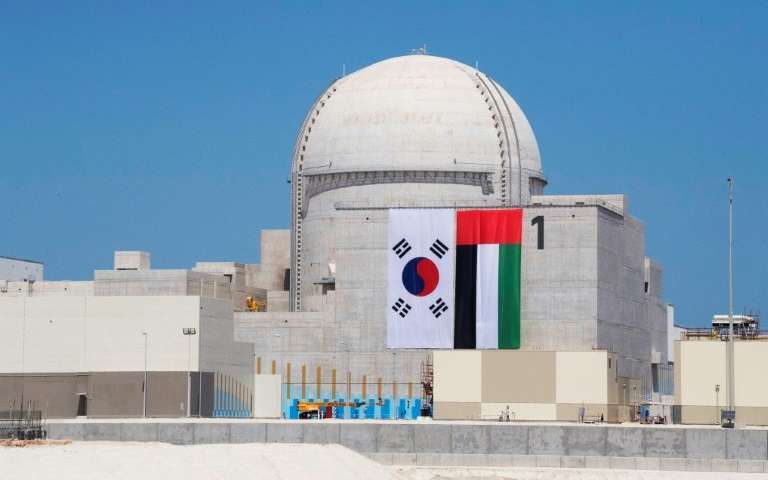
United Arab Emirates’ new ‘cheap and cheerful’ Barakah nuclear reactor adds to danger and Middle East tensions
|
The wrong reactor at the wrong time”: inside the UAE’s Barakah nuclear , Power Technology, JP Casey, 17 Apr 20,
The UAE has announced that the first reactor of its under-construction Barakah nuclear power plant is scheduled to come online within “a few months”. The country’s first nuclear plant could address a key energy need in the region, but questions remain as to its usefulness and safety in a geopolitically tense environment.
……. Located 53km from the city of Ruwais in Abu Dhabi’s Gharbiya region, construction on the $20bn project began in 2012, and is finally nearing completion. With four reactors, developed by the state-owned Emirates Nuclear Energy Corporation and the South Korea-based Korean Electric Power Corporation (KEPCO), the plant is expected to have an operating capacity of 5.6GW, which will account for one quarter of the country’s energy needs.
But behind these grand claims, the project has been dogged by controversy. From macro problems, such as the inherent dangers of building a nuclear reactor in a geopolitically tense region, to specific weaknesses with Barakah, such as the cracking of the cement used to build the facility itself, the project has no shortage of critics. With the UAE eager to continue with the project, its completion appears a matter of when, not if, opening up a series of lessons to learn ahead of new nuclear construction……
The plant is expected to produce 5.6GW of power once fully operational, with four reactors powered with APR-1400 technology, developed in South Korea, driving this production. This figure would make the plant the sixth-largest nuclear facility in the world by net production capacity, and its backers hope the project will help to kick-start an energy revolution in the Middle East. However, questions remain about the ultimate suitability of the plant, considering the risks inherent in nuclear and the potential for alternative sources of clean energy in the region. Dr Paul Dorfman, an honorary research associate at UCL and founder and chair of the Nuclear Consulting Group, an independent group of academics that aim to assess the risks and merits of nuclear projects, is sceptical about the suitability of Barakah for the UAE. So, given the fact – and it is a fact – that nuclear investment generates significant financial losses, one wonders if there are other reasons for Barakah,” he said. “Especially because nuclear energy seems to make limited economic sense for the Gulf States. As desert kingdoms, they have some of the best solar resources in the world, with solar having much, much lower investment and generation costs than nuclear.”
These solar resources are particularly significant considering the relative importance of renewable technology and nuclear power to the UAE’s 2050 climate goals. The nation aims to develop renewables as a primary source of power, and nuclear as a backup, a policy that could positively impact the solar industry, but hamstring the nuclear sector.
“Saudi recently tripled its renewable energy targets, and has successfully tended for large scale projects in wind and solar, with a Saudi-based consortium launching a world record low price of $17 per megawatt hour for a 900 megawatt solar park in Dubai itself,” said Dorfman. “So, worldwide and in the Gulf, the fate of new nuclear is linked to and determined by renewable energy technology rollout.” ……..
Dorfman is again concerned about these safety assurances, not only because of alleged mishaps at Barakah, but the generally lax approach to safety regulation across the nuclear sector.
“And what’s particularly worrying is the lack of a core catcher, which in the event of a failure of the emergency reactor core systems, would retain the nuclear fuel once it breached the reactor pressure vessel. On top of that, concrete cracking in all four reactor containment buildings hasn’t helped, nor has installation of faulty pilot-operated safety relief valves.”
 He also noted that KEPCO’s reputation has been somewhat tarnished by a series of scandals originating in 2013, where top safety officials were sentenced for falsifying safety documents for parts used in its nuclear reactors. 100 people were ultimately charged, as six of the country’s 23 operating nuclear reactors were shut down between late 2012 and late 2013, discrediting the reputation in which the UAE has placed such high stock to justify its safety moves at Barakah. He also noted that KEPCO’s reputation has been somewhat tarnished by a series of scandals originating in 2013, where top safety officials were sentenced for falsifying safety documents for parts used in its nuclear reactors. 100 people were ultimately charged, as six of the country’s 23 operating nuclear reactors were shut down between late 2012 and late 2013, discrediting the reputation in which the UAE has placed such high stock to justify its safety moves at Barakah.Finances may have played a key role in the involvement of KEPCO. The UAE awarded KEPCO a contract worth $20bn for the construction of the plant, a much lower bid than was made by other firms. In 2008, Synapse Energy predicted that new nuclear construction could cost up to $9bn for each 1.1GW plant; while this figure is not a specific measurement for all nuclear facilities, this prediction would place the expected cost of Barakah at around $45bn, more than double what KEPCO invested into the facility. “It’s a bit of a ‘cheap and cheerful’ reactor,” Dorfman added. Political damage The impact of these uncertain safety credentials could significantly discredit many of the world’s nuclear regulatory bodies, which have signed off on the Barakah plant despite these risks. Dorfman said that the plight of the facility highlights the “discretionary rather than mandatory” nature of nuclear regulation, where national governments are given exclusive responsibility to enforce operational and safety standards without the support of a strong international body. “The International Atomic Energy Association can attempt to control what’s happening, but it can’t necessarily say to anybody: ‘you will do this’ or ‘you will do that’, as we’ve found out to a cost in Iran, Pakistan, or Israel,” he said. The lack of a central global executive to take responsibility for safety, and the resulting burden on national governments, means nuclear power and nuclear safety are tied to national policy and local geopolitics in a way that is unlike any other energy source. Dorfman pointed to the example of the Houthi insurgency in Yemen, which saw rebel groups overthrow the Yemeni president Abd-Rabbu Mansour Hadi, who was allied with the Gulf states, in 2015. Two years later, the rebels claimed to have fired rockets at Barakah as a warning to the UAE against future involvement in Yemeni affairs, with the prospect of military strikes launched at a nuclear facility an obvious political, and potentially humanitarian, emergency.
“Following a very recent military strike against Saudi oil refineries, and all that implies, nuclear safety in the region increasingly revolves around the broader issue of security,” Dorfman continued, highlighting the pressure on the UAE government to ensure the security of the Barakah plant. “Tense Gulf strategic geopolitics makes new civil nuclear construction more controversial there than elsewhere,” said Dorfman, summarising many of the threats to local people and regional stability posed by the plant, which remain unresolved. “Once Barakah begins full-scale generation there will be a major maritime risk, whether directly intended or unintentional. “It’s the wrong reactor in the wrong place at the wrong time.” https://www.power-technology.com/features/the-wrong-reactor-at-the-wrong-time-inside-the-uaes-barakah-nuclear-plant/ |
|

Heavy winds fan new fires breaking out in Chernobyl exclusion zone
— New wildfires spread around Chernobyl nuclear plant, New Europe, By Elena Pavlovska, 17 Apr 20,
The state emergency service said three new fires had broken out, but were “not large-scale and not threatening”…..
The [previous] fire sparked concerns that clouds of radioactive smoke could be released and blow south towards Kyiv, after an activist posted a video online showing a cloud of smoke rising within sight of the protective dome over Chernobyl’s Unit 4 nuclear reactor. https://www.neweurope.eu/article/new-wildfires-spread-around-chernobyl-nuclear-plant/
Covid 19 outbreak causes EDF to extend outages of nuclear reactors for several months
 EDF extends nuclear reactor outages as virus outbreak hit maintenance plans PARIS (Reuters) 17 Apr 20, – French utility EDF on Thursday extended outages at three nuclear reactors including the Flamanville 1 and 2 facilities by several months as it adjusts its maintenance schedule due to the coronavirus outbreak.
The utility said earlier on Thursday that it expected a sharp drop in its domestic nuclear power output to a record low in 2020 as a result of the fall in business activity caused by the coronavirus.
EDF extended the outages at the 1,300 megawatt each Flamanville 1 and 2 reactors in the north of France by five months until the end of October.
It had already reduced staffing at the nuclear power plant to around 100 from 800 because of a cluster of coronavirus outbreaks in the area.
The reactors have been offline since September and January 2019 respectively for maintenance and had been scheduled to resume production at the end of May.
The company said that the outages could be extended due to complex maintenance activities.
It extended the production shutdown at its 1,300 MW Paluel 2 reactor by four months until Dec. 31, saying the “duration of the outage maybe be longer due to technical issues requiring the implementation of a new and complex process”.
The Paluel 2 reactor was halted in October for refuelling and maintenance and had been expected to resume on at the end of August.
Reporting by Bate Felix; Editing by Jan Harvey AT TOP https://www.reuters.com/article/us-france-nuclearpower/edf-extends-nuclear-reactor-outages-as-virus-outbreak-hit-maintenance-plans-idUSKCN21Y28P
Will nuclear refuelling workers at Limerick nuclear station spread Coronavirus to each other, and to the wider community?
 Coronavirus cases at Limerick nuclear station raised concern. Pa. plants say they’re working to prevent outbreaks during refueling outages, State Impact 15 Apr 20, Coronavirus cases at Limerick nuclear station raised concern. Pa. plants say they’re working to prevent outbreaks during refueling outages, State Impact 15 Apr 20,
Pennsylvania’s nuclear operators said they are taking extra steps to safeguard the health of workers involved in springtime shutdowns for refueling, following the positive testing of two workers for COVID-19 at Exelon’s Limerick plant in Montgomery County.
The cases of the two workers – who Exelon said Monday were resting at home – raised concerns that the hundreds of contractors who are needed to refuel the plants every 18-24 months would be unable to effectively practice social distancing, and would end up infecting each other and the wider community…….. https://stateimpact.npr.org/pennsylvania/2020/04/15/coronavirus-cases-at-limerick-nuclear-station-raised-concern-pa-plants-say-theyre-working-to-prevent-outbreaks-during-refueling-outages/ |
|
Coronavirus cases at Hanford nuclear waste site and at Nuclear Fuel Services
 Hanford Employee Being Tested for COVID-19; Cases Confirmed at Nuclear Fuel Services BY EXCHANGEMONITOR, 15 Apr, 20, Hanford Employee Being Tested for COVID-19; Cases Confirmed at Nuclear Fuel Services BY EXCHANGEMONITOR, 15 Apr, 20, An employee at the Hanford Site in Washington state is being tested for COVID-19, the Department of Energy said in an overnight post. …….
Hanford, like most other DOE nuclear cleanup sites, has drawn down to minimal operations during the federal public health emergency. Probably no more than 20% of its usual workforce remains on-site. To date, Hanford has not reported any positive COVID-19 results among its workforce of about 11,000 federal and contractor employees. Meanwhile, BWX Technologies subsidiary Nuclear Fuel Services on Tuesday reported multiple cases of COVID-19 among its workforce. The Erwin, Tenn., defense-uranium contractor did not say how many employees were infected, or how many potentially exposed employees were in quarantine following contact with the sick workers……
It was not clear whether the COVID-19 emergency response might delay any Nuclear Fuel Services contract milestones. Among other things, the company is producing low-enriched uranium to produce tritium in civilian nuclear reactors for National Nuclear Security Administration (NNSA) nuclear weapons programs. Nuclear Fuel Services also could wind up purifying defense uranium for the weapons program around 2023. The NNSA is negotiating with the company to act as a backstop for the Y-12 National Security Complex in Oak Ridge, Tenn., in a few years.
As of late last week, there were more than 50 confirmed cases across the NNSA’s nuclear weapons sites. There are currently at least nine confirmed cases at nuclear-cleanup programs overseen by the DOE Office of Environmental Management. https://www.exchangemonitor.com/nuclear-fuel-services-reports-covid-19-cases/?printmode=1
|
|
1 This Month



26 September – International Day for the Total Elimination of Nuclear Weapons


PLEASE OPPOSE HR 8255 AND S.3639 – bills would accelerate satellite deployment, with no environmental review or safeguards – https://ncstd5li.quorum.us/campaign/169331/
To see nuclear-related stories in greater depth and intensity – go to https://nuclearinformation.wordpress.com
-
Archives
- September 2026 (245)
- August 2026 (330)
- July 2026 (355)
- June 2026 (287)
- May 2026 (306)
- April 2026 (356)
- March 2026 (251)
- February 2026 (267)
- January 2026 (308)
- December 2025 (358)
- November 2025 (359)
- October 2025 (375)
-
Categories
- 1
- 1 NUCLEAR ISSUES
- business and costs
- climate change
- culture and arts
- ENERGY
- environment
- health
- history
- indigenous issues
- Legal
- marketing of nuclear
- media
- opposition to nuclear
- PERSONAL STORIES
- politics
- politics international
- Religion and ethics
- safety
- secrets,lies and civil liberties
- spinbuster
- technology
- Uranium
- wastes
- weapons and war
- Women
- 2 WORLD
- ACTION
- AFRICA
- Atrocities
- AUSTRALIA
- Christina's notes
- Christina's themes
- culture and arts
- Events
- Fuk 2022
- Fuk 2023
- Fukushima 2017
- Fukushima 2018
- fukushima 2019
- Fukushima 2020
- Fukushima 2021
- general
- global warming
- Humour (God we need it)
- Nuclear
- RARE EARTHS
- Reference
- resources – print
- Resources -audiovicual
- Weekly Newsletter
- World
- World Nuclear
- YouTube
-
RSS
Entries RSS
Comments RSS
 nuclear-news