Barrow, UK – hub of nuclear weapons work and nuclear transport
Close Capenhurst 10th May 2020, Barrow is best known as the place where BAE Systems build Trident nukiller submarines. The company is also building the Astute-class submarines.
What is less well know is that the ships which transport nukiller waste around the globe go out of the port of Barrow. Neither do most people realise just what else goes on in the town. Pacific Nuclear Transport Limited, a subsidiary of International Nuclear Services, is based at Barrow. The
company website boast that it is ‘the world’s most experienced shipper of nuclear cargoes’. Barrow is also the home port for James Fisher & Sons, which works for the military, and built its first ship suitable fortransporting irradiated nuclear fuel in the 1960s. The company also provides Nukiller equipment and services.
The search for the 4th hydrogen bomb dropped over Palomares, Spain
|
Who Do You Call When Nuclear Weapons Go Missing? Mathematicians. Here’s What You Need To Remember: With no witnesses, no debris and a search area in the least understood part of the world’s ocean, there’s little even mathematical wizards can do. But even then, few thought 50 years ago that the lost bomb of Palomares would ever turn up. National Interest, 10 May 20
When a routine Cold War operation went terribly wrong, two planes and seven men died, a village got contaminated and a hydrogen bomb disappeared.
The search and cleanup required 1,400 American and Spanish personnel, a dozen aircraft, 27 U.S. Navy ships and five submarines. It cost more than $120 million and a lot of diplomatic capital. And it made an obscure 18th-century mathematical theorem a practical solution to finding veritable needles in haystacks. Around 10 a.m. on Jan. 17, 1966, two B-52Gs of the 31st Bomb Squadron based out of North Carolina approached two KC-135 tankers over the Spanish coast southwest of Cartagena.
The bombers each carried four 1.5-megaton B-28 hydrogen bombs as part of Operation Chrome Dome, a U.S. deterrence mission that placed nuclear-armed bombers on the Soviet Union’s doorsteps. The resulting breakup destroyed the tanker in a fireball of blazing jet fuel. All four crew on board the tanker died. One hundred tons of flaming wreckage fell upon the arid hamlet of Palomares, near the Mediterranean Sea.
Three of the four H-bombs aboard the bomber fell there, too. Within 24 hours, a U.S. Air Force disaster team arrived from Torrejon Air Base near Madrid. Specialists from the Los Alamos and Sandia weapons labs — and Air Force logistics units — descended on the tiny rural town.
The search teams found the three H-bombs within a day. One landed on a soft slope, its casing relatively intact. The high explosives within the other two bombs detonated on impact, blowing 100-foot-wide craters in the dry soil and scattering plutonium, uranium and tritium across the landscape. The region’s long history of human habitation complicated the land search. Almeria, the province where Palomares sits, hosted a mining industry for more than 5,000 years. Countless mine shafts, diggings and depressions pepper its dry landscape made famous by the spaghetti westerns filmed there. ,,,,,,, https://nationalinterest.org/blog/buzz/who-do-you-call-when-nuclear-weapons-go-missing-152441
|
|
Nuclear Regulatory Commission plans a dangerous deregulation of radioactive waste
 Critics alarmed by US nuclear agency’s bid to relax rules on radioactive waste https://www.theguardian.com/environment/2020/may/07/nuclear-regulatory-commission-radioactive-waste
Nuclear Regulatory Commission keen to allow material to be disposed of by ‘land burial’ – with potentially damaging effects Daniel Ross 8 May 2020 The federal agency providing oversight of the commercial nuclear sector is attempting to push through a rule change critics say could allow dangerous amounts of radioactive material to be disposed of in places like municipal landfills, with potentially serious consequences to human health and the environment.
Currently, low-level radioactive waste is primarily disposed of in highly regulated sites in Texas, Washington, South Carolina and Utah. The Nuclear Regulatory Commission (NRC) also provides exemptions allowing “low-level waste” to be dumped in unlicensed disposal sites, but these exemptions are given only rarely, and are conducted with strict case-by-case protocols in place.
The proposed “interpretive” rule change relaxes the rules surrounding how radioactive materials would be disposed of in unlicensed disposal sites “significantly”, said Hirsch.
“If you dump radioactive waste in places that aren’t designed to deal with it, it comes back to haunt you. It’s in the air you breathe, the food that you eat, the water you drink,” he added.
In an email, David McIntyre, an NRC spokesperson, explained that the rule would apply only to a “small subset” of very low-level waste, and that the agency would not allow such disposals “if we felt public health and safety and the environment would not be protected”.
But major sticking point, say experts, concerns how the term “very low-level waste” is not defined by statute or in the NRC’s own regulations.
The NRC describes low-level wastes as contaminated materials like clothing, tools, and medical equipment. According to McIntyre, the radioactivity of “very low-level waste” is just above background. “The radioactivity level of very low-level waste is so low that it may be safely disposed of in hazardous or municipal solid waste landfills,” he wrote.
Nevertheless, “background doesn’t mean it’s safe,” said Diane D’Arrigo, radioactive waste project director for the Nuclear Information and Resource Service, who added that the interpretive rule’s loose language “opens the floodgates” for nuclear waste to be disposed of “as if not radioactive”.
The proposal caps the maximum annual “cumulative dose” to a person from the radioactive wastes dumped into unlicensed sites to 25 millirems – the same limit the NRC uses for highly regulated waste disposal sites. That measurement, said D’Arrigo, is a “projected” amount that can be manipulated through modeling.
Experts point out that the nuclear industry has long sought cheaper ways to dispose of its wastes. As the nation’s fleet of nuclear power plants continues to age, and as more of them approach retirement, some of the decommissioning funds set up to safely dismantle the reactors are proving inadequate.
“The NRC regulations are in effect a cost-benefit analysis,” explained Rodney Ewing, a professor of nuclear security at Stanford University. “It’s been a common trend to look for waste streams that, if separated out, they could be disposed of in less expensive ways.”
Some environmentalists fear the rule change will also disproportionately impact low-income, marginalized communities who are more likely than their wealthier neighbors to be situated near solid waste landfills.
According to Caroline Reiser, nuclear energy legal fellow with the Natural Resources Defense Council, if the proposal is successfully passed, then the issue could end up in court.
“Once it starts getting implemented, that’s when the real fights end up happening,” she said.
Lithuania presses Belarus to delay use of nuclear fuel, for safety reasons
|
Lithuania urges Belarus not to use nuclear fuel delivered to new power plant https://bnn-news.com/lithuania-urges-belarus-not-to-use-nuclear-fuel-delivered-to-new-power-plant-213078 After Belarus announced that nuclear fuel has been delivered to its new Astravyets nuclear power plant, Lithuania has called on Minsk not to load it into power productions facilities before international safety recommendations have been met, according to the Lithuanian Foreign Ministry.
On Wednesday, May 6, the issue was discussed in a telephone conversation between Minister of Foreign Affairs of Lithuania Linas Linkevičius and Minister of Foreign Affairs of Belarus Vladimir Makei.
Therefore, we urge Belarus not to load nuclear fuel into its nuclear power station until full implementation of the recommendations by international experts. We agreed to consult regularly on all these issues,» told L. Linkevičius as quoted by the Lithuanian Foreign Ministry. Lithuania’s Ministry of Foreign Affairs also sent a diplomatic note to Belarus, requesting the neighbouring state to give priority to safety rather than to the construction schedule, and to avoid jeopardizing its own residents, as well as citizens in other countries. A positive step in this direction, as is expected by Lithuania and the European Union, would be to halt the launch of the Belarusian NPP and to immediately organize an official EU expert review of the implementation of the stress test recommendations under the National Action Plan, as well as to promptly welcome a group of international experts that would monitor the process, the Lithuanian Foreign Ministry wrote in the press release. |
|
“Stand-down” of activities at Michigan nuclear reactor, due to certain number of COVID-19 workers
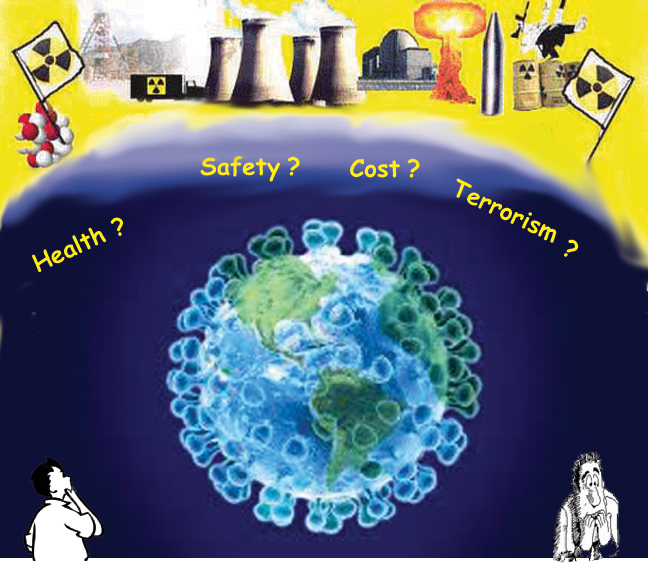 Pandemic concerns interrupt Michigan nuclear plant outage, S and P Global Platts, Author Michael McAuliffe EditorKeiron Greenhalgh CommodityElectric Power 8 May 20 Washington — Some work has resumed after a coronavirus pandemic-caused “stand-down” of activities at DTE Energy’s Fermi-2 nuclear reactor in Newport, Michigan, that interrupted a refueling and maintenance outage, company spokesman Stephen Tait said Thursday. The “stand-down,” in which contractor work was suspended, would add to the duration to the outage, which began March 21, but the company does “not provide estimates of outage or individual project durations,” Tait said.
DTE previously confirmed it had employees test positive for the novel coronavirus, but Tait said: “As a company, we are not releasing numbers of positive cases.”
The 1,205-MW plant is located in Monroe County, Michigan, and Kim Comerzan, health officer/director of the Monroe County Health Department, said in an interview Thursday the department is working with DTE Energy to determine the number of regular employees and contractors who have tested positive for the virus.
The stand-down began May 1, with some work resuming Monday. Normal crews that maintain the plant remained on the job over the weekend to ensure plant safety, according to Tait.
During refueling outages, hundreds of contract workers are brought in to supplement permanent staff and complete fuel replacement as well as a variety of maintenance tasks and inspections that can only been done with the reactor shut……..
Many nuclear units in the US and overseas have reduced the scope of outages to limit the number of on-site workers and are employing distancing measures to reduce the chance of spreading the novel coronavirus.
While some outages have been completed in shorter-than-normal times as a result, some have been extended both for health reasons and, in some European countries that are heavily reliant on nuclear power, because of a sharp drop in demand for power due to lockdowns related to the pandemic. https://www.spglobal.com/platts/en/market-insights/podcasts/focus/050620-lng-market-disruption-new-projects
The pandemic is a direct threat to Russia’s secret nuclear cities – says Rosatom chief
 Rosatom fears for its nuclear cities amid coronavirus pandemic, The head of
 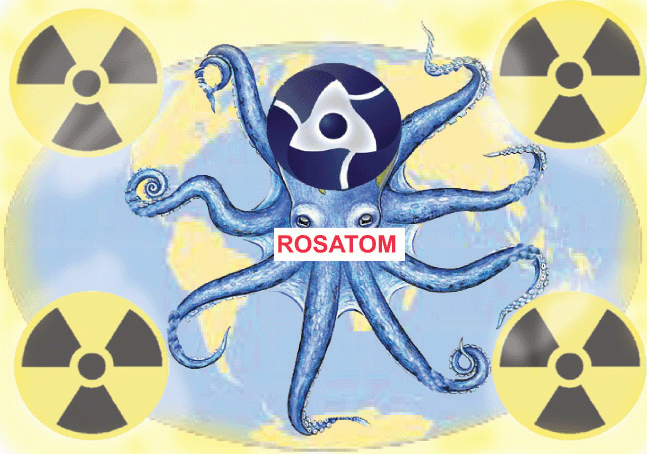 Russia’s state nuclear corporation has expressed concerns about the spread of the novel coronavirus to three of its so-called “nuclear cities,” including one that houses a top-secret research institute that helped develop the Soviet nuclear bomb. May 5, 2020 by Charles Digges charles@bellona.noThe head of Russia’s state nuclear corporation has expressed concerns about the spread of the novel coronavirus to three of its so-called “nuclear cities,” including one that houses a top-secret research institute that helped develop the Soviet nuclear bomb.
The cities hold a fabled place in Russia’s nuclear industry, which is managed by the state-controled Rosatom corporation. Most of them are closed to foreigners and even most Russians require special permission to enter them because of the top-secret facilities that many of them house.
In his most recent video appearance, Rosatom chief Alexei Likhachev said a special delivery of ventilators and personal protective equipment for medical workers has been sent to the city of Sarov and other closed towns where dozens of cases have been reported.
“This (pandemic) creates a direct threat to our nuclear towns,” Likhachev said in the video address on the Rosatom website – a communication method he has embraced since the beginning of the pandemic. “The situation in Sarov, Elektrostal, Desnogorsk is today particularly alarming.”
His remarks come as Russia reports a total of 155,370 cases of coronavirus infection and 1,451 deaths, making Russian the seventh most infected country, having surpassed China, Turkey and Iran last week.
The spread of the coronavirus has posed special challenges to the worldwide nuclear industry, where small groups of highly trained specialists are required to safely run reactors and manage nuclear fuel and radioactive waste services in close quarters.
In Russia, Rosatom has moved to sequester its nuclear technicians onsite at the plants and facilities where they work to minimize their exposure to carriers of the coronavirus.
Rosenergoatom, which is the utility subsidiary of Rosatom, hasn’t made clear precisely how many Russian nuclear workers have been put in isolation or ordered to shelter at their plants. But Rosatom controls a sprawling network of reactors, laboratories, commercial structures and fuel fabrication facilities that employ some 250,000 people.
Russia’s 11 commercial nuclear power plants operate a total of 38 nuclear reactors. Rosatom also has 36 power units at different stages of implementation in 12 countries around the world. It is currently constructing seven reactors overseas: two each in Bangladesh, Belarus and India, plus one unit in Turkey.
In a sense, Russian nuclear power and scientific facilities are uniquely designed to handle outbreaks of the virus. The 10 so-called “closed administrative territorial formations,” which were formed as part of the Soviet nuclear weapons program, are nearly entirely off limits for foreigners as well as most Russians.
The cities hosting Russia’s commercial nuclear plants, while less strictly separated from the rest of the country, are nonetheless surrounded by checkpoints and often require foreign visitors to get special permission to enter them.
As of last week, said Likhachev in his address, there were 47 infected personnel among the corporation’s ranks.
In the city of Sarov alone, there have been 23 cases of Covid-19, Likhachev said – 7 of them Rosatom employees.
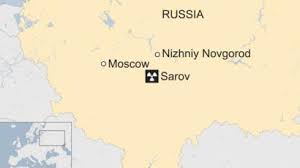
Known formerly as Arzamas-16, Sarov didn’t even appear on maps until the breakup of the Soviet Union in 1991. It remains home to the All-Russian Scientific Research Institute of Experimental Physics, which made headlines last year when five of its scientists died in a mysterious radiological explosion at a weapons testing site in the Russian Arctic.
The institute, which is now run by Rosatom, is an important part of Russia’s nuclear military complex. Likhachev indicated in his address that the workers who tested positive are affiliated with the institute.
In the city of Sarov alone, there have been 23 cases of Covid-19, Likhachev said – 7 of them Rosatom employees.
Known formerly as Arzamas-16, Sarov didn’t even appear on maps until the breakup of the Soviet Union in 1991. It remains home to the All-Russian Scientific Research Institute of Experimental Physics, which made headlines last year when five of its scientists died in a mysterious radiological explosion at a weapons testing site in the Russian Arctic.
The institute, which is now run by Rosatom, is an important part of Russia’s nuclear military complex. Likhachev indicated in his address that the workers who tested positive are affiliated with the institute.
Looking back to May 1986 – the exodus from Kiev, after the Chernobyl nuclear catastrophe

|
From the Guardian archive Chernobyl nuclear disaster Exodus from Kiev: aftermath of
 Chernobyl nuclear accident – archive, 1986 Chernobyl nuclear accident – archive, 1986
5 May 1986: Moscow has seen many Russians arriving by train from Kiev in the disaster area Martin Walker The first real signs of alarm among the Soviet public began to emerge over the weekend as Russians arriving by train from Kiev in the Chernobyl disaster area, began saying frankly that they were worried by radiation. “I am very glad to be able to be in Moscow at this time,” a young father, with two daughters, said on arrival at the Kiev Station in Moscow yesterday. “Of course I am worried about radiation. It is not something any government can control.”
There was no sign of any organised evacuation, and the exodus seems to be spontaneous, provoked by the highly publicised visit to the Chernobyl nuclear disaster area last Friday by the Prime Minister, Mr Nikolai Ryzhkov, and the party ideology chief, Mr Yegor Ligachev, perhaps the two most powerful men in the country after Mr Mikhail Gorbachev. Their visit to the area was clearly intended to continue the official campaign of reassurance and to fend off panic. It seems to be having the opposite effect, however. …… Japanese experts testing Moscow water, milk and foods in their embassy reported yesterday that they had found “low but distinct radiation,” which was the more alarming since winds had not carried the radiation direct to Moscow. The Japanese embassy and Japanese companies are now flying in milk, fruit and vegetables for their personnel. The head of the International Atomic Energy Agency, Dr Hans Blix, is to arrive in Moscow today, and Soviet authorities have promised to give him “full documentation” of the nuclear accident. But it is not clear whether he will be allowed to visit the site, or if he will be restricted to Moscow.
It emerged over the weekend that some rudimentary precautions were being recommended to the Soviet population. Soviet friends report that their children in Moscow schools had been told that some foodstuffs had been accidentally infected with rat poison in the city warehouses, and that all vegetables should be scrubbed and peeled. In Kiev, the Greek and Lebanese students still there have been warned by their Soviet liaison officials not to bathe or shower in the local water, nor to drink tap water, and to stay away from the local lake reservoir known as the Sea of Kiev. Bottled water had disappeared from Moscow shops yesterday…….. https://www.theguardian.com/environment/2020/may/05/exodus-from-kiev-aftermath-of-chernobyl-nuclear-accident-archive-1986
|
|
|
As UK’s Torness nuclear power station deteriorates, – cheaper to build renewables than to repair aging reactors
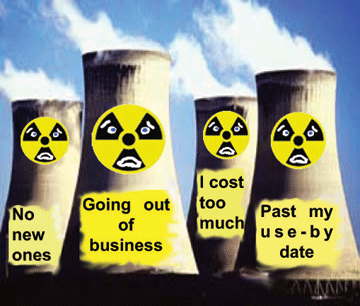 The Ferret 6th May 2020, Cracks that could increase the risk of a radioactive accident at Torness
nuclear power station in East Lothian will start appearing six years sooner than previously thought, according to the UK government’s safety watchdog. The Office for Nuclear Regulation (ONR) said that cracking which could cause debris to inhibit vital cooling of highly radioactive reactor fuel is now predicted to begin in 2022 rather than 2028.
After a major review ONR has given Torness permission to keep operating until 2030 –
but only if inspections to check for cracks are intensified. ONR promises
to “robustly challenge” the plant’s operators, EDF Energy, to ensure
that it “remains safe”.
Campaigners fear that Torness will become
increasingly unsafe, and warn it may have to close down sooner than
expected. EDF, however, insists that the station will keep generating
electricity safely until 2030. The coalition of 50 nuclear-free local
authorities in the UK has called on ONR to keep Torness under close
scrutiny. “These safety reservations surrounding the Torness periodic
safety review need to be cleared up as soon as possible,” said the
group’s Scotland convenor, SNP Glasgow councillor, Feargal Dalton.
“Whilst EDF is having to spend large resources trying to persuade the
regulator that it is safe to restart the Hunterston B reactors, this report
emphasises that similar issues with ageing are likely to arise at Torness
over coming years.” Councils would press ONR “to forensically
scrutinise what look like significant weaknesses in the EDF safety case,”
Dalton added.
“In the meantime, the Scottish Government should start
discussions about a ‘just transition’ for the workers at both
Hunterston and Torness so that Scotland can move to a safe, sustainable and
non-nuclear economy as quickly as possible.” The Edinburgh-based nuclear
consultant, Pete Roche, argued that it could be cheaper to build new
renewable capacity instead of continuing to operate ageing reactors.
“This could soon be the case with Torness, especially if it has to keep
being turned on and off to inspect the graphite core,” he said.
“Scotland clearly needs to be prepared for the possibility that Torness
might be forced to close not long after 2022.”
https://theferret.scot/torness-nuclear-reactors-cracking-2022/
More delay for Japan to open Onagawa nuclear power plant Unit 2: Unit 1 to be closed
|
Onagawa 2 upgrade faces further delay, WNN, 04 May 2020
The completion of safety countermeasures at unit 2 of the Onagawa nuclear power plant in Miyagi Prefecture, in Japan, will not be completed until March 2023, two years later than previously scheduled, Tohoku Electric Power Company announced on 30 April. Japan’s nuclear regulator concluded in February the unit meets revised safety standards, clearing the way for it to resume operation.
Tohoku expects to spend about JPY340 billion (USD3.2 billion) on the countermeasures, which include seismic reinforcement of Onagawa 2 and construction of a 29-metre high and 800m long sea wall to protect the plant from tsunamis. The company had originally planned to complete this construction work by April 2017, but the schedule has been pushed back a number of times. The latest plan had been for the countermeasures to be in place by the end of financial year 2020 (ending March 2021). However, Tokohu has now announced it has reviewed its upgrade works plan for Onagawa 2’s operation. Based on discussions it has had with the Nuclear Regulation Authority (NRA), Tohoku has decided to expand or revise its construction works for improving the facilities at the plant. As a result, the entire plan of construction work has been delayed and is now expected to be completed in FY2022 (ending March 2023). ……..
Tohoku has already decided to decommission unit 1 of the plant and is considering applying to restart unit 3. https://www.world-nuclear-news.org/Articles/Further-delay-in-completion-of-Onagawa-2-safety-up
|
|
The Southwest Research and Information Center says that rules are ignored in nuclear waste construction in New Mexico
|
Appeal: New Mexico ignored rules in OK of nuke site work, https://www.myhighplains.com/news/new-mexico/appeal-new-mexico-ignored-rules-in-ok-of-nuke-site-work/ by: SUSAN MONTOYA BRYAN, Apr 28, 2020, ALBUQUERQUE, N.M. (AP) — A watchdog group wants the New Mexico Court of Appeals to put the brakes on a key construction project at the nation’s only underground nuclear waste repository.The Southwest Research and Information Center alleges state environmental officials ignored regulations and past practices in giving temporary approval for contractors to begin building a new ventilation shaft at the Waste Isolation Pilot Plant. The state stands by its decision. A radiation release in 2014 forced the repository’s temporary closure. Resulting contamination limited the air flow underground, prompting the need for a new system so full-scale operations can resume. |
|
Comment Period For Proposed Nuclear Waste Dump In New Mexico extended by 60 days

 60-Day Extension Of Public Comment Period For Proposed Nuclear Waste Dump In New Mexico, KRWG, By NEWS EDITOR AND PARTNERS • MAY 2, 2020 U.S. Senators Tom Udall and Martin Heinrich, and U.S. Representatives Xochitl Torres Small, Ben Ray Luján, and Deb Haaland are welcoming an announcement from the Nuclear Regulatory Commission (NRC) that their March 20 request has been met and a 60-day extension on the public comment period will be implemented for the Draft Environmental Impact Statement for Holtec’s proposed spent nuclear fuel storage facility in Southeast New Mexico. Here is statement from the office of Senator Martin Heinrich:
“Allowing for full public participation, as NEPA requires, is particularly important for projects involving nuclear waste,” the delegation said. “Any proposal to store commercial spent nuclear fuel raises a number of health, safety and environmental issues, including potential impacts on local agriculture and industry, issues related to the transportation of nuclear waste, and disproportionate impacts on Native American communities.”…….https://www.krwg.org/post/60-day-extension-public-comment-period-proposed-nuclear-waste-dump-new-mexico
The pandemic poses a danger that is unique to the nuclear industry

The Hidden Nuclear Risk of the Pandemic The coronavirus crisis highlights the resilience problem of civilian nuclear power plants. https://thebulwark.com/the-hidden-nuclear-risk-of-the-pandemic/ by VICTOR GILINSKY AND HENRY SOKOLSKI APRIL 27, 2020
The coronavirus crisis has revealed a significant Achilles’ heel in civilian nuclear power: The plants can’t operate if their relatively few highly skilled operators get sick or become contagious and have to be quarantined, a situation that, according to news reports, some plants are getting close to. That puts a dent in nuclear-industry assertions that its plants provide a level of protection against natural events far beyond that of most other electricity suppliers.
In recent weeks, several vital institutions—police forces, food-processing plants, the U.S. Postal Service, not to mention health care providers—have reportedly been strained as personnel have become sick with COVID-19. As the pandemic spreads, it could create a problem for the smooth functioning of nuclear plants, as well. Just operating in safe shutdown state could be challenging. The details differ from plant to plant and are spelled out in technical specifications that are part of each plant’s federal license, but generally it takes a supervisor and several operators to man the control room and some number of maintenance staff. Altogether, counting all shifts, there may be a couple of dozen operators per plant. That doesn’t sound like much, but these are highly skilled personnel who are licensed to operate an individual plant. You can’t just pull in operators from elsewhere. If the licensed operators are unavailable because of disease or medical concerns, you are out of luck.
The Nuclear Energy Institute also argues that by contributing reliable power to military installations, nuclear energy “supports the nation’s ability to defend itself.” Yet here we have a type of emergency—involving a possible lack of operating staff—in which the nuclear plants could become a serious liability rather than an asset.
Nuclear plants are not without their advantages. But they also come with serious disadvantages, one of which—the safety imperative for constant, highly trained staffing no matter what—has become evident during the current pandemic. They are an inflexible source of energy that carries an enormous overhead in terms of safety and security, when what we need in our energy system for dealing with inevitable emergencies is not rigidity, but resilience.
UK ignored warnings about pandemic danger, cut health funding, spent up big on nuclear weapons
 Pride: why the UK spent billions on nuclear bombs but ignored Pride: why the UK spent billions on nuclear bombs but ignored  pandemic threat https://www.opendemocracy.net/en/opendemocracyuk/pride-why-uk-spent-billions-nuclear-bombs-ignored-pandemic-threat/ pandemic threat https://www.opendemocracy.net/en/opendemocracyuk/pride-why-uk-spent-billions-nuclear-bombs-ignored-pandemic-threat/
A viral outbreak was judged more likely than a nuclear attack – so why was Trident ring-fenced while NHS funding was cut? Richard Norton-Taylor 30 April 2020 We now know that the government was warned last year that a viral pandemic posed the greatest potential threat to the country. In a confidential briefing from the Cabinet Office, which was leaked last week, ministers were told that tens of thousands lives could be at risk if an outbreak occurred. Among the recommendations were stockpiling PPE (personal protective equipment) and establishing plans for a contact tracing system.
It was not the first time that warnings fell on deaf ears. In 2014, the Ministry of Defence advised that “alertness to changing trends” was vital to mitigating the likelihood of a pandemic. Senior civilian and military officials promptly shoved the report into a draw where it was left to gather dust.
To make matters worse, the austerity programme carried out over the last decade, has led to significant cuts to government projects and public services, including the NHS, that would ready us for a pandemic. There has, however, been one notable exception to the cuts – the country’s nuclear weapons arsenal. Tens of billions continue to be spent on weapons that are of no use against the types of attacks judged a possible threat to the UK in the government’s National Risk Register. The latest register, drawn up in 2017, refers only to the need to protect nuclear power stations and the possibility of chemical, biological and nuclear material attacks by terrorists. But it adds that terrorists’ use of conventional weapons is “far more likely”. Successive governments have described Britain’s nuclear arsenal as an “ultimate insurance” against an attack, or blackmail, by a foreign power. If that is the case, then why did the government not increase its healthcare spending as insurance against what it knew was a far greater threat – an infectious pandemic. Defenders of Britain’s nuclear weapons argue that they are needed for political reasons, to preserve Britain’s status as world power. But arguments about whether nuclear weapons would ever be considered a realistic or effective threat against a potential aggressor are dodged. Continue reading |
Coronavirus a big threat to Russia’s secret nuclear cities, as virus incidence rises

Concern as coronavirus threatens Russia’s closed ‘nuclear cities’ https://www.theguardian.com/world/2020/apr/28/concern-as-coronavirus-threatens-russias-closed-nuclear-cities
Rosatom nuclear chief warns of ‘particularly alarming situation’ in three areas as country reports biggest daily rise in cases, Reuters in Moscow 29 Apr 2020
Alexei Likhachev, Rosatom chief, said the pandemic ‘creates a direct threat’ to Russia’s nuclear cities.
The head of Russia’s state-run nuclear corporation has expressed concern about the spread of the new coronavirus to three “nuclear cities”, including one that houses a top-secret research institute that helped develop the Soviet atomic bomb.
The cities are closely linked to Russia’s nuclear industry, which is managed by the Rosatom corporation. Several are closed to foreigners and Russians require special clearance to enter them as facilities located there are closely guarded secrets.
Rosatom chief Alexei Likhachev said special deliveries of ventilators and personal protection equipment (PPE) were being sent to the closed town of Sarov, east of Moscow, and other towns where dozens of cases of the virus have been registered.
“This [pandemic] creates a direct threat to our nuclear towns. The situation in Sarov, Elektrostal [and] Desnogorsk is today particularly alarming,” he said in an online speech to Russia’s nuclear industry workers.
“The situation in Sarov is exacerbated by an outbreak of the illness in the nearby Diveyevo monastery,” he said, without elaborating further.
Likhachev made his remarks on a day when Russia reported its biggest daily rise in new coronavirus cases. Russia now ranks eighth worldwide with 93,558 confirmed cases, though its death toll of 867 is still far below that of many other countries.
Moscow, which accounts for more than half of Russia’s cases, and many other regions have imposed stay-at-home orders to curb the spread of the virus.
Sarov, which was so secret that it did not appear on maps until the breakup of the Soviet Union in 1991, remains an important part of Russia’s nuclear military complex, defence experts say.
It is home to a research institute that gained prominence last year when five of its scientists died in a mysterious accident at a military testing site in the far north.
Rosatom said the incident had occurred during a rocket engine test on a sea platform. Some US experts said they suspected it had been a botched test of a new missile vaunted by the president, Vladimir Putin.
Last week, Rosatom said seven people at Sarov’s All-Russian Scientific Research Institute of Experimental Physics had been diagnosed with coronavirus, bringing the total number of cases in the city – which has a population of about 95,000 – to 23.
It said the outbreak in Sarov had begun when a retired couple returned to the city from a Russian holiday resort and that more than 100 people had since been isolated to stop it spreading further.
USA Government prioritises nuclear industry over its duty to public health
As Pandemic Rages, Federal Nuclear Regulators Put Keeping Reactors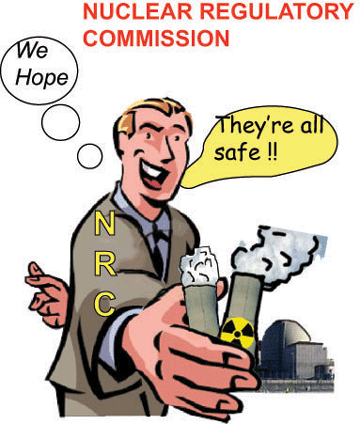 Running Ahead of Public Health and Safety https://www.ewg.org/energy/23141/pandemic-rages-federal-nuclear-regulators-put-keeping-reactors-running-ahead-public-27 Apr 20,
The federal government’s toothless nuclear “watchdog” has historically shown more concern for keeping dangerous aging reactors running than for Americans’ safety from a nuclear accident. So how is the Nuclear Regulatory Commission, or NRC, responding to the coronavirus pandemic?
-
-
- Letting nuclear power plants cut back their workforces to facilitate social distancing – but letting them make up for the reduced numbers by requiring the remaining control room operators and other key employees to work back-to-back 84-hour weeks, heightening the danger of worker exhaustion that could contribute to a reactor accident.Telling the agency’s on-site safety inspectors – two or more resident inspectors at each plant – to work from home, and allowing plants to defer required inspections of piping systems critical to cooling the reactors.
- Keeping reactor refueling crews of up to 1,500 technicians traveling from plant to plant, working in crowded conditions and staying in nearby communities, increasing the likelihood of crew members spreading the virus
The U.S. has 58 nuclear power plants housing 96 nuclear reactors in 29 states. Each plant employs 500 to 1,000 workers. Every 18 to 24 months, plants are powered down for four to six weeks for refueling, done in the spring or fall, when electric demand is low. According to the Nuclear Energy Institute, or NEI, the lobbying arm of the nuclear industry, refueling is scheduled at 56 plants this year.
On March 20, the NEI wrote the NRC to request that refueling crews have “unfettered access to travel across state lines” and unrestricted access to local hotels and food services, and to be prioritized for personal protective equipment. The NRC responded by allowing a reduction in the required number of plant personnel, and allowing an increased work week for remaining employees of 12-hour days for up to 14 days straight.
That worries Beyond Nuclear, a nonprofit that advocates “for an energy future that is sustainable, benign and democratic.”“Nuclear plant operators on extended 12-hour shifts, who can now be assigned to work two consecutive 84-hour weeks, will suffer excessive fatigue,” Beyond Nuclear’s director of plant oversight, Paul Gunter, said in a news release. “This not only compromises their immune systems, but makes catastrophic mistakes more likely.” The release cited the infamous Three Mile Island nuclear accident, in 1979, which it said was attributed to “mechanical failure worsened by operator fatigue and error.”
One week after the Nuclear Institute’s letter, the NRC directed resident inspectors to work from home, “only coming on site for risk-significant in-plant operations.” The agency has also allowed utilities operating the plants to request postponement of inspections and maintenance. “There are some ancillary activities during an outage that can be deferred,” an NRC spokesperson told Bloomberg.Among the “ancillary” activities that can be deferred is inspection of piping critical to cooling the reactors. Beyond Nuclear says three plants, in Illinois, Florida and Texas, have requested 18-month deferments of inspections of steam generator tubes that are subject to extreme heat, radiation and vibration. Failure of the piping, says the International Atomic Energy Agency, could lead to “core damage or large release events” of radiation.At least four nuclear plants – Fermi 2, near Detroit, Susquehanna, near Berwick, Pa., Limerick, near Pottstown, Pa., and Vogtle, near Waynesboro, Ga. – have seen cases of COVID-19
The Pottstown Mercury reports that local officials asked Exelon, the owner of Limerick, to postpone refueling because they found the company’s plans to address the pandemic inadequate. Regardless, the company went ahead with refueling and didn’t begin social distancing until workers told the press they were “terrified” that they’re working in a “breeding ground” for COVID-19.Nearly 30 Limerick workers have tested positive for the virus, according to The Philadelphia Inquirer. But Vogtle has by far the biggest outbreak, with 143 workers testing positive. It’s unknown how many nuclear plant workers nationwide have tested positive, because the NRC has not reported cases.“The key question,” Edwin Lyman, director of nuclear power safety for the Union of Concerned Scientists, told Utility Dive, “is how much additional risk will the NRC allow nuclear plants to accept in order to keep them running during the crisis?”Good question
-
1 This Month



26 September – International Day for the Total Elimination of Nuclear Weapons


PLEASE OPPOSE HR 8255 AND S.3639 – bills would accelerate satellite deployment, with no environmental review or safeguards – https://ncstd5li.quorum.us/campaign/169331/
To see nuclear-related stories in greater depth and intensity – go to https://nuclearinformation.wordpress.com
-
Archives
- September 2026 (245)
- August 2026 (330)
- July 2026 (355)
- June 2026 (287)
- May 2026 (306)
- April 2026 (356)
- March 2026 (251)
- February 2026 (267)
- January 2026 (308)
- December 2025 (358)
- November 2025 (359)
- October 2025 (375)
-
Categories
- 1
- 1 NUCLEAR ISSUES
- business and costs
- climate change
- culture and arts
- ENERGY
- environment
- health
- history
- indigenous issues
- Legal
- marketing of nuclear
- media
- opposition to nuclear
- PERSONAL STORIES
- politics
- politics international
- Religion and ethics
- safety
- secrets,lies and civil liberties
- spinbuster
- technology
- Uranium
- wastes
- weapons and war
- Women
- 2 WORLD
- ACTION
- AFRICA
- Atrocities
- AUSTRALIA
- Christina's notes
- Christina's themes
- culture and arts
- Events
- Fuk 2022
- Fuk 2023
- Fukushima 2017
- Fukushima 2018
- fukushima 2019
- Fukushima 2020
- Fukushima 2021
- general
- global warming
- Humour (God we need it)
- Nuclear
- RARE EARTHS
- Reference
- resources – print
- Resources -audiovicual
- Weekly Newsletter
- World
- World Nuclear
- YouTube
-
RSS
Entries RSS
Comments RSS
 nuclear-news