Transport of nuclear wastes – a Pandora’s Box of problems for North Texans
Transporting the waste to the New Mexico and West Texas facilities by rail car and through major cities, including those in the Dallas-Fort Worth region, could be a Pandora’s Box of problems for North Texans
|
High-level nuclear waste refers to spent, or used, reactor fuel and waste materials that exist after the used fuel is reprocessed for disposal. The radioactive waste poses potentially harmful effects to humans and only decreases in radioactivity through decay, which can take hundreds of thousands of years, according to the Nuclear Regulatory Commission, the federal agency that regulates nuclear power plants and the storage and disposal of waste. Activists who oppose the West Texas plan say the impact will not be limited to residents of Andrews County, where the toxic waste site owned by Waste Control Specialists already sits near the Texas-New Mexico border. The commission is considering a similar plan for a high-level waste storage facility in southeastern New Mexico, brought forward by the nuclear company Holtec. Transporting the waste to the New Mexico and West Texas facilities by rail car and through major cities, including those in the Dallas-Fort Worth region, could be a Pandora’s Box of problems for North Texans, said Lon Burnam, a former state representative and the chair of the Tarrant Coalition for Environmental Awareness. “We’ve created all this waste, there’s no good way to handle it, and the question is: What is the least objectionable way to handle it?” Burnam said. “But carting it all through Dallas-Fort Worth, from my perspective, is one of the worst ways to handle it. Why should we be the community that 90% of this stuff goes through on its way to either West Texas or the New Mexico side?” For years, the U.S. Department of Energy has struggled to find a long-term storage solution for the country’s growing stockpile of radioactive waste. With no permanent destination for safe disposal, more than 80,000 metric tons of highly radioactive nuclear waste sit at the country’s commercial nuclear plants, according to the U.S. Government Accountability Office. …… Texans have until Nov. 3 to submit online public comments on the report, which may be the last chance that the public has to voice opposition or support for the application…… https://www.star-telegram.com/news/state/texas/article245941215.html |
|

Tsunami risk for nuclear reactors on coastlines of India and Pakistan
Nuclear plants in Arabian Sea face tsunami risk https://phys.org/news/2020-09-nuclear-arabian-sea-tsunami.html, by SciDev.Net, 21 Sep 20, A major tsunami in the northern Arabian Sea could severely impact the coastlines of India and Pakistan, which are studded with sensitive installations including several nuclear plants, says the author of a new study.
“A magnitude 9 earthquake is a possibility in the Makran subduction zone and consequent high tsunami waves,” says C.P. Rajendran, lead author of the study, which was published this September in Pure and Applied Geophysics.
“Our study is a step towards understanding the tsunami hazards of the northern Arabian Sea,” says Rajendran. “The entire northern Arabian Sea region, with its critical facilities, including nuclear power stations, needs to take this danger into consideration in hazard perceptions.”
Atomic power stations functioning along the Arabian Sea include Tarapur (1,400 megawatts) in India’s Maharashtra state, Kaiga (being expanded to 2,200 megawatts) in Karnataka state and Karachi in Pakistan (also being expanded to 2,200 megawatts). A mega nuclear power plant coming up at Jaitapur, Maharashtra will generate 9,900 megawatts, while another project at Mithi Virdi in Gujarat may be shelved because of public opposition.
Nuclear power plants are located along coasts because their enormous cooling needs can be taken care of easily and cheaply by making using abundant seawater.
“Siting nuclear reactors in areas prone to natural disasters is not very wise,” says M.V. Ramana, Simons Chair in Disarmament, Global and Human Security and Director, Liu Institute for Global Issues, University of British Columbia, tells SciDev.Net. “In principle, one could add safety systems to lower the risk of accidents—a very high sea wall, for instance. Such safety systems, however, add to the cost of nuclear plants and make them even more uncompetitive when compared with other ways of generating electricity.”
“All nuclear plants can be subject to severe accidents due to purely internal causes, but natural disasters like earthquakes, tsunamis, hurricanes, and storm surges make accidents more likely because they cause stresses on the reactor that could lead to some failures while simultaneously disabling one or more safety systems,” says Ramana, who has worked extensively on nuclear energy.
Rajendran and his team embarked on the study after noticing that, compared to peninsular India’s eastern coast, tsunami hazards on the west coast were under-recognized. This despite the 8.1 magnitude earthquake that occurred in the Makran subduction zone in 1945.
The study relies on historical reports of a major disturbance that struck the coast of western India in 1524 that was recorded by a Portuguese fleet off Dabhol and the Gulf of Cambay, and corroborated by geological evidence and radiocarbon dating of seashells transported inland which are preserved in a dune complex at Kelshi village near Dabhol.
Modeling carried out by the team produced results suggesting that the high impact in Kelshi could have been generated by a magnitude 9 earthquake sourced in the Makran subduction zone during the 1508 —1681 period, says Rajendran. Subduction zones occur where one tectonic plate slides over another, releasing seismic energy.
As per radiocarbon dating of the shells, the inundation may have occurred during 1432—1681 and overlaps the historical reports of major sea disturbances in 1524 that were recorded by a Portuguese fleet of 14 ships led by Vasco da Gama, the man who discovered the sea-route between India and Europe.
A future mega-tsunami originating in the Makran subduction zone could not only devastate the coasts of Iran, Pakistan and Oman but also the west coast of India, says Rajendran, adding that alternate offshore quake sources are yet to be identified in the Arabian Sea.
The larger Indian Ocean features another tectonically active tsunamigenic source—in the Andaman-Sumatra region where the devastating 2004 Asian tsunami occurred. “The next tsunami, after our experience in 2004, will likely be on the west coast,” says Rajendran.
The 2004 tsunami claimed more than 250,000 lives and devastated the beaches of Indonesia, Thailand and Sri Lanka, and claimed lives as far away as Yemen, Somalia and South Africa. Significantly, an atomic power plant at Kalpakkam, on the coast of India’s south-eastern, Tamil Nadu state, was flooded.
Earlier studies, such as the one published in 2013 in Geophysical Research Letters, have indicated that tsunamis, similar in magnitude to the one caused by the 2004 Sumatra earthquake, could occur at the Makran subduction zone where the Arabian plate is subducting beneath the Eurasian plate by about 1.5 inches per year.
According to the 2013 study, the Makran is a wide-potential seismogenic zone that may be capable of generating a very significant (greater than 8.5 in magnitude) tsunamigenic earthquake that poses risks to the coastlines of Pakistan, Iran, Oman, and India.
Vinod Menon, a founder member of India’s National Disaster Management Authority tells SciDev.Net that the new study “raises pertinent questions on the seismic and tsunamigenic risks from a potential rupture of the Makran subduction zone.”
“The tsunami risk and vulnerability of the west coast has not received adequate attention in spite of a history of occurrence in the past as curated by the authors as well as previous studies,” says Menon, who adds that it is worth noting that there are far more sensitive installations around the northern Arabian Sea than in the Andaman-Sumatra region.
Ramana says that such studies serve as a warning against the risks and costs of setting up nuclear power plants in seismically vulnerable areas. “A decade after the 2011 disaster in Fukushima, the prefecture retains radioactive hotspots and the cost of clean-up has been variously estimated to range between US$20 billion and US$600 billion.”
Nuclear waste transport , and legal action – UK
Due to numerous safety issues with storage of high-level waste at Biblis, the BUND Hessen has filed a lawsuit saying it will take legal action against the now reinstated transport licence. With last Sunday’s local German elections in North Rhine-Westphalia, the Greens achieved a record result with 20% and there will be green mayors in the former capital Bonn, Münster and the anti-nuclear stronghold Aachen.
http://www.no2nuclearpower.org.uk/wp/wp-content/uploads/2020/09/Plain-sailing.docx
Relicensing Turkey Point nuclear station – a striking example of a dangerous action in climate change times

 With climate change, aging nuclear plants need closer scrutiny. Turkey Point shows why. https://thebulletin.org/2020/09/with-climate-change-aging-nuclear-plants-need-closer-scrutiny-turkey-point-shows-why/ By Caroline Reiser , September 14, 2020
Last December, two nuclear reactors at Florida’s Turkey Point Nuclear Generating Station, located 25 miles south of Miami, became the first reactors in the world to receive regulatory approval to remain operational for up to 80 years, meaning reactors that first came online in the 1970s could keep running beyond 2050.
The ages of the Turkey Point reactors are not unusual; of the 95 reactors currently licensed to operate in the United States, only five are less than 30 years old, while more than half are 40 or more years old. The Turkey Point reactors are a bellwether, just the first of possibly many aging nuclear reactors that will seek permission to stay online well into the middle of the century. Not long after the December decision, in March 2020, the US Nuclear Regulatory Commission granted two more reactors, located in Pennsylvania, the same extensions that it gave Turkey Point.
In pursing these extensions, the US commercial nuclear industry and its supporters collide with the realities of the aging US nuclear fleet and climate science projections. Existing safety and environmental requirements fail to provide the oversight necessary to ensure communities and the environment are protected. As nuclear reactors receive permission to operate for twice as long as originally envisaged, and in a world that, because of climate change, is drastically different from the one they were built for, the insufficiency of the existing regulatory framework is daunting.
A 40-year lifespan? At the beginning of its commercial nuclear power program, the United States designed and licensed reactors with a 40-year projected lifetime. Once the 40-year license is set to expire, regulations require the reactor owner to apply for a renewed license in order to continue operating for an additional 20 years. What the regulations don’t make clear, however, is the number of times a reactor license can be renewed. What Turkey Point received last year was not its first, but its second extension—what regulators call a subsequent renewed license. Continue reading
The coronavirus pandemic and the increased safety risks for nuclear reactors

Nuclear Alert: NRC & Nuke Safety In the Time of COVID-19 https://www.fairewinds.org/demystify/nuclear-alert-nrc-amp-nuke-safety-in-the-time-of-covid-19 September 14, 2020 By The Fairewinds Crew
First off, we would like to preface this by saying that the world simply cannot afford a meltdown or nuclear disaster on top of the already traumatic times wrought by Pandemic 2020.
Did you know that nuclear plants close for scheduled refueling every 18-months, meaning that 1/3 of the operating reactors are off-line each spring and fall? For the record, more than three dozen reactors had planned to do so in Spring 2020. The Nuclear Regulatory Commission (NRC) defines this rather temporary closing as an outage. During these outages, used-up nuclear fuel is replaced, and critical safety inspections are performed.
You may remember, that in early May, Maggie wrote extensively about the numerous safety risks to all of us if the nuclear industry continued operating these reactors during the COVID-19 Pandemic without implementing critical safety protocols and procedures. Along with 86 other organizations from all over the U.S., Fairewinds Energy Education nonprofit cosigned a letter to Vice President Pence and the COVID-19 Task Force detailing significant safety risks that must be addressed. You can read more about that letter and the increased safety hazards here. To date, we have received no response!
When the COVID-19 Pandemic began in late February, atomic reactor operators and owner corporations begged the NRC for special exemptions from regulatory requirements to implement critical safety and security inspections for up to two years! And, in an extreme example of regulatory capture, the NRC has approved all the corporate requested safety inspection delays, handing them out like candy to eager Trick-or-Treaters on Halloween! We know you have heard this before from the Crew at Fairewinds Energy Education, however, let us emphasize again that the federal laws [called statutes] that authorize the NRC, chartered it to protect ‘public health and safety’. Letting the industry continue to ignore critical safety inspections risks public health and safety!
During the past decade, the success in the growth of renewables has caused the nuclear industry to fight tooth and nail to keep operating even though nuclear power plants are much more expensive to operate than sustainable energy sources, and nukes charge much higher rates to consumers. Additionally, the risk of a disaster or other calamity has increased dramatically due to the old age of all current U.S. operating reactors. Instead of moving to solar and wind and shutting down these decrepit reactors, the energy and utility corporations are trying to reduce their higher operating costs by laying off employees and pushing the people remaining to work harder to save money and continue stockholder profit earnings.
Rather than slowing down these Spring refueling outages and allowing more time for inspections and repairs due to the extra burden the COVID-19 Pandemic has put on their employees and contractors, America’s nuclear monopoly has decided to risk ‘public health and safety’ – you remember what the federal law states – by reducing the amount of safety inspections the staff at each reactor was scheduled to perform. We agree that squeezing three or more people into a confined space for an inspection could be a recipe for COVID-19 transmission. However, slowing the inspection down and using fewer people at a time means having the reactor offline [shutdown] for a longer amount of time. In other words, the truth is that any operating schedule delay reduces each corporation’s profits.
Most atomic power reactors earn $1Million dollars in revenue every day. In addition, vice presidents, plant managers, and other corporate functionaries are on special bonus plans equivalent to between 40 and 70% of their salaries in a special year-end bonus. Such huge sums create a unique incentive for nuclear corporate executives to keep the outages as short as possible. When a vice president earns about $500,000, they will receive a $350,000 year-end bonus for meeting corporate goals, especially a short outage. We tend to notice that bonuses of that size cloud one’s judgment. Furthermore, we are reminded of Upton Sinclair when he so aptly said, “it is difficult to get a man to understand something, when his salary depends on his not understanding it.”
Is the risk of a disaster and a major radiation release to the surrounding community worth the extra millions of dollars earned by the corporate owner for starting these reactors up too soon? We don’t believe so.
Despite there being an abundance of available electricity without even using the atomic chain-reaction, the nuclear power operators and their corporate owners as well as the nuclear industry lobby are claiming that delayed testing will not cause a disaster and no nearby communities will be damaged or deal with the radioactive exposure to its residents.
Safety risks obviously increase because critical inspections are being delayed.
Seabrook nuclear power plant’s license extension upheld, with conditions
Seabrook nuclear power plant’s license extension upheld, with conditions, By Angeljean Chiaramida, 14 Sep 20, news@seacoastonline.com
SEABROOK – After nearly a year of analysis, the Atomic Safety and Licensing Board upheld the operating license amendment to NextEra Energy’s nuclear power plant in Seabrook.
The board in its 207-page ruling Friday, Sept. 11, however, imposed four additional conditions to address further on the alkali-silica reaction (ASR) concrete degradation issues within the plant’s structures…….. https://www.seacoastonline.com/news/20200914/seabrook-nuclear-power-plantrsquos-license-extension-upheld-with-conditions
A powerful message on the seismic dangers in Hinkley Point C nuclear construction. It would be cheaper to pull out now.
Radiation Free Lakeland 12th Sept 2020, Seismic Warnings – if not now when will the Government Scrap Hinkley C? This week there was yet another earthquake recorded in the Bristol area. It was small but significant, contributing to the well documented seismic activity of the area. If eyewatering costs, long delays, a mental and physical health crisis among the employees building Hinkley Point C are not enough to scrap this hubristic nuclear new build plan then the seismic warnings should be.
This insane project next to operational reactors has seen the geological stresses of the biggest pours of concrete in the UK
alongside three huge tunnels being bored below the seabed. German based multi-national company Herrenknecht built the hugely expensive tunnel boring machines which will be dumped under the Bristol Channel once done.
A total of 38,000 concrete segments are needed to support the tunnels, which would transfer 120,000 litres of water per second for the new nuclear plant when finished. The Bristol area is seismically active so to put increased geological stress deliberately in the vicinity of existing nuclear reactors is the kind of hubris that disaster movies are made of.
Scrapping Hinkley C now and paying off the developers would be far cheaper and far safer than continuing down this route to nuclear disaster.
Unmarked ?nuclear convoy with strong military police guard sweeps through Bristol city centre
This is the moment an unmarked military and police convoy stopped the traffic and stunned drivers and commuters as it swept through the city centre of Bristol this week.
The 14-vehicle convoy was captured on camera as it held up traffic on a main road into Bristol, and then headed out of the city on the M32.
The convoy began with a military police 4×4 car and then went on to include two police cars, three large police vans, another police 4×4, three large army people carriers and what appeared to be the subject of the guard of the convoy – four large LGV lorries with large unmarked containers on the trailers.
The brief video of the convoy was posted on social media within minutes of being spotted at around 7.50am on Wednesday, September 9 this week, and prompted a range of speculation as to what exactly was going on.
There was speculation that the convoy was operated by the AWE, the Atomic Weapons Establishment, an organisation which handles all the nuclear fuel for submarines and material for Britain’s nuclear weapons.
The AWE is based at Aldermaston, at a base just the other side of Newbury in Berkshire. People commenting on the video, which went viral on Facebook, said they had seen many similar convoys around that area, but they usually took place in the middle of the night so did not attract attention……… https://www.bristolpost.co.uk/news/watch-moment-unmarked-nuclear-convoy-4510383
Dominion Energy has filed to keep nuclear station in Virginia going for 80 years!
 Dominion files to keep Virginia’s North Anna nuclear plant operating 80 years, Utility Dive, 9Sep 20,
Dominion Energy announced on Friday it has filed with the U.S. Nuclear Regulatory Commission (NRC) for a 20-year extension of its license to operate two generating units at the North Anna nuclear power plant in Louisa County, Va.
More reports of drones flying near Paolo Verde nuclear power plant, and others, and over spent nuclear fuel storage sites
 Dozens More Mystery Drone Incursions Over U.S. Nuclear Power Plants Revealed, Forbes, David Hambling– 7 Sept 20, Forbes recently described how a swarm of drones flew in a restricted area at Palo Verde Nuclear Power Plant on two successive nights last September. A new cache of documents obtained under the Freedom of Information Act (FoIA) reveals how 24 nuclear sites suffered at least 57 drone incursions from 2015 to 2019 – and Palo Verde itself was overflown again in December, despite new security measures.
A 2003 report noted how vulnerable such pools were to terrorist action, simply by making a hole in the pool to drain out the cooling water and causing the stored fuel to overheat: “We warned that U.S. spent fuel pools were vulnerable to acts of terror. The drainage of a pool might cause a catastrophic radiation fire, which could render an area uninhabitable much greater than that created by the Chernobyl accident.”
Iran has halted numerous cyber-attacks on its nuclear plants
Iran announced that it had stopped a large number of cyber-attacks targeting its nuclear facilities, spokesman of the Atomic Energy Organisation of Iran (AEOI), Behrouz Kamalvandi, announced yesterday.
In a press release reported by news agencies, Kamalvandi said that the explosion which hit Natanz nuclear facility a few months ago was a result of a terrorist attack.
Kamalvandi added: “The details of the terror attack on Natanz are still at the hands of the security services. We cannot reveal them now.”……. https://www.middleeastmonitor.com/20200907-iran-halts-numerous-cyber-attacks-on-nuclear-plants/
Dominion Energy wants to prolong old nuclear reactors – yet again!
Dominion Energy applies for additional 20-year license for its North Anna Power Station nuclear reactor units, By JOHN REID BLACKWELL Richmond Times–Dispatch, 7 Sept 20,
Dominion Energy, Virginia’s largest utility company, is seeking approval from federal regulators to continue operating its two nuclear reactor units in Louisa County until the years 2058 and 2060.
The Richmond-based company said Friday it has filed an application with the Nuclear Regulatory Commission to renew the North Anna Power Station’s operating licenses for additional 20-year terms.
An approval of the license would allow the company to operate the two reactors beyond a current license extension that was granted in 2003, which enabled the company to run the reactors until 2038 and 2040.
The original licenses for the two North Anna reactor units were granted in 1978 and 1980. As with all U.S. nuclear power plants, the original licenses were granted for 40 years……….
The application has not been made public yet. The NRC staff will conduct an initial review and ensure that protected information such as security-related information is redacted before the application is made public.
Two other nuclear reactor plants in the U.S.—the Turkey Point Nuclear Generating Station in Florida and the Peach Bottom Nuclear Generating Station in Pennsylvania—already have received a second renewal for their reactor licenses. …. https://fredericksburg.com/news/local/dominion-energy-applies-for-additional-20-year-license-for-its-north-anna-power-station-nuclear/article_ad34f155-d01d-5a41-9e05-8a48fe78fcf5.html
The biggest nuclear site in Europe is at risk of blowing up
Why nuclear power is always going to be unsustainable
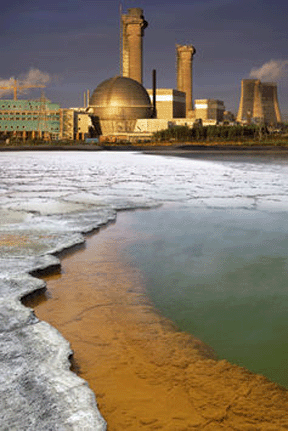
Energy Transition 3rd Sept 2020 The biggest nuclear site in Europe containing the world’s biggest stockpile of nuclear explosives is at risk of blowing up. What does this short-term decay tell us about the very long-term sustainability of a technology whose toxic waste last at least 24,000 years? Dr David Lowry takes a closer look.
|
|
Risks of cyberattacks on nuclear reactors
 Homeland Preparedness News 7th Aug 2020, The Nuclear Threat Initiative’s NTI Index shows that only 47 percent of countries have a response plan in place for a cyberattack on a nuclear
facility. Further, NTI reveals that most of those nations do not have
adequate regulations for cybersecurity. The NTI Index found that only 34
percent receive a high score for cybersecurity.
More of Britain’s ageing nuclear power stations are likely to close early
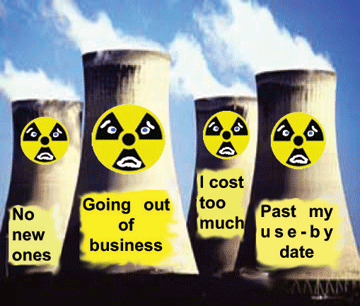 Times 6th Sept 2020, More nuclear power stations could close early as EDF wrestles with problems with patching up its ageing plants. The French power giant owns Britain’s fleet of eight nuclear power stations together with British Gas parent Centrica.
…………. just one new nuclear power station is being built, Hinkley Point C, in Somerset.
B in Somerset and Dungeness B in Kent.
happen sooner. It is currently not generating while its graphite core is inspected. EDF is due to make a decision on its future in November.
publication of a much-delayed energy white paper.
https://www.thetimes.co.uk/edition/business/nuclear-closures-pose-power-puzzle-d6bnnnrcs
1 This Month



26 September – International Day for the Total Elimination of Nuclear Weapons


PLEASE OPPOSE HR 8255 AND S.3639 – bills would accelerate satellite deployment, with no environmental review or safeguards – https://ncstd5li.quorum.us/campaign/169331/
To see nuclear-related stories in greater depth and intensity – go to https://nuclearinformation.wordpress.com
-
Archives
- September 2026 (245)
- August 2026 (330)
- July 2026 (355)
- June 2026 (287)
- May 2026 (306)
- April 2026 (356)
- March 2026 (251)
- February 2026 (267)
- January 2026 (308)
- December 2025 (358)
- November 2025 (359)
- October 2025 (375)
-
Categories
- 1
- 1 NUCLEAR ISSUES
- business and costs
- climate change
- culture and arts
- ENERGY
- environment
- health
- history
- indigenous issues
- Legal
- marketing of nuclear
- media
- opposition to nuclear
- PERSONAL STORIES
- politics
- politics international
- Religion and ethics
- safety
- secrets,lies and civil liberties
- spinbuster
- technology
- Uranium
- wastes
- weapons and war
- Women
- 2 WORLD
- ACTION
- AFRICA
- Atrocities
- AUSTRALIA
- Christina's notes
- Christina's themes
- culture and arts
- Events
- Fuk 2022
- Fuk 2023
- Fukushima 2017
- Fukushima 2018
- fukushima 2019
- Fukushima 2020
- Fukushima 2021
- general
- global warming
- Humour (God we need it)
- Nuclear
- RARE EARTHS
- Reference
- resources – print
- Resources -audiovicual
- Weekly Newsletter
- World
- World Nuclear
- YouTube
-
RSS
Entries RSS
Comments RSS
 nuclear-news