69 safety incidents and “near misses” on UK nuclear submarines
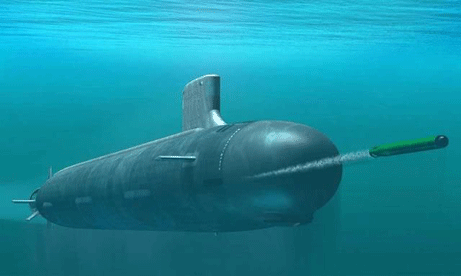 Reactor incidents on new nuclear subs double in one year, Herald Scotland, 21 Feb 16 The Royal Navy’s new nuclear-powered submarines have been plagued by 69 safety incidents and “near misses” over the last four years.
The Astute class of submarines based at Faslane on the Clyde has seen reported reactor incidents at sea or on shore almost double from 12 in 2014 to 21 in 2015. Though the MoD insists that the incidents are all minor, critics warn that they undermine the boats’ reliability and safety………
According to the independent nuclear engineer John Large, the submarines were suffering serious problems. “This continuing experience of the Astute class reactor problems not only imperils the boats when at sea but is likely to result in cutbacks to the number of patrols, voyage durations and the extent of roaming of the high seas,” he said.
John Ainslie, coordinator of the Scottish Campaign for Nuclear Disarmament, pointed out that Astute submarines had been involved in a series of mishaps, including running aground on the Isle of Skye. “It is only a matter of time before one of these incidents results in a serious nuclear accident,” he said……..http://www.heraldscotland.com/news/14291467.Reactor_incidents_on_new_nuclear_subs_double_in_one_year/
Stolen Radioactive Material: What Is Iridium-192?
Live Science, by Tia Ghose, Senior Writer | February 18, 2016 Some security experts are worried that a cache of radioactive material reportedly stolen from an oil field in Iraq could be used by organizations such as the Islamic State group to produce a dirty bomb.
A laptop-size case with about 0.35 ounces (10 grams) of the material, called iridium-192, allegedly went missing from an oil field storage facility in Basra that is run by the American company Weatherford,Reuters reported. Both the company and the Iraqi government declined to confirm the report.
“We are afraid the radioactive element will fall into the hands of Daesh,” a senior security official with the Iraqi government, told Reuters, using an Arabic acronym for the Islamic State group, also called ISIS. “They could simply attach it to explosives to make a dirty bomb.” [Doomsday: 9 Real Ways Earth Could End]……..http://www.livescience.com/53773-what-is-radioactive-iridium-192.html
Belgian terror suspect had video of high ranking nuclear official
 Belgium Finds Video of Nuclear Official at Home of Terrorism Suspect, NYT By MILAN SCHREUER and ALISSA J. RUBINFEB. 18, 2016 PARIS — A suspect linked to the Nov. 13 Paris attackers was found with surveillance footage of a high-ranking Belgian nuclear official, the Belgian authorities acknowledged on Thursday, raising fears that the Islamic State is trying to obtain radioactive material for a terrorist attack.
The existence of the footage, which the police in Belgium seized on Nov. 30, was confirmed by Thierry Werts, a spokesman for Belgium’s federal prosecutor, after being reported in the Belgian daily newspaper La Dernière Heure.
The news set off an immediate uproar among Belgian lawmakers, who charged that they and the country had been misled about the extent of the potential threats to the country’s nuclear facilities, as well as about the ambitions of the terrorist network linked to the Islamic State that used Belgium to plot the Paris attacks, which killed 130 people.
The International Atomic Energy Agency also confirmed on Thursday a report by Reuters that radioactive material had gone missing since November in Iraq, where the Islamic State controls broad areas of territory, adding to fears that the group may be able to acquire material for an attack with newly disconcerting dimensions.
The Belgian news media, citing sources close to the investigation, said that the surveillance footage had been retrieved from the home of Mohamed Bakkali, who was arrested after the attacks and is in detention on charges of terrorist activity and murder.
Belgian officials have asserted privately that Mr. Bakkali may have been involved in planning several attacks, not only those in Paris. There are currently eight people in detention in Belgium and charged with involvement in the November attacks.
The purpose of the footage retrieved by the Belgian police was not clear. But experts and officials speculated that it could have been part of a plot to abduct the nuclear official, who was not identified but had access to secure areas of a nuclear research facility in Mol, and force him to turn over radioactive material, possibly for use in a dirty bomb.
Sébastien Berg, a spokesman for Belgium’s Federal Agency for Nuclear Control, confirmed that the agency had been informed right away of the existence of the footage and said that employees had been told to increase their vigilance on the work floor. But he acknowledged that no additional guards had been hired or other measures taken to secure the perimeters of Belgium’s nuclear sites.
“We took increased security measures at all four Belgian nuclear sites, based on the general raised security alert in the country and on concrete indications that showed that the terrorists involved in the Paris attacks had the intention to do something involving one of our four nuclear sites,” Mr. Berg said.
Those sites include two power plants and a private company that produces medical isotopes, in addition to the facility in Mol, where scientists conduct research and experiments on radioactive waste to try to find safer ways to store it and reduce damage to the environment, Mr. Berg said.
One experiment being carried out involves the stocking of nuclear waste in bunkers dozens of meters underground, he said, adding that the facility had large stocks of nuclear waste on hand.
Members of Belgium’s Parliament expressed outrage in a regular session Thursday, saying that the interior minister, Jan Jambon, had told them in January that there was no specific threat to nuclear facilities……..
Extremist organizations have long expressed interest in obtaining radioactive material, and there is a market for stolen nuclear waste. News reports in October documented at least four attempts by Russian gangs to sell radioactive material in Moldova, which were thwarted by local officials in concert with the United States’ Federal Bureau of Investigation.
The International Atomic Energy Agency identified the material missing in Iraq as iridium-192, a highly radioactive isotope that is sometimes sought for use in dirty bombs.
Mr. Berg said that, if acquired, the material at the site in Mol could also be used to make a dirty bomb, which would spread radioactive material over the whole impact zone……. http://www.nytimes.com/2016/02/19/world/europe/belgium-nuclear-official-video-paris-attacks.html?_r=0
Radioactive packages lost or stolen in Canada
 Nuclear and Radioactive Packages Keep Going Missing in Canada, VICE News By Justin Ling
February 13, 2016 If you’ve ever lost your wallet or car keys, you’ve got something in common with the people who run Canada’s nuclear facilities, who keep misplacing nuclear and radiological material.
Last year alone, 14 radioactive packages were lost or stolen, according to the annual report from the Canadian Nuclear Safety Commission (CNSC), and less than half were later recovered. That’s on top of the dozen of other nuclear packages from recent years that have yet to be found.
The report doesn’t detail the circumstances of the losses or thefts, except to say that they were either “sealed sources” — a secure container carrying nuclear or radioactive material — or “radioactive devices.”
The lapses, at a time when security services pledge neurotic devotion to tracking and recovering dangerous goods that could reach the black market, are thanks in part to a handful of private companies that are mishandling radioactive material. n the nuclear watchdog’s 2014/2015 annual report, it identified 27 companies that were mislabeling or mishandling nuclear material, or which had inadequate security protections.
In some cases, CNSC lightly rapped the knuckles of companies, including a New Brunswick brewery which, according to the government body, had “several non-compliances related to safety requirements for nuclear gauges.”
Pump House Brewery, at the time, told CBC News that the problem amounted to some missed paperwork.
In other cases, the problems were more serious and resulted in fines…….https://news.vice.com/article/nuclear-and-radioactive-packages-keep-going-missing-in-canada
Fire/Explosion Reported at North Carolina Nuclear Plant
Officials:  — Emergency Alert Declared — Fire/Explosion occurred after “unexpected power decrease” in reactor — “Emergency response facilities staffed” — “Abnormal event with potential to impact plant equipment or public health and safety” (VIDEO) http://enenews.com/officials-emergency-alert-declared-nuclear-plant-fireexplosion-reported-after-unexpected-power-decrease-reactor-emergency-response-facilities-staffed-abnormal-event-potential-impact-public-he?utm_source=feedburner&utm_medium=email&utm_campaign=Feed%3A+ENENews+%28Energy+News%29
U.S. Nuclear Regulatory Commission, Feb 8, 2016 (emphasis added): Facility: BRUNSWICK [Nuclear Plant in N.C.]… Emergency Class: ALERT… EMERGENCY DECLARED… RPS [Reactor Protection System] ACTUATION – CRITICAL… MANUAL SCRAM AND ALERT DECLARATION DUE TO ELECTRICAL FAULT RESULTING IN FIRE/EXPLOSION… Unit 1 declared an Alert… due to an explosion/fire in the Balance of Plant 4 kV switchgear bus area.Prior to the Alert declaration, the operators initiated a manual SCRAM due to an unexpected power decrease from 88% to 40%. The licensee has visually verified that there isno ongoing fire and is investigating the initial cause of the event… [T]he licensee reported the following… “a manual reactor scram was initiated due to loss of both recirculation system variable speed drives as a result of an electrical fault. At this time, a Startup Auxiliary Transformer (SAT) experienced a lockout fault; interrupting offsite power to emergency buses 1 and 2. Emergency Diesel Generators (EDGs) 1, 2, 3, and 4 automatically started”… The licensee has notified… DHS, FEMA, USDA, HHS, DOE, DHS NICC, EPA… FDA… and Nuclear SSA…
WWAY, Feb 7, 2016: Electrical damage sets off alert at Brunswick Nuclear Plant… An Alert is the second in increasing significance of four nuclear emergency classifications.
WECT, Feb 8, 2016: [Unit 1] remains in shutdown mode, while officials work through “detailed process/procedures to fully understand this event and make the needed repairs”… An alert… is used when abnormal events have the potential to impact plant equipment or public health and safety… No estimated timeline has been given for getting Unit 1 back into service.
North Carolina Department of Public Safety, Feb 7, 2016: Duke Energy notified the emergency management agencies… of damaged electrical equipment at the Brunswick Nuclear Plant…
Duke Energy, Feb 7, 2016: Alert declared and exited at Brunswick… federal, state and local officials were notified, and Brunswick plant emergency response facilities were staffed…
At Pilgrim nuclear power plant, security officer skipped more than 200 fire watches
NRC: Nuclear plant employee skipped assigned fire watches http://www.bostonherald.com/news/local_coverage/2016/02/nrc_nuclear_plant_employee_skipped_assigned_fire_watches Associated Press Thursday, February 11, 2016 PLYMOUTH, Mass. — The owner of the Pilgrim nuclear power plant in Plymouth faces possible punishment from federal regulators because a former security officer admitted to skipping his hourly fire watches then falsifying records to make it appear as if they been completed.
In a letter to Entergy, the Nuclear Regulatory Commission said its investigators found the security officer skipped more than 200 fire watches from 2012 to 2014.
An NRC spokesman tells the Cape Cod Times (http://bit.ly/1KHRoIV ) that Entergy could be assessed a civil fine of up to $140,000 per day per violation, but at this point a civil penalty will likely not be assessed.
Entergy says its own investigation reached a similar conclusion. The employee was fired. Entergy is still considering how it will respond.
Pilgrim has been scheduled to close by 2019.
LA gas disaster – a mini Chernobyl?
Breaking: They may have “lost control entirely of entire field” involved in LA gas disaster, and it’s coming up everywhere… We learned there’s many other leaks -Attorney — Officials: Loud sound of gas escaping heard half mile away; A “mini-Chernobyl” — AP: Leak “out of control”… amount released “seriously underestimated” (VIDEO)http://enenews.com/breaking-company-entirely-lost-control-entire-gas-field-involved-la-methane-disaster-leaking-everywhere-learned-many-other-wells-leaking-attorney-official-mini-chernobyl-ap-leak-control-tv-a?utm_source=feedburner&utm_medium=email&utm_campaign=Feed%3A+ENENews+%28Energy+News%29
Porter Ranch Town Hall Meeting, Jan 22, 2016 (emphasis added) — Patricia Oliver, attorney (at 11:30 in): “Now it’s kind of simple — if you have a well blow-out, you quit injecting [more gas] underground… No order had been issued [to stop this] though… We sent a letter [to the Division of Oil, Gas & Geothermal Resources (DOGGR)] saying, “Stop all of the injections, until you can stop the leak”… So we sent a letter on Dec. 1 asking them to stop all injections… Nine days later, they said, “Stop injecting gas”… You’d think that at least temporarily settled it — because if [SoCalGas] didn’t like that, SoCalGas could have temporarily appealed… I have no record of appeal… AQMD [Air Quality Management District] inspected the facility on Nov. 10… and they found all these wells that weren’t accessible — 16 approximately… We don’t know yet why they were inaccessible. We also learned that 15 wells were leaking. We also don’t know why that happened. I spoke at the AQMD hearing this last week and said, “I’m concerned that the fact that now you guys are looking at these injection wells — you don’t know what that means.” You see, DOGGR knows what that means — and that’s a sign that SoCalGas lost control entirely of the entire field and it’s leaking everywhere… So we were like, “We want proof. Now if it’s just coincidental, and you show us why that’s not what’s happening, that’s fine, but provide the evidence”… Families have a right to know what’s going on in that oil field.” (Audience applauds)
Rep. Brad Sherman, U.S. House of Representatives, Jan 21, 2016 (at 17:45): “This the largest natural gas leak in history. We were up there yesterday… what we heard was a loud sound of natural gas escaping that you could hear quite loudly from over half a mile away.”
The Guardian, Jan 11, 2016: Residents attack slow response to what official called ‘a mini-Chernobyl’… “This is a mini-Chernobyl,” Mike Antonovich, the LA county supervisor, told a public hearing at the weekend… [It] is the largest leak of… methane known to experts.
CBS/AP, Jan 15, 2016: A new report shows the level of toxins released… has been seriously underestimated, state regulators said… The findings were released in response to [SoCalGas’ admission that they] underestimated the number of times the cancer-causing chemical benzene has spiked.
AP, Jan 22, 2016: AP, Jan 22, 2016: Officials Waited Months To Monitor California’s Massive Gas Leak — A massive natural gas leak… had been out of control for more than a month when the county’s acting health director said in November that long-term impacts of the cancer-causing chemical benzene should be measured. It took many more weeks to implement the testing… “We can always look back and say, ‘Why didn’t we start with an expanded monitoring program?’” said Angelo Bellomo, deputy county director for health protection… Rob Jackson, an environmental scientist at Stanford University, said… it had undermined the ability to measure health impacts.
Fatal rockfall at planned French repository site
World Nuclear News 26 January 2016 One person was killed and another injured today by a tunnel collapse within an underground laboratory operated by French waste management agency Andra. The laboratory, near Bure in the Meuse/Haute Marne area, is assessing the site for its suitability to house a national radioactive waste repository.
According to an Andra statement, the working face of the gallery within the laboratory collapsed at 12.20pm. Geophysical surveys were being carried out at the time and the rockfall is believed to have happened as drilling was taking place. The gallery has now been evacuated and its stability is being assessed……. http://www.world-nuclear-news.org/RS-Fatal-landslide-at-planned-French-repository-site-2601165.html
Dangerous situation in Los Angeles gas crater
 LA gas well has ‘destabilized’, large crater develops in area — Officials: “Could be catastrophic” — TV: Risk of massive fire, possible explosion — Expert: “If wellhead fails, the thing is just going to be full blast… a horrible, horrible problem” — Company refuses to provide photos or media access (VIDEO) http://enenews.com/la-gas-destabilized-officials-could-be-catastrophic-tv-experts-highly-flammable-gas-creating-risk-massive-fire-explosion-professor-wellhead-fails-going-be-full-blast-itll-be-horrible-horrible-pr?utm_source=feedburner&utm_medium=email&utm_campaign=Feed%3A+ENENews+%28Energy+News%29
Los Angeles Times, Jan 15, 2016 (emphasis added): Efforts to plug Porter Ranch-area gas leakworsened blowout risk, regulators say — Southern California Gas Co… is trying to avoid a blowout, which state regulators said is now a significant concern after a seventh attempt to plug the well created more precarious conditions at the site. If a blowout occurs, highly flammable gas would vent directly up through the well… rather than dissipating as it does now… State officials said a blowout would increase the amount of leaked gas… That natural gas also creates the risk of a massive fire… The risk of fire already is so high that cellphones and watches are banned from the site… [The gas company’s attempts to stop the leak] expanded a crater around the wellhead, state and gas company officials said. The crater is now 25 feet deep, 80 feet long and 30 feet wide, those officials said… [The gas company] declined repeated requests from The Times… The gascompany would not provide current photos of the site or allow media access… In one internal state report obtained by The Times, an agencyofficial described [one] kill effort as a “blowout to surface.” “A large column of gas, aerated mud, and rock formed a geyseraround the wellhead,” the state observer wrote.
Scott McGurk, senior oil and gas field regulator assigned to daily watch at Aliso Canyon, Jan 15, 2016: The site and wellhead were made more unstable by the gas company’s attempts to stop the leak by pumping a slurry directly into the well… The wellhead sits exposed within the cavernous space, held in place with cables attached after it wobbled during the plugging attempt… During one of [the plugging] attempts Nov. 13, a hole in the ground opened 20 feet north of the well… Gas that had seeped through diffuse rock fissures on the western side of the narrow ridge began streaming instead from the new vent… the vent allowed a “serious amount of gas” to escape.
Gene Nelson, a physical sciences professor at Cuesta College, Jan 15, 2016: “If the wellhead fails, the thing is just going to be full blast… It will be a horrible, horrible problem. The leak rates would go way up.”
Don Drysdale, California Department of Conservation spokesman, Jan 15, 2016: Thepossibility of fire [is] “a concern” even without a blowout.
Los Angeles Times, Jan 16, 2016: [There’s] new evidence the [Puclic Utility Commission] is concerned that the compromised well site in Aliso Canyon is vulnerable to either a blowout… an explosion, or both… PUC includes a warning that damage to the well system, which was subjected to two months of aggressive high-pressure pumping to try to plug the leak, might now permit air to mix with methane in a way that “could be catastrophic.”… [T]he utility began a series of increasingly aggressive attempts to plug the well with heavy mud… those efforts instead scoured a 25-foot-deep crater around the well, blew out a large vent from which gas could escape more freely, and threatened the stability of the wellhead itself… The Department of Conservation says those facilities present “a direct and ongoing threat to public health, safety, and the environment”…
NPR, Jan 15, 2016: Adding to concerns over the disaster, efforts to stop the leak appear to have destabilized the well, the Los Angeles Times reports, raising the risk of a blowout… SoCalGas’ efforts to cap the well have actually increased the risk of a blowout. Seven attempts to plug the leak have made the area less stable… even without a blowout, the leak could catch on fire.
FOX LA transcript, Jan 16, 2016: “Trying to avoid a blowout, state regulators say it’s now a big concern after SoCalGas has tried to plug a leaking well near Porter Ranch seven times. If a blowout happens, experts say highly flammable gas would go up the well, creating a risk of a massive fire — possibly even an explosion.”
Watch FOX LA’s broadcast here (wait for 2nd video to play autonatically)
Major disaster: radioactive material constantly being emitted from LA gas blowout
 Experts: Multiple types of radioactive material constantly being emitted from LA gas blowout — “I’d be running like hell” — “We are getting higher and higher levels…it’s accumulating” — “Poisons spreading through entire San Fernando Valley” home to 2 million people — “Thousands getting sick… it really is a major, major disaster” (AUDIO) http://enenews.com/experts-multiple-types-radioactive-material-being-continuously-emitted-la-gas-blowout-accumulating-getting-higher-higher-levels-poisons-all-moving-down-spreading-entire-san-fernando-valley-th?utm_source=feedburner&utm_medium=email&utm_campaign=Feed%3A+ENENews+%28Energy+News%29Follow up to: Radioactive material reportedly now being released from massive gas blowout in LA — Byproduct of Uranium — Expert: “A lot” has been detected… Very dangerous (VIDEO)
Interviews from Nuclear Hotseat hosted by Libbe HaLevy, Jan 13, 2016 (emphasis added):
Kevin Kamps, Beyond Nuclear’s nuclear waste watchdog (8:30 in): “Another important thing that is very significant is that the radon is continually resupplied… Radon is going to beconstantly generated by the uranium contained in the methane… So really you’ve got achronic constant supply of hazardous radon gas coming out of this breach in California.”
Cindy Folkers, Beyond Nuclear‘s expert on ionizing radiation (16:00 in): “I’m absolutely astounded that they are not measuring for radon that I know of… I can’t believe that they’re not measuring for radon… [Radon] also decays to a number of what are called radon progeny which includes a number of short-lived radioactive substances, some of which are lead and polonium. Both of those can be very biologically damaging… There is question as to the kind of doses that they would be getting of radon, but it still is really very much a worry… I feel like — doing the research that I’ve done — that we are not getting the full story of what’s happening there.”
Richard Mathews, candidate for California State Senate who studied physics & astronomy at CALTECH (32:00 in): “People are really concerned about this, people are seriously getting sick… Thousands of people are getting sick from this — and it really is a major, major disaster… Methane floats away and spreads around the whole world… All the contaminants that are in with the methane are heavier than the air and that includes… benzene and toluene, hydrogen sulfide — all of those are heavier than air — they tend to stay close to the ground and move downhill. This is happening in the hills above the San Fernando Valley [home to nearly 2 million people] and so the poisons are all moving down into the San Fernando Valley and spreading through the entire San Fernando Valley… As the radon and other substances flow around, they are accumulating. They are not easily blown out of the valley, and we are getting higher and higher levels… The lead is going to be around for decades… The initiallead that you get is radioactive. This will be a continuing problem… It could spread through the entire San Fernando Valley… The damage that the radon does stays in your body… andshows up as cancer a decade after, maybe even 80 years later. So we really need to follow through.”
Terry Lodge, attorney (50:00 in): “You have a massive release, probably, of radon going on — and there may actually also be radium particulate… I’d be taking very rapid steps [if I lived in the area], I’d be running like hell. And the reason is, I suspect that there’s little by way of emergency anticipation — what could possibly go wrong? We have this vast underground storage facility… There are not radiation monitors… the problem is sort of the Three Mile Island problem… the radiation emission went way off the meter… there were no redundant rings, there was no monitoring certain distances outside the plant boundary. You don’t even have that at Porter [Ranch]… They don’t know how much radon is being dispersed… [Radon] can be concentrated by rainfall, concentrated by humidity, and inversions… There needs to be some type of soil sampling… air, and all that… So the problem is that radon is around in the Porter Ranch situation — nobody’s prepared for it. They’re not talking about it now — this may months into the crisis.”
Massive gas blowout in Los Angeles now releasing radioactive material
 TV: Radioactive material reportedly now being released from massive gas blowout in LA — Byproduct of Uranium — Expert: “A lot” has been detected in area… Very dangerous… May be coming up from ground into people’s homes — Official: Levels can cause “significant long-term health effects” (VIDEO) http://enenews.com/tv-reports-radioactive-material-being-released-massive-gas-blowout-la-byproduct-uranium-expert-lot-being-measured-area-very-dangerous-be-coming-ground-peoples-living-rooms-bedrooms-nurseries?utm_source=feedburner&utm_medium=email&utm_campaign=Feed%3A+ENENews+%28Energy+News%29
Robert F. Kennedy Jr., Jan 8, 2016: Their animals are dying… their fish are dying in their fish bowls, their dogs are dying, their cats are getting sick. And their children are getting sick — they’re suffering nose bleeds, they’re suffering terrible debilitating migraine headaches, asthma attacks, respiratory infections, eye infections, ear infections, stomach ailments… The health impact — it’s not just methane coming out of that hole… This is global crisis, more importantly this is a local crisis. Because not only do you have methane — you have benzene, toluene, xylene, which are carcinogenic. You have hydrogen sulfide, sulfur dioxide — which are neurotoxic, which can injure your brain, affect memory, injure your kidneys, your liver, your other bodily organs. There’s also a lot of radon gas being measured in the area. People believe — we don’t know if this is true — the gas that is leaking at 2 miles deep is now coming out and pushing that radon up into people’s living rooms, their bedrooms, their nurseries.
Lawyers and Settlements, Jan 7, 2016: The leak has caused a continuous flow of gases and fluids. Methane alone is leaking 100,000 pounds per hour, according to Los Angeles city attorney Mike Feuer. Along with that greenhouse gas is methyl mercaptans (odorants added to gas to aid in leak detection) and aromatic hydrocarbons. More concernedly, health officials have identified benzene and radon, both known carcinogens.
CBS LA, Dec 11, 2015: Dr. Cyrus Rangan, the Director of Toxicology and Assessment for the county, came to CBS2/KCAL9 to answer questions…. It’s been reported that radon is being released… “This is a theoretical possibility,” Dr. Rangan said, “and when you’re addressing a problem that might be several hundred or even several thousand feet deep, you might generate what are called preferential pathways for something like radon, beneath the Earth’s surface, to make its way up to the surface. So primarily our concern about radon is from the worker’s exposure, for the people actually doing the repair job. If we find radon there, we can address the situation. And if radon does exist in the work site then we may need to have to look at the residential community and monitor for it.”
Lawyers and Settlements, Dec 12, 2015: There is the issue of radon, a naturally occurringbyproduct of uranium… as SoCalGas and its partners bore into the ground in an attempt to stem a leak that is unleashing a constant cloud of gas into the atmosphere, radon has crept into the conversation.
Robert Kennedy Jr, Dec 17, 2015: Public officials and the gas industry have a tricky and deceptive way of saying things. Methane itself is not dangerous… methane is an indicator that other gases are involved, including radon and benzene, both carcinogenic and very dangerous… gas can escape through any perforation in the earth and on the way up to the surface, it can encounter the aquifers underground, where it will leave behind chemicals, including benzene and radon.
Erin Brockovich, Dec 22, 2015: [B]enzene and radon [are] the carcinogens that are commonly found in natural gas.
Los Angeles Daily News, Dec 2, 2015: [R]adon gas, which may potentially be released during repair operations, is also a concern [L.A. County Department of Public Health Interim Director Cynthia Harding] said.
Los Angeles Times, Dec 2, 2015: Los Angeles County Supervisor Michael D. Antonovich said a new report by county public health officials had concluded that since the gas leak has continued for so long, emissions levels could produce “significant long-term health effects, including cancer.” Antonovich said the report had identified benzene as the “chemical of greatest concern,” because it is known to cause cancer. It also cited concerns about radon, another known carcinogen.
KPCC, Dec 9, 2015: Public Health Director Cynthia Harding told members of the Board of Supervisors in a Dec. 1 letter [that radon] could also be released as the leak is repaired.
Los Angeles Times, Dec 20, 2015: Health officials are also concerned that the company’s attempt to fix the leak by drilling into the ground to construct a relief well could release radon, a radioactive, naturally occurring and odorless gas that is found in geologic formations and causes lung cancer.
Fire at Japan’s Hamaoka nuclear power plant
Fire at Japan nuclear plant put out; no danger to public – operator http://www.channelnewsasia.com/news/asiapacific/fire-at-japan-nuclear-pla/2406296.html
Posted 07 Jan 2016 TOKYO: A fire broke out at Chubu Electric Power Co’s (9502.T) Hamaoka nuclear power plant in central Japan on Thursday, but was quickly put out and there had been no danger to the public, the company said.
The fire started at about 11 a.m. (0200 GMT) in the exhaust fan of the turbine building of the plant’s No.2 reactor, which is currently under being decommissioned, a company spokesman said.
The fan was shut down and the fire was confirmed as put out an hour later, he said. An investigation into the cause of the fire was under way.
The plant’s No.1 and No.2 reactors are being decommissioned, while its No.3, No.4 and No.5 reactors remain shut pending stringent safety checks imposed following the Fukushima nuclear disaster nearly five years ago.
(Reporting by Osamu Tsukimori; Editing by Richard Pullin) Reuters
Timeline of major incidents at Los Alamos National Laboratory
2013: A waste container at the lab is packaged with a volatile mix of nitrate salts and organic kitty litter and is shipped to WIPP.
Feb. 14, 2014: The container ruptures in the underground WIPP facility, leaking radiation. Several workers are exposed, although levels are not considered a health hazard. WIPP is closed indefinitely.
March-December 2014: Federal investigators issue scathing reports finding multiple problems with how waste is handled at the lab. One report finds workers who tried to alert supervisors to problems with waste containers were ignored.
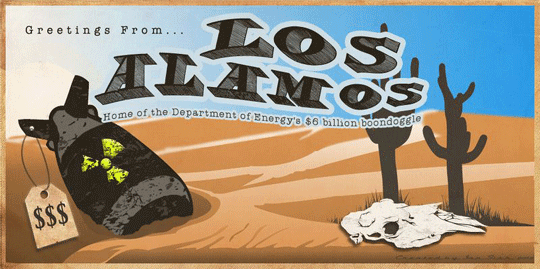
Chronology of major incidents marking Los Alamos National Laboratory’s management history, Local News, Santa Fe, New Mexico , 4 Jan 16 The New Mexican
Jan. 1, 1943: A secret national laboratory is set up in Los Alamos to design a nuclear bomb during World War II. The University of California is named the official lab manager and is paid $5 million for a one-year contract. The U.S. Department of Energy oversees the lab’s operations. J. Robert Oppenheimer is the lab’s director.
1945: An atomic bomb is tested at the Trinity Site in Southern New Mexico on July 16, ushering in the nuclear age………
1988: A new federal law gives the Department of Energy more leverage over lab contractors. The University of California at Los Alamos National Laboratory is exempted from the law. Continue reading
Nuclear sub accident costs $1m, commander loses job
Down periscope: Nuclear sub accident costs $1m, commander loses job Rt.com 5 Jan, 2016 A US Navy commander has lost his job following an accident that damaged a 18,000-ton nuclear guided-missile submarine. The banged-up sub will cost taxpayers at least $1 million to repair, the Navy said.
Captain Dave Adams was relieved of his command of the USS Georgia on Monday, and was reassigned to another post with Submarine Group 10 of Naval Submarine Base Kings Bay in Georgia.
On November 25, 2015, Adams was commanding one of the two alternating crews that operate the USS Georgia when the 560-foot submarine crashed into a channel buoy on its way back to base in Kings Bay……https://www.rt.com/usa/328018-navy-submarine-crash-georgia/
Rain-sodium reaction caused fire in nuclear waste dump
Beatty waste dump fire blamed on rain-sodium reaction By Wesley Juhl Las Vegas Review-Journal, December 31, 2015 A fire at a low-level radioactive waste dump in Nye County that shut down a 140-mile stretch of Nevada’s main north-south highway for almost 24 hours in October was caused by rainfall that seeped through a compromised cover and reacted with metallic sodium, according to a report released Thursday.
On Oct. 18, during heavy rainfall, the now-closed, state-owned landfill at the US Ecology dump near Beatty roared to life with explosions and fire. Beatty is about 115 miles northwest of Las Vegas, off of U.S. Highway 95.
A state probe of the incident was launched to consider if the fire was related to the wet weather, and if disposal records kept by the state in Carson City and at the site list any materials that could have reacted with water to cause the fire. Monday’s report details how corrosion of the steel drums containing the metallic sodium allowed the packing fluid to seep out, leaving the metallic sodium exposed to underground elements.
The 305-page report released Thursday collects statements from staffers who were there, aerial maps, results of laboratory analyses and a 195-page study on low-level radioactive waste management from 1981 as an attachment……..
Recommendations for long-term fixes from the Nevada Division of Environmental Protection include setting up enhanced monitoring of the waste facility capable of handling remote video surveillance and radioactivity measurement. The agency suggested an evaluation of the various types of wastes placed in the site and a redesign of a more protective cover cap…….. http://www.reviewjournal.com/news/nevada/beatty-waste-dump-fire-blamed-rain-sodium-reaction
1 This Month



26 September – International Day for the Total Elimination of Nuclear Weapons


PLEASE OPPOSE HR 8255 AND S.3639 – bills would accelerate satellite deployment, with no environmental review or safeguards – https://ncstd5li.quorum.us/campaign/169331/
To see nuclear-related stories in greater depth and intensity – go to https://nuclearinformation.wordpress.com
-
Archives
- September 2026 (219)
- August 2026 (330)
- July 2026 (355)
- June 2026 (287)
- May 2026 (306)
- April 2026 (356)
- March 2026 (251)
- February 2026 (267)
- January 2026 (308)
- December 2025 (358)
- November 2025 (359)
- October 2025 (375)
-
Categories
- 1
- 1 NUCLEAR ISSUES
- business and costs
- climate change
- culture and arts
- ENERGY
- environment
- health
- history
- indigenous issues
- Legal
- marketing of nuclear
- media
- opposition to nuclear
- PERSONAL STORIES
- politics
- politics international
- Religion and ethics
- safety
- secrets,lies and civil liberties
- spinbuster
- technology
- Uranium
- wastes
- weapons and war
- Women
- 2 WORLD
- ACTION
- AFRICA
- Atrocities
- AUSTRALIA
- Christina's notes
- Christina's themes
- culture and arts
- Events
- Fuk 2022
- Fuk 2023
- Fukushima 2017
- Fukushima 2018
- fukushima 2019
- Fukushima 2020
- Fukushima 2021
- general
- global warming
- Humour (God we need it)
- Nuclear
- RARE EARTHS
- Reference
- resources – print
- Resources -audiovicual
- Weekly Newsletter
- World
- World Nuclear
- YouTube
-
RSS
Entries RSS
Comments RSS
 nuclear-news