A Small Nuclear Reactor exploded in Russian accident – fallout isotopes prove this

Isotopes’ Composition Proves Nuclear Reactor Was Involved in Russian Explosion, Expert Says
Analyses of the radionuclides in the fallout over Severodvinsk show several isotopes that would not have been present if was a simple RTG in the explosion.
Contradictory reports from Russia, over the Aug. 8 nuclear incident
|
Russia says nuclear accident during suspected missile engine test released radioactive gas cloud https://www.cbsnews.com/news/russia-nuclear-accident-released-radioactive-gas-cloud-isotopes-government-reveals-today-2019-08-26/ AUGUST 26, 2019 MOSCOW — Russia’s state weather and environment monitoring agency on Monday released new details about a brief spike in radioactivity following a mysterious explosion at the navy’s testing range that has been surrounded by secrecy and fueled fears of increased radiation levels.
Russia’s state weather and environmental monitoring agency Rosgidromet said Monday the brief rise in radiation levels was caused by a cloud of radioactive gases containing isotopes of barium, strontium and lanthanum that drifted across the area. The agency said its monitoring has found no trace of radiation in air or ground samples since Aug. 8. It has previously said that the peak radiation reading in Severodvinsk on Aug. 8 briefly reached 1.78 microsieverts per hour in just one neighborhood — about 16 times the average. Readings in other parts of Severodvinsk varied between 0.45 and 1.33 microsieverts for a couple of hours before returning to normal. The authorities said those readings didn’t pose any danger, and the recorded levels were indeed several times less than what a passenger is exposed to on a long-haul flight. Still, contradictory statements from the authorities and their reluctance to reveal details of the explosion have drawn comparisons to the Soviet cover-up of the 1986 explosion and fire at the Chernobyl nuclear power plant, the world’s worst nuclear disaster. The Defense Ministry denied any radiation leak even as the local administration in Severodvinsk reported a hike in radiation levels and told residents to stay indoors — a move that prompted frightened residents to buy iodine, which can help reduce risks from exposure to radiation. Russian media reported that the victims of the explosion received high doses of radiation. They said that medical workers at the Arkhangelsk city hospital that treated three of those injured said they hadn’t been warned that they would treat people exposed to radiation and lacked elementary protective gear. The Moscow Times on Monday cited Igor Semin, a cardiovascular surgeon at the hospital, who scathingly criticized the authorities in a social network post for failing to warn the hospital workers about the deadly risks. “They were abandoned and left to fend for themselves,” the newspaper quoted Semin as saying. Asked about the doctor’s statement, Kremlin spokesman Dmitry Peskov said that the authorities will look into the matter. Officials have said the explosion in Nyonoksa occurred during tests of a “nuclear isotope power source” of a rocket engine — a cryptic description that made many observers conclude that the test involved one of Russia’s most secretive weapons — the prospective Burevestnik (Storm Petrel) nuclear-powered cruise missile which was code-named “Skyfall” by NATO. U.S. President Donald Trump has thrown his weight behind that theory, saying the U.S. learned much from the failed test. |
|
Toxic leak from North Korea’s nuclear programme
|
Nuclear warning: Huge leak spotted in North Korea turns rivers black in freak accident https://www.express.co.uk/news/world/1169175/north-korea-news-latest-kim-jong-un-donald-trump-US-nuclear-weapons-pollution-Pyongsan
NORTH KOREA’s contentious nuclear programme has allegedly leaked tonnes of toxic waste into rivers used for drinking water.He believes that the leakage has been covered up by the highly secretive insular state, and the true scale of disaster is only now unfolding.
Mr Bogle thinks that North Korea will struggle to keep the claimed leakage under wraps for any longer, as the river eventually leads into the Yellow Sea that North Korea shares with neighbouring South Korea and China. If true, the scale of those affected could grow to nearly 600million people and end up being the world’s worst man-made disaster. The photos shared by Mr Bogle appear to show a pipeline, built to carry toxic water from the facility to a nearby waste reservoir, digressing its intended route and leaking into the river instead.
Mr Bogle said: “I was able to review high-resolution historical satellite imagery for multiple years going back to 2003. “Each of the images shows an ever-growing pile of leaked material on either end of the pipe that takes waste material from the plant to an unlined reservoir. “Some of the images also show fluids being actively spilled directly into the river. “The plant is one of two declared uranium milling facilities in the country. It takes low-quality coal and processes it to create yellowcake, which then contains around 80 per cent uranium.
“The extraction and milling requires multiple chemical processes and leaves behind a very toxic mix of waste materials. “That toxic waste is then sent to the nearby reservoir, leaking and travelling into the Ryesong River in the process.” The Pyongsan facility is the largest in North Korea, and is built next to its largest uranium mine, and has recently undergone a ramped-up level of production of nuclear fuel for electricity generating purposes. Many have pointed out that the Conowingo Dam 16 miles downstream might be sufficient enough to trap and prevent any toxic waste from getting out – although experts told The Sun that the dam is “no longer capable of trapping sediment”.
|
|
|
USA lost unexploded nuclear bomb in Japanese waters
However, it was not until 1989 that the Pentagon admitted the loss of a one-megaton hydrogen bomb.
The revelation inspired a diplomatic inquiry from Japan, however, neither the weapon, or the pilot, was ever recovered.The incident, the most serious involving nuclear weapons in the Navy’s history, showed that US warships carried atomic weapons into Japanese ports in violation of policy, according to researchers.
Japanese law banned ships carrying nuclear weapons from sailing in its territorial waters or calling on its ports following the terrible Hiroshima and Nagasaki incidents.
However, the US warship routinely docked in Japan.
William M. Arkin of the liberal Institute for Policy Studies claimed in 1989: “For 24 years, the US Navy has covered up the most politically sensitive accident that has ever taken place.
“The Navy kept the true details of this accident a secret not only because it demonstrates their disregard for the treaty stipulations of foreign governments but because of the questions it raises about nuclear weapons aboard ships in Vietnam.”
The event was highly sensitive, with Japan being the only country to ever be attacked with nuclear weapons at the end of World War 2.
On September 8, 1951, 49 nations drew a line under the devastating event and signed the Treaty of San Francisco – also known as the Treaty of Peace with Japan.
The document officially ended US-led occupation of Japan and marked the start of re-establishing relations with the allied powers.
Meanwhile, In 1965, the US was arguably at the height of tensions with the Soviet Union.
Not only did the accident threaten to spoil already tenuous relations with Japan, but it would have also have given the USSR an excuse to start a nuclear war.
Despite the worrying claims, the US Navy confirmed inn 1989 that the waters were too deep for the weapon to pose a threat.
Worryingly though, it would not be the last of the nuclear gaffes for America. On January 17, 1966, a B-52G USAF bomber collided with a KC-135 tanker during a refuelling mission at 31,000 feet over the Mediterranean Sea.
During the crash, three MK28-type hydrogen bombs headed for land in the small fishing village of Palomares in Almeria, Spain.
Worse still, the explosives in two of the weapons detonated on impact, contaminating the surrounding area of almost one square mile with plutonium.
The fourth sunk off the coast of Spain and was recovered three months later.
Confusion and secrecy following Russian explosion, backflip on evacuation of village
Key points:
- Medics who treated victims of an accident have been sent to Moscow for medical examination
- Russia’s state weather service said radiation levels spiked in Severodvinsk by up to 16 times
- Many Russians spoke angrily on social media of misleading reports reminiscent of Chernobyl
The explosion took place on Thursday at a naval weapons range on the coast of the White Sea in northern Russia.
State nuclear agency Rosatom said the accident occurred during a rocket test on a sea platform.
The rocket’s fuel caught fire after the test, causing it to detonate, it said in a statement carried by Russian news agencies.
Two days later, after a spike in radiation levels was reported, Rosatom conceded the accident involved nuclear materials.
On Tuesday (local time), the Russian military ordered residents of the small village of Nyonoksa to temporarily evacuate, citing unspecified activities at the nearby navy testing range.
But a few hours later, it said the planned activities were cancelled and told the villagers they could go back to their homes, said Ksenia Yudina, a spokeswoman for the Severodvinsk regional administration.
Local media in Severodvinsk said Nyonoksa residents regularly received similar temporary evacuation orders, usually timed to tests at the range.
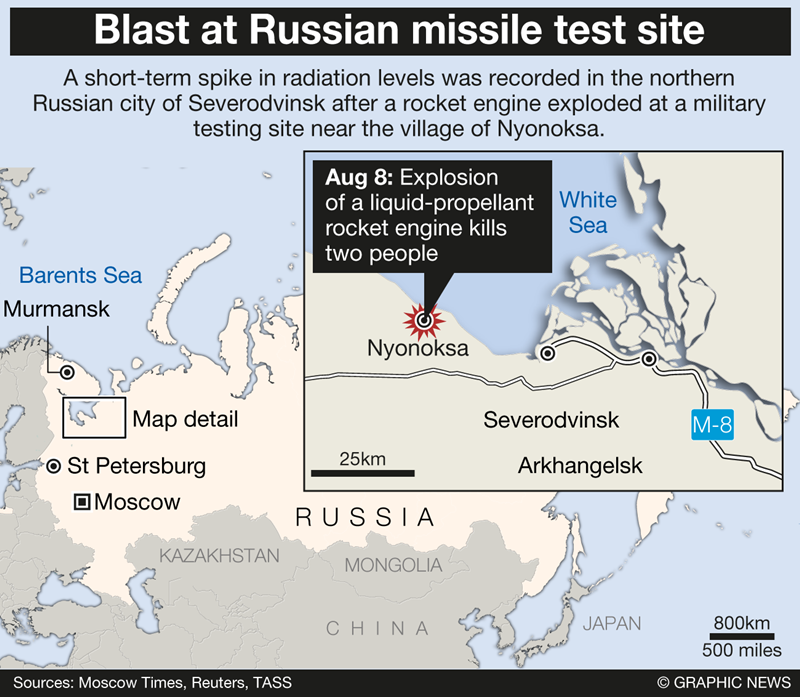
Russia’s state weather service said radiation levels spiked in the Russian city of Severodvinsk, about 30 kilometres west of Nyonoksa, by up to 16 times following the explosion.
Emergency officials issued a warning to all workers to stay indoors and close the windows, while spooked residents rushed to buy iodide, which can help limit the damage from exposure to radiation.
‘People need reliable information’
Many Russians spoke angrily on social media of misleading reports reminiscent of the lethal delays in acknowledging the Chernobyl accident three decades ago.
US experts said they suspected the cause was a botched test of a nuclear-powered cruise missile commissioned by President Vladimir Putin.
Boris L Vishnevsky, a member of the St. Petersburg City Council, told the New York Times that dozens of people had called asking for clarification about radiation risks.
“People need reliable information,” Mr Vishnevsky told the Times.
“And if the authorities think there is no danger, and nothing needs to be done, let them announce this formally so people don’t worry.”
The five scientists that died in the explosion were buried Monday in the closed city of Sarov — which houses a nuclear research facility and is surrounded by fences patrolled by the military.
While hailing the deceased as the “pride of the atomic sector”, Rosatom head Alexei Likhachev pledged to continue developing new weapons. “The best tribute to them will be our continued work on new models of weapons, which will definitely be carried out to the end,” Mr Likhachev was quoted as saying by RIA news agency.
Medics who treated victims sent to Moscow
Medics who treated the victims of an accident were sent to Moscow for medical examination, TASS news agency cited an unnamed medical source as saying on Tuesday.
The medics sent to Moscow have signed an agreement promising not to divulge information about the incident, TASS cited the source as saying.
US President Donald Trump said on Twitter on Monday the United States was “learning much” from the explosion and the United States had “similar, though more advanced, technology”.
He said Russians were worried about the air quality around the facility and far beyond, a situation he described as “Not good!”
But when asked about his comments on Tuesday, the Kremlin said it, not the United States, was out in front when it came to developing new nuclear weapons.
“Our president has repeatedly said that Russian engineering in this sector significantly outstrips the level that other countries have managed to reach for the moment, and it is fairly unique,” Kremlin spokesman Dmitry Peskov said.Mr Putin used his state-of-the nation speech in 2018 to unveil what he described as a raft of invincible new nuclear weapons, including a nuclear-powered cruise missile, an underwater nuclear-powered drone, and a laser weapon.
Tensions between Moscow and Washington over arms control have been exacerbated by the demise this month of a landmark nuclear treaty.
Church Rock America’s Forgotten Nuclear Sacrifice Zone

|
Church Rock, America’s Forgotten Nuclear Disaster, Is Still Poisoning Navajo Lands 40 Years Later. https://www.vice.com/en_us/article/ne8w4x/church-rock-americas-forgotten-nuclear-disaster-is-still-poisoning-navajo-lands-40-years-later Residents say they’ve been ignored even as they struggle with contaminated water and worry about having children. By Samuel Gilbert; photos by Ramsay de Give, Aug 12 2019,
Early in the summer of 1979, Larry King, an underground surveyor at the United Nuclear Corporation’s Church Rock Uranium mine in New Mexico, began noticing something unusual when looking at the south side of the tailings dam. That massive earthen wall was responsible for holding back thousands of tons of toxic water and waste produced by the mine and the nearby mill that extracted uranium from raw ore. And as King saw, there were “fist-sized cracks” developing in that wall. He measured them, reported them to his supervisors, and didn’t think anything more of it.
A few weeks later, at 5:30 a.m. on July 16, 1979, the dam failed, releasing 1,100 tons of uranium waste and 94 million gallons of radioactive water into the Rio Puerco and through Navajo lands, a toxic flood that had devastating consequences on the surrounding area. “The water, filled with acids from the milling process, twisted a metal culvert in the Puerco,” according to Judy Pasternak’s book Yellow Dirt: A Poisoned Land and the Betrayal of the Navajos. “Sheep keeled over and died, and crops curdled along the banks. The surge of radiation was detected as far away as Sanders, Arizona, fifty miles downstream.” According to a Nuclear Regulatory Commission report, radioactivity levels in the Puerco near the breached dam were 7,000 times that of what is allowed in drinking water. The heavily contaminated water flowed over the river banks, creating radioactive pools. “There were children up and down the river playing in those stagnant pools, and they were deadly poisonous,” Jorge Winterer, a doctor with Indian Health Service in Gallup, New Mexico, said after the spill. Earlier this year, standing in his yard next to an old Chevy, King pointed in the direction of the now dry Rio Puerco. “It came right through there,” said King. The unleashed river of waste had flowed through his family’s land just a half-mile from his house. “I remember the terrible odor and the yellowish color of the water.” He recalls seeing an elderly woman who had burned her feet crossing the Puerco while watering her sheep that day. King still lives on the family land, two miles downstream of the rebuilt dam in the Church Rock chapter of the Navajo Nation. His home is surrounded by a beautiful, unforgiving landscape of red rock cliffs, a scattering of Navajo residences and, if you look closely, fencelines with KEEP OUT signs marking the numerous abandoned uranium sites. Forty years later, the Church Rock spill remains the largest single largest accidental release of radioactivity in U.S. history, worse in terms of total radiation than that of the partial meltdown at Three Mile Island and second in world history only to the 1986 Chernobyl catastrophe, both of which have loomed much larger in the cultural imagination. The effects of the spill have lingered for an entire generation: In 2007, the Church Rock Uranium Mining Project found widespread contamination of drinking water sources in the Church Rock area. Navajo residents say they have not been given the attention given to other victims of nuclear accidents, even as they remain under the catastrophe’s long shadow, dealing with poisoned livestock and ongoing health problems amid other aftereffects. “We have never been a priority,” said King. “Forty years after the spill and nothing has been done.” “Our generation is afraid of having children,” said Faith Baldwin, who grew up on the Navajo nation surrounded by abandoned uranium mines. “Cancer runs in our family but it shouldn’t. Cancer, diabetes were nonexistent in Navajo rez.” During the Cold War, Navajo lands provided much of the raw material for the burgeoning nuclear industry. From 1944 to 1986 some 30 million tons of uranium ore were extracted from mines, but as demand for uranium decreased the mines closed, leaving over a thousand contaminated sites, few of which have been cleaned up. The Church Rock Chapter has some 20 such contaminated uranium sites, including the mine where King worked. Navajo workers at these places were often poorly paid, underprotected, and uninformed about the danger of radiation exposure. And even before the spill, King said, UNC would routinely pump uranium-contaminated water from the mine into the Puerco, turning the seasonal wash into a toxic “man-made stream.” According to a 1994 report by the U.S. Geological Survey on levels of radioactive elements in the Rio Puerco and Little Colorado River basins, “at least 300 times more uranium and 6 times more total gross alpha activity were released by day-to-day pumping from the underground mines than was released by the spill.” As a child King remembers playing in the dry Puerco wash, its banks often coated with a “yellowish slime.” And ranchers used the Puerco to water their livestock. Residents couldn’t have known that the Church Rock dam was at risk of rupturing, but there’s evidence that the United Nuclear Corporation did. King wasn’t the first to notice cracks in the dam: An Army Corps of Engineers report would later find that UNC was aware of the cracks as early as 1977, two years before the breach. That report concluded that UNC failed to properly reinforce the tailings dam, ignored advice from its own engineering consultant that might have prevented the coming disaster, and did not report the cracks to regulators. “The company was remiss in not heading the problem off,” said Chris Shuey, director of the Uranium Impact Assessment Program at the Southwest Research and Information Center, an organization providing information to the public about the impacts of energy development and resource extraction. Shuey said that UNC failed to repair cracks in the dam while simultaneously overfilling the uranium mill’s toxic tailing ponds that were being held back by that cracking wall. The cleanup process after the spill was also lacking. Only 1 percent of solid radioactive waste was removed, according to Paul Robinson, the research director at the Southwest Research and Information Center, and no compensation for the nearby residents was provided. In contrast, those affected by the Three Mile Island disaster were paid thanks to the company that operated that plant and its insurers. “Governments took meaningful measures to deal with the Three Mile Island accident,” said Eric Jantz, a lawyer from the New Mexico Environmental Law Center, “while neither the federal nor New Mexico governments have taken any steps to remediate the Church Rock spill even after 40 years.” As time went on, the impacts of uranium exposure became more evident to residents. King watched as his former mine coworkers died early deaths. Community members complained of health problems that prior to the entrance of the uranium industry were foreign: kidney disease, bone cancer, and lung cancer afflicting non-smokers. According to King, the only warnings about radioactivity were a few signs telling residents not to water their livestock in the wash. UNC’s cleanup efforts consisted of hiring some temporary workers to shovel waste from the wash into five-gallon buckets and haul it away, according to Colleen Keane, who made a documentary about the aftermath of the spill called The River That Harms. In the early 90s, King joined the Eastern Navajo Diné Against Uranium Mining (ENDAUM), a grassroots organization fighting against new uranium projects and trying to mitigate the negative impacts of mining operations. Through that work, King began hearing troubling stories from nearby Red Water Pond Road, a small community sandwiched between three uranium sites where residents “unwittingly used water from contaminated wells to drink, bathe, and hydrate their livestock,” according to a 2017 Reveal article. “Their sheep were born hairless… like baby rats,” said King. There were also the stories of butchered animals whose insides had turned a sickly yellow. A few years back, one of King’s neighbors killed a sheep. Instead of white, the stomach fat was yellow, “more yellow than those happy faces,” said King, pointing to a stuffed smiley face pinned above his couch. “They got concerned and decided to butcher another one. Pretty soon there was a pile of carcasses, all the same… They burned the whole thing.” he health impacts of the spill on residents remain poorly understood, with only a few authoritative heath studies having been conducted. One of the few government studies that came out after the spill did limited testing on both residents (six in total) and livestock. The resulting 1983 report from the New Mexico government, based on Centers for Disease Control (CDC) tests, concluded that Rio Puerco water “may be hazardous if used over several years as the primary source of drinking water, livestock water or irrigation water.” The report goes on to state that “the severity of these hazards is not well known at the time.” But since then, it’s become more obvious that the spill has had long-lasting and serious effects. In 2015, Tommy Rock, a doctoral student of earth science, uncovered uranium contamination in Rio Puerco water in Sanders, a town in eastern Arizona, by looking at tests stretching back to 2003. “The Church rock spill was the single most likely cause,” he said. “For decades people were unknowingly drinking poisoned tap water.” The water company did not report the contamination to residents, and after Rock’s findings a new company took over operations and is drawing on a different well. For many residents, the spill has come to embody the broader toxic legacy of the uranium industry on the indigenous lands of the West. According to the EPA, there are over 500 abandoned uranium mines, mill sites, and waste piles on Navajo Nation land that continue to contaminate water, soil, livestock and housing. “The Church Rock spill symbolizes the governmental and societal indifference to the impacts of uranium development on Indigenous lands,” said Jantz. “The Church Rock spill is the third largest nuclear accident after Fukushima and Chernobyl, and the largest in the US in terms of radiation released, but nobody knows about it.” “Three Mile Island had more coverage and people were compensated right away,” said King. “I always say we don’t get the same attention because we live in impoverished native community… We live in a sacrifice zone.” |
|
|
‘Dirty bomb’: Mystery Russian ‘superweapon’ kills five
An on-board reactor would give an engine almost unlimited range. In the case of a guided cruise missile, it could circle the world before receiving orders to attack from out of the blue.
But they’re not easy to control.
They operate at extremely high temperatures. They use explosive fuels, such as liquid hydrogen. And any accident could have devastating, long-lasting effects.
|
‘Dirty bomb’: Mystery Russian ‘superweapon’ kills five https://www.news.com.au/technology/innovation/military/dirty-bomb-mystery-russian-superweapon-kills-five/news-story/c3f85442bc12c6fea43cc4cf67df392e 13 Aug 19It was an explosion, played down by Russian officials — until they were forced to admit five people were dead and many more are at risk.
Jamie Seidel When an experimental missile exploded at a secret Russian base, things were immediately odd. Children from the nearby city of Severodvinsk were sent home from school. Its 185,000 residents were told to stay indoors. Doses of Iodine were distributed. All shipping was barred from the area for at least 30 days. What could cause such a reaction? How could a relatively small explosion cause such confusion? Russia’s nuclear energy agency Rosatom eventually stepped forward: It explained that a missile testing an “isotope power source for a liquid-fuelled rocket engine” had misfired. Rosatom conceded the accident on Thursday night had killed five, and three were being treated for burns. Russian officials said elite scientists Alexey Vyushin, Yevgeny Koratayev, Vyacheslave Lipshev, Sergey Pichugin and Vladislav Yanovsky — were killed during tests on a liquid propulsion system Little else is officially known. But military analysts have been speculating. Was it some sort of “dirty bomb”, with a radioactive warhead? Could it have been a failed launch from a nuclear-powered submarine? Suspicion has also fallen on one of President Vladimir Putin’s vaunted new “superweapons”. STORMY PETREL The idea of using a nuclear-reactor powered ramjet isn’t new It appears to have been thought up by Nazi rocket scientists during the dying days of World War II. With the fall of Berlin, these experts were divided up between the United States and the Soviet Union. Both nations embarked upon experimental nuclear-powered missile projects in the 1950s. It was quickly recognised the radiation-spewing technology was far too perilous to be practical. But a boisterous President Putin revealed what he called the 9M730 Burevestnik (Petrel) early last year as one of six new “superweapons”. NATO calls it the SSC-X-9 “Skyfall”. “Since its range is unlimited, it can manoeuvre as long as you want. No one in the world has anything like that,” Mr Putin boasted. “It may appear some day, but by that time we will develop something new.” The accompanying presentation showed the missile weaving its way between radar stations in the mid-Atlantic, passing around South America’s Cape Horn and worming its way up towards Hawaii. Mr Putin said the missile was successfully tested in late 2017 and was “invincible against all existing and prospective missile defence and counter-air defence systems”. “I want to tell all those who have fuelled the arms race over the last 15 years, sought to win unilateral advantages over Russia, introduced unlawful sanctions aimed to contain our country’s development: Aall that you wanted to impede with your policies have already happened,” Mr Putin declared. “You have failed to contain Russia.” But things don’t appear to be going to plan. EXPLOSIVE POTENTIAL Nuclear propulsion is promising — but also problematic. Continue reading |
Russia says small nuclear reactor blew up in deadly accident
|
August 13, 2019 The failed missile test that ended in an explosion killing five scientists last week on Russia’s White Sea involved a small nuclear reactor, according to a top official at the institute where they worked.
The institute is working on small-scale power sources that use “radioactive materials, including fissile and radioisotope materials” for the Defence Ministry and civilian uses, Vyacheslav Soloviev, scientific director of the institute, said in a video shown by local TV.
The men, who will be buried on Monday, were national heroes and the “elite of the Russian Federal Nuclear Centre,” institute Director Valentin Kostyukov said in the video, which was also posted on an official website in Sarov, a high-security city devoted to nuclear research less than 400 kilometers east of Moscow.
The blast occurred on August 8 during a test of a missile that used “isotope power sources” on an offshore platform in the Arkhangelsk region, close to the Arctic Circle, Russia’s state nuclear company Rosatom said over the weekend. The Defence Ministry initially reported two were killed in the accident, which it said involved testing of a liquid-fuelled missile engine. The ministry didn’t mention the nuclear element.
Rosatom declined to comment on the incident on Monday and a spokeswoman for the Sarov institute couldn’t immediately be reached.
Russian media have speculated that the weapon being tested was the SSC-X-9 Skyfall, known in Russia as the Burevestnik, a nuclear-powered cruise missile that President Vladimir Putin introduced to the world in a brief animated segment during his state-of-the-nation address last year.
The incident comes after a series of massive explosions earlier last week at a Siberian military depot killed one and injured 13, as well as forcing the evacuation of 16,500 people from their homes. Russia’s navy has suffered numerous high-profile accidents over the years. In July, 14 sailors died in a fire aboard a nuclear-powered submarine in the Barents Sea in an incident on which officials initially refused to comment. A top naval official later said the men gave their lives preventing a “planetary catastrophe.”
Russia’s worst post-Soviet naval disaster also occurred in the Barents Sea, when 118 crew died on the Kursk nuclear submarine that sank in after an explosion in August 2000. https://www.theage.com.au/world/asia/russia-says-small-nuclear-reactor-blew-up-in-deadly-accident-20190813-p52gfm.html
|
|

Putin’s silence on mysterious radiation accident
 Russia nuclear leak: Mysterious footage of hazmat officials escalates radiation panic https://www.express.co.uk/news/world/1164125/Russia-nuclear-leak-radiation-Putin-iodine-hazmat
CHILLING footage from Russia has intensified fears of a nuclear radiation accident after ambulances were spotted lined with protective chemical sheets and hospitals workers were seen wearing hazmat suits.
Rostam added that the explosion took place during the testing of an “isotope power source”.
The official said five of its employees had died as a result of the accident and three more were being treated for burns.
However, the extent of the incident and threat of radiation has not been disclosed, amid growing global concern.
The Archangelsk naval base has been placed under emergency lockdown for a month, with the nearby White Sea also closed to commercial shipping.
A sudden radiation spike detected in the region following the explosion prompted the initial speculation that the incident was related to a nuclear missile test.
The radiation level was recorded as 20 times higher than the normal level in the nearby city of Severodvinsk.
This has been reinforced by chilling footage filmed in the aftermath of the incident.
One video showed hospital workers wearing hazmat suits while they loaded the injured into an ambulance. Another terrifying video revealed a security escort of ambulances transporting the injured to Moscow.
In this footage, one of the ambulance is clearly coated in a chemical protection film.
A defence ministry source said that the worker’s clothes had been burned as soon as they were hospitalised with suspected radiation. Experts have linked the incident to the testing of the new nuclear-powered cruise missile Burevestnik mentioned during a speech by Vladimir Putin last year.
Local people have reportedly been urged to take precautions against radiation, with children from local kindergartens taken indoors after the blast.
There has also been a rush to buy iodine in Russia’s far north.
Russian expert Dr Mark Galeotti said the incident was “clearly a bigger issue than the Russians are letting on”.
He told the BBC: “Despite what the Kremlin have said, there must have been some sort of radiation leak – and they want people to not just stay out of harm’s way, but also don’t want people coming to the site with Geiger Counters.”
Five people were killed following Russian rocket explosion
Russia explosion: Five confirmed dead in rocket blast, BBC 10 Aug 19, Five people were killed and three injured following a rocket explosion on a naval test range in Russia on Thursday, state nuclear company Rosatom confirmed.
Rostacom said the accident occurred during tests on a liquid propellant rocket engine.
The three injured staff members suffered serious burns in the accident.
Authorities had previously said that two people died and six were injured in the blast at the site in Nyonoksa.
The company told Russian media that its engineering and technical team had been working on the “isotope power source” for the propulsion system.
The Nyonoksa site carries out tests for virtually every missile system used by the Russian navy, including sea-launched intercontinental ballistic missiles, cruise missiles and anti-aircraft missiles.
Authorities in Severodvink, 47km (29 miles) east of Nyonska said that radiation levels shortly after the blast were higher than normal for about 40 minutes but returned to normal……..
Ammunition dump blaze
It is the second accident involving Russia’s military this week.
On Monday, one person was killed and eight others were injured in a blaze at an ammunition dump in Siberia.
Flying munitions damaged a school and a kindergarten in the area. More than 9,500 people were evacuated.https://www.bbc.com/news/world-europe-49301438
Test rocket explosion causes radiation spike in northern Russian city
Test rocket explosion causes radiation spike in northern Russian city, killing two, https://thenewdaily.com.au/news/world/2019/08/09/rocket-radiation-explosion-russia/?fbclid=IwAR1udqv3rSjTDZE5hZpDHPDo-r7Q-zPhdnuvA-Ejqwu4iButecBmHPW2QdU Locals have been urged to take iodine tablets and stay indoors after a liquid-propellant rocket engine exploded at a nuclear test site, spiking radiation levels, killing two people and injuring another six.
Greenpeace cited data from the Emergencies Ministry that it said showed radiation levels had risen 20 times above the normal level in Severodvinsk, which is about 30 kilometres from Nyonoksa.
The environmental group said it had appealed to Russia’s consumer watchdog to establish how high radiation had risen, whether it posed a health risk to people and what had actually caused the spike.
According to Norway’s Barents Observer, the explosion happened about 9am on Thursday local time.
The paper reported the site is used for the testing of liquid-fuelled engines of ballistic missiles “for strategic nuclear-powered submarines”.
Authorities in Severodvinsk, which has a population of 185,000, reported the spike, forcing a bay in the White Sea to shut down to shipping.
“A short-term rise in background radiation was recorded at 12 o’clock in Severodvinsk,” Ksenia Yudina said on Thursday local time. However, Russia’s defence ministry was quoted earlier by state media as saying radiation was normal.
Explosion at Russian missile test, kills two, releases spike of radiation
Two killed and four injured after blast, defence ministry say, A short-term spike in radiation levels has been recorded after a rocket engine exploded during a test in Russia, regional authorities said.Moscow’s defence ministry said two were killed and four others wounded after the blast at a military shooting range in the northwestern region of Arkhangelsk.
The ministry said there was no release of radioactivity or any toxic substances.
However, Ksenia Yudina, a spokeswoman for the city of Severodvinsk, which has a population of around 185,000, said: “A short-term rise in background radiation was recorded at 12 o’clock in Severodvinsk.”
The defence ministry confirmed six servicemen and civilian engineers were injured, and two died of their injuries. It said the explosion took place during the test of a liquid-propellant rocket engine.
City officials said background radiation levels had fully “normalised”.
An Arkhangelsk port official said the Dvina Bay area of the White Sea would be closed off to shipping for a month following the explosion, the Interfax news agency reported.
The rocket engine explosion occurred at a weapons testing area near the village of Nyonoksa in the Arkhangelsk region, 800 miles north of Moscow, said the Interfax news agency.
Russian media said an area near Nyonoksa is used for tests on weapons including ballistic and cruise missiles used by the navy.
It came two days after 16,500 people were forced to flee their homes when massive blasts rocked an arms depot in Siberia.
Powerful explosions went on for about 16 hours, killing one person and injuring 13.
The nuclear disasters that we don’t hear about – The Kyshtym Disaster
5 Unknown Nuclear Disasters: Chernobyl Is Far from the Only One, Chernobyl is not the world’s only nuclear disaster, there are plenty of others to keep you up at night., Interesting Engineering, By Marcia Wendorf, 2 Aug 19
The Kyshtym Disaster
In September 1957, Ozyorsk, Russia was a closed city, built around the Mayak plant which produced plutonium for both nuclear weapons and fuel.
After scrambling to build the Mayak plant between 1945 and 1948, all six of its reactors initially dumped high-level radioactive waste directly into Lake Kyzyltash. When it became contaminated, they moved on to dumping into Lake Karachay, which also became contaminated.
In 1968, the Soviet government disguised the EURT area by creating East Ural Nature Reserve, with access allowed to only authorized personnel. Documents describing the disaster were only declassified in 1989.
On the International Nuclear Event Scale (INES), Kyshtym is rated a 6, making it the third-most serious nuclear accident behind only the Fukushima Daiichi nuclear disaster and the Chernobyl disaster, which are both Level 7
In 1953, workers built a storage facility for liquid nuclear waste, but that waste was being heated by residual decay heat from the nuclear reaction. The coolers around one of the tanks failed, and on September 29, 1957, that tank exploded with the force of between 70 to 100 tons of TNT.
While there were no immediate casualties, the explosion released an estimated 20 MCi (800 PBq) of radioactivity into the air. A plume containing 2 MCi (80 PBq) of radionuclides, primarily caesium-137 and strontium-90, moved toward the northeast and contaminated an area of more than 52,000 square kilometers (20,000 sq miles).
At least 270,000 people lived in that area, which is referred to as the East-Ural Radioactive Trace (EURT).
In an attempt to maintain secrecy, no evacuation was ordered, but a week later, on October 6, 1957, 10,000 people were removed from their homes.
Estimates of the death toll caused by the accident go from 200 to more than 8,000, depending on the study. A 2001 work stated that the accident caused 66 diagnosed cases of chronic radiation syndrome.
Amazingly, it wasn’t until 18 years later, in 1976, that the full scope of the disaster was disclosed by Zhores Medvedev in the publication the New Scientist.
In 1968, the Soviet government disguised the EURT area by creating East Ural Nature Reserve, with access allowed to only authorized personnel. Documents describing the disaster were only declassified in 1989.
On the International Nuclear Event Scale (INES), Kyshtym is rated a 6, making it the third-most serious nuclear accident behind only the Fukushima Daiichi nuclear disaster and the Chernobyl disaster, which are both Level 7…… https://interestingengineering.com/5-unknown-nuclear-disasters-chernobyl-is-far-from-the-only-one
K-19: The Widowmaker Trailer
The nuclear disasters we don’t hear about – The Windscale Fire
Windscale: Britain’s Biggest Nuclear Disaster – Part 01
5 Unknown Nuclear Disasters: Chernobyl Is Far from the Only One, Chernobyl is not the world’s only nuclear disaster, there are plenty of others to keep you up at night., Interesting Engineering, By Marcia Wendorf, 2 Aug 19
The Windscale Fire
Less than two weeks after Kyshtym, a fire broke out in Unit 1 of the two reactors at the Windscale facility located in what is now known as Sellafield, Cumbria UK.
The two reactors were created because of Britain’s need for an atomic weapon following World War II. Determining that a uranium enrichment plant would cost ten times as much to produce the same number of atomic bombs as a nuclear reactor, the decision was made to build a nuclear reactor that would produce plutonium.
The cores of the reactors were comprised of a large block of graphite, with horizontal channels drilled through it for the fuel cartridges. Each cartridge consisted of a 12-inch-long (30 centimeters) uranium rod encased in aluminum.
The reactor was cooled by convection through a 400-foot (120 m) tall chimney. When Winston Churchill committed the UK to create a hydrogen bomb, the fuel loads at Windscale were modified to produce tritium, but this also meant that the core became hotter.
On the morning of October 10, 1957, the core began to uncontrollably heat, eventually reaching 400 degrees C. Cooling fans were brought in to increase the airflow, but just worsened the problem. It was then that operators realized that the core was on fire.
Workers tried dousing the core first in carbon dioxide, then in water, but both proved ineffective. What finally worked was cutting off air to the reactor building, which starved the fire.
The fire caused the release of radioactive radionuclides across the UK and Europe, including an estimated 740 terabecquerels (20,000 curies) of iodine-131, 22 TBq (594 curies) of caesium-137 and 12,000 TBq (324,000 curies) of xenon-133.
By comparison, the 1986 Chernobyl explosion released far more, and the Three Mile Island accident in 1979 in the U.S. released 25 times more xenon-135 than Windscale, but less iodine, caesium, and strontium. The atmospheric release of xenon-133 by the Fukushima Daiichi nuclear disaster was similar to that released at Chernobyl, and thus, high above what the Windscale fire released.
There were no evacuations of the surrounding area, but it has been estimated that the incident caused 240 additional cancer cases. For a month after the accident, milk coming from 500 square kilometers (190 sq mi) of the nearby countryside was destroyed.
The reactor tank has remained sealed since the accident and still contains about 15 tons of uranium fuel. The reactor core is still slightly warm due to continuing nuclear reactions. It is not scheduled for final decommissioning until 2037. On the International Nuclear Event Scale, Windscale ranks at level 5………. https://interestingengineering.com/5-unknown-nuclear-disasters-chernobyl-is-far-from-the-only-one
 |
ReplyForward
|
The nuclear accidents we don’t hear about – Soviet Submarine K-19
5 Unknown Nuclear Disasters: Chernobyl Is Far from the Only One, Chernobyl is not the world’s only nuclear disaster, there are plenty of others to keep you up at night., Interesting Engineering, By Marcia Wendorf, 2 Aug 19
Soviet Submarine K-19
K-19 was one of what the Soviets called their Project 658-class submarines, while NATO called them Hotel-class. They were the first generation of nuclear submarines equipped with nuclear ballistic missiles.
Commissioned on April 30, 1961, K-19 was snake bit from the start. On its initial voyage, on July 4, 1961, it was conducting exercises off the coast of Greenland when suddenly, pressure in the reactor’s cooling system dropped to zero due to a leak.
The emergency SCRAM system immediately inserted the control rods, but due to decay heat, the reactor’s temperature rose to 800 degrees C (1,470 degrees F). The accident released steam containing fission products throughout the ship through the ventilation system.
The captain ordered the ship’s engineering crew to fabricate a new cooling system, but this required them to work within the radioactive area. The jury-rigged cooling water system prevented a complete meltdown of the reactor core.
American warships nearby had picked up K-19’s distress call and offered to help, but K-19’s captain, fearful of giving away Soviet military secrets, refused. Instead, K-19 sailed to meet up with a diesel-powered Soviet submarine. The accident had irradiated K-19’s entire crew, as well as the ship and some of her ballistic missiles.
Within a month, all eight members of the ship’s engineering crew died of radiation exposure. They are Boris Korchilov, Boris Ryzhikov, Yuriy Ordochkin, Evgeny Kashenkov, Semyon Penkov, Nicolai Savkin, Valery Charitonov, and Yuriy Povstyev.
Within the next two years, 15 other sailors died of radiation-related illnesses.
Towed into port, K-19 contaminated a 700 meter (2,300 feet) wide area, and the repair crews who worked on her. Eventually, the Soviet Navy dumped the damaged reactor into the Kara Sea.
The 2002 movie K-19: the Windowmaker, which starred Harrison Ford and Liam Neeson, is based on the K-19 disaster….. https://interestingengineering.com/5-unknown-nuclear-disasters-chernobyl-is-far-from-the-only-one
1 This Month

of the week – Shut Down Drone Warfare!


Tell the Ukrainian Government to Drop Prosecution of Peace Activist Yurii Sheliazhenko

Petition to revoke the licensing of the Near Surface Nuclear Disposal Facility (NSDF) at Chalk River. https://www.ourcommons.ca/petitions/en/Petition/Details?Petition=e-7247
To see nuclear-related stories in greater depth and intensity – go to https://nuclearinformation.wordpress.com
-
Archives
- April 2026 (79)
- March 2026 (251)
- February 2026 (268)
- January 2026 (308)
- December 2025 (358)
- November 2025 (359)
- October 2025 (376)
- September 2025 (257)
- August 2025 (319)
- July 2025 (230)
- June 2025 (348)
- May 2025 (261)
-
Categories
- 1
- 1 NUCLEAR ISSUES
- business and costs
- climate change
- culture and arts
- ENERGY
- environment
- health
- history
- indigenous issues
- Legal
- marketing of nuclear
- media
- opposition to nuclear
- PERSONAL STORIES
- politics
- politics international
- Religion and ethics
- safety
- secrets,lies and civil liberties
- spinbuster
- technology
- Uranium
- wastes
- weapons and war
- Women
- 2 WORLD
- ACTION
- AFRICA
- Atrocities
- AUSTRALIA
- Christina's notes
- Christina's themes
- culture and arts
- Events
- Fuk 2022
- Fuk 2023
- Fukushima 2017
- Fukushima 2018
- fukushima 2019
- Fukushima 2020
- Fukushima 2021
- general
- global warming
- Humour (God we need it)
- Nuclear
- RARE EARTHS
- Reference
- resources – print
- Resources -audiovicual
- Weekly Newsletter
- World
- World Nuclear
- YouTube
-
RSS
Entries RSS
Comments RSS
 nuclear-news