Radioactive muck found in pond; liner may be leaking at SC nuclear fuel plant, The State BY SAMMY FRETWELL, MAY 13, 2020 Nearly 40 years ago, the operators of a nuclear fuel plant near Columbia installed a liner in a treatment lagoon, hoping to trap radioactive and chemical waste before it could trickle into groundwater beneath the pond.
Now, the lagoon liner is wearing out. And that’s a concern.
Recent research suggests radioactive pollution has seeped through the synthetic barrier that was supposed to protect soil and groundwater in the Congaree River flood plain. Soil below the liner is suspected of being polluted with waste from the east lagoon, according to a new report for the plant’s operator, Westinghouse Nuclear.
’“It is expected that some contamination will exist in the soil underlying the east lagoon liner, given the long operating history of the lagoon and the potential for a liner system leak,’’ the May 8 report for Westinghouse says.
If the soil below the lagoon is polluted, as Westinghouse suspects, it could indicate that groundwater flowing away from the property and toward the Congaree River has been contaminated.
No one knows the extent of the contamination yet, but Westinghouse has a plan to dig radioactive sludge from the lagoon and haul it across the country for disposal in the Idaho desert.
Once the company has removed the mucky sludge and the lagoon’s 1980s era liner, it plans to test the soil below the waste pond to see how much contamination may be in the earth.
The new Westinghouse consulting report, released by the U.S. Nuclear Regulatory Commission, says sludge in the east lagoon at Westinghouse is contaminated with low enriched uranium and technetium-99, nuclear materials generated as part of production of fuel rods at the 51-year-old factory.
Exposure to sufficient amounts of uranium can cause kidney damage in adults and children. Technetium 99, which concentrates in the thyroid and gastrointestinal tract, can increase a person’s chances of cancer if exposed to certain amounts………
For now, Westinghouse is moving forward with cleanup efforts. Although the company doesn’t plan to clean up some pollution until it closes the plant in future decades, Westinghouse has agreed to get rid of other contamination sooner. …….
The tainted material that would be shipped to Idaho, likely next year, includes 45,000 cubic feet of sludge, soil and debris from the east lagoon, a 160-foot long pond behind the plant on Bluff Road.
Radioactive pond sludge would be hauled away on railroad cars to a U.S. Ecology site in the Owyhee Desert near Grand View, Idaho, according to plans filed with the U.S. Nuclear Regulatory Commission. Contaminated cylinders and a polluted sludge pile also will be carted away from the site for disposal……. https://www.thestate.com/news/local/environment/article242667201.html
May 14, 2020
Posted by Christina Macpherson |
environment, incidents, USA |
Leave a comment
|
Who Do You Call When Nuclear Weapons Go Missing? Mathematicians. Here’s What You Need To Remember: With no witnesses, no debris and a search area in the least understood part of the world’s ocean, there’s little even mathematical wizards can do. But even then, few thought 50 years ago that the lost bomb of Palomares would ever turn up. National Interest, 10 May 20
When a routine Cold War operation went terribly wrong, two planes and seven men died, a village got contaminated and a hydrogen bomb disappeared.
The search and cleanup required 1,400 American and Spanish personnel, a dozen aircraft, 27 U.S. Navy ships and five submarines. It cost more than $120 million and a lot of diplomatic capital.
And it made an obscure 18th-century mathematical theorem a practical solution to finding veritable needles in haystacks.
Around 10 a.m. on Jan. 17, 1966, two B-52Gs of the 31st Bomb Squadron based out of North Carolina approached two KC-135 tankers over the Spanish coast southwest of Cartagena.
The bombers each carried four 1.5-megaton B-28 hydrogen bombs as part of Operation Chrome Dome, a U.S. deterrence mission that placed nuclear-armed bombers on the Soviet Union’s doorsteps.
The resulting breakup destroyed the tanker in a fireball of blazing jet fuel. All four crew on board the tanker died. One hundred tons of flaming wreckage fell upon the arid hamlet of Palomares, near the Mediterranean Sea. Three of the four H-bombs aboard the bomber fell there, too.
Within 24 hours, a U.S. Air Force disaster team arrived from Torrejon Air Base near Madrid. Specialists from the Los Alamos and Sandia weapons labs — and Air Force logistics units — descended on the tiny rural town.
The search teams found the three H-bombs within a day. One landed on a soft slope, its casing relatively intact. The high explosives within the other two bombs detonated on impact, blowing 100-foot-wide craters in the dry soil and scattering plutonium, uranium and tritium across the landscape.
The region’s long history of human habitation complicated the land search. Almeria, the province where Palomares sits, hosted a mining industry for more than 5,000 years. Countless mine shafts, diggings and depressions pepper its dry landscape made famous by the spaghetti westerns filmed there. ,,,,,,, https://nationalinterest.org/blog/buzz/who-do-you-call-when-nuclear-weapons-go-missing-152441
|
|
May 11, 2020
Posted by Christina Macpherson |
incidents, Spain |
Leave a comment
 Ukraine Continues Fighting Fires Near Defunct Chernobyl Nuclear Plant, Radio Free Europe, 27 Apr 20 KYIV — Firefighters in Ukraine continue to battle a series of fires near the defunct Chernobyl nuclear power plant nearly a month after they broke out.
The State Service for Emergency Situations said on April 27 that brigades were still working to extinguish fires in the Lubyanskiy, Paryshivskiy, Dytyatkivskiy, and Denysovytskiy forest districts in the Chernobyl exclusion zone.
“The main efforts are focused on the localization of two fire sites, smoldering stumps, wood segments, and peat-boggy soil,” the service said, adding that radiation in the area does not exceed permissible levels.
The fires began on April 3 in the western part of the uninhabited exclusion zone before spreading to nearby forests.
Ukrainian officials have said they have extinguished the fires several times, but new fires continue appearing in the area…… https://www.rferl.org/a/ukraine-continues-fighting-fires-near-defunct-chernobyl-nuclear-plant/30579563.html
April 28, 2020
Posted by Christina Macpherson |
climate change, incidents, Ukraine |
Leave a comment
|
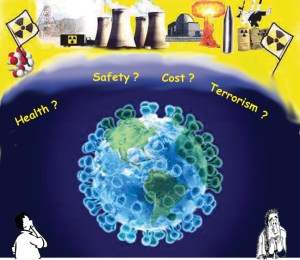 Hanford Employee Being Tested for COVID-19; Cases Confirmed at Nuclear Fuel Services BY EXCHANGEMONITOR, 15 Apr, 20, Hanford Employee Being Tested for COVID-19; Cases Confirmed at Nuclear Fuel Services BY EXCHANGEMONITOR, 15 Apr, 20, An employee at the Hanford Site in Washington state is being tested for COVID-19, the Department of Energy said in an overnight post. …….
Hanford, like most other DOE nuclear cleanup sites, has drawn down to minimal operations during the federal public health emergency. Probably no more than 20% of its usual workforce remains on-site.
To date, Hanford has not reported any positive COVID-19 results among its workforce of about 11,000 federal and contractor employees.
Meanwhile, BWX Technologies subsidiary Nuclear Fuel Services on Tuesday reported multiple cases of COVID-19 among its workforce.
The Erwin, Tenn., defense-uranium contractor did not say how many employees were infected, or how many potentially exposed employees were in quarantine following contact with the sick workers……
It was not clear whether the COVID-19 emergency response might delay any Nuclear Fuel Services contract milestones. Among other things, the company is producing low-enriched uranium to produce tritium in civilian nuclear reactors for National Nuclear Security Administration (NNSA) nuclear weapons programs.
Nuclear Fuel Services also could wind up purifying defense uranium for the weapons program around 2023. The NNSA is negotiating with the company to act as a backstop for the Y-12 National Security Complex in Oak Ridge, Tenn., in a few years.
|
|
April 16, 2020
Posted by Christina Macpherson |
health, incidents, USA |
Leave a comment
 Wildfires near Chernobyl under control, Ukrainian authorities say, By Jack Guy and Mary Ilyushina, CNN, April 14, 2020 The fires reportedly came within two kilometers of the Chernobyl nuclear power plant.
April 14, 2020
Posted by Christina Macpherson |
incidents, Ukraine |
Leave a comment

Blaze rages near Chernobyl, endangering abandoned nuclear plant https://www.mercurynews.com/2020/04/13/blaze-rages-near-chernobyl-endangering-abandoned-nuclear-plant/
“A fire approaching a nuclear or hazardous radiation facility is always a risk” By Margaryta Chornokondratenko and Alexander Marrow | Reuters
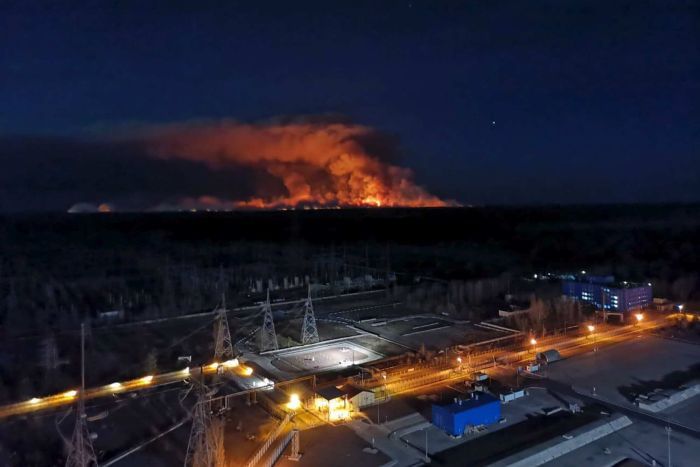
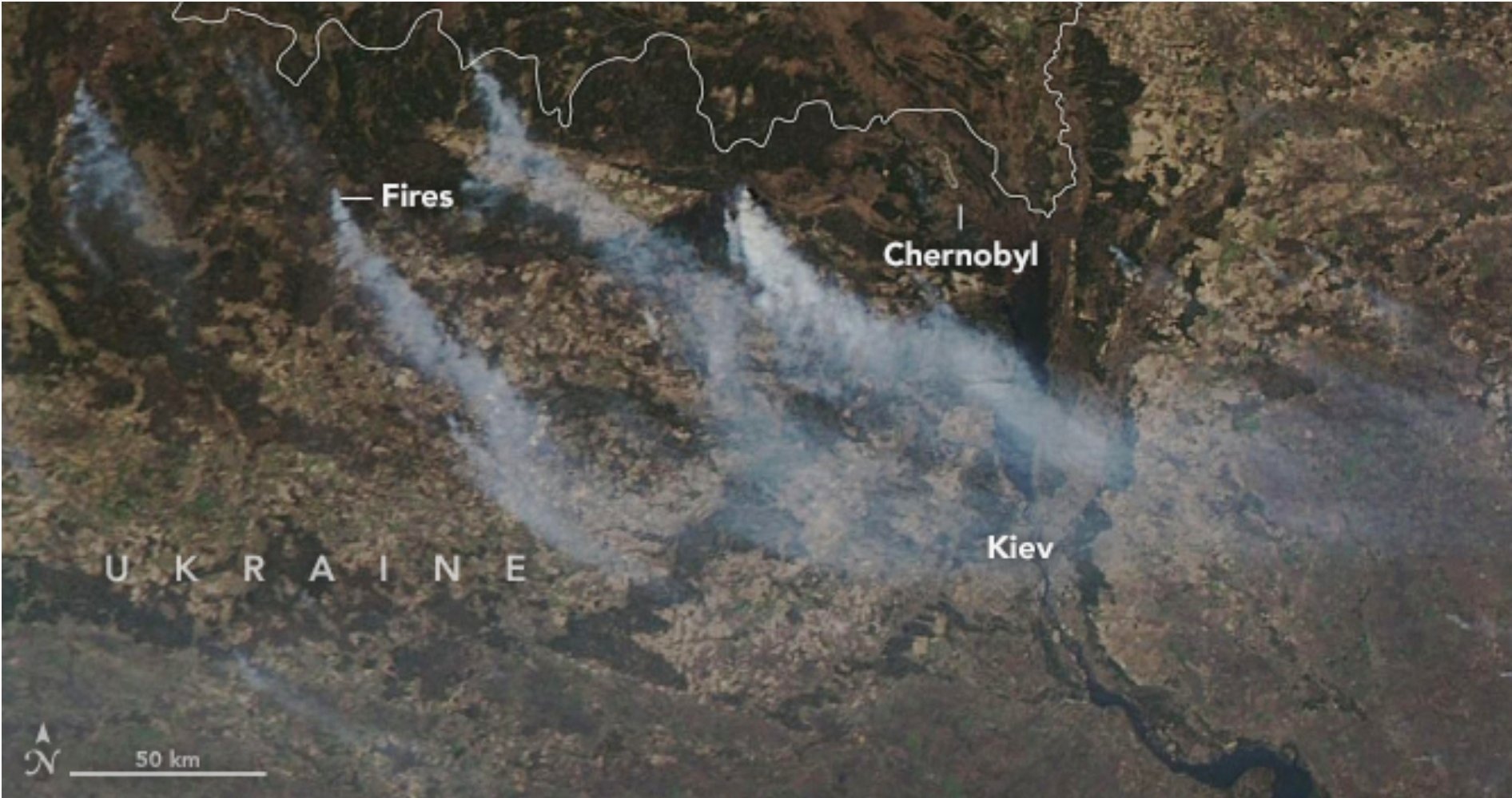
KIEV – A huge forest fire in Ukraine that has been raging for more than a week is now just one kilometer from the defunct Chernobyl nuclear power plant and poses a radiation risk, Greenpeace Russia warned on Monday, citing satellite images.
Ukraine’s Emergency Situations Service said it was still fighting the fires, but that the situation was under control.
Video footage shot by Reuters on Sunday showed plumes of black smoke billowing into the sky and trees still
ablaze, with firefighters in helicopters trying to put out the fires.
Aerial images of the 19 mile exclusion zone around the plant, site of the world’s worst nuclear accident in 1986, showed scorched, blackened earth and the charred stumps of still smoldering trees.
The Emergency Situations Service said radiation levels in the exclusion zone had not changed and those in nearby Kiev, the Ukrainian capital, “did not exceed natural background levels.”
Greenpeace Russia said the situation is much worse than Ukrainian authorities believe, and that the fires cover an area one thousand times bigger than they claim.
On April 4 Ukrainian authorities said the blaze covered an area of 20 hectares, but Greenpeace cited satellite images showing it was around 12,000 hectares in size at that time.
“According to satellite images taken on Monday, the area of the largest fire has reached 34,400 hectares,” it said, adding that a second fire, stretching across 12,600 hectares, was just one kilometer away from the defunct plant.
Ukrainian officials did not immediately respond to a request for comment on those claims.
Rashid Alimov, head of energy projects at Greenpeace Russia, said the fires, fanned by the wind, could disperse radionuclides, atoms that emit radiation.
“A fire approaching a nuclear or hazardous radiation facility is always a risk,” Alimov said. “In this case we’re hoping for rain tomorrow.”
Chernobyl tour operator Yaroslav Yemelianenko, writing on Facebook, described the situation as critical.
He said the fire was rapidly expanding and had reached the abandoned city of Pripyat, two kilometers from where “the most highly active radiation waste of the whole Chernobyl zone is located.” He called on officials to warn people of the danger.
Satellite images taken by NASA Worldview and seen by Reuters showed the two fires had extended far into the exclusion zone.
The fires, which follow unusually dry weather, began on April 3 in the western part of the exclusion zone and spread to nearby forests. Police say they have identified a 27-year old local resident who they accuse of deliberately starting the blaze.
It remains unclear if the person, who has reportedly confessed to starting a number of fires “for fun,” is partly or fully responsible.
April 14, 2020
Posted by Christina Macpherson |
incidents |
Leave a comment

Raging forest infernos in Chernobyl Exclusion Zone burning for eight days are now ‘close’ to exploded nuclear reactor amid new fears of radiation contamination
- Wildfires burning through Chernobyl forests are nearing the nuclear reactor
- There are fears that flames could reach radioactive trucks and vehicles abandoned after the notorious 1986 power station explosion
- Kiev has deployed more than 300 people and 85 pieces of equipment By JACK WRIGHT FOR MAILONLINE, 13 April 2020
|
- Wildfires burning through radioactive forests in the Chernobyl Exclusion Zone are getting ever closer to the exploded nuclear reactor.Firefighters are rushing to build firebreaks around the sarcophagus covering the ruined plant in Ukraine amid swirling winds.
There are fears that flames could reach abandoned trucks and other vehicles contaminated from the disastrous 1986 explosion.
An extraordinary video from firefighter Andrei Kukib shows an emergency vehicle driving through the raging fire and smoke laying waste to the polluted ‘dead zone’.
Fires have been blazing for nine days in the almost uninhabited 1,000-square-mile exclusion zone surrounding the disused plant. On Tuesday, the fire covered some 87 acres, having tripled in size due to strong winds, the emergencies service said in a statement.
- There are fears of radiation in the ground unleashed by the infernos can reach nearest city Kyiv, the Ukrainian capital, and other populated areas.This could be worse if the flames reach the Chernobyl reactors.
Kateryna Pavlova, a senior official involved in the firefighting, said: ‘We have been working all night digging firebreaks around the plant to protect it from fire.’
She told The New York Times: ‘At the moment, we cannot say the fire is contained.’
More than 300 people and 85 pieces of equipment have been deployed daily in the fight to extinguish the flames which comes as Ukraine – one of Europe’s poorest countries – is also battling against coronavirus.
- The State Agency for Management of the Exclusion Zone – which Pavlova heads – has ordered in three Antonov planes (AN-32P) and two MI-8 helicopters which have air dropped more than 250 tonnes of water in the wildfires.Police said the blaze broke out after a man set fire to dry grass near the exclusion zone. The man was detained by Ukrainian police. Ukrainian authorities rejected the warnings of the acting head of the country’s state ecological inspection service, Yehor Firsov, who withdrew remarks made this week that ‘radioactivity is higher than normal at the heart of the blaze’.
Initially covered up by the USSR, the 1986 explosion sent radioactive fallout across Europe exposing millions to dangerous levels of radiation. People are not allowed to live within 18 miles of the power station, which is some 62 miles north of Ukraine’s capital city Kiev.
The three other reactors at Chernobyl continued to generate electricity until the power station finally closed in 2000.
A giant protective dome was put in place over the fourth reactor in 2016.
Fires occur regularly in the forests near the Chernobyl power plant.
|
|
April 13, 2020
Posted by Christina Macpherson |
climate change, incidents, Ukraine |
Leave a comment
|
Chernobyl fires: Radiation fears as firefighters struggle to contain blazes in radioactive zone, 9 News, By AAP, Apr 10, 2020 Ukrainian firefighters are in their sixth day of battling fires within the Chernobyl exclusion zone amid concerns over radiation that has remained in the area since the nuclear disaster more than three decades ago.
More than 300 firefighters aided by several firefighting aircraft were working to contain the blazes, which in recent days have been exacerbated by high winds.
Authorities have more than doubled the number of firefighters in the area since Monday. The extent of the blazes has not been disclosed for the past two days.
Ukrainian firefighters are in their sixth day of battling fires within the Chernobyl exclusion zone amid concerns over radiation that has remained in the area since the nuclear disaster more than three decades ago.
More than 300 firefighters aided by several firefighting aircraft were working to contain the blazes, which in recent days have been exacerbated by high winds.
|
|
April 11, 2020
Posted by Christina Macpherson |
incidents, Ukraine |
Leave a comment

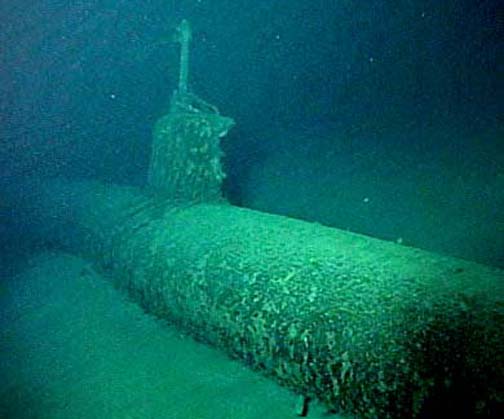
CTY Pisces – Photos of a Japanese midget submarine that was sunk off Pearl Harbor on the day of the attack. There’s a hole at the base of the conning tower where an artillery shell penetrated the hull, sinking the sub and killing the crew. Photos courtesy of Terry Kerby, Hawaii Undersea Research Laboratory. August 2003.
On April 10, 1963, the nuclear-powered fast attack submarine USS Thresher (SSN 593), the first of a new class of submarine, was lost at sea when it sank while conducting a deep dive test some 220 miles east of Cape Cod. All 129 crew members and civilians on the Thresher perished with her. Later that day, the commander in chief of the United States Atlantic Fleet ordered a court of inquiry to investigate Thresher’s sinking. The court of inquiry issued its report in June 1963 but was unable to determine what caused Thresher to sink. The court of inquiry did opine, however, that a flooding casualty in the Thresher’s engine room was the most probable cause of Thresher’s sinking. The court of inquiry encouraged further study.
Over a half-century later, very little of the record of the court of inquiry has been publicly released even though the Navy undertook a declassification review of the records in April 1998 with a stated purpose to declassify and release information from these records to the public “whenever possible.” That review came to naught when in February 2012, after up to 75 percent of the records had been declassified, the Navy changed course, deciding it would not make a public release of the records. Instead, the Navy said the records were “available for public release through” a Freedom of Information Act (FOIA) request.
Last year, retired Navy Captain James Bryant, who had commanded a Thresher-class submarine in the 1980s, learned that Arlington National Cemetery planned a September 2019 dedication ceremony for a memorial to the 129 lives lost with the Thresher. As a result, Bryant, who now investigates, lectures and writes about the loss of the Thresher and the accuracy of the investigating court of inquiry, submitted a FOIA request in April 2019 to the Navy for records about the loss of the Thresher, specifically including the record of the court of inquiry. He requested expedited processing, hoping the Navy might release the records before the Thresher memorial’s dedication ceremony. In July 2019, after exhausting his administrative appeals, Bryant
filed a FOIA lawsuit.
In February this year, Judge Trevor N. McFadden of the U.S. District Court for the District of Columbia ordered the Navy to review 300 pages of documents a month starting April 30 and by the end of every month thereafter, and to begin rolling productions of documents starting on or before May 15 and every month thereafter.
Therefore, during this 57th anniversary year of the Thresher’s sinking, the American public, including the families of the 129 men who lost their lives, may finally begin to see the Navy’s documents on the loss of the Thresher and the record of the court of inquiry that investigated that loss. How much of the information in these documents the Navy will choose to release is a separate matter. The Navy may continue to keep as much information as possible from the public as allowed by law, may use its discretionary authority to release as much information as possible to the public, or may take an approach somewhere in between. What one can say with some degree of confidence, however, is that
some amount of these records will be released in full or with redactions before the 58th anniversary of the loss of the USS Thresher.
April 11, 2020
Posted by Christina Macpherson |
incidents, Legal, Reference, secrets,lies and civil liberties, USA |
Leave a comment
|
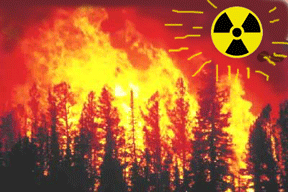 Ukraine battles forest fires near Chernobyl https://abcnews.go.com/Health/wireStory/forest-fire-chernobyl-boosts-radiation-level-69983859 Ukraine battles forest fires near Chernobyl https://abcnews.go.com/Health/wireStory/forest-fire-chernobyl-boosts-radiation-level-69983859
Ukrainian says firefighters are laboring to put out two forest blazes in the area around the Chernobyl nuclear power station that was evacuated because of radioactive contamination after the 1986 explosion at the plant
By The Associated Press 6 April 2020 MINSK, Belarus — Ukrainian firefighters labored into Sunday night trying to put out two forest blazes in the area around the Chernobyl nuclear power station, which was evacuated because of radioactive contamination after the 1986 explosion at the plant.
Ukraine’s emergencies service said one of the fires, covering about five hectares (12 acres), had been localized. It said the other fire was about 20 hectares (50 acres). Earlier Sunday, the head of the state ecological inspection service, Yehor Firsov, said the fires had spread to about 100 hectares (250 acres). The discrepancy in sizes could not immediately be resolved.
Firsov said radiation levels at the fire were substantially higher than normal. But the emergencies service said radiation levels in the capital of Kyiv, about 100 kilometers (60 miles) south, were within norms.
The fires were within the 2,600-square-kilometer (1,000-square-mile) Chernobyl Exclusion Zone established after the 1986 disaster at the plant that sent a cloud of radioactive fallout over much of Europe. The zone is largely unpopulated, although about 200 people have remained despite orders to leave.
|
|
April 6, 2020
Posted by Christina Macpherson |
climate change, incidents, Ukraine |
Leave a comment
|
This Is What Happens When a Nuclear Submarine Hits a ‘Mountain’
That’s one heck of an accident. National Interest by Caleb Larson Apr 5, 20 20, In 2005, a U.S. Navy nuclear submarine ran around on a mountain. No, it wasn’t out of the water—it hit an underground mountain, and nearly sank.
The USS San Francisco is an American nuclear powered submarine, one of the large Los Angeles-class submarines first laid down in 1972 and are among the U.S. Navy’s quietest submarines.
At the time of the collision, or grounding in Navy parlance, the USS San Francisco was near Guam on a peacetime training mission en route to Australia. The sub was at a depth of about 525 feet and skipping along at a crisp thirty-ish miles per hour.
The grounding was massive. Sailors in the dining room were tossed up to twenty-five feet across the mess-hall. One of the sub’s Petty Officers, Brian Barnes, recalled the incident during an interview with 60 minutes. “I remember just bodies everywhere,” he said. “Broken glass, stepping on plates, your shipmates moaning because they’re in pain, yelling.”
The bow of the USS San Francisco was shattered, the frontal thirty feet or so were crushed and exposed to the sea. Water was rushing into the sub—it was critical that an emergency blow be initiated in which air is pumped into the submarines ballast tanks to bring it up to the surface. …… https://nationalinterest.org/blog/buzz/what-happens-when-nuclear-submarine-hits-mountain-140687
|
|
April 6, 2020
Posted by Christina Macpherson |
incidents, USA |
Leave a comment
Jakarta. An employee of the National Nuclear Energy Agency, or Batan, was named suspect for illegally storing radioactive waste at his home in Batan Indah housing complex in South Tangerang, Banten, police have said.
The news came a month after nuclear authorities launched decontamination operation at the housing complex, followed by criminal investigation by the National Police.
The cleanup, that took weeks to complete, was called after the Batan and the Nuclear Energy Regulatory Agency (Bapeten) detected radiation in the area. Around 100 drums of soil and grass containing radioactive substance have been removed from the area.
The suspect, identified by initials S.M., is accused of storing radioactive substance called Cesium-137 and dumping toxic waste at the housing complex, National Police’s special crimes director Brig. Gen. Agung Budijono said on Friday.
“We named S.M. as suspect after we conducted the crime scene investigation,” Agung told Jakarta Globe’s sister publication Beritasatu.com.
“At least 26 witnesses, including Batan and Bapeten officials, have been questioned by the police and it was learned that S.M. has no license for storing and processing radioactive waste,” he said.
The suspect is alleged to have run illegal decontamination services for money at his home. He is charged under the 1997 law on nuclear energy, which carries a sentence of up to two years’ imprisonment.
His position at Batan was not disclosed.
A joint investigation involving Batan, Bapeten and police was formed last month after radiation was detected and nine resident had to undergo medical examination for fear of exposure to Cesium-137, which may pose serious risks to human health including cancer and death.
Nuclear agencies ban companies who hold license to use Cesium-137 from storing or managing radioactive waste themselves. They must send it to Batan’s Center for Radioactive Waste Technology in South Tangerang.
The Batan facility is located around 45 kilometers from the housing complex.
March 16, 2020
Posted by Christina Macpherson |
incidents, Indonesia, secrets,lies and civil liberties |
Leave a comment
|
Workers falsified fire inspection records at SC nuclear plant, feds say, The State, BY SAMMY FRETWELL, FEBRUARY 24, 2020
Two contract workers at the V.C. Summer atomic power plant falsified records last year to show that they were making fire safety checks, even though they had not done so, according to a federal nuclear oversight agency.
In a Feb. 13 letter to plant owner Dominion Energy, the U.S. Nuclear Regulatory Commission said the utility violated federal rules by failing to ensure fire safety checks were done as required.
Dominion did not respond to questions about whether the two contract employees still worked at the power plant near Columbia. But a federal official said they didn’t get the job done.
“They provided inaccurate information,’’ NRC spokesman Roger Hannah said.
An inspection report accompanying the agency’s Feb. 13 letter says federal inspectors found problems with records used to document that workers had made fire safety checks inside an auxiliary building at the Summer nuclear site in Fairfield County.
Workers were supposed to conduct regular fire watch checks every 20 minutes while fire suppression systems in a section of the plant were shut down for repairs.
“Inspectors reviewed the completed logs for Sept. 26, 2019, and discovered multiple discrepancies when compared to the observations that the inspectors made’’ in the auxiliary building, the inspection report said. “The fire watch log readings were recorded as being completed at times and locations when the NRC inspectors observed that fire watches had not been conducted.’’………
The agency’s Level 4 violation notice follows a radioactive water leak in 2019 that prompted Dominion to shut the plant down while repairs were made. The company said the water came in contact with reactor fuel, but never escaped the plant’s containment building. The leak occurred in piping that connects the nuclear reactor with steam generators, The State reported last year. ….. https://www.thestate.com/news/local/environment/article240486456.html
|
|
February 25, 2020
Posted by Christina Macpherson |
incidents, USA |
Leave a comment