Kudankulam nuclear plant too close for Sri Lanka’s comfort
India’s nuclear fallout: Raise the bar to political level, The Sunday Times, 28 Oct 12 The Indian Government’s plans to expand its nuclear energy programme by establishing 48 new reactors throughout the sub-continent, more
than double of what it has, is already causing ripples within that country.
It will also be cause for concern for Sri Lanka whose population is less than 160 kms from India’s southern-most plant at Kudankulam and not too far away from the Kalpakkam plant. Continue reading
Plight of Fukushima’s heroic emergency workers
 Nuclear workers in Japan Heroism and humility Meet the “Fukushima 50”, the men on the front line of the nuclear disaster The Economist Oct 27th 2012 | TOKYO | ACCORDING to his friends, the man in charge of the Fukushima Dai-ichi nuclear-power plant during the 2011 disaster, Masao Yoshida, says it felt like being on Iwo Jima. That is the North Pacific island heroically defended by the Japanese in 1945 but doomed to fall to the Americans.
His two underlings, Atsufumi Yoshizawa and Masatoshi Fukura, do not portray the struggle quite so graphically. In their first interviews since the disaster, they spoke of the sense of responsibility of the so-called Fukushima 50, those who risked their lives to fight the soaring levels of radiation coming out of the plant in the hours and days after the earthquake and tsunami on March 11th last year. They were driven, especially, by a desire to protect the local communities in which many of their families lived.
Yet the Fukushima 50, despite heroic efforts, still suffer from the complex of emotions that soldiers might experience when returning from a losing battle. A sense of shame and stigmatisation lingers. Continue reading
The wisdom of being afraid of nuclear weapons and nuclear power
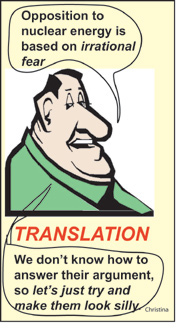 Lies, Damn Lies, and Nuclear Lies The International News Magazine , 22 September 2012 David Swanson USA Our government likes to lie to us about nuclear weapons. This poor impoverished nation halfway around the world is about to nuke us. No, that one is. The result, of course, is mass murder. But there’s another result potentially even worse. We begin to think there’s something wrong with being terrified of nuclear weapons and nuclear energy.
There isn’t. This stuff should scare the hell out of us. And the arrogant lunacy of imagining that even an honest and accountable authority, much less our government, could set up a commission to regulate the winds of hell and deadly substances with a half-life as long as the age of the Earth must give us serious pause.
What are we thinking? How are we thinking? Are we thinking?
One Pentagon report documents 563 nuclear mistakes, malfunctions, and false alarms over the years so far — near misses, near apocalypses.
Soldiers in war sometimes learn to accept the senseless risk to their lives. But need our whole species and all the other species that we write off as collateral damage accept catastrophic risks as part of a permanent state of war? Or has accepting that risk in fact facilitated our acceptance of this permanent state of war? If nuclear weapons and nuclear energy were done away with, imagine the space that would open up in our minds for the possibility of living in peace and looking back on war as we look back on more small-scale forms of human sacrifice, and on cannibalism, slavery, or duelling. Continue reading
USA and Israel’s demonisation of Iran
On a Pedestal of Nuclear Immorality, Counter Punch by SAUL LANDAU, 21 Sept 12, “…….Western leaders did not predict, however, the political turnaround that occurred with the Iranian revolution. The fiercely pro western orientation of the Shah quickly turned as millions of Iranians backed a nationalist and anti American ideology in which the country’s leaders rejected both western ideology and the legitimacy of its regional representative, Israel.
Teheran denounced the very idea of a Jewish state and began to refurbish the old plans to produce nuclear power, which the U.S. and Israel now claim is a cover for a nuclear weapons program. The Ayatollah Khamenei, however, has condemned nuclear weapons and denies nuclear weapon ambitions. Continue reading
Kawasaki city serves students radioactive lunches
Kawasaki city mayor, “School serves radioactive lunch for educational
purpose.” http://fukushima-diary.com/2012/09/kawasaki-city-mayor-school-serves-radioactive-lunch-for-educational-purpose/#.UE6PhZVElhg.facebook by Mochizuki on September 10th, 2012 · Schools keep serving contaminated lunch for the students and they
don’t even solve the problem. (cf. Cesium from finished school lunch in Miyagi) Continue reading
Ethics and medical radiation
 John Gofman on medical x rays. http://nuclearhistory.wordpress.com/2012/09/10/john-gofman-on-medical-x-rays/ 10 Spt 12,
http://www.ratical.org/radiation/CNR/OHofJWGforDOE/
An Interview with John Gofman, “Benefits of Radiation Therapy and Ethics”.
GOURLEY: Now, one thing confuses me terribly about all this, and I’m not a scientist and I’m new on this: You, yourself, said that [there are] medical benefits in certain cases and certain specific cancers and that sort of thing. How does the line fall between where it can be therapeutic, [and] where it’s harmful?
GOFMAN: Line falls at one point. I have no difficulty with radiation therapy being beneficial in certain situations. I have no difficulty with diagnostic radiation, finding something important out [from] a diagnosis that can [save] a person’s life.
GOURLEY: Which diagnosis are you speaking of here?
GOFMAN: You can talk about the possibility of pneumonia that’s not appreciated or some mass in the abdomen or something like a cardiac lesion. I have never in my life said people should not have an x ray. I have never argued against radiation therapy. I talked to you earlier about some places where I participated in radiation therapy and I know people were benefited.
GOURLEY: Right.
GOFMAN: That is a world apart from what your problem is in this whole thing. Where I stand on it is, you voluntarily, you accept a risk for a benefit to you or your child or your mother or father if you discussed it with them. That’s not what I’m talking about. It’s when somebody says you shall be allowed to get x units of radiation as a member of the public without any benefit to you: “Society will benefit.”
That’s immoral, it’s illegal, and it’s being done every day. I just think it’s just illegal and it’s a violation of the Declaration of Independence. It’s a violation of Constitutional rights and none of the medical ethicists are saying a goddamn thing about. I’m very critical of medical ethicists for that.’ http://www.ratical.org/radiation/CNR/OHofJWGforDOE/
Tougher charges against elderly Catholic anti nuclear nun: could face 10 years in prison
 New charges filed in nuclear weapons plant breach The Sacfamento Bee, By ERIK SCHELZIG Associated Press, Aug. 9, 2012 – NASHVILLE, Tenn. — A federal grand jury toughened the charges against three anti-war protesters who authorities say cut their way through three security fences and spray-painted slogans on the walls of a nuclear weapons plant in Tennessee.
An indictment released Thursday in Knoxville charges an 82-year-old Roman Catholic nun with Sisters of the Holy Child Jesus, a gardener and a housepainter with “depredation”
of the Y-12 National Security Complex in Oak Ridge. The charge carries a maximum penalty of 10 years in prison. Continue reading
That naughty 82 year old anti nuclear nun!
 Aging protesters paint nuclear arsenal in Tenn. Knox News Associated Press July 31, 2012 OAK RIDGE, Tenn. (AP) — Emerging details about a security alert at the federal government’s Y-12 nuclear weapons plant in Oak Ridge reveal three aging activists staged the protest.
uranium.
offered to share a Bible, candles and white roses with the guards.
Rice is from Nevada; Boertje-Obed is from Duluth, Minn.; and Walli is from Washington, D.C. They were arrested on federal trespassing charges.
The protesters called themselves “Transform Now Plowshares.” There is no known Plowshares national protest group, but there is a philosophical practice of using high-profile demonstrations to draw attention to nuclear disarmament and related causes.
Details about how they got into the high-security area aren’t known….. http://www.knoxnews.com/news/2012/jul/31/aging-protesters-paint-nuclear-arsenal-in-02/
Catholic nun and two workers breach top security nuclear weapons complex
 Catholic activists breach Tennessee nuclear weapons plant in protest National Catholic Reporter, Jul. 31, 2012 By Joshua J. McElwee Michael Walli, Sr. Megan Rice and Greg Boertje-Obed. The three were arrested Saturday at the Y-12 National Security Complex in Oak Ridge, Tenn.
Three Catholics broke into a guarded nuclear weapons complex in Tennessee on Saturday in an act of civil disobedience and made their way into one of its most secure facilities before they were arrested.
The three, an 82-year-old religious sister and two middle-aged men connected with the Catholic Worker movement, were able to enter the Y-12 National Security Complex in Oak Ridge early Saturday before a guard found them inside the complex’s storage facility for bomb-grade uranium.
The three call themselves the Transform Now Plowshares and said they wished to “indict the U.S. government” for its nuclear weapons modernization program and for planning to build a new facility at the Y-12 site, according to friends of the activists….
The activists’ next hearing has been set for Thursday. They are currently being held
in the Blount County Detention Facility in Maryville, Tenn.
In the documents explaining their action, the activists said the continued use of the facility is an “ongoing criminal endeavor in violation of international treaty law.”
“The ongoing building and maintenance of Oak Ridge Y-12 constitute war crimes that can and should be investigated and prosecuted by judicial authorities at all levels,” the activists wrote. “We are required by International Law to denounce and resist known crimes.” …
http://ncronline.org/news/peace/catholic-activists-breachtennessee-nuclear-weapons-plant-protest
Plowshares speak out against USA nuclear weapons facility

 Transform Now Plowshares Continues a Long Tradition by Leonard Eiger for Salem-News.com 29 July 12Includes two statements from Transform Plowshares about Y-12 nuclear weapons facility, Courtesy: disarmnowplowshares.wordpress.com
(OAK RIDGE, TN) – Early this morning three plowshares activists performed a disarmament action in response to Government plans to invest $80 billion to sustain and modernize the nuclear weapons complex. Calling themselves Transform Now Plowshares, Michael R. Walli (63), Megan Rice (82), and Greg Boertje-Obed (57) entered the Y-12 nuclear
weapons facility before dawn.
They released a faith-based statement saying, “A loving and compassionate Creator invites us to take the urgent and decisive steps to transform the U.S. empire, and this facility, into life-giving alternatives which resolve real problems of poverty and environmental degradation for all.”
The actors also delivered an indictment citing U.S. Constitutional and Treaty Law as well as the Nuremberg Principles:
“The ongoing building and maintenance of Oak Ridge Y-12 constitute war crimes that can and should be investigated and prosecuted by judicial authorities at all levels. We are required by International Law to denounce and resist known crimes.”
This action is one of a long tradition of Plowshares disarmament actions in the US and around the world which challenge war-making and weapons of mass destruction.
At Y-12 NNSA plans to replace facilities for production and dismantlement of enriched uranium components with a new consolidated Uranium Processing Facility (UPF). It is budgeted to cost more than $6.5 billion……
http://www.salem-news.com/articles/july292012/transform-plowshares-le.php
Japan’s religious leaders call for an end to nuclear power
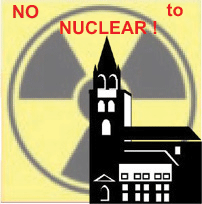
 Religious figures call for future free of atomic energy http://www.japan-press.co.jp/modules/news/index.php?id=3629July 14, 2012 Regardless of differences in faiths, 51 religious figures on July 13 jointly published a statement calling for an end to nuclear power generation.
Initiators of this statement, including the former president of the
Japan Buddhist Federation (JBF) and a reverend of the Anglican
Episcopal Church in Japan, met in Kyoto City to seek broader support
to the statement from other religious leaders.
Kono Taitsu, the former JBF president and now the chief priest of the Myoshinn-ji branch of the Rinzai Zen Denomination, said, “As a religious leader who speaks to the value of life, I came to feel obliged to say something” about the nuclear energy issue.
The statement asserts that the Fukushima accident has proven that all beings and creatures cannot coexist with atomic energy, and points out that as nuclear power plants “inevitably accumulate radioactive wastes, they will endanger ‘all living things’ and pass on a negative legacy to future generations.”
The statement requests that the government and nuclear establishment complete the earliest possible decontamination, provide long-term healthcare for victims, and sincerely fulfill compensation obligations.
Regarding the resumption of operations and export of nuclear power plants with the cause of the Fukushima accident still remaining unknown, the statement criticizes these moves as “giving preference on ‘making money’ over safeguarding ‘lives’.”
Chief temple priest of Fukui Prefecture speaks out against nuclear reactor restarts
 The myth about the safety of nuclear energy did not collapse with the Fukushima accident. It had already collapsed when nuclear plants were forced on isolated villages in various parts of Japan because there was the understanding that those plants were dangerous facilities that could not be built close to major urban centers.
Tetsuen Nakajima: Japan must thoroughly re-examine nuclear energy policy THE ASAHI SHIMBUN 16 June 12, When I was a student, I was only interested in literature and the arts. Then in 1963, a friend took me to a peace march against nuclear weapons.
There I met a hibakusha who had been exposed to radiation after the dropping of the atomic bomb on Hiroshima. Continue reading
Pro uranium mining bias in Nunuvat’s supposedly independent report
“It is not clear why the GN chose to have its background document prepared by Golder and Associates, a consultancy that depends on the mining industry (including uranium mining), rather than either developing it internally or seeking an independent consultant,”
Nunavut group says uranium policy process biased, Questions hiring of consultant with mining industry clients CBC News Jun 8, 2012 A Nunavut group opposed to uranium mining says the territorial government’s consultation process for forming its official uranium policy , which supports mining — with conditions, was biased. Continue reading
“Malicious” anti nuclear nun gets some support from top military man
last week some of her views gained traction from a surprise and formidable source, retired General James Cartwright, the former Vice Chairman of the Joint chiefs of Staff who also used to oversee the entire American nuclear arsenal.
Recently, Sister Anne and the other Bangor 5 appealed their conviction for “willfully and maliciously” destroying federal property by cutting through the fences on the Kitsap-Bangor naval base. The five defended their actions by claiming they were upholding international humanitarian law which deems nuclear weapons illegal.
A Malicious Nun? HUFFINGTON POST, Helen Young, 05/31/2012 There are many words that come to mind to describe Sister Anne Montgomery, and her work but “malicious” is certainly not one of them. Sister Anne, an 85-year-old Roman Catholic nun from the Society of the Sacred Heart who once taught students in Spanish Harlem and high school dropouts in Albany, also spent years working for Christian Peacemakers, an ecumenical anti-war group.
She has put her life on the line in some of the world’s most war-torn regions, including the Balkans in the 1990’s, the Middle East, and more recently in Iraq. Her life has been devoted to working for peace and on nuclear disarmament.
It’s not work for the fainthearted. This diminutive woman, who is still razor sharp in her thinking, and who barely weighs 90 pounds soaking wet, has spent more than three years in prison because of her non- violent protests against nuclear weapons. Continue reading
Denouncing the Doctrine of Discovery as the basis for exploitation of indigenous peoples
Papal bull that granted those European monarchs the right to claim sovereignty over these newly “discovered” lands occupied by non-Christian “barbarous nations.”
the Doctrine of Discovery is the basis for all Indian land law in this country, and it has imposed similar burdens on indigenous peoples all over the world — in Canada, Australia and New Zealand, in Africa, in Latin America and in the island nations of the Caribbean and Oceania.
 Stand for Human Rights for Indigenous Peoples and Renounce the ’Doctrine of Discovery’ HUFFINGTON POST, Tadodaho Sid HillSpiritual Leader, Haudenosaunee (Six Nations/Iroquois Confederacy), 15 May 12,
When the United Nations Permanent Forum on Indigenous Issues convened on May 7th in New York, native peoples around the world turned their eyes to the most important effort to renounce the Doctrine of Discovery, a 15th century Papal bull that has been exploited for five centuries to deny the human rights of hundreds of millions of people who continue to be subject to its power. Continue reading
1 This Month

of the week – Shut Down Drone Warfare!


Tell the Ukrainian Government to Drop Prosecution of Peace Activist Yurii Sheliazhenko

Petition to revoke the licensing of the Near Surface Nuclear Disposal Facility (NSDF) at Chalk River. https://www.ourcommons.ca/petitions/en/Petition/Details?Petition=e-7247
To see nuclear-related stories in greater depth and intensity – go to https://nuclearinformation.wordpress.com
-
Archives
- April 2026 (103)
- March 2026 (251)
- February 2026 (268)
- January 2026 (308)
- December 2025 (358)
- November 2025 (359)
- October 2025 (376)
- September 2025 (257)
- August 2025 (319)
- July 2025 (230)
- June 2025 (348)
- May 2025 (261)
-
Categories
- 1
- 1 NUCLEAR ISSUES
- business and costs
- climate change
- culture and arts
- ENERGY
- environment
- health
- history
- indigenous issues
- Legal
- marketing of nuclear
- media
- opposition to nuclear
- PERSONAL STORIES
- politics
- politics international
- Religion and ethics
- safety
- secrets,lies and civil liberties
- spinbuster
- technology
- Uranium
- wastes
- weapons and war
- Women
- 2 WORLD
- ACTION
- AFRICA
- Atrocities
- AUSTRALIA
- Christina's notes
- Christina's themes
- culture and arts
- Events
- Fuk 2022
- Fuk 2023
- Fukushima 2017
- Fukushima 2018
- fukushima 2019
- Fukushima 2020
- Fukushima 2021
- general
- global warming
- Humour (God we need it)
- Nuclear
- RARE EARTHS
- Reference
- resources – print
- Resources -audiovicual
- Weekly Newsletter
- World
- World Nuclear
- YouTube
-
RSS
Entries RSS
Comments RSS
 nuclear-news